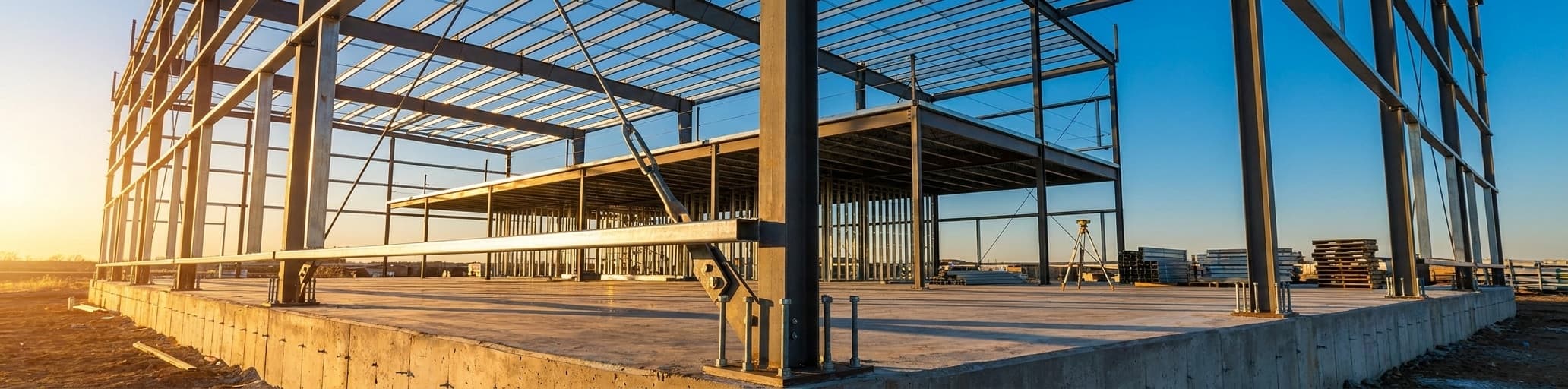

We help you understand two-story metal building design, costs, and structural requirements so you can plan confidently. Steel's durability and lower maintenance deliver significant long-term savings compared to traditional construction methods.
What Makes a 2-Story Metal Building Different from Single-Story Structures
A properly engineered mezzanine system can maximize your usable floor space while maintaining the structural integrity of your entire steel frame.
How tall does a metal building need to be for 2 stories?
In steel construction, height is always measured by eave height — the distance from the finished floor to the point where the roof meets the sidewall — not by peak height.[1] That distinction matters when planning a 2 story metal building, because the eave height must fit two functional floors inside a single steel envelope: first-floor clear height, the mezzanine deck and framing thickness, and second-floor clear height above it.
A second level in a metal building is achieved through a mezzanine system that attaches to and is supported by the primary structure, and it must be engineered specifically to maintain the structural integrity of the entire frame.[1] Critically, out-to-out measurements don't equal usable interior clearances — rigid steel frames, insulation, and liner panels all occupy physical space, so the functional floor-to-ceiling height on each level will be less than a simple division of the total eave height.[1] If your municipality imposes a maximum building height, your consultant needs that limit before finalizing any dimensions, because local codes typically restrict total height rather than peak height alone.[1] Steel can be engineered for up to three floors, and two-story metal building configurations can be designed as partial mezzanines for viewing galleries or full upper-floor spaces — but each added level requires a complete structural review to preserve load paths throughout the frame.[1]
Load-bearing capacity and structural engineering for vertical expansion
Adding a second story to a steel building isn't simply a matter of stacking another level on top — it triggers a complete re-engineering of the structure from the ground up.
Every floor system carries two categories of load: dead loads, which include the fixed weight of the steel framing, concrete deck, insulation, and mechanical systems built into the floor assembly itself, and live loads, which represent the people, equipment, vehicles, and stored materials that will occupy and move through the space.[2] For a two-story metal building, both load types compound vertically, which means column sections must be sized larger, anchor bolts must be spec'd to resist higher base reactions, and the rigid frame must be designed with enough lateral stiffness to handle wind and seismic forces that increase proportionally with height.[2] A mezzanine floor system in a pre-engineered steel building typically relies on cold-formed steel joists or hot-rolled beams spanning between primary columns, topped with a composite concrete deck — and every connection point where that secondary system ties into the primary rigid frame must be explicitly engineered to transfer loads without introducing weak points in the load path.[2] Because these structural demands are interdependent, you cannot retrofit a full second floor onto a building that wasn't designed for vertical expansion from the start; the entire frame, foundation, and anchor system must be sized for two-story loads before the first piece of steel goes up.[2]
Why 2-story steel buildings outperform wood-frame alternatives in durability and maintenance
For a two-story structure, the maintenance burden of wood framing compounds with every added level of surface area, weather exposure, and load stress.
Wood buildings carry an economic life of 15 to 20 years, and wood siding and roofing typically require replacement after just 7 to 10 years of service.[4] Repainting cycles hit every three years, and continuous treatments for rot, mold, and insect infiltration add recurring costs that accumulate fast across a multi-story envelope.[4] Steel eliminates all of those line items.
The frame won't rot near moisture-prone base connections, won't warp under load cycles as seasons shift, and won't give pests a foothold — making a properly specified steel frame structure virtually maintenance-free across decades.[4] Fire resistance compounds the financial advantage: because steel is non-combustible, steel-framed buildings qualify for lower insurance premiums, and some multi-story developers have saved more than $100,000 over a building's life compared to combustible wood-frame alternatives.[5] Steel-framed commercial buildings routinely last 50 or more years with minimal upkeep, while wood structures may require extensive component replacement within 20 to 30 years — a gap that widens when vertical complexity increases the exposed surface area and load paths inherent in a two-story layout.[5]
2-Story Metal Building Costs: Real Pricing Breakdown for 2026
A fully installed 40×60 metal building with concrete slab costs $34,000 to $64,000, with location and specifications determining your final price within that range.
How much does a 40×60 metal building cost with a slab?
A single-story 40×60 metal building structure starts around $28,000 in most U.S. markets — but treat that figure as a starting point only, not a finished project budget.[6] The concrete slab is priced separately at $5 to $7 per square foot, adding $12,000 to $16,800 for a 40×60 footprint, while steel materials run $8 to $10 per square foot, contributing another $19,200 to $24,000 to the total.[7] Labor to erect the structure typically falls between $3 and $5 per square foot — $7,200 to $12,000 for this footprint — and customizations such as insulation, upgraded doors, interior walls, and finish-out add $8,000 to $12,000 beyond the base structure price.[7] When every line item is included, a fully installed 40×60 metal building with a concrete slab lands between $34,000 and $64,000 or more, with location, occupancy type, and spec level driving where within that range your project falls.[7] Rural sites generally carry lower labor rates, while high-wind or seismic zones require heavier engineering drawings and structural members that raise costs independent of footprint size.[7] For a two-story configuration on the same 40×60 footprint, add the mezzanine floor assembly, heavier column sections, and the full structural re-engineering described in the previous section — all of which push the total well above these single-story baselines.
Cost comparison table: Foundation, materials, labor, and total project investment
Are metal buildings cheaper to build than traditional construction methods? The short answer is yes — and the gap widens significantly when you look beyond the initial quote. Steel building kits for commercial purposes run $10 to $25 per square foot for materials, while wood framing averages around $35 per square foot before siding or brickwork, and concrete can reach $50 per square foot.[10] Translate those figures to a 10,000-square-foot structure and the difference becomes stark: a pre-engineered steel building lands between $120,000 and $250,000 all-in, while comparable wood construction runs $350,000 to $500,000 and concrete construction ranges from $500,000 to $700,000 for the same footprint.[10] For residential-scale projects like two-story metal buildings with living quarters or barndominiums, completed steel structures cost roughly $65 to $160 per square foot, compared to $100 to $200 per square foot for standard stick-built homes — a 20 to 30% savings that stems directly from pre-engineered framing, faster assembly, and smaller required crews.[11]
Maintenance costs widen the gap further over time. Steel requires roughly 1% of initial construction cost in annual upkeep — about $1,500 to $2,500 per year on a 10,000-square-foot building — because the frame resists moisture, pests, and load-induced warping without repainting or chemical treatment cycles.[10] Wood and concrete structures carry annual maintenance burdens of 2 to 4% of initial cost, translating to $7,000 to $20,000 per year, and that estimate excludes unplanned events like termite damage, which alone can generate $30,000 or more in repair costs.[10] Projected across 20 years, a steel building's total cost of ownership — including construction, energy, and maintenance — comes to approximately $350,000 for a 10,000-square-foot facility, while traditional materials run $670,000 to $1.1 million over the same period.[10] For anyone evaluating a 20-year cost comparison between steel and wood barn construction, the math consistently favors steel on every time horizon beyond year three.
The one caveat worth flagging in 2026 is raw material pricing. Domestic steel supply is tight, Section 232 tariffs have added a 25 to 30% burden on imported steel, and nonresidential construction input prices rose at an annualized rate of 7.1% in January 2026.[12] Basic kits currently range from $15 to $25 per square foot, turnkey packages run $24 to $43 per square foot, and fully finished commercial builds can exceed $50 to $100 per square foot depending on occupancy and finish level.[12] Even with these pressures, steel remains the lower-cost option against traditional construction — but locking in a quote early with a down payment is advisable, since most quotes hold for only 30 to 60 days before material price adjustments take effect.[12]
Design Options and Customization for Two-Story Steel Structures
A 40-foot-wide footprint eliminates interior columns on both floors, offers readily available engineered drawings, and scales affordably in length for most commercial and mixed-use applications.
Common 2-story metal building footprints and how to choose the right dimensions
Footprint selection for a 2-story metal building hinges on two variables that interact: the width of the ground-level frame and the use case stacking on the second floor. Buildings 30 feet wide and under rely on double-post leg construction, while anything wider shifts to ladder-leg framing — a distinction that affects both structural cost and the interior finish options available on each level.[13] For most commercial and mixed-use applications, the practical starting point is a 40-foot-wide footprint: wide enough to eliminate interior columns on both floors, common enough that engineered drawings are readily available, and scalable in length without triggering dramatic cost increases per square foot.[14] When a second story carries residential quarters — the "2 story metal buildings with living quarters" configuration — the structural spec tightens further: 12-gauge framing is required throughout, 26-gauge panels are mandatory on both roof and walls, and the foundation steps up to a 6-inch slab with perimeter footers to handle the compounded vertical load.[13] The table below maps the most common footprints to their primary uses so you can anchor your sizing conversation around real-world layouts before committing to engineering drawings.
| Footprint | Total sq ft (both floors) | Best fit | Key structural note |
|---|---|---|---|
| 30×40 | ~2,400 | Small commercial office, residential loft, 2-story steel garage | Double-leg columns; 30-ft max before ladder-leg threshold[13] |
| 40×60 | ~4,800 | Mixed-use retail + storage, light industrial with mezzanine office | Clear-span interior on both floors; commercial truss required[13] |
| 40×80 | ~6,400 | Warehouse with upper office, agricultural facility with second-level storage | Longer bays; verify panel run lengths against 35-ft splice limit[13] |
| 50×100 | ~10,000 | Multi-tenant commercial, large barndominium with workshop below | Ladder-leg construction required; heavier anchor bolt schedule[13] |
| 60×100+ | ~12,000+ | Industrial, covered arenas with upper observation, large-scale agricultural | Engineering cost rises sharply; site-specific drawings typically required[13] |
Choosing between a 30×40 and a 40×60 isn't just a square-footage question — it's a question of what the second floor needs to do. A 30×40 footprint works for a two-level 2 story metal building with living quarters or a compact office above a shop bay, but the narrower frame limits clear-span flexibility on each level and constrains equipment access on the lower floor. Step up to a 40×60 and you gain full clear-span interiors on both levels, which is the configuration most commercial and light-industrial operators need when storing vehicles, running production equipment, or accommodating the kind of layout changes that happen every few years.[14] If your primary driver is a 2 story metal building with living quarters above a working ground floor, the 40×60 footprint also gives your HVAC, plumbing, and electrical rough-in trades enough room to run systems without compromising structural access — a practical constraint that often gets underestimated during early planning.[13]
Interior layout strategies: mezzanines, storage, and operational flow
The interior layout of a two-story metal building hinges on three decisions that reinforce each other: where the mezzanine lands, how storage zones divide between floors, and what movement patterns need to flow between levels without collision.
On the ground floor, clear-span framing eliminates interior columns entirely — and clearspan warehouses show a 15% improvement in operational efficiency compared to column-supported structures because forklift paths, conveyor lines, and racking aisles can be configured without routing around fixed obstructions.[16] When storage demands shift toward multi-level racking or heavy-duty shelving rather than open floor space, configurable interior column systems can be positioned to carry those specific loads: warehouses with strategically placed column systems see a 20% increase in storage capacity and a 10% reduction in material handling time because column layout is coordinated with racking type — pallet, cantilever, or drive-in — from the structural design phase rather than retrofitted afterward.[16] Mezzanine framing produces the best results when specified at the design stage; common configurations include office buildouts above dock-level operations, pick-and-pack areas suspended over bulk storage, and viewing platforms over production floors — all of which are engineered into the primary frame before fabrication begins.[15] A useful starting point for evaluating whether a mezzanine or a separate building addition better serves your storage ROI is covered in the mezzanine vs. building addition storage comparison, which maps out cost and capacity tradeoffs in detail.
Bay spacing reinforces every layout decision: 25-foot bays accommodate standard selective racking, while 30-foot bays open wider forklift aisles and double-deep rack configurations without column conflicts at mid-aisle — a spec choice made at the framing stage that directly governs how much of the upper mezzanine floor can serve as active picking area versus passive overflow storage.[15]
Roof styles, wall systems, and door configurations that maximize usable space
Roof slope is the first decision that cascades through every other dimension of a two-story metal building, because it directly governs how much usable vertical space remains inside the structural envelope after the second-floor deck is installed.
Standard clearspan steel buildings accommodate roof slopes ranging from 1:12 to 4:12, with eave heights available from 10 to 30 feet and widths from 20 to 150 feet — giving engineers enough design room to preserve functional clearance on both floors regardless of pitch.[19] A shallower slope, like 1:12, conserves interior height and keeps the ridge point lower, which matters in jurisdictions with total height limits; steeper pitches improve precipitation runoff but consume vertical budget that a second floor can't afford to lose.[19] Roof and wall panels are typically 26-gauge steel with high-performance coatings that contribute to diaphragm strength alongside their weather-protection function — meaning panel selection is a structural decision, not just an aesthetic one.[17] On the wall system side, girt placement determines how much interior clearance each floor actually delivers.
Flush girts — which attach to the web of the columns rather than the outer flange — keep the girt face coplanar with the column face and recover several inches of interior clearance per wall line, a meaningful gain when both floors need to accommodate equipment, racking, or finished interior walls.[19] Standard girt spacing runs the first girt at 7 feet 4 inches above the finish floor with a maximum of 6 feet between subsequent girts, though low-girt options at 3 feet 6 inches are available in high-wind conditions to stiffen the lower wall section without disrupting floor-level clearance.[19] For facade systems, wall panels aren't limited to standard purlin-bearing rib profiles — two-story structures can incorporate insulated metal panels, commercial glass and curtain wall systems, aluminum composite material panels, or fiber cement designs on either or both levels, each of which meets residential or commercial energy codes while maintaining the structural contribution of the wall assembly.[18] Door configurations on a two-story steel building require the most deliberate planning, because standard X-bracing — the go-to lateral bracing method for longitudinal wind load transfer — must be located in undisturbed wall bays and will conflict with large framed openings if door placement isn't coordinated with the bracing layout at the design stage.[19] Expandable mainframe endwalls sidestep that conflict entirely: because mainframe endwalls don't require any form of X-bracing, endwall column spacing can be adjusted freely to position large overhead doors, drive-through openings, or dock doors wherever operations demand — and an expandable endwall can span up to 150 feet of unobstructed opening width, wide enough to serve as a full-width covered truck dock across the building's entire end.[19] When X-bracing can't be placed in a sidewall bay due to door or window requirements, fixed-base columns or portal frames take over the lateral load path — portal frames in particular run parallel to the sidewall and typically don't induce a moment to the foundation, which keeps the foundation design simpler and the overall budget tighter.[19]
How to Plan, Permit, and Build Your 2-Story Metal Building with National Steel Buildings
Professional soil testing and proper drainage installation are non-negotiable first steps that prevent the foundation failures most common in two-story steel buildings.
Site preparation and foundation requirements for two-story installations
The foundation for a two-story installation carries substantially more compounded load than any single-story equivalent, which means site preparation is an engineering decision, not an administrative formality.
Start with a professional soil test: a geotechnical assessment measures bearing capacity and determines whether the ground is prone to expansion, contraction, or settlement under the combined dead and live loads of a two-story frame.[21] Vegetation removal, grading, and drainage installation all follow — and every step must be completed before a single form is set, because poor drainage and unstable grade are the most common causes of long-term foundation failure on multi-story steel structures.[21] For two-story steel buildings, continuous concrete footings or reinforced concrete slabs are the standard foundation system, because both distribute heavy vertical loads across a sufficient area and resist the lateral forces that grow proportionally with building height.[21] The slab-on-grade configuration — a concrete slab poured with footings that extend below the local frost line — is the most common commercial and industrial choice; pier systems, which concentrate load at discrete points using vertical concrete piers drilled and poured below frost depth, serve sites where uneven terrain or poor soil bearing capacity makes a full slab impractical or cost-prohibitive.[20] Regardless of which type you use, every column position needs a discrete footing sized to the specific load reaction at that point, and a metal base plate pre-punched for anchor bolts connects each column to the concrete — those bolts are embedded in exact positions according to the anchor bolt layout drawing included in your engineered permit package.[20] Frost line depth is a non-negotiable variable: in cold climates, footings must extend below the frost line to prevent frost heave, and your local building authority is the correct source for the required depth in your jurisdiction.[22] Improper concrete curing is one of the most consequential mistakes at this stage — concrete that cures incorrectly can lose up to 50% of its design strength, directly compromising the integrity of the entire two-story frame sitting above it.[20] A certified foundation engineer — separate from your steel building supplier — must design and stamp the foundation drawings based on your permit package, site soil report, frost depth requirements, and local seismic zone classification before any concrete is ordered.[20]
Navigating permits and local building codes for multi-story steel structures
The International Building Code classifies every building into one of five construction types, and that classification is the most consequential permit variable you'll face on a two-story steel project — because it governs allowable height, maximum square footage, occupant load, required fire-resistance ratings, exit placement, window configurations, and whether sprinklers are mandatory, all before a single drawing reaches your permit authority.[23] Two-story steel buildings fall under Type I or Type II construction under the IBC: Type II uses non-combustible materials — metal framing and concrete — with a one-hour fire-resistance rating, and covers most commercial retail, light-industrial, and mixed-use occupancies; Type I steps up to two-to-three-hour fire resistance using protected or insulated steel framing, and applies to larger multi-story structures where occupant load or height pushes beyond Type II thresholds.[23] The classification cascades through every downstream requirement: setbacks from adjacent properties, exit counts, travel distances to egress doors, and the building's maximum allowable area on each floor are all set by construction type — which means a misclassification caught at permit review stops your project cold and forces revised drawings.[23] Steel's non-combustible nature is a direct code advantage over wood: wood-framed structures fall into Type V or Type IV construction, where lower inherent fire ratings force smaller footprints, tighter setbacks, and more restrictive occupancy limits, while a steel-framed two-story structure can qualify for Type II or Type I designations that allow larger footprints and higher occupant loads on both floors without the same restrictions.[23] One spec choice worth coordinating early is the sprinkler system: in many Type I and Type II multi-story occupancies, sprinklers are a code requirement regardless of preference, but a sprinklered building of a given construction type is also permitted at a larger square footage than an equivalent non-sprinklered building — meaning the sprinkler investment recovers partially through the additional permitted building area it unlocks.[23] For a state-by-state breakdown of how permit timelines and approval requirements vary by jurisdiction, the warehouse addition permits approval roadmap maps out what each state's review process actually looks like so you can build realistic project schedules before submitting drawings.
From design consultation to erection: the single-source advantage in project delivery
The fragmented approach — separate architect, separate fabricator, separate erection crew, separate foundation contractor — is where two-story steel building projects most commonly break down on cost and schedule.
Budget overruns affect 73% of traditional construction projects managed across multiple contracts, according to Construction Industry Institute research analyzing 351 U.S. building projects.[24] The mechanics behind that failure rate are straightforward: when design and construction are split across separate entities with separate contracts, no single party owns the outcome as a whole, and each trade protects its own scope while the owner mediates disputes between parties with conflicting financial incentives.[26] Design-build projects — where one entity holds a single contract covering design through erection — deliver 102% faster than traditional design-bid-build methods, with 3.8% less cost growth.[25] Those advantages don't come from efficiency alone; they stem from three structural features that fragmented delivery cannot replicate: overlapping design and construction phases so site work begins while interior detailing is still being refined, early procurement of long-lead materials before a traditional contractor would even be selected, and proactive value engineering during design rather than reactive scope-cutting after bids come in over budget.[25] For a two-story metal building specifically, that front-end integration is especially consequential — the structural engineering, mezzanine framing specification, foundation design, and erection sequencing are all interdependent, and a coordination gap between any two of them produces either a redesign or a field change order, both of which cost time and money the project budget didn't plan for.[24] Under a single-source model, when a question arises at any phase, there is one call to make and one team accountable for the answer — a dynamic that, as documented across hundreds of commercial projects, eliminates the blame-shifting that is endemic to multi-contract delivery and keeps the project moving toward a defined outcome.[26] For owners evaluating erection partners, understanding why the installation crew matters as much as the steel kit itself is the final variable separating a project that finishes within budget from one that doesn't.
- Steel buildings cost 20-30% less than stick-built homes and require only 1% of initial construction cost annually for maintenance, compared to 2-4% for wood and concrete structures.
- 40×60 footprint is the practical commercial starting point, providing clear-span interiors on both floors without interior columns while remaining cost-effective and readily engineered.
- Design-build delivery models complete projects 102% faster with 3.8% less cost growth than traditional multi-contract approaches by integrating design, procurement, and construction phases.
- Type II IBC construction classification for steel buildings allows larger footprints and higher occupant loads than wood-framed alternatives due to superior non-combustible fire ratings.
- https://norsteelbuildings.com/steel-building-basics/metal-building-system-guide/
- https://www.nachi.org/structural-design-loads-home-inspector.htm
- https://systemswestinc.com/steel-frame-vs-wood-frame-commercial-buildings/
- https://norsteelbuildings.com/us/steel-building-basics/steel-vs-wood/
- https://nexgenbp.com/insights/wood-vs-steel-framing-the-switch-that-cut-build-time-by-30
- https://www.northtexassheds.com/steel-building-cost-guide
- https://www.smaestimating.com/40×60-morton-building-cost/
- https://builtmammoth.com/how-much-does-a-steel-building-cost/
- https://iconsteelbuildings.com/how-much-are-metal-buildings/
- https://www.summitsteelbuildings.com/20-year-cost-comparison
- https://www.vcstar.com/press-release/story/11641/americans-turning-to-metal-buildings-for-affordable-living/
- https://ameribuilds.com/steel-building-costs-what-to-expect-2026/
- https://metal-america.com/complete-guide-to-metal-buildings/
- https://www.getcarports.com/40×40-metal-building-guide?srsltid=AfmBOoruxLj-jdlCStKcMeXv7bpMETbirJ1dIYyzpLUy57JNFy3usN_c
- https://www.hybrid-steel.com/building-types/warehouse/
- https://ostrostructures.com/warehousing-metal-buildings/
- https://www.summitsteelbuildings.com/anatomy-of-a-pre-engineered-steel-building
- https://ostrostructures.com/residential-metal-buildings/
- https://rapidsetbuildings.com/below-is-an-expanded-explanation-of-the-metal-building-parts/
- https://norsteelbuildings.com/steel-building-foundations/an-introduction-to-building-foundations/
- https://chinasteelbuildsales.com/two-story-metal-building/
- https://www.absoluterv.com/metal-building-kits/concrete-foundation/
- https://www.samuelsgroup.net/blog/5-types-of-building-construction
- https://cicconstruction.com/blog/single-point-of-accountability-how-design-build-delivery-eliminates-project-risk-across-multiple-markets/
- https://terrapincg.com/news/what-does-a-design-build-contractor-do
- https://www.selectlee.com/2025/02/25/the-benefits-of-design-build-vs-design-bid-build-for-large-projects/