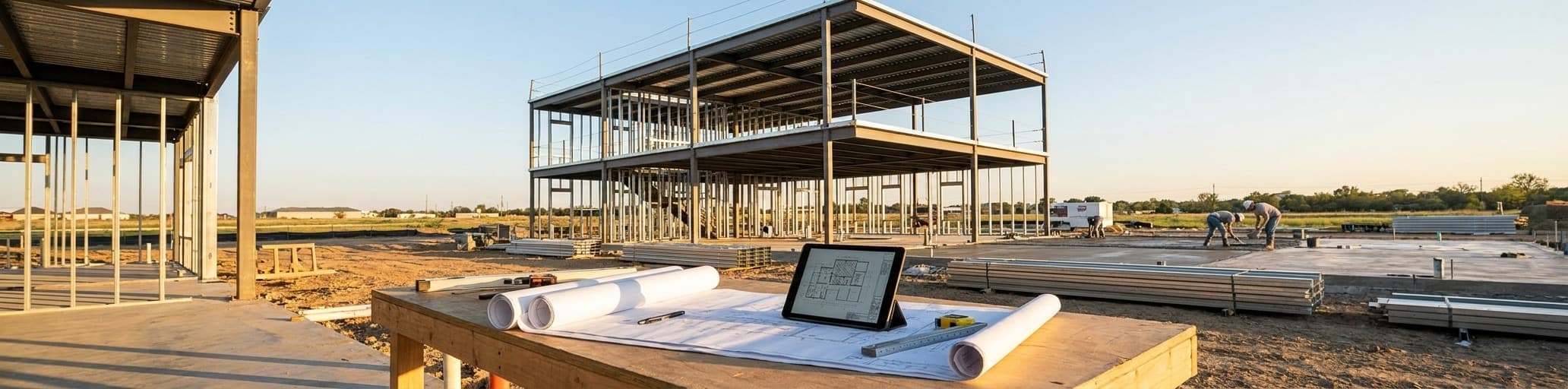

We help you understand 2-story metal building costs, ranging from $50-$300 per square foot depending on your design and finish level. Single-source contracting and proper engineering upfront protect your budget while delivering 20-30% savings versus traditional construction.
What 2-Story Metal Buildings Cost in 2026: Real Numbers & Variables
A finished 2-story metal building with living quarters typically costs $65-$160 per square foot, saving you 20-30% compared to traditional stick-built construction.
Average price per square foot for 2-story structures with living quarters
The shell of a standard metal building runs $25-$40 per square foot for steel framing and panels only, before any site prep, foundation, or interior work.[2] Once you add those elements for a finished living space, the all-in cost jumps to $100-$300 per square foot depending on complexity and location.[2] For a barndominium or shop-with-living-quarters configuration–the most common use case for 2-story metal buildings with living quarters–completed structures typically cost $65-$160 per square foot at a standard finish level, rising to $150-$300 per square foot for high-end custom or shop-combo builds.[3] Kit-based approaches narrow that range: a metal home kit plus assembly and core services runs $50-$120 per square foot, while a fully custom build without a kit averages around $120 per square foot when land is already prepared and utilities are in place.[1] A 2-story configuration pushes costs toward the upper end of whichever range applies, because intermediate floor decking, secondary structural framing, stairways, and split-level HVAC zones all add material and labor that a single-story footprint avoids. Interior finishes alone account for $35-$110 per square foot on top of the structure, with standard drywall and laminate at the low end and hardwood or custom cabinetry at the high end.[1] For comparison, traditional stick-built homes average $150-$250 per square foot for custom builds and can exceed $300-$450 per square foot at the premium tier, meaning a finished metal building with living quarters typically saves 20-30% over comparable conventional construction.[3]
| Build type | Typical PSF range | Notes |
|---|---|---|
| Metal building shell only | $25-$40 | Steel frame and panels; no foundation or finishes |
| Barndominium / standard finish | $65-$160 | Completed, livable; includes basic interior |
| High-end custom or shop-combo | $150-$300 | Premium finishes, large footprint, 2-story complexity |
| Kit-based metal home (all-in) | $50-$120 | Kit + assembly + services; land prep assumed |
| Traditional stick-built custom | $150-$450+ | Benchmark for cost comparison |
How foundation, roof pitch, and living space finishes drive total cost
National Steel Buildings cost advantage: Single-source pricing vs. fragmented bids Fragmented bids — separate contracts for design, engineering, fabrication, and erection — introduce coordination gaps that consistently push 2-story projects over budget. When responsibility splits across multiple parties, change orders multiply and schedule disputes stall the job.
A single-source design-build model eliminates that friction: all key stakeholders engage from the earliest planning stages, architects and engineers evaluate design and construction options together before any steel is ordered, and one contractor carries accountability for the entire scope.[5] The financial result is measurable — industry data shows 91% of projects managed under a single competitively solicited contract are delivered on budget, and owners report 24% savings in administrative costs compared to traditional fragmented procurement.[7] Faster execution compounds those savings further: time-related savings in design-build delivery typically run 3-5% of total project value, because overlapping design and construction phases compress the calendar instead of waiting for a fully stamped drawing set before groundbreaking.[5] For a 2-story metal building with living quarters, where foundation complexity, intermediate floor engineering, and residential finish coordination must stay synchronized, a single point of accountability isn't a convenience — it's a cost-control mechanism. Cold-formed steel framing reinforces the advantage at the material level: a Canadian Institute of Steel Construction case study on a comparable multi-story structure found a net cost savings of $7.50 per square foot versus cast-in-place concrete, driven by a lighter load path, reduced foundation requirements, and a shorter construction cycle.[6] The broader case for turnkey steel building advantages applies at every project scale, but the core principle is the same: one contract, one budget conversation, and one team keeping your build within budget every step of the way.
Design Constraints & Load Limits: What Your 2-Story Metal Building Can Actually Do
A full second floor costs 40-60% more per square foot than ground-floor construction, while a mezzanine runs only 15-25% above equivalent footprint costs.
Span limitations and column placement for upper-floor living quarters
Mezzanine vs. true second floor: Engineering differences that matter The distinction between a mezzanine and a true second floor isn't cosmetic — it's structural, and it drives every downstream decision from foundation sizing to occupancy classification.
A full second floor spans most or all of the building footprint as a permanent structural level, engineered to handle residential or operational occupancy loads across the entire area.[11] A mezzanine, by contrast, is a partial intermediate level that fits within the building's existing eave height — typically covering 30-50% of the ground floor area — and can often be reconfigured or removed later, because the intermediate structure doesn't load the primary frame uniformly the way a full floor does.[11] The load difference follows directly: a full second floor carries occupancy-rated live loads over the entire footprint, pushing concentrated forces through every column down into the foundation; a mezzanine carries lighter storage-rated or partial-occupancy loads over a smaller area, requiring less foundation reinforcement and lighter column sections overall.[12] Cost reflects that engineering gap — a mezzanine addition typically runs 15-25% above equivalent-footprint ground-floor construction cost, while a full second floor addition with operational loads runs 40-60% higher than the original ground-floor structure cost per square foot.[12] Eave height is a variable owners frequently overlook: each level needs its own floor-to-ceiling clearance for its intended use, and the building's total eave height must cover both finished heights plus the depth of the floor structure between them, which is why a two-story shell stands noticeably taller than adding two single-story heights together would suggest.[11] When a mezzanine is attached to and supported by the primary metal building frame, the entire frame must be engineered to maintain structural integrity under the combined load — you cannot bolt a mezzanine onto a building that was never designed to carry one.[13] The practical implication for 2-story metal buildings with living quarters: if a mezzanine serves phase one but a full second floor is the long-term goal, the columns and foundation must be sized for the heavier future load from day one, because retrofitting structural capacity after fabrication is both expensive and disruptive to operations below.[11]
Local code compliance for residential occupancy: What changes from commercial steel
A standard pre-engineered steel warehouse lands in IBC Type II-B construction: the steel frame is noncombustible, satisfying Type II material requirements, but no fire protection is applied to the structural steel itself, so the building carries zero required fire resistance rating.[14] That works for commercial and industrial occupancies where height and area limits are manageable — but the moment you add residential living quarters on an upper floor, the classification calculus shifts.
A building's construction type is set by its weakest structural element, meaning one combustible interior framing member or one unprotected floor assembly brings the entire structure down to a lower, more restrictive type.[14] For 2-story metal buildings with living quarters, the practical effect is this: you can no longer rely on the bare Type II-B shell.
Residential occupancy typically demands Type II-A treatment — fire resistance ratings of one hour or more on structural components, achieved through gypsum board encasement, spray-on fireproofing, or concrete protection on steel columns and beams.[14] Adding automatic fire sprinklers doesn't change the construction type itself, but it does unlock significantly larger allowable floor areas — sometimes up to 300% more than the unsprinklered baseline — which makes sprinkler installation a cost-effective path to design flexibility on larger footprints like a 40×60 or 50×80 layout.[14] Single-family residential use alone defaults to Type V-B under the IBC, but a shop-with-living-quarters hybrid that combines a commercial ground floor with a residential upper level may trigger mixed-occupancy analysis, requiring the more fire-resistant classification to govern the entire structure.[14] The takeaway for buyers planning a 2-story metal building with living quarters: budget for fire-rated wall and floor assemblies from day one, confirm whether your jurisdiction requires sprinklers for the combined occupancy load, and verify that your steel fabricator engineers the frame to the correct construction type — not just the cheaper commercial default.
2-Story Metal Building Floor Plan Options: Common Layouts & Customization
Choose your layout model first–shop-with-living-quarters, barndominium, or residential-primary–because picking the wrong one forces structural compromises that undermine every function.
30×40, 40×60, and 50×80 footprints: Square footage and living quarter sizing
Shop-with-living-quarters vs. barn-home vs. residential-primary layouts The three layout types serve different primary users, and confusing them at the design stage leads to floor plans that compromise every function. A shop-with-living-quarters configuration treats the ground floor as an operational workspace first — vehicle bays, equipment storage, or a small-business production area — with living space stacked above or tucked into a rear wing.
The barndominium model, by contrast, organizes both levels primarily around residential living, using metal construction to gain open-span floor plates and high ceilings that wood framing can't deliver at the same cost; barndominiums cost $65-$160 per square foot to build, compared to $150-$400 per square foot for traditional stick-built homes, and can be completed in 3-6 months versus 6-12 months for conventional construction.[16] A residential-primary layout takes that further — it prioritizes traditional room configurations, dedicated bedrooms, and design details that match established neighborhood aesthetics, which matters when financing and resale value are central concerns, since barndominiums can face lender unfamiliarity and long-term resale uncertainty that conventional homes with decades of market data do not.[17] Steel construction supports all three layouts through the same core advantage: the metal frame eliminates load-bearing interior walls, allowing the floor plan to allocate space between shop, living, and sleeping zones without structural walls forcing the boundary lines.[17] The practical difference between layouts shows up in how the second floor is accessed and separated — a shop-with-living-quarters build typically isolates the residential entry from the commercial bay entirely, while a barn-home merges the great room, kitchen, and loft into a continuous open volume that uses ceiling height as the dominant design element. Choosing the wrong model for your actual use pattern is the most common source of costly mid-project redesigns, so identify whether your primary driver is operational workspace, open-concept living, or resale-oriented residential value before a single dimension is drawn.
National Steel Buildings custom engineering: Why prefab doesn't mean one-size-fits-all
The term "prefab" trips up buyers because it gets conflated with "pre-engineered" — and for 2-story living-quarters builds, that confusion carries a real cost.
Prefab describes factory-made components built to standardized, repeatable specifications; pre-engineered metal buildings (PEMBs) are also factory-fabricated, but each primary frame is cut and shaped to match structural calculations specific to your project — loads, roof pitch, snow and wind data, and local code requirements all feed the design before fabrication starts.[18] That engineering front-end is what makes genuine customization possible: with a PEMB, you can request non-standard clearances, larger door openings, integrated mezzanines, and wider clear spans because the frames are engineered for those conditions rather than assumed away by a catalog size.[18] A standard prefab kit treats your site as average — it won't catch a mixed-occupancy floor assembly, a high-wind coastal exposure, or an intermediate-floor deflection limit that deviates from a standard residential default.[18] Pre-engineered suppliers provide stamped drawings from a licensed structural engineer keyed to your jurisdiction, which simplifies permit submission and confirms compliance with wind, seismic, and snow load requirements rather than leaving you to source supplemental engineering after the kit arrives.[19] For anyone weighing prefab metal homes against a fully engineered living-quarters structure, the distinction lands here: factory fabrication is the delivery mechanism, not the design limit — the engineering discipline applied before the first piece of steel is cut determines whether the building passes inspection, handles future loads, and performs the way the floor plan actually requires.[20]
2-Story Metal Building Decision Essentials: Site Prep, Permits & Timeline
Your foundation choice–monolithic slab, stem wall, or frost-protected perimeter–can shift costs by 50% depending on climate, soil conditions, and site slope.
Pre-purchase Essentials: Zoning, setbacks, and residential classification requirements
Foundation and site preparation costs: Concrete slab vs. frost-protected perimeter The choice between a floating slab and a frost-protected perimeter foundation shifts the cost range by roughly 50% — not because of materials alone, but because climate, soil conditions, and load concentration each add their own multiplier.
A monolithic slab, the most economical starting point, runs $6-$14 per square foot and suits flat terrain with stable soils in mild climates where frost penetration is minimal.[24] A stem wall foundation — a short perimeter wall that encircles the building and accommodates grade changes — runs $6-$18 per square foot, making it the practical option on sloped sites or wherever the slab needs elevation above grade for drainage.[24] Both options face a hard limit in cold climates: any footing that doesn't extend below the local frost line is vulnerable to frost heave, where freeze-thaw cycling lifts and cracks the concrete above it.[24] In regions with severe winter conditions, a T-shaped or frost-protected perimeter foundation resolves that risk by positioning the footing below frost penetration depth regardless of how manageable other site conditions appear.[25] Soil conditions independently drive costs beyond foundation type: unstable or expansive ground requires additional excavation and stabilization, high water tables demand drainage systems, and sloped parcels add grading labor that flat lots never incur.[25] Concrete labor for slab work runs $3-$7 per square foot — roughly half of the total foundation cost — with crews billing $50-$150 per hour, and a standard pour typically requiring a three-person crew working eight hours.[24] Rebar reinforcement, which is not optional under a two-story load path, adds another $1.40-$4.00 per square foot above the base slab price, and sub-slab insulation is increasingly code-required even in jurisdictions that didn't mandate it previously.[24][26] The practical planning rule: treat the foundation as an independent line item at $7-$18 per square foot fully installed — not a kit supplier's rough estimate — and commission a site-specific soil report before locking in a foundation type, because what looks like a simple slab site in summer can require a fully frost-protected perimeter design once the local frost depth and column point loads are evaluated together.[25]
From design approval to move-in: Realistic timeline for a 2-story metal structure
Most metal building projects run three to nine months from initial planning to final completion, but a 2-story structure with finished living quarters consistently lands at the upper end of that range.[28] The added complexity of intermediate floor engineering, residential finish coordination, and mixed-occupancy permitting adds weeks that a simple warehouse or storage shell never encounters. A realistic phase-by-phase breakdown looks like this:
| Phase | Typical duration | Notes for 2-story living quarters |
|---|---|---|
| Design, engineering & permitting | 4-12 weeks | Mixed-occupancy review and stamped structural drawings extend this phase |
| Fabrication & material delivery | 6-16 weeks | Custom residential roof pitch and intermediate floor framing add lead time |
| Site preparation & foundation | 2-8 weeks | Run concurrently with fabrication wherever possible to compress the schedule |
| Steel erection | 2-10 weeks | Two-story primary frame, floor decking, and secondary framing take longer than a single-story shell |
| Interior build-out | 4-16 weeks | Electrical, plumbing, HVAC zoning, drywall, and flooring across two occupied levels |
| Final inspections & certificate of occupancy | 1-2 weeks | Residential occupancy triggers additional inspection stages beyond a commercial shell |
Permitting is the phase owners most consistently underestimate.[28] Some rural jurisdictions issue permits within one to two weeks, while busy urban or suburban building departments can take two to four months — and a residential-use upper floor often triggers plan review by multiple departments simultaneously, including building, zoning, and fire.[29] The single most effective schedule-compression tactic is overlapping phases: submit permit applications while engineering drawings are still being finalized, and begin site clearing and foundation work during the fabrication lead time so steel arrives at a ready site rather than an empty lot.[27] Interior build-out is where a 2-story living-quarters project diverges most sharply from a commercial metal building timeline — a warehouse shell may need only minimal interior work, but a finished residential upper floor adds four to sixteen weeks for rough-in trades, insulation, drywall, cabinetry, and flooring, all of which require sequential inspections before proceeding.[28] The practical planning rule: budget nine to fourteen months from design approval to move-in for a 2-story structure with a fully finished living suite, add a 15-20% schedule buffer for weather and inspection delays, and treat the permit submission date — not the fabrication order date — as the true start of your countdown.[29]
- 2-story metal buildings with living quarters cost $65-$160 per square foot for standard finishes, saving 20-30% versus traditional stick-built homes at $150-$450 per square foot.
- Single-source design-build contracts deliver 91% of 2-story projects on budget with 24% lower administrative costs compared to fragmented multi-party procurement models.
- Full second floors cost 40-60% more than ground-floor construction due to occupancy loads and foundation reinforcement, while mezzanines cost only 15-25% more.
- Residential upper floors require Type II-A fire-resistant construction with one-hour ratings on structural components, not the cheaper Type II-B commercial default.
- Foundation costs range $7-$18 per square foot and require site-specific soil reports; frost-protected perimeter designs are mandatory in cold climates to prevent frost heave.
- 2-story living-quarters projects require 9-14 months from design approval to occupancy, with permitting and interior build-out consuming the majority of time.
- Pre-engineered metal buildings are customized per project loads and codes, unlike standardized prefab kits that may miss mixed-occupancy requirements or local conditions.
- https://www.homeadvisor.com/cost/architects-and-engineers/metal-home-kit-prices/
- https://builtmammoth.com/how-much-does-a-steel-building-cost/
- https://www.thenewsstar.com/press-release/story/8715/americans-turning-to-metal-buildings-for-affordable-living/
- https://iconsteelbuildings.com/how-much-are-metal-buildings/
- https://ncsturgeon.com/design-build/
- https://modernstructuralsystems.com/reduce-time-and-budget-on-construction-projects/
- https://www.sourcewell-mn.gov/cooperative-purchasing-idiq-contracting
- https://awc.org/resource-hub/span-table-tutorial/
- https://www.madfab.com/post/how-far-can-a-steel-beam-span
- https://www.aisc.org/architecture-center/resources/engineering-basics/preliminary-beam-girder-and-column-size-tables/
- https://kafafab.com/two-story-metal-building/
- https://pentaumec.in/2026/05/21/second-floor-existing-factory-guide/
- https://norsteelbuildings.com/steel-building-basics/metal-building-system-guide/
- https://academy2.youngarchitect.com/construction-types/
- https://metal-america.com/complete-guide-to-metal-buildings/
- https://www.houseplans.com/blog/is-it-cheaper-to-build-a-house-or-barndominium-in-2025
- https://www.barndosdirect.com/blog/barndominium-vs-traditional-home-which-is-right-for-you
- https://titansteelbuildings.ca/guide/difference-between-prefab-and-pre-engineered-steel/
- https://www.okonrecycling.com/industrial-scrap-metal-recycling/steel-and-aluminum/prefabricated-metal-buildings/
- https://metalprobuildings.com/what-is-the-difference-between-pre-engineered-and-prefabricated-metal-buildings/
- https://www.aacounty.org/planning-and-zoning/zoning-administration/zoning-classifications-guide
- https://eastonmd.gov/434/Article-III-Zoning-District-Regulation
- https://www.volusia.org/services/growth-and-resource-management/faqs-zoning.stml
- https://estimators.us/foundation-cost-per-square-foot/
- https://www.summitsteelbuildings.com/understanding-concrete-foundations
- https://www.ecohome.net/en/guides/2370/slab-on-grade-or-foundation-and-basement/
- https://metalprobuildings.com/pre-engineered-steel-building-timeline/
- https://hollidaygroup.com/metal-building-timelines/
- https://www.blockrenovation.com/guides/new-home-construction-timelines-important-factors