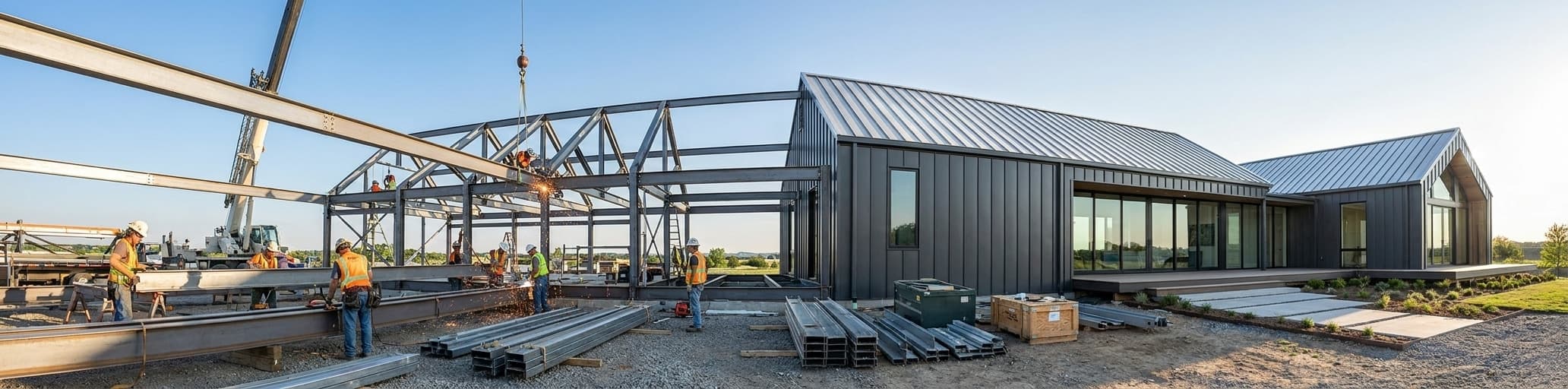

Prefab metal homes deliver 20-30% cost savings and 30-50% faster construction than traditional stick-built homes while offering superior durability against extreme weather. We help you understand how factory-controlled steel fabrication, lower maintenance expenses, and energy efficiency compound into meaningful long-term ownership advantages.
Why Prefab Metal Homes Are Gaining Momentum
The U.S. prefab metal building market is doubling to $27.10 billion by 2033, driven by extreme weather resilience, rural expansion, and environmental compliance requirements.
Rising demand for prefab metal homes in 2024‑2025
The numbers back up what you're already seeing on job sites. The U.S. pre-engineered metal building market reached $12.98 billion in 2024 and is on track to double to $27.10 billion by 2033, growing at an 8.6% CAGR.[1] Zoom out to the global metal building systems market and the trajectory is steeper — $25.2 billion in 2026, forecast to hit $56 billion by 2033 at 12.1% annually.[3] North America commands 30.4% of global demand, with the U.S. holding the single largest country share at 26.1%.[3] For context on what those figures mean at the project level, current metal building home costs per square foot range from kit-only prices around $15-$35 to fully finished interiors at $60-$100+, a spread that explains why more buyers are choosing prefab over conventional stick-built.
Three converging forces are driving demand for prefab metal homes specifically. Extreme weather is the most immediate: property owners across Wyoming, Arizona, Montana, and Nevada are moving to steel because it handles wind, snow loads, and temperature swings that wood framing cannot match long-term.[2] Rural expansion and the rise of home-based businesses are pushing demand for structures that blend residential and commercial use under one roof.[2] And environmental compliance is no longer optional — prefab metal construction generates less site waste, uses recyclable steel, and accepts insulation upgrades that help owners hit green building standards without a costly redesign.[1]
How prefab metal homes compare to traditional wood construction
The most direct comparison starts with price per square foot. Traditional stick-built homes averaged $150-$250/sq ft in 2024, while finished prefab metal homes come in at $65-$160/sq ft — a 20-30% cost advantage before you count a single year of ownership.[6] That gap compounds over time. Steel's 20-year total cost of ownership runs roughly 15% lower than wood, driven by insurance premiums that drop 10-20% and maintenance expenses cut by up to 50%.[4] Lumber's price instability makes wood comparisons even harder to justify: softwood surged 438% during the early COVID period while steel scrap rose only moderately, and lumber still sits about 80% above pre-pandemic levels entering 2026.[4]
The construction process widens the gap further. Prefab metal building shells go up in days — a 30×40 or 40×60 steel-tube frame reaches weather-tight status in as little as two to four days once the slab cures.[6] Traditional wood framing runs sequentially on-site, exposed to weather delays, inspection cycles, and culling waste that typically adds 15% to wood material estimates.[4] Factory-controlled steel production eliminates that variability: light-gauge steel generates roughly 2% construction waste versus up to 30% for timber, and steel's ability to span 24" on-center versus wood's standard 16" uses fewer members without sacrificing load capacity.[4] For a deeper look at how those structural differences play out in load paths, fire ratings, and insurance savings, the numbers consistently favor steel across commercial, agricultural, and residential applications.
| Factor | Prefab metal home | Traditional wood construction |
|---|---|---|
| Finished cost per sq ft | $65-$160 | $150-$250+ |
| Construction speed | 30-50% faster | Baseline |
| Material waste | ~2% | Up to 30% |
| 20-year TCO | ~15% lower | Baseline |
| Insurance premiums | 10-20% lower | Baseline |
| Raw material price volatility | Low | High |
The shift in builder behavior reflects this math. A 2017 Steel Framing Industry Association study found steel only 2.61% more expensive upfront for mixed-use buildings; by mid-2020, with lumber up 80%, cold-formed steel framing was already 24% cheaper than the wood equivalent on a total-building basis.[4] Prefabrication accelerates those savings further — McKinsey analysis shows prefab construction can speed up project delivery by up to 50%, cut material costs by 10%, and lower total project cost by 20%.[4] For property owners weighing a warehouse, hangar, farm facility, or residential build, prefab metal construction now delivers a cost structure that wood simply cannot match on a per-dollar, per-decade basis.[5]
Key advantages that resonate with modern homeowners
Cost and speed get homeowners in the door, but four ownership realities close the deal on prefab metal homes. Maintenance is the first. Steel doesn't warp, rot, or split, and it resists mold, termites, and pest intrusion that quietly drain wood-home budgets for years.[7] Protective coatings reinforce that durability under harsh environmental conditions, so you're not repainting, re-treating, or replacing components on a five-year cycle.[8] Design flexibility is the second. Metal frame construction handles contemporary or traditional aesthetics with equal ease, and clear-span framing eliminates interior load-bearing walls — opening floor plan options that would require expensive structural engineering in wood.[7] That same adaptability extends into the future: adding a room, upgrading an HVAC system, or installing energy-efficient windows is a modification rather than a rebuild, and HVAC upgrades in metal homes can reduce cooling costs by up to 20%.[8] For homeowners weighing how that flexibility translates into livable space, metal building home layouts show how clear-span construction lets the floor plan serve your needs instead of the framing system's constraints.
Fire safety and sustainability round out the case. Steel is non-combustible — it doesn't burn and compromise structural integrity the way wood framing does under fire conditions, which is a direct driver of lower insurance premiums.[7] On the environmental side, construction teams can build prefab metal homes using 100% recycled steel and recycle all leftover scraps without sacrificing any structural performance.[8] That matters more as buyers compare alternatives: concrete production alone accounts for roughly 8% of global carbon emissions due to its energy-intensive processes, and wood lacks the longevity of steel, often requiring replacement rather than repair.[8] Combined with energy-efficient design features like reflective roof coatings and advanced insulation, prefab metal homes reduce both utility bills and carbon footprints over a typical ownership horizon — a benefit set that wood and concrete construction can't easily replicate.[8]
Industry growth statistics and future outlook
The broader market picture reinforces what local deal flow is already showing.
The global prefabricated buildings market reached $146.47 billion in 2024 and is on pace to hit $208.10 billion by 2030 at a 6.03% CAGR.[9] The combined prefabricated building and structural steel segment is larger still — $245.7 billion in 2024, projected to reach $381.8 billion by 2034 at 5.5% annually.[10] The U.S. prefab segment alone is estimated at $41.45 billion in 2025 and is forecast to reach $58.41 billion by 2030 at a 7.1% CAGR, outpacing overall construction sector growth.[9] Factory shipments confirm the demand: manufacturers delivered 103,300 homes in 2024, up from 89,169 in 2023, with the annualized rate climbing to 106,000 units by May 2025.[9] Modular construction's single-family market share has tripled since 2015 and now sits at 2-3%, while more than 22 million Americans already live in factory-built housing — signaling mainstream acceptance is building, not plateauing.[9] Three forces sustain the trajectory going forward: population growth in high-absorption states (Texas holds 14.2% of U.S. prefab market share; California leads expansion at 7.95% CAGR), BIM and fabrication automation that keep compressing per-unit costs, and tightening environmental regulations that reward steel's recyclability and near-zero site waste over timber alternatives.[9][10] For property owners tracking lead times alongside those market numbers, prefab building kit delivery schedules connect industry demand to the production windows you'll actually navigate on your project.
Financial Benefits and Transparent Pricing
Lock in your prefab steel building budget before breaking ground with transparent kit pricing that eliminates mid-project surprises from lumber volatility.
Reduced material and labor costs through steel efficiency
Steel's cost advantage over traditional construction runs deeper than raw material price — it lives in how fabrication eliminates waste before a single truck reaches your job site. Factories manufacture steel components in controlled environments, protecting them from the weather exposure that degrades on-site lumber and forces material replacement mid-project.[5] Modular units then allow site preparation and steel fabrication to run simultaneously: your concrete slab cures while components are being cut and drilled off-site, a scheduling efficiency that traditional construction's sequential on-site assembly can't replicate.[5] Prefabrication also enables mass production that holds quality consistent across every component, cutting the rework and on-site culling that quietly inflates wood-frame budgets — and prefabricated frame walls specifically can reduce costs by up to 39% on commercial and industrial projects.[5]
The labor side compounds the savings. Fewer skilled man-hours are needed on-site when workers bolt together pre-cut components rather than measuring, cutting, and fitting raw materials from scratch.[12] That compression is a direct driver of the 20-30% lower construction costs prefabricated steel delivers over traditional methods.[5] Metal buildings can be significantly more cost-effective than traditional structures — with savings reaching up to 50% — largely because the bolt-together design reduces the crew size and on-site hours required to reach weather-tight.[12] At the kit level, steel building packages run $15-$20 per square foot for the structure itself, scaling to $24-$43 per square foot fully installed with slab, delivery, and erection included.[11] That pricing structure lets you lock in your prefab building budget before breaking ground — no mid-project surprises driven by lumber volatility or trade-stacking delays.
Fixed‑price kits and clear budgeting for prefab metal homes
The kit price on a prefab metal home is a fixed, knowable number — but it covers only 40-60% of your total project investment.[14] Metal home kits run $20,000-$90,000 with most averaging $55,000, and that price covers the steel frame, wall panels, roof system, and hardware delivered to your site.[13] What the sticker price excludes matters just as much: foundation work adds $5-$15 per sq ft, assembly labor runs another $5-$15 per sq ft, and interior finishes range from $35-$110 per sq ft depending on the finish level you specify.[13][14] For a fully constructed, move-in-ready prefab metal home, the realistic all-in range lands at $74,000-$240,000, with most homeowners finishing around $157,000.[13]
Breaking your budget into three distinct layers — kit, foundation, and construction crew — is what separates a project that stays on track from one that stalls mid-build.[14] The table below maps how those layers stack across common pricing tiers in 2026:
| Cost layer | Kit only | Mid-range installed | Fully finished |
|---|---|---|---|
| Kit price per sq ft | $10-$30 | $20-$40 | Included in turnkey |
| Turnkey installed per sq ft | — | $24-$43 | $50-$100+ |
| Typical total project cost | $20,000-$90,000 | $74,000-$157,000 | Up to $240,000 |
Several line items catch buyers off guard before a single steel beam goes up. Delivery fees add 5-10% on top of the kit price, permits run $500-$2,000 depending on jurisdiction, and any 2026 budget should carry a 7-10% contingency given current material cost pressures from tariffs and constrained domestic supply.[13][15] Three planning moves reliably keep prefab metal home projects within budget: stick to standard footprints like 30×40 or 40×60 to avoid custom engineering fees, schedule construction during off-peak months for labor savings that can reach 15%, and compare at least three itemized quotes — buyers who do this save up to 28% on final project costs.[14][15] For a line-by-line cost breakdown on a specific footprint, the 30×40 prefab building cost guide walks through every budget layer with 2026 pricing.
Long‑term savings: maintenance, energy, and insurance
The three ownership costs that erode most residential budgets — maintenance, energy, and insurance — all run lower in prefab metal homes, and the gap widens with each year of ownership.
Steel doesn't warp, crack, or split, and the protective coatings used on metal surfaces last longer than paint on wood, meaning when upkeep is eventually required it's less extensive and less expensive than comparable work on a wood-frame home.[18] Steel's resistance to termites, rot, and mold eliminates entire categories of recurring repair costs that quietly drain conventional home budgets across a typical ownership period.[18] Energy performance adds a second savings stream: properly insulated prefab metal homes hold consistent indoor temperatures year-round, reducing the workload on heating and cooling systems without constant adjustments.[16] Reflective roof coatings reject solar heat in summer rather than absorbing it, and steel's tight construction seals the air leaks that inflate utility bills in conventional builds — two design features that compound annual energy savings over time.[18] Insurance is where the third savings channel opens.
Carriers price steel favorably because it's non-combustible and resistant to pests and extreme weather, and that risk profile produces lower premiums compared to wood or traditional construction.[17] Cumulative insurance savings over a 30-year mortgage can amount to thousands of dollars, making the premium reduction a meaningful line item — not just a footnote — in any long-term budget.[18] Prefab metal homes that incorporate energy-saving features such as cool roof coatings or high-performance insulation may also qualify for local or federal tax incentives and rebates, stacking an additional financial benefit on top of the insurance discount in a single build.[17]
Financing options and 2026 government incentives
Prefab metal homes permanently attached to a foundation qualify for the same residential loan programs as conventional stick-built construction.[19] FHA loans require 3.5% down at a 640-plus FICO, VA loans offer zero down for eligible veterans with no mortgage insurance requirement, conventional programs start at 5% down on primary residences, and USDA loans cover rural builds where geography qualifies.[19][20] For ground-up builds — which describes most prefab metal home projects — the funding path runs through a construction loan that releases money in staged draws as work is verified by inspection, then converts to a permanent mortgage at completion.[20] Three structures cover that conversion: One-Time Close locks the permanent rate at construction start; Two-Time Close uses separate closings so you can capture rate movement during the build; and hybrid programs pair a single closing with rate optionality and streamline refinance eligibility on the permanent loan.[20] Loan amounts scale from $150,000 up to $4.5 million depending on program and credit, and land you already own free and clear counts toward your loan-to-value calculation — which can eliminate the cash down payment entirely on conventional financing.[20] For a line-by-line look at how those program structures apply to a specific footprint, financing options for prefab metal builds walks through program selection and cash-to-close estimates in plain numbers.
| Loan program | Minimum down payment | Credit floor | Best fit |
|---|---|---|---|
| VA | 0% | No minimum (lender-set) | Eligible veterans and surviving spouses |
| FHA | 3.5% | 640 FICO | First-time builders, lower credit profiles |
| Conventional | 5% | 640 FICO | Standard residential builds within county limits |
| USDA | 0% | Lender-set | Rural parcels in eligible areas |
| Jumbo | Program-specific | 720 FICO | High-value custom builds above conforming limits |
The 2026 policy environment adds a second layer of savings that most buyers overlook. As of 2026, roughly 40 U.S. jurisdictions operate preapproved building plan programs — pre-cleared blueprints that bypass the standard permit review cycle and save builders $5,000-$12,500 per project in design and approval costs alone.[21] Port Angeles, Washington, pairs its preapproved plan program with fee waivers of $5,000-$20,000 covering permit, planning, and public works fees for eligible housing types.[21] At the federal level, the Accelerating Home Building Act — introduced by Senators Blunt Rochester and Moreno — would create a HUD-funded pilot grant program for preapproved building plan pattern books targeting missing middle and infill housing, and it has drawn strong bipartisan support.[21] Colorado's H.B. 1152 separately allocated $10 million in grant funding to boost ADU production through preapproved plan programs, while California mandated preapproved ADU plans statewide across all jurisdictions by early 2025.[21] For prefab metal home buyers, these overlapping incentives compress two of the highest soft-cost line items — permitting timelines and design fees — before a single steel panel leaves the factory.
Streamlined Construction Process and Speed
Factory-level inspection catches defects before components leave the facility, so your building arrives verified against code rather than waiting for on-site inspection delays.
Factory‑controlled fabrication ensures quality and consistency
The factory environment is what separates prefab metal homes from every quality promise made on a traditional job site. When steel components are fabricated indoors under climate-controlled conditions, the variables that create defects in field construction — weather exposure, inconsistent lighting, and shifting ground conditions — are removed from the equation.[22] Workers in a fabrication facility specialize in specific tasks and repeat them on every unit, which produces measurable workmanship consistency that a rotating field crew cannot replicate.[22] Calibrated tools, documented torque values, and traceable materials mean every weld and connection point can be audited against a spec sheet rather than estimated.[23] Sub-assemblies follow specified standards throughout production, so uniform quality is built into the process — not inspected in at the end.[24]
Quality assurance doesn't wait for the building inspector to arrive on your lot. Factory-level inspection catches dimensional errors, weld defects, and fit problems at the least expensive point to fix them: before components ever load onto a truck.[23] Each module passes a series of standardized checks against predefined building codes, so by the time your steel arrives on site, the critical structural verification is already complete.[22] That inspection compression pays a second dividend at the permit stage — building inspectors can evaluate multiple identical units at once rather than reviewing each on-site phase sequentially, which cuts approval timelines and reduces the back-and-forth that stalls traditional builds.[22] For commercial, industrial, and agricultural owners who need a predictable schedule, understanding how steel frame construction is engineered clarifies exactly why factory-produced components perform more consistently than field-assembled alternatives.
The controlled production environment also changes the safety equation for the crews assembling your building. Field workers spend fewer hours on exposed job sites — reducing falls, equipment hazards, and weather-related risks — because the most labor-intensive fabrication already happened indoors.[22] Strict factory safety protocols are easier to enforce and audit in a fixed facility than on a dynamic construction site where conditions shift daily.[24] For prefab metal home buyers and commercial property owners alike, factory fabrication converts the unpredictable variables of outdoor construction into a repeatable, auditable process — and that predictability is what keeps your project within budget and on schedule.[23]
Typical build timeline for a prefab metal home in 2026
The steel shell goes up faster than almost any other residential construction method, but your total timeline from signed contract to move-in depends on three phases that run mostly in sequence: permitting and engineering, site preparation and foundation cure, and interior finishing. Understanding where time actually accumulates helps you set a realistic schedule before you break ground. The physical assembly phase is where prefab metal delivers its clearest advantage: a 30×40 or 40×60 shell reaches weather-tight status in as little as two to four days once the concrete slab cures, and larger footprints up to 50×100 commonly achieve dried-in status within a single week.[25] Southeastern builders now market "rapid-set" packages where owners see the complete shell standing within one extended workweek — a benchmark that traditional wood framing simply cannot approach.[25] Frame assembly overall averages one to two weeks, with smaller structures finishing in a few days and larger or more complex designs requiring more time; crew experience is a consistent variable that moves that number in either direction.[26] That speed is not without a counterbalance: planning permissions and permitting can represent a meaningful share of the overall calendar, so front-loading your permit application before the slab is even poured keeps the project moving.[13] Working with vetted local prefab contractors who know your jurisdiction's review cycle is the single most effective way to compress total project duration without cutting corners on compliance.
The table below maps the five build phases against realistic 2026 durations for a standard residential prefab metal home:
| Build phase | Typical duration | Key variables |
|---|---|---|
| Engineering, design & order | 2-4 weeks | Customization level, manufacturer queue |
| Permitting & plan review | 2-8 weeks | Jurisdiction, preapproved plan programs |
| Site prep & foundation cure | 1-2 weeks prep + cure time | Soil conditions, slab thickness, weather |
| Frame & shell assembly | 2 days – 2 weeks | Footprint size, crew size, experience |
| Interior finishing | 4-12 weeks | Finish level, trade scheduling, DIY vs. contractor |
A real-world reference point: a 1,500 sq ft home combined with a 1,500 sq ft garage shell was erected in under two weeks — far faster than a comparable stick-built project at the same combined footprint.[25] Interior finishing then extends the timeline based on how complex the finish specification is, ranging from a few weeks for basic drywall and laminate to three months or more for high-end custom work.[13] Budget your schedule the same way you budget your cost: kit and shell assembly are predictable, but permitting and interior trade scheduling are where most delays accumulate.
Impact on financing, move‑in dates, and project management
The speed advantage of prefab metal homes doesn't just get you into the building faster — it directly cuts how much you pay to finance the project. Construction loans accrue interest on every dollar drawn, so every week shaved off the build timeline is a week you're not paying carrying costs on borrowed money. Modular construction reduces total build time by up to 50%, averaging 8 months versus nearly 10 months for conventional stick-built homes.[9] That compression matters most when you're managing a construction-to-permanent loan: fewer months in the construction phase means less interest accrued before the permanent rate locks in, and earlier occupancy converts that build investment into productive use — whether that's a move-in date, rental income, or operational capacity — sooner.[27] For commercial, agricultural, or industrial owners especially, a two-month acceleration on a mid-size project can represent meaningful savings that never appear on the kit quote but show up clearly on the final project cost statement.
Predictability is where prefab metal construction reshapes project management most visibly. Traditional builds run sequentially on-site, exposed to weather stoppages, subcontractor scheduling gaps, and inspection hold points — and the numbers reflect it: 85-91% of traditional construction projects experience delays, with 60% delayed by at least two months.[9] Nearly half of all conventional projects saw those delays push total costs more than 20% over budget.[9] Factory fabrication removes the primary sources of that variability. Site preparation and steel component manufacturing run simultaneously, so your slab cures while panels are being cut and drilled off-site — a parallel workflow that condenses what would otherwise be sequential phases.[27] The result is a schedule you can actually manage against: 66% of building professionals who switched to modular methods accelerated their construction schedules, with 35% cutting timelines by four or more weeks.[9] For property owners coordinating contractors, permits, and move-in commitments on a fixed calendar, that reliability converts directly into fewer surprises and tighter budget control from start to finish.[27] Many manufacturers and third-party lenders support this with financing programs tailored to prefabricated steel structures — including 0% down options, 12- to 60-month loan terms, and rent-to-own arrangements that spread capital expenditure over a defined schedule, making it easier to match cash flow with your actual project timeline.[28]
Logistics and site‑preparation best practices
The most common prefab metal home delays don't happen on the factory floor — they happen on your lot, before the first truck arrives. Three site conditions determine whether delivery runs smoothly: truck access, drainage, and a level staging area large enough for unloading and temporary component storage.[29] Delivery vehicles carrying pre-engineered steel are heavy, so assess your access route for weight limits, turn radius, and overhead clearances well before scheduling a drop.[29] The ground must be compacted and level so equipment stays stable during unloading, and all debris and hazardous materials need to be cleared before the crew shows up.[29] One practical tip: keep excavated soil on-site after foundation work — it fills low spots post-pour and supports a stable base without a separate material order.[29]
Foundation selection is the structural decision that shapes everything downstream, and the right choice turns on your soil conditions, climate zone, and intended building use. Slab-on-grade suits most residential and light commercial applications; pier and beam foundations work for agricultural or storage builds where a concrete floor isn't required; frost-protected shallow foundations handle perimeter loads in heated structures; and T-shaped foundations carry heavier loads in colder climates where frost depth is a factor.[29] Your jurisdiction will likely require this decision to be supported by structural calculations before issuing a permit — and no foundation or frame work should start without that approval in hand.[29] A complete permit package typically includes building plans, a site plan showing property lines, structural load calculations, and an energy efficiency report.[29] Coastal jurisdictions often add hurricane-rated anchoring requirements, while mountain counties impose enhanced snow load calculations before signing off on any foundation design.[30] For a line-by-line look at what foundation costs actually add to a standard footprint, the 30×40 concrete slab cost breakdown maps slab thickness against intended use and 2026 pricing.
Once your site is prepped and permits are approved, logistics coordination shifts to delivery sequencing and materials verification — two steps that directly protect your assembly schedule. Align your fabrication delivery window with actual site readiness so components don't sit exposed on-site longer than necessary; weather exposure before installation introduces damage risk that factory quality control can't prevent.[29] When materials arrive, compare the packing slip against the purchase order line by line, checking material type, size, and thickness, then inspect each piece for cleanliness and physical damage before signing off.[29] Verify the Certificate of Conformance against your purchase order and document material traceability from the point of production — that paper trail is your protection if a connection issue surfaces during framing or a later inspection.[29] Factory-engineered components allow erection rates of up to 5,000 square feet per week with a qualified crew, so the faster your receiving process confirms component integrity, the faster your frame goes vertical and your project stays within budget.[30]
Durability, Safety, and Longevity
Steel's three-layer defense system–engineered wind ratings to 300+ mph, seismic performance rated to 11.0, and noncombustible fire resistance–compounds protection against every major natural hazard.
Structural strength and resistance to wind, seismic, and fire
Steel's durability against natural hazards isn't a single feature — it's three separate performance layers that compound each other. On the wind side, high winds generate torsional forces capable of dragging and uplifting an entire building, so every prefab metal home is engineered to comply with local load requirements before a single component leaves the factory.[31] That engineering isn't generic: manufacturers calculate your specific wind zone and design connection points accordingly, which is why RSG 3-D's steel panel system — used in disaster-resilient residential builds — carries a wind-rating certification of up to 300-321 mph under real-world test conditions.[32]
Seismic performance is where steel's material properties translate directly into structural survival. Unlike concrete or masonry, steel bends without fracturing under seismic movement, absorbing and redistributing energy through the frame rather than transferring it catastrophically to occupants and finishes.[31] FEMA has formally identified steel buildings as "one of the best earthquake resisting systems available," and pre-engineered manufacturers take that a step further by engineering every structure to match your site's specific seismic zone — not a national average.[33] RSG 3-D's steel panels were subjected to a simulated 9.4 Richter event without a single structural or cosmetic crack, and were subsequently rated up to 11.0 after internal inspection.[32] For property owners building in California, the Pacific Northwest, or any active seismic corridor, that margin matters far more than a general durability claim.
Fire resistance closes the third side of the hazard triangle, and it's the performance dimension driving the sharpest shift in buyer behavior right now. Cold-formed steel is noncombustible: it contains no elements that serve as fuel, doesn't contribute to fire growth, and generates no smoke or toxic fumes under fire conditions.[32] Steel studs don't ignite at 500 degreesF, and the framing can actually contain fire spread rather than accelerating it — the structural opposite of what happens in a wood-frame home under the same conditions.[32] Critically, steel maintains that noncombustibility across the entire lifecycle of the building, through construction, occupancy, and renovation, which is why insurers classify steel-framed structures as wildfire-hardened and price premiums up to 20% lower as a direct result.[32] Following the 2025 Los Angeles fires, one CFS home manufacturer reported a 300-400% surge in inquiries — a market signal that buyers in high-fire-risk states are treating noncombustible framing as a baseline requirement, not an upgrade.[32] For a deeper look at how those load paths and fire ratings interact at the component level, the structural steel components overview connects material engineering to the real-world performance numbers above.
Corrosion protection, coatings, and low‑maintenance requirements
Steel corrodes only when moisture and oxygen are present at the same time — remove either condition and the electrochemical reaction that produces rust stops entirely.[34] That physical reality is why corrosion protection in prefab metal homes starts with an environment assessment, not a coating catalog: structural steel in a dry, heated interior needs no protective coating at all, while components exposed to coastal salt air, industrial pollutants, or persistent humidity require a high-performance treatment system specified before fabrication begins.[34] Getting that classification right upfront determines both your coating spec and your long-term maintenance budget — two numbers that compound each other across a 50-year ownership horizon.
The coating systems available today give you real control over durability outcomes across three proven methods. Hot-dip galvanizing immerses steel components in molten zinc at roughly 450 degreesC, creating a metallurgical bond that's tough, abrasion-resistant, and provides cathodic (sacrificial) protection even at small damaged areas where the substrate is exposed; minimum average coating thickness for structural steelwork runs 85μm.[34] For more aggressive environments, thermally sprayed zinc or aluminium coatings extend protection further, with pores sealed by an organic topcoat that locks out moisture before it can reach the steel surface.[34] Modern paint systems layer primer, intermediate build coats, and a finish coat in sequence — and duplex systems that combine metallic coatings with paint multiply protection, extending maintenance intervals well beyond what either approach delivers independently.[34] Coastal and high-humidity builds benefit specifically from galvanization or powder finish coatings that resist the degrading effects of salt air without requiring frequent recoating cycles.[35]
Surface preparation is the foundation that makes every coating perform as specified — abrasive blast cleaning not only strips mill scale and rust but creates the angular surface profile that high-build coatings need to mechanically bond to the steel substrate.[34] A sealed building envelope adds a second protective layer by preventing water intrusion at doors, windows, and panel joints, reducing moisture exposure before any coating system even comes into play.[35] The practical outcome of a correctly specified system: properly protected prefab metal homes remain structurally sound for 50 years or more with minimal upkeep — a maintenance profile that pole barns and wood-frame structures rarely approach without repeated treatment cycles.[35] For property owners weighing steel against pole barn alternatives, the 50-year maintenance math on a steel-truss building shows what coating performance differences actually cost — or save — across a full ownership horizon.
Design for extreme climates and disaster resilience
The frequency of extreme weather events has made climate-zone performance a baseline requirement, not an optional upgrade. In 2024 alone, the U.S. endured 27 weather and climate disasters each exceeding $1 billion in losses, and since 2019, 115 separate billion-dollar events have totaled $746.7 billion in combined damage.[36] Wood-framed homes — still 93% of new U.S. residential construction — max out at 135 mph wind resistance, a threshold a Category 4 hurricane or F2 tornado clears without difficulty.[36] Prefab metal homes designed with cold-formed steel close that gap by a measurable margin: CFS framing withstands winds up to 150 mph, and FEMA confirms steel- and concrete-framed homes handle wind speeds 60-80 mph greater than equivalent wood construction.[36] That performance difference shows up in real disaster outcomes — in regions affected by the Turkey earthquake, CFS-framed walls survived with minimal structural or cosmetic damage while surrounding conventional construction failed, and UC San Diego's shake table validation of a 10-story prefab CFS structure pushed the height limits for steel in active seismic zones further than previously tested.[36] For coastal commercial builds, agricultural facilities in hurricane corridors, or any property in a documented wind or seismic zone, those margins are the engineering reason prefab metal consistently survives what wood doesn't.
Geographic adoption patterns confirm where steel-specific climate design pays off most directly. Hawaii — where hurricanes, termites, and seismic activity are daily operating conditions — frames 72% of its homes in steel.[36] Japan, Germany, and the Netherlands have standardized steel and concrete over timber for the same resilience and longevity reasons, and the U.S. is increasingly following that pattern in high-exposure regions.[36] Modular CFS construction extends climate resilience into disaster recovery as well: prefabricated steel units can be produced off-site, shipped in compact form, and assembled on-site within days — the exact deployment profile that emergency housing operations require after events that level wood neighborhoods.[37] Steel buildings designed for hurricane-prone and high-humidity climates follow the same engineering principles whether the end use is a residence, agricultural structure, or light commercial facility — non-combustible framing, engineered connection points for your specific wind zone, and a frame that doesn't degrade under moisture, temperature swing, or repeated weather stress the way wood does over a typical ownership horizon.[36]
Lifecycle expectancy, warranties, and service excellence
The lifespan gap between steel and other framing materials is wide enough to change how you think about total ownership cost. Steel-framed homes last 75 years or more under normal conditions, with well-maintained structures routinely reaching the 100-year mark — decades beyond what timber framing delivers before rot, termite damage, or warping forces structural intervention.[38] Prefabricated steel buildings built with high-quality frames land in the 50-100 year range depending on environment and maintenance,[40] and standing seam metal roofing systems specifically carry a useful life of up to 80 years — compared to 15-30 years for traditional asphalt shingles.[39] To put that in perspective: quality metal roofing installed today is on track to enter the 22nd century in serviceable condition.[39] For commercial, agricultural, and industrial owners who measure building value in decades rather than years, that longevity profile changes the math on every cost-per-year comparison against wood or conventional construction.
Warranties on prefab metal homes reflect that durability in writing. High-performance corrosion-resistant steel products carry warranties of up to 50 years, guaranteeing structural strength across the full coverage period.[38] Metal building materials — particularly roofing and cladding systems — often carry lifetime warranties, a coverage tier that asphalt, vinyl, and wood-based alternatives cannot match.[39] Those warranty terms are not just marketing language: they transfer real financial protection to you as the property owner, converting long-term durability into a documented, enforceable commitment backed by the manufacturer. For a closer look at how metal roofing lifespan translates into per-year cost advantages over competing materials, the metal roof lifespan and durability guide maps coverage periods against real-world maintenance records.
Maintaining a prefab metal home to its full lifecycle potential takes less effort than most owners expect, but it does require a consistent schedule. A practical maintenance routine covers four checkpoints:
- Biannual walk-throughs of walls, ceilings, and joints to catch rust spots or movement early — coastal builds warrant more frequent checks due to salt-air exposure[38]
- Annual roof inspections and yearly rinse of steel panels and cladding to remove debris before it traps moisture[38]
- Annual foundation evaluations and HVAC system checks to catch settling or mechanical wear before it affects structural components[40]
- Immediate touch-up of chipped paint or scratched coatings with anti-corrosion paint to seal exposed metal before the oxidation cycle starts[38]
Steel doesn't shrink, warp, or split between inspection cycles, so the scope of each check stays narrow — you're looking for coating damage and moisture ingress, not the structural deterioration that accumulates steadily in timber frames.[38] With routine preventive care, a prefab metal home built today remains structurally sound well past the 75-year baseline and can realistically push past 100 years — a service life that pole barns, wood-frame homes, and standard modular construction rarely approach without repeated material replacement.[38][40]
Design Flexibility, Sustainability, and Smart‑Home Integration
Monitor, gambrel, and clerestory roof styles let you customize your prefab metal home's visual character while maximizing natural light and interior functionality.
Architectural styles and customizable floor plans for prefab metal homes
The architectural range for prefab metal homes starts at the frame level, and the options cover far more ground than the utilitarian box most buyers picture. A monitor-style roof — a raised central section with lower flanking slopes — replicates the character of traditional barn architecture and is gaining traction in residential builds, workshops, and commercial structures that want visual depth without custom engineering.[41] The gambrel style uses two roof slopes on each side to create a spacious interior profile with room for a second-floor loft, combining storage or living space with a classic silhouette that fits rural and suburban settings equally well.[41] When natural light is the priority, a clerestory frame places a vertical wall between two sloping roof sections, allowing a continuous band of high windows that brings daylight into the interior well above sight lines — a feature that single-slope and gable roofs can't replicate.[41] Straight-column frames deliver an unobstructed interior suited to open-plan living or commercial use, while single-slope designs drain water off one low side, making them a practical choice for additions to existing structures.[41] Multi-story mezzanine configurations use I-beams, open-web bar joists, and columns to support a partial or full upper level — handling live-work and two-story residential layouts without committing to a complete second-floor build.[41]
Floor plan options scale from compact single-bedroom layouts with attached garages and home offices up to four- and five-bedroom configurations running 2,400-4,000 sq ft on one level or two.[42] Ranch-style single-level plans put everything on one floor, typically pairing covered decks with open-plan kitchen and living areas; two-story designs compress the footprint and stack living space above a ground-floor garage or shop.[42] Dual-purpose layouts are among the most-requested configurations: the "shouse" (shop plus house) combines a traditional living area with a dedicated workspace or storefront; a garage-with-living-quarters places the residence above the ground-floor garage to make the most of a constrained lot; and the workshop-home combo co-locates a production or hobby space with residential comfort under a single roof, eliminating the cost of two separate builds.[43] Roof pitch is the design variable that most directly shapes how the finished building reads from the street — a 4:12 or 5:12 pitch delivers balanced water runoff and suits both traditional and contemporary aesthetics at moderate material cost, while a 2:12 or 3:12 pitch produces the low-profile modern look with fewer materials and a flatter visual line.[41] None of these configurations require custom architectural drawings from scratch: you can adapt existing prefab metal home kits to your preferred layout without hiring an independent architect, which keeps design soft costs well below what a fully custom traditional home design typically runs.[41] For buyers weighing how a combined shop-and-residence layout functions within a standard footprint, the 30×40 metal building with living quarters guide maps room count, garage sizing, and finish options against 2026 pricing.
Energy‑efficient insulation, solar‑ready design, and net‑zero potential
The tight building envelope that cold-formed steel framing enables is where energy efficiency in prefab metal homes begins. Steel's manufacturing precision produces tighter seals and better insulation performance than field-framed wood can match, which directly reduces the HVAC load before a single solar panel goes on the roof.[45] EcoSteel pairs commercial-grade steel framing with energy-efficient insulated panels specifically to combine structural performance with thermal control in one integrated system.[44] BrightBuilt homeowners report that thick walls and triple-pane glass kept indoor temperatures at a comfortable 70 degreesF during 90 degreesF-plus summer days without activating the cooling function — one family in southern Maine held off turning on heat entirely at 24 degreesF outside.[46] That envelope performance is what converts a high-efficiency mechanical spec from a marketing claim into a measurable monthly utility reduction you can plan a budget around.
Full electrification and solar-ready design compound those gains in ways that add up fast. Momo homes run entirely on electricity — a high-performance heat pump, hybrid water heater, and a smart thermostat that manages temperature and humidity together — and a fully electrified home with quality appliances can reduce or eliminate electricity bills outright.[45] A 2024 report from the Northeast Energy Efficiency Partnerships (NEEP) confirms that off-site construction methods can meet both Passive House and DOE Zero Energy Ready Home standards today through precise manufacturing, improved airtightness, and high-performance mechanical systems — not as a future upgrade path, but as a standard build outcome.[45] For prefab metal homes where components are factory-cut to within a millimeter, hitting net-zero is a process result rather than an aspiration. If you want to translate those performance tiers into specific R-values and payback periods for your footprint, the steel building insulation guide maps the numbers in plain terms.
Smart‑home technology and future‑proof upgrades
The steel frame in a prefab metal home gives you a structural advantage that wood can't replicate when it comes to technology integration: clear spans and consistent framing make routing conduit, data cables, and electrical runs predictable rather than a guessing game around irregular members. The global smart home market was valued at approximately $137 billion in 2024 and is projected to reach $347 billion by 2033 — and the property owners capturing the most value from that growth are those who built smart infrastructure into their structures from day one rather than retrofitting it later.[48] The most successful smart homes integrate technology from the very first design sketches, ensuring systems are woven into the building fabric rather than bolted on as afterthoughts.[48] For prefab metal home buyers, that principle is directly actionable: factory-fabricated steel kits make it straightforward to specify pre-installed conduit runs, concealed cable pathways, and centralized equipment closets before a single panel ships — at a fraction of the cost of cutting into finished walls post-occupancy.[48] Prioritizing infrastructure elements that are difficult to add later — robust electrical systems, structured wiring, and modular wall systems with hidden ports — protects your build budget while keeping every future upgrade fast and smooth.[47]
Four smart systems deliver the clearest payback when integrated during construction rather than added later. Whole-home automation platforms now offer predictive capabilities, adjusting climate, lighting, and security based on weather forecasts, calendar events, and historical usage — homes that anticipate needs rather than just respond to commands.[47] Zone-based HVAC with learning thermostats cuts energy waste by maintaining different temperatures in different areas while AI-driven optimization responds to occupancy and energy pricing in real time.[48] Integrated security layers biometric entry, AI-powered cameras with facial recognition, encrypted communication channels, and remote monitoring into a single ecosystem — features that custom house builders are now treating as standard rather than premium additions.[47] EV charging infrastructure rounds out the baseline spec: intelligent charging stations that optimize based on grid demand and electricity rates, and advanced systems that can use vehicle batteries as emergency power sources for the building itself.[48] For prefab metal homes where energy-efficient metal building design already compresses the HVAC load, pairing a tight envelope with smart climate controls compounds annual utility savings in ways that neither system delivers independently.
Future-proofing goes beyond what you install today — it's about what your building can accept tomorrow without a renovation. Modular infrastructure means easy upgrades as new devices emerge; accessible wire chases with hidden ports and racks allow expansion without opening walls; and interoperable systems that work across brands and platforms protect you from being locked into a single vendor's ecosystem as technology evolves.[48] Steel's adaptability at the structural level mirrors that flexibility at the technology level: adding a conduit run, upgrading an electrical panel, or installing rooftop solar is a modification in a steel-framed building, not a rebuild.[49] Smart home integration also boosts resale value by aligning with buyer expectations — a documented factor that makes the infrastructure investment work twice, first as a daily operational benefit and second as a balance-sheet asset when you eventually sell or refinance.[49] Building in robust networking with pre-wired ethernet, dedicated tech closets for routers and AV equipment, and conduit systems sized for tomorrow's cable standards converts your prefab metal home from a structure into a platform — one that accepts whatever the next decade of residential technology requires without touching the frame.
Environmental impact: recyclability, reduced waste, and carbon‑footprint reduction
The construction industry accounts for 37% of global greenhouse gas emissions and more than 30% of all solid waste generated worldwide — numbers that make material choice a direct environmental decision, not just a budget one.[51] Steel changes that equation at the source. Approximately 90% of construction steel is recycled, which cuts landfill volume and reduces the carbon footprint significantly compared to traditional building materials.[50] Recycling or reusing steel instead of sending it to landfill saves roughly 31.6% in CO₂ emissions per lifecycle analysis of steel components, and buildings designed specifically for deconstruction and reuse achieve up to 88% reduction in global warming potential compared to demolition-and-dispose alternatives.[51] For commercial, agricultural, and industrial property owners, that end-of-life recyclability means your prefab metal building retains material value across its entire lifespan — not just during occupancy.
Waste reduction starts in the factory, not on your lot. Precise off-site fabrication generates only 482.1 kg of construction waste compared to 1,991.7 kg produced by conventional on-site methods — a difference that directly compresses your disposal costs and site cleanup time.[51] Factory-controlled manufacturing also reduces material overordering by 15-20% and cuts rework rates by 90%, meaning the steel that ships to your site gets used, not discarded.[50] A study by Satola et al. found that prefabrication reduced building waste and energy consumption by 50% and 20% respectively versus traditional construction,[51] and prefabricated systems after deconstruction achieve a material recovery rate of around 98% — reducing downstream consumption of cement, steel, and wood by approximately 9.3%.[51] Those aren't abstract sustainability metrics; they translate directly to fewer dumpster loads, tighter material budgets, and cleaner job sites.
The carbon-footprint reduction across a full building lifecycle is where prefab metal construction makes its strongest environmental case. Life cycle assessment studies covering 96 peer-reviewed articles found that prefabricated elements carry a CO₂ mitigation potential ranging from 11% to 96% depending on material selection and process efficiency.[51] At the construction phase specifically, prefabricated steel components cut emissions by 34% through factory-controlled manufacturing and minimized on-site waste.[50] Shorter construction durations — 30-50% faster than conventional builds — reduce three-quarters of the fuel and electricity emissions generated by on-site construction equipment, and prefabricated components' integration with low-carbon design reduces operational energy consumption by 10-35% through better insulation and airtightness.[51] The adoption of low-carbon material alternatives within prefab systems can reduce embodied carbon by 85-90% compared to conventional construction materials, making prefab metal the most credible path to meeting tightening green building standards without rebuilding your budget around compliance costs.[51]
- U.S. prefab metal building market reached $12.98B in 2024, forecast to double to $27.10B by 2033.
- Finished prefab metal homes cost $65-$160/sq ft versus $150-$250/sq ft for traditional stick-built construction.
- Steel frame assembly reaches weather-tight status in 2-4 days; traditional wood framing takes 15% longer with weather delays.
- Steel requires 15% lower 20-year total cost of ownership through 10-20% lower insurance premiums and 50% reduced maintenance.
- Cold-formed steel is noncombustible and withstands winds up to 150 mph; wood-frame homes max out at 135 mph.
- Prefab metal construction generates only 2% waste versus up to 30% for timber, with 90% of steel recyclable.
- Factory-controlled production eliminates 85-91% of construction delays common in traditional builds; 66% of builders report accelerated schedules.
- https://www.businesswire.com/news/home/20251121488773/en/U.S.-Pre-engineered-Metal-Building-Market-Forecast-to-2033-A-%2427-Billion-Opportunity—FMCG-and-E-commerce-Boom-Spurs-Increased-Demand-for-Warehousing-Space—ResearchAndMarkets.com
- https://www.carportsadvisor.com/blog/top-emerging-states-for-metal-building-demand-in-2025?srsltid=AfmBOooVgHZztlnVZZvBf5Dn5IJGXjuVkxbqyIxqlTDQ-KGjDTBbsVyc
- https://www.coherentmarketinsights.com/market-insight/metal-building-system-market-5459
- https://www.scottsdalesteelframes.com/residential-construction/pricing-of-wood-and-steel-framed-homes-revisited-all-you-need-to-know
- https://www.hcsteelstructure.com/pros-cons-prefabricated-steel-buildings-vs-traditional-construction/
- https://www.palmbeachdailynews.com/press-release/story/13244/americans-turning-to-metal-buildings-for-affordable-living/
- https://futurebuildings.com/blog/steel-built-homes.html
- https://metalcon.com/blog/the-rise-of-metal-building-homes-why-are-they-gaining-popularity/
- https://www.mesocore.com/blog/prefab-construction-statistics
- https://finance.yahoo.com/news/global-prefabricated-building-structural-steel-093000500.html
- https://www.buildingsguide.com/metal-building-prices/?srsltid=AfmBOor7qnZzBYcFPQu_nCAOgcEUmmeg-xiDtBIDsB8FfLmV8AYxF17v
- https://mbmisteelbuildings.com/blog/advantages-of-prefabricated-metal-buildings/
- https://www.homeadvisor.com/cost/architects-and-engineers/metal-home-kit-prices/
- https://iconsteelbuildings.com/how-much-are-metal-buildings/
- https://ameribuilds.com/steel-building-costs-what-to-expect-2026/
- https://bulldogsteelstructures.com/blog/the-roi-benefits-of-commercial-metal-buildings-cost-savings-long-term-value/
- https://www.alliedbuildings.com/cost-efficiency-of-pre-engineered-metal-buildings/
- https://lionbuildings.com/why-are-metal-houses-affordable-to-build/2/
- https://www.amerisave.com/learn/modular-home-prices-complete-cost-breakdown-financing-guide
- https://www.buildbuyrefi.com/barndominium-construction-loans-best-lender-for-building
- https://www.pew.org/en/research-and-analysis/reports/2026/05/preapproved-building-plans-help-cities-improve-housing-affordability
- https://www.steelcell.com/benefits-of-modular-construction-streamlining-the-building-process/
- https://www.plcconstruction.com/modular-fabrication-in-facility-construction-how-to-hit-dates-control-costs-and-raise-quality/
- https://esub.com/blog/7-benefits-prefabrication-construction
- https://www.dailycomet.com/press-release/story/28386/americans-turning-to-metal-buildings-for-affordable-living/
- https://www.hcsteelstructure.com/assemble-prefabricated-steel-building-kit-yourself-guide/
- https://www.s2amodular.com/2026/01/30/modular-vs-traditional-construction-in-2026-cost-speed-roi-compared/
- https://hintonbuildings.com/prefabricated-metal-buildings/?srsltid=AfmBOorAo8MZmobk6moOZrmNu4LtPLybcOlV524M90eOTq4W0zFl7oCt
- https://www.hcsteelstructure.com/step-by-step-delivery-installation-prefabricated-steel-building/
- https://hintonbuildings.com/prefabricated-metal-buildings/?srsltid=AfmBOookSQN2VWilV0Qa4owg_HgFoZr7zfBt1SVw_U4SUg5LCi9GkwI2
- https://armstrongsteel.com/blog/weatherproofing-your-steel-structure-tips-for-extreme-climates
- https://buildsteel.org/technical/fire/this-wildfire-season-cold-formed-steel-leads-the-way-in-building-fire-resilient-homes/
- https://profilesandreviews.com/best-steel-buildings/
- https://steelconstruction.info/Corrosion_protection
- https://sunwardsteel.com/commercial-garages-how-long-do-metal-buildings-last/
- https://buildsteel.org/why-steel/cold-formed-steel-101/steel-framing-for-homes-facing-hurricanes-wildfires-and-other-hazards/
- https://unbakmachinery.com/en/modular-cold-formed-steel-building/
- https://tagsteelhouseframes.com.au/what-is-the-life-expectancy-of-a-steel-house/
- https://gbdmagazine.com/metal-building-homes/
- https://www.ibeehivesteelstructures.com/blog/prefabricated-buildings-life/
- https://sunwardsteel.com/building-type/homes/
- https://www.buildingsguide.com/floor-plans/metal-house-plans/?srsltid=AfmBOopNxNPeTcqP1CY8Pi8rW9pnvKC7QnKSNi3gVLFWGAtFTRUjulK_
- https://futurebuildings.com/blog/metal-building-homes-and-house-kits.html
- https://ecosteel.com/ecosteelprefab/custom-luxury-modern-homes/
- https://momohomes.io/category/cold-formed-steel/
- https://www.brightbuilthome.com/
- https://renaissance-homes.com/news/top-design-features-custom-home-builders-2025/
- https://www.ubwsf.com/post/ultimate-smart-home-integration
- https://premierkitchenandbath.com/future-proof-your-home/
- https://www.jysteelstructure.com/blog/energy-efficient-steel-building-designs-reducing-environmental-impact
- https://link.springer.com/article/10.1007/s44290-026-00458-2