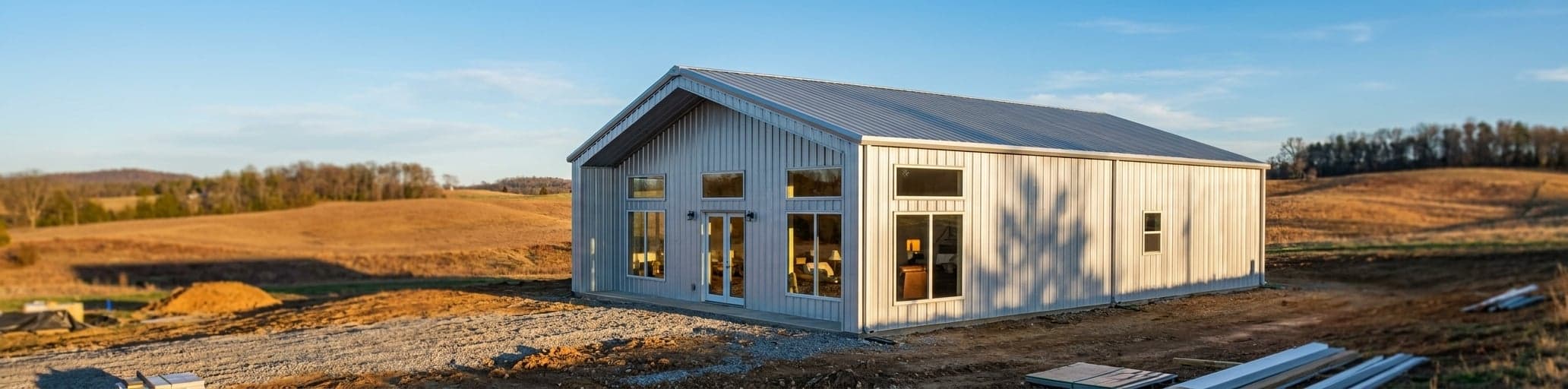

A 30×40 metal building with living quarters delivers 1,200 sq ft of functional space at a lower cost per square foot than smaller builds, with single-source engineering and fabrication that keeps projects on schedule and within budget. Steel's 50-year lifespan, lower insurance premiums, and minimal maintenance make it a financially smarter choice than pole barns over the life of the structure.
Why a 30×40 Metal Building with Living Quarters Is the Smart Choice for Modern Living
At 1,200 sq ft, a 30×40 metal building absorbs fixed costs across enough functional space to deliver comparable livability at a leaner build cost.
1,200 Square Feet: The Sweet Spot for Cost and Functionality
Every home–regardless of size–carries the same fixed costs: kitchen fixtures, bathroom finishes, plumbing rough-in, permits, and foundation work.[1] In a structure under 800 sq ft, those fixed costs compress into a small footprint with no low-cost square footage–extra bedrooms, hallways, storage–to average them down, which is why smaller builds often show an inflated cost per square foot that doesn't reflect actual value.[1] At 1,200 sq ft, the math shifts in your favor.
You gain enough functional space to absorb the expensive rooms without padding the footprint with square footage that adds utility bills and maintenance without adding livability.[2] Industry benchmarks put the "good-sized home" range at 1,500-2,500 sq ft, meaning 1,200 sq ft sits just below that threshold–delivering comparable day-to-day functionality at a leaner build cost.[3] Market demand confirms the opportunity: 26% of buyers actively want homes under 1,600 sq ft, yet only 16% of new single-family homes started in 2023 came in at that size.[1] That gap means a 30×40 metal building home floor plan isn't a compromise–it's a well-timed entry into an underserved housing segment, with a footprint large enough to function and small enough to stay within budget.
Single-Source Steel Construction Eliminates Coordination Headaches
Traditional construction splits responsibility across framers, roofers, window installers, and trim crews–each trade scheduling independently, creating gaps, overlaps, and disputes when components don't fit.
A single-source steel building package replaces that fragmented process: one manufacturer provides in-house structural engineering alongside the primary steel frame, metal roofing system, wall panels, fenestration, trim, and accessories–all fabricated to the same drawings and shipped as a coordinated package.[4] The model has proven itself at scale; single-source metal building systems now account for roughly 40 percent of all new low-rise nonresidential construction in the U.S., a figure that reflects how consistently the approach delivers on time and within budget.[4] The scheduling advantage compounds further because in-house engineering completes before fabrication begins–meaning your foundation design can be finalized and concrete work can start while steel components are still being fabricated, running two phases concurrently rather than sequentially.[4] Factory-applied finishes add another layer of time savings by replacing the multi-pass field applications required by brick veneer or EIFS, removing the weather windows those processes demand.[5] Warranty responsibility consolidates in the same way: one source, one point of contact, one entity accountable for fit and performance from frame to fascia.
For anyone planning a 30×40 turnkey steel build, that single-source accountability is what keeps the project on schedule and eliminates the coordination gaps that inflate costs on conventionally built homes.
Metal Buildings Outperform Wood and Pole Barns Over 20 Years
The upfront price gap between a pole barn and a steel building runs about 15%, but that difference erases once maintenance cycles begin.[6] Pole barn posts shift in the ground and require professional straightening every five to seven years–each cycle costing thousands of dollars–while loosening nails and wood framing demand periodic repainting on top of that.[7] Steel frames anchored to a concrete foundation carry none of those recurring costs. Fire resistance adds a compounding financial advantage: steel is never the first-ignited material in a structural fire, and insurers recognize that fact with premiums up to 30% lower than equivalent wood-framed structures.[7] For a 30×40 metal building with living quarters used as a primary residence, those annual insurance savings alone can close the initial price gap within a few years. The full line-by-line math is detailed in this cost comparison between a 30×40 steel building and a pole barn if you want to run the numbers against your own budget.
Longevity is where the comparison becomes decisive. Pole barns are classified as semi-permanent structures with a typical lifecycle of only 15-20 years before major rehabilitation or outright replacement becomes necessary.[7] Pre-engineered steel buildings last 50 years or longer with minimal upkeep and ship with manufacturer warranties of up to 40 years–meaning your structure retains both its integrity and its resale contribution long after a comparable pole barn would need rebuilding.[6][8] When a steel frame does reach end of service, the material recycles into new steel products rather than becoming construction debris in a landfill–a distinction that matters to property owners thinking about long-term asset value, not just build-day cost.[7] What Does a 30×40 Layout Actually Give You? Real Space Planning Examples
2-Bedroom + Office Configuration: Floor Plan Breakdown
The reason a 2-bedroom + office layout fits so cleanly into 1,200 sq ft comes down to one structural fact: a clear-span steel frame carries its load through the exterior walls, not interior ones, so you decide where every partition goes.[9] A proven approach pulls the master bedroom to the rear of the building — sized to accommodate a walk-in closet, a full bathroom, and a large window — while the second bedroom anchors near the front entry.[10] That positioning keeps both sleeping areas separated from the main activity zone without burning square footage on a dedicated hallway, which means the space between them — roughly the central third of the footprint — is fully available for kitchen, living area, and a walled-off office.[10] With 9-foot walls running the full perimeter, even a compact office alcove reads as a professional workspace rather than a converted closet.[10] For anyone who wants to see how this configuration compares to other steel residential layouts, metal building home floor plans lay out the spatial tradeoffs across four distinct arrangements.
Where you place the office within that central zone depends on your workflow. Positioning it adjacent to the front door creates a clear separation between client-facing space and the rest of the home — useful if you take meetings on-site.[9] Tucking it beside the second bedroom instead gives you acoustic separation from the kitchen and living area during focused work hours.[9] Either way, the kitchen stays functional: a well-designed layout includes an island sized for both dining and conversation, with the pantry and utility room within a few steps of the cooking zone.[10] The one area most people underplan: dedicate at least 50 sq ft to a utility closet for your water heater, HVAC equipment, and electrical panel.[9] Skip that allocation and those mechanicals compress the office or a bedroom instead — a problem that's expensive to fix once interior framing is complete.
3-Bedroom Family Layout: Making 1,200 Square Feet Work
Three bedrooms in 1,200 sq ft functions well when the floor plan separates private and shared zones rather than blending them throughout.[12] Proven layouts pull the primary suite to the rear of the building–with a walk-in closet and a dedicated bath–while the two secondary bedrooms sit on the opposite end of the plan sharing a hall bath.[11] That split keeps adult and children's spaces acoustically distinct without dedicating square footage to corridors that serve no secondary purpose.[11] The resulting central zone handles everything shared: an open layout connecting the kitchen to the family room, a small island for casual meals, and a pantry within reach of the cooking area.[11] Every inch of the footprint carries a defined function, which is what makes the layout feel spacious rather than compressed.[12]
Where a 3-bedroom plan earns its flexibility: one of the two secondary bedrooms sizes up easily as a home office, accommodating family needs that shift over time without requiring structural changes.[11] A mudroom positioned at the garage-side entrance manages daily shoe-and-coat traffic before it reaches the main living area–a small square footage allocation that pays off every morning.[11] The arrangement gives each occupant genuine privacy while the open central living area keeps the household connected–a balance that larger homes often fail to achieve simply by adding square footage without a plan.[12]
Shop + Living Quarters Hybrid: Combining Work and Home Under One Roof
The shop + living quarters hybrid uses all 1,200 sq ft for two distinct functions–splitting the footprint between a working shop and a self-contained residence on a single foundation, under one roof.[13] A practical arrangement dedicates roughly 600 sq ft to an attached shop capable of handling vehicle repairs, woodworking equipment, or agricultural tools, with the remaining half holding a full one-bedroom residence complete with kitchen and bathroom.[14] Steel construction handles both sides without structural compromise: the same frame that anchors the shop walls carries the living quarters, and factory-applied exterior finishes hold up against the heavy use a working shop generates over time.[13] That consolidation–one parcel, one structure, one set of utility connections–is what makes the hybrid genuinely cost-effective compared to building a separate shop and home on the same land.[13] If you want a broader look at how the 30×40 footprint adapts across different use cases, the 30×40 metal buildings guide covers configuration options and key decisions in one place.
Zoning determines whether a hybrid layout is permitted on your parcel before you finalize any floor plan. If you're planning dual-purpose use, local ordinances must explicitly allow it–some municipalities restrict commercial activity on residentially zoned land or assign different permit classifications to mixed-use structures.[13][14] Sorting that out before design begins avoids permit-stage revisions that add weeks and cost to the schedule.[14]
30×40 Metal Building Living Quarters Cost Breakdown: What You'll Actually Pay in 2026
A turnkey 30×40 living quarters project runs $52,000-$106,000 in 2026, with customization and site conditions pushing costs toward the upper range.
Average Cost Range and What's Included in the Price
A 30×40 metal building kit–the structural shell only–runs $18,000-$26,000 in 2026 and covers primary steel framing (columns and rafters), secondary framing (purlins and girts), roof panels, and wall panels.[15] That's your starting number, not your project cost. Add a 6-inch reinforced concrete slab ($8,500-$13,500), professional erection ($5,000-$15,000), and freight ($500-$2,500), and a basic shell lands between $35,000-$55,000 before a single residential finish goes in.[15][16] A 30×40 metal building with living quarters falls firmly at the upper end of the project range: HVAC, plumbing rough-in, insulation, and interior finishes required by residential code push complete turnkey projects to $52,000-$106,000 depending on site conditions, climate zone, and finish level.[15] Buildings in high snow-load or seismic zones sit closer to that ceiling due to additional engineering requirements that can shift the structural package 10%-15% heavier than a standard design.[15]
| Cost component | Typical 2026 range |
|---|---|
| Building kit (structural shell) | $18,000-$26,000 |
| Concrete slab (6" reinforced) | $8,500-$13,500 |
| Erection / labor | $5,000-$15,000 |
| Freight / delivery | $500-$2,500 |
| **Shell-only subtotal** | **$35,000-$55,000** |
| Interior finishes + utilities (living quarters) | $15,000-$50,000+ |
| **Turnkey with living quarters** | **$52,000-$106,000+** |
One figure worth anchoring before you finalize a budget: kit customization–framed openings, specialty trim, added fenestration–adds 20%-50% over the base kit price alone, and that increase compounds before erection or site work begins.[16] Sourcing quotes from multiple suppliers and requesting itemized breakdowns rather than a single lump figure is the fastest way to spot where a budget is being padded.[16] For a full line-by-line walkthrough of every phase, this 30×40 total project budget guide sequences each cost component from kit order through move-in.
Foundation, Insulation, and Interior Finishes: Where the Real Expenses Live
The shell–kit plus slab plus erection–accounts for only 30% of total project cost on a finished metal building home; site prep, mechanical systems, and interior finishing make up the other 70%.[17] That ratio flips most buyers' intuition, and missing it is the single fastest way to underfund a project. The foundation alone runs $8,500-$13,500 for a standard 6-inch reinforced concrete slab, with the final number driven by regional labor rates, drainage conditions, and site access.[15] For a full breakdown of how thickness and reinforcement decisions shift that figure before you pour, the 30×40 concrete slab cost breakdown covers every variable.
Insulation is the line item most budgets shortchange. Heating and cooling consume 50%-70% of energy costs in a finished structure, and spray foam–priced at $1.00-$4.50 per square foot of surface area–can cut those bills by 30%-50% depending on climate zone and application depth.[15][17] On a 1,200 sq ft build with full wall and ceiling coverage, the surface area adds up fast. Skipping quality insulation to trim the upfront number trades a one-time saving for higher utility costs every month for the life of the build–a poor trade in any climate.
Interior finishes carry the widest cost spread of any phase, and your selections here control where your total lands within the $52,000-$106,000 turnkey range. The major finish categories and their 2026 costs:
| Finish category | Typical 2026 range |
|---|---|
| Drywall installation | $1.50-$3.50/sq ft of surface area |
| Spray foam insulation | $1.00-$4.50/sq ft of surface area |
| Flooring | $4-$15/sq ft |
| Interior painting | $1-$6/sq ft |
| HVAC system with ductwork | $7,000-$16,000 |
| Kitchen cabinets (installed) | $4,500-$15,000 |
| Kitchen countertops (installed) | $50-$150/sq ft |
| Kitchen appliances | $2,500-$6,800 |
| Plumbing rough-in | $4-$6/sq ft |
| Building permits | $500-$2,000 |
Stack those categories against your footprint and the interior scope of a 30×40 metal building with living quarters accounts for the bulk of your total investment.[17] The practical sequencing move: rough-in plumbing and electrical first, insulate second, hang drywall third–each phase inspects clean before the next trade arrives, and nothing gets buried before it's verified.[16]
National Steel Buildings Cost Estimates: Get Your Accurate Quote in Minutes
A lump-sum quote tells you almost nothing useful–it just moves the surprises to later in the project.
The only way to get a firm price for a 30×40 metal building with living quarters is a detailed, itemized quote specific to your zip code, site conditions, and finish level.[18] Before you contact any supplier or contractor, prepare your specification inputs: building dimensions, eave height, door sizes and quantities, required wind and snow load ratings for your county, foundation type, and the interior finish scope you're targeting.[19] Bring those details to at least three contractors and request line-by-line breakdowns–materials, labor, permits, freight, and any engineering surcharges listed separately.[18] That structure makes it straightforward to compare bids and spot where one supplier is padding a category or quietly excluding site prep that another has included.[18] Ask each contractor directly whether delivery and erection are included in the quoted number, what insulation options are available and at what cost, and what warranties cover both materials and workmanship.[18] Financing terms vary significantly across suppliers–some metal building lenders offer plans up to 15 years–so asking about payment schedules and financing options during the quote conversation, rather than after you've committed, keeps your budget intact.[18] For a full breakdown of what drives price movement on a 30×40 project, the 30×40 prefab building cost guide sequences every cost component before you sign anything.
Design, Permits, and Construction: From Concept to Move-In Day
HVAC, plumbing, and electrical systems must be installed from scratch in a metal shell conversion, with sequencing and code compliance directly affecting long-term costs.
Custom Engineering for Living Quarters: HVAC, Plumbing, and Code Compliance
Converting a 30×40 steel shell into code-compliant living quarters means installing three systems from scratch: HVAC, plumbing, and electrical.[20] Metal structures present a specific thermal challenge–they absorb heat rapidly in summer and shed it just as fast in winter, making a properly sized HVAC system non-negotiable rather than a comfort upgrade.[20] Spray foam insulation applied before HVAC sizing reduces the heating and cooling load the equipment must handle–getting that sequencing right prevents oversizing, which inflates both install cost and monthly energy bills.[21] Your jurisdiction specifies minimum R-values by climate zone, so confirm those requirements before selecting insulation depth; building to code minimums and building for efficiency are not always the same target. For a deeper look at how insulation assembly decisions affect long-term operating costs in metal structures, this guide to energy-efficient metal buildings covers ASHRAE 90.1 compliance and available tax incentives.
Plumbing in a 30×40 metal building with living quarters starts before the concrete is poured. Drain lines must be stubbed through or under the slab prior to the pour–relocating them afterward means cutting reinforced concrete at significant cost.[20] The International Plumbing Code (IPC) governs installation in most U.S. jurisdictions, while the Uniform Plumbing Code (UPC) applies in western states including California, Arizona, and Washington.[22] Under either code, any new fixture rough-in or drain relocation is a permit-required activity, and most states restrict permitted plumbing work to licensed contractors.[22] Failure to vent drain lines correctly–one of the most commonly skipped steps in metal building conversions–allows sewer gas to enter living spaces, a health hazard and inspection failure that requires opening finished walls to remediate.[22]
Code compliance for a metal building used as a primary residence hinges on one classification issue: steel structures are typically permitted as agricultural or storage buildings, and residential use requires reclassification under stricter safety standards.[20] That reclassification triggers residential building code requirements covering egress windows, minimum ceiling heights, smoke detection, and structural load ratings that an agricultural shell won't automatically satisfy.[20] Resolving the classification question before design is finalized–not during permit review–prevents the plan revisions that add weeks and cost to any schedule. Licensed professionals for HVAC, plumbing, and electrical ensure each system passes inspection on the first review, eliminating the stop-work orders that compound costs when corrections happen late in the build sequence.[20]
Permitting and Inspection: What Your County Requires
ProTrades Erection: Why In-House Installation Matters for Residential Quality Erecting a steel building looks deceptively simple–numbered components, detailed assembly drawings, a four-man crew finishing a 30×40 in three to six days.[28] The real complexity is the dual skill set every qualified erector must carry at once. Framing primary steel columns and rafters demands ironworker training; installing sheeting, panels, and trim requires a separate sheet metal competency.[26] Crews that specialize in only one discipline routinely struggle with the other half–ironworkers rush or botch the sheeting package, sheet metal workers can't control the primary frame–and each error compounds into longer build times, higher costs, and lower-quality finishes.[26] For a 30×40 metal building with living quarters, those compounding errors surface as air gaps behind cladding, misaligned trim that fails weathertight inspections, and Standing Seam Roof installations that void manufacturer warranties when certified procedures aren't followed.[26] OSHA compliance is the legal floor, not the quality ceiling: an erection crew that follows all safety regulations but lacks factory-specific certification is meeting the minimum, not the standard a residential-quality build requires.[26]
The accountability gap between a subcontracted crew and a dedicated in-house erection team is where residential quality is decided. Seventy-seven percent of builders subcontract at least 75% of their work, and improper installation is one of the most common reasons product warranties get voided–because most manufacturers require certified installation to keep warranty protections valid.[27] A subcontracted crew hired for a single project brings no ongoing relationship with the building supplier, no factory-sponsored training specific to the panel system being installed, and no financial stake in whether the roof performs in year five.[27] Dedicated erection teams, by contrast, carry credentials that follow the crew across every project: Standing Seam Roof compliance, High R-Value insulation installation certifications, and specialty door qualifications for bi-fold, sliding, and hydraulic assemblies–components that otherwise require a paid subcontractor or manufacturer site supervision at additional cost.[26] Teams that have worked together long enough to have defined roles execute faster and with tighter craftsmanship than a newly assembled roster of individual tradespeople figuring out the division of labor on your build.[26] When you vet any erection crew before signing, the questions that cut through are direct: Are they certified by the specific manufacturer whose system they're installing? Do they carry consistent crew membership across projects, or does turnover mean new members learning roles on your timeline?[26] A well-matched, experienced crew is the difference between a shell that passes every inspection on the first review and one that generates stop-work orders while corrections are made late in the build sequence.[27]
- A 1,200 sq ft 30×40 metal building absorbs fixed construction costs across functional space, delivering comparable livability at lower cost per square foot than smaller builds.
- Single-source steel building packages eliminate coordination gaps between trades by providing engineered frame, roofing, panels, and trim as one coordinated system.
- Steel structures cost 15% more upfront than pole barns but recoup that difference within years through eliminated maintenance cycles and insurance savings up to 30%.
- Steel frames enable clear-span interior layouts with zero load-bearing walls, letting you position bedrooms, offices, and living zones without structural constraints.
- The structural shell accounts for only 30% of total project cost; site prep, mechanical systems, and interior finishing make up the remaining 70% of budget.
- Spray foam insulation at $1.00-$4.50 per sq ft can cut heating and cooling costs 30-50%, making it a critical investment rather than an optional upgrade.
- Residential reclassification from agricultural use triggers stricter code requirements for egress windows, ceiling heights, and smoke detection before design is finalized.
- https://hiatushomes.com/2025/01/17/small-home-building-costs/
- https://realtyraquel.com/blog/why-do-larger-homes-cost-less-per-square-foot-than-smaller-homes
- https://www.softprowatersystems.com/pages/understanding-installation-costs-home-size-difference?srsltid=AfmBOoqFxj_4Fp8YSgVhwiWdqPrJmildvOP6g2raYKiptnqu6CzdvGBI
- https://continuingeducation.bnpmedia.com/architect/course_lms.php?l=metal-building-manufacturers-association&c=specifying-the-latest-in-metal-buildings
- https://precisionsteelbuildings.ca/benefits-of-metal-buildings/
- https://www.buildingsguide.com/build/pole-barn-vs-metal-building/?srsltid=AfmBOootXSxYBWB9JOx9MEJ9QQG0nPY7bNqJ7ZMHa-zUSimhZOr-plA4
- https://www.rhinobldg.com/blog/which-costs-less-over-time-a-metal-barn-or-a-pole-barn
- https://www.omni-builders.com/home-tips/pole-barn-vs-metal-building-cost-maintenance-longevity-compared
- https://www.smallbarndo.com/30×40-metal-building-layouts-shops-tiny-homes/
- https://mybarndoplans.com/floorplan/rustic-nook-barndominium-30×40-1200-sq-feet/
- https://www.houseplans.com/blog/3-bedroom-2-bath-1200-sq-ft-house-plans
- https://snapadu.com/adu-plans/snap-adu-floor-plan-3-bedroom-3-bath-1199-sqft-48×31-l-shape/
- https://buildmax.com/understanding-the-size-and-potential-of-a-30×40-barndominium/?srsltid=AfmBOop-yXN4TklrTYrXvJxR7eGGaTz6prWJA7_KaYiraplHm1mG7S8u
- https://www.buildingsguide.com/floor-plans/barndominium-floor-plans/?srsltid=AfmBOorYFQ__w5yX__7l9rrUde0MG5O48QEqS2KN8rhsQNuqai2C04zP
- https://www.steelcobuildings.com/how-much-does-a-30×40-steel-building-cost-in-2026/
- https://www.uspatriotsteel.com/blog/how-much-does-a-30×40-metal-building-cost/
- https://homeguide.com/costs/metal-building-homes-cost
- https://homeguide.com/costs/metal-building-cost
- https://www.probuiltsteel.com/blog/30×40-metal-building-cost/?srsltid=AfmBOoqIZifQC4kbm5VjDAE0Z86s3i__buZH3dGpZUOiuGAWSjkZuZ65
- https://prestigesteelstructures.com/is-it-legal-to-convert-a-metal-barn-into-a-home-explained/?srsltid=AfmBOoqDcmblPcuNuqHPVBZ-7mVlu2q7Q4nwnZPnRB83FnwDvyH9OC8U
- https://waltersbuildings.com/convert-a-pole-barn-into-home/
- https://homeregulationsauthority.com/plumbing-code-compliance-residential/
- https://alldraft.com/barndominium-c-of-o-complete-guide/
- https://www.stlouis-mo.gov/government/departments/public-safety/building/permits/building-permits/residential-permit-criteria.cfm
- https://bouldercounty.gov/property-and-land/land-use/building/building-permits/
- https://www.steelsmithinc.com/2017/05/how-to-choose-the-right-erection-crew/
- https://energyswingwindows.com/blog/subcontractor-vs-in-house-installer
- https://steelbuildingsguide.org/construction/