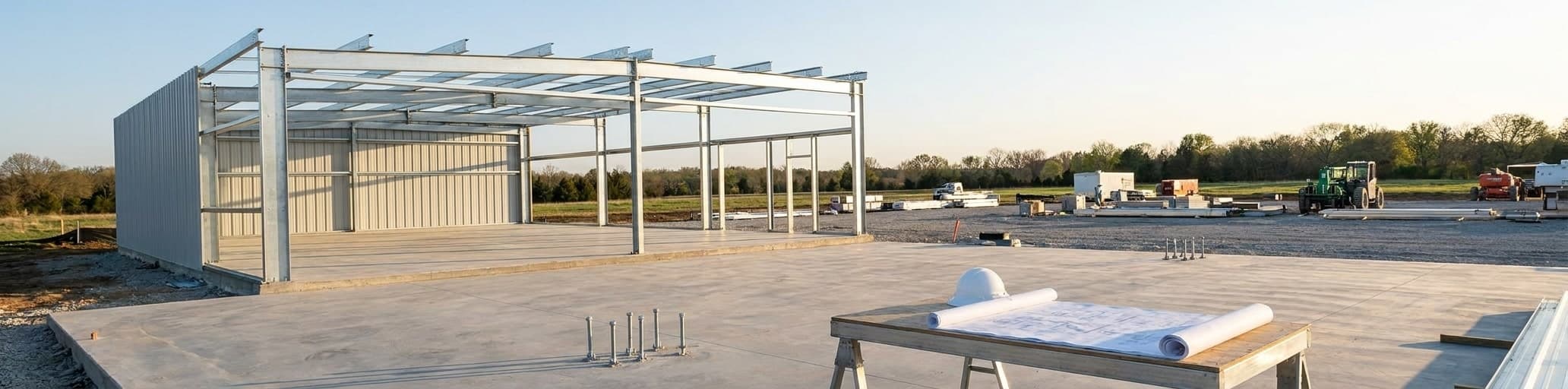

We walk you through every cost element of a 30 by 40 steel building kit, foundation, permits, engineering, site work and upgrades so you can assemble a budget before contracts are signed. Locking specs early with our approach prevents overruns, keeps schedule tight, and delivers spend between $52k and $106k with future savings and resale value.
Breakdown of Core Building Costs for a 30×40 Steel Structure
Your 30×40 steel kit runs $18,000-$26,000, but foundation costs of $10,800-$13,200 and excluded systems like doors and insulation often double the final price.
Base Steel Frame and Panel Pricing from National Steel Buildings
The steel building kit is where your 30×40 metal building cost actually begins–and knowing exactly what that price covers prevents the most common budget surprises.
A standard 30×40 kit runs $18,000-$26,000 in 2026, covering the primary steel frame (I-beams and columns), secondary framing (purlins and girts), roof and wall panels, plus trim and hardware. [1][2] That base price does not include the foundation, doors, windows, insulation, or utility systems–every one of which a functional building requires. [1] As explained in detail in what a 30×40 metal package doesn't include, the gap between kit price and all-in cost catches many buyers off guard.
Steel gauge is the biggest variable inside that range: lower gauge numbers mean thicker, stronger steel that handles heavy snow loads and high wind loads better over decades of use. [1] Local code requirements for wind, snow, and seismic loads can shift your kit price by 10-15% depending on your region–coastal builds and northern climates almost always land at the higher end. [2] Per-square-foot costs improve as footprint grows, so the 30×40 size–1,200 sq ft of clear-span space–hits a standardized manufacturing sweet spot that keeps the kit price cost-effective without trading away structural integrity. [1]
Foundation Options: Concrete Slab Costs and NSB's Recommended Preparation
The foundation is the second-largest cost in your 30×40 metal building budget, and the numbers are predictable once you know what drives them. A 1,200-square-foot slab for a 30×40 footprint runs $10,800-$13,200 installed in most U.S. regions–roughly $9-$11 per square foot depending on thickness, reinforcement type, and local labor rates. [4] The core decision is 4-inch versus 6-inch concrete. A 4-inch slab with welded wire mesh suits light storage and general workshop use, priced around $9.23 per square foot. If you're parking heavy vehicles, running equipment lifts, or operating machinery with dynamic loads, the 6-inch spec with #4 rebar on an 18-inch grid–at approximately $10.38 per square foot–is the one that holds. [4] Both require a 12-inch perimeter beam at minimum, a 6-mil polyethylene vapor barrier under the pour, and 3,500 PSI concrete as the baseline strength rating. On expansive clay soils common across many regions, that perimeter beam should go 24 inches deep–the added cost is small compared to what foundation movement repairs cost later. [4] For a full picture of how slab costs fit into your overall spend, budgeting a 30×40 metal build without cutting corners breaks down every line item side by side.
Three preparation steps separate a slab that lasts from one that fails early. First, confirm your exact building frame dimensions before the concrete is poured–a half-inch misalignment creates anchor bolt problems that cost far more to correct after the fact than to prevent upfront. [4] Second, grade the site so water drains away from all four sides; water pooling against a foundation edge is the primary driver of soil movement and long-term slab cracking. [4] Third, cure the slab a minimum of 5-7 days before steel installation begins–cold weather extends that window, and installing on under-cured concrete compromises the anchor connections in ways that don't show up immediately. [4] Site clearing, grading, and leveling add $1-$1.25 per square foot beyond the slab itself, and sloped lots, rocky ground, or clay-heavy soils push that figure higher. [4] Skipping the vapor barrier is one of the most common and costly oversights–without it, ground moisture wicks through the slab, promoting rust on tools, fasteners, and the building frame over time. [4] Getting these steps sequenced correctly keeps your project within budget and on schedule from the ground up.
Additional Features: Doors, Windows, and Custom Options Impact
Every opening you cut into a 30×40 steel building–walk-in doors, roll-up doors, windows, skylights–carries its own price tag and adds a distinct line item to your budget. [5] A basic workshop needs one roll-up and one walk-in door.
A commercial operation, agricultural facility, or small industrial bay often adds multiple windows, a second roll-up, and skylights for natural light–and each of those additions compounds fast. [5] Wall height makes the math worse: stepping from 9-foot to 12-foot walls adds roughly $2,300 to the kit price, and then you need taller door units to match the clearance, so the cost stacks. [5] Custom finishes follow the same logic–the more factory customization required, the higher the final price, which is why keeping specs standard where function allows is a direct way to control your 30×40 metal building cost. [6] The single most effective cost-control move is locking every opening, height, and finish spec before your order enters production.
Nearly every 15-20% budget overrun traces back to adding a window or upgrading a door after steel is already in manufacturing–those change orders are expensive, and suppliers price them accordingly. [5] Some suppliers bundle doors, insulation, and hardware as a package, which typically costs less than sourcing each component separately, so it's worth asking about bundled pricing before you finalize your quote. [6]
Permits, Engineering, and Site Preparation Expenses
I don't see the actual section content provided after "Section Content:" in your request. Could you please share the specific details, costs, or information from the Permits, Engineering, and Site Preparation Expenses section so I can generate an accurate callout sentence based on the real content?
State‑by‑State Permit Requirements and NSB's Permit‑Ready Package
Permits, engineering, and site preparation expenses
Permit costs range from $200 to $3,500 depending on your location, but submitting a complete application before your kit ships keeps projects on schedule.
State‑by‑state permit requirements and NSB's permit‑ready package
Permit costs for a 30×40 steel building run $200-$3,500, and that range reflects where you build far more than what you build. [7] Forty-eight states have adopted the International Building Code, but each layers on amendments that reflect local conditions–Florida enforces wind speeds of 140-180 mph in coastal counties and requires state-licensed contractors for all structural work; California adds extensive seismic design requirements and Title 24 energy codes that push permit fees to $3,500 in some jurisdictions; Texas gives counties local control, leaving unincorporated rural areas with permit costs as low as $300 and minimal enforcement. [7] Interior states like Kansas, Nebraska, and Wyoming follow similar local-control models, where major cities enforce codes strictly and rural areas operate with few requirements at all. [7] Every permit application–regardless of state–requires PE-stamped engineered drawings calibrated to your site's specific wind, snow, and seismic loads under ASCE 7 standards; without them, no building department will issue approval. [8] Agricultural owners building in qualifying rural jurisdictions may find structural exemptions available in states like Iowa, Wisconsin, and Pennsylvania, but electrical and plumbing permits remain required in every state regardless of those exemptions–a detail that consistently surprises farm and ranch buyers. [7] Approval timelines add another scheduling variable: straightforward rural projects clear in one to two weeks, standard commercial builds in incorporated cities take three to six weeks, and complex projects or those requiring zoning variances can run eight to sixteen weeks, with each revision cycle adding one to two weeks per resubmittal. [7] The best way to keep your 30×40 metal building on schedule is to submit a complete permit package before your kit ships–incomplete applications that cycle through multiple review rounds are the single most common cause of construction delays on otherwise well-planned projects. [8] NSB's permit-ready package addresses this directly: location-specific PE-stamped drawings, structural calculations, anchor bolt layouts, and load documentation are delivered with your building order, so your permit application arrives at the building department complete on the first submission.
Engineering Design Fees and How NSB Handles Custom Engineering
Standard 30×40 kits ship with basic PE-stamped structural drawings–enough for a straightforward permit application in most jurisdictions. The cost escalates when your build deviates from that baseline.
Any modification that changes how the structure performs under load–clear-span configurations wider than standard, specialized door openings, mezzanine additions, or utility-specific penetrations through the frame–requires a full structural recalculation and separate engineering certification. [1] That additional engineering typically adds 15-20% to your base kit price, not counting the permit fee itself. [1] Regional load requirements compound the number further: meeting current IBC standards for seismic zones, coastal wind exposure, or heavy northern snow loads can push engineering costs another 10-15% above that already-adjusted figure. [2] Sites with soft, expansive, or poorly compacted soils add one more line item–a geotechnical bearing capacity report, which runs $1,200-$2,500 before the structural engineer can finalize your foundation spec. [9] The practical takeaway is that engineering fees aren't fixed; they're driven by how far your project departs from a standard design and how demanding your local code environment is. Locking your specs early–wall height, openings, span, intended use–is the single most direct way to keep engineering costs predictable.
Every change after design begins resets part of the calculation, and that reset costs money. NSB's in-house engineering approach bundles location-specific structural calculations, ASCE 7 load documentation, and anchor bolt layouts into your building order from the start, so you're not paying a third-party engineer to start from scratch after your kit quote is already set.
Site Work Costs: Grading, Utilities, and NSB's Coordination Services
Site work is where commercial, agricultural, and industrial builds most often blow past budget–not because any single cost is large, but because they're never budgeted together. Grading and compaction for a 30×40 pad runs approximately $6,500 before concrete is poured, covering the earthwork needed to establish a stable, level base under real site conditions. [11] That number assumes reasonable access; steep grades, wet ground, or soft soil push it higher and slow crew access enough to cascade delays into every phase that follows. [10] Utility connections–electrical service, water lines, drainage infrastructure–are separate line items that no kit quote includes. [11] Electrical alone means trenching from the service point to the building, conduit runs, and panel work, all coordinated with local utility providers on their schedules, which rarely align with your erection window.
Remote or rural sites add another layer: freight to difficult-access locations runs $1.50-$3.00 per square foot above standard delivery costs, a figure that surprises buyers who priced the kit but not the haul. [11] The real coordination problem is sequencing: grading contractors, utility crews, concrete finishers, and the steel erection team all have to hit the site in the right order, or one delay pushes every downstream trade. Managing that sequence yourself across multiple independent contractors is where most project budgets quietly collapse.
NSB's turnkey approach to a 30×40 build keeps site work, kit delivery, and erection on a single coordinated schedule–so you're not the one making phone calls when the grading crew finishes two weeks late and the steel truck is already en route.
Total Project Budget Calculator – Printable Checklist
Track actual costs against planned figures in six columns so you catch budget overruns before they become unrecoverable problems.
Step‑by‑Step Cost Calculator Template (What to Fill In)
A budget that works is one where every line item has a specific number written next to it–not a range, not a guess. The template below follows the same logic as a standard construction budget: list every cost category, assign a planned figure to each, and track the actual spend as contracts come in. [12] Start with six columns across the top: cost category, planned amount, quoted amount, contract amount, actual cost, and variance.
That last column is where your project stays honest–it tells you immediately when a line item is running over before the overrun becomes unrecoverable. [12] Down the left side, list every category in sequence: (1) steel building kit, (2) site clearing and grading, (3) concrete slab, (4) anchor bolts and foundation prep, (5) doors and windows, (6) insulation, (7) permit fees, (8) engineering and PE-stamped drawings, (9) utility connections, (10) freight and delivery, (11) erection labor, and (12) a contingency line set at 10-15% of your subtotal. [13] Fill in your planned amount for each line before you request a single quote–this forces you to confront every cost category upfront instead of discovering them mid-project. [12] Then, as contractor quotes arrive, enter them in the quoted column and flag any line where the quote exceeds your planned figure by more than 10%; that gap needs a scope conversation before you sign anything. [12] The contingency line isn't optional padding–it's the buffer that absorbs the cost of one change order, one soil condition you didn't expect, or one permit revision cycle that adds two weeks and a resubmittal fee. [13] Projects that skip it aren't leaner; they're just one surprise away from a cash problem. For a fully itemized view of how each of these categories breaks down at the line level, breaking down 30×40 metal building cost line by line walks through every number side by side.
Sample Budget for a Typical 30×40 Warehouse Using NSB's Turnkey Solution
A mid-range 30×40 warehouse using NSB's turnkey solution lands between $52,000 and $106,000 all-in for 2026, depending on your location, site conditions, and the finishes you choose. [1] The sample below reflects a realistic mid-point–a standard clear-span warehouse in a mid-cost U.S. region, built on a 6-inch reinforced slab, insulated to a functional commercial standard, with one 14×14 roll-up door, one walk-in door, and basic electrical service.
Every line item is drawn from actual contract categories, not estimates padded with guesswork: steel building kit ($22,000), site clearing and grading ($6,500), 6-inch reinforced concrete slab ($12,000), anchor bolts and foundation prep ($1,500), doors and windows package ($5,000), fiberglass insulation ($3,000), permit fees ($1,500), freight and delivery ($2,500), erection labor ($9,000), and a 10% contingency buffer ($6,300)–bringing the project total to approximately $69,300. [1] That contingency isn't padding; it's the line that absorbs a permit revision cycle, an unexpected soil condition, or a single change order without derailing your cash position. [1] Engineering and PE-stamped drawings are bundled into NSB's turnkey package rather than billed as a separate line item, which is where single-source coordination delivers its most direct budget benefit–you're not paying a third-party engineer to restart calculations after your kit is already quoted.
What this sample makes clear is that the 30×40 metal building cost is predictable when every category is named before contracts are signed; the projects that run over are almost always the ones that discovered a line item mid-construction rather than at the planning table.
Adjusting the Calculator for Living Quarters or Specialty Add‑Ons
The standard 12-line calculator covers a warehouse or workshop build accurately, but living quarters, mezzanines, and lean-to additions each require new line items–and several existing ones expand significantly. Living-quarter conversions demand the biggest budget restructure.
Insulation alone jumps from a functional commercial spec to a habitable-space requirement: basic fiberglass runs $0.50-$1.50 per square foot in materials plus $0.50-$1.25 per square foot in labor, while spray foam–the option that actually creates the airtight envelope a living space needs–costs $2.00-$4.00 per square foot, pushing total insulation spend to $2,400-$6,600 for a 30×40 footprint. [14] HVAC systems, plumbing rough-in, interior wall framing, and electrical panel upgrades all shift from optional to required, each carrying its own contractor quote and separate permit category–meaning your permit line item likely doubles when habitable occupancy is involved. [14] Mezzanine additions are a different kind of budget adjustment: they add usable vertical space without expanding your foundation footprint, but any structural modification that changes how loads move through the frame–a mezzanine, a wide specialized opening, utility penetrations–triggers a full engineering recalculation rather than a simple line-item addition, so budget that recalculation as its own cost before pricing the mezzanine structure itself. For a practical look at how mezzanine and loft configurations affect both cost and design, steel buildings with loft options walks through the full range of configurations.
Lean-tos are the most cost-effective specialty add-on on the list: a 12-foot lean-to spanning the 30-foot width adds roughly 30% more functional space for about 20% more cost–$15-$25 per square foot depending on region and spec–making it the logical first expansion when you need covered equipment storage or a sheltered work area without a fully enclosed structure. [14] When you adjust your calculator for any of these add-ons, insert five new line items after your base build subtotal: (1) insulation upgrade to habitable spec, (2) HVAC system, (3) plumbing rough-in, (4) interior framing and finish work, and (5) lean-to or mezzanine structure. Then raise your contingency from 10-15% to 15-20%–living-quarter and structural add-ons involve more trade coordination, more inspection phases, and more opportunities for one change order to cascade into the next. [14]
Financing, Lead Times, and Long‑Term Value of a 30×40 NSB Building
Coordinate your delivery and erection crew schedule together before fabrication ships to avoid paying for idle equipment or workers waiting on site.
Financing Options and Price‑Lock Programs Offered by NSB
Delivery Schedule, Erection Timeline, and ProTrades Installation Services Once your order clears engineering review, fabrication runs 4-8 weeks for a standard 30×40 kit–closer to 3-4 weeks for straightforward clear-span configurations, and toward the longer end when specialty coatings, non-standard panel profiles, or peak-season production volume are involved. [16] That window is your best opportunity to run site prep and foundation work in parallel rather than in sequence; a concrete slab for a 30×40 footprint involves less than a week of active labor once conditions are right, plus cure time, so the two phases can overlap without conflict. [16] Your kit ships on a 53-foot flatbed, which means your access route needs to be graded, firm, and wide enough to accommodate the truck plus crane turning radius before delivery day–soft ground after rain stops everything and pushes your erection schedule back while you wait for conditions to firm up. [17] Lock your delivery date and erection crew schedule against each other before the truck leaves the fabrication plant; a kit that arrives without crew on standby turns into an unorganized staging problem, and crew that shows up without the kit means paying hourly for people waiting. [17]
# Erection timeline: what to expect on-site
# ProTrades installation services: single-source erection from delivery to enclosure The coordination problem on most 30×40 builds isn't any single trade–it's the handoff between them.
Kit suppliers deliver components; what you do with the truck on arrival is your problem unless you've already arranged a crew, a forklift or skid steer, and a staging plan that puts every column near its anchor bolt before assembly begins. [17] ProTrades resolves that gap directly.
The erection team handles unloading, equipment, and component staging as part of the same coordinated handoff as the kit delivery–so you're not sourcing rental equipment on the morning the truck arrives. [16] Smart staging alone shaves meaningful time off the build: panels stored elevated on blocks away from traffic, hardware packages centralized, columns pre-positioned at their anchor points. [17] Two inspections protect your investment at delivery–one against the packing list while the driver waits, and a second after unpacking to photograph any damage before the 14-day claim window closes, since a single missing component can halt assembly across every phase that follows. [17] For buyers who want a complete picture of how delivery, erection, and site coordination fit into a single managed schedule, the turnkey promise for a 30×40 build from dirt to door lays out how single-source accountability keeps every trade sequenced correctly without the buyer managing the calls.
Lifecycle Cost Savings: Maintenance, Durability, and ROI Compared to Alternatives
Steel's annual maintenance load runs roughly 1% of total construction cost–$1,500-$2,500 per year for a commercial-scale structure–because it doesn't face the failure modes that drive repair bills on wood and concrete: termites, rot, warping, and moisture intrusion. [18] Wood-framed equivalents carry 2-4% annual maintenance costs, or $7,000-$20,000 per year, and that figure excludes unplanned events like termite remediation, which can run $30,000 on a single wood-framed building. [18] Concrete isn't exempt either–structural cracking from settling and freeze-thaw cycles requires periodic professional repair that disrupts operations and rarely appears in initial cost comparisons. [19]
Durability extends the advantage beyond routine upkeep. Steel doesn't warp, split, decay, or attract pests, eliminating entire cost categories that wood owners treat as normal operating expenses. [19] Class IV Impact Resistance-rated metal roofs handle severe hail that destroys conventional roofing, and steel frames engineered to your site's specific load requirements resist wind and weather without the cumulative structural degradation that wood accumulates over time. [14] Insurers price that performance directly into premiums–steel buildings typically qualify for 20-30% lower rates than traditional construction, a recurring saving that compounds year after year without any operational change on your part. [14]
The 20-year lifecycle math is where the 30×40 metal building cost argument closes decisively. A properly insulated steel building saves $2,000-$5,000 annually in energy costs compared to $1,000-$2,500 for traditional construction of equivalent square footage–a gap that widens as energy prices rise. [18] Scaled to a 10,000-square-foot facility, total lifecycle costs for steel run approximately $350,000 versus $670,000-$1.1 million for comparable wood or concrete when maintenance, energy, and remodeling expenses are fully factored in. [18] Your 30×40 sees the same principle at smaller scale: compounding energy savings, near-zero pest and rot costs, and a modular design that accepts future expansions without demolition–factors that contribute to a projected 20-30% resale value increase over two decades. [18] For a direct comparison of how these numbers play out against pole barns specifically, the 10-year cost gap between a 30×40 steel building and a pole barn shows exactly where the lines cross.
- 30×40 steel building kit costs $18,000‑$26,000 (2026) and excludes foundation, doors, windows, insulation, and utilities.
- Concrete slab for 1,200 sq ft runs $10,800‑$13,200; 4‑in slab $9.23/sq ft, 6‑in slab $10.38/sq ft with rebar.
- Permit fees vary $200‑$3,500; all require PE‑stamped drawings per ASCE 7, with 1‑2 wk rural and 3‑6 wk city approval times.
- Engineering changes add 15‑20% to kit price; local load codes can add another 10‑15%; geotech report costs $1,200‑$2,500.
- A typical mid‑range 30×40 build totals $52k‑$106k; a realistic midpoint example is $69,300 including a 10% contingency.
- Steel buildings need ~1% of construction cost per year for maintenance ($1.5k‑$2.5k), vs wood 2‑4% ($7k‑$20k) and lower insurance premiums.
- Fabrication takes 4‑8 weeks; schedule site grading and slab concurrently, and ensure 53‑ft flatbed access for delivery.
- https://nationalsteelbuildingscorp.com/blog/30×40-metal-building-with-slab-cost-the-complete-pricing-guide
- https://www.steelcobuildings.com/how-much-does-a-30×40-steel-building-cost-in-2026/
- https://nationalsteelbuildingscorp.com/blog/how-much-does-a-30×40-metal-building-with-slab-cost
- https://www.northtexassheds.com/concrete-foundation-steel-building-guide
- https://nationalsteelbuildingscorp.com/blog/breaking-down-30×40-metal-building-cost-line-by-line
- https://artsprimesteelstructures.com/30×40-metal-building-cost/
- https://www.metal-buildings.org/metal-building-permits-and-codes/
- https://www.buildingsguide.com/build/metal-building-codes-permits/?srsltid=AfmBOoqr94L0qMHC0dAPtVqfkbNJG_s8lOYD0SYvPpnxCZP3S9uww-KC
- https://www.factorysteeloverstock.com/metal-building-permit-process/
- https://www.americanmetalbuildings.com/blog/how-much-does-a-30×40-metal-garage-cost-in-2026-real-installed-prices-and-what-changes-the-quote/?srsltid=AfmBOopu_KMv266zgHcqO-q9-U2VsjEFKrLfAJzIbyk61I-6ckWmDphP
- https://nationalsteelbuildingscorp.com/blog/2025-price-guide-30×40-metal-building-costs-explained
- https://www.projectmanager.com/templates/construction-budget-template
- https://steelestimatingsolutions.com/steel-building-cost-estimator/
- https://nationalsteelbuildingscorp.com/blog/the-ultimate-guide-to-30×40-metal-building-price-2025-cost-breakdown
- https://nationalsteelbuildingscorp.com/blog/financing-options-that-close-the-gap-on-a-30×40-build
- https://nationalsteelbuildingscorp.com/blog/timeline-truth-how-fast-a-30×40-steel-building-goes-up
- https://www.buildingsguide.com/build/30×40-building-construction/?srsltid=AfmBOoo9T_uqMNcjdgCzL_pywDdJYa8dBokcpZZVSgr9XF7BSOkhJVAv
- https://nationalsteelbuildingscorp.com/blog/budgeting-a-30×40-metal-build-without-cutting-corners
- https://americansteelinc.com/blog/steel-building-vs-wood-concrete/