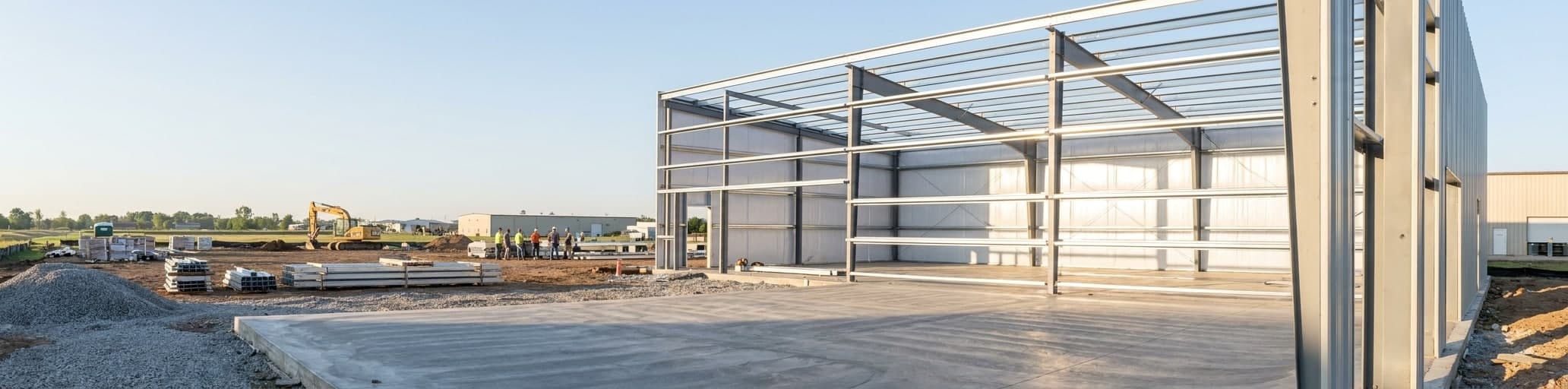

We help you understand exactly what a 30×30 metal building costs, from the base kit through installation, accounting for regional variations and your specific needs. Steel delivers meaningful savings over wood-frame construction both upfront and across decades of ownership with minimal maintenance.
30×30 Metal Building Cost: What You'll Actually Pay in 2026
A 30×30 metal building kit runs $9,000-$15,000, but plan for $18,000-$30,000 installed once you add concrete, labor, doors, and windows.
Base Building Price Without Foundation
The base price for a 30×30 metal building kit covers the core structural components: the I-beam frame, wall and roof panels, and all the fasteners and sealants needed for assembly.[1] That package typically falls between $9,000 and $15,000, depending on your configuration.[1] Nothing beyond the steel itself is bundled in — no concrete, no site prep, no erection labor, no doors or windows.[1] Those additions are what push a fully installed 30×30 project to $18,000-$30,000, or roughly $10-$25 per square foot complete.[1] Several decisions shift the kit price before your quote is even finalized: steel gauge (lower gauge numbers mean thicker, stronger material at higher cost), wall height, roof style, and factory-cut openings for doors and windows all affect the base figure.[1] Opting for a vertical roof, for instance, costs more than a standard boxed-eave profile but channels water and snow off the building far more effectively — a trade-off worth making in most climates.[1] For a deeper look at how these component choices interact with overall 30×30 metal building pricing, that guide breaks down the spec decisions you will face early in the quoting process.
How Location and Local Steel Market Prices Affect Your Quote
Steel behaves like a globally traded commodity, not a local building supply.[3] The price behind your quote is shaped by forces far outside your county: mill utilization rates, global freight costs, and federal trade policy. Section 232 tariffs on steel imports rose from 25% to 50% in June 2025 and now apply to all countries without exception, including Canada and Mexico.[3] At the construction level, steel accounts for roughly 15% of total project cost, so even a moderate commodity spike flows directly into your kit price.[3] Quotes in this market typically carry a 30-day validity window — not because suppliers are being evasive, but because mill capacity, freight availability, and spot pricing can shift inside that window.[3] The most reliable protection is a deposit-and-lock arrangement: once your scope is finalized, a deposit commits the material price so the steel portion of your package is no longer exposed to weekly index movement.[3]
Your zip code adds a second, independent layer of cost variation through local engineering requirements that are invisible on a floor plan but very visible on a final invoice.[3] A 30×30 metal building on the Texas Gulf Coast carries higher wind loads under ASCE 7-22 than the same footprint in inland East Texas, and that difference shows up as heavier bracing, additional anchors, and more connection hardware.[3] Snow load drives similar divergence in northern states, where ground snow values can swing from 20 psf to 50 psf across a single state, changing purlin gauge, bridging, and frame deflection requirements.[3] Seismic conditions in zones like the New Madrid region add yet another engineering layer.[3] The practical result: two buyers requesting the same 30×30 shop cost in different states can receive quotes thousands of dollars apart before either one has chosen a door, a wall height, or an insulation package.
Cost Comparison: Metal vs. Wood Frame Construction
Steel versus wood for a 30×30 shop breaks into two separate cost conversations: what you pay to build and what you pay to own. On the build side, a prefab metal building kit runs $10-$25 per square foot for the structural package alone.[1] Wood-frame construction for a comparable shop footprint costs more to assemble because every piece is field-cut and hand-framed on-site rather than pre-engineered and factory-produced. The price gap is visible at the finished-structure level: fully finished metal building homes average $50-$145 per square foot, while comparable traditional construction runs $180-$280 per square foot.[4] Even when you add erection labor and site work to the steel side of the ledger, the total installed cost for a 30×30 metal building consistently lands below a wood-framed equivalent of similar size and specification.
The ownership math is where steel creates its clearest advantage. Steel is non-combustible, which often qualifies a building for lower insurance premiums — a recurring annual saving that compounds over decades.[1] Wood requires periodic repainting, pest treatments, and structural repairs as rot and termite damage accumulate; a steel building has none of those vulnerabilities.[1] It won't warp, rot, or attract pests, so the maintenance budget for a 30×30 metal shop is effectively near zero beyond basic upkeep.[1] Metal buildings are rated to last 50-100 years under normal conditions, while wood-frame structures typically need significant structural attention well before that threshold.[4] Over a 20- or 30-year ownership window, the lower maintenance cost on a steel building routinely offsets any remaining difference in initial build price — making metal the more cost-effective choice across the full life of the structure.[1]
30×30 Metal Building With Concrete Slab: Complete Cost Breakdown
A 30×30 concrete slab costs $5,400-$10,800 installed, with the 6-inch rebar specification recommended to prevent cracking and anchor bolt misalignment over time.
Concrete Slab Costs for a 30×30 Footprint
A 30×30 concrete slab runs $5,400-$10,800 installed, based on the national average of $6-$12 per square foot.[5] The low end applies to a basic 4-inch slab without reinforcement; the high end reflects a 6-inch slab with rebar, vapor barrier, and gravel base — the specification most jurisdictions require under a load-bearing steel building.[5] Labor accounts for 40%-50% of the total, with materials covering the rest.[5] Geography adds an independent cost layer: central-state contractors average roughly $5.35 per square foot, while coastal markets — California, New York, and similar — push toward $8.50 per square foot for identical work.[6] Rebar, required for slabs thicker than 4 inches, runs $1.40-$1.85 per linear foot and is sometimes folded into a contractor's flat rate rather than shown as its own line item, so ask for itemized pricing before you sign.[6] A gravel base, which improves drainage and reduces shifting under heavy loads, adds another $1-$3 per square foot on top of the slab price.[5] The table below shows how slab specification affects the 30×30 budget:
| Slab spec | Cost per sq ft | 30×30 total estimate |
|---|---|---|
| 4-inch, unreinforced | $6-$7 | $5,400-$6,300 |
| 4-inch, wire mesh | $7-$9 | $6,300-$8,100 |
| 6-inch, rebar + gravel base | $10-$12 | $9,000-$10,800 |
For a prefab steel building, the 6-inch rebar spec is the right target in most markets — the upgrade from wire mesh costs a few thousand dollars upfront and prevents the cracking and shifting that would otherwise compromise your anchor bolts and frame alignment over time.[5]
Total Project Cost: Building Plus Foundation
Stack the building kit and foundation together and the all-in number for a 30×30 metal building with concrete slab lands between $18,000 and $30,000 for most buyers — roughly $20 to $33 per square foot across the complete project.[1] The kit ($9,000-$15,000) and the slab are the two largest line items, but site grading, erection labor, and accessories each add real dollars that budget-builders frequently undercount.[1] Detached structures built to similar size and occupancy in the broader garage market run $40-$70 per square foot when fully finished, which puts a steel building package at a meaningful discount against conventional construction at equal specification.[7] The table below breaks the total into its component parts so you can see where the money goes before you request a quote:
| Cost component | Low estimate | High estimate |
|---|---|---|
| 30×30 metal building kit | $9,000 | $15,000 |
| Concrete slab (900 sq ft) | $3,600 | $10,800 |
| Site grading and prep | $1,200 | $3,000 |
| Erection labor | $1,500 | $4,500 |
| Doors, windows, insulation | $1,200 | $4,000 |
| **Estimated total** | **~$17,500** | **~$37,300** |
The spread between the low and high totals is wide for a reason: slab specification alone accounts for up to $7,200 in variation depending on thickness and reinforcement, and labor rates shift another 15%-30% between rural and coastal markets.[8] A buyer in a low-cost central-states market choosing a wire-mesh slab and DIY erection can realistically land near the bottom of the range; a buyer in a coastal market with a 6-inch rebar slab and a professional erection crew will approach the top.[7] Neither outcome is a surprise if you build the budget line by line before you finalize your scope — the total figure only catches people off guard when they price the kit and forget everything else.[1]
National Steel Buildings Cost Estimator Tool [Estimates]
The $18,000-$30,000 all-in range is a planning anchor, but configuration — not footprint — determines where your project actually lands within it.[1] A basic shop on an unreinforced 4-inch slab with no insulation sits near the bottom; a fully outfitted two-car garage with a 6-inch rebar slab, spray foam insulation, and a commercial roll-up door lands near the top.[1] The table below translates the three most common build scenarios into installed cost estimates so you can identify your position before any contractor visits your site.
| Configuration | Kit estimate | Slab estimate | Installed total estimate |
|---|---|---|---|
| Basic shop, 4" slab, no insulation | $9,000-$11,000 | $5,400-$6,300 | $18,000-$22,000 |
| Two-car garage, wire-mesh slab, batt insulation | $11,000-$13,000 | $6,300-$8,100 | $22,000-$27,000 |
| Commercial bay, 6" rebar slab, spray foam, upgraded doors | $13,000-$15,000 | $9,000-$10,800 | $27,000-$37,000+ |
For buyers watching the total, three decisions consistently move the number without compromising structural integrity: choosing a vertical roof over a boxed-eave profile reduces long-term moisture repair costs even though it costs more upfront; deferring interior finish work to a later phase keeps the initial invoice manageable; and using a higher steel gauge only where local wind and snow loads actually require it avoids unnecessary material cost.[1] For context, conventionally built detached structures at comparable square footage typically run $40-$70 per square foot under standard construction methods — making a steel package at the high end of this range still well below a wood-frame equivalent of equal size and occupancy.[7] If upfront capital is the constraint, financing options through third-party lenders are available for projects in this price range, with soft-pull rate checks that don't affect your credit score, so you can specify the right build from the start rather than downgrading components to fit a tighter cash position.[9] Specifications and Sizing: Is a 30×30 Building Right for Your Use?
Square Footage and Clear Span Interior Space
A 30×30 metal building delivers exactly 900 square feet of usable floor space — and the number that matters more than the square footage itself is how much of it you actually get to use.[1] Unlike wood-frame construction, which relies on interior posts or load-bearing walls to transfer roof loads to the foundation, a steel building uses a rigid I-beam frame to carry those loads entirely through the exterior structure.[1] The result is a completely unobstructed interior: no columns interrupting your floor plan, no walls dictating where equipment goes, no compromises on layout.[1] That design principle — called clear-span framing — is what separates a 900-square-foot steel building from a 900-square-foot wood-frame building of the same footprint, even though both occupy identical ground area.[1] In practical terms, clear-span means you can park two full-size vehicles side by side and still open both doors fully, position a vehicle lift anywhere on the slab without engineering around a column, or reconfigure the entire space for a different use years from now without any structural demolition.[1] The open floor plate also creates a subjective spaciousness that matters when you're working inside the building every day — the absence of interior obstructions makes the space feel larger than the square footage alone suggests.[1] For buyers wondering whether 30×30 metal building plans translate into enough room for their actual intended use, the clear-span format is the deciding factor: 900 unobstructed square feet is a fundamentally different asset than 900 square feet interrupted by structural supports.
Common Heights and How They Impact Cost and Usability
Wall height sits alongside steel gauge and roof style as one of the primary variables that shifts a 30×30 quote before the building ever leaves the factory.[1] The reason height matters so much is purely functional: eave height determines what you can actually do inside the building, and the gap between a 10-foot wall and a 12-foot wall can be the difference between a building that works and one that doesn't. A real-world illustration of this comes from a buyer planning a 15×27 shop near Pittsburgh who specified a 12-foot ceiling specifically because the long-term plan involved a vehicle lift — and a two-post lift needs that clearance overhead to operate safely with a full-size truck raised.[10] Taller walls require longer columns, more panel material, and additional lateral bracing to handle the increased moment forces on the frame, all of which add steel tonnage to the kit and push the base price upward.[1] The practical takeaway: decide your intended use before you set wall height, not after.
A basic storage application tolerates a 10-foot eave. A working shop with overhead equipment, a lift, or tall roll-up doors needs more — and specifying that height correctly the first time avoids the costly redesign that comes from underbidding the vertical dimension of the project.[1]
30×30 Metal Building Uses: Shop, Garage, Agricultural, and Commercial Applications
The 900 square feet inside a 30×30 building works across more use categories than most buyers initially consider.[1] The two-car garage is the most common application: the footprint fits two full-size vehicles side by side — an SUV and a pickup truck — with enough perimeter space left over for a workbench and storage wall.[11] Workshop users — woodworkers, mechanics, fabricators — value the clear-span interior differently; without interior columns, large equipment can be positioned wherever workflow demands, not wherever the structure permits, and dedicated zones for rough work like cutting or sanding can be kept physically separate from clean assembly areas.[1] On the agricultural side, all-steel construction protects equipment, animal feed, and seasonal inventory from weather without the rot and pest vulnerabilities that accumulate in wood structures over time.[1] Small commercial operators find the same footprint serves as a service bay, a contractor's staging hub, or a retail storage annex — any application where covered, column-free space directly translates to operational efficiency.[1]
The square geometry is a planning asset that rectangular footprints can't match. Equal sides divide cleanly into two or three distinct functional zones — receiving, fabrication, storage — without the awkward proportions that come with a long, narrow building.[12] Most owners find a standard 12-foot eave height handles the majority of these applications, though anyone planning overhead equipment, a vehicle lift, or tall roll-up doors should specify 14 feet or more before the kit is ordered.[12] Because the rigid steel frame carries all loads through the exterior perimeter, any interior configuration can be rearranged without structural demolition — a practical advantage when a building transitions from a personal shop to a commercial use, or when operations scale over a 10- or 20-year ownership period.[1]
How to Get an Accurate 30×30 Metal Building Quote From National Steel Buildings
Prepare details about your building's use, site conditions, timeline, and finish requirements before requesting a quote to eliminate costly supplier guesswork.
What Information You Need Before Requesting a Quote
A quote built on incomplete information is essentially a guess — and typically a padded one.[13] Vague or missing details force suppliers to build contingency into their numbers, which means the buyer absorbs the cost of their own ambiguity.[13] Before contacting any supplier, have four categories of information ready: your building's intended use and functional requirements (vehicle lift clearance, roll-up door dimensions, livestock access points, or equipment footprints), your site's location and soil conditions, your preferred timeline for both delivery and erection, and a clear picture of the finish state you need — bare kit delivery, partial erection, or a fully installed turnkey package.[14] The more precisely you define each of these before the first conversation, the less room there is for a supplier to estimate around your gaps.[13]
What gets included in a quote varies significantly by supplier, so ask for explicit confirmation on every line item rather than assuming anything is standard.[15] Some companies quote only the structural frame and panels; others bundle insulation, doors, windows, and anchors at different price points.[15] Site preparation and foundation work — costs that can reach several thousand dollars on a 30×30 footprint — are almost never included in a base kit price, and failing to ask upfront is the single most common source of budget shock after a contract is signed.[15] Additional questions worth putting in writing before committing include: what metal grade and gauge is specified in the frame, what roof profile is standard versus an upgrade, what the warranty covers and under what maintenance conditions, and whether the supplier assists with local permit documentation or leaves that entirely to you.[15] For buyers who want a structured approach to vetting steel building contractors before requesting a quote, that guide covers the five questions that separate accountable suppliers from those who disappear after the deposit clears. The goal of pre-quote preparation isn't to interrogate your vendor — it's to arrive at a number that reflects your actual project, not a simplified version of it, so the figure you approve matches the invoice you receive.
Why Single-Source Design-Build Saves Time and Money
Next Steps: From Estimate to Installation With ProTrades Erection Services The path from a signed estimate to a standing 30×30 building moves through phases that are predictable when managed correctly — and expensive when they're not.
Planning and design typically runs two to six weeks, during which structural specifications, local code compliance, and interior layout are finalized.[19] Permitting follows, and the window varies sharply by jurisdiction: a smaller municipality may issue permits within a week, while a busy urban office can stretch that to several months, making early submission a first-priority action regardless of location.[19] Site preparation and foundation work take one to four weeks depending on soil conditions and slab specification, and this phase is the one most often underestimated — poor site conditions or unexpected soil problems can push the entire downstream schedule.[19] Steel components ship within one to two weeks after the design is approved and the foundation is ready, arriving pre-engineered and pre-cut so no on-site fabrication is required.[18] The erection phase — the part that transforms a cured slab into a standing structure — takes as little as three to five days for a clear-span building this size when the crew is experienced with the specific system.[18] That speed is not incidental: pre-engineered components eliminate the on-site measuring and cutting that slow conventional framing, and a crew already familiar with the connection details and sequencing moves through assembly without the corrections that cost inexperienced teams hours per day.[18] Crew selection deserves the same due diligence as kit specification, because the gap between an experienced erection team and an unfamiliar one shows up directly in your schedule and in the quality of the finished frame — a point covered in more depth in this guide to why your steel erection crew matters.
Final inspection and close-out add one to two weeks before occupancy.[19] End to end, a straightforward 30×30 project — design through final sign-off — typically completes in three to six months, with actual steel erection representing only a small fraction of the overall calendar.[19] ProTrades erection services coordinate directly with the fabrication and delivery schedule so the crew arrives when the slab is cured and the kit is on site, removing the scheduling gaps that add weeks to projects managed across multiple independent contractors.
- A 30×30 metal building kit costs $9,000-$15,000, but fully installed with slab and labor runs $18,000-$30,000 or $10-$25 per square foot.
- Steel tariffs and global commodity pricing affect quotes significantly; lock in prices with a deposit within the typical 30-day validity window.
- Local engineering requirements for wind, snow, and seismic loads vary dramatically by zip code and can shift quotes thousands of dollars.
- A 6-inch reinforced concrete slab with rebar costs $9,000-$10,800 and prevents cracking and anchor bolt compromise over time.
- Clear-span steel framing eliminates interior columns, providing 900 unobstructed square feet versus wood-frame construction with load-bearing walls.
- Steel buildings cost 40-50% less than wood-frame equivalents upfront and require minimal maintenance, offsetting initial price differences within 20-30 years.
- Complete project timelines span three to six months from design through occupancy, with actual steel erection taking only three to five days.
- https://iconsteelbuildings.com/30-x-30-metal-building/
- https://www.brookings.edu/articles/introduction-to-steel-an-industrial-material/
- https://www.tylerbuilding.com/post/2026-metal-building-cost-variables
- https://homeguide.com/costs/metal-building-homes-cost
- https://homeguide.com/costs/concrete-slab-cost
- https://www.homeadvisor.com/cost/outdoor-living/concrete-slab/
- https://trusscore.com/blog/how-much-does-it-cost-to-build-a-garage.html
- https://www.angi.com/articles/concrete-slab-cost.htm
- https://www.northtexassheds.com/steel-buildings/30×50
- https://www.garagejournal.com/forum/threads/ill-take-free-advice-and-some-opinions-too-metal-vs-stick-build.472151/
- https://bullbuildings.com/locations/30×30-metal-garage-in-ga/
- https://metal-america.com/30×30-metal-building/
- https://www.masteelfab.com/blog/what-information-do-i-need-to-provide-for-accurate-metal-fabrication-quote/
- https://www.amgindustries.com/blog/how-to-request-a-metal-fabrication-quote-what-buyers-need-to-know/
- https://lionbuildings.com/best-questions-to-ask-when-requesting-a-quote-for-your-metal-building/
- http://www.gonzalesconstruction.com/metal-buildings-construction-advantages.html
- https://forgebuildings.com/pre-engineered-metal-buildings-an-investment-alternative/
- https://www.mtnssb.com/how-quickly-can-a-metal-building-be-erected-when-done-correctly/
- https://gravitycontractors.com/how-long-does-it-take-to-erect-a-steel-building/