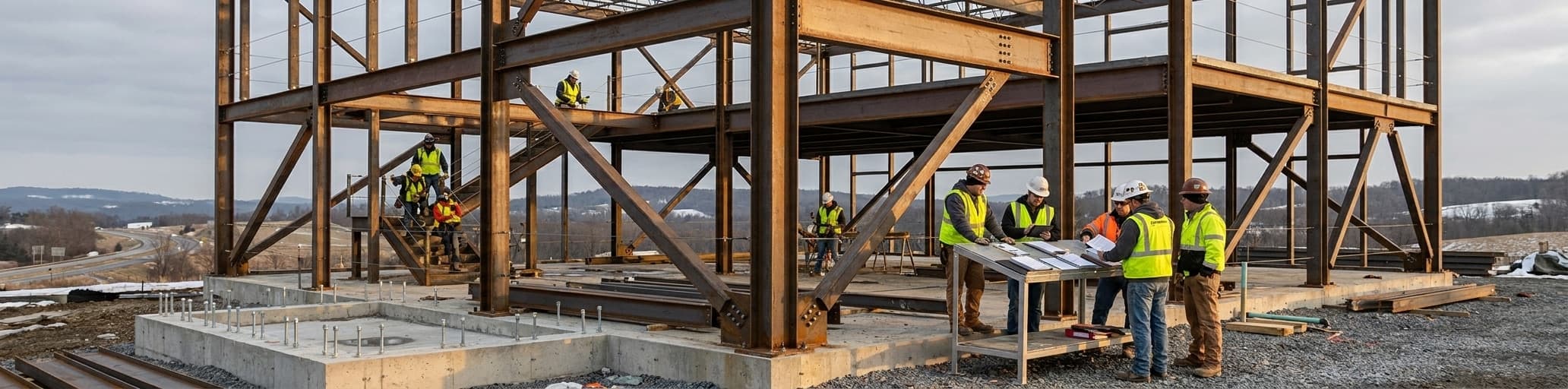

Pennsylvania's 2018 UCC requires your 30×30 steel building to integrate wind, snow, fire-resistance, egress, foundation, and permitting into a single engineered package before submission–we walk you through each code section and inspection hold point so your permit advances without corrections.
Pennsylvania Code Requirements for 30×30 Steel Buildings
Pennsylvania's 2018 UCC requires you to combine 115 MPH wind and 30 PSF snow loads in your structural calculations and document every derived value in construction drawings to pass permit review.
Structural Wind & Snow Load Standards
Pennsylvania's 2018 Uniform Construction Code–built on the 2018 IBC–sets a statewide wind design speed of 115 MPH and a ground snow load of 30 PSF.[2] For a 30×30 steel building, both loads must be combined–not evaluated in isolation–using either Strength Design (LRFD) or Allowable Stress Design (ASD) per IBC Section 1605.[1] Pennsylvania falls under Seismic Design Category A, the lowest seismic tier, so wind and snow drive your structural calculations on most commercial sites rather than earthquake forces.[2] Your engineer must also classify the site as Exposure Category B, C, or D under IBC Section 1609.4, because terrain differences change effective wind pressure even when the mapped speed is identical across a region.[1] Snow load work begins with the 30 PSF ground figure under Section 1608.2, then factors in roof shape coefficients, drift accumulation, and thermal conditions before arriving at the actual design roof load–and every one of those calculated values must be documented in your construction drawings under IBC Section 1603, or Pennsylvania's Bureau of Occupational and Industrial Safety will return the permit package before a reviewer touches it.[1]
Fire-Safety & Egress Regulations
Bare steel loses structural integrity fast under fire conditions, which is why IBC Chapter 7 Section 704 requires every load-bearing steel member in a rated assembly to carry a tested fire-resistance protection system.[4] For a 30×30 steel building, that means your columns can't stay exposed unless your occupancy classification and construction type specifically allow unprotected framing–a determination your engineer makes, not your permit clerk. When protection is required, IBC Section 722.5 gives you three compliant paths: gypsum wallboard enclosure, sprayed fire-resistant materials (SFRM), or concrete encasement.[4] SFRM is the most common choice on pre-engineered steel frames because it conforms to irregular shapes and adds minimal dead load, but the minimum applied thickness is calculated against each column's weight-to-heated-perimeter ratio under Section 722.5.1.3, so "spray and go" isn't a real strategy–the thickness must be specified in the drawings before the permit is issued.[4] Any penetration through a fire-resistance-rated wall–HVAC ducts, conduit, pipe sleeves–requires a listed through-penetration firestop system under IBC Section 714.3; reviewers flag unprotected penetrations as a leading cause of plan-review rejections, so coordinate those locations with your MEP engineer before submitting.[4]
Egress planning starts with occupant load, which Pennsylvania's UCC calculates using occupancy-specific load factors under IBC Section 402.8.2–your architect assigns a gross or net floor area per occupant based on how the space is actually used, not just its square footage.[3] From that number, IBC Section 402.8.3 determines how many exits are required, and Section 402.8.5 caps how far any occupant can travel to reach one.[3] Most single-story 30×30 commercial occupancies qualify for two exits minimum, but the arrangement matters as much as the count: exits must be positioned so they can't both be blocked by the same fire event, a spacing requirement enforced at the final inspection walk-through.[3] Pennsylvania also folds in automatic sprinkler requirements through IBC Section 402.5, which can trigger based on occupancy group, building area, or both–and a sprinkler system, once required, has to be designed by a licensed fire-protection engineer and submitted as a separate drawing set alongside your structural package.[3] Getting fire-safety and egress details right before you submit saves weeks; errors in this section are among the most common reasons Pennsylvania's Bureau of Occupational and Industrial Safety issues correction notices rather than approvals.
Foundation & Slab Engineering Mandates
Pennsylvania's IBC Chapter 18 treats foundation design as an engineering process, not a prescriptive checklist–which means your 30×30 steel building permit won't advance until a qualified geotechnical investigation is on file. Under IBC Section 1803.2, a formal investigation is required whenever soil conditions are unknown, and the scope under Section 1803.3.1 must address soil classification under Section 1803.5.1, identify any expansive or questionable soil conditions under Sections 1803.5.2 and 1803.5.3, and establish the groundwater table depth under Section 1803.5.4.[5] Every one of those findings feeds directly into what your engineer documents under IBC Section 1603.1.6–geotechnical information is a mandatory element of the construction documents, and Pennsylvania's plan reviewers check for it before opening the structural package.[1]
Frost protection is the most immediate constraint on footing depth for any 30×30 commercial build in Pennsylvania. IBC Section 1809.5 requires footings to extend below the local frost line to prevent seasonal heave from lifting the foundation.[5] Pennsylvania's adopted climate data sets that depth at 36 inches below finish grade across much of the state, including Lancaster County.[6] Column base plates and anchor bolts must transfer loads into footings at that depth or lower–and if your geotechnical report identifies expansive soils, IBC Section 1808.6.2 adds design requirements for the slab-on-ground to resist uplift forces without cracking the floor or shifting anchor bolt patterns over time.[5]
Before your engineer can specify the slab, IBC Section 1806 requires confirming that the soil's presumptive load-bearing value is adequate for your occupancy's floor loads.[5] Any fill material placed under the slab must meet the engineered-fill requirements of Section 1804.6–uncontrolled site spoils don't qualify, because differential settlement from unengineered fill is one of the leading causes of slab cracking and anchor bolt misalignment in pre-engineered steel frames.[5] Where the slab sits at or near the groundwater table, IBC Section 1805 requires dampproofing or waterproofing treatment; the specific system–whether a sub-slab vapor barrier, a perimeter foundation drain per Section 1805.4.2, or full waterproofing membrane per Section 1805.3–depends on what your groundwater investigation finds, and that determination must be documented in the drawings before permit issuance.[5] If you're weighing how intended floor use affects slab thickness and reinforcement alongside these soil requirements, the guide on choosing concrete thickness for steel buildings walks through how load assumptions and soil data connect to the final spec.
Permit Paperwork & Submission Process
Before submitting your land development application, you'll need zoning clearance, a boundary survey, environmental assessments, and a certified site plan prepared by a licensed professional.
Site Plan, Survey & Zoning Clearance
Before your 30×30 steel building ever reaches a building permit reviewer, two parallel tracks need to clear: zoning approval and a recorded land development plan. Pennsylvania's Municipalities Planning Code pushes both of these through your local municipality–not a state agency–which means requirements differ by township or borough.[7] Your first concrete step is confirming the parcel's zoning classification with the municipal zoning officer, who administers the local ordinance and can tell you which uses are permitted, what setbacks govern your footprint, and whether your project needs any special relief such as a variance, conditional use approval, or text amendment before a land development application will even be accepted.[7]
A boundary survey is a prerequisite to the site plan, not an afterthought. The survey must document property lines, easements, title exceptions, setbacks, and any use or development restrictions before your engineer can begin the engineered sketch plan.[7] Pennsylvania also requires you to order a PINDI (Pennsylvania Infrastructure Natural Diversity Inventory) and, where site conditions warrant, a wetlands assessment, floodplain study, and full environmental investigation–including a jurisdictional determination with the Army Corps of Engineers if wetlands are present.[7] Those findings determine how much of your parcel is actually buildable and feed directly into the sketch plan your design professional uses to identify what relief, if any, is required before the municipality will accept a formal land development application.[7]
The land development plan itself is governed by your municipality's Subdivision and Land Development Ordinance (SALDO), which controls how the site is improved–stormwater management, driveway placement, utility connections, and sidewalk requirements–independent of what zoning permits.[9] A licensed surveyor, engineer, or landscape architect must prepare and certify that plan; Pennsylvania law requires it.[9] Once submitted, the planning commission has 90 days to act, but well-prepared plans commonly move through in 45 to 60 days.[9] Plans that lack required detail or don't address SALDO design requirements delay the clock–sometimes by months if outside agency permits from PennDOT, DEP, or a sewer authority are also outstanding.[9] Some municipalities add a layer on top of that: Abington Township, for example, requires all commercial plans to pass third-party review before the township will even accept your application.[8] Confirming your local municipality's exact pre-submission requirements–and attending a pre-application meeting with planning staff before you file–can prevent delays that push your project start date back by months.
Construction Drawings & Engineer Stamps
Pennsylvania draws a hard line for commercial new construction: every set of construction documents for a new commercial structure–including your 30×30 steel building–must be prepared by a licensed Pennsylvania architect or professional engineer, full stop.[10][11] Under PA UCC § 403.42a, the only scenario where an unlicensed person may touch design documents is non-structural remodeling where no compensation changes hands and the work doesn't affect the building's structure or means of egress–none of those conditions apply to a new 30×30 steel frame build.[10] Stamping rules differ by discipline, and getting them wrong is just as costly as missing them entirely.
Architects must display their signature, seal, and issuance date prominently on the first page of every document set, with facsimile seals carried through on all subsequent sheets.[10] Engineers face a stricter standard: every single page of the drawing package must carry the engineer's stamp, signature, and date–not just the cover sheet.[10] For a pre-engineered steel frame, that means your manufacturer's structural calculations and shop drawings need a PA-registered engineer's review and stamp before the package reaches the permit counter, regardless of where the building system was fabricated.
Submitting a set where interior sheets lack a registered engineer's stamp is a routine trigger for correction notices; confirming page-by-page compliance before you hand over the package prevents that delay entirely.
Fees, Timelines & Fast-Track Options
Pennsylvania permit fees for commercial buildings aren't set at the state level–your local municipality controls the building permit fee schedule, and DEP environmental permit fees vary by permit type and county conservation district, so verify costs directly with each reviewing agency before you finalize your budget.[12] What you can count on: every permit has its own clock, and those clocks run in parallel, not series. If your 30×30 steel building project disturbs earth, crosses a waterway, or triggers an air quality authorization, DEP environmental permits sit on a separate timeline from your municipal building permit–and whichever takes longer sets your actual start date. Understanding that gap early prevents the most common scheduling surprise in Pennsylvania commercial builds, and the Pennsylvania commercial steel building permit timeline breakdown covers how those phases stack against each other in practice.
For projects that need DEP permits–Chapter 102 stormwater, Chapter 105 water encroachment, or air quality authorizations–Pennsylvania's SPEED Program, launched in July 2024 under Act 54, lets you engage a DEP-approved Qualified Professional to conduct the initial review on an expedited basis instead of waiting in the standard DEP queue.[12] Entry is straightforward: submit the SPEED Intake Form along with a draft permit application and project materials to RA-EPSPEED@pa.gov, and DEP schedules an intake meeting within 2 to 3 business days of receiving those materials.[12] DEP then has 10 business days to select a Qualified Professional, who provides a project-specific fee quote separate from your standard application fees–that QP fee is due within 3 business days of your acceptance, and both fees must clear before the Qualified Professional begins work.[12] If a deficiency emerges, the program allows up to two tolling periods to address it, and DEP makes the final permit decision based on the QP's recommendation.[12] Fees for both the application and the QP review are accepted through DEP's Public Upload with Electronic Payment (PUP) system, with County Conservation District fees payable directly to the district.[12]
If your 30×30 project is part of a broader economic development effort involving multiple simultaneous state agency permits, Pennsylvania's PA Permit Fast Track Program–created by Executive Order 2024-04–coordinates that permitting across agencies through the Office of Transformation and Opportunity (OTO).[13] OTO assigns interagency coordination, organizes agency meetings, and maintains a public-facing dashboard so you can track permit status and hold agencies accountable to their timelines.[13] Fast Track doesn't bypass technical review; every permit submitted through it undergoes the same standard review as any other application.[13] It's purpose-built for complex, large-scale projects, but if your 30×30 steel building sits within a larger development that requires parallel DEP, municipal, and infrastructure approvals, engaging OTO before you submit can replace serial agency reviews with coordinated parallel processing–and that difference alone can shave weeks off your overall permit-to-groundbreak window.[13]
30×30 Steel Building Design Options
Vertical roof panels shed Pennsylvania snow efficiently without pooling, reducing structural load calculations and maintenance costs over the building's lifetime.
Vertical Roof vs Sloped Roof Loads
Roof panel orientation directly determines how your 30×30 steel building sheds Pennsylvania's snow and rain–it's a structural decision, not an aesthetic one. Regular (horizontal) roof panels run perpendicular to the slope, creating seams where debris, ice, and water accumulate.[15] Beyond 31 feet of roof run, those horizontal seams multiply and every one becomes a potential leak point that demands periodic maintenance.[15] Vertical roof panels run parallel to the slope from ridge to eave, so snow, water, and debris channel straight off without pooling.[15] That drainage efficiency matters most in Pennsylvania, where ground snow loads range from 30 to 90 psf depending on whether your site is in the Lehigh Valley or the Poconos and Laurel Highlands.[16] Steeper and vertical roof profiles allow snow to shed rather than accumulate, which reduces the design roof snow load your engineer must calculate–so roof style choice feeds directly into your structural load calculations.[14]
The tradeoff is upfront cost and installation complexity. A vertical roof system requires additional structural components–hat channels or purlins, a more complex ridge cap, extra trim, and more fasteners–plus greater installation labor compared to laying horizontal panels.[15] That said, your building's official engineered load rating comes from the primary frame (columns and rafters) and panel gauge, not panel orientation alone, so a vertical roof improves real-world drainage performance without replacing proper engineering.[15] For a commercial 30×30 in a Pennsylvania snow zone regularly seeing 50 psf or more, the reduced accumulation and lower long-term maintenance cost of a vertical roof typically offset the added upfront spend within the first few winters.[16]
| Feature | Regular (horizontal) | Vertical |
|---|---|---|
| Panel direction | Perpendicular to slope | Parallel to slope (ridge to eave) |
| Snow/debris shedding | Moderate; accumulates at seams | Fast; channels directly off roof |
| Horizontal seam risk | High beyond 31 ft run | None |
| Installation complexity | Lower | Higher (hat channels, purlins, complex ridge cap) |
| Upfront cost | Lower | Higher |
| Long-term maintenance | More frequent cleaning and seam inspection | Fewer ladder trips, less debris-related moisture risk |
| Best fit for PA snow zones | Under 30 psf areas | 30-90 psf zones (Poconos, Laurel Highlands, Erie lake-effect belt) |
Framing Gauge & Bay Spacing Choices
Steel gauge is counterintuitive: a lower number means thicker, stronger steel.[17] For a 30×30 steel building in Pennsylvania–where ground snow loads run 30 PSF and wind design speed hits 115 MPH–that distinction matters at the quote stage, not after the frame goes up. Most commercial 30×30 applications call for 12-gauge primary framing over the lighter 14-gauge option, because the heavier section absorbs combined wind and snow loads with less deflection and gives your engineer more margin when calculating drift accumulation.[17] Primary I-beam columns and rafters in a pre-engineered system are typically fabricated from ASTM A 992 steel with a minimum yield strength of 50,000 psi, so the gauge you select at ordering directly determines the load path your foundation anchor bolts must handle.[18] If you want a deeper look at how those structural steel components work together under combined loads, the overview covers the full primary-frame load path in detail.
Bay spacing sets the grid your entire building is organized around. The distance between frame centerlines–called a bay–controls where you can place roll-up doors, walk-in doors, and windows without interrupting the primary frame.[19] Standard bay spacing runs 20 or 25 feet because those dimensions align with 8-inch roof purlins at the most material-efficient spacing, keeping secondary framing costs in check without overbuilding the system.[18] For a 30×30 footprint, a single 30-foot clear-span bay is the standard approach–no interior columns, full use of the 900 square feet, and a purlin layout your manufacturer has already optimized for Pennsylvania's load combinations.[18] If you plan to add length later, specify expandable end walls at order; adding bays to a non-expandable end wall costs significantly more than building that flexibility in from the start.[18]
The interaction between gauge and bay spacing isn't just structural–it feeds directly into your permit drawings. Your engineer must document purlin size, depth, and spacing in the construction documents because those values are derived from the same wind and snow load calculations Pennsylvania's Bureau of Occupational and Industrial Safety reviews.[19] A 12-gauge primary frame with 25-foot bay spacing under 30 PSF ground snow is a well-understood configuration; deviating from standard bay dimensions or dropping to 14-gauge without a supporting load analysis is a common trigger for plan-review corrections that push your start date back by weeks.[17] Locking in gauge and bay spacing before your engineer stamps the drawings keeps your permit package clean and your project within budget.
| Specification | 14-gauge framing | 12-gauge framing |
|---|---|---|
| Steel thickness | Thinner | Thicker |
| Best fit | Low snow/wind zones | PA 30+ PSF snow, 115 MPH wind |
| Engineer load margin | Tighter | More flexibility |
| Upfront cost | Lower | Moderate premium |
| PA commercial permit risk | Higher if load calcs are marginal | Lower; standard for commercial |
| Bay spacing | Purlin efficiency | Opening flexibility | Best for |
|---|---|---|---|
| 20 ft | High | More frequent frame bays | Frequent large door openings |
| 25 ft | Optimal (8-in purlins) | Standard commercial layout | Most 30×30 commercial builds |
| Custom | Requires engineering review | Varies | Crane rails, specialty openings |
Doors, Windows & Insulation Packages
Framed openings are locked in at order, not on-site–which means your door and window layout must be finalized before your engineer stamps the drawings or your permit package will need revision. A 30-foot-wide steel building splits naturally into two 15-foot bays, giving you room to configure front-facing overhead doors, side-access personnel doors, or a combination of both.[22] Style options include overhead, rollup, sliding, and bifold doors, and each imposes a different framing demand on your secondary structure.[22] The most common measurement error at this stage: forgetting the 2-foot minimum clearance between the top of your door and the eave–a 12-foot rollup door requires at least a 14-foot eave, or the header physically can't fit.[22] Windows follow the same logic; every opening cuts into a girt or purlin, so count and placement must appear in your construction documents before submission.
Insulation choice connects directly to Pennsylvania's energy code compliance and your long-term operating cost, so it belongs in the budget from day one–not as an afterthought once the frame is up. Three paths are available for a 30×30 steel building: vinyl-faced fiberglass batts (lowest upfront cost, standard for heated shops and light-commercial occupancies), spray foam (seals the entire building envelope but requires a vapor barrier evaluation under your MEP drawings), and insulated metal panels that combine the structural wall facing and insulation into a single factory-assembled unit.[22] For shop and light-commercial use, pairing insulation with a light-colored roof–white is the most common field choice–reduces solar heat gain through the roof deck and lowers your cooling load without adding structural weight.[20] Doors, windows, and insulation are line items separate from the base kit price; budget for them explicitly, because the average installed 30×30 package lands between $26,700 and $35,500 and those three components are among the most frequent add-ons that push the number higher.[21]
| Insulation type | Upfront cost | Air-sealing | Vapor barrier needed | Best fit |
|---|---|---|---|---|
| Vinyl-faced fiberglass batts | Lowest | Moderate | Yes, separate | Heated shops, light commercial |
| Spray foam | Higher | Excellent | Evaluate with MEP engineer | Conditioned commercial space |
| Insulated metal panels (IMPs) | Highest | Excellent | Built-in | High-performance or food-safe occupancies |
Post-Permit Construction & Inspection Checklist
Schedule your pre-pour foundation inspection at least 24 hours in advance with your local inspection agency, as same-day calls won't meet Pennsylvania's mandatory hold point requirement.
Pre-Pour Foundation Inspection
The pre-pour foundation inspection is a mandatory hold point in Pennsylvania commercial construction–concrete cannot go in until the building code official physically signs off on what's in the ground.
Scheduling that inspection isn't automatic; you must contact your local inspection office or the third-party inspection agency named on your permit when your contractor is ready to proceed.[23] In Lebanon and across most Pennsylvania jurisdictions, a 24-hour minimum advance notice is required before any inspection can take place, so a same-day call won't work–plan concrete day around that window, not the other way around.[25] Lower Gwynedd Township makes the sequencing explicit in its permit documents: there is a specific inspection sequence that must be followed, and that sequence is provided with the building permit itself.[24] Read those instructions the day the permit is issued, not the morning you plan to pour.
Your permit also must be posted on-site and accessible to the inspector at every visit–a buried or missing permit is grounds for an inspector to leave without signing off.[25] Questions about plan review comments or inspection scheduling go directly to whichever inspection agency is under contract with your municipality–in Lebanon, for example, that's Commonwealth Code Inspection Services or ABI Inspection Services, not the municipality itself.[25] Once the inspector clears the foundation, that approval advances the project to the next phase in the required sequence; inspections cannot be reordered or skipped.[24] Successful completion of all required inspections–from pre-pour through final–results in a Certificate of Approval that formally closes the construction phase and leads directly to your certificate of occupancy.[23]
Frame Erection & Welding Sign-Offs
Before the first column goes up on your 30×30 steel building, your contractor must produce a site-specific quality plan (SSQP) that documents inspection criteria, bolting requirements, tolerance standards, and any special framing conditions.[26] This isn't optional paperwork–AISC 207 requires AISC-certified fabricators and erectors to review contract documents as part of their certification obligations, and that review must confirm code dates are consistent across design drawings and project specifications before erection begins.[26] Filler metal specifications and NDT (non-destructive testing) requirements must be explicit in those documents; vague language like "NDT at the discretion of a third-party inspector" isn't enforceable and can't be bid accurately.[26] Filler metals should reference the latest edition of AWS D1.1, Structural Welding Code–Steel, with specific NDT requirements written in–not left to inspector discretion.[26]
Welding inspection runs on a two-tier structure that Pennsylvania commercial permits expect to see documented: quality control (QC) performed by the erector's own personnel, and quality assurance (QA) performed by an independent third-party agency.[26] Under AISC 360-22 Chapter N, QC welding inspectors must hold at minimum an Associate Welding Inspector (AWI) certification per AWS B5.1, or qualify under AWS D1.1 Clause 8.1.4.[26] QA welding inspectors must hold a full Welding Inspector (WI) or Senior Welding Inspector (SWI) designation–AWIs can only assist QA inspection when a credentialed WI is physically on-site.[26] Any weld rejected by ultrasonic testing must be marked directly over the flaw for length and depth per D1.1/D1.1M:2025 Clause 8.25.9, and rejection reports must identify the inspected area and basis for rejection under Clause 8.26–copies go to both the fabricator and erector per AISC 303 before work on that connection proceeds.[26] Bolting inspection runs parallel and requires its own qualified personnel, with AISC 360-22 Table N5.6-1 providing the QC and QA checklist of duties prior to tightening any structural bolt.[26]
| Inspection tier | Who performs it | Minimum welding credential | Bolting credential |
|---|---|---|---|
| Quality Control (QC) | Fabricator or erector's own program | AWI per AWS B5.1, or AWS D1.1 Clause 8.1.4 | Documented training and experience |
| Quality Assurance (QA) | Independent third-party agency | WI or SWI per AWS B5.1:2025 (AWI permitted only under WI supervision on premises) | Documented training and experience; ICC S1 certification is one recognized path |
Timing determines whether corrections cost you hours or weeks. Inspecting connections after an erector has demobilized from an area–or after secondary framing has covered the primary connections–is both more expensive and more dangerous than catching issues while the crew and access equipment are still in position.[26] Schedule a pre-erection meeting with your fabricator, erector, and QA inspector before steel arrives on-site; use it to align on inspection hold points, field access windows, and the reporting format–including a daily punch list that ironworkers can review at the end of each shift.[26] That alignment keeps sign-offs moving in sequence, which is exactly what Pennsylvania's Bureau of Occupational and Industrial Safety expects to see in your inspection record before it advances your project toward a certificate of occupancy.[26]
Final CO & Occupancy Walk-Through
The final inspection is the last mandatory hold point before your 30×30 steel building can legally operate. Pennsylvania's Uniform Construction Code, under Act 45 Section 403.64, mandates inspections for all construction for which a permit is issued–and your final inspection cannot be scheduled until every prerequisite inspection in the required sequence has been signed off.[28] That sequencing rule has teeth: continuing construction without prior required approvals can jeopardize final approval entirely and trigger mandatory removal and reconstruction of non-compliant work.[29] Before you call to schedule, confirm two documents are on-site and accessible: the UCC-7 Inspection Log issued with your building permit, which lists every required inspection and your assigned L&I inspector's contact information, and the UCC-12 Contractors' Installation Certification Form, which requires contractors who installed sprinkler, fire alarm, smoke control, emergency lighting, and hood extinguishing systems to certify those systems have been installed and tested per UCC requirements–inspectors check for both.[29] Scheduling itself requires advance notice to your local inspection office; a same-day call won't work, and building departments vary in turnaround based on workload, so reaching out early protects your target pour and occupancy dates.[27]
The most common reason a final inspection fails isn't a structural defect–it's a mismatch between approved drawings and as-built conditions.[27] A room with the wrong outlet count, a handrail at the wrong clearance height, or a window that no longer meets egress requirements after a last-minute framing change can all stop the clock.[27] Issues that pose a life-safety risk must be corrected before the inspector returns; issues that don't may allow you to submit revised as-built drawings to the municipality as an alternative to full remediation.[27] Either path costs time and, in worst-case scenarios, exposes the general contractor to liquidated damages while the building sits idle.[27] Extensive documentation–approved building plans, proof that all prerequisite inspections passed, and photos of structural connections, anchor bolt placements, or insulation that are now behind finished walls–is the single most effective way to keep the walk-through moving and answer any question the inspector raises on the spot.[27] If you're working with a local prefab contractor who has navigated Pennsylvania UCC inspections before, that documentation habit should already be built into their project management process–it's one of the fastest ways to separate qualified erectors from those who create expensive surprises at closeout.
Passing the final inspection produces a Certificate of Occupancy–the document that legally authorizes your building for its intended use and, for contractors, is typically tied directly to final payment or retainage release.[27] Treat the items below as your walk-through readiness check before the inspector arrives:
| Item | Status check |
|---|---|
| UCC-7 Inspection Log on-site | All prior inspections signed off, log accessible to inspector |
| UCC-12 Certification Form on-site | Signed by all system contractors (sprinkler, fire alarm, smoke control, emergency lighting, hood suppression) |
| Approved construction drawings on-site | Current approved set, not a preliminary version |
| As-built conditions match approved drawings | Verify outlet counts, handrail clearances, egress window dimensions |
| Address numbers posted | Visible from the street per local code |
| All egress doors operable and unlocked | Signs posted where required by occupancy |
| Sprinkler and fire alarm systems tested | Functional test documentation available |
| ADA compliance verified | Accessible route, hardware, restroom clearances confirmed |
| Permit posted and visible on-site | Required for inspector access at every visit |
A delay in obtaining the CO means your building cannot generate revenue from its intended use–every day past your target occupancy date is a cost the inspection checklist above is designed to prevent.[27]
- Pennsylvania's 2018 UCC requires 115 MPH wind and 30 PSF snow loads combined in structural calculations, not evaluated separately.
- Fire-resistance protection for load-bearing steel members is mandatory; SFRM thickness must be specified in drawings before permit issuance.
- Every page of construction documents must carry a licensed PA engineer's stamp–not just the cover sheet–or the permit will be rejected.
- Geotechnical investigation is required before foundation design; soil classification, groundwater depth, and expansive soil conditions must be documented.
- Framing openings (doors, windows) are locked in at order; a 12-foot rollup door requires minimum 14-foot eave clearance or the header won't fit.
- Final inspection cannot proceed until all prerequisite inspections in the required sequence are signed off; as-built conditions must match approved drawings.
- Pre-erection coordination with fabricator, erector, and QA inspector prevents expensive rework by catching connection issues before crews demobilize.
- https://up.codes/viewer/pennsylvania/ibc-2018/chapter/16/structural-design
- https://metalbuildingsus.com/pennsylvania/
- https://up.codes/viewer/pennsylvania/ibc-2015/chapter/4/special-detailed-requirements-based-on-use-and-occupancy
- https://up.codes/viewer/maine/ibc-2015/chapter/7/fire-and-smoke-protection-features
- https://up.codes/viewer/pennsylvania/ibc-2018/chapter/18/soils-and-foundations
- https://ecode360.com/8117180
- https://www.foxrothschild.com/publications/navigating-the-zoning-and-land-use-permit-and-approval-process-for-commercial-development-in-the-pa-suburbs
- https://www.abingtonpa.gov/243/Commercial-Applications-Forms
- https://www.snydercounty.org/departments/planning-commission/
- https://code-sys.com/faq/
- https://www.lgsdesignanddrafting.com/about-5
- https://www.pa.gov/services/dep/speed
- https://www.pa.gov/governor/newsroom/2024-press-releases/executive-order-creating-the-pa-permit-fast-track-program
- https://americanmetalgarages.com/snow-load-vs-wind-speed-metal-buildings/
- https://www.engineeredmetalbuildings.com/blog/metal-building-roof-styles/?srsltid=AfmBOoo_ZZq95qGsL-nslk_NIdiAgOwv25-rutdIlv8oGJlG-T-XWslu
- https://keensbuildings.com/metal-buildings-pennsylvania/?srsltid=AfmBOoqleyMzCL19C-XgPHcdMBCeHwaJwFCCX-QYmBIcrp-wTBCHq2Qj
- https://iconsteelbuildings.com/30-x-30-metal-building/
- https://www.buildingsguide.com/build/pre-engineered-metal-building/?srsltid=AfmBOors-9CVHsjQmv-9foaFaAoKMa9grHFOiFUTffpWiqwOGftZhg38
- https://www.carportcentral.com/blog/why-pre-engineered-steel-buildings-are-better-than-conventional-construction-2?srsltid=AfmBOoo0rn1VlygNKRZle1PvPoMU8khjrYIISLEMfwfdFPUZHAOQgNTP
- https://alansfactoryoutlet.com/30-x-30-metal-building/?srsltid=AfmBOoquea9XDzbuJjAkAIJ98E7jTS12kGd760s3qKsjDnZIDcA_aJum
- https://www.buildingsguide.com/metal-building-prices/?srsltid=AfmBOoqDZ9ZtTZhvTUFec50F010g75fpEApTOrRuqbrLzuaJURTHX0Ed
- https://www.buildingsguide.com/products/standard-size/30×30-metal-building/?srsltid=AfmBOopOMD9UnPE8nDz0lzhZw6OyJ9PULcszDipY0RrfLXE76BdS7fOd
- https://www.phila.gov/services/permits-violations-licenses/apply-for-a-permit/building-and-repair-permits/get-a-building-permit/
- https://www.lowergwynedd.org/departments/building-zoning/
- https://www.lebanonpa.org/business/building-and-zoning
- https://www.aws.org/magazines-and-media/inspection-trends/it-aug-25-feat-01-gase/
- https://www.procore.com/library/final-inspection
- https://www.ckcog.com/services/inspections/
- https://www.pa.gov/agencies/dli/programs-services/labor-management-relations/bureau-of-occupational-and-industrial-safety/uniform-construction-code-home/historic-buildings/plan-review-and-inspection-requirements