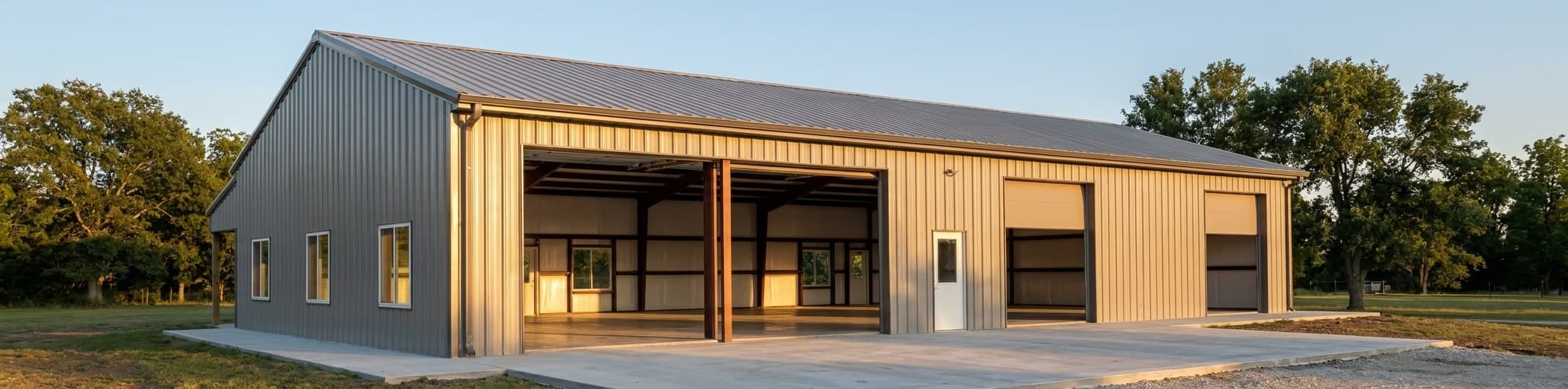

A 30×40 metal building with living quarters delivers 1,200 to 2,400 square feet of adaptable space that functions as a residence, workshop, or hybrid live-work facility without interior support columns. Steel's durability, lower maintenance costs, and structural flexibility make it a more cost-effective choice than wood-frame construction over the building's 30-50 year lifespan.
What Is a 30×40 Metal Building With Living Quarters and Why It Works
Steel framing eliminates interior columns, letting you configure 1,200 to 2,400 square feet however you need for living and working without structural compromise.
The Core Concept: 1,200 to 2,400 Square Feet of Flexible Space
A single-story 30×40 metal building delivers 1,200 square feet of clear-span floor space.[2] Add a second story — a full floor, a loft, or a mezzanine — and usable area can reach 2,400 square feet without expanding the footprint at all.[3] Steel framing eliminates interior load-bearing columns, so you decide where every wall goes and how space gets divided between living and working areas.[1] That structural freedom is what makes a 30×40 metal building with living quarters so adaptable: the same exterior shell that houses a two-car garage can equally contain a two-bedroom apartment, a full shop house, or a barn-style residence with up to four bedrooms, depending entirely on how you configure the interior.[1] Explore 30×40 metal building home floor plans to see how that square footage range translates into real, livable layouts before you commit to a design.
Why Metal Construction Beats Traditional Framing for Live-Work Spaces
For a building that has to function as a workshop on Monday and a home every night, structural integrity isn't optional — it's the whole point. Steel doesn't rot, warp, shrink, or attract insects, which means the door frames you hang today will still align in 20 years.[5] Wood-frame live-work buildings don't hold that promise: wood members naturally dry out over time, causing shrinking, swelling, and cracking that compromises both seals and load paths — and wherever moisture sits near the base, decay follows.[4] A pre-engineered steel building is commonly expected to perform for 30 to 50 years or more with minimal structural maintenance, compared to a 15-to-20-year economic life for a comparable wood structure before major repairs or replacements become unavoidable.[4] That gap matters most in a live-work building, where envelope failure affects both your equipment and your family.
Clear-span framing is the second reason steel wins for mixed-use layouts. Wood trusses require interior posts and beams to carry roof loads across wide spans, which carves up the floor plan before you've placed a single wall.[4] Steel's rigid-frame system carries those loads from the exterior walls only, leaving every square foot of your 1,200-square-foot footprint free for you to configure — shop on one side, living quarters on the other, or any split you need.[5] When you want to reconfigure later, you're moving partition walls, not structural columns. For a deeper look at how that structural logic plays out across load paths and fire ratings, steel frame structure vs. wood frame comparisons break down exactly what changes at the framing level.
The long-term financial case closes the argument. Wood buildings typically require repainting every three years and ongoing treatment against rodents, mold, and rot — costs that compound quietly over a decade.[4] Steel is non-combustible, which directly reduces insurance premiums for the life of the building, a savings most buyers don't factor into their initial comparison.[4] Pre-engineered components also arrive fabricated to exact dimensions, so assembly requires less labor, generates virtually no on-site waste, and cuts total construction time compared to stick-framing a comparable footprint.[5] When you add lower maintenance, lower insurance, and a longer service life into the math, steel's slightly higher upfront kit cost becomes the more cost-effective choice well before the first decade is out.[4]
Common Use Cases: Residential, Agricultural, Commercial, and Mixed-Purpose Buildings
The same 30×40 shell adapts to four fundamentally different owner situations — what changes is the interior partition plan, not the steel frame.
On the residential side, buyers use the footprint as a full-time barndominium, a garage apartment that generates rental income, or a guest house that keeps extended family on-property without sharing a primary home.[6] Agricultural owners typically run a split layout: equipment storage, feed space, or small livestock housing on the ground level with a caretaker's or weekend-use living area alongside it — a configuration that keeps the person managing the operation physically close to what needs managing.[6] Commercial use cases skew toward trades businesses — auto detailers, welders, landscapers — who want a functional workshop on one side and an attached residence or overnight quarters on the other, combining workplace and housing costs into a single mortgage.[7] Mixed-purpose shop houses pull all three functions together: workspace, storage, and finished living quarters under one roof, which makes the 1,200-square-foot footprint produce more utility per dollar than any single-purpose building at the same size.[6] If your situation leans agricultural, steel frame farm building systems cover how to plan an expandable layout from the start so adding bays later doesn't require structural rework.
Layout Options: Single-Story vs. Two-Story Configurations
Two-story layouts reduce your cost per square foot by requiring less foundation and roofing, while single-story designs offer simpler accessibility and horizontal live-work separation.
Layout Comparison: Single-Story vs. Two-Story Floor Plans (Cost, Functionality, Zoning Impact)The choice between a single-story and two-story layout in a 30×40 metal building with living quarters isn't just a design preference — it directly changes your construction cost, how the space functions day-to-day, and which zoning categories your building falls into. Understanding those three variables before you order steel saves you from redesigning mid-project.
| Factor | Single-story (1,200 sq ft) | Two-story / loft (up to 2,400 sq ft) |
|---|---|---|
| Footprint | Full 30×40 used on one level | Same 30×40 footprint; second floor stacked above |
| Foundation cost | Full 1,200 sq ft slab required | Slab covers first floor only — roughly half the poured area |
| Roof cost | Full 1,200 sq ft roof | Roof covers first floor only; floor deck replaces it above |
| Cost per sq ft (structural elements) | Higher — foundation and roof span the entire sq footage | Lower — two-story layouts reduce foundation and roofing costs per sq ft |
| Accessibility | All living areas on one level; no stairs | Stairs required; less suitable for aging-in-place or mobility needs |
| Live-work separation | Horizontal split — shop one side, living the other | Vertical split — workspace below, living quarters above |
| Zoning risk | Typically classified residential or agricultural | Taller structure may trigger height limits or commercial zoning review |
On cost, the two-story configuration has a structural math advantage: because the second floor sits directly above the first, your concrete slab and roof system only need to cover the first-floor footprint.[9] A one-story layout with equivalent total square footage requires full foundation and roofing across every square foot, which is why two-story designs consistently come in at a lower cost per square foot for the structural shell alone.[9] For a complete turnkey metal building home, finished construction runs $100 to $180 per square foot depending on region and finish level — a 1,200 sq ft single-story and a two-story with the same footprint both sit within that range, but the two-story delivers more livable area without expanding your slab.[10] You can explore how those square footage trade-offs play out in practice through metal building home layouts that compare open ranch plans against two-story configurations side by side.
Functionality and zoning pull in opposite directions depending on your use case. Single-story layouts keep the entire living area accessible without stairs — a real advantage if you're planning for long-term occupancy, accommodating older family members, or combining the space with agricultural use where you need quick ground-level access at any hour.[10] Two-story designs earn their keep when you need strict separation between a functioning workspace below and a finished residence above, since noise, dust, and equipment activity stay on the lower level without competing for the same corridor.[10] On the zoning side, taller buildings can cross height thresholds that trigger different permit categories or setback requirements, particularly in suburban or semi-rural counties where residential zones cap structure height at 25 to 35 feet — worth confirming with your local planning department before locking in a roof pitch and wall height.[10]
The Side-Car Layout: Living Quarters Along One Wall, Workspace on the Other
The side-car layout places living quarters along one long wall of the 30×40 footprint, with workspace occupying the opposite side and a single interior partition separating the two zones at ground level.[11] A metal building configured side-by-side this way supports one to multiple bedrooms — the exact count depends on how you allocate the 1,200 square feet between residential and working areas — while allowing the shop side to run full height from floor to roof ridge without a ceiling drop cutting into usable clearance.[11] That uncompromised shop height is the layout's core advantage over a vertical split: stacking living quarters above the workspace introduces a structural floor deck and a fixed ceiling height on the lower level, whereas a horizontal side-car split keeps both zones at grade under a shared roof, so neither area borrows headroom or structure from the other.[11] For owners whose priority is protected vehicle storage alongside a residence rather than a dedicated working shop, the same horizontal split accommodates that use just as cleanly — one side holds vehicles, the other holds finished living space, all within the same exterior shell.[12] If you're weighing how many bedrooms realistically fit against a functional workspace footprint in your specific situation, the 30×40 metal building with living quarters full guide maps those trade-offs against real floor plan examples before you commit to a partition plan.
The Vertical Split: Two-Story Design With Residential Upstairs, Functional Space Below
The vertical split stacks living quarters directly above the workspace, and wall height determines whether both zones remain functional. A 30x40x18 configuration — 18-foot eave height — provides enough clearance to run a ground-floor garage or workshop at full operational height, complete with a large overhead door suited to RV storage or heavy vehicle maintenance, while still supporting a complete residential level above.[13] Upper-level layouts in two-story metal buildings routinely accommodate three bedrooms plus full living space within the same 30×40 footprint, pushing total usable area toward 2,400 sq ft without any change to the foundation or exterior shell.[13] Adding a mezzanine or full second story is precisely how owners double their livable square footage without expanding their slab — a structural move that makes the footprint work significantly harder than any single-level plan at equivalent size.[15] For a realistic read on what finished metal building home costs per square foot look like once you add that upper residential level, pricing varies meaningfully between shell-only and turnkey-finished outcomes.
The practical separation between zones is what distinguishes the vertical split from every horizontal alternative. Shop traffic, noise, and equipment activity stay on the ground floor with a dedicated entry point, while the residence operates independently above — a divide that a shared interior partition wall simply cannot replicate with the same physical isolation.[14] You can further customize the kit — roof pitch, insulation type, door and window specifications — to optimize each zone on its own terms, such as specifying spray foam or insulated metal panels on the residential floor while selecting a different insulation system for the shop environment below.[13] That ability to configure the shell to separate functional requirements, rather than compromising one zone to accommodate the other, is the vertical split's core argument for owners who need both a working facility and a finished residence performing at full capacity every day.[14]
Actual Costs: What You'll Pay for a 30×40 Metal Building With Living Quarters
Your 30×40 metal building shell costs $12,000 to $18,000, but foundation, labor, and interior finishes typically represent the larger budget share.
Metal Building Shell Cost: $12,000 to $18,000 (Price Per Square Foot Breakdown)
The shell price is what arrives on your flatbed: primary framing (columns and rafters), secondary framing (purlins and girts), and the roof and wall steel panels that close the exterior.[17] For a 30×40 footprint, a standard commercial-grade kit runs $10 to $20 per square foot — roughly $12,000 to $18,000 depending on steel specification and configuration.[16] Customization moves you through that range quickly: non-standard roof pitches, heavier steel gauges, or additional framed openings can add 20% to 50% over the base kit price, and freight charges add another $500 to $2,500 depending on your distance from the fabricator.[16] The kit price does not cover foundation, erection labor, insulation, doors, windows, or any interior finish work — those items represent the larger share of your total project budget, so treating the shell quote as your all-in cost will leave you significantly short.[17] For a complete line-item breakdown of what falls inside and outside a standard 30×40 kit quote, Kit Price Reality: What a 30×40 Metal Package Doesn't Include maps every cost clearly before you commit.
The table below shows how those cost layers stack against each other so you can build an accurate budget from the start:
| Cost component | Included in shell kit | Typical range |
|---|---|---|
| Primary framing (columns, rafters) | Yes | Core of $12,000-$18,000 |
| Secondary framing (purlins, girts) | Yes | Included in kit |
| Roof and wall panels | Yes | Included in kit |
| Framed openings (doors/windows) | Rough openings only | Custom specs add 20-50% to kit base[16] |
| Delivery/freight | No | $500-$2,500[16] |
| Erection labor | No | $5,000-$15,000[16] |
| Concrete slab | No | $8,500-$13,500[17] |
Steel gauge is the single biggest lever inside the $12,000-$18,000 window.[16] A heavier gauge increases both the framing weight and the per-square-foot cost of wall and roof panels, but it also raises wind and snow load capacity — which matters directly if your county enforces strict IBC standards for those loads.[17] Buyers in northern climates or high-wind zones frequently find their engineered spec pushes kit pricing 10% to 15% above the base range before a single accessory is added.[17] Metal building prices also track steel commodity markets, so locking in a quote quickly after finalizing your configuration protects you from mid-project price shifts on a globally traded material.[18]
Living Quarters Interior Finish: Materials, Labor, and Customization Costs
The interior finish is where most of your project budget actually concentrates — the steel shell is the starting point, not the finished product. Framing and drywall for the living quarters zone runs $8 to $18 per square foot installed.[20] Insulation choice is the next major variable: fiberglass batt installs at $0.70 to $2.50 per square foot, spray foam steps up to $2.50 to $4.50 per square foot with meaningfully better thermal and vapor performance, and structural insulated panels (SIPs) reach $5 to $10 per square foot for maximum efficiency.[20] For a 30×40 metal building with living quarters, allocating the higher-performance systems specifically to the residential zone — spray foam or SIPs rather than fiberglass — eliminates the thermal bridging inherent to metal-frame construction and keeps HVAC loads manageable year-round. You can see how insulation type shifts total assembly performance in detail through steel building insulation R-value and vapor barrier guidance before committing to a spec.
| Interior component | Installed cost per sq ft | Notes |
|---|---|---|
| Framing and drywall | $8-$18 | Partition walls, ceilings, basic finish work |
| Fiberglass insulation | $0.70-$2.50 | Standard thermal performance |
| Spray foam insulation | $2.50-$4.50 | Superior thermal barrier; also air-seals the envelope |
| SIP panels | $5-$10 | Maximum efficiency; significantly reduces HVAC sizing |
| Accessories and customization | +15-20% of kit cost | Windows, walk-in doors, skylights, electrical add-ons |
Labor splits into two distinct phases with separate cost buckets. Shell erection runs $5 to $10 per square foot for the frame assembly alone.[20] Interior finishing labor — drywall hanging and finishing, insulation installation, trim work — compounds on top of each material line item as a separate trade cost. Plumbing rough-ins add $2 to $6 per square foot, and electrical rough-ins run a similar range.[20] Customization items like upgraded windows, skylights, and walk-in doors typically add another 15 to 20 percent on top of the base kit price.[19] A turnkey-finished building, covering the kit, delivery, erection, and a functional enclosed shell, runs $24 to $43 per square foot — but residential interior finishing sits outside that figure and represents the larger share of your living quarters budget once drywall, mechanical systems, flooring, and trim are included.[21] Buyers who treat the shell quote as their all-in number consistently run short; the living quarters finish work routinely exceeds the steel kit cost when all interior trades are totaled.
Foundation and Site Preparation: Why a Concrete Slab Matters to Your Total Budget
The concrete slab is the second-largest single cost item in a 30×40 metal building with living quarters — and the one most buyers discover only after signing the kit agreement. A standard 30×40 slab runs $9 to $11 per square foot in typical mid-market conditions, putting the total between $10,800 and $13,200 depending on thickness, reinforcement, and soil conditions.[24] National averages reflect a wider band, with garage-grade slabs ranging $6 to $12 per square foot installed before site-specific adjustments are factored in.[23] Either way, the slab alone can equal or exceed the cost of the steel kit — which means it needs to be in your budget from the first planning conversation, not treated as a line item you price out after the frame ships.
For a building that combines living quarters with a functional workspace, the standard 4-inch slab isn't the right spec. A 6-inch slab with 3,500 PSI concrete and #4 rebar on an 18-inch grid handles vehicle loads, heavy equipment, and the daily foot traffic of a working shop without the cracking and deflection that a thinner pour risks under combined live-work conditions.[24] A 4-inch slab is workable for light storage, but for garages and workshops — especially where the slab also supports a residential zone — the 6-inch reinforced spec is the standard recommendation.[22] The cost difference is roughly $1.15 per square foot, about $1,380 on a 1,200 sq ft footprint, which is far less than slab repair or replacement after the frame is already standing.[24] For a full line-item view of how thickness and reinforcement choices shift your actual number, 30×40 concrete slab cost breakdown maps those decisions clearly before you commit to a spec.
Site conditions determine where your slab cost actually lands within the range. A flat, well-drained lot with stable soil hits the baseline estimate; a sloped site requiring grading, expansive clay soil, or a high water table pushes costs above it.[24] Clay soil — present across large portions of the South, Midwest, and parts of the West — swells when wet and shrinks when dry, creating a seasonal movement cycle that cracks shallow footings over time.[24] On clay, the perimeter beam needs to go 24 inches deep rather than the standard 12 inches to resist that movement — a spec change that adds modest cost upfront and prevents foundation repair bills later.[24] Beyond soil type, three preparation mistakes consistently surface after installation and cost owners significantly more to fix than they would have cost to prevent:
- Pouring before confirming exact frame dimensions from the manufacturer — even a half-inch misalignment creates anchor bolt problems that require costly corrections after the fact.[24]
- Skipping the vapor barrier — without 6-mil or 10-mil polyethylene sheeting under the slab, ground moisture wicks upward through the concrete, accelerating rust on equipment and compromising living quarters finishes over time.[24]
- Making the slab larger than the building footprint — excess concrete at the edges collects water against the perimeter beam, accelerating soil movement and undermining the foundation.[24]
The slab also controls your erection timeline in a way that can't be compressed. Concrete requires a minimum of 5 to 7 days of cure time before the steel frame can be installed, with cold weather extending that window further.[24] The actual pour takes a single day for a typical residential-scale slab, but from site prep through a fully cured foundation ready for building installation, plan on roughly two weeks total.[24] Scheduling your pour at least two weeks before your target erection date keeps the project on track — rushing that cure window risks cracking the slab and compromising anchor connections, which costs far more time than the days saved.[24]
Key Decisions Before You Order: Permits, Utilities, and Customization
Confirm your parcel's zoning classification with the county planning office before finalizing your floor plan to avoid months-long variance delays.
Zoning and Permits: What Residential + Commercial Hybrid Buildings Require
A 30×40 metal building with living quarters doesn't fit neatly into a single regulatory box, and that ambiguity is where projects stall. Zoning permits confirm the land is approved for the intended use — residential, agricultural, or mixed-use — and verify the structure complies with setback distances, height limits, and land-use designations tied to that specific parcel.[25] A building that combines a functional workspace with finished living quarters may satisfy residential zoning on its face while simultaneously triggering a commercial or industrial use review, depending on the business activity inside.[26] Local zoning ordinances and building codes are non-negotiable: failure to comply can result in significant fines, project delays, or a requirement to demolish non-compliant portions of the structure.[27] Confirming your parcel's classification with the county planning office before finalizing your floor plan — not after the steel ships — is the single step that prevents a months-long variance process from derailing an otherwise straightforward build.
The permit stack for a hybrid metal building is longer than most owners expect, and each permit runs on its own timeline. A building permit requires submitted plans and inspections at the foundation, framing, and final construction stages.[25] Separate electrical and plumbing permits apply the moment you add wiring, panels, or water supply lines — both require licensed trades and their own inspection schedules.[25] If the property isn't connected to municipal sewer, a septic permit adds a percolation test and design approval before any groundwork begins.[25] HVAC systems carry their own permit in most jurisdictions.[25] Every one of those approvals needs to be in motion well before erection day — not after the frame is standing and rough-in inspections are already behind schedule. For a broader view of how permit timelines vary by state and building type, the warehouse addition permits state-by-state roadmap maps the approval process across jurisdictions before you commit to a construction schedule.
Some jurisdictions impose additional scrutiny on metal-frame residential construction simply because it falls outside what local plan reviewers encounter regularly.[25] Steel buildings can face requirements for extra permits or face outright restrictions in areas where zoning hasn't been updated to reflect hybrid live-work structures as a recognized use category.[25] The practical fix is early engagement: contact your local building department during the design phase — before you lock in wall heights, door placements, or the residential-to-workspace partition plan — and ask specifically whether your intended use requires a zoning variance or a conditional-use permit in addition to the standard building permit stack.[27] Skipping that conversation is the most common source of mid-project redesigns on hybrid builds, and redesigning after steel is fabricated to exact dimensions is far more expensive than a preliminary call ever will be.[27]
Electrical, HVAC, and Plumbing Routing in a Metal Building With Living Quarters
Plumbing in a steel shell carries three risks that wood-frame construction largely avoids: freezing, noise, and galvanic corrosion. Metal conducts temperature far faster than wood, so supply lines routed near exterior walls or in contact with steel framing are significantly more vulnerable to freezing in cold climates.[28] Route all water supply lines on interior walls wherever possible, and specify PEX piping — it resists freeze-expansion bursting and flexes through tight spaces more easily than copper or rigid PVC.[28] Where pipes must pass through or near steel framing, isolate them with rubber grommets or nylon spacers; direct metal-on-metal contact creates galvanic corrosion, an electrochemical reaction where dissimilar metals in contact cause one to deteriorate prematurely.[28] At hot water heater connections where copper and steel must meet, dielectric unions break that galvanic circuit and prevent early pipe failure.[28] The most consequential plumbing decision on a slab-foundation build is sequencing: all under-slab supply and drain lines must be fully installed, inspected, and backfilled before the concrete pour — corrections after the slab is poured mean jackhammering finished work.[28] Noise is the issue most owners don't anticipate: metal shells reflect sound rather than absorbing it, so water hammer, flushing, and pipe vibration register noticeably louder than in conventional construction.[28] Rubber pipe isolators at every framing contact point, cushioned clamps on long horizontal runs, and sound-dampening mineral wool batts around noisy wall and ceiling runs address both the direct transmission path and the airborne component.[28]
Air infiltration — not wall or window losses — is the dominant heat load variable in a metal building with living quarters, and the numbers bear that out. In documented high-performance barndominium projects, infiltration has accounted for nearly 44% of total heating load, outpacing every other loss category combined.[29] That figure drops sharply with disciplined envelope air sealing: the same project type achieved 0.99 ACH50 in the living quarters, reducing HVAC sizing requirements well below initial heat loss projections.[29] For mixed-use builds where a shop occupies the lower level and residence the upper, the two zones carry fundamentally different load profiles — the living quarters need conditioning year-round while the workspace may only need heat maintenance — and serving both from a single system produces oversized equipment that short-cycles and underperforms in each zone.[29] Balanced mechanical ventilation through an ERV maintains indoor air quality without compromising the envelope performance your insulation investment creates; exhaust should pull from bathrooms, laundry, and the kitchen while fresh air feeds into the return side of the forced-air duct system.[29] In the shop or garage zone, where wet vehicles and tools introduce moisture that air exchange alone can't manage efficiently at large volumes, a standalone dehumidifier is the more practical humidity control strategy.[29] For owners targeting meaningful energy cost reductions, the interaction between envelope tightness, HVAC sizing, and insulation spec is covered in depth through energy-efficient metal building design guidance before you finalize mechanical system sizing.
The electrical load profile of a 30×40 metal building with living quarters is wider than a standard residence because it must carry both residential circuits and shop or HVAC equipment simultaneously. In documented live-work builds, heat pump systems alone draw 36 amps at 240 volts — approximately 8.6 kWh — while a full lighting package for both living and storage areas draws a comparable 50 amps at 120 volts.[29] Size your panel and service entrance for the combined maximum load of all HVAC equipment, lighting, and shop circuits operating concurrently, not for residential demand alone — undersized service is one of the most common and expensive post-construction corrections on hybrid builds.[29] Lighting controls that allow zone-by-zone scheduling and remote operation are a practical addition in a live-work building where residential and workspace zones run on different schedules; with lighting representing a significant share of total energy draw, the ability to manage each zone independently keeps operating costs in check over the life of the building.[29]
Custom Engineering for Your Specific Layout: Why One-Size-Fits-All Doesn't Work
Pre-engineered metal building manufacturers produce stamped engineering drawings as part of their building package — drawings completed by a licensed structural engineer and tailored to your specific dimensions, local load requirements, and foundation design.[30] Those drawings must carry an engineer's seal registered in your state.[30] Some lower-cost package providers ship generic drawings that still need state engineering review after delivery, adding cost and weeks to your permit timeline after you've already committed to a supplier.[30] For custom metal buildings — layouts where the interior partition plan, wall heights, and door placements deviate from stock configurations — the engineering process is more involved because the entire structural system is designed from scratch, which takes longer but produces drawings matched precisely to your project rather than adapted from a template.[30]
The load values written into those drawings are where a generic package breaks against site-specific reality. Metal buildings must be engineered to handle the design wind speeds and ground snow loads for your specific location, values established by ASCE 7 and incorporated into local building codes.[30] A building engineered for lower loads than your site actually experiences is a structural problem — not a paperwork issue.[30] High-snow-load areas in mountain communities sometimes require significantly heavier framing and closer rafter spacing than any standard package includes, a difference that directly affects cost and that reputable manufacturers build into the quote when they use your actual location data.[30] Elevation compounds the gap: a building permitted for a valley property and one permitted at 6,000 feet in the same county will carry meaningfully different structural specs even when the footprint is identical.[30] For a deeper look at how structural steel components interact with these load path requirements, structural steel components and infrastructure performance covers how framing choices downstream of the engineering spec affect long-term performance.
Occupancy classification is the engineering variable most live-work owners underestimate. How your building will be used determines which code requirements apply — a storage-only shop carries different structural and fire-separation requirements than a building with finished residential quarters — and misclassifying your occupancy early means discovering the error during plan review, when corrections require full engineering revisions rather than a conversation before fabrication begins.[30] All structures must be engineered to satisfy local jurisdiction building codes and load requirements, and while reputable manufacturers will not fabricate or ship a building that fails to meet local codes, the responsibility for specifying the correct loading requirements and the applicable code edition ultimately falls on you as the owner.[31] The safest sequence is to confirm your occupancy classification and local load values with your county building department during the design phase — before you lock in wall heights or partition placement — so the engineering drawings your manufacturer produces reflect your actual regulatory environment on the first submission rather than requiring a paid revision cycle after plan review flags a mismatch.[30]
- A 30×40 metal building delivers 1,200 sq ft single-story or up to 2,400 sq ft with a second floor, all within the same footprint.
- Steel framing eliminates interior load-bearing columns, allowing you to configure space freely between workspace and living quarters.
- Steel buildings last 30-50 years with minimal maintenance, compared to 15-20 years for wood structures before major repairs.
- Two-story layouts reduce foundation and roofing costs per square foot despite delivering more usable area than single-story designs.
- Shell kits run $12,000-$18,000, but interior finishing, concrete slab, and labor typically exceed the steel kit cost combined.
- Confirm zoning classification and occupancy requirements with your county before finalizing floor plans to avoid costly mid-project redesigns.
- Air infiltration accounts for 44% of heating load in metal buildings–envelope air sealing and proper insulation selection are critical.
- https://www.buildingsguide.com/metal-building-kits/residential/?srsltid=AfmBOorHe47PwBgg8fSHfEOWtTjy29VBnsFuF7N7GGJ9cFAI1jsQ1sfJ
- https://www.coast-to-coastcarports.com/how-much-does-a-30×40-metal-building-cost?srsltid=AfmBOooSXIyTNseF62zA-I6oVv2UnGxs_LBAeCO7Tx8-qXAPFog_vCaP
- https://alansfactoryoutlet.com/blog/metal-garage-with-living-quarters/?srsltid=AfmBOopVsltLNP9B5uw3mpYZMqo-KgCKCRF-xMW8KXKzsR4yrGOVk7jA
- https://norsteelbuildings.com/steel-building-basics/steel-vs-wood/
- https://www.rigidbuilding.com/why-metal-buildings/
- https://alansfactoryoutlet.com/blog/metal-garage-with-living-quarters/?srsltid=AfmBOopm_U1KbCdz74leY1l4npkkWhvKeL1_OymJeSEur_UMw00i5xZh
- https://www.coast-to-coastcarports.com/30×40-metal-building?srsltid=AfmBOop6K5gMonBEyBEUbsyAuGjzIyH5WFb3fV0M2_3UQQk9djFZjVom
- https://www.buildingsguide.com/metal-building-prices/?srsltid=AfmBOooW5OfB71S_yGCzfVBij5-Yegnc8q37aFYESZTlO7_oV-4WA9cY
- https://www.turnerandsonhomes.com/blog/cost-to-build-is-a-2-story-house-plan-less-expensive
- https://metalbuildingshop.com/metal-building-homes/
- https://www.buildingsguide.com/metal-building-kits/residential/shop-living-quarters/?srsltid=AfmBOoq4nXUY73fuVs9C1FxRiHfuT155CqzAc8sySscpn1SIsBBsI2Pu
- https://garagebuildings.com/30-x-40-metal-garages-customizing-to-fit-your-needs
- https://www.buildingsguide.com/products/shop-houses/30x40x18-shop-living-quarters/?srsltid=AfmBOooPhicFyEJUOAGnoBQdn1fq491qaz_aWq6DYPuluEo8ucjUDCFF
- https://www.buildingsguide.com/metal-building-kits/residential/shop-living-quarters/?srsltid=AfmBOopuEVZM4VJE7L2dd9MkF22TebYGolNAeBWHPHKI8A6CC9vP6kcN
- https://www.smallbarndo.com/30×40-metal-building-layouts-shops-tiny-homes/
- https://www.uspatriotsteel.com/blog/how-much-does-a-30×40-metal-building-cost/
- https://www.steelcobuildings.com/how-much-does-a-30×40-steel-building-cost-in-2026/
- https://www.buildingsguide.com/metal-building-prices/?srsltid=AfmBOoq7aH-Nw8225bMxyXJyLKyLsjdVoX_CcxIFoRsxnFkmVFjidBZz
- https://www.probuiltsteel.com/blog/30×40-metal-building-cost/?srsltid=AfmBOooecX_NT6XrMiDsncoXWSzyHcbUS3RbptMprCV1ahmvnC_SYOkv
- https://www.cascadingfallsinc.com/what-do-prefab-metal-building-cost-to-construct
- https://www.engineeredmetalbuildings.com/blog/30×40-metal-building-prices/?srsltid=AfmBOopxYAZE_doFt6EtoDdR5slg4SgbdA-CnTN_6YAU4OslhNplrBlX
- https://www.probuiltsteel.com/blog/30×40-metal-building-cost/?srsltid=AfmBOoqh5CngqQUNITvAcoS9yczij2PSJq6AV7K-tIebfvJIg0BJAME5
- https://www.engineeredmetalbuildings.com/blog/30×40-metal-building-prices/?srsltid=AfmBOoo_GAFWYQRKRi2Cge7M58UyyjFprAQ_dxCn47gSSE8EjSJ4eLMh
- https://www.northtexassheds.com/concrete-foundation-steel-building-guide
- https://prestigesteelstructures.com/which-permits-are-required-to-build-a-barndominium/?srsltid=AfmBOoq1LvcMUNG7v4U2T58jpBbfxyvS-xv-U3PwSrL2r36ynVX3Z2NP
- https://roimetalbuildings.com/zoning-regulations-for-industrial-buildings/
- https://nordicsteel.construction/designing-a-steel-building-what-you-need-to-know-before-you-build/
- https://alldraft.com/barndominium-plumbing-challenges-running-pipes-in-a-metal-building/
- https://www.northernbuilt.pro/barndominium-mechanical-electrical-plumbing-and-final-blower-door-numbers/
- https://www.steelstructuresamerica.com/metal-building-permits-codes-and-engineering-requirements-what-you-need-to-know/
- https://www.buildingsguide.com/build/metal-building-codes-permits/?srsltid=AfmBOooBK0PXt9SYsFVuc76mW-hD-xjg6EOrRG6DPKvXTxlvgkSA319S