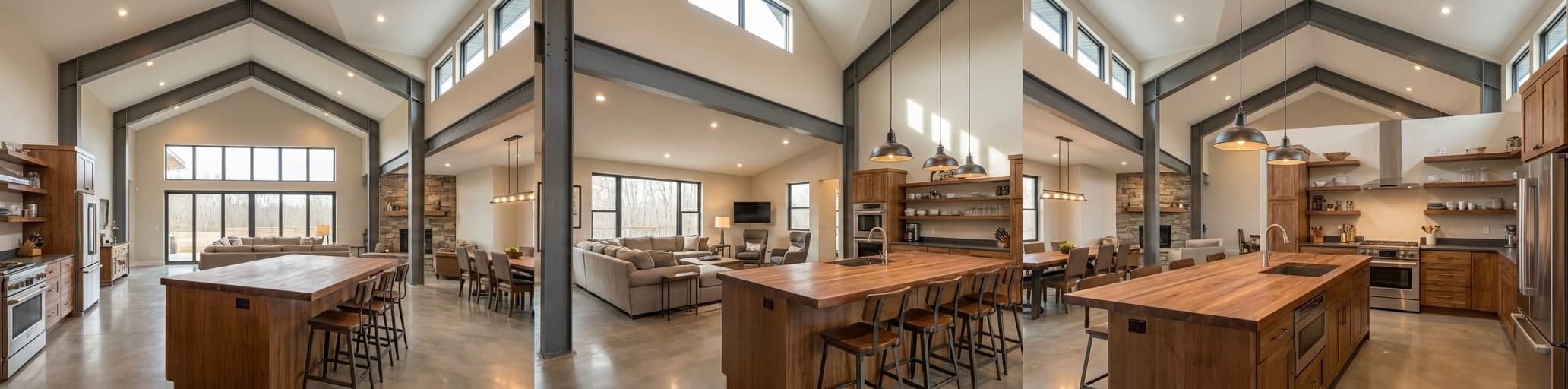

We help you understand why a 30×40 barndominium delivers 1,200 square feet of flexible living space at competitive costs, typically between $112,800 and $540,000. Steel construction gives you 40 to 60 year durability with 35 to 50% lower maintenance costs than wood-frame homes.
Why 30×40 Is the Perfect Barndominium Size for Modern Living
A 30×40 barndominium delivers 1,200 square feet of clear-span living space for $230,000 on average, positioning it below comparable traditional home costs.
1,200 Square Feet: The Ideal Balance Between Space and Cost
A 30×40 metal building with living quarters delivers exactly 1,200 square feet–the upper ceiling of what industry data identifies as the small barndominium category, which spans 600 to 1,200 SF.[1] At that footprint, total build costs typically fall between $112,800 and $540,000 depending on finish level and location, with the national average landing around $230,000.[2] That positions a fully finished 30×40 barndominium at or below the $138,937 to $531,294 range for a comparable traditional home.[1] The per-square-foot math sharpens the picture further: a turnkey build runs $150 to $190 per square foot, while a hybrid approach–where you take on finish work yourself–can bring costs down to $85 to $95 per square foot.[2] For buyers weighing space against budget, 1,200 square feet comfortably accommodates two to three bedrooms, an open living area, and a flex space without the cost creep that follows larger footprints.
Clear-Span Advantage: Why Metal Construction Beats Traditional Framing for Living Quarters
Pre-engineered steel buildings are clear-span by design, which means no interior columns or posts interrupt the full 1,200 square feet of a 30×40 footprint.[6] Steel framing handles roof loads without any interior structural support, delivering 100% usable floor space and opening up design possibilities that are either expensive or outright impossible with wood.[5] With steel capable of spanning up to 200 feet without load-bearing walls, every partition in your living quarters goes exactly where your floor plan requires it–not where the structure demands it.[4] Conventional stick-built homes lock in the layout the moment framing is complete, because moving a load-bearing wall later means costly structural surgery.
Steel removes that constraint before construction even begins.
Once the frame is up, interior walls can be finished with standard drywall for a traditional residential look, or left with exposed steel beams for a modern aesthetic–either approach works without any structural compromise.[4]
Durability and Low Maintenance: The Hidden Cost Savings of Steel Over 20+ Years
The numbers here are stark. Annual maintenance costs for metal buildings average just $0.25 to $0.45 per square foot, compared to $1.10 to $1.80 for wood-framed equivalents–a gap that compounds every year you own the building.[9] Wood siding and roofing typically require replacement after just 7 to 10 years, and wooden structures carry an economic life of only 15 to 20 years before major structural components need attention.[8] Steel-framed buildings, by contrast, consistently achieve 40 to 60 year service lives with basic upkeep, outlasting wood by 15 to 35 years.[9] For a 30×40 metal building with living quarters, that longevity difference is the difference between one building that serves your family for generations and another that drains your budget on repairs before you've paid off the note.
Three specific failure modes drive most of the long-term cost difference. First, steel eliminates rot and termite damage entirely–problems that cost wood-structure owners roughly $5,200 in repairs every 5 to 7 years.[9] Second, steel is non-combustible, which translates directly to lower insurance premiums: fire-resistant steel construction typically reduces insurance costs by 18 to 25%.[9] Third, wood requires repainting every three years when exposed to temperature swings, humidity, and UV radiation, while properly specified steel coatings extend that interval to once every 20 to 25 years.[8][9] Taken together, maintenance costs for steel buildings run 35 to 50% lower than wood structures over a 30-year period.[9]
Ownership economics also show up at resale. Commercial and residential metal buildings hold 17 to 23% more resale value than wood-frame equivalents after 25 years, partly because appraisers increasingly factor in documented structural integrity and predictable maintenance costs.[9] Insurance companies apply the same logic, charging 12 to 15% less annually for metal structures due to fewer weather-related claims.[9] For a barndominium owner, that combination–lower annual upkeep, reduced insurance, and stronger resale–means the total cost of ownership over 50 years runs 40 to 60% below what a comparable wood-frame structure would cost to carry. Getting metal building HVAC and utilities roughed in correctly at the start of construction locks in one more layer of those long-term savings by preventing the costly retrofits that plague buildings where mechanical systems were treated as an afterthought.
Real-World 30×40 Barndominium Layouts: 2-Bedroom, 3-Bedroom, and Shop-Home Hybrids
Smart 30×40 layouts eliminate hallways entirely, redirecting every wasted foot into your living area, kitchen, and flex spaces without compression.
The Efficient 2-Bedroom Layout: Living, Kitchen, and Flex Space in 1,200 SF
The most popular configuration for a 30×40 barndominium puts two bedrooms and two full baths inside 1,200 square feet, with the remaining area devoted to an open living-kitchen-dining zone and at least one flex space.[10] The design principle driving most of these plans is the deliberate elimination of hallways–every linear foot of corridor is square footage that serves no functional purpose, so redirecting it into the main living area is how a well-executed plan fits a full kitchen run, a dining area, and a living room without compression.[10] A kitchen island does double duty as a prep surface and casual seating bar, positioned to overlook the living room and keep the cook connected to the rest of the household.[11] Bedrooms placed at opposite ends of the footprint–rather than clustered side by side–deliver acoustic separation without thick walls or wasted corridors, and the primary suite typically anchors one end with a walk-in closet, dual sinks, and a dedicated bath.[12] Vaulted or cathedral ceilings amplify the open-plan core further, drawing the eye upward so the space reads larger than its measured square footage.[12] The flex allocation–usually a utility room, mudroom, or pantry alcove–absorbs the practical functions that otherwise clutter living areas, keeping the main zone genuinely open for daily life.[10] For buyers considering 30×40 metal building home floor plans, this two-bedroom arrangement is the baseline most projects start from, and NSB's engineering team can reposition bedroom walls, adjust ceiling height, and shift partition layouts to match your local code requirements before fabrication begins.
The Family-Focused 3-Bedroom Option: Where Open Concept Meets Functional Separation
Three bedrooms can comfortably fit within a 30×40 footprint when the floor plan is engineered for maximum efficiency–not just minimum square footage.[14] The key constraint is hallway length: unnecessary corridor space must be minimized so the living area retains enough room to breathe.[14] In practice, the best 3-bedroom layouts route household traffic through the open kitchen-dining-living core rather than through dedicated passages, so the main living area doubles as the circulation path between sleeping zones.[14] Open-concept kitchen, dining, and living spaces are the structural solution to that challenge–they provide the square footage that three modest bedrooms would otherwise consume.[14] Three-bedroom barndominium plans are also among the most flexible configurations on the market, offering families room for a primary suite, a dedicated children's room, and a third space that can function as a guest room, home office, or hobby room depending on what the household actually needs.[15] For buyers who want a more pronounced separation between sleeping and living areas than a single-story plan naturally provides, a two-story layout within the same 30×40 shell is a viable path: bedrooms occupy the upper level, away from the main living program below, and the vertical stacking delivers clear acoustic and functional separation without expanding the slab footprint.[15] The one discipline that determines whether a 3-bedroom plan succeeds in 1,200 square feet is bedroom sizing–oversized bedrooms consistently steal square footage from the kitchen, living room, bathrooms, laundry, and storage, which are the areas that make the home functional day to day.[14]
The Shouse Hybrid: Shop Space Below, Living Quarters Above or Attached
The shouse–a portmanteau of shop and house–integrates a functional workshop directly into the building envelope rather than treating it as a separate structure.[17] Within a 30×40 footprint, the layout typically runs the shop bay along one end of the slab with living quarters occupying the remaining area, or stacks living space above a full-width ground-floor workshop when lot dimensions or zoning favor vertical expansion.[16] The architectural detail that determines whether the hybrid succeeds or frustrates is the connector zone: a purpose-built mudroom or laundry room positioned between the shop and the residential interior.[17] Without that physical buffer, gasoline fumes, sawdust, and noise travel freely into the kitchen and living areas–which defeats the entire point of combining both programs under one roof.[17] Barndominium plans with attached shops and garages serve car enthusiasts, equipment operators, and hobbyists who need a climate-controlled workspace immediately adjacent to their living quarters.[16] For buyers who want complete separation between work and residential functions, the two-story configuration goes further: bedrooms and living areas occupy the upper level, away from the ground-floor shop, delivering acoustic and air-quality separation that no horizontal buffer can fully replicate.[16] NSB's engineering team works through door placement, overhead clearances for vehicles, and the structural boundary between shop and living zones at the design stage–before a single piece of steel is cut–so layout conflicts surface on paper rather than mid-build.
Cost Breakdown: What You'll Actually Pay for a 30×40 Metal Building with Living Quarters
Lock in a turnkey quote now to protect yourself from steel price increases and avoid costly coordination delays between subcontractors.
Foundation and Site Prep: Slab, Utilities, and Local Code Requirements
Steel Structure, Roofing, and Walls: The NSB Turnkey Advantage vs. DIY Assembly The steel kit for a 30×40 footprint–structural frame, roof panels, and wall panels–runs $15 to $25 per square foot for materials alone, putting the shell package between $18,000 and $30,000 for a 1,200 SF structure.[19] Certified crews add $5 to $12 per square foot for assembly on top of that figure.[19] That gap between material cost and installed cost is precisely where most DIY plans break down: a general contractor managing separate framers, roofers, and insulation crews adds 10-20% to total project costs, and coordination failures between those trades routinely trigger schedule slippage.[19] The current market makes slippage expensive–steel building quotes are only valid for 30 to 60 days, so a mid-project delay caused by subcontractor hand-offs can expose you to repricing when tariff conditions shift.[19] Section 232 tariffs have placed a 25-30% burden on imported steel from North America's major trading partners, domestic mills are running tight supply with lead times stretching into summer, and hot-rolled coil steel is priced at roughly $1,002 per ton as of 2026–a market where locking in a turnkey quote early, at $24 to $43 per square foot installed, is a straightforward hedge against mid-build cost increases.[19] Comparing barndominium contractors who operate on a turnkey model versus those who sell a shell kit and hand you a subcontractor list consistently shows lower final costs and fewer change orders when one entity controls the full sequence.
Insulation is the wall-and-roof specification most buyers defer until after the frame is up–a sequencing mistake that adds cost and undermines building performance. Fiberglass runs $1 to $3 per square foot; spray foam costs $3 to $7 per square foot; and insulated metal panels, which integrate thermal and structural performance into a single assembly, push the wall-and-roof cost to $20-$50 per square foot compared to $15-$20 for a basic shell package.[19] For a living-quarters build, the insulation specification determines whether the HVAC system sized for the space can maintain comfort through seasonal extremes, so it must be engineered into the wall and roof assembly before steel is cut–not retrofitted after erection when access is limited and labor costs are higher. The steel shell and on-site assembly together account for roughly 30% of a finished barndominium's total cost; labor and materials for interior finishing and mechanical systems make up the remaining 70%.[20] When one company engineers the frame, erects the structure through an in-house crew, and carries accountability through the finish phase, the transition between structural and interior work is a scheduled handoff rather than a gap where coordination problems compound into budget overruns.
Interior Finishing: Insulation, HVAC, Electrical, and Plumbing for Livable Space
Interior finishing is where the barndominium cost equation levels out with traditional construction. The cost of finishing a barndominium interior–electrical, plumbing, HVAC, and countertops–runs comparable to finishing a conventional home of the same size.[1] Trades price their work based on scope, not building type, so the steel shell saves money on structure and erection speed, but it does not discount the electrician, plumber, or HVAC contractor. Barndominium kits exclude insulation and all interior materials from their package price, meaning those costs land as separate budget lines that need early allocation–not afterthoughts tacked onto the tail end of a project.[1] For a 30×40 living-quarters build, the practical takeaway is to budget the mechanical and finish scope the way you'd budget a 1,200 SF conventional home, then treat the shell savings as the structural advantage they are, rather than a reason to underestimate what comes after erection.
Insulation carries particular consequence in a metal building because steel conducts heat more readily than wood framing, and thermal bridging will undermine HVAC performance if the wall and roof assembly isn't engineered before steel is ordered–not retrofitted once the frame is standing and access is limited. Getting those specifications locked in during design, rather than discovering the gap mid-build, is one of the clearest separators between a steel barndominium that performs well as a year-round residence and one that runs high utility bills from day one. The U-factor specs for metal building insulation assemblies are worth reviewing before your wall assembly is finalized.
As a cost benchmark, conventional home construction averages $126 per square foot nationally, with the full range running $100 to $200 per square foot depending on finishes and location.[1] A finished 30×40 barndominium with living quarters generally lands at or below that range when shell-cost efficiency is captured correctly–but only when the interior finishing budget is planned with the same discipline as the structural scope from the start.[1]
How to Get Your 30×40 Barndominium Built: NSB's Design-Build Process From Concept to Move-In
NSB's engineering team seals structural designs for residential loads before steel is cut, preventing the costly foundation corrections that plague kit-built barndominiums.
Step 1: Custom Engineering and Code Compliance–Why NSB Handles This From Day One
The moment a 30×40 steel building includes living space, local building departments classify it as a residential structure–and that classification triggers the full stack of residential requirements: zoning approval, structural engineering review, foundation design, energy code compliance, electrical permits, plumbing permits, mechanical permits, and final occupancy inspection before you can legally move in.[23] Most projects ordered from kit suppliers or assembled through a general contractor without in-house engineering hit expensive walls at exactly this stage.
Standard DIY building kits are almost never adequate for residential use–they're designed to meet minimum agricultural standards, which fall short of residential building codes in multiple areas.[21] That gap matters more than most buyers realize, because residential interiors introduce structural loads that agricultural designs simply don't account for: HVAC systems, drywall, cabinetry, mezzanines, and finish materials all add weight and stress that must be calculated during the engineering phase, not discovered after the frame is standing.[22] Foundation design is where the shortfall most commonly surfaces in a costly way.
A foundation sized for a farm shed may not carry the combined dead and live loads of a finished interior, and correcting a foundation after the fact is expensive–often disproportionately so relative to what correct engineering at the start would have cost.[21] Every residential barndominium's drawings should carry a seal from a licensed engineer or architect; if a supplier can't provide that seal, it means no licensed professional is taking responsibility for whether the structure is safe and code-compliant.[21] NSB's engineering team closes all of these gaps before steel is cut: structural frame engineered for residential loads, foundation specified for the actual weight of a finished interior, insulation assembly detailed to prevent condensation inside wall and roof cavities, and stamped drawings ready for local permit review.[22] Working with local prefab contractors who carry verified engineering credentials rather than a kit reseller is the single decision that keeps the permit process on schedule and prevents the redesign costs that surface when code review happens after the slab is poured.[23]
Step 2: Material Sourcing and Fabrication–National Buying Power Keeps Costs Down and Lead Times Predictable
Once engineering is locked and permits are secured, the steel kit moves into production fast–typically within three business days of final approval.[24] For a 30×40 barndominium, cold-formed C-channel steel is the right framing system: it costs less per component than rigid frame I-beams, handles spans comfortably under the 60-foot threshold where rigid frame becomes necessary, and integrates cleanly with residential mechanical systems–HVAC ductwork, plumbing runs, and interior partition framing all work around C-channel members without the clearance conflicts heavier structural steel creates.[24] Every component is fabricated off-site using computer-aided design, arriving pre-cut to exact specifications with bolted connections already engineered into the assembly sequence–no field welding required, which compresses erection time and eliminates the need for specialized equipment on-site.[24] Understanding how cold-formed and hot-rolled steel frame construction differ matters at this stage: C-channel components are lighter, easier to transport to rural parcels, and don't require heavy cranes to place–factors that affect both delivery cost and how quickly your crew can begin erection once materials arrive.
Kit delivery runs four to eight weeks from production start, though distance from major distribution corridors, seasonal demand, and weather disruptions can all affect that window.[24][25] NSB's national buying power means material costs are contracted at volume-purchase rates well before individual projects are quoted, insulating your budget from spot-market steel price swings–a real advantage when tariff conditions and mill lead times shift quickly.
Stamped, signed engineering drawings are approved in all 50 states, so the plans that ship with your kit go directly to your local permit office without additional review cycles or costly revision rounds.[24]
Step 3: Turnkey Erection and Interior Finishing–Single-Source Accountability From Foundation to Keys
Once fabricated components arrive on site, ProTrades, LLC–NSB's in-house erection division–takes the project from steel delivery to a weathertight shell without the coordination gaps that plague projects assembled through independent subcontractors.[28] In a conventional build path, the owner or general contractor becomes the connector between the structural crew, mechanical trades, the drywall team, and finish contractors; when one trade falls behind or installs something incorrectly, responsibility is diffused and correcting the problem burns time and money from every trade that follows.[28] NSB's single-source model eliminates that diffusion: the same accountability covering the engineering stamp and the fabricated kit carries through erection and into the interior finishing phase.[27] After the steel shell is weathertight, interior work follows the same sequencing a conventional residential build uses–mechanical rough-ins (plumbing, HVAC, electrical) installed and inspected before walls are closed, insulation installed after rough-in approval, then drywall, cabinets, flooring, and fixtures in order–except every handoff happens within one project management chain rather than across separate contracts.[26] That sequencing discipline matters more in a metal building than a conventional home because mechanical rough-ins must be installed before drywall is hung; once walls are closed, retrofitting insulation corrections or rerouting mechanical runs becomes expensive and disruptive in ways that upfront planning prevents entirely.[26]
The finish line on a residential barndominium is a certificate of occupancy, not just a complete steel frame, and reaching it requires code-compliant inspections at every phase: foundation, framing, mechanical rough-ins, insulation, and final sign-off.[26] Working with a turnkey builder shifts responsibility for those inspection milestones away from the owner and onto the builder, which means fewer schedule disruptions from missed coordination between trades and a clearer path when conditions change on site.[28] NSB's stamped engineering drawings are approved in all 50 states, so the same documentation package that moved through your local permit office at the start of the project serves as the reference your inspector uses at every stage–no revision rounds, no additional engineering cycles mid-build.[27] Before your consultation, confirming the following items sharpens the scope and keeps the process moving:
- Site readiness: utilities stubbed to the pad, zoning confirmed for residential use, soil conditions documented
- Layout decision: 2-bedroom, 3-bedroom, or shouse hybrid with shop square footage identified
- Finish level: basic livable versus premium (cabinet grade, flooring type, fixture tier)
- Timeline and budget: target move-in date and total project budget including site prep, foundation, shell, and interior finishing
With 1,480+ buildings completed across commercial, agricultural, and residential programs, the path from first steel delivery to final walk-through is a known sequence rather than an improvised one. To confirm your layout, nail down your budget, and lock in a timeline before market conditions shift, connect with NSB's erection and installation specialists for a free design consultation–no obligation, and every detail stays within budget every step of the way.
- A 30×40 barndominium provides 1,200 square feet and costs $112,800-$540,000 total, or $150-$190 per square foot for turnkey builds.
- Steel framing eliminates interior load-bearing walls, enabling 100% usable floor space and flexible layout designs impossible with wood construction.
- Steel buildings require 35-50% lower maintenance costs over 30 years than wood structures due to eliminated rot, lower insurance, and extended repainting intervals.
- Residential barndominiums require full building code compliance including engineering seals, permits, and inspections–agricultural kits are insufficient.
- Insulation specifications must be engineered before steel fabrication to prevent thermal bridging and condensation issues in metal buildings.
- Interior finishing costs for barndominiums match conventional homes; structural shell savings do not reduce electrical, plumbing, or HVAC expenses.
- Turnkey builders managing complete projects reduce coordination failures and cost overruns compared to owners coordinating separate subcontractors.
- https://www.realtor.com/advice/buy/how-much-does-it-cost-to-build-a-barndominium/
- https://www.homeadvisor.com/cost/architects-and-engineers/build-metal-home-barndominium/
- https://homeguide.com/costs/barndominium-cost
- https://www.fortifybuildingsolutions.com/resources/blog/interior-options-for-your-metal-building/
- https://iconsteelbuildings.com/metal-building-vs-stick-built/
- https://norsteelbuildings.com/advantages-of-steel-series/advantages-of-steel-buildings-advantages-clear-span-design/
- https://systemswestinc.com/steel-frame-vs-wood-frame-commercial-buildings/
- https://norsteelbuildings.com/us/steel-building-basics/steel-vs-wood/
- https://www.jysteelstructure.com/blog/low-upkeep-costs-of-metal-buildings-saving-money-over-time
- https://mybarndoplans.com/1200-sq-foot-barndominium-plan/
- https://www.houseplans.com/blog/1200-sq-ft-barndominium-floor-plans
- https://www.dreamhomesource.com/blog/1200-sq-ft-barndominium-floor-plans
- https://mybarndoplans.com/floorplan/rustic-nook-barndominium-30×40-1200-sq-feet/
- https://barndominiums.com/blogs/blog/1-200-sq-ft-barndominium-plans-small-affordable-efficient
- https://www.houseplans.com/collection/s-3-bed-barndominium-plans
- https://www.houseplans.com/collection/barn-house-plans
- https://foyr.com/learn/popular-barndominium-floor-plans/
- https://www.northtexassheds.com/steel-building-cost-guide
- https://ameribuilds.com/steel-building-costs-what-to-expect-2026/
- https://homeguide.com/costs/metal-building-homes-cost
- https://www.pinneng.com/what-structural-engineers-want-you-to-know-before-building-a-barndominium/
- https://norsteelbuildings.com/steel-building-applications/what-is-a-barndominium/
- https://barndominiums.com/blogs/blog/do-you-need-a-permit-to-build-a-barndominium
- https://nuecosystems.com/frequently-asked-questions/
- https://www.tubularbuildingsystems.com/
- https://summertownmetals.com/barndominium/how-to-build-a-house/
- https://bylersqualityconstruction.co/turnkey-homes-and-barndominiums/
- https://lockebuildings.com/building-kit-vs-turnkey-construction/