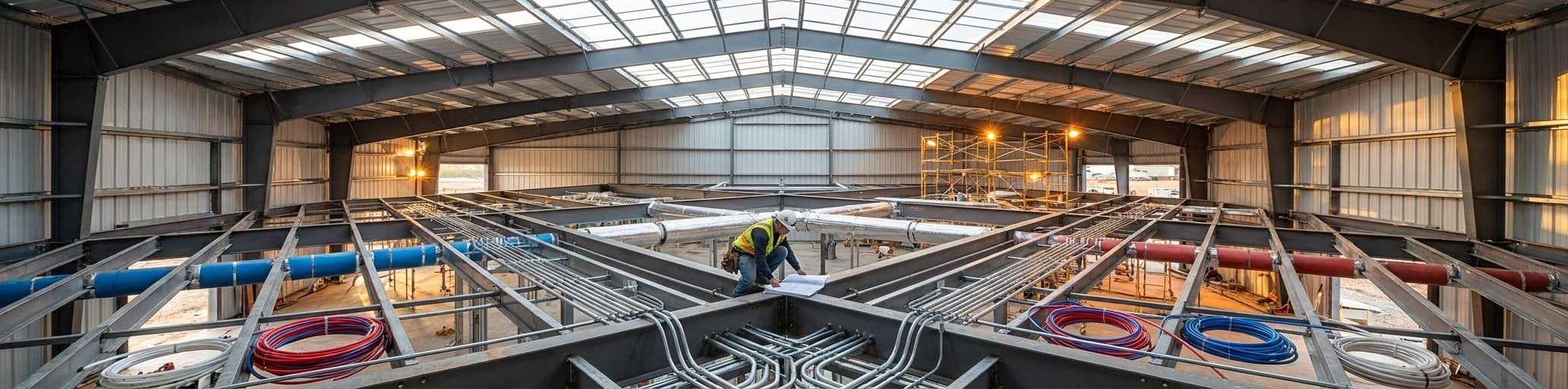

We help you plan HVAC and utility systems before metal building construction begins, avoiding costly retrofits that multiply expenses five to fifty times over. Coordinating mechanical, electrical, and plumbing rough-in during design–not after walls close–saves 20-40% on modifications and prevents weeks of project delays.
Why HVAC Planning Matters Before Your Metal Building Walls Go Up
A $500 utility decision during design costs $25,000 to fix after walls go up, making upfront HVAC planning essential for metal buildings.
The cost of retrofitting utilities after construction vs. planning during design phaseThe numbers make the case plainly. A utility decision that costs $500 during the design phase balloons to $5,000 once the slab has cured and can reach $25,000 after the walls are up.[1] That multiplier exists because retrofitting utilities in a pre-engineered metal building isn't a simple patch job — it means cutting concrete, rerouting steel members, and paying full trade labor rates to redo work that should have been done once.[1] For a metal building with living quarters, where you're coordinating HVAC, plumbing, and electrical across both shop and residential zones, a single missed stub-out can cascade into weeks of delay and serious budget damage.
The cost gap widens further when you look at expansion-zone utility planning. Running electrical conduit, water lines, and sewer connections to a future expansion zone during initial construction typically adds $8,000-$15,000 to the upfront project cost — but saves $30,000-$50,000 when those utilities are actually needed.[2] On a hypothetical 5,000-square-foot warehouse addition, planned expansion costs around $75 per square foot; retrofitting an unprepared structure runs closer to $110 per square foot, a 46% premium that reflects engineering redesign, structural modifications, and operational disruption.[2] Designing for utilities upfront adds roughly 3-5% to initial project cost while delivering 20-40% savings if you ever need to expand or modify.[2]
The window to get this right is narrow and unforgiving. Underground utility connections must be run before the concrete foundation is poured — once the slab is down and the steel frame is up, your options shrink fast.[1] Design-build delivery addresses this directly: when design and construction are managed under a single coordinated process, trades are brought in before drawings are locked, clashes are caught in the model instead of on-site, and every drain location, conduit route, and panel position is confirmed before a yard of concrete is ordered.[3] If you're working with a kit-only supplier and a separate general contractor, that coordination rarely happens — and you absorb the cost of the gap.
How metal buildings differ from traditional framing for HVAC rough-in work
Wood-framed walls let trades drill through studs and notch top plates wherever the run demands it. Steel framing built for a pre-engineered metal building doesn't offer that flexibility. These structures rely on factory-fabricated steel members — columns, rafters, purlins — manufactured off-site and assembled on location as fixed geometry.[4] A carpenter can cut a duct chase on the spot; a steel primary frame member requires a planned penetration sleeve before the building closes in. The distinction matters more in clear-span layouts, where interior columns are removed to open the floor area.[4] Without intermediate walls to carry ductwork, runs span the full width of the building through open air — which means support hangers, routing paths, and equipment clearances all need to be locked into the design before a single steel member ships from the fabricator.
That sequence also shifts where the mechanical equipment lives. In a stick-frame building, split systems and air handlers typically sit in attic bays or interior mechanical closets fed by framing cavities. In a metal building, rooftop units are the dominant choice because the structure doesn't provide the concealed interstitial space that wood framing does — so contractors plan the RTU curb locations, structural reinforcement, and duct drops as part of the pre-construction coordination package, not as an afterthought.[4] For owners comparing these two approaches, the structural differences between steel and wood frames reach further than load capacity — they determine where every duct, pipe, and conduit can physically go. Digital modeling addresses this directly: when mechanical runs are mapped against the structural layout before fabrication begins, conflicts get resolved in the model rather than on-site, and the building arrives ready for rough-in without expensive field modifications.[4]
What National Steel Buildings's design-build process catches that kit-only builders miss
Kit-only suppliers do one thing well: they ship engineered steel. What they don't do is coordinate trades. When you buy a kit and hire a separate general contractor, you're managing the gap between two parties who have never spoken — and that gap is exactly where utility mistakes live.[1] A generalist contractor working on a metal building typically applies wood-frame logic: frame it, then figure out the utilities.[1] Metal building sequencing doesn't allow for that. Underground lines, slab penetrations, and conduit routes all have hard deadlines tied to construction phases that move in one direction only — and once a phase closes, reversing course is expensive.[1]
A design-build process under a single contract closes that gap by putting engineers, estimators, and trade partners on the same team before drawings are locked.[5] Pre-construction utility planning isn't a courtesy call — it's a structured walkthrough where every electrical load gets identified, every drain location gets mapped, and every vent stack and subpanel gets a confirmed position on paper before a yard of concrete is ordered.[1] Trades come in early, not the week steel arrives.[1] When coordination lives inside a single contract, there's no finger-pointing between designers and builders when systems conflict — one entity owns the problem and resolves it internally.[5] That accountability is what separates a building that closes in ready for rough-in from one that sends you back to cut concrete three months after the slab cured. Can You Build Living Quarters in a Metal Building? HVAC & Utility Requirements
Residential comfort standards: heating, cooling, and ventilation codes for living spaces
Zoning and separating HVAC systems for shop vs. living quarters in one metal structure The living area and shop must run on completely independent HVAC systems — no exceptions.[8] Connecting both zones to a shared system routes shop dust, exhaust fumes, and chemical odors directly into your home every time the blower kicks on.[8] On the living side, a standard residential system works: central air, a mini-split, or a heat pump.[8] The shop side calls for different equipment matched to its actual conditions — a ductless mini-split handles moderate climates well, while a gas-fired unit heater is the practical choice for cold-climate shops where temperatures swing hard.[8] A zoned approach using multiple thermostats and motorized duct dampers lets you hold different temperatures in each area simultaneously, so the shop stays cool during a summer project while the bedrooms hold a steady sleeping temperature — without one side fighting the other.[9]
The partition wall between zones is the physical backbone of that separation. Most building codes require a minimum 1-hour fire-rated assembly between residential space and an attached workshop; upgrading to a 2-hour rating costs only $1-$2 per square foot of wall area and adds meaningful protection.[8] A 2-hour wall uses steel stud framing with two layers of 5/8" Type X drywall on each side.[8] Fire resistance alone doesn't block sound or temperature transfer — closed-cell spray foam in the wall cavity handles both, while resilient channel (metal strips that decouple the drywall from the framing) reduces vibration transmission from compressors and power tools.[8] Seal every penetration and the floor-to-wall junction with acoustical sealant, and specify a solid-core steel door with weatherstripping for the interior access point; that single door swap delivers 15-20 decibels of additional noise reduction over a hollow-core alternative.[8]
Shop ventilation runs on its own logic, separate from the residential mechanical system. An exhaust fan sized to turn over the entire shop air volume at least once every three to five minutes is the baseline requirement.[8] Any shop where engines will run needs carbon monoxide detectors — mandatory, not optional.[8] If welding, painting, or solvent work is planned, a dedicated exhaust hood or fresh-air filtration system must be roughed in during construction; the wall penetrations and electrical rough-in for those systems are far cheaper to coordinate before insulation for metal buildings and wall finishes are in place than after the building closes in.[8]
Ductwork routing and insulation strategies specific to metal building geometry
Metal building geometry forces duct routing decisions that wood-frame construction never demands. Without interstitial framing cavities, ducts running through unconditioned zones — above drop ceilings or through open shop bays — must be externally insulated to a minimum R-8.[11] Ducts in directly conditioned space require a minimum R-4.2, but any run that crosses from a conditioned zone into an uninsulated bay needs R-8 wrap regardless of how small the temperature gap feels on a mild day.[11] Rectangular, round, and flat-oval duct profiles are all viable across metal building clear spans, but round and oval move more air per inch of insulation thickness — a real advantage when you're wrapping every exterior run to meet code.[12]
The purlin layout introduces a second problem: compression. Fiberglass batt insulation squeezed tightly between a purlin and the metal skin loses effective R-value and creates a thermal bridge exactly where condensation is most likely to form.[10] Thermal spacer blocks keep insulation at full designed thickness across purlins, while a continuous foam board layer over the entire assembly eliminates bridging more reliably than batts alone.[10] For a metal building with living quarters — where you're holding residential temperature differentials year-round — spray foam on duct and wall assemblies adds airtightness that layered materials can't replicate, and that airtightness is what prevents moist interior air from reaching cold metal surfaces and generating water damage behind finished walls.[10]
Vapor control is a standalone task, not a byproduct of adding insulation. Seal seams, penetrations, and wall-to-roof transitions before any ceiling or wall finish closes in — access after the fact means tearing out finish work.[10] The same sequencing discipline applies to duct penetrations through the partition wall between shop and living zones: every sleeve and collar must be sealed with mastic or UL 181-rated tape before the wall closes, because connections left unsealed allow conditioned air — and with it, moisture — to migrate into unconditioned cavities and sit against cold steel.[11]
Metal Building HVAC Rough-In Essentials: What to Install Before Walls Close
Plan all HVAC penetrations, duct drops, and rooftop unit curb locations before framing closes, since metal building code prohibits field cuts that compromise structural integrity.
Framing penetrations and structural reinforcement for HVAC equipment placement
Every penetration through a cold-formed steel wall member needs a planned sleeve location before framing closes — not a field cut made after the fact.
IRC Section R603.2.6 governs web holes in cold-formed steel framing members and requires that oversized or improperly located holes be reinforced or patched according to specific criteria; cutting and notching rules under R603.3.4 further restrict what can be removed from a stud without compromising the member's structural contribution.[13] That's a different universe from wood framing, where a carpenter can notch a top plate on the spot.
In a pre-engineered metal building, verify that your site plan includes all HVAC rough-in locations — duct drops, line-set penetrations, condensate drain paths, and rooftop unit curb positions — before any framing member is installed.[14] Rooftop unit curbs require structural reinforcement at the roof plane: the purlin framing beneath the curb must be designed to carry the static equipment weight plus dynamic loads from fan vibration, and sleeve collars at wall penetrations for refrigerant lines and condensate drains must be set in position while stud tracks are still accessible.[14] Plumbing and HVAC penetrations through metal panels need coordination specifically so every opening through the building envelope is correctly sealed — a gap left unsealed at a line-set penetration becomes a moisture intrusion point that sits against cold steel and generates condensation damage behind finished walls.[14] Roughing in sleeve locations, blocking details, and curb reinforcement while the structural steel components are still exposed is the only way to avoid cutting into finished assemblies later.
Electrical rough-in coordination: panel location, circuit requirements, and load calculations
Load calculations come before a single wire is pulled or a box is set — this is non-negotiable on any metal building project, and especially on a metal building with living quarters where you're running two distinct load profiles under one roof.[15] The calculation, guided by NEC standards, determines the total amperage your main service panel must supply.[15] A basic workshop with lighting and receptacles might stay within a 200-amp service, but add welders, air compressors, HVAC units, and a residential zone and you'll push well past that threshold.[16] The standard rule: plan for at least 20% headroom beyond your calculated peak load so a future EV charger, heat pump, or shop upgrade doesn't force a panel replacement.[15] If your building sits 200 feet or more from the main service source, voltage drop becomes a live design variable — undersized conductors at that distance cause overheating and equipment malfunction, so conductor sizing must be calculated against both amperage and run length before conduit is laid.[16]
Panel location in a metal building follows a different logic than in wood-framed construction. Because most pre-engineered steel structures are detached or function as separate use zones, code requires a dedicated feeder and a subpanel inside the building — you cannot tap a shared panel from an adjacent structure.[16] Inside the subpanel, neutral and ground conductors must be isolated from each other, and the panel must include clearly labeled circuit breakers sized to each load.[16] For larger barndominium-style projects combining shop and residential zones, it often makes sense to install a separate service panel with its own meter rather than a subpanel — the right call depends on the total load, the distance from the utility service point, and whether local code treats the residential portion as a separate dwelling.[16] Nail the panel location during pre-construction coordination: the panel must be accessible, protected from physical damage, and positioned so feeder conduit routes don't cross primary structural members or conflict with HVAC equipment clearances.[15]
Circuit requirements branch out from the load calculation. Dedicated 240-volt circuits are mandatory for any heavy equipment — welders, air compressors, large HVAC units — and each circuit must be sized with wire gauge matched to its amperage under NEC Article 310.[15] For any run exceeding 50 to 75 feet, move up one wire gauge to compensate for voltage drop, particularly on motor loads like HVAC compressors where sustained undercurrent causes premature failure.[15] Grounding and bonding in a steel building carry additional weight that wood-frame projects don't face: steel framing and metal cladding conduct electricity, so every metallic component must be bonded to the grounding system.[16] Without complete bonding, a single fault can energize the entire building shell — a shock hazard that circuit breakers won't clear until the ground path is intact.[16] Install a ground rod, verify continuity throughout the structure, and confirm system resistance is below 25 ohms before any wall finish closes in.[15] GFCI protection is mandatory at exterior receptacles, concrete-floor areas, and any location near sinks — in a shop environment with concrete floors, moisture, and heavy equipment, GFCI devices are life-safety requirements, not optional upgrades.[16]
Plumbing rough-in essentials: water lines, drain routing, and freeze protection in metal buildings
Every drain location, waste line, and water supply stub must be mapped on paper and confirmed before concrete is ordered — because once the slab cures, those positions are permanent.[1] The cost of a missed floor drain after four inches of concrete has set means cutting, breaking, and re-pouring: a fix that runs thousands of dollars and weeks of delay in a structure where the slab is the foundation of everything else.[1] Supply lines must be sized to maintain adequate pressure across the whole system — a 3/4-inch main line feeds the building, with 1/2-inch branches running to individual fixtures — so multiple fixtures can run simultaneously without pressure drops.[18] PEX tubing is the practical material choice for metal building supply runs: flexible, easier to install than copper, and significantly more resistant to freeze damage in unheated zones.[17] PEX-A specifically uses expansion rings rather than crimp fittings, which means the internal diameter of the fitting matches the pipe so flow isn't restricted — a real advantage on long supply runs through large clear-span metal building layouts.[17]
Waste lines beneath the slab require a precise downward slope — standard is 1/4 inch per foot — and must be sized for the number of fixtures they serve; a single utility sink has very different demands than a full employee restroom or a commercial wash bay.[18][1] Use PVC or ABS piping and secure lines with rebar ties before the pour to prevent movement while concrete flows around them.[1] Every fixture drain needs a trap to block sewer gases, and vent pipes must be sized and positioned correctly for each fixture — some extend individually through the roof, others tie into a common vent stack.[18] Vent penetrations through a metal roof deserve specific coordination with the roofing installer: pipes crossing panel seams create water dams and restrict the expansion and contraction of roof panels, so place vent stacks at the center of the roof panel pan whenever the layout allows.[1] Before insulation or wall finishes close in, pressure-test all supply lines and fill DWV systems to check for leaks — finding and correcting a leak at rough-in costs a fraction of what repairs cost after finished surfaces are in place.[18]
Supply lines routed through unheated bays, exterior wall cavities, or underfloor zones need insulation or heat trace cable before walls close in around them.[1] In cold climates, vent stacks carry their own freeze risk: warm, moist air rising through the stack condenses at the top, eventually forming a blockage that backs up the entire DWV system.[1] Running cold water supply lines below the slab before the pour — bedded in adequate insulation — addresses below-grade freeze risk while satisfying code requirements for pipe protection through concrete.[17] A backflow preventer and pressure-reducing valve round out the rough-in package: the backflow preventer protects the public water supply from reverse pressure events, while the PRV brings incoming pressure — which can exceed 120 psi in some municipalities — down to the 40-90 psi range that supply pipes and fixtures are engineered to handle long-term.[17]
Common HVAC & Utilities Mistakes in Metal Buildings–and How to Avoid Them
Steel's 400-fold higher thermal conductivity than wood means your insulation R-value calculation must account for thermal bridging or your HVAC system will be dangerously undersized.
Undersizing equipment for open-concept metal building layouts and thermal bridging
The most common HVAC calculation error in clear-span metal buildings is treating floor area as the only sizing variable. Open-concept layouts with high ceilings behave like multiple stacked zones — a single mini-split serving a main floor beneath a 23-foot ceiling must effectively condition two levels of air volume, not one, because heat stratification means the upper air mass operates at a completely different temperature than the lower.[19] Run the load calculation on square footage alone and you'll install a unit that works fine on mild days and fails badly when the season turns.
The second error compounds the first: contractors using nominal insulation R-values to size equipment without accounting for thermal bridging through steel framing are working with numbers that don't reflect real-world heat loss. Steel's thermal conductivity sits at approximately 50 W/mK — roughly 400 times more conductive than softwood timber at 0.12 W/mK — which means unmitigated steel members bypass the majority of insulation R-value placed between them.[20] That gap between nominal and effective R-value is not theoretical: 14 inches of closed-cell spray foam installed between steel roof rafters produces an actual assembly R-value near R-15, not the R-90 the insulation depth would suggest, because the steel carries heat around the foam rather than through it.[19] The practical result is a building that loses or gains heat far faster than your equipment was sized to handle — and a comfort complaint that looks like an HVAC failure but is actually an insulation and framing problem.
Solving it requires steel building insulation specified to the effective assembly R-value, not the nominal batt value, and load calculations that input real envelope performance — including the frame factor that accounts for the proportion of wall and roof area occupied by steel versus insulation.[20] Get those two inputs right before equipment is selected and you avoid the cascading cost of undersized units, short-cycling compressors, and comfort failures in the zones farthest from supply air.
Condensation and moisture control in metal structures: insulation and vapor barriers
Metal's thermal conductivity is what makes condensation in steel buildings fundamentally different from wood-frame moisture problems. When outdoor temperatures drop, metal panels cool to match exterior conditions almost instantly — meanwhile, interior air stays warmer and carries moisture from occupants, equipment, and daily operations.[21] The moment that warm, moist air contacts a cold metal surface, temperature at the contact point drops instantly, the air loses its capacity to hold water vapor, and liquid forms on the panel.[22] Winter creates the most obvious scenario, but summer adds a counterintuitive version: air-conditioned buildings in humid climates experience reverse condensation on exterior wall surfaces when hot, humid outside air infiltrates through openings and contacts the cooled panels.[22] Both directions of moisture formation follow the same physics, so a moisture management strategy that only addresses one season is already incomplete.
Insulation is the primary defense, but only when specified to actual performance — not nominal R-value. Most commercial steel building applications in moderate to cold climates require a minimum R-19 at the roof and R-13 at walls to manage condensation effectively, with specific requirements scaling up by climate zone and occupancy type.[22] Gaps in coverage, compressed batts, and unsupported spans between purlins all create cold spots where condensation concentrates regardless of the overall R-value on your spec sheet.[22] Spray foam closes this gap more reliably than any batt system: it adheres directly to metal panels, eliminates air pockets where moisture can form, and delivers an integrated air barrier alongside its thermal resistance.[22] For operations where condensation risk is critical — hay storage buildings or livestock facilities, for example — insulated metal panels are the highest-reliability option, with foam cores factory-bonded to both metal facings during manufacturing so thermal bridges and installation gaps never enter the equation.[22]
Vapor barriers control the direction moisture moves through your building envelope, and placement determines whether they work at all. In heating-dominated climates, the barrier belongs on the warm side of the insulation — the interior face — to block moist interior air from migrating toward cold exterior panels where it would condense.[22] Faced fiberglass insulation includes an integrated barrier; unfaced products require a separate layer.[22] Every seam, penetration, and termination must be sealed with vapor barrier tape, because a gap at a single electrical knockout or pipe sleeve can allow enough moisture bypass to produce localized condensation that looks like a random leak.[22] Relative humidity above 60% means your ventilation or vapor management is failing; a hygrometer reading consistently above that threshold points to a ventilation or dehumidification gap rather than an insulation deficiency.[22] For operations that generate significant moisture — concrete curing in new construction, vehicle exhaust, manufacturing processes involving water — passive insulation and vapor barriers alone won't hold humidity below the condensation threshold, and a dedicated refrigerant or desiccant dehumidification system becomes a practical necessity rather than an optional upgrade.[22]
Single-source design-build advantage: catching conflicts before fabrication begins
The steel fabrication deadline is the hard boundary that separates recoverable design problems from expensive field disasters. Once your building's structural members enter the fabrication queue, their geometry is locked — column hole locations, purlin spacing, and roof curb reinforcements are cut and welded to spec.[23] Any HVAC, electrical, or plumbing conflict discovered after that point can't be resolved in a model; it gets resolved on-site with grinders, custom brackets, and day-rate trade labor.[23] Under a split delivery model — kit supplier on one contract, general contractor on another — the team responsible for mechanical systems rarely sees the structural drawings before the steel ships, which means clashes between a duct drop and a primary rafter, or between a rooftop unit curb and a purlin bay, surface during erection rather than during design.[23] A single-source design-build process eliminates that gap by putting engineers, estimators, and trade partners in the same coordination environment before any drawings are finalized.
The coordination tool that makes early conflict resolution actionable is Building Information Modeling. BIM clash detection works by integrating discipline-specific models — structural, mechanical, electrical, plumbing — into a single federated model, then running automated comparisons to identify where elements conflict spatially.[24] Three categories of conflicts surface in that analysis: hard clashes, where two physical elements occupy the same space (a mechanical duct running through a structural beam, for example); soft clashes, where clearance zones are violated without direct intersection (HVAC equipment mounted too close to a wall to allow service access); and workflow clashes, where installation sequences conflict with structural access requirements.[24] Each conflict is logged, assigned to the responsible discipline, and resolved through a structured coordination meeting — the model is updated, rechecked, and confirmed clean before fabrication begins.[24] For a metal building with living quarters, where mechanical, electrical, and plumbing systems must thread through a clear-span structure with no interstitial framing cavities to hide reroutes, that digital resolution process is the only cost-effective way to coordinate system interactions before the building closes in.
Single-source accountability is what gives the BIM coordination process teeth. In a fragmented delivery model, a conflict between the structural engineer's drawings and the mechanical contractor's duct layout produces a dispute between two parties who answer to different contracts — and the owner mediates.[23] Under a unified design-build contract, one entity owns both the conflict and the resolution, with no contractual boundary to hide behind.[23] That structure also enables prefabrication: when mechanical runs are locked into a coordinated model early enough, components can be fabricated off-site to precise dimensions and delivered ready to install, rather than cut and assembled in the field against a structure that arrived with unanticipated constraints.[23] For owners who want to understand how the fabrication-to-delivery sequence works before committing, the prefab building kits delivery timeline shows exactly when engineering decisions lock and why pre-construction coordination must happen before that window closes. The difference between a building that rough-ins on schedule and one that sends crews back to cut concrete comes down to whether your MEPF systems were coordinated against your structure in a model — or discovered against it in the field.[25]
- Utility retrofitting after construction costs 5-25x more than planning during design phase.
- Underground connections must be installed before concrete pours–the only window to get positioning right.
- Design-build coordination catches HVAC, electrical, and plumbing conflicts in models before fabrication locks geometry.
- Living quarters require completely separate HVAC systems from shops to prevent dust, fumes, and odors from transferring.
- Steel's thermal conductivity (400x more conductive than wood) creates condensation risk unless insulation accounts for effective R-value, not nominal.
- BIM clash detection resolves conflicts between structural, mechanical, electrical, and plumbing systems before crews arrive on-site.
- Every HVAC penetration, duct drop, and rooftop unit curb must be mapped and approved before any framing member installs.
- https://metalprobuildings.com/metal-building-utilities/
- https://www.steelcobuildings.com/designing-steel-buildings-for-future-expansion/
- https://www.unitempinc.com/blog/the-future-of-hvac-engineering-in-design-build/
- https://www.arrantconstruction.com/metal-building-construction-and-remodeling-guide/
- https://www.dunnandstonebuilders.com/knowledge-center/design-build-services-explained
- https://up.codes/viewer/california/ca-residential-code-2022/chapter/3/building-planning
- https://energycodeace.com/content/114-building-indoor-air-quality-and-ventilation-requirements
- https://barnsnbarndos.com/blog/barndominium-with-shop
- https://alldraft.com/barndominium-utility-planning/
- https://chinasteelbuildsales.com/metal-building-interior/
- https://www.energycodeace.com/content/d-the-installed-thickness-of-duct-insulation-used-to-determine
- https://docs.bentley.com/LiveContent/web/Station%20Designer%20Help-v1/en/BMechToolGroupDuct.html
- https://up.codes/viewer/new_york/irc-2018/chapter/6/wall-construction
- https://www.steelcobuildings.com/how-to-build-steel-building/
- https://blackrhinoelectric.com/blog/electrical-rough-in-checklist/
- https://www.theelectriciansco.com/blog/electrical-wiring-for-pole-barns-and-barndominiums/
- https://www.greenbuildingadvisor.com/article/saving-sustainably-plumbing-rough
- https://jomory.com/understanding-rough-in-plumbing-for-new-construction/
- https://www.greenbuildingadvisor.com/question/unique-icf-home-that-im-having-trouble-sizing-hvac
- https://imaginekithomes.com.au/guides/advanced-thermal-bridging-solutions-for-steel-frame-kit-homes-in-australia-mm98z37k/?srsltid=AfmBOooVloUXmkEHXxJIjarSYDqc-xgLit5xMTTQPmwEn_Zv4j7kArVy
- https://armstrongsteel.com/blog/7-proven-methods-to-prevent-condensation-in-steel-buildings
- https://mbmisteelbuildings.com/blog/steel-building-condensation-guide/
- https://www.selectlee.com/2025/02/25/the-benefits-of-design-build-vs-design-bid-build-for-large-projects/
- https://www.theengineeringdesign.com/blog/mep-clash-detection-bim
- https://optimarprecon.com/role-of-bim-coordination-in-construction/