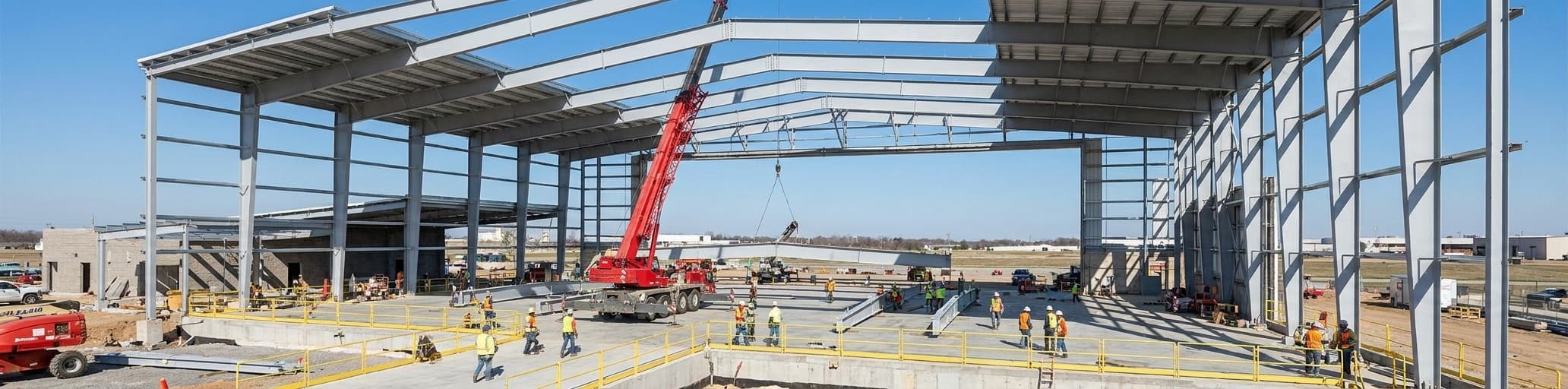

We help you understand 2026 aircraft hangar costs, which range from $62 to $350 per square foot depending on size, location, and specifications. Locking in your scope and choosing design-build delivery protects your budget from hidden costs that traditionally emerge mid-construction.
2026 Aircraft Hangar Construction Costs: What You'll Actually Pay Per Square Foot
Aircraft hangar costs range from $80,000 to $500,000 depending on size, use type, and fit-out level, so pinpointing your project's scope before bidding prevents budget surprises.
Average cost range for steel aircraft hangars in 2026
Steel aircraft hangar construction cost per square foot in 2026 spans a wide band depending on size, use type, and fit-out level.
At the lower end, a basic single-aircraft metal hangar can come in around $80,000, while mid-range owner-operated hangars commonly run $200,000 or more, and fully equipped facilities push past $500,000.[3] Luxury hangar-condo shells in high-demand Sun Belt markets like Addison, Texas list at approximately $460 per square foot for the structure alone.[2] Large-scale MRO-capable hangars scale differently: Ascent Aviation Services' 2024 expansion at Pinal Air Park added 180,000 sq ft of hangar space plus 60,000 sq ft of support facilities for a $55 million capital investment — translating to roughly $229 per square foot across the full footprint.[2] Even a simple T-hangar can carry a purchase price of $180,000 before accounting for annual property taxes, HOA fees, and ongoing maintenance.[1] The range is wide because hangar cost per square foot is not a single number — it shifts with door systems, fire-suppression requirements, slab engineering, electrical capacity, and whether the building serves basic storage or active maintenance operations.[2] Understanding where your project falls within that spectrum before you request bids is how you stay within budget on an aviation facility rather than discovering scope gaps after steel is already on order.
Why steel hangar costs vary significantly by location and size
Size is the single most direct lever on aircraft hangar construction cost per square foot — but not in the way most buyers expect.
Wider clear-span structures require heavier structural members and more complex engineering, which pushes material tonnage and fabrication costs upward even before a single bolt is tightened on site.[4] Building height compounds the effect: hangars sized for tall-tail business jets carry meaningfully more steel per square foot than a low-profile single-engine storage bay.[4] Location then applies a multiplier on top of structural demands.
Urban airport sites absorb higher land costs, stricter zoning reviews, and limited available parcels, while rural or regional airports trade those pressures for infrastructure gaps that require roads, drainage, and utility extensions.[4] Labor markets magnify the gap further — regions with heavy construction demand face skilled-trade shortages that push wages up and extend project timelines, both of which erode contingency budgets.[4] Environmental load requirements add another regional variable: a hangar in a Gulf Coast hurricane zone needs a fundamentally different framing specification than one on a dry inland plateau, and high-seismic or high-snow-load jurisdictions require stronger, heavier systems throughout.[4] The spread in published benchmarks reflects exactly these compounding variables — standalone general aviation hangars have been cited ranging from roughly $60 to $120 per square foot for the structure, while a leasehold 60×60 box hangar with two doors has come in near $19 per square foot under favorable conditions.[5] Neither number is wrong; they simply describe different projects in different markets, which is why locking in a firm scope — aircraft type, door configuration, site conditions, and local code requirements — before requesting bids is the only reliable way to compare proposals on equal terms.
How National Steel Buildings delivers predictable pricing through design-build transparency
The core problem with traditional aviation construction isn't poor materials or bad contractors — it's a fragmented delivery model that separates design from cost reality. In the conventional design-bid-build sequence, architects complete detailed drawings without contractor input, bids come back over budget, and the project restarts: redesign, rebid, delay.[6] Every cycle burns weeks and erodes the contingency that was supposed to protect your budget.
Design-build eliminates that loop entirely. One contract, one team, one point of accountability covers the project from concept through completion — no finger-pointing between architect and contractor when foam-suppression requirements surface mid-construction or site conditions trigger a scope change.[6] The practical result is real-time cost modeling during design itself: value decisions happen before steel is ordered, not after a budget overrun forces a painful scope reduction.[6] Pre-engineered steel structures reinforce that predictability further — standardized fabrication reduces on-site labor hours and shortens construction schedules compared to fully custom builds, which directly compresses the labor-rate exposure that makes aviation projects chronically over budget.[7] For owners who need a firm number early, prefab aviation hangars built on a design-build framework combine fixed material pricing with integrated engineering review — the two variables that most often blow hangar bids off course when managed separately.
Cost Breakdown by Hangar Size: 40×40, 100×100, and Custom Dimensions
Benchmark your target hangar footprint against real market transactions–a 40×40 runs roughly $62 per square foot, while a 50×50 reaches $90 per square foot, helping you set realistic budgets before requesting quotes.
Small single-aircraft hangars: 40×40 and 50×50 cost analysis
For a single-aircraft owner, the two most common footprints are the 40×40 (1,600 sq ft) and 50×50 (2,500 sq ft) — and real market transactions show a significant jump between them. A 40×40 steel hangar with electrical service, radiant heat, a powered overhead door, and a concrete floor has listed at $100,000, which pencils out to roughly $62 per square foot for a fully finished structure.[9] Step up to a 50×50 with a 42-by-12-foot electric door, full insulation, LED lighting, and a furnace, and asking prices reach $225,000 — approximately $90 per square foot.[9] Those figures reflect completed, equipped structures in an active aviation market, so they serve as a useful lower-bound benchmark: new construction aircraft hangar construction cost per square foot for a comparable spec will typically run higher once you factor in today's labor rates, current steel pricing, site preparation, and permit fees. The gap between the two sizes is also instructive. Adding 900 square feet of floor area — moving from a 40×40 to a 50×50 — increased the per-square-foot cost by roughly 45% in these comparable listings, largely because door system costs, electrical panel capacity, and insulation all scale faster than raw floor area.[9] Builders searching for forum data on recent construction costs in active building states like Florida confirm that pricing shifts quickly enough that year-old benchmarks can mislead early-stage budgets.[8]
| Hangar size | Square footage | Approx. market price | Approx. cost per sq ft |
|---|---|---|---|
| 40×40 | 1,600 sq ft | $100,000 | ~$62/sq ft |
| 50×50 | 2,500 sq ft | $225,000 | ~$90/sq ft |
Cost estimator: Calculate your hangar project in minutes
Before requesting quotes, benchmarking your target footprint against real builds prevents scope surprises later. Prefab steel hangars follow identifiable pricing tiers when you separate structure cost from site work: a 35×45 ft single-aircraft bay runs approximately $28,000 in components and assembly, a 50×60 ft multi-aircraft configuration reaches around $65,000, and a 100×150 ft cargo-class build comes in near $220,000 — all figures excluding site preparation, foundation pours, and specialty door systems.[11] Fully engineered private hangars covering 2,000-10,000 sq ft carry substantially higher per-square-foot costs once civil work, structural compliance, and regional code requirements enter the calculation: Texas coastal projects run $180-$320 per sq ft due to TWIA wind certification demands, North Carolina inland sites land at $160-$300 per sq ft, and Florida's hurricane-zone mandates push pricing to $200-$350 per sq ft.[10] The spread between prefab component pricing and fully engineered installed cost reflects everything that happens between factory fabrication and a certificate of occupancy — foundation engineering, stormwater management, permitting fees, and fire-suppression compliance — which is why evaluating metal airplane hangar options early in the process, before scope is locked, protects your contingency budget.
| Hangar footprint | Sq ft | Prefab kit and assembly | Fully engineered installed range | Key exclusions |
|---|---|---|---|---|
| 35×45 | 1,575 | ~$28,000 | $237K-$551K | Site prep, foundation, doors |
| 50×60 | 3,000 | ~$65,000 | $450K-$1.05M | Site prep, foundation, doors |
| 100×150 | 15,000 | ~$220,000 | $2.25M-$5.25M | Site prep, foundation, fire suppression |
Non-compliant designs can add 20-30% to total budgets through rework alone, which makes aligning structural scope with local code requirements — before steel is ordered — the single highest-leverage cost-control move available at the planning stage.[10]
Key Cost Drivers in Aircraft Hangar Construction
Lock in your door configuration before steel is ordered to avoid one of the most common hidden cost triggers in hangar projects.
Steel material costs, labor, and hangar doors: The three biggest expenses
Three line items consistently dominate aircraft hangar budgets regardless of project size: structural steel, on-site labor, and the door system. Steel is the standard structural choice for hangars because it achieves the wide, column-free spans that aircraft maneuvering requires — but as clear-span width grows, frame members must grow heavier and stronger, which drives up steel tonnage and fabrication cost before a single bolt is tightened on site.[12] Labor then applies a regional multiplier on top of those material costs: high-construction-demand markets face skilled-trade shortages that push hourly wages upward and extend schedules, eroding contingency budgets.[12] Counterintuitively, hiring a contractor with verified aviation project experience often costs less overall — specialized crews sequence work efficiently, coordinate smoothly with airport authorities and inspectors, and avoid the rework that turns low-bid projects expensive.[12] Aircraft hangar construction cost is heavily influenced by door systems alongside these two line items, because the door must provide a clear opening sized for your largest aircraft while operating reliably in local weather conditions.[12] Three common door configurations each carry different cost and operational trade-offs:
- Sliding doors are mechanically simple and carry lower upfront cost, but require side clearance space and operate more slowly than alternatives.[12]
- Bi-fold doors fold upward to create a canopy effect when open, providing good clearance and a clean visual profile at moderate cost.[12]
- Hydraulic one-piece doors swing outward as a single panel for the largest unobstructed opening, but carry the highest initial cost and most complex maintenance requirements.[12]
Changing door type or size late in the design phase is one of the most common hidden cost triggers in hangar projects, which is why locking in door configuration during initial scope — before steel is ordered — directly protects your contingency budget.[12]
Site preparation, utilities, and regulatory compliance impact on final price
Site work is the cost category that most first-time hangar owners underestimate, often because it doesn't appear in prefab kit pricing or early structural estimates. Poor soil conditions, significant grading needs, or inadequate stormwater drainage can consume a substantial portion of the budget before a single steel column is erected.[12] The concrete slab alone demands careful engineering: aircraft landing gear imposes concentrated point loads, and ground support equipment like tugs and forklifts add continuous rolling stress that a standard commercial slab cannot handle reliably.[12] A well-engineered slab costs more upfront, but it prevents the cracking, settlement, and operational disruptions that force expensive remediation mid-project.[12] Developers who treat site work as a secondary line item routinely discover it is actually one of the top three budget drivers once soil reports, drainage studies, and apron reinforcement specs are fully priced.
Utility scope is equally easy to underestimate at the planning stage. Basic electrical service covers lighting and standard outlets, but hangars designed for active maintenance or avionics work require three-phase power, compressed air distribution, and specialized outlet configurations — each of which adds both material cost and engineering review.[12] High-bay LED lighting systems improve inspection visibility and reduce long-term operating costs but carry a real upfront premium.[12] Plumbing requirements depend on use case: restrooms, aircraft wash bays, and fire-suppression water supply all introduce separate rough-in costs that must be scoped before foundation work begins.[12] Modern hangar projects targeting eVTOL staging or electric ground support equipment face an additional layer — high-capacity electrical service at 480 V or megawatt-class charging capacity — that can dwarf conventional utility budgets.[2] Locking in utility rough-in sequences early in the design phase prevents the costly retrofits that come from treating power and plumbing as afterthoughts.
Regulatory compliance is the third hidden cost that bends final budgets in ways that preliminary estimates rarely capture. Fire protection alone is governed by NFPA 409, which sets clear requirements for suppression system type and coverage based on hangar size and category — and non-compliant designs routinely add 20-30% to total project costs through rework.[13] Electrical systems in fuel-handling zones must meet NFPA 70 standards and use explosion-proof fixtures, which cost substantially more than standard commercial fittings.[13] Beyond code requirements, projects on airport property require approvals from both local building authorities and the airport operator or authority, a dual-track permitting process that extends timelines and introduces indirect costs in the form of design adjustments triggered by airside setback or taxiway proximity rules.[12] Early engagement with code officials and airport stakeholders — before drawings are finalized — is the most reliable way to prevent regulatory surprises from detonating a contingency reserve that was sized for construction unknowns, not permitting delays.[2]
Why single-source design-build saves money compared to traditional bidding
The financial case for single-source design-build in hangar construction is quantified, not theoretical.
Research from the Design-Build Institute of America found that design-build delivers a 6% cost savings on average alongside 12% faster construction speeds and 33% faster overall project delivery compared to traditional bidding.[16] A University of Texas analysis of 75 projects completed for the U.S. Navy confirmed the pattern: design-build projects took less time, had less cost growth, and cost less to build than their design-bid-build counterparts.[14] The Construction Institute refined the finding further — design-build projects carried a 6% reduction in change orders, which in aviation construction is precisely where budgets routinely blow apart.[14] Traditional bid-build creates structural conditions that generate change orders: architects work without contractor input, documents go to bid complete on paper but routinely incomplete on site-specific scope, and coverage gaps become contested territory between parties with no contractual obligation to each other.[15] When those gaps surface mid-construction — as they regularly do on complex aviation sites navigating dual permitting tracks and specialized fire-suppression codes — the owner absorbs both the rework cost and the schedule penalty, with no single party responsible for either.[15] Vertically integrated design-build teams that self-perform key trades eliminate the subcontractor markup stacking that drives 40-60% of a project's hard costs in a fragmented delivery model, compressing both MEP costs and timelines meaningfully compared to a traditionally subcontracted approach.[15] One contract, one cost model, one team accountable from foundation through certificate of occupancy means the coordination failures that generate change orders in siloed projects simply don't occur — and when site conditions do trigger scope adjustments, decisions happen inside the team rather than across adversarial contracts.[15]
Reducing Aircraft Hangar Construction Costs Without Sacrificing Quality
Pre-engineered steel hangars cut construction costs 20-30% while compressing schedules by 30-50%, with additional savings locked in through lower insurance premiums and minimal maintenance over decades.
Pre-engineered steel structures vs. custom builds: Where savings actually occurThe cost gap between a pre-engineered steel hangar and a fully custom-built facility isn't theoretical — it shows up in four specific budget lines. Pre-engineered metal buildings cost 20-30% less than traditional construction methods and assemble 30-50% faster, primarily because factory fabrication replaces the slow, weather-dependent, on-site labor that drives custom-build overruns.[17] The mechanism behind that speed advantage matters for aviation owners: while your concrete apron is being poured and cured, the steel frame components are being manufactured off-site in parallel — two work streams running simultaneously rather than sequentially.[19] That compression of the schedule directly reduces the number of billable labor days on site, which is where aviation projects most often lose budget control. Material waste is a second savings lever. Stick-built and fully custom construction cuts, trims, and fabricates on-site under variable conditions, generating scrap and rework; pre-engineered systems are produced to spec in a controlled factory environment, which minimizes offcuts and ensures every component arrives ready to bolt together.[17] Insurance costs represent a third, often overlooked, savings category: steel is non-combustible and resists fire, pests, and rot, which translates into annual insurance premium reductions of 30% or more compared to equivalent structures built from combustible materials.[19] Maintenance is the fourth line. A wood or mixed-material custom build requires painting, sealing, and rot remediation on a recurring schedule; a steel hangar's factory-applied coatings need little more than periodic inspection, eliminating a recurring cost that compounds significantly over a 20- or 30-year asset life.[19] The table below maps where each savings category actually originates:
| Savings category | Pre-engineered steel source | Custom build exposure |
|---|---|---|
| Construction cost | Factory precision cuts waste 20-30% vs. traditional methods | On-site labor, rework, and material waste inflate hard costs |
| Schedule | Parallel off-site fabrication compresses timeline 30-50% | Sequential on-site assembly is weather-dependent and linear |
| Insurance | Non-combustible steel reduces annual premiums by 30%+ | Combustible materials carry higher insurer risk ratings |
| Long-term maintenance | Factory coatings resist fading, pests, and rot for decades | Wood and mixed materials require repainting, sealing, and pest management repeatedly |
The clear-span structural capability of pre-engineered steel also eliminates a cost that custom builds routinely encounter: interior columns. Aircraft maneuvering demands unobstructed floor area, and achieving wide column-free spans with traditional construction requires expensive laminated beams or complex custom truss engineering.[18] Pre-engineered steel frames handle clear spans up to 250 feet without the structural gymnastics, so the open interior you need for aircraft movement is a standard product feature rather than a costly engineering special.[18] That distinction — standard versus special — is ultimately where the savings occur across every budget line: pre-engineered systems deliver aviation-grade performance as the baseline, while custom builds charge you to engineer it from scratch.
Choosing the right door system and HVAC strategy for your budget
Door cost and building height are more tightly coupled than most hangar buyers realize, and that relationship directly shapes your HVAC budget. A 60-foot sliding door opening runs $10,000-$15,000 in hardware, while high-end hydraulic doors for the same span cost $25,000-$50,000.[21] That gap looks straightforward until you factor in what each door type demands from the building structure itself. Traditional bi-fold doors require additional ceiling height to accommodate the folding panels — which adds steel tonnage, raises wall height, and increases the cubic volume your heating and cooling system must condition.[20] Hydraulic swing-out doors solve that problem differently: because the panel swings outward as a single piece rather than folding inward, the building can be constructed shorter, reducing both structural steel costs and the interior volume your HVAC system has to manage.[20] On large multi-aircraft hangars, a single wide door also typically costs less than two narrower doors covering the same total opening, and eliminates the need to move aircraft to access others — a dual operational and budget advantage.[21]
Insulation decisions for both the door system and the building envelope drive HVAC sizing and long-run energy costs in ways that early-stage budgets routinely underestimate. Modern bi-fold and hydraulic door systems now support insulation values up to R-50, and properly sealed door systems reduce air infiltration enough to hold interior temperatures meaningfully more stable than older designs.[21] That performance level matters because energy code compliance is now actively enforced: the International Energy Conservation Code increasingly requires hangars equipped with HVAC to meet defined envelope performance standards, which means underinsulated doors and walls can trigger code-driven retrofits after construction is complete.[21] HVAC installation itself starts around $3,000 for a basic small-hangar heating unit and climbs past $15,000 as square footage, climate zone, and use intensity increase.[22] Electrical rough-in for climate and lighting systems adds $3,000-$10,000 depending on service capacity.[22] The sequence that protects your budget: lock in door type and height before finalizing building dimensions, size insulation to the local energy code in the initial design, and rough in electrical capacity for HVAC before the slab is poured — retrofitting any of these three elements after steel is erected costs substantially more than specifying them correctly at the start.[20]
How to get a firm quote and avoid hidden costs with National Steel Buildings
The contract structure you agree to before breaking ground determines whether hidden costs emerge mid-construction or stay outside your budget entirely.
Cost-plus contracts — where the owner reimburses all direct project costs plus a contractor markup — are common on aviation builds because they allow work to start quickly when scope isn't fully defined.[23] The problem is that a basic cost-plus arrangement leaves the final invoice uncertain; without a guaranteed maximum price clause capping total expenditure, the finished project can exceed every preliminary estimate by a meaningful margin.[23] That exposure is manageable with the right contract language: a not-to-exceed provision limits the owner's total liability while still giving the contractor flexibility to handle site-driven unknowns — and it's one of the most effective hidden-cost protections available at the contract-formation stage.[23] Before signing any agreement, request a detailed schedule of values — an itemized breakdown of estimated costs for each project component — alongside clearly defined lists of reimbursable and non-reimbursable items and an explicit dispute resolution process.[23] A contractor who cannot produce a schedule of values before contract execution hasn't priced the work in enough detail to hold a firm number through construction, and the gap between their verbal estimate and the final invoice is where aviation project budgets most often collapse.[23] Carefully reviewing change-order procedures at the outset matters equally: on complex aviation sites with dual permitting tracks and specialized fire-suppression requirements, scope adjustments are predictable, and a contract that defines how those adjustments get priced and approved prevents a single change order from unraveling a fixed-price agreement.[23] Custom metal aviation buildings delivered through a single-source contract give you a structured quote with those protections built in — scope, schedule of values, and change-order terms locked before steel is ordered — so the number you approve at the start is the number you manage to at the finish.
- Aircraft hangar construction costs range from $60-$350 per square foot depending on size, location, environmental requirements, and equipment specifications.
- Door system selection directly impacts building height, structural steel costs, and HVAC sizing, making early design decisions critical to final budget.
- Site work and utility infrastructure are consistently underestimated cost categories that can consume substantial portions of budgets before steel erection begins.
- Design-build delivery models reduce costs by 6% on average and cut change orders by 6% compared to traditional design-bid-build approaches in aviation construction.
- Pre-engineered steel structures cost 20-30% less and assemble 30-50% faster than custom builds while eliminating interior columns needed for aircraft maneuvering.
- Fire suppression, electrical, and permitting compliance oversights add 20-30% in rework costs, making early code alignment with local authorities essential.
- Cost-plus contracts require not-to-exceed clauses and detailed schedules of values to prevent final invoices from exceeding preliminary estimates by significant margins.
- https://www.pilotsofamerica.com/community/threads/hangar-build-and-cost.151643/
- https://www.scbconstructiongroup.com/aircraft-hangar-construction-build-checklist-design-trends-and-developer-roi/
- https://metalprobuildings.com/how-much-does-it-cost-to-build-a-metal-airplane-hangar/
- https://www.ibeehivesteelstructures.com/blog/steel-hangar-construction/
- https://straitsresearch.com/report/aircraft-hangar-market
- https://arcodb.com/resources/from-concept-to-takeoff-why-aviation-needs-a-new-kind-of-builder/
- https://coastalsteelstructures.com/a-cost-analysis-of-pre-fabricated-steel-airplane-hangars-should-you-build-it-or-buy-it/
- https://vansairforce.net/threads/metal-building-hangar-costs-2024.226467/
- https://metroairports.org/our-airports/rent-lease-sell-space
- https://www.jrhengineering.net/post/2026-private-aircraft-hangar-design-updates-tx-nc-fl
- https://www.ibeehivesteelstructures.com/blog/prefab-aircraft-hangar-cost/
- https://www.ibeehivesteelstructures.com/blog/airplane-hangar-building-cost/
- https://chinasteelbuildsales.com/airplane-hangar-construction/
- https://www.asd-usa.com/blog/design-build-vs-design-bid-build
- https://itdgconstruction.com/blog/design-build-vs-bid-build-commercial
- https://onekeyresources.milwaukeetool.com/en/what-is-design-build
- https://www.hcsteelstructure.com/pros-cons-prefabricated-steel-buildings-vs-traditional-construction/
- https://rsjobberinc.com/pre-engineered-buildings/
- https://iconsteelbuildings.com/metal-building-vs-stick-built/
- https://planeandpilotmag.com/buyers-guide-to-hangars-doors/
- https://www.metalconstructionnews.com/articles/latest-trends-in-hangar-doors/
- https://chinasteelbuildsales.com/cost-to-build-a-hangar/
- https://www.procore.com/library/cost-plus-contracts