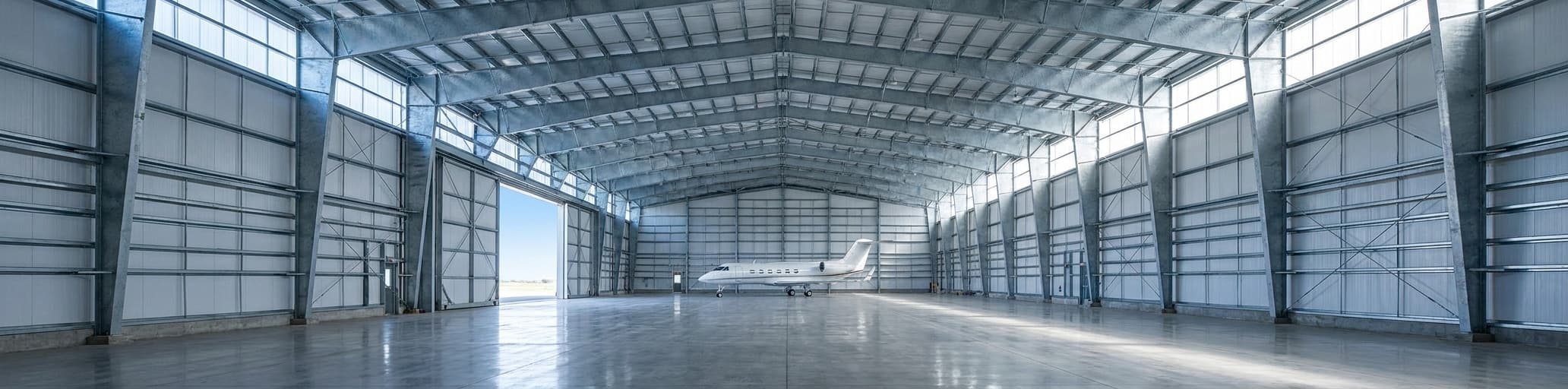

We deliver factory-engineered metal aviation buildings in 12 weeks by pre-designing standard bay configurations and managing permit coordination as a single point of contact. Steel frames with galvanized corrosion protection eliminate wood's maintenance burden while cutting lifetime costs 3-8x lower over 20-40 year ownership windows.
Why Metal Aviation Buildings Outperform Every Time
Factory-applied Galvalume coating eliminates rust inspections and repaints, letting you skip the 3x to 8x higher maintenance costs of wood-framed hangars over your building's lifetime.
50-year corrosion warranty vs. wood rot & steel corrosion
Wood framing is the wrong material for an airport environment. Jet fuel vapor, standing moisture, and temperature swings accelerate rot and splitting, and most wood-framed hangars show visible structural wear within a few years of service.[1] Untreated or poorly coated steel carries its own risk: corrosion doesn't just stain panels — it weakens the frame, shortens service life, and triggers expensive remediation cycles.[1] The practical answer is factory-applied corrosion protection that removes the maintenance variable entirely.
Properly galvanized or Galvalume-coated steel panels resist moisture and harsh weather across the full service life of the building.[1] Galvalume is an aluminum-zinc alloy applied at the factory, and it provides a second layer of electrochemical protection beyond standard galvanizing — particularly useful in coastal and high-humidity airport environments where salt air accelerates surface degradation.[1] Because corrosion protection is baked in at the manufacturing stage, you're not scheduling repaints or inspecting for rust every spring.
That factory-level protection is why a metal aviation building can carry a 50-year structural warranty — a commitment no wood-framed hangar can match.[1] Steel buildings don't rot, split, warp, or expand with moisture the way wood framing does, and they won't contract and crack under cold.[1] Over a 10-year ownership window, traditional wood structure maintenance runs 3x to 8x higher than an equivalent steel building — a gap that compounds every decade you own the asset.[2] For aviation owners planning 20- to 40-year holds, the math consistently favors steel.[2]
Clear-span widths to 300 ft–no internal columns, more usable space
Column-free interior space is what separates a functional hangar from a frustrating one.
Steel clear-span frames eliminate interior columns entirely, giving you unobstructed floor space across the full structure width — room to park, maneuver, and service aircraft without routing around structural obstructions.[5] Those frames extend to 300 feet in width without intermediate supports, with spans beyond 150 feet moving into custom engineering territory.[4] For aviation specifically, tapered column rigid frames deliver optimal interior efficiency: variable-depth columns and rafters concentrate steel where the load demands it, which is why prefab aviation hangars default to this frame style for large-aircraft and MRO facilities.[4] The same construction logic enables high eave heights that accommodate full-size aircraft and helicopters — structural clearances wood framing simply can't match at comparable widths.[5]
Engineered for 150 mph+ winds & snow loads to 80 psf–certified nationwide
Airport sites almost universally fall into Exposure Category C — open terrain with few surface obstructions — which raises wind pressures compared to suburban or wooded sites and directly increases frame member sizing, purlin and girt spacing, panel gauge, fastener count, and anchor bolt reactions throughout the structure.[7] The IBC addresses hangar-specific risk through Section 1609.1.2, a provision dedicated to aircraft hangar wind loads, because large door openings concentrate uplift and lateral forces in ways standard commercial framing never encounters.[6] Engineering to 150 mph+ ultimate wind speed (Vult) accounts for those forces at every connection in the system, not just the frame.
Snow loads work the same way: ground snow (Pg) feeds a derived roof snow value (Pf) that factors in exposure, thermal conditions, slope, and drift accumulation at parapets and step-downs — 80 psf represents the upper range for high-accumulation U.S. regions, and frames sized to that figure require drift checks that lighter-load buildings skip entirely.[7] Because jurisdictions adopt IBC editions on staggered timelines and routinely layer on local amendments, PE-stamped drawings that match your authority having jurisdiction's exact code year are what move permits through review without costly resubmittals — and confirming that alignment before fabrication begins is what keeps your metal aviation building on schedule from coastal Florida to mountain Colorado.[7]
12-Week Delivery on Standard & T-Hangar Configurations
Pre-engineered bay modules eliminate the custom design delays that stretch conventional hangar projects into months, delivering your facility in 12 weeks instead.
Pre-designed bay modules (40×40, 60×60, 100×125) cut engineering & fab time
Pre-designed bay modules compress your timeline by eliminating the engineering loop that stalls custom projects.
When a 40×40, 60×60, or 100×125 bay is already fully engineered, shop drawings, load calculations, and connection details are complete before fabrication begins — so the factory builds to a proven design instead of waiting on custom iterations.[8] That off-site production model is what drives prefabricated hangar systems to erect in weeks rather than months, not the open-ended schedules conventional aviation construction routinely runs.[8] If you're tracking how that prefab kit delivery timeline sequences from order placement through on-site erection, each phase maps to a predictable milestone.
Modular geometry also protects your future flexibility: pre-engineered bays can be reconfigured or extended as your fleet grows, supporting phased expansion without triggering a full re-engineering cycle for every addition.[8]
Dedicated aviation project manager keeps approvals, shipping & erection on schedule
Aviation permits involve more stakeholders than a standard commercial build — local building codes, FAA coordination for airport properties, fire marshal approvals, and environmental permits where applicable, all running on independent review timelines.[9] Without a single point of contact managing all four simultaneously, a delay in one queue quietly consumes fabrication and shipping windows before you spot the problem.[9] A dedicated aviation project manager owns that coordination sequence end-to-end: permit submissions go out on the right timeline, shipping is sequenced so components arrive in erection order, and the crew on-site has what it needs before each phase starts — no sorting steel in the yard, no waiting on a missing piece.[9] That model eliminates the coordination gaps that appear when kit suppliers and general contractors operate as separate entities, giving you single-source accountability from signed drawings through final inspection.[9] Transparent cost tracking runs in parallel with the schedule the entire time, so you know exactly where the project stands financially before each phase begins — no surprise line items after milestones pass.[10]
Optional bi-fold, stack-leaf or hydro-swing door packages pre-hung before delivery
The right door depends on your site geometry, aircraft tail height, and how much side clearance you have to work with — and all three configurations ship as complete, pre-hung packages so erection crews aren't assembling hardware at the jobsite.
Bi-fold panels split into two horizontal sections that fold upward against the header, consuming almost no interior side clearance — the practical choice when T-hangar bays sit in tight rows with little room to spare.[12] Stack-leaf systems use multiple panels rolling along top and bottom tracks, stacking at one or both sides of the opening; because the full door weight rests on ground-level tracks, the header carries almost no load, which makes stack-leaf the standard retrofit solution for older wood-frame hangars whose headers weren't built for an overhead system.[12] Hydro-swing (single-panel hydraulic) doors hinge at the top of the opening and pivot outward to form a solid canopy, delivering a completely clear opening with zero headroom loss inside — the most requested configuration for corporate jet bays and MRO facilities where every inch of vertical clearance counts.[12] Sizes run from 24-foot T-hangar entries up to 120-foot-wide corporate bay openings, and battery backup systems are available on hydraulic packages to keep operations running through power outages without a separate generator circuit.[11]
Customize Without Slowing the Timeline
Pre-engineered metal aviation buildings coordinate permits, fire codes, and pilot safety requirements in one factory-locked package, eliminating field substitutions that trigger re-approval cycles.
Cladding, color & trim packages that meet airport authority design guides
Airport design guides aren't background reading — they determine whether your permit clears review or stalls in it.
Most airports restrict reflective cladding materials like zinc panels because their high-gloss surface can blind incoming pilots on approach, and many layer on color palette requirements to maintain consistent airfield aesthetics.[14] Fire resistance is a separate compliance track: NFPA 409 and local fire marshal requirements frequently specify the fire rating of exterior wall panels independent of suppression system mandates, so your cladding material and your fire system both need to clear the same authority.[13] A pre-engineered metal aviation building handles all three constraints in a single coordinated package — exterior finishes spanning standard metal panels, masonry wainscot, and architectural facades are locked into the factory drawing set before fabrication starts, so the airport authority reviews exactly what gets built with no field substitutions triggering re-approval cycles.[13] Low-gloss and non-reflective coating options are already part of the trim color spec sheet, meaning you can match a local authority's palette without custom paint runs or re-engineering the entire envelope — a flexibility detailed further in the 10 benefits of metal airplane hangars that pre-engineered systems carry over conventional construction.[14]
Interior mezzanines, shops, fire-suppression & HVAC pre-engineered in BIM
BIM is the coordination layer that keeps mezzanines, parts shops, HVAC ductwork, and fire-suppression piping from fighting each other on the jobsite.
When all four systems share a single 3D model, routing conflicts surface in software — not in the field after steel is already erected.
Fire and life safety modeling in BIM integrates egress paths, fire-rated assemblies, and protection systems into one coordinated environment, giving architects, MEP engineers, and structural teams a unified view before drawings are released for construction.[16] NFPA 13 governs sprinkler spacing by hazard classification, and BIM enforces those spacing rules automatically while flagging obstructions before a single pipe gets cut.[16] The same clash detection pass catches ductwork crossing mezzanine framing or alarm devices blocked by structural members — exactly the coordination gaps that generate expensive rework on conventionally designed hangars.[16] Insulated mezzanines paired with hybrid interior fit-outs can meet tight HVAC and acoustic specs when the envelope and interior systems are specified together, rather than engineered in isolation after the shell is standing.[15] Because every penetration, hangar, and rated assembly is resolved in the model first, your PE-stamped package arrives at the AHJ with zero field-substitution surprises, and the erection crew walks in knowing exactly where every component lands.
Future expansion kits–add adjoining bays or extend clear-span depth later
The expansion advantage of a pre-engineered metal aviation building is locked in at the design stage — specifically, whether end walls are framed as expandable connections that accept a matching bay without cutting into the existing structure.
When that detail is specified upfront, an adjoining bay ties directly into the standing end wall, and only the new components require fresh PE-stamped drawings.[18] Modular steel building kits make that process more affordable than a standalone new structure because the primary frame geometry is already established, and the connection hardware is pre-planned rather than field-fabricated.[18] Extending clear-span depth follows the same logic: as your fleet grows from single-engine aircraft to twin-engine or light turboprop, you extend the ridge line and add depth to the existing footprint rather than funding a separate building.[17] For the structural specifics of how new bays tie into standing steel — including what to specify at initial order so the connection requires no field modifications — the adding bays to steel buildings guide walks through the full tie-in sequence.
The result is that your 12-week initial build becomes the foundation for a facility that scales within budget as your operation grows, not a structure you eventually replace.
Lower Lifetime Cost From Day One
Cool-coated roofing and insulated metal panels cut utility bills up to 50% while reducing insurance premiums up to 30% compared to standard construction.
Energy-star cool roofs & insulated wall systems cut utility bills up to 30%
Hangars run climate control around large door openings and exposed wall surfaces — conditions that punish under-insulated envelopes harder than most commercial buildings.
Cool-coated roofing panels cut that exposure at the source, reducing summer energy expenditures 7-15% in hot climates by reflecting solar gain before it transfers through the roof deck.[20] Insulated metal panels on the walls compound the savings: each panel is a factory-assembled composite with an insulating foam core between two metal skins, delivering R-values up to 8 per inch with no supplemental insulation layer required.[19] When you specify deep-cavity wall assemblies with 6- to 12-inch batt insulation, a thermal break, and a vapor barrier, the combined system typically cuts utility bills up to 50% compared to a standard uninsulated steel shell.[20] The Alaska Airlines MRO hangar in Anchorage used 4-inch IMP panels as the complete envelope solution — no additional insulation — because continuous high R-values held interior temperatures stable despite a 286-foot-wide door opening punching through the shell.[19] For aviation owners heating and cooling large-volume spaces year-round, the steel building insulation R-values and payback breakdown quantifies how quickly the insulation upgrade recoups its cost against monthly energy bills.
Recyclable steel lowers insurance premiums & qualifies for green building credits
Insurance companies set premiums by structural classification, and how a building burns — or doesn't — is the primary variable.[22] Wood and composite frames collapse under fire more readily than steel, placing them in higher-risk categories that carry higher base rates.[22] Pre-engineered steel hangar frames land in the "Noncombustible" classification, which can cut insurance premiums up to 30% compared to wood-frame equivalents.[22] On coastal airport sites, where rate increases already trend 10-20% above inland benchmarks and compound annually, that classification advantage grows with every renewal cycle.[22] Adding sprinkler systems and smoke alarms to a steel hangar drives premiums down further, because fire risk is the single highest-weighted variable in commercial underwriting models.[22]
The green-building case runs on a separate track but delivers equally concrete returns. Structural steel is 100% recyclable, and most new production steel already contains significant recycled content — a combination that directly supports credits under LEED's Materials and Resources category, Green Globes' resource efficiency criteria, and the National Green Building Standard's responsible material sourcing requirements.[23] Pre-engineered fabrication adds a second certification layer: components cut to exact specifications generate almost no job-site waste, and Environmental Product Declarations (EPDs) document embodied carbon and recyclability for LEED and Green Globes submittals.[23] When you pair steel framing with reflective cool-roof coatings and high-performance insulation, the building can qualify for ENERGY STAR certification by meeting the EPA's energy-performance benchmarks — a third path from the same envelope system, without adding separate materials or systems.[23] For aviation owners who want to connect those certifications to deductions, the energy-efficient metal buildings compliance guide maps the documentation steps required to qualify.[21]
Factory corrosion protection eliminates repainting cycles–maintenance almost zero
Factory-applied coatings remove the repaint cycle from your maintenance calendar entirely.
Silicone-protected polyester paint technology bonds to Galvalume panels at the manufacturing stage, forming a finish that resists fading, chalking, and UV degradation across decades of service — not a field-applied coat requiring reapplication every five to ten years.[24] The same protective layer reflects up to 70% of solar radiation, so you're eliminating a maintenance line item and cutting roof-surface heat transfer simultaneously.[24] Beyond the surface coating, steel resists the failure modes that generate most wood-structure maintenance work: mold, mildew, rot, pest infestation, and moisture expansion are not variables in a steel envelope.[25] A metal aviation building's annual maintenance calendar shrinks to periodic fastener checks and gutter clearing — replacing the repainting schedules, pest treatments, and structural inspections wood-framed hangars require every few years.[25] For owners comparing total cost of ownership over a 20- to 40-year hold, the 40×80 pole barn alternative breakdown quantifies what eliminated maintenance cycles save versus conventional framing — numbers that compound significantly over long ownership windows.
- Factory-applied Galvalume coating eliminates repainting cycles and enables 50-year structural warranties that wood hangars cannot match.
- Steel clear-span frames extend to 300 feet without columns, delivering unobstructed floor space for aircraft parking and maneuvering.
- Pre-engineered bay modules compress timelines to 12 weeks by eliminating custom engineering loops before fabrication begins.
- Dedicated aviation project managers coordinate permits, FAA approvals, and shipping simultaneously, preventing delays from independent review queues.
- Insulated metal panels cut utility bills up to 50% while cool-coated roofing reduces summer energy costs 7-15% in hot climates.
- Steel's noncombustible classification cuts insurance premiums up to 30% compared to wood-frame equivalents and compounds savings annually.
- Modular design enables future expansion without re-engineering–new bays tie directly into standing end walls as your fleet grows.
- https://armstrongsteel.com/blog/key-strengths-of-steel-buildings-resilience-against-nature
- https://www.vikingsteelstructures.com/blog/steel-garage-vs-traditional-garage?srsltid=AfmBOor8DFuVrkcAJmXEyM1ufEasEhzsjCIJ2oHwRK5AaD98iQZRvHSE
- https://blog.legacybuildingsolutions.com/customized-aviation-facilities-with-legacy
- https://www.alliedbuildings.com/open-span-steel-buildings/
- https://titansteelstructures.com/prefab-building-types/7-benefits-of-choosing-steel-for-your-airplane-hangar/
- https://up.codes/viewer/department-of-defense/ibc-2024/chapter/16/structural-design
- https://metalbuildingsguide.com/loads-codes
- https://www.sprung.com/structures/industrial-buildings/aircraft-hangars/
- https://www.hswilliams.com/metal-building-types/aviation-metal-buildings
- https://a1airporthangars.com/hangar-development
- https://www.bifold.com/q-list.php?id=Hydraulic_Hangar_Doors
- https://www.wilcoxdoor.com/aircraft-hangar-doors/
- https://www.steelcobuildings.com/metal-aircraft-hangars-design-advantages-and-structural-options/
- https://www.hswilliams.com/blog/everything-you-need-to-know-about-aircraft-hangar-construction
- https://www.scbconstructiongroup.com/pre-engineered-building-systems-in-the-southeast-trends-debunking-myths-costs-construction-types/
- https://www.tejjy.com/bim-for-fire-safety-model/
- https://www.worldwidesteelbuildings.com/steel-buildings/aircraft-hangars/
- https://miracletruss.com/portfolio-items/aircraft-hangars/
- https://continuingeducation.bnpmedia.com/architect/courses/metal-construction-association/architectural-excellence-with-insulated-metal-panels
- https://www.rhinobldg.com/blog/7-long-term-benefits-of-pre-engineered-steel-buildings
- https://www.hswilliams.com/blog/pre-engineered-metal-buildings-hangar-warehouse-construction
- https://miracletruss.com/why-metal-buildings-can-decrease-the-cost-of-your-insurance-premium/
- https://sunwardsteel.com/how-steel-structures-qualify-for-green-building-certifications/
- https://steelcommandercorp.com/learning-center/
- https://futurebuildings.com/blog/reasons-to-invest-in-steel-agricultural-buildings.html