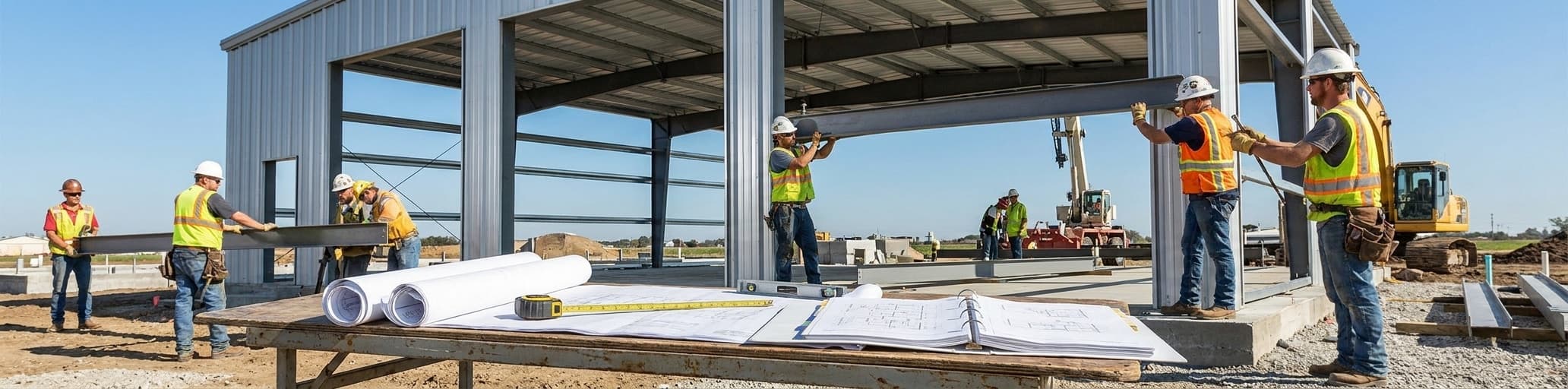

We help you navigate the real costs and hidden variables that separate legitimate metal garage suppliers from brokers who disappear after delivery. Choosing the right company means locking in steel prices upfront, securing site-specific engineering before permits, and establishing clear communication that protects your budget from start to finish.
What Makes a Metal Garage Company the Best Choice for Your Project
Pre-engineered kits save money on standard projects under 5,000 square feet, while custom designs cost less when your build requires non-standard dimensions or complex modifications.
Single-source accountability: Why design-build matters more than separate contractors
Custom engineering vs. one-size-fits-all kits: What actually saves money The answer depends almost entirely on what you're building.
Pre-engineered packages win on straightforward builds — a standard 40×60 shop, a single-bay agricultural storage building, a basic commercial garage — because the structural engineering is already done, which cuts both lead time and design cost.[4] Manufacturers who produce hundreds of similar buildings optimize every process, and that efficiency lowers your price.[4] Kit prices typically run $15-$25 per square foot, but that number only covers the steel shell — site prep, concrete foundation, erection labor, doors, windows, and insulation are all separate line items.[5] Most buyers underestimate those additions on paper, which is where the kit-vs-custom comparison gets distorted.[5] Once your project crosses into non-standard territory — unusual clearspan widths, a mezzanine, a crane rail system, complex foundation conditions — a pre-engineered package starts requiring significant modifications anyway, and at that point a fully custom design often costs less overall because you're not paying to work around a standard template.[4] Lead time tells the same story: pre-engineered packages ship in 6-14 weeks; custom designs run 12-24 weeks or more because original engineering drawings must be completed before production starts.[4] For most metal garage projects under 5,000 square feet with standard dimensions, a pre-engineered kit built to your local wind, snow, and seismic codes delivers the best cost-to-value ratio — steel's strength-to-weight ratio is roughly 25 times greater than wood, yet the frame arrives lighter and faster to erect than any stick-built alternative.[5] The real savings aren't in the kit price itself; they're in the shorter construction window, lower insurance premiums that run up to 40% less than wood-frame equivalents, and a maintenance cost that approaches zero over decades.[5]
Local code compliance and permits: The hidden cost of choosing the wrong partner
The permit step is where projects fail fastest — and where your choice of company has the most direct financial consequence.
Most buyers treat permits as a formality and underestimate how much they cost when handled wrong.[6] Building before approval is granted can force you to tear down a completed structure at your own expense and pay fines on top of it; without building authority certification, you may also be unable to sell the property later.[7] Your permit application must include state-licensed engineer-stamped drawings, a plot plan showing existing and proposed structures, intended use, and any wiring or plumbing plans — your local building department supplies the full checklist.[7] Incomplete or improperly filed applications don't just slow things down; they can halt construction entirely and expose you to legal liability.[8] A company that delivers state-specific stamped engineering plans as part of every standard package — not as a paid upgrade — moves through local building departments without surprises.[7] The practical rule: never accept delivery of fabricated steel before your permit approval is in hand, because last-minute adjustments required by building officials after steel has been cut to spec come out of your pocket.[7] For a clear picture of how permit timelines vary across jurisdictions, the warehouse addition permits state-by-state approval roadmap is worth reviewing before you finalize your project schedule.
How Much Should a Metal Garage Cost in 2026: Real Pricing for Common Sizes
A 30×40 metal garage shell costs $18,000 to $26,000, but your complete installed project–with slab, labor, doors, and permits–runs $29,000 to $52,000 for an enclosed building.
30×40 metal garage with concrete slab: Itemized cost breakdown and what's included
A 30×40 metal garage gives you 1,200 square feet of clear-span space — enough for three vehicles, a workshop, or small commercial storage — and it's one of the most popular footprints precisely because pre-engineered kits hit their peak cost efficiency at this size.[9] The installed price range looks wide at first glance, but it's honest: it reflects three real variables — what the steel shell includes, what your slab requires, and what your local building department demands in engineering.[10] The kit itself covers primary steel framing (columns and rafters), secondary framing (purlins and girts), and roof and wall panels, and runs $18,000 to $26,000 for a standard package.[10] That number trips up buyers who treat it as the project total. A 6-inch reinforced concrete slab — the minimum for vehicles and equipment — adds $8,500 to $13,500 before aprons or edge thickening are factored in, and a basic garage slab runs $6-$12 per square foot depending on regional labor rates.[9][10] For a full treatment of how slab thickness changes with intended use, the 30×40 concrete slab cost breakdown covers what actually moves that line item.
A complete 2026 project looks like this when every cost is on the table:
| Line item | Typical cost range |
|---|---|
| Steel building kit (shell only) | $18,000 – $26,000 |
| Concrete slab (6" reinforced, 1,200 sq ft) | $8,500 – $13,500 |
| Erection labor (3-5 days, professional crew) | $6,000 – $12,000 |
| Doors, windows, and walk-in entry | $2,500 – $6,000 |
| Insulation | $3,000 – $7,000 |
| Permits and engineer-stamped drawings | $1,500 – $4,000 |
| **Total — enclosed shell, no interior finishing** | **$29,000 – $52,000** |
| **Total — fully finished, climate-controlled** | **$52,000 – $106,000** |
The kit price never includes site preparation, utility connections, interior finishing, or electrical wiring — and buyers who compare quotes without accounting for those additions consistently underestimate final cost.[11] The gap between a basic enclosed shell and a fully finished, climate-controlled facility is real and comes entirely from those additions: door quality, insulation system, HVAC, and interior work.[10] Spray foam insulation alone can reduce building energy costs by 30-50%, which makes it worth budgeting as a separate line item rather than an afterthought.[10] Climate loads apply pressure from the other direction: northern counties with heavy ground snow loads typically require 10-15% more on the base kit price because roof pitch and beam sizing must be engineered specifically for those conditions, and high-wind coastal sites carry a comparable premium for heavier-gauge framing.[10] A 10-12 ft eave height handles most full-size pickups with roof racks and leaves room for a basic storage loft, but taller clearances for commercial vehicles or equipment push the kit cost up as well.[9]
40×60 garage pricing: Why size and customization drive final quotes
National vs. regional suppliers: Buying power and how it affects your final bill The supplier you choose determines how much of the current steel market volatility lands on your invoice. Hot-rolled coil prices climbed from $650 to roughly $900 per ton following the initial 25% tariff on steel and aluminum imports.[16] That tariff then doubled to 50% in June 2025, triggering 10-12% pre-summer price increases from most fabricators.[17] Quotes can shift further due to ongoing supply chain disruptions, anti-dumping investigations involving multiple exporting countries, and coil-coating inflation — all of which are still unresolved.[17] In that environment, the supplier's purchasing infrastructure is the real variable in your estimate, not the size of the building.[15]
National suppliers with volume mill contracts lock in steel prices weeks or months ahead of delivery, absorbing tariff shocks before they reach your line items.[16] Regional suppliers ordering steel project-by-project carry no such buffer — each policy change rolls directly into a revised quote.[17] Bundling design, fabrication, and erection under one supplier also removes the overhead layering that accumulates when separate vendors each add their margin to the same job.[17] Prices fluctuate based on global market conditions, economic policy, and supply chain disruptions, so comparing quotes without accounting for when and how each supplier purchases their steel produces a misleading comparison.[15] When comparing steel garage kits from national and regional sources, ask one direct question before you sign: is the steel already purchased and allocated to your project, or will it be bought at whatever the market rate is after you commit? That single answer separates a firm price from a placeholder.
Five Critical Questions to Ask Before Choosing a Metal Garage Company
Your metal garage's structural safety depends on site-specific engineering for wind uplift, roof panel fasteners, and snow loads–not generic standard frames.
Can they customize for your specific climate, wind loads, and snow requirements? Climate customization is where budget kit suppliers fail first — and where your building's structural integrity is actually decided. U.S. wind loads are governed by ASCE 7-22, adopted into the 2024 International Building Code, with design wind speeds expressed as 3-second gusts at 33 feet above ground.[23] Those speeds range from roughly 115 mph in sheltered interior regions to over 185 mph along the Gulf Coast and South Florida hurricane zone.[23] A company selling the same standard frame to a buyer in central Nebraska and a buyer in coastal Louisiana is selling the wrong building to at least one of them. Wind doesn't just push horizontally against walls — it also creates uplift on roofs and outward suction on surfaces, and both forces require separate engineering calculations for your specific site.[23] A common mistake that costs buyers money: verifying the frame is engineered for main wind force resisting system (MWFRS) loads without ever requesting the components-and-cladding (C&C) pressure calculations that govern how roof panel fasteners perform at corners and edges — ask for that document as a standalone item, not buried in the general engineering package.[23]
Snow load adds a second layer of site-specific engineering that generic kits handle poorly. Average snow load ratings for metal garages run 20-30 psf, but state-by-state ranges stretch from 0-10 psf in Georgia to 20-30 psf in West Virginia and Pennsylvania — and those are state-wide averages that don't account for elevation and microclimate differences within a single county.[24] The weight variable shifts further based on snow type: light snow exerts 5-20 psf, packed snow reaches 20-40 psf, and ice can load a roof at up to 57 psf — nearly three times the minimum most standard kits are engineered to handle.[25] Roof pitch interacts with accumulation directly: steeper pitches shed snow more effectively, reducing the structural load the frame must carry, but only when pitch was specified against your actual local ground snow load figure, not a regional average.[24] Drifting compounds the problem — wind pushes snow into uneven accumulations at roof penetrations and equipment curbs, creating concentrated loads on sections of the frame that standard kit engineering may never have modeled for your site.[25]
The practical test is direct: ask any candidate supplier for the ground snow load figure for your parcel address, the ASCE 7-22 design wind speed and exposure category for your site, and a separate C&C pressure calculation confirming how roof panel fastening was engineered for corners and edges.[23] For projects in Pennsylvania, where ground snow loads reach 20-25 psf and local building departments scrutinize engineering submissions closely, the Pennsylvania steel building climate specs covering snow and humidity requirements shows exactly how those numbers interact with code enforcement expectations. A supplier who responds with a site-specific PE-stamped engineering package has done the work. One who hands you a standard kit spec sheet has not — and that gap is the difference between a building engineered for your climate and one that passes until the first hard winter tests it.
How to Vet and Compare Metal Garage Companies: Decision Essentials
Ask these twelve questions before signing a contract to uncover hidden costs and separate legitimate manufacturers from brokers who disappear after delivery.
Vetting Essentials: 12 must-ask questions and red flags to watch for
Most buyers ask the wrong questions at the wrong time — usually after they've signed a contract and discovered that the quote covered far less than expected. Vetting a metal garage company before you commit takes one focused conversation, and the questions below are the ones that separate legitimate suppliers from brokers who disappear after delivery.[26] The hidden costs and time commitments that catch buyers off guard are almost always predictable — they show up in exactly the answers a company gives (or avoids) before you sign.[26]
Twelve questions worth asking any supplier before you commit:
- Are you the manufacturer, or are you a broker reselling another company's steel? Brokers can offer low prices because they carry no engineering responsibility and have limited incentive to handle warranty claims.[27]
- Who employs the engineer who stamps my drawings? If the answer points to a third party, you're dealing with a coordinator, not a single-source partner.[27]
- What does your quote actually include — line by line? A steel shell kit price and a complete project price are different numbers, and conflating them is where most budget surprises originate.[26]
- Does your price reflect current steel market conditions, or was it locked in before recent tariff increases? Prices fluctuate with steel markets, engineering requirements, and regional labor rates — a quote that looks low may reflect last quarter's coil pricing.[28]
- Can I select my own doors, windows, gutters, and accessories, or are those pre-selected for me? A supplier who won't let you make your own selections on accessories is likely bundling margin into items you never priced separately.[27]
- What is your realistic fabrication-to-delivery timeline for my size and location? A steel building requires engineering drawings, approval cycles, direct-buy design review, permit submission, and fabrication before anything ships — any supplier promising delivery in a matter of weeks without a completed permit should be questioned.[27]
- How do you handle engineering modifications required by my local building department after submission? Changes required after steel is cut come out of someone's budget — find out whose before you sign.
- What warranty do you offer, and which company is legally responsible for honoring it? Brokers who outsource fabrication and engineering have less incentive to placate warranty claims.[27]
- Do your standard packages include PE-stamped, state-specific engineering drawings, or is that an add-on? This determines whether your permit application moves forward or stalls.
- Can I see examples of projects you've completed in my county or jurisdiction? Local permit track record is a direct predictor of your approval timeline.[27]
- Is freight consolidation available if I'm flexible on delivery dates? Working with the shipping and logistics department on delivery scheduling can produce real savings — a supplier who offers no flexibility on this question is limiting your options.[27]
- What is your process if fabricated parts don't fit correctly on site? Cheap buildings often arrive with holes that don't align because fabrication prioritized speed over precision — ask how they handle it before it becomes your problem.[27]
The red flags that matter most tend to cluster around three patterns. A quote that is dramatically lower than comparable suppliers is almost always cheap because the company doesn't follow industry standards and is padding its own bottom line at the expense of fabrication quality — in the construction industry, the cheapest building routinely ends up being the most expensive once you account for labor costs, construction delays, and poor fit.[27] "All-included" language deserves the same skepticism you'd give any bundled package: if a supplier pre-selects your doors, windows, and accessories without offering you the choice, you have no visibility into the markup applied to each item.[27] And any company that promises steel building delivery in days or a few weeks without a completed engineering, permitting, and fabrication cycle is either describing a pre-fabricated shell with no site-specific engineering, or is simply telling you what you want to hear — a full-service agricultural building contractor checklist applies the same scrutiny to farm projects, but the principles hold across every build type.[27]
Communication and responsiveness: Why it matters more than you think
How a metal garage company responds to your first inquiry is the most accurate preview you'll get of how they'll handle a permit delay, a fabrication question, or a site issue at 7 a.m. on erection day. Poor communication between a supplier and buyer produces predictable damage: delayed decisions stall production schedules, unresolved questions become change orders, and small frustrations compound into disputes that slow your project and inflate your final cost.[30] A company that takes three days to return a quote call will not suddenly become responsive when your building permit triggers a revision request from the county engineer.
The practical test is simple — call before you buy, ask a technical question about your specific site, and measure the response: did they answer directly, or did they hand you to voicemail and follow up with a generic email two days later?[29] Establishing a clear communication protocol from the first contact isn't a courtesy; it's a structural requirement of any project that touches engineering, permitting, fabrication, and erection across weeks or months.[30] On projects lasting longer than six to eight weeks, suppliers who build scheduled update checkpoints into their standard process — not just reactive calls when something goes wrong — catch problems while corrections are still inexpensive.[31] The financial consequence of the alternative is direct: customers who feel their concerns aren't being addressed report lower satisfaction, shorter project cycles disappear, and maintenance costs from late-stage corrections climb — all of which trace back to a communication gap that existed before the first bolt was tightened.[30] When you're comparing suppliers, one question cuts through the noise: who is your single point of contact from quote to final inspection, and what is their direct line? A company that can answer that question immediately has already structured their operation around your outcome.
One that routes you through a general inbox has not.[29]
Warranty, maintenance, and long-term support: What to demand in writing
Metal building warranties split into four distinct categories, each covering different failure modes. Structural warranties cover the primary frame — columns, rafters, and main framing members — and reputable manufacturers offer 50 years on this component.[34] Panel and roofing warranties run separately, typically 20-40 years, but most are prorated: a failure in year 15 of a 25-year panel warranty yields a partial credit based on remaining warranty life, not a full replacement.[33] Paint warranties cover fading, chalking, peeling, and coating breakdown, generally for 20-30 years.[32] Workmanship warranties address installation problems — improper sealing, fastener issues, and misalignment.[32] Each warranty originates from a different party (manufacturer vs. installer), follows its own claim process, and carries its own exclusions, which means your building can be fully within warranty on the frame, out of warranty on panels, and disputing a workmanship issue at the same time.[32]
The detail most buyers miss is what a warranty claim actually costs when you file one. A panel covered under a manufacturing defect warranty costs nothing for the part itself — but labor, shipping, and installation of replacement components come out of your pocket.[33] One buyer paid $2,400 in labor to install a $180 panel that was fully covered.[33] That gap is predictable and almost never disclosed at the point of sale. Get labor and shipping responsibility in writing before you sign, not after a failure forces the conversation.
Three factors determine whether a warranty actually protects your investment. First, company longevity: a 50-year structural warranty from a manufacturer who goes out of business in year three is unenforceable — stick with suppliers who have been operating at least 20 years, because that track record is the only real guarantee the warranty will be honored when you need it.[33] Second, transferability: a non-transferable warranty reduces resale value because lenders and buyers routinely require proof of valid coverage during sales and refinancing.[33] Third, maintenance requirements: most warranties require "reasonable maintenance" without ever defining what that means, and claims get denied when owners can't produce documentation of annual inspections or when they patched a surface scratch without first contacting the manufacturer.[33] Some warranties also void coverage if insulation is added after construction — a detail that matters if you're planning a phased build.[33] Get the complete exclusions list as a standalone document, separate from the marketing materials, and document every maintenance action against that schedule.
Before you sign any steel building contract, demand the following in writing:
- Structural frame warranty duration and whether it covers manufacturing defects, premature corrosion, and load specification failures[33]
- Panel and roofing warranty terms — prorated or full replacement, and for how many years[33]
- Paint and finish warranty covering fading, chalking, and peeling, with defined maintenance triggers[32]
- Workmanship warranty covering installation errors, with the name of the legally responsible party[32]
- Complete exclusions list, including post-construction modifications that void coverage[33]
- Transferability terms confirming the warranty follows the property, not the original buyer[33]
- Labor and shipping responsibility on warranty claims[33]
- Maintenance schedule with documentation requirements so you know exactly what records to keep[33]
Negotiate warranty extensions as part of your purchase price rather than asking for a kit discount — an additional 10 years of structural coverage is worth more than a few hundred dollars off the base price.[33] For any metal garage buildings pros and cons comparison you run before committing, warranty transferability and supplier age should rank alongside price as primary decision factors — a low quote from a company that has been in business three years carries warranty risk that never appears on the line-item breakdown.
- Pre-engineered kits win on standard builds under 5,000 sq ft; custom designs cost less when projects require non-standard modifications.
- A 30×40 metal garage shell costs $18,000-$26,000, but total project cost ranges $29,000-$52,000 once slab, labor, and permits are included.
- Steel tariffs doubled to 50% in June 2025; national suppliers with volume contracts lock in prices, while regional suppliers pass increases directly to you.
- Site-specific engineering for wind loads, snow loads, and roof panel fastening is critical–generic kit specs fail in challenging climates.
- Warranty claims often exclude labor and shipping costs; a $180 panel replacement can cost $2,400 in installation labor out of your pocket.
- Ask suppliers directly: Is steel already purchased and allocated, or will it be bought at market rate after you commit? This separates firm quotes from placeholders.
- Red flags cluster around three patterns: dramatically low quotes, pre-selected accessories with hidden markups, and promises of delivery without completed engineering.
- https://cicconstruction.com/blog/single-point-of-accountability-how-design-build-delivery-eliminates-project-risk-across-multiple-markets/
- https://fraser-construction.com/the-benefits-of-choosing-a-design-build-approach-for-commercial-construction/
- https://www.buildingsguide.com/metal-building-kits/?srsltid=AfmBOoqlZ8zcTQ6eRTji8xn3NHoqN2eTPEXf9bPBownDN0D9avVGHy9h
- https://www.steelstructuresamerica.com/pre-engineered-vs-custom-metal-buildings/
- https://buildway.com/cheapest-steel-building-types-2026-costs/
- https://buildway.com/steel-building-permits-guide-and-checklist/
- https://www.rhinobldg.com/blog/do-you-need-building-permits-for-metal-buildings
- https://ddcon.co/metal-building-failures-common-mistakes-in-metal-building-construction-and-how-to-avoid-them/
- https://www.engineeredmetalbuildings.com/blog/30×40-metal-building-prices/?srsltid=AfmBOoqrV2N_33h4308RRcJqcbc5jsFEl5EE3Oiaoyopt3CrI_2MbpMr
- https://www.steelcobuildings.com/how-much-does-a-30×40-steel-building-cost-in-2026/
- https://homeguide.com/costs/metal-building-cost
- https://steelbuildingkit.com/40×60-metal-building-kit-cost-guide/
- https://prometalbuildings.com/how-much-does-a-40×60-metal-building-actually-cost-in-2026/?srsltid=AfmBOor5iBgupXvXWOuP03QbJjO3fmrinQQ-imMne19odzpEBGrZ2JiF
- https://www.buildingsguide.com/metal-building-prices/?srsltid=AfmBOoogefm_zLyoiJnWilj2PuJaPA8E1X0i4BUM67TiCn_V8zRM8_1D
- https://americansteelinc.com/blog/steel-building-costs-prices-guide/
- https://www.tylerbuilding.com/post/steel-market-trends-why-now-is-the-time-to-buy-a-metal-building
- https://www.steelcobuildings.com/2025-steel-tariffs-and-rising-metal-building-costs/
- https://fse-ok.com/labor-only-vs-materials-erect/
- https://bansalpoles.co.in/blog/tips-for-choosing-the-right-supplier-for-your-pre-engineered-metal-buildiing
- https://www.netsuite.com/portal/resource/articles/erp/in-house-manufacturing-vs-outsourcing.shtml
- https://www.arcosteel.com/what-permits-and-codes-are-required-for-steel-buildings/
- https://www.universalsteel.com/navigating-metal-building-permits-and-requirements-a-comprehensive-guide/
- https://www.vikingsteelstructures.com/blog/steel-building-wind-load-requirements-asce-7-exposure-categories-usa-regional-guide?srsltid=AfmBOopVpL50oHfDEEV5EE5t-5Oim7H89VlaDeRjh9scueSs50Osjuzm
- https://americanmetalgarages.com/snow-load-vs-wind-speed-metal-buildings/
- https://www.alliedbuildings.com/understanding-snow-load-limits-for-steel-buildings/
- https://buildway.com/questions-to-ask-a-metal-building-supplier/
- https://armstrongsteel.com/blog/buyer-beware-watch-3-steel-building-red-flags
- https://roimetalbuildings.com/how-to-vet-a-metal-building-quote/
- https://www.ecisolutions.com/blog/residential-construction/top-10-communication-strategies-in-construction-project-management/
- https://www.builderleadconverter.com/essential-role-of-customer-service-in-home-building-projects/
- https://projul.com/blog/construction-customer-satisfaction-surveys-guide/
- https://www.vikingsteelstructures.com/blog/what-is-included-in-a-metal-building-warranty-know-the-in-out?srsltid=AfmBOoqVF_6zShKQpZiws6qenBEdJrhFm4I2TL-Z3J9pmFn_OZcWdG4I
- https://www.factorysteeloverstock.com/steel-building-warranty-coverage/
- https://www.worldwidesteelbuildings.com/about/50-year-structural-warranty/