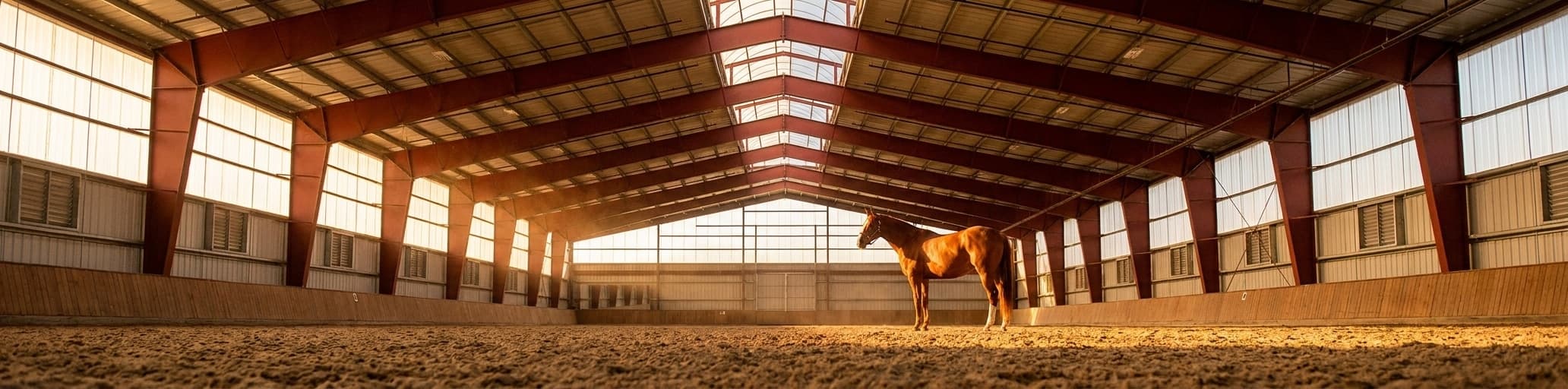

Proper ventilation in equestrian facilities prevents respiratory disease in horses and structural deterioration from moisture and ammonia buildup. Steel framing lets us integrate ridge vents, sidewall inlets, and mechanical systems during design rather than retrofitting them later, protecting both animal health and your budget.
Why Ventilation Makes or Breaks Your Indoor Horse Arena
Poor ventilation drives ammonia concentrations high enough to suppress immune function and trigger inflammatory airway disease that silently erodes your horse's performance.
How Poor Air Quality Affects Horse Health and Performance
Horses breathe far more air during exercise than at rest, which means every airborne contaminant inside your indoor horse arena gets delivered deeper into the lungs at exactly the wrong moment.[2] The primary offenders are dust particulates, ammonia from manure breakdown, and fungal spores from bedding and forage — each capable of triggering airway inflammation independently, and measurably more damaging in combination.[3] Research monitoring indoor equestrian facilities recorded ammonia concentrations as high as 22.39 mg/m³ in poorly ventilated stables, a level that attacks the upper respiratory tract at lower doses and leads to immune suppression and metabolic stress with sustained exposure.[3] Repeated exposure over time drives two distinct clinical outcomes: inflammatory airway disease (IAD), which causes subclinical performance decline with few obvious symptoms, and recurrent airway obstruction (RAO), a hypersensitivity-driven condition that produces visible respiratory distress and lower airway obstruction.[1] The performance cost is concrete — particulate-driven tracheal mucus accumulation, confirmed endoscopically in multiple studies, correlates directly with reduced race speed and compromised respiratory function in working horses.[1] Even animals showing no outward symptoms can carry subclinical inflammation that quietly erodes conditioning gains, which is why air quality inside steel riding arenas deserves the same engineering attention you give the footing or structural span.[2]
The True Cost of Inadequate Ventilation: Respiratory Issues and Facility Damage
The respiratory harm described above is only half the ledger. Poor ventilation accelerates structural deterioration at a rate that compounds quietly until repair estimates arrive. High humidity from stagnant air generates wood rot and rust, creates hospitable conditions for termites and carpenter ants, allows mold to colonize feed storage areas, and causes paint to peel from stall doors.[4] More insidiously, moisture migrates into structural members in hard-to-inspect locations, compromising integrity long before any visible warning appears.[4] Owners of prefabricated steel riding arenas gain natural resistance to rot and insect damage through their material choice — but sustained high humidity still shortens roof and wall panel life spans without adequate airflow to clear that moisture load.
The contamination burden also falls on every person working inside your facility. Dust particles cause eye and nose irritations and contribute to respiratory damage in riders, trainers, and barn staff — not just the horses.[5] Beyond biology, airborne particulates settle continuously on equipment, electrical fixtures, and mechanical systems throughout the structure, increasing maintenance frequency and accelerating component wear.[5] Ammonia from decomposing urine and feces compounds this effect, degrading the working environment for everyone on site and making the barn unpleasant long before any animal shows clinical symptoms.[4]
The scale of the problem sharpens when you factor in air intake volume. An idle horse inhales roughly 16 gallons of air per minute; during strenuous exercise that figure climbs to 600 gallons per minute.[5] Every contaminant circulating in your indoor horse arena gets delivered in direct proportion to that volume, which means financial exposure accumulates on two fronts simultaneously — veterinary costs on one side, accelerated facility maintenance and structural repair on the other.[5] Addressing ventilation at the design stage costs a fraction of what remediation demands after the fact.
What Makes Steel Buildings the Superior Choice for Equestrian Ventilation
Steel's structural properties solve a problem that wood frames fundamentally cannot: integrating ventilation into the building itself rather than bolting it on afterward. Because steel framing carries roof loads through large-span trusses out to the exterior walls, there are no interior columns interrupting airflow across the full arena width.[6] Wood construction tops out around 50 to 60 feet before requiring internal supports; steel spans 80, 100, even 120 feet clear.[6] Every post you eliminate is a point where air stagnates, dust settles, and ammonia concentrates at horse-breathing level.
With steel framing, ridge vents, continuous sidewall vents, cupolas, and mechanical exhaust fans all integrate cleanly into the structure during the design phase — not as awkward retrofits.[7] Ventilation systems must be incorporated at the design stage to perform effectively; adding them to a completed building almost always reduces airflow efficiency and raises costs.[7] A combination of ridge vents for heat release, sidewall openings for cross-ventilation, and mechanically assisted fans for circulation handles the overlapping demands of humidity, ammonia, dust, and temperature that equestrian facilities generate at a scale greater than standard commercial buildings.[7] Insulated steel panels contribute a second layer of control: an R-19 assembly stabilizes interior temperatures, which breaks the condensation cycle that concentrates airborne particulates near ground level where horses spend most of their time.[6]
The material behavior matters as much as the structural geometry. Wood absorbs moisture from daily horse activity — urine, manure, wet bedding, and exhalation — which sustains the damp microenvironment that ammonia and fungal spores need to accumulate.[7] Steel doesn't absorb moisture, so humidity removed by a properly designed ventilation system stays removed rather than being reabsorbed into wall and roof framing overnight.[7] That single characteristic means your indoor riding arena cost doesn't quietly compound through structural degradation driven by the same air quality problems your ventilation system was supposed to solve.
Indoor Horse Arena Ventilation Specifications: What You Need to Know
Your indoor arena needs 4 to 8 air changes per hour — 8 to 16 times higher than a home — to control moisture, ammonia, and dust from horses.
Required Air Exchange Rates and CFM Calculations for Equestrian Facilities
The ventilation target for any indoor horse arena is 4 to 8 air changes per hour (ACH) — enough to suppress mold spores, prevent condensation, and keep ammonia and moisture from accumulating.[8] For context, a modern home turns over its air roughly half a time per hour; horse facilities need 8 to 16 times that rate because of the moisture, manure gases, and dust load generated inside.[8] Natural ventilation achieves this through two coordinated opening types: sidewall inlets that admit fresh air at horse-breathing level and ridge vents that exhaust warm, stale air rising to the roof peak.[8] When mechanical fans are added — necessary in heated facilities or during hot, windless days — the required airflow scales directly with horse bodyweight. The table below shows the tiered CFM targets from agricultural engineering guidance:
| Season / condition | CFM per 1,000 lbs of horse | Purpose |
|---|---|---|
| Cold weather | 25 cfm | Moisture and ammonia removal |
| Mild weather | 125 cfm total (add 100 cfm) | Heat removal, temperature ~50 degreesF |
| Hot weather | 325 cfm total (add 200 cfm) | Prevent heat stress, fans trigger ~60 degreesF |
Calculating whether your facility actually hits those targets is straightforward: measure air velocity at each inlet opening with an anemometer (feet per minute), multiply by the open area in square feet to get CFM, then divide the total CFM by the building's air volume (floor area x average ceiling height) and multiply by 60 to convert to ACH.[8] For mechanical systems, size your fresh-air inlets at 1.7 square feet per 1,000 CFM of fan capacity — undersized inlets create back-pressure that cuts fan performance even when the fan itself is correctly sized.[8] Getting this math right at the design stage is far cheaper than adding fans and cutting new openings into finished wall panels afterward.
Natural ventilation opening specs translate those ACH targets into construction dimensions you can hand directly to your builder. The minimum cold-weather eave inlet is 1 continuous inch of slot opening per 10 feet of building width, running the full length of each sidewall so every stall gets equal fresh air.[8] Ridge openings should match eave area — at minimum 1 square foot of unobstructed throat opening per horse housed — and agricultural-grade ridge vent assemblies must be used, since residential soffit and ridge products restrict airflow to roughly one-third of what equestrian facilities need and clog with stable dust within months.[8] For warm-weather cross-ventilation, each stall should have openings equivalent to 5 to 10 percent of its floor area; a standard 12×12 stall requires a 3×2.5-foot open window at the 5 percent minimum.[8] Sliding panel wall systems purpose-built for riding arenas are a practical way to hit warm-weather targets without the noise of curtain systems that can startle horses — rigid panels operate quietly even in wind and can be motorized for precise control of opening size.[10]
Dust Control, Ammonia Removal, and Humidity Management Standards
Dust behaves differently at different heights, and your fan placement determines whether ventilation solves the problem or redistributes it. Mount circulation fans just above head height so airflow moves over the horse's back and neck — at that elevation, fans cool the animal without lifting settled particles from floor level, where dust and manure debris concentrate.[11] The single most impactful management decision for dust load is eliminating overhead hay and bedding storage directly above stalls: dust, chaff, and mold spores fall continuously onto horses from overhead storage, and stable managers who move forage to a separate structure consistently report a marked drop in airborne irritants.[8] Where overhead storage can't be avoided, position it above the work aisle rather than the stalls, and maintain at least 3 feet of clearance between stored materials and the roofline so an airflow path to the ridge opening remains unobstructed.[8]
Ammonia is a floor-level problem, not an aisle-level one. Because ammonia originates from decomposing urine and manure in bedding, concentrations are highest near the stall floor — at foal height, at feeding height when horses eat from ground level, and during the hours horses spend lying down.[8] Evaluating air quality from the barn aisle tells you almost nothing useful; you need to check it inside the stall, near the bedding.[8] In winter, when doors and windows stay closed, ammonia accumulates faster than any other season — and double-aisle stable configurations with central stalls far from any exterior opening are the hardest to keep below harmful thresholds without daily manure removal and dedicated fresh-air inlets positioned at each affected stall.[8] The ventilation fix is positioning at least one air inlet adjacent to every box stall so fresh air reaches the horse rather than stopping at the aisle.[9]
Humidity management starts with understanding the moisture source: a single horse respirates roughly 2 gallons of water per day, and bathing, cleaning, and wet bedding add more.[11] That moisture load, trapped in a closed building, creates condensation on interior surfaces — which is your clearest field indicator that ventilation is failing.[8] The winter standard is keeping interior temperature no more than 5 to 10 degreesF above the outside temperature; a tighter building chasing warmth will show condensation before it shows any other warning sign.[8] Insulation targets for mechanically ventilated facilities are R-15 for walls and R-25 for the ceiling, with a vapor barrier installed on the warm side of all insulated assemblies to stop moisture migration into structural components.[9] For naturally ventilated barns, a roof-only assembly of R-2 to R-4 prevents condensation from forming on the underside of the roof in winter while reducing summer heat gain — a steel building insulation assembly specified correctly at the design stage costs far less than remediating condensation damage discovered years after completion.[9] During summer in mechanically ventilated facilities, keeping the building closed and running exhaust fans and inlets to manage temperature is more effective than opening large doors, which bypasses the exhaust fan system and transfers control entirely to unpredictable wind forces.[9]
How National Steel Buildings Designs Custom Ventilation Systems Into Your Structure
Custom equestrian layout plans coordinate ventilation, drainage, and lighting as a single integrated system from the first drawing — not three separate problems solved after the structure is framed.[12] Clear-span framing removes every interior column that would otherwise deflect airflow, concentrate ammonia, and create dead zones across the arena floor; a Red Iron structure spanning 100 feet delivers that column-free space economically in a way no other structural system matches at that scale.[13] Large sliding doors on endwalls handle dual duty, giving horses easy access while creating natural cross-ventilation on warm days without any additional mechanical equipment.[13] The result is a building where the geometry itself moves air before a single fan turns on.
When natural ventilation alone isn't enough — heated facilities in cold climates, fully enclosed barns in humid regions, or arenas where competition schedules require consistent conditions regardless of outside weather — HVLS (high-volume, low-speed) fans integrate cleanly into the structure during construction to improve airflow and temperature control across the full arena width.[12] For precise climate management year-round, an HVAC system can be added during the metal building construction phase rather than retrofitted around finished wall panels later, which keeps mechanical runs clean and avoids the cost penalties of cutting new penetrations into completed assemblies.[12] Specifying your prefabricated steel riding arena with ventilation components positioned in the original drawings means mechanical contractors work from a complete set of engineered dimensions — no improvised duct routes, no fan mounts competing with primary framing members, and no surprises on the final invoice.
Indoor Horse Arena Size and Layout: Impact on Ventilation Costs
Your arena's footprint and frame material directly determine ventilation costs, with a 100×200 steel structure typically requiring $20,000 to $40,000 for mechanical systems.
Standard Arena Dimensions and How They Affect Airflow Design
Ventilation Cost Comparison: 100×200 Covered Arena vs. Other Configurations Arena size determines both the ventilation scope and which structural system you can actually use — and those two variables together set your ventilation budget more than any single component choice. A 60×120 indoor horse arena works for basic training and single-horse use, and at that footprint a wood frame structure remains viable.[17] Wood frame construction tops out at roughly 90 feet of width, though, which eliminates it as an option for any 80×200 or 100×200 build — leaving only steel framing or fabric-covered structures at those larger spans.[16] Fabric-covered structures are difficult to insulate, which compounds ventilation costs in cold climates because mechanical systems have to compensate for what insulation would otherwise handle.[16] Steel framing sidesteps both constraints: it handles any width up to 200 feet or more, integrates ridge vents and mechanical fans cleanly during fabrication, and provides an insulation-ready envelope.[16] Adding heating, ventilation, or full climate control to an indoor arena runs $8,000 to $40,000 depending on scope — and a 100×200 footprint at 20,000 square feet will consistently land in the upper half of that range when mechanical systems are included, while a 60×120 natural-ventilation build can stay near the lower end.[17] Mechanical systems cost more than natural ventilation but give you direct control over air exchange rates, which matters most in fully enclosed arenas or heated facilities where doors stay shut for extended periods.[16]
| Arena size | Floor area | Viable structure types | Practical ventilation approach | Estimated ventilation/HVAC cost |
|---|---|---|---|---|
| 60×120 | 7,200 sq ft | Wood frame, steel, fabric | Natural (ridge + sidewall openings) | $8,000-$15,000 |
| 80×200 | 16,000 sq ft | Steel, fabric only | Natural + supplemental mechanical | $15,000-$28,000 |
| 100×200 | 20,000 sq ft | Steel, fabric only | Natural + full mechanical recommended | $25,000-$40,000 |
The 100×200 configuration is one of the most popular indoor horse arena sizes precisely because it handles reining, cutting, and multi-horse schooling without requiring a larger structural commitment — but that footprint is also where ventilation moves from an optional upgrade to a budget line you plan around from day one.[18] Larger structures cost more in total but less per square foot, so the incremental cost of engineering proper ventilation into a 100×200 steel build is proportionally smaller than retrofitting a smaller wood-frame arena that was never designed for it.[17]
Ridge Vents, Soffit Intakes, and Mechanical Systems–Which Combination Fits Your Budget
The lowest-cost starting point is a natural system — continuous eave-slot inlets paired with an agricultural-grade ridge vent — because it has no electrical operating cost and no mechanical components to maintain.[8] The critical spec decision here is product selection: residential soffit and ridge vent products pass only one-third of the airflow equestrian facilities require, and stable dust clogs their small perforations within months of installation.[8] Agricultural ventilation manufacturers produce ridge assemblies with an unobstructed throat opening at the narrowest point of the airflow path — that restriction, not the manufacturer's listed dimensions, is the number that determines actual throughput.[8] Natural systems are adequate for unheated, temperate-climate barns with consistent wind exposure, but they offer no control during hot, still summer days or during heated winter operation when doors stay shut — conditions where airflow depends entirely on forces outside your control.[9]
A hybrid configuration adds sidewall exhaust fans to the natural baseline and closes the gaps without committing to full mechanical infrastructure. Fan sizing scales directly with horse bodyweight: 25 cfm per 1,000 lbs covers cold-weather moisture and ammonia control, a second fan stage adds 100 cfm per 1,000 lbs for mild-weather heat removal, and a third stage brings total capacity to 325 cfm per 1,000 lbs for hot-weather conditions.[9] Fresh-air inlets must be sized at 1.7 square feet per 1,000 cfm of fan capacity — an undersized inlet creates back-pressure that degrades fan output regardless of motor rating, which is the most common installation mistake in retrofitted systems.[9] For most agricultural steel buildings operating in temperate to cold climates without year-round heating, a hybrid system delivers the control you need at a fraction of full mechanical cost.
Full mechanical ventilation is the right choice for heated facilities, enclosed competition arenas, or any building where doors stay closed for extended periods and natural forces can't be counted on.[9] These systems require the building envelope to be as airtight as practical, with R-15 walls, R-25 ceiling, and a vapor barrier on the warm side of all insulated assemblies — insulation values roughly four to six times higher than what a naturally ventilated barn needs.[9] Summer operation in a fully mechanical building runs counter to instinct: keep large doors closed, run exhaust fans and inlets to manage temperature, and resist the urge to open endwalls, which bypasses the fan system entirely and transfers air exchange control to unpredictable wind.[9] A cupola can supplement the ridge vent in any of the three configurations — sized at a minimum 1 square foot of unobstructed opening per horse, with louvered sidewalls providing at least the same net free area as the opening below — and adds architectural value without the complexity of electrical equipment.[8]
| System type | Best fit | Key limitation | Install complexity |
|---|---|---|---|
| Natural (ridge vent + eave inlets) | Unheated, temperate-climate arenas | No control during windless or cold-closure days | Low — openings specified in original drawings |
| Hybrid (natural + staged exhaust fans) | Most arenas in temperate to cold climates | Requires correctly sized inlets to avoid back-pressure | Moderate — fan wiring and controls added at build |
| Full mechanical | Heated, enclosed, or competition-schedule facilities | Higher install cost and ongoing energy expense | High — airtight envelope, R-15/R-25 insulation required |
Building Your Indoor Horse Arena: From Ventilation Plans to Final Installation
Plan ventilation during the design phase to lock in costs before steel fabrication, eliminating expensive changes and permit delays down the road.
Single-Source Design-Build Advantage: Ventilation Engineered Into Your Steel Frame
The single-source design-build advantage is concrete: when one team handles design, engineering, fabrication, and erection, ventilation components land in the original structural drawings rather than getting figured out by a separate mechanical contractor working around a completed frame.
Planning ventilation and other functional elements during the early project phases directly controls your budget — decisions locked in before steel is cut cost far less to implement than changes made after fabrication.[16] A pre-engineered steel system produces stamped permit drawings that already account for ridge vent placements, fan mounting points, and inlet locations, so your permit package reaches the county office complete rather than triggering revisions that delay your schedule.[20] Features like adjustable roofing systems, enhanced ventilation options, and integrated footing systems all incorporate cleanly into the steel framework when they're specified from the start.[19] For enclosed arenas where doors stay shut for extended periods, HVLS fans and insulated roof systems integrate into those same structural drawings, giving mechanical contractors engineered dimensions to work from rather than improvised routes around existing framing.[20] That coordination is where budget surprises get eliminated — and it's why choosing the right design-build partner matters as much as the ventilation specifications themselves.
Material and Labor Cost Breakdown: What Premium Ventilation Actually Adds to Your Project
Ventilation equipment for an indoor horse arena runs $10,000-$30,000 for materials, and that figure covers only the hardware — ridge vent assemblies, exhaust fans, inlets, and controls — before a single hour of labor is logged.[21] Interior finishes as a budget category, including footing, lighting, ventilation, doors, and ancillary spaces, typically equal or exceed the structural steel cost on a completed arena build, which means ventilation isn't a line item you negotiate down at the end; it's a core budget commitment you plan around from the first drawing.[21] Labor is the other half of the equation: on a fully custom indoor arena build, labor can consume up to 50% of total project cost, and mechanical ventilation work is disproportionately expensive when it's retrofitted around a completed structure.[22] Cutting new penetrations through finished roof and wall panels, routing ductwork around primary framing members, and commissioning staged fan controls after erection all carry a cost premium that disappears entirely when ventilation is engineered into the original fabrication package. The premium between a natural system and a full mechanical build isn't just the fan price — it's the insulation envelope that mechanical systems require to function correctly, which adds its own material and labor scope on top of the equipment cost.[23] A higher roof pitch improves natural airflow but adds to structural cost, so pitch, insulation grade, and mechanical scope compound into a single configuration decision with downstream budget consequences.[23] The table below shows where ventilation dollars land across system types, using the cost range from industry data:
| Ventilation system | Equipment cost range | Primary labor driver | Best-fit arena type |
|---|---|---|---|
| Natural (ridge vent + eave inlets) | Low end of $10K-$30K range | Specified in original drawings; no electrical scope | Unheated, temperate-climate arenas |
| Hybrid (natural + staged exhaust fans) | Mid range of $10K-$30K | Fan wiring, staged controls, inlet sizing verification | Most arenas in temperate to cold climates |
| Full mechanical (HVAC + fans + airtight envelope) | Upper range of $10K-$30K plus insulation upgrade | Airtight envelope, R-15/R-25 insulation, vapor barrier installation | Heated, enclosed, or competition-schedule facilities |
For indoor riding arena cost planning purposes, the most budget-efficient move is locking ventilation scope before steel is cut — not because the equipment itself is dramatically cheaper, but because every mechanical component specified in the original engineered drawings eliminates the retrofit labor premium that turns a $12,000 fan installation into a $20,000 project once the building is standing.
Next Steps: Getting Your Equestrian Building Ventilation Specs and Quote
Before you request a quote, the most useful thing you can do is arrive with your use-case defined: discipline, number of horses stalled, whether the building will be heated, and your climate zone.
Those four variables determine whether you need a natural system, a hybrid, or full mechanical — and they're the inputs a builder needs to size ridge vent throat area, eave inlet slot width, fan CFM stages, and insulation R-values correctly.[9] Good ventilation is ideally designed into the original stable plans, so the time to lock in these decisions is before steel is cut, not after framing is complete.[8] Builders who specialize in equestrian facilities understand that horse stable ventilation demands substantially more air exchange than residential or commercial construction — a distinction that architects and contractors working primarily in non-agricultural sectors frequently underestimate.[8] When you engage a design-build team, ask specifically how ventilation openings are coordinated with primary framing members and where fan mounting points appear in the engineered drawings; a team that can answer both questions from a completed permit package is one that has solved this problem before.[8] For recreational steel buildings purpose-built for equestrian use, the quote conversation should cover ridge vent product selection — agricultural-grade assemblies only, not residential soffit products that clog with stable dust within months — along with eave inlet dimensions, warm-weather stall opening percentages, and the insulation assembly your ventilation strategy requires.[8] Bring your arena footprint, horse count, and climate data to that first call, and the spec conversation stays fast and smooth from the opening question to the final line item.
- Horses inhale 600 gallons of air per minute during exercise, delivering contaminants deep into lungs and causing inflammatory airway disease or recurrent airway obstruction.
- Poor ventilation accelerates structural deterioration through moisture damage, wood rot, rust, and mold colonization that compounds silently until major repairs are needed.
- Indoor arenas require 4-8 air changes per hour–8 to 16 times higher than homes–achieved through ridge vents, sidewall inlets, and mechanical fans sized by horse bodyweight.
- Ventilation must be specified in original engineered drawings before steel is cut; retrofitting mechanical systems after construction can double labor costs and reduce efficiency.
- A 100×200 arena footprint requires $25,000-$40,000 in ventilation investment, making it a core budget commitment rather than an optional upgrade decided at project end.
- https://madbarn.com/research-topics/air-quality/?srsltid=AfmBOoo4LyaQ1UA5aWFog7lbdKFjcnWswmZTjd5IvAAS_tq9Nguxo9Qz
- https://www.farnam.com/stable-talk/barn-air-quality
- https://link.springer.com/article/10.1186/s12917-024-03930-2
- https://thehorse.com/1117614/farm-fresh-create-a-well-ventilated-horse-barn/
- https://extension.psu.edu/riding-arena-footing-material-selection-and-management/
- https://finehomekeeping.com/riding-arenas-101-why-steel-is-the-go-to-choice-for-serious-equestrians/
- https://steelcraftbuilders.com/designing-a-steel-indoor-riding-arena/
- https://extension.psu.edu/horse-stable-ventilation/
- https://extension.umn.edu/horse-pastures-and-facilities/ventilation-systems-horse-barns
- https://equinewellnessmagazine.com/ventilation-equine-facility/
- https://www.canarm.com/agriculture/equinecentral/equine-ventilation-basics
- https://koehnbuildings.com/horse-arena-builders
- https://missourimetal.com/buildings/horse-arena-metal-buildings
- https://www.horizonstructures.com/build-safety-horse-and-rider-when-building-indoor-arena/
- https://www.alliedbuildings.com/what-is-a-good-size-for-an-indoor-riding-arena/
- https://www.alliedbuildings.com/indoor-horse-riding-arena-cost/
- https://www.angi.com/articles/indoor-riding-arena-cost.htm
- https://gensteel.com/steel-building-kits/riding-arenas/100×200-riding-arena/
- https://primesteelmanufacturing.com/structures/horse-arena/
- https://www.steelcobuildings.com/steel-buildings/horse-arenas/
- https://www.steelcobuildings.com/metal-riding-arenas-design-considerations-for-equestrian-facilities/
- https://www.homeadvisor.com/cost/additions-and-remodels/indoor-riding-arena/
- https://reichconstructionllc.com/cost-of-pre-engineered-steel-indoor-horse-riding-arena/