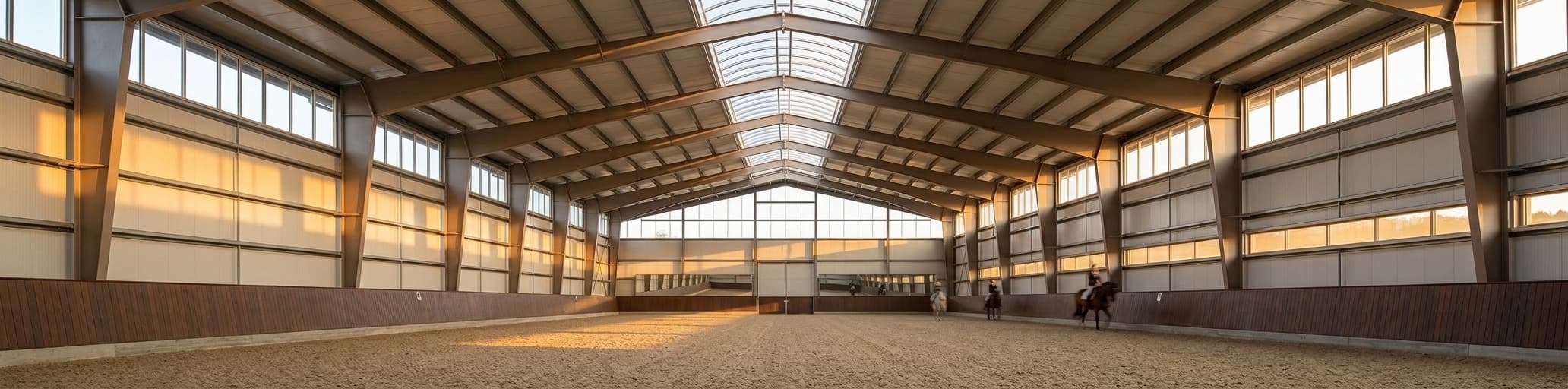

We help you design a steel riding arena that delivers unobstructed clear-span floors, proven durability, and customizable add-ons tailored to your discipline and budget. Steel outperforms wood and pole barns with superior longevity, faster prefab construction, and integrated ventilation that keeps horses and riders comfortable year-round.
Why Steel Riding Arenas Outperform Wood & Pole Barns
Steel clear-span arenas eliminate interior columns entirely, giving you unobstructed riding surfaces up to 300 feet wide where wood and pole barns structurally cannot.
Clear-span strength up to 300 ft for uninterrupted riding
Clear-span framing works on one principle: the roof load transfers entirely to the exterior walls, so no interior columns are needed to hold the structure up.[3] For a steel riding arena, that matters immediately — a 60×120 warm-up pen or a 100×200 full competition floor stays completely open, with no posts to route around during flatwork, jumping, or group lessons.[1] Steel rigid frame systems achieve clear spans up to 300 feet wide, which makes them the only practical structural option when you need that kind of unobstructed interior at that scale.[2] You can integrate stables, bleachers, and tack rooms within the same footprint without sacrificing a single square foot of riding surface.[2] Wood-frame and pole barn alternatives simply can't match this at width — interior columns become structurally necessary well before you reach the spans most serious equestrian facilities require.[3]
Code-compliant engineering for snow, wind & seismic zones
Every steel riding arena built today must meet IBC 2024 requirements, now driven by the ASCE 7-22 standard — a fundamental shift away from historical weather averages toward site-specific load data.[4] For your arena, the impact lands in three categories: snow, wind, and seismic.
ASCE 7-22 replaces generalized ground snow maps with site-specific targeting and mandates a "rain-on-snow" surcharge that accounts for rapid weight gain when rain follows a heavy snowfall — a scenario responsible for numerous roof failures in 2025.[4] In northern and mountainous regions, that translates to steel arenas engineered for snow loads routinely exceeding 60 PSF, with capacity beyond 100 PSF in critical transition zones, typically paired with roof pitches of 2:12 or steeper to encourage natural shedding.[4] On the wind side, the code now calculates pressure differently across building zones: corners, roof edges, and ridges carry significantly higher suction and uplift forces than center panels, so primary I-beam framing, purlins, and girts are densified near those edge points rather than rated to a single blanket MPH figure.[4] If your facility falls under Risk Category III — an assembly occupancy where failure poses substantial life-safety risk — ASCE 7-22 Chapter 32 adds mandatory tornado load provisions in designated regions, engineering for vortex-driven vertical uplift and lateral pressure that straight-line wind calculations don't capture.[4] Because the location of your arena determines the exact local codes your structural steel components must satisfy, every building ships with state-stamped blueprints from a licensed structural engineer — your assurance that the permit package reflects current requirements for your specific site, not a national average.[4][5]
Low-maintenance Galvalume steel vs. rotting wood posts
Wood posts set in soil or anchored in concrete degrade from contact moisture — the decay weakens structural components well before it's visible, often requiring costly replacement of compromised parts.[6] Without a full concrete foundation, post-frame buildings also shift and settle over time, causing misaligned doors and structural strain that shortens building life.[6] Steel riding arenas sidestep all of that.
Steel won't rot, warp, or attract termites, and a properly built frame runs 30-50 years with nothing more than occasional cleaning — no painting, sealing, or structural monitoring required.[6][7] Galvalume coating takes that durability further by bonding a zinc-aluminum-silicon alloy directly to the panel surface, blocking corrosion and extending roof service life well beyond shingled wood roofs, which typically need full tear-off and replacement every 12-15 years.[7][8] Fire risk is the other hidden cost of wood framing: barn fires kill an estimated 150,000 animals annually, and non-combustible steel framing is one of the most direct ways to reduce that exposure — and often your insurance premiums alongside it.[8] For a full picture of how those gaps compound over time, the 20-year steel barn cost vs. wood barn math makes the case clearly.
Faster build times that cut labor costs by up to 30%
The labor savings on a steel riding arena start at the factory, not on your job site.
Every kit ships pre-punched, pre-cut, and pre-welded, so a substantial portion of the construction work is already complete before your crew lifts the first beam.[11] On-site, that means bolting engineered components together rather than measuring, cutting, and nailing raw lumber from scratch — a process that adds significant hours for wooden structures, and even more as building size increases.[10] Wooden barns require more labor overall, particularly for larger structures, which drives up both cost and schedule length in ways that compound fast on an 80×200 or 100×200 arena footprint.[10] Steel's prefabricated framing sidesteps that entirely: the kit scales to full competition-size spans without adding proportional crew time, keeping your erection window tight and your labor invoice predictable.[9] For a precise look at how a pre-engineered prefab building kit moves from order confirmation through engineering, fabrication, and site delivery, the timeline breaks down every phase so you can plan your ground prep and crew schedule around real dates, not estimates.
Proven Design Options That Fit Your Discipline & Budget
Choose from three proven steel arena sizes–60×120, 80×200, or 100×300–or customize your footprint to match your discipline, budget, and property constraints.
Standard 60×120, 80×200 & 100×300 layouts vs. custom footprintsArena size is the single biggest driver of overall cost — and the decision that directly determines which disciplines you can train and compete in.[12] The 60×120 footprint (7,200 sq ft) handles private warm-up sessions and basic flatwork without requiring a large land footprint or budget. The 80×200 (16,000 sq ft) fits most dressage, hunter/jumper, and group lesson programs comfortably, while a 100×300 floor (30,000 sq ft) opens up full competition use, rodeo events like reining and barrel racing, and multi-discipline configurations simultaneously — the extra width matters specifically for events that need ample space and secure high panels to keep livestock contained.[12] Across all three footprints, steel riding arenas run $40-$125 per square foot depending on customization and features, with pre-engineered kit builds consistently coming in below custom-framed alternatives at equivalent structural quality.[12] Custom footprints make sense when site geometry, competition regulations, or mixed-use plans don't fit a standard rectangle — you can configure an L-shaped layout with an attached stable wing, add covered warm-up pens on either end, or adjust dimensions to match irregular property lines, all without sacrificing the clear-span interior.
If you're planning phased growth, steel frame farm building systems are designed to accept future add-ons without structural rework, so the footprint you build today doesn't limit what you expand into tomorrow. Whatever size you choose, a well-built steel arena can recoup 50-70% of construction costs in added property value — especially in active equestrian markets where boarding and lesson revenue converts the structure into a direct income asset.[12]
Roof pitch, eave height & overhang choices for climate control
Eave height is the single spec that touches airflow, lighting, and rider safety at the same time.
A 10-foot sidewall is the absolute minimum that keeps a mounted rider's head clear of structure, but 12 to 14 feet is the working target for a functional arena: taller eaves let warm, humid, dust-laden air rise naturally and exit through ridge vents and cupolas above instead of cycling back down through the riding zone.[13] That vertical stack effect is passive climate control — no mechanical system required when the geometry is right.[13] Clerestory and eave windows positioned just below the roofline reinforce both functions at once, adding natural light along the full building length while acting as passive intake vents when paired with high-point exhaust openings — eliminating the shadowed corners that spook horses and the still, humid pockets that degrade arena footing.[13] Roof pitch feeds directly into that same thermal logic: a steeper slope raises the ridge point, extending the rise distance warm air travels before it exits, and it accelerates rain and snow drainage off the panel surface; shallower pitches trap heat longer in summer and increase condensation drip risk in winter, both of which compromise footing and horse health.[13] Overhangs extend the eave line outward to shade lower wall panels and any operable louvers from direct afternoon sun, reducing radiant heat load at the wall plane where horses work closest — a detail that pays back immediately in summer comfort without adding structural complexity to the steel frame farm building system you're already engineering for the rest of the facility.[13]
Colored wall & trim palettes that match your farm branding
Color selection for a steel riding arena goes further than aesthetics — it's how your facility signals brand identity from the road, and pre-engineered steel delivers it at every surface simultaneously.
Wall panels, roof panels, corner trim, and even the exterior fasteners can all be color-coordinated, so the building reads as a unified whole rather than a patchwork of mismatched finishes.[16] The palette range runs from Ash Gray and Galvalume silver through earthy mid-tones to Rustic Red, with custom-matched options available when standard selections don't align with existing signage, fencing, or barn colors already on your property.[14] Every color ships with a written 25- to 40-year paint warranty, so the branding you choose holds across decades without repainting — a direct cost advantage over wood-painted structures that need refinishing every five to seven years.[14] One practical note before you finalize: screen previews shift with monitor calibration, so requesting physical metal color chips is the only reliable way to confirm a match against structures already standing on your property before the order locks.[14]
Attachable stall rows, tack rooms & viewing lounges
The most practical upgrade for a working equestrian facility is attaching stall rows, a tack room, and hay storage directly to the arena's primary steel frame rather than building them as separate structures.
A single pre-engineered red-iron frame handles all of it — clear-span arena floor plus shed-row stalls, tack room, and hay storage — engineered together with county-specific stamped plans that cover the combined wind, snow, and collateral loads in one permit package.[17] Stall rows attach as lean-tos along the arena sidewall, keeping costs low while adding direct interior access between the barn aisle and the riding surface.[18] You can configure those stalls with a central aisle and interior-only entry, or open the sidewalls to Dutch barn-style doors that let horses load from outside without routing through the building's interior — a useful layout when managing a high-volume lesson or boarding program.[18] Tall gabled ceilings in the attached barn section serve two functions at once: they pull warm, humid air upward and out, and they create the clearance needed for an overhead hay loft that keeps feed accessible without consuming ground-level square footage your stalls and aisle need.[18] Viewing lounges and observation areas fit into the same lean-to envelope — the same versatile design logic that accommodates stalls and tack rooms scales to enclose a spectator space at the arena end, giving you a conditioned, separated viewing area without an additional foundation or permit application.[18]
Ventilation & Climate Strategies for Horse & Rider Comfort
Proper eave and ridge ventilation sizing–1 inch per 10 feet of building width–prevents respiratory risk and maintains footing quality in steel arenas.
Continuous ridge vents, eave intakes & cupola sizing rules
Natural ventilation in a steel riding arena runs on two forces: wind pressure and thermal buoyancy, with warm, humid air rising and exiting at the ridge while fresh air enters continuously at the eaves.[19] Getting the opening geometry right is what separates a comfortable arena from one that builds respiratory risk and degrades footing.
For eave intakes, the minimum is 1 inch of continuous slot opening for every 10 feet of building width — on a 100-foot-wide arena, that's a 10-inch slot running the full length of both sidewalls, positioned 10 to 12 feet above the floor so incoming cold air mixes with warmer stable air before it reaches horses and riders, rather than arriving as a direct chilling draft.[19] Ridge openings should match the eave area one-to-one: the same 1-inch-per-10-feet rule applies at the ridge, and if you omit the ridge vent entirely, you'll need to double your eave intake area to compensate.[19] Two things will kill both openings fast: residential soffit treatments and insect screening.
Both cut effective airflow by 50% or more at installation, then clog with arena dust within months until ventilation nearly stops — the perforated metal soffit common on residential steel buildings was engineered for attic airflow rates that are roughly one-third of the minimum a horse facility needs.[19] Cupolas are a functional option for ridge exhaust when sized to these rules: 1 inch of cupola width for every foot of roof length, louver open area equal to or greater than the throat opening into the stable (louvers typically block half the nominal area), and multiple units spaced at approximately 50-foot intervals on longer arenas rather than one oversized unit at center.[19] The hardware choice matters as much as the sizing: agricultural-grade ridge vent assemblies designed for livestock buildings allow relatively unrestricted airflow, while residential ridge vents don't provide adequate opening area and are prone to condensation freeze-up in winter that seals them shut precisely when you need them working.[19] For a practical look at how this same eave-to-ridge stack-effect logic scales across a larger livestock footprint, the 40×80 metal barn ventilation specs article covers the sizing math in detail.
Insulated roof systems to stop summer heat gain & winter drip
Roof insulation in a steel riding arena solves two problems that both hit horses and footing directly: summer radiant heat gain and winter condensation drip.[20] An uninsulated metal roof turns into a radiant heat source on hot afternoons, raising air temperatures at rider height above ambient; in cold months, warm humid air from horses and riders meets the cold panel underside, condenses, and drips — wetting footing, degrading dust-control additives, and creating the respiratory environment you built a covered arena to avoid.[21] Light-colored metal panels help by reflecting solar radiation before it converts to interior heat, but color alone doesn't address the winter condensation side of the equation.[21] Insulation handles both.
A single-layer fiberglass blanket placed over the roof purlins with the vapor barrier facing inward maxes out at R-19 with a 6-inch profile — sufficient for mild-climate arenas with low seasonal swing.[22] In regions with heavy snowfall, extended cold periods, or wet springs, a double-layer system builds a higher thermal barrier and attacks moisture build-up more aggressively, with local energy codes in many northern jurisdictions now requiring it.[22] For the highest performance in a single assembly, foam-insulated metal panels deliver R-values up to R-48 — approximately 7.5 per inch of thickness — integrating roof cladding and insulation so there are no exposed seam points where condensation can form between layers.[22] Thermal spacer blocks add precision control at the purlin contact point itself: a 1-inch foam-filled block isolates the outer roof panel from the steel purlin beneath it, achieving a non-compressed R-6 value per contact point and documented to double overall insulation performance in certain configurations, with energy payback in as little as 12-18 months after installation.[22] For direct panel-level condensation control, a vapor-absorbing membrane bonded to the underside of the roof sheet holds moisture until daytime temperatures and ridge ventilation allow it to evaporate completely — keeping drip off horses and footing without any mechanical system.[22]
Dust-reducing ceiling fans & operable wall louver placement
Ceiling fans in a steel riding arena serve a specific, limited role: they move air across horses and riders to reduce perceived heat and keep suspended dust particles circulating long enough for exhaust ventilation to carry them out — but only when footing dust-control treatments are already in place.[24] Without pre-treated footing, ceiling fans redistribute dust rather than remove it, which makes footing prep a prerequisite, not an afterthought.[24] Treat them as a comfort supplement to your ridge-and-eave stack system rather than a replacement: fans inside the barn increase airflow but deliver significantly less air exchange than sidewall exhaust fans, which should remain your primary mechanical ventilation driver.[23] Operable wall louvers follow a different logic — their value is in placement geometry, not just quantity.
Well-spread-out air inlets eliminate stagnant air pockets in mechanically ventilated arenas; concentrating louvers on one wall leaves the far end of a 200-foot floor starved for fresh air regardless of fan capacity.[23] Louver panels positioned 1 to 2 feet above floor level in attached stall rows feed fresh air directly into the horse's breathing zone without creating high-velocity drafts at rider height.[24] In summer, when large end doors are open, exhaust fans lose their pressure differential and should be switched off entirely — at that point, ceiling circulation fans take over, moving air over horses while natural wind forces handle exchange through the open wall planes.[23]
Natural-light skylight spacing that eliminates arena shadows
Shadow elimination in a steel riding arena is a function of distribution geometry, not total panel count.
Indoor arena lighting must be as diffuse and shadow-free as possible in both day and night conditions, because horses respond to contrast — a shadowed corner at one end of a 200-foot floor creates a consistent avoidance zone that disrupts flatwork and jumping regardless of how bright the arena's center is.[26] The recommended illuminance for an active riding surface runs 200 to 500 lux depending on discipline: lower for general training, higher for dressage and jumping where precise evaluation of movement matters.[27] Natural light through roof skylights is the most direct path to that target during daylight hours, reducing electrical load while producing the soft, even quality that diffused overhead light delivers — shown to improve focus and comfort for both horses and riders.[27] The spacing rule that prevents shadow bands is one skylight panel for every 10 feet of building length, distributed consistently along the full roof run rather than clustered at the center or the ends, where concentrated panels create bright zones separated by dim corridors.[25] Fiberglass-reinforced skylight panels integrate directly into the steel roof's corrugation profile — no raised curbs, no framed openings — with a standard 2-foot width and lengths up to 10 feet that give you a precise coverage footprint for layout planning.[25] Pairing ridge skylights with operable eave-level glass or garage door panels layers the light source: the ridge panel fills the center of the floor from overhead, while lower glass panels illuminate the wall-plane areas where shadows typically persist longest.[26] That staggered placement — high-point panels overhead, sidewall glass at the eave — delivers natural light from multiple angles simultaneously, eliminating the single-source shadow lines that compromise both horse confidence and rider depth perception.[27]
8 High-Value Add-Ons to Customize Your Steel Arena
Radiant heaters, powder-coated aluminum railings, and integrated LED lighting transform your observation deck into a professional, weatherproof destination that functions year-round.
Heated observation deck with powder-coated railing
An observation deck turns a functional riding arena into a year-round destination — but only if spectators can actually stay in it when temperatures drop. Flush-mount radiant heaters installed overhead deliver reliable warmth that extends the usable window of any outdoor or semi-enclosed viewing area, and their low-profile design disappears into the ceiling plane so the deck reads as clean architecture rather than a collection of hardware.[28] Positioning heaters strategically across the deck ceiling — rather than clustering them at one end — eliminates cold spots and keeps every seat comfortable through winter clinics, early-spring competitions, and late-autumn schooling sessions when arena use peaks but ambient temperatures do not.[28]
The railing surrounding that deck does double duty: it's a safety system and the first thing visitors see from the arena floor below. Powder-coated aluminum railing frames hold up in agricultural and equestrian environments precisely because the finish meets AAMA 2604 specifications for weather resistance, color adherence, and impact performance — the same demands your arena walls face every day.[28] A palette of 18 or more colors, including classic blacks, warm bronzes, and realistic wood-grain finishes, means the railing can match your farm's existing color scheme or coordinate with your arena's exterior trim package without a custom paint order.[28] That matters when you're trying to project a professional image to boarders, clients, and competition organizers who form their first impression from the stands.
Lighting rounds out the package. LED strip systems rated for wet locations can be integrated directly into the top or bottom rail of the same aluminum railing frame, adding ambient light to the deck stairway and perimeter without separate conduit runs or additional structural penetrations.[28] A dimmer-compatible system lets you dial brightness down during evening flat-work sessions where arena lighting matters more than deck ambiance, and up for evening social events or awards presentations — all from a single switch. Combined, the heater, powder-coated rail, and integrated lighting convert what would otherwise be a raw concrete ledge into a legitimate spectator amenity that supports boarding revenue, lesson enrollment, and facility rental income every step of the way.
Retractable mirror walls for dressage schooling
Mirrors are a functional training tool, not a luxury — they give riders real-time visual feedback on position, straightness, and horse outline that no amount of instruction can fully replicate between lessons.[29] Top event riders and biomechanics researchers both note that from the first day mirrors go up, rider position and horse way of going improve measurably, and the gains hold because the visual reference keeps subtle corrections in place session after session rather than letting habits drift back.[29] The critical decision when integrating mirrors into a steel riding arena isn't whether to add them — it's which mirror system survives the environment.
Glass mirrors with high-impact laminate cores, like the DIAMOND SYSTEM(R) approach, use full-surface bonding so that if the panel does break, fragments stay in the frame rather than shattering to the floor, giving you a safety margin comparable to automotive windshield construction.[31] Film-based alternatives weigh under 15 lbs per panel and won't produce dangerous shards on impact, but arena dust is abrasive enough to scratch the polyester surface during cleaning, and temperature-driven tension changes can cause the film to tear — making glass-core panels the more durable choice for a permanent steel arena installation.[30][31] Mounting follows one rule: position panels above the kick wall so horses load from outside the reflection zone, and always select an odd number of panels across the short side so the center line remains unobstructed for dressage figures.[31] The retractable element matters most when the arena shifts to free jumping or lunging — horses can startle at their own reflection and jump toward it, which makes a cover system non-optional rather than cosmetic.[31] Electric vertical awnings are the right specification here: manual cranks become impractical above 3.5 meters of combined kick wall and mirror height, and a single wall switch or remote motor can drop covers across an entire run of mirrors simultaneously rather than requiring one-by-one manual operation.[31] That same motor system integrates cleanly into the steel arena's electrical package, keeping the installation tidy and the retract cycle fast enough that a trainer can switch between dressage work and jumping without losing session time.
Integrated kick-board lining & horse-safe corner guards
Kick boards do one job: they put a sacrificial barrier between horse and steel wall at the exact zone — roughly knee to shoulder height — where impact is most likely during flatwork, spooking, or a misjudged turn.[32] The corner is where that risk concentrates hardest, and standard 90-degree corners compound it — a horse can trap a leg there, and a rider can catch a stirrup on any protrusion that breaks the wall plane.[32] Curved kick-board systems engineered specifically for riding arenas resolve both problems at once.
The CURVE-style kick wall uses 7-9 thermoformed layers — poplar wood core, hardwood outer faces — that absorb impact without fracturing and hold up against the moisture cycle an active arena floor produces year-round.[32] Each panel runs 1,100 mm wide and 26 mm thick, available at either 1,250 mm or 1,400 mm in height, and the four corner joints ship pre-cut to size so the transition from a straight wall run to a curved corner radius is a measured fit, not a field cut.[32] Those rounded corner profiles serve a second function beyond safety: they make dragging a leveling harrow or grooming tractor through the full arena perimeter possible without stopping to navigate a tight pocket, which directly reduces the labor time your footing maintenance takes each week.[32] Installation doesn't require a complex substructure or a separate concrete base — panels mount directly to your arena's steel frame — keeping this add-on within budget and off the critical path of your erection schedule.[32] For lunging halls and horse walkers where a tighter radius is required, panel width can be cut to custom dimensions on-site, so the same product line covers your main arena and any attached satellite spaces without a separate fabrication order.[32]
Motorized curtain walls to open arena to outdoor arenas
Opening a steel riding arena to adjacent outdoor paddocks or warm-up rings transforms the space from a closed training environment into a seamless indoor-outdoor facility — but the hardware choice determines whether that transition works for horses or against them.
Fabric curtain systems, the kind common in dairy facilities, flap and snap in variable wind, creating the intermittent noise that spooks horses and disrupts training sessions precisely when you want the wall open most.[34] The right specification for an equine facility is a rigid sliding panel system: panels built from polycarbonate or clear acrylic mounted to a structural frame move silently in any wind condition, transmit natural light across the full wall plane even when closed in cold weather, and open to create continuous ventilation apertures along the entire sidewall length.[34] That light-transmission detail matters operationally — on overcast days or during early-morning sessions, a closed polycarbonate wall still floods the riding surface with diffuse natural light, so you're not forced to choose between keeping the arena climate-controlled and keeping it well-lit.[34] Electric drive motors activated by a single wall switch replace the hand-crank winch option and make practical sense the moment your panel run extends beyond a single bay — manually cranking open 60 or 80 linear feet of wall before a lesson wastes time a motorized system eliminates entirely.[34] On still summer days with high heat and humidity, even a fully open sidewall needs air moving across it to do meaningful work; that's where the sliding panel system earns its full value — large continuous openings on both sidewalls let cross-ventilation run unobstructed across the full arena width, which passive ridge venting alone can't replicate under low-wind conditions.[34] For arenas connected directly to outdoor competition rings or round pens, the panel system can be configured to open a full end wall rather than just the sidewall, effectively removing the boundary between structures so horses load from outdoor to indoor without a visible threshold change — a detail that matters for training young horses and managing high-traffic schooling days.[33]
Sound-absorbing ceiling baffles for noise-sensitive horses
Horses register sound differently than humans — their hearing range extends well above what riders perceive, and an unexpected sharp noise in an enclosed steel arena can trigger a startle response that ends a training session or creates a genuine safety incident. The acoustic challenge in a steel riding arena is structural: a large, hard-surfaced enclosure reflects sound from every direction simultaneously, building reverb that amplifies announcements, crowd noise, and the resonant impact of rain on an uninsulated roof panel until even familiar sounds become disorienting.
That's exactly why the World Equestrian Center in Ocala, Florida — the world's largest equestrian park — engineers the acoustic profile of each space independently rather than treating the facility as one uniform audio environment, with solutions matched precisely to the specific requirements of each arena, stabling area, and event space.[35] Ceiling baffles address this directly: suspended vertically from the roof purlins across the full arena span, they break up the reflective ceiling plane and absorb mid- and high-frequency energy before it bounces back into the riding zone. Spacing matters more than quantity — evenly distributed baffles across the full ceiling run perform better than clusters, because sound energy travels the entire arena length before finding an absorptive surface if your coverage is uneven.
For a working steel riding arena, the substrate choice has to survive horse hair, arena dust, and humidity cycles; perforated metal-faced panels with mineral wool cores hold their absorption coefficient across those conditions without compressing or degrading, keeping the acoustic environment consistent whether you're running a single-horse schooling barn or a multi-ring competition facility.[35]
Wash-rack bay with hot-water heater & drainage trench
A wash-rack bay attached to your steel riding arena pays back immediately in time and horse welfare — but only when the drainage and floor system are designed correctly from the start. Poor drainage is the single most common failure point in wash bays, and retrofitting a drain through finished concrete costs far more than routing it correctly before the slab is poured.[36] Pitch the concrete 1/8 inch per foot toward a trench drain, and position that trench approximately 2 feet from the rear wall — not the center of the floor, where horses are most likely to step on it and startle.[37][38] A 4-inch-wide trench with a nonslip, removable grate and a sediment trap downstream handles hair and footing material without clogging; ask users to clear the grate after each horse, and clean the trap on a set schedule.[37] For the floor surface, skip smooth concrete and standard stall mats: smooth concrete becomes dangerous when wet, and mats trap moisture underneath and invite mold.[37] Seamless poured-rubber flooring with a nonslip coating keeps water on top and eliminates the joints where bacteria accumulate.[37] Minimum bay dimensions are 10 feet wide by 12 feet deep — enough room for the handler to move safely around the horse from every angle without getting pinned against a wall.[37]
Water temperature determines whether the space gets used year-round or sits idle through winter. On-demand heaters cost more upfront but eliminate recovery wait times during high-volume use days — the right call when multiple horses move through the bay daily.[37] A 40- to 50-gallon storage-tank heater is a practical alternative for lower-traffic facilities.[37] Either way, set the heater to 80-90 degreesF: warm enough to rinse soap and keep horses calm, cool enough not to waste energy on temperatures the task doesn't require.[37] In cold climates, a heated wash bay dramatically extends usable days into winter[36], and in-slab radiant tubing installed before the concrete pour costs little now versus the expense of tearing through a finished floor later — it accelerates evaporation after each use and keeps horses comfortable standing on a warm surface.[36][38] The same concrete-slope logic that governs dairy barn wash-down compliance applies here: a consistent pitch toward the trench is what keeps standing water from shortening the life of every surrounding surface, and getting it right at the pour stage is the only cost-effective window to do it. For a detailed look at how slope geometry affects drainage compliance in agricultural wash environments, the 40×80 dairy barn design guide covers the same principles at scale.
Wall and lighting choices in the wash bay either hold up or fail fast — water is relentless here. Concrete block sealed with waterproof paint or fiberglass-reinforced panels both handle daily hose-down without rotting or harboring mold.[37] Avoid metal panels: they rust, stay cold to the touch, and amplify the sound of a hose hitting the surface in ways that unsettle horses.[37] Walls should extend at least 4 to 5 feet high with water-resistant material, with full-height wash-down coverage in premium builds.[36] For lighting, sealed waterproof fixtures are non-negotiable — and placement on the side walls, not directly overhead, eliminates the shadows that spook horses and make it hard to spot coat issues or injuries.[37] Position one fixture high on each side wall and one at approximately 3 feet to illuminate the full horse from multiple angles.[37] A radiant heater suspended from the ceiling and wired to a timer dries the horse, the handler, and the bay itself after each use — and the timer keeps boarding clients moving without requiring a conversation about it.[37] Combined, the trench drain, on-demand heater, nonslip rubber floor, waterproof walls, and side-mounted lighting give you a wash bay that functions as a professional-grade clinical and grooming station every day of the year, not just when conditions cooperate.
Overhead loft storage for hay, bedding & jumps
An overhead loft built into your steel riding arena's existing frame is the most cost-effective way to add bulk storage without consuming a single square foot of your riding surface or paying for a separate foundation.
The structural logic is straightforward: steel roof purlins sized for your arena's snow and collateral loads already span the full building width, and a loft deck ties directly into that framing — no supplemental columns punching through your arena floor.[39] Sizing the loft bay in multiples of 12 feet aligns with standard purlin spacing and delivers the best structural return on your framing investment, keeping material waste low and load paths clean.[39] What the loft stores determines how you build it: hay bales are dense and static, so deck loading matters immediately; jump standards and poles are lighter but awkward to maneuver, so clear headroom above the loft deck and a wide hatch opening matter more than raw load rating.
One design detail that's easy to overlook is fire separation — hay stored directly above horses and riders is a genuine risk, and your jurisdiction may require a fire-rated assembly between the loft deck and the arena floor below, which affects both your permit package and your insurance terms.[39] For moisture protection of stored hay specifically, the 40×80 hay storage building moisture barrier guide covers the wall and roof assembly details that keep nutrient value intact from delivery through feeding season.
Solar-panel-ready roof purlins for future energy savings
Purlins are horizontal structural beams that support roof panels and distribute loads across the primary steel frame.[40] In a steel riding arena, they're also the component that determines whether your roof can carry a photovoltaic array — a decision that costs nothing to make correctly at design time and significantly more to retrofit later.[40] Specifying purlins sized for future solar load means your structural engineer accounts for panel weight, wind uplift on mounted arrays, and racking load paths in the original stamped drawings, so adding panels in three or five years requires only a mounting installation, not a structural re-evaluation of the frame.[41] Steel roof systems accommodate solar panels, solar laminates, and solar crystalline products without difficulty, because the material strength engineered for snow and wind loads handles the incremental dead load of a solar array as well.[41]
The roof panel profile you choose today directly controls what solar mounting options are available later. Standing seam panels — with their raised, concealed seam running the full roof length — are the preferred substrate for clamp-mounted solar systems because the clamp attaches directly to the seam without penetrating the panel surface, preserving the weathertight integrity the arena depends on year-round.[41] A 26-gauge standing seam steel panel provides the substrate strength a solar array requires, and the same floating-panel design that handles thermal expansion in temperature-variable climates also manages the cyclical loading a mounted system introduces over its service life.[41] Metal roofs in qualifying applications contribute LEED points toward green building certification — a detail worth tracking if your facility is pursuing certification for competitive reasons or to access available tax incentives.[41]
- Clear-span steel framing eliminates interior columns, keeping 60×120 to 100×300 arenas completely open for all disciplines.
- ASCE 7-22 codes now require site-specific engineering for snow, wind, and seismic loads with state-stamped blueprints.
- Steel arenas last 30-50 years maintenance-free; wood structures need repainting every 5-7 years and full roof replacement every 12-15 years.
- Proper ventilation requires 1 inch of eave intake per 10 feet of width, matched ridge exhaust, and 12-14 foot eaves for passive stack effect.
- Attached stall rows, tack rooms, and hay storage integrate into a single pre-engineered frame without separate foundations or permits.
- Eight high-value add-ons–observation decks, mirrors, kick boards, sliding panels, acoustic baffles, wash bays, lofts, and solar-ready purlins–customize arenas for specific programs.
- Insulated roofs prevent summer radiant heat gain and winter condensation drip; foam-integrated panels deliver R-48 with sealed seams.
- https://gensteel.com/steel-building-kits/riding-arenas/
- https://www.universalsteel.com/steel-metal-riding-arena-buildings/
- https://www.rigidbuilding.com/why-metal-buildings/
- https://titansteelstructures.com/steel-building-engineering/designing-for-disaster-2026-wind-and-snow-load-requirements-for-metal-buildings/
- https://www.alliedbuildings.com/indoor-horse-riding-arena-cost/
- https://torosteelbuildings.com/blog/pole-vs-steel-barn/
- https://armstrongsteel.com/blog/why-metal-frame-construction-leads-to-durable-buildings
- https://www.metalsales.us.com/blog/barn-construction/
- https://www.buildingsguide.com/build/pole-barn-vs-metal-building/?srsltid=AfmBOoomRaOOrUzVAOYr_Z_RpzdfFPQdZ2K7bT_OMQeWkhHfWNEmpYix
- https://alansfactoryoutlet.com/blog/metal-building-vs-pole-barn/?srsltid=AfmBOor5YmfQd2_Vg2FFiJkCSAoO9GJ0t1Lqp7130xEW7edGH0O0LXlr
- https://sunwardsteel.com/building-type/commercial/
- https://www.homeadvisor.com/cost/additions-and-remodels/indoor-riding-arena/
- https://ruralbuildermagazine.com/design-features-for-horse-barns/
- https://sunwardsteel.com/steel-building-colors/
- https://metal-america.com/commercial/
- https://www.factorysteeloverstock.com/economy-model-50×75/
- https://trusteelbuildings.com/steel-buildings/riding-arena/
- http://myecia.com/metal-building-types/riding-arenas/
- https://extension.psu.edu/horse-stable-ventilation/
- https://mortonbuildings.com/projects/riding-arena
- https://www.horizonstructures.com/top-ten-tips-building-indoor-arena/
- https://sunwardsteel.com/utah/metal-horse-riding-arenas/
- https://extension.umn.edu/horse-pastures-and-facilities/ventilation-systems-horse-barns
- https://www.infohorse.com/horsestallairquality.asp
- https://torosteelbuildings.com/options-and-finishes/steel-arch-buildings/skylights/
- https://www.archerbuchanan.com/archer-buchanan-designs-indoor-horse-training-arena-at-windurra-usa/
- https://www.paclights.com/explore/indoor-riding-arena-lighting-explained/
- https://www.aecdaily.com/news/10006531/aec-daily-launches-new-course-from-holcim-elevate
- https://www.arenamirrors.com/
- https://litemirror.com/pages/about-arena-mirrors
- https://www.equus-design-products.com/en/riding-mirror/riding-mirrors-worthknowing/faqs-riding-mirror
- https://www.equus-design-products.com/en/arena-kickboards/
- https://ruralbuildermagazine.com/creating-big-span-riding-arenas/
- https://equinewellnessmagazine.com/ventilation-equine-facility/
- https://www.atlasied.com/installations-case-studies?srsltid=AfmBOooLpQCsdFRGAC9PGXtKs1WDsdL-J-k4sY_X1ctsmjnTu_CsgjhN
- https://systemequine.com/how-to-set-up-the-perfect-horse-wash-bay/
- https://stablemanagement.com/barns-grounds/operation-wash-stall-design/
- https://matadorstructures.com/blog/multi-use-pole-barn-designs/
- https://www.hansenpolebuildings.com/tag/horse-barn/?srsltid=AfmBOoocPuKV11iypF6ByILOMOrCmQZozrMjrx95vwfnOXgg0RjPo9Ok
- https://peb.steelprogroup.com/steel-structure/components/purlins/
- https://greatwesternbuildings.com/features/roof-systems/