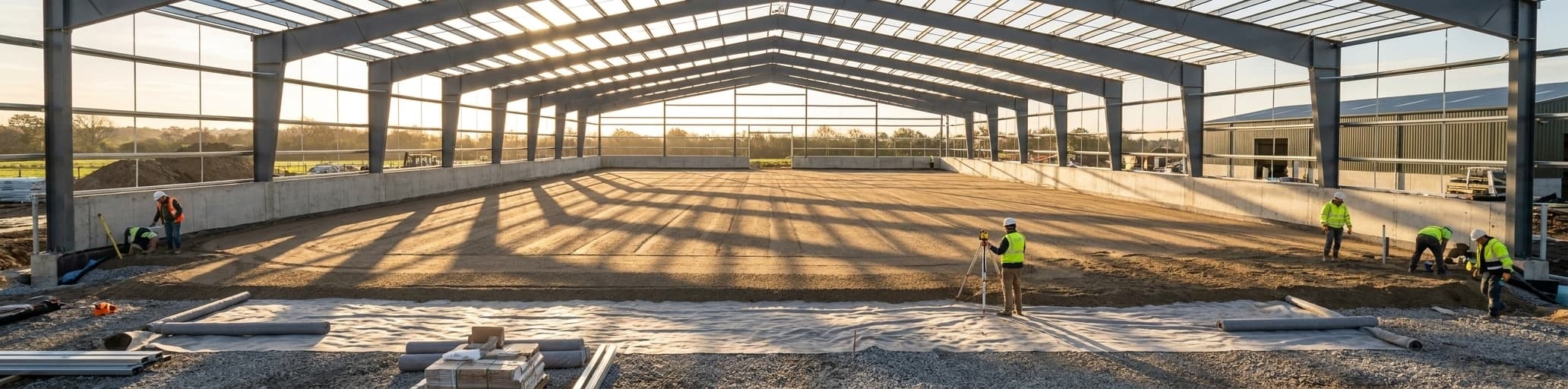

We help you move beyond kit-only pricing to understand the true 2026 cost of building an indoor riding arena, which averages $325,000 with most owners spending $180,000 to $450,000 depending on size and structure type.
Indoor Riding Arena Cost Breakdown: What You'll Actually Spend in 2026
Most indoor riding arenas cost $325,000 on average, but your actual price depends on choosing between a 60×120 private setup or a 100×200 commercial facility.
Average cost range by arena size and material type
Building an indoor riding arena costs $325,000 on average, with most owners landing between $180,000 and $450,000, or $40 to $125 per square foot for a fully turnkey build.[1] The number you see quoted online is almost never that number — manufacturers typically publish kit-only prices, and the actual turnkey cost runs two to three times higher once you add the foundation, footing, electrical service, lighting, and permits.[2] Knowing where your project falls in the range starts with two decisions: footprint size and structural material.
Size is the single biggest lever on total indoor riding arena cost. Per-square-foot pricing drops as the building gets larger because fixed costs — engineering fees, permit applications, foundation crew minimums — get spread across more square footage.[2] The table below shows 2026 turnkey benchmarks by common arena footprint:
| Arena size | Steel kit only | Turnkey range | Typical use case |
|---|---|---|---|
| 60×120 | $35K-$55K | $150K-$250K | Private owner, light training |
| 80×200 | — | $300K-$450K | Dressage, lesson or training barn |
| 100×200 | $100K-$200K | $400K-$500K+ | Commercial or competition facility |
| 100×200 premium | — | $500K-$1.2M | Full HVAC, engineered footing, gallery |
Material choice reshapes cost in ways most owners don't anticipate. Steel clear-span is the default for any span wider than 70 feet — the structural math simply favors steel over wood at those widths, and the gap widens as size increases.[2] At 2026 lumber prices, a wood post-frame arena wider than 60 feet runs 10 to 20 percent more than the steel clear-span equivalent, and that's before factoring in two decades of rot, termite, and weathering maintenance that steel doesn't carry.[2] Fabric tension structures — high-tension PVC over steel hoops — cost slightly less for the kit itself, but turnkey pricing lands roughly equal to steel because the foundation, footing, and drainage work costs the same regardless of what sits above it.[2] For a deeper look at how structural choices affect long-term ownership economics, steel riding arenas design and ventilation options walks through the tradeoffs by discipline and climate. Size, structure type, geographic location, and local labor rates all shift the final number — which is why the kit price is a starting point, not a budget.[3]
Steel vs. wood construction: 2026 pricing comparison
The assumption that wood is the cheaper structural option stopped being accurate around 2022.[4] At 2026 lumber prices, a wood post-frame arena wider than 60 feet runs 10 to 20 percent more than a comparable steel clear-span build — before you price in two decades of rot treatment, termite protection, and weathering repairs that steel doesn't require.[4] The per-square-foot spread by material type shows where each option actually lands:
| Material | Kit cost per sq ft | Key tradeoff |
|---|---|---|
| Fabric (PVC over steel hoops) | $10-$30 | Translucent roof saves daytime lighting; membrane needs replacement around year 17 |
| Steel clear-span | $20-$40 | Structural default for spans over 70 ft; no rot, no termite exposure |
| Wood post-frame | $30-$50 | 10-20% higher than steel on wide spans; ongoing maintenance costs compound annually |
The structural math behind steel's advantage is straightforward: a wide clear-span roof requires less material in steel than in wood, and that efficiency gap widens as footprint grows.[4] For any arena wider than 70 feet — which covers most serious training barns and every commercial facility — steel clear-span is the default because the physics favor it at scale.[4] Fabric tension structures sit in a different category. The kit price is slightly lower than steel, but turnkey cost equalizes fast because foundation work, footing, drainage, and lighting cost the same regardless of what's overhead.[4] Fabric does return value through translucent panels that reduce daytime lighting demand and faster erection times, but the membrane needs replacement around year 17 and carries real risk from heavy snow loads or falling debris — exposures that a steel roof simply absorbs.[4] For owners weighing these options across a 20-year ownership window, the steel barn cost vs. wood barn math consistently favors steel once maintenance cycles are priced in alongside the initial build.[4]
Cost per square foot for common arena dimensions (60×100, 80×120, 100×200)
Per-square-foot pricing is where size economics become concrete and useful for budget planning. Fixed costs — engineering fees, permit applications, foundation crew minimums — don't scale with footprint, so every additional square foot you add dilutes them across a larger base.[2] A 60×120 carries the same engineering review fee and permit cost as a 100×200, which is why the smaller arena runs higher per square foot even though its total spend is lower.[2]
| Footprint | Total sq ft | Steel kit range | Turnkey range | Per sq ft (turnkey) |
|---|---|---|---|---|
| 60×120 | 7,200 | $35K-$55K | $150K-$250K | ~$21-$35 |
| 80×200 | 16,000 | — | $300K-$450K | ~$19-$28 |
| 100×200 (standard) | 20,000 | $100K-$200K | $400K-$500K+ | ~$20-$25 |
| 100×200 (premium) | 20,000 | — | $500K-$1.2M | ~$25-$60 |
The per-square-foot gap between a 60×120 and a 100×200 is real, but it narrows fast when you add premium finishes. A standard 100×200 with mid-range footing and basic lighting lands at $20-$25 per square foot turnkey.[2] Add engineered footing, full HVAC, mirrors, and a viewing gallery and that same footprint pushes $25-$60 per square foot — still less per square foot than the smaller arena, but a very different total check.[2] The practical implication runs in one direction: if you're between sizes at design time, the marginal cost to add 20 feet of length is $10,000-$25,000.[2] After the slab is poured, adding that same length costs roughly double the original kit price because the roof line, foundation, and steel framing all require re-engineering.[2] Size up before concrete day — it's the lowest-cost expansion decision you'll ever make on this project. For owners comparing recreational steel building sizing across disciplines, the same economies of scale apply: going one standard size larger almost always costs less per square foot than you expect, and more than pays for itself over a 10-year use cycle.[2]
Key Cost Drivers: Foundation, Footing, and Structural Systems
A $200 soil test before construction is the highest-return investment on your entire project, preventing $30,000-$60,000 in drainage repairs later.
Foundation and site preparation: budgeting for concrete, drainage, and grading
Site prep is where arena budgets surprise owners most — and where the gap between an initial quote and the final invoice runs widest. Land clearing and grading typically costs $10,000 to $50,000 depending on existing conditions, with environmental or permitting requirements pushing the number higher.[1] That range assumes the contractor walked a cooperative site; reality often differs.
If a dozer hits ledge two feet down on day three, blasting adds $4-$8 per cubic yard plus a week of schedule delay, and unexpectedly deep topsoil tacks on another $5,000-$15,000 that the original line item never captured.[2] A soil test runs roughly $200 and is the single highest-return pre-construction dollar on the entire project — almost nobody orders one before signing, and most owners who skip it wish they hadn't.[2] Sloped sites carry their own concrete-day penalty: a perimeter strip foundation requires a pump truck whenever truck access is restricted, adding $1,500-$3,500 per pour that kit-only quotes never include because the kit supplier hasn't seen the land.[2] Drainage deserves its own line in your budget, not a cut. A perimeter drain, geotextile fabric, and a 1-1.5 percent surface crown are what separate an arena that rides well in year ten from one that turns to soup after the third wet spring.[2] Owners routinely cut the $7,500 perimeter drain package to trim the bid — then spend $30,000-$60,000 rebuilding the base four years later because surface water destroyed it from below.[2] In wet-climate states across the Pacific Northwest, the Carolinas, and the Gulf Coast, poor drainage destroys arenas faster than heavy riding does.[2] Site preparation costs also vary with how your local code classifies the structure; understanding how regional soil conditions and foundation specs interact before your contractor walks the site is worth the research, and the concrete and foundation guide for metal buildings covers the key variables by climate zone.
Arena footing materials and installation: sand, rubber, recycled materials explained
Steel frame engineering vs. wood trusses: structural cost impact and longevity Span width is where the structural difference between steel frame engineering and wood trusses becomes a hard constraint rather than a preference. Wood post-frame construction hits a practical clear-span ceiling around 90 feet — beyond that, the truss geometry requires so many intermediate members that the system stops being cost-efficient and the structural math no longer favors wood.[8] Steel clear-span frames scale to 200 feet or more with no interior columns, which is precisely why steel is the default structural system for any serious training or commercial arena.[8] That absence of interior posts isn't just a cost advantage; it eliminates collision hazards for riders and horses that post-frame systems unavoidably introduce on wider footprints.[8] For owners weighing these trade-offs across load paths and fire ratings, the steel frame vs. wood frame engineering comparison maps how those variables interact with long-term insurance and structural risk.
Longevity is where wood's structural limitations compound into ongoing cost exposure. A wood frame arena requires a carefully engineered combination of treated and untreated lumber — specify that combination incorrectly and rot accelerates through load-bearing members well before year ten.[8] Steel carries none of that vulnerability: no rot pathways, no termite exposure, and no weathering degradation that rebuilds after every wet season.[3] Pre-engineered steel arenas require minimal upkeep compared to wood or fabric structures, and that maintenance gap widens with every annual treatment cycle wood demands.[3] Steel also handles the forces that wide-span arenas routinely face — heavy snow loads, high winds, and seismic loading — without the structural review costs that aging wood trusses accumulate over time.[3]
The table below maps both systems across the structural and maintenance variables that drive 20-year ownership cost:
| Factor | Steel clear-span frame | Wood truss/post-frame |
|---|---|---|
| Max practical clear span | 200 ft+ | ~90 ft |
| Interior posts on wide spans | None | Required above ~60 ft |
| Rot and termite exposure | None | Requires treated lumber specification |
| Maintenance demand | Minimal periodic inspection | Annual treatment plus structural review |
| Snow/wind load performance | Engineered to local code without structural compromise | Requires reinforcement as span width increases |
| Obstacle-free riding field | Full clear span at any width | Compromised by posts on wider arenas |
Complete Cost Estimates: Estimate Your Indoor Arena Budget by Specifications
Choose your arena width based on your discipline, not your budget, because correcting width mistakes after construction costs far more than specifying it correctly upfront.
Sizing guide: how arena dimensions affect total project cost
Width is permanent. Length is expandable. That single rule should anchor every dimension decision before the foundation is poured — because getting the width wrong means a rebuild, not a remodel.[8] The length of an indoor riding arena can always be extended later as your program or budget grows, but the width is fixed the moment steel goes up, and no renovation budget reverses it.[8] Your discipline, not your current budget, should set the width number — because the cost to add width after erection dwarfs what you would have spent specifying it correctly on day one.
Discipline determines your minimum footprint, and the gaps between disciplines are wider than most owners expect. A 60×120 provides enough room for a single-horse flat-work program, but multiple horses, group lessons, or any lateral movement pattern pushes that boundary immediately.[5] Jumping and multi-horse work require at least 80×200 to give horses adequate straight-line run and turning radius without compressing the track.[5] Rodeo disciplines — reining, barrel racing, and pole bending — need comparable square footage plus high, sturdy perimeter panels to contain livestock safely between runs.[1] Dressage riders need a full 20×60-meter standard arena inside the building envelope, which means the structure must accommodate that footprint with safe margins at each short end.
| Discipline | Minimum recommended footprint | Height note |
|---|---|---|
| Flat work / light training | 60×120 | Standard eave height |
| Multi-horse lessons | 80×160 | Standard eave height |
| Jumping | 80×200 | Add 2+ ft to standard eave height |
| Dressage (standard arena) | 80×200 | Standard eave height |
| Barrel racing / reining | 100×200 | Standard eave height |
| Competition / commercial | 100×200+ | Custom per discipline |
Height deserves its own budget line when jumping is part of the program. Adding 2 feet to the eave height at design time costs a fraction of what it costs to raise the roof line after erection.[8] That clearance also creates buffer for ventilation systems, lighting rigs, and any future overhead infrastructure — improvements that a tightly dimensioned arena makes difficult to retrofit later.[1] For owners who want to map these footprint decisions against 2026 pricing before their first contractor conversation, the prefabricated steel riding arena cost guide covers how common dimensions translate into budget ranges across structure types.
Roofing, ventilation, and lighting add-ons: realistic pricing for climate control
Roofing insulation, ventilation, and lighting aren't optional line items for most arena owners — they're what separates a building you can ride in year-round from a steel shell that sits dark and damp from November through March. Electrical installation for lighting, outlets, and wiring runs $5,000 to $25,000 depending on arena size and the lighting plan.[5] HVAC — heating, ventilation, or full climate control — adds $8,000 to $40,000 on top of that.[5] Private owners riding three to five times per week can skip the full HVAC package; lesson and training barns cannot, because half the business runs after school hours when natural light is gone.[2] Competition and commercial facilities in temperature-extreme regions need the full system — condensation from horses alone will rain off an uninsulated metal roof onto saddles and footing if the building isn't thermally controlled.[2]
Lighting is where owners make the costliest quiet mistakes. A grid of LED high-bays looks adequate on installation day; two years later, when fixture output has declined and shadow zones open between units, evening riding stops.[2] Spec a minimum of 30 foot-candles average across the riding surface with a max-to-min uniformity ratio under 3:1 — any electrician who doesn't quote in those terms shouldn't be pricing your lighting plan.[2] LED fixtures are the default for long-term cost control: lower energy draw, longer replacement cycles, and no warm-up delay when you flip the switch in January.[1] For owners focused on keeping operating costs in check over a 20-year window, pairing LED lighting with natural light panels — translucent roof or sidewall inserts — meaningfully reduces daytime electrical demand and is easier to install than skylights.[1] The energy-efficient metal buildings guide maps how lighting and insulation choices interact with ASHRAE compliance and available tax deductions for commercial facilities.
Ventilation deserves its own budget line regardless of whether you add HVAC. Strategic ridge vents, sidewall louvers, and gable fans control both summer heat load and the ammonia buildup that concentrates in enclosed arenas with horses.[1] An unventilated 100×200 steel arena in a humid climate becomes a condensation problem within a single winter — moisture off horse respiration has nowhere to go, and it lands on footing, tack, and structural fasteners.[2] The table below breaks down realistic 2026 add-on pricing across roofing insulation, ventilation, and lighting so you can model each against your use case before finalizing the budget:
| Add-on | 2026 cost range | Best for | Skip if |
|---|---|---|---|
| LED lighting (full grid) | $5,000-$25,000 | All arenas with any evening use | Daylight-only, single-horse private arenas |
| Natural light panels (roof/sidewall) | $1,500-$6,000 | Reducing daytime lighting demand | Fabric structures (already translucent) |
| Ridge + sidewall ventilation | $2,000-$8,000 | All enclosed arenas | Open-sided or fabric structures |
| Insulation (roof + walls) | $8,000-$20,000 | Commercial, lesson, competition facilities | Private arenas in mild climates |
| Full HVAC | $8,000-$40,000 | Lesson barns, competition facilities, cold climates | Private owners in moderate climates |
| Vapor barrier | $1,500-$4,000 | Any steel arena in humid or high-rainfall regions | Arid climates with low seasonal humidity |
One practical issue that doesn't appear on any quote: the footing near end doors freezes several weeks before the rest of the arena does, because cold air pours in every time the door opens.[2] If your program runs through hard winter, budget for door-adjacent supplemental heat — a unit heater positioned to temper that cold-air column at each entry point costs far less than rebuilding frozen footing or managing horse refusals at that end of the arena.
Permitting, labor, and hidden costs: what most builders forget
Permit fees are the line item that multiplies quietly after you've already committed. Most owners budget one permit and get four. The base building permit runs $1,000-$10,000 depending on jurisdiction, but separate $300-$1,500 fees for stormwater review, electrical inspection, and fire-marshal sign-off appear as distinct line items — and they almost never show up on the kit quote because the manufacturer hasn't called your county.[9] Before you sign anything, call the permit office directly and ask for every fee that applies to a covered agricultural or commercial structure. Ask twice. There's usually one they forget to mention the first time.[9] Some agricultural-zoned counties offer streamlined ag-exempt permits that move faster and cost less than a standard commercial path — worth ten minutes of research before you file under the wrong classification.[9]
Freight is the hidden cost inside your footing budget that almost no one catches until the first invoice arrives. A truckload of washed silica sand from the nearest quarry runs $300-$800 in delivery charges on top of the material price, and a 60×120 arena needs roughly 20 truckloads.[9] That means a footing material quote that looks competitive on a per-ton basis can easily cost more in total once haul distance is priced in. Always ask for the per-ton delivered cost — not just the per-ton material cost — when comparing footing suppliers.[9] The same logic applies to concrete day on sloped or access-restricted sites: a perimeter strip foundation requires a pump truck whenever truck access is limited, adding $1,500-$3,500 per pour that kit-only quotes never include because the kit supplier hasn't seen your land.[9]
The labor decision — whether to hire a single design-build firm or manage subcontractors yourself — is the one most owners underestimate before breaking ground. Acting as your own general contractor saves 15-25% on the overall build, but you spend every weekend on the phone coordinating excavation crews, concrete subs, steel erectors, electricians, and footing installers, each with their own schedule and mobilization window.[9] A pre-engineered steel building shifts most of that complexity to the factory: components arrive pre-cut, pre-punched, and sequenced for assembly, which reduces layout time and trade interference on-site.[9] That factory preparation is why PEMBs typically erect 30-50% faster than conventional construction — and finishing four months early on a financed build isn't just a scheduling win.[9] It's four fewer months of interest carry on your construction loan and four months of earlier use.[9] If you're in a volatile steel market, a deposit-and-lock approach after final scope approval removes the biggest pricing risk: once loads, spans, and openings are confirmed, a materials commitment means the steel portion of your package stops moving with weekly index fluctuations.[9] For owners who want help vetting which contractor structure fits their project, the steel building contractors vetting guide walks through the questions that separate cost-effective partnerships from expensive coordination problems.
The table below maps the hidden costs most builders omit from early budgets — line items that don't appear on kit quotes but reliably appear on final invoices:
| Hidden cost item | Typical range | Why it surprises owners |
|---|---|---|
| Stormwater / electrical / fire-marshal permit add-ons | $300-$1,500 each | Quoted separately from base building permit |
| Footing freight (delivered, not material-only) | $300-$800 per truckload | ~20 loads for a 60×120; haul distance changes the math |
| Concrete pump truck on sloped sites | $1,500-$3,500 per pour | Never in kit quotes; triggered by access or grade |
| End-door upsize to 12×14 minimum | $1,500-$2,500 | A 10-ft door catches arena drag arms on every pass |
| Owner-GC labor coordination time | 15-25% of build cost saved — or lost | Savings real; time demand underestimated |
| Steel price escalation (unsigned scope) | Variable | Deposit-and-lock after scope approval removes exposure |
Why Single-Source Steel Building Solutions Lower Your Total Cost of Ownership
Design-build contracts align your architect and contractor's incentives to resolve problems internally, delivering 6-10% lower costs than traditional bidding models.
Design-build efficiency: eliminating coordination delays and change orders
The hidden cost in most arena builds isn't the steel or the footing — it's coordination time lost between separate design and construction teams.
In a traditional design-bid-build model, an architect produces drawings, contractors bid on them, and separate entities execute.
When design assumptions don't match site reality, the result is change orders: formal scope revisions that add weeks to a schedule and thousands to a budget already committed.[11] Design-build eliminates that gap by placing design and construction under one contract from day one, so constructability problems surface during design review rather than after concrete is poured.[10] Industry data backs the outcome: design-build projects deliver 6-10% lower costs than traditional delivery methods, with construction-phase cost growth running nearly 4% below design-bid-build projects — not because surprises disappear, but because one accountable team resolves them internally instead of billing them back as change orders.[12] For an arena owner managing a financed build, that discipline compounds: every month shaved off a coordination delay is a month less of construction-loan interest and a month closer to a revenue-generating or fully operational facility.[10] Design-build is now projected to account for up to 47% of all non-residential construction spending by 2026, precisely because owners have priced the alternative and found it costly.[11] When your design team and construction crew share a contract and a schedule, the incentive structure changes entirely — finishing on budget isn't a target, it's a mutual obligation built into how the job is structured from the first site visit.[11] For a closer look at how that single-source delivery model applies to a turnkey prefab steel building project from permitting through erection, the timeline mechanics are the same whether you're building a warehouse or a 100×200 riding arena.
National Steel Buildings's approach to prefabricated arena structures and erection
Long-term maintenance costs: steel durability vs. wood deterioration over 20 years The 20-year cost gap between steel and wood isn't driven by a single large expense — it accumulates through compounding annual maintenance cycles that wood demands and steel simply doesn't. Steel requires just 1-1.5% of initial construction costs annually in maintenance, averaging $0.25-$0.45 per square foot, while wood structures demand 2-4%, running $1.10-$1.80 per square foot.[15] For a 20,000-square-foot arena, that spread produces $5,000-$9,000 in annual steel upkeep versus $22,000-$36,000 for a comparable wood build — before accounting for the structural events that wood generates mid-ownership and steel structurally cannot.[14] Termite damage alone represents a realistic $30,000 repair scenario for wood-framed buildings, a cost category that doesn't exist on any steel maintenance schedule.[14] Proper galvanization reduces repainting frequency from every 8-10 years to once every 20-25 years, so your steel arena's maintenance calendar aligns with structural inspections rather than annual treatment reminders.[15] Over a full ownership window, total costs for traditional wood construction run $670,000-$1.1 million for a comparable commercial facility versus roughly $350,000 for the steel equivalent.[14] Steel buildings also hold 17-23% more resale value after 25 years, because buyers and appraisers increasingly price structural documentation and predictable maintenance records into commercial valuations.[15] For arena owners comparing these trajectories before committing to a structural system, the 40×80 pole barn alternative cost analysis maps how steel-truss construction reduces yearly upkeep across agricultural and equestrian applications with the same math.
The table below puts the key maintenance variables side by side across a 20-year ownership window:
| Factor | Steel clear-span | Wood post-frame |
|---|---|---|
| Annual maintenance cost per sq ft | $0.25-$0.45 | $1.10-$1.80 |
| Annual maintenance as % of build cost | 1-1.5% | 2-4% |
| Termite/rot exposure | None | Requires treatment; $30,000+ repair risk |
| Repainting cycle | Every 20-25 years (galvanized) | Every 8-10 years |
| Insurance premium impact | 18-25% lower (fire-resistant classification) | Standard rate |
| Structural lifespan | 40-60 years; 95% capacity maintained | 15-35 years shorter than steel |
| 20-year total ownership cost (commercial facility) | ~$350,000 | $670,000-$1.1M |
| Resale value after 25 years | 17-23% higher than wood equivalent | Declining as maintenance history accumulates |
- Average indoor riding arena costs $325,000 turnkey; kit-only prices are 2-3x lower than final costs.
- Steel clear-span outperforms wood on spans over 70 feet and costs 10-20% less long-term with minimal maintenance.
- Fixed costs like permits and engineering don't scale, so larger arenas cost less per square foot despite higher total spend.
- Foundation, drainage, and site prep are hidden cost drivers; poor drainage rebuilds cost $30,000-$60,000 within four years.
- Design-build delivery reduces costs 6-10% versus traditional bidding by eliminating change orders and coordination delays.
- Steel maintenance averages $0.25-$0.45/sq ft annually versus $1.10-$1.80 for wood; 20-year gap reaches $670,000 on commercial builds.
- Specify width before pouring concrete–adding width after erection costs roughly double the original kit price.
- https://www.homeadvisor.com/cost/additions-and-remodels/indoor-riding-arena/
- https://www.uspatriotsteel.com/blog/how-much-does-it-cost-to-build-an-indoor-riding-arena/
- https://reichconstructionllc.com/cost-of-pre-engineered-steel-indoor-horse-riding-arena/
- https://homeguide.com/costs/indoor-riding-arena-cost
- https://www.angi.com/articles/indoor-riding-arena-cost.htm
- https://extension.psu.edu/riding-arena-footing-material-selection-and-management/
- https://footingsolutionsusa.com/riding-arena-footing-faq/?srsltid=AfmBOooBlgvz8p1qEJR7L8UHmLkYaaLzwjvLkg-YJXIH64UaobL8rwUT
- https://www.alliedbuildings.com/indoor-horse-riding-arena-cost/
- https://www.tylerbuilding.com/post/2026-metal-building-cost-variables
- https://finfrock.com/how-design-build-maximizes-cost-savings/
- https://www.performanceservices.com/resources/10-reasons-why-the-design-build-delivery-method-works/
- https://seufertconstruction.com/company/blog/streamlining-construction-process-with-design-build
- https://coastalsteelstructures.com/planning-on-purchasing-a-riding-arena-read-here-before-you-do/
- https://www.summitsteelbuildings.com/20-year-cost-comparison
- https://www.jysteelstructure.com/blog/low-upkeep-costs-of-metal-buildings-saving-money-over-time