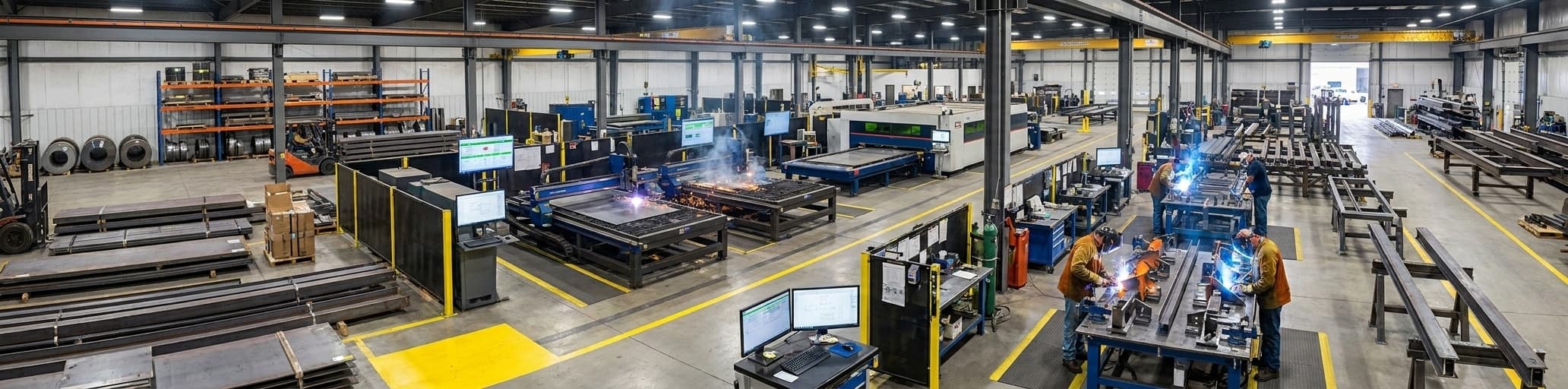

We walk you through setting clear KPIs, eliminating bottlenecks, aligning your team, and designing a layout that moves material efficiently from receiving to shipping. The result is faster throughput, lower costs, and on-time delivery without buying new equipment.
Set Clear Goals and Metrics for Your Steel Shop
Track WIP by production stage to spot slowdowns before they cascade into missed deadlines and costly bottlenecks.
Define performance KPIs aligned with delivery expectations
Before you can improve your steel shop workflow, you need to know exactly what you're measuring and why it connects to delivery.
KPI selection isn't universal — for a job shop, lead time and workflow performance matter far more than raw throughput volume.[2] Start by asking which operational activities most directly affect on-time delivery, product quality, and financial health, then build your metrics around those answers.[2] The most actionable KPIs for a steel shop fall into four categories: throughput (assemblies or linear feet completed per shift), on-time delivery rate (whether finished steel ships when the field crew needs it), rework and error rates (hours lost fixing mistakes instead of producing new work), and work-in-progress by stage (where jobs stall between cutting, welding, and assembly).[1] Tracking WIP by stage in particular gives you real-time visibility into slowdowns before they cascade into missed field deadlines.[1] The data only creates value when you act on it — what gets measured gets managed, and daily KPI monitoring lets you rebalance workloads, forecast material needs accurately, and keep every project within budget and on schedule.[3]
Identify and prioritize workflow bottlenecks
A bottleneck in your steel shop is any point where demand outpaces capacity — one station falls behind, unfinished steel piles up upstream, and downstream operations sit idle waiting for material.[4] The damage runs deeper than missed days: chronic bottlenecks generate overtime pay, extra storage costs for unfinished assemblies, rushed orders that spike error rates, and potential contractual penalties for late delivery.[4] Start identification by drawing a value stream map of your entire production flow — cutting, fit-up, welding, assembly, paint, shipping — and recording cycle times, wait times, and capacity at each step.[4] Linking each process to the one before it exposes where an upstream delay quietly throttles everything that follows.
Layer that with daily floor walkthroughs; material pileups near a single station, idle welders waiting on parts, and late deliveries that cluster around specific product types are the clearest physical signals a constraint exists.[4] Employee feedback adds what the data misses: operators and welders encounter constraints firsthand and often run undocumented workarounds that never reach management.[4] When a problem is difficult to trace, apply the Five Whys — ask why the slowdown is occurring, then keep asking why until you reach the root cause rather than treating the symptom.[4] Intangible barriers matter just as much as physical ones; communication gaps between your engineering team and the shop floor, or team resistance to revised sequencing, can choke throughput as effectively as a broken saw.[5] Once every constraint is visible, rank them by full cost — lost output, rework hours, and overtime combined — and attack the highest-cost constraint first, understanding that clearing one bottleneck will typically reveal the next one waiting behind it.[4]
Communicate objectives across teams for unified execution
Aligning your estimating, engineering, and shop floor crews around the same production targets is where most steel shops either gain momentum or lose it entirely.
In steel construction, clear communication across all participants — designers, project managers, procurement teams, and site crews — is as operationally critical as any physical resource, and its absence directly threatens schedules and margins.[6] The root cause of most miscommunication is knowledge fragmentation: essential job details scatter across spreadsheets or stay locked in individual employees' heads rather than being documented in a shared system, forcing every crew to operate on a different version of reality.[7] Breaking each project into defined work packages at the start resolves the structural side of this problem — clear scope assignments prevent the overlaps, omissions, and disputes that erode team trust and drain your supervisors' time on issues that should never surface.[6] The operational side requires closing the gap between what your plan says and what's actually happening on the floor; as one industry framework describes it, your ERP tells you where production *should* be, but without a real-time connection to shop activity, you never know what the actual situation looks like.[8] Digital work instructions distributed through a shop floor control system directly address both gaps: operators see which job has priority and receive automatic material replenishment alerts, while production leaders view station status and emerging delays without leaving their desk.[8] When objectives are visible to every team simultaneously — rather than summarized in an end-of-shift report that arrives hours after the problem — your steel shop can rebalance workloads in real time, flag material shortages before they stall a weld station, and keep every crew pulling toward the same delivery target.[7]
Design a Flexible, Flow‑Optimized Steel Shop Layout
Separate your five core zones–receiving, storage, processing, assembly, and shipping–to eliminate bottlenecks and keep material flowing smoothly toward completion.
Zone the shop for receiving, storage, processing, assembly, and shipping
Every steel shop needs five defined zones — receiving, storage, processing, assembly, and shipping — and the single biggest layout mistake is letting those zones bleed into each other.[9] A well-planned structure moves material smoothly from receipt to shipping, and operational assessments should identify potential bottlenecks at each stage before you finalize any floor plan.[11] Keeping reception independent from the rest of the shop is especially important: it gives you a controlled space to inspect incoming steel for damage, break down bundles, and route material to the right storage area without disrupting active production downstream.[9]
Your choice of flow pattern determines how material travels between zones. A U-shaped layout places receiving and shipping docks side by side at one end of the building, minimizing product handling, enabling shared dock equipment, and supporting cross-docking when a cut piece moves directly from receiving to an assembly station.[10] Through-flow patterns — I-shaped or L-shaped — position receiving and shipping on opposite sides or adjacent walls, which suits high-volume pre-engineered steel shops that need separately monitored inbound and outbound operations and can absorb the added floor space.[10] The right choice comes down to your throughput volume, available footprint, and whether consolidating dock labor outweighs the efficiency of separating flows entirely.
Within each zone, the goal is the same: reduce the distance material travels between steps.[9] Place your processing area — saws, drills, plasma tables — directly downstream from raw material storage so steel moves in one direction toward assembly and then to the shipping staging area, never doubling back.[11] High-use stock placed within reach of cutting and fit-up stations eliminates back-and-forth travel that drains hours from every shift, while a dedicated shipping staging area keeps finished assemblies separate from in-process work and prevents last-minute sorting chaos before a truck arrives.[9]
Create linear material flow to minimize handling and cycle time
The root cause of most steel shop waste isn't a broken machine or a slow welder — it's a floor plan that forces material to zigzag across the building.[13] When equipment gets placed wherever floor space happened to be available on delivery day, you pay for that shortcut in perpetuity through transportation waste, excessive operator motion, and the overproduction that follows when crews process larger batch sizes just to reduce the number of trips between distant stations.[13] The fix starts with a product-quantity-routing (PQR) analysis: document every product family you run, how many pieces you produce, which processes each requires, and in what sequence those processes occur.[13] That data reveals your actual value streams — for a typical steel fabrication operation, you might find three or four distinct families such as structural members, plate work, tube and pipe, and shared finishing operations like painting and assembly — and it shows you exactly which processes must sit side by side to prevent flow from breaking down.[13] Companies that apply systematic layout planning methods achieve 20-40% higher throughput than those arranging equipment by available space alone.[12]
Once your value streams are mapped, the goal is a single unidirectional path: raw steel enters one end, finished assemblies exit the other, with no backtracking.[12] Straight-line flow from receiving to shipping removes non-value-added handling at every step, and for high-volume structural steel components, keeping total travel distance under 500 meters is a practical design target.[12] Where floor geometry prevents a pure straight-line run, U-shaped or circular cell arrangements offer a strong alternative — operators work inside the curve, which shortens the distance between process steps, allows a single person to manage multiple machines, and keeps communication tight across the cell without anyone leaving the work area.[13] Gravity-fed flow racks between stations support this pattern cost-effectively: materials advance automatically to the next station without manual intervention, maintaining FIFO sequencing and eliminating the gaps in staging that stall downstream operations.[14] Before committing any equipment to a new position, simulate the revised flow by walking material through the proposed path — even hand-carrying a part between stations exposes imbalances and blockages that look fine on paper but create bottlenecks in practice.[13]
The financial case for linear flow is straightforward. A fabrication operation generating $5 million in annual revenue with 25 employees typically runs 30% of all activity as non-value-added movement and waiting — improving the layout enough to cut just half of that waste can deliver $195,000 in direct labor savings, with an additional $750,000 in sales potential from the 15% productivity gain, without purchasing a single new machine.[13] Material flow analysis makes those gains visible before you move anything: record current cycle times, wait times, and transport distances for each step, visualize where queues form between operations, then develop and compare multiple layout alternatives before selecting the one that delivers the shortest end-to-end path for your highest-volume work.[14] Discipline in repeating this analysis when new products or equipment enter your steel shop is what keeps the gains from eroding as the business grows.[13]
Plan for scalability, safety clearances, and future equipment placement
Planning for scalability starts with one structural decision: clear-span steel framing removes interior columns entirely, so your floor plan never gets locked to fixed obstacles as equipment needs change.[16] Without columns dictating zone boundaries, you can rezone fabrication, assembly, and storage areas as your production mix evolves — and mobile workstations extend that flexibility further, letting you roll equipment directly to where the work is rather than routing heavy material across a rigid floor.[16] When layouts are poorly thought through, the consequences compound: longer cycle times, higher injury rates, and ballooning maintenance costs accumulate month after month on a floor that was never designed for the work actually running on it.[15] Building safety clearances into the initial floor plan — not retrofitted after an incident — is how you keep aisle widths and equipment perimeters intact as new machines arrive.
When a layout change does happen, track every relocation through a dedicated work order system that logs equipment reconnection tasks and post-move validation checks before a station returns to production; that discipline is how you confirm clearances are preserved rather than assuming them.[15] Strategic layout redesign has cut material handling distances by more than 35% and lifted floor utilization by 25% or more in documented deployments, but those gains erode quickly without the same rigor applied to each subsequent change.[15] Location-based performance tracking — monitoring which floor zones accumulate the most downtime and repair costs — gives you the data to make future equipment placement decisions proactively rather than reactively.[15] For shops expecting future growth, designing your steel building's end wall as an expansion point rather than a permanent termination means adding bays later costs a fraction of a new structure, without interrupting current production.
Select Smart, Sustainable Equipment for Your Steel Shop
Smart automation systems with AI-integrated robotics and IoT sensors routinely achieve 75-85% overall equipment effectiveness while cutting lead times 20-40% through faster, repeatable processes.
Match cutting, welding, and forming machines to production volume needs
Integrate robotics, cobots, and IoT sensors for consistent quality The critical distinction between traditional and smart automation is adaptability: traditional automation repeats fixed tasks, while smart automation responds to variation, learns from data, and optimizes in real time — making it far better suited for the complex, high-mix reality of a steel shop.[20] Robotic welding cells are the clearest example. Rather than repeating programmed movements, an AI-integrated welding robot uses seam tracking, arc monitoring, and adaptive fill algorithms to compensate for fit-up variations and material inconsistencies as they occur, maintaining weld quality that fixed automation cannot match consistently across production volume.[20] The performance gap shows up directly in OEE scores: smart automation systems routinely hit 75-85% overall equipment effectiveness compared to 50-65% for manual operations, while first-pass yield improvements of 5-15% are common after a well-executed rollout.[20]
IoT sensors close the gap between equipment status and your production schedule. Connected sensors monitor vibration patterns, temperature fluctuations, and performance metrics continuously, so predictive maintenance systems can flag potential failures before pulling a machine offline — shifting repair work into planned downtime windows instead of emergency stops.[20] Machine learning layers on top of sensor data to extract optimization signals: CNC and laser cutting systems analyze thousands of cuts to determine the feed rates, power settings, and gas pressures that deliver the best quality and speed for each material condition.[20] That combination of sensor-driven monitoring and machine learning can cut lead times 20-40% through faster cycle times, repeatable processes, shorter changeovers, and unmanned shift capability.[20]
Collaborative robots (cobots) fill the gap between full robotic cells and manual labor. Unlike caged industrial robots, cobots work safely beside your operators without physical barriers, handling repetitive positioning, material handling, and measurement while skilled workers focus on programming, quality verification, and process optimization.[20] Machine learning makes cobots more adaptive over time, improving their ability to handle variable part families where production requirements shift between shifts.[21] Most smart automation investments in steel fabrication show positive ROI within 18-36 months, and automation can justify that return at volumes as low as 10,000-50,000 parts annually — well within the range of a mid-sized prefab industrial steel building designed for fabrication and assembly work.[20]
Choose energy‑efficient, low‑emission equipment and design for easy maintenance
Equipment selection shapes your energy bills, emissions profile, and maintenance burden simultaneously — treating them as separate decisions costs you three times over. Modern fabrication technologies like laser cutting and CNC machining consume significantly less energy than conventional alternatives, cutting greenhouse gas emissions and operating costs in the same motion.[22] Upgrading to high-efficiency electric arc furnaces and adding heat recovery systems to capture waste heat from production delivers around 20% reduction in energy consumption with direct cuts to operational costs.[23] For finishing, powder coating produces far fewer volatile organic compounds than solvent-based paints, letting you meet tightening environmental regulations without sacrificing throughput or surface quality.[22] Choosing equipment with recognized energy-efficiency certifications — Energy Star or equivalent — and retrofitting energy-saving features onto existing machines extends those gains without full replacement capital.[23] Steel shops that formalize this discipline through an ISO 50001-certified energy management system, which structures monitoring and continuous improvement around verified data, have achieved 25% reductions in energy consumption.[23] If you're also optimizing the building shell your equipment operates inside, aligning with ASHRAE 90.1 compliance standards ensures the facility envelope holds the gains your machines deliver.
Maintenance accessibility belongs in your equipment specification before you sign any purchase order, because unplanned downtime hits hard: a single hour offline can cost a steel operation tens of thousands of dollars in lost output and overtime labor, before accounting for missed delivery windows.[24] Reactive repairs and calendar-driven preventive routines both fall short — one arrives too late, the other drains resources on machines that didn't need attention.[24] Sensor-based monitoring and real-time diagnostics close that gap by flagging failure signals early and shifting repair work into planned downtime windows rather than emergency stops.[24] Beyond sensors, the physical design of your equipment matters equally — specifying accessible service panels, standardized fasteners across machine families, and modular component layouts means your technicians spend time fixing rather than disassembling. A preventive maintenance program that pairs scheduled inspections with real-time sensor data reduces energy waste from degrading equipment and keeps your steel shop running closer to rated capacity between service intervals.[23]
Leverage Digital Platforms in Your Steel Shop
Real-time data sharing between ERP and MES eliminates manual entry gaps, giving you end-to-end visibility and the ability to rebalance production when problems actually occur.
Integrate ERP and MES systems for synchronized scheduling and inventory
ERP and MES solve fundamentally different problems, and conflating the two is how steel fabricators end up with expensive software that doesn't fix the actual pain point. An ERP system manages company-wide resources — purchasing, inventory levels, finance, and production planning from the top down.[26] A Manufacturing Execution System operates at the shop floor level, monitoring and controlling production in real time: tracking work orders, recording machine downtime, capturing operator assignments, and collecting quality data as each job moves through cutting, fit-up, welding, and assembly.[26] ERP tells you where production *should* be based on the plan; MES reports what is *actually* happening right now on the floor.[27] Without both layers communicating continuously, your scheduler is planning against stale inventory counts, your procurement team is guessing at material burn rates, and floor supervisors are reacting to problems an integrated system would have surfaced hours earlier.
When the two systems share data in real time, a closed loop forms between planning and execution.[26] A customer order enters ERP, which checks inventory, sets delivery dates, and releases a production order. MES then breaks that order into individual operations, assigns workstations, records start and end times, flags deviations, and pushes live status back up to ERP.[27] That two-way flow eliminates the manual entry and communication gaps that generate duplicate records, mismatched part numbers, and scheduling conflicts — exactly the kind of errors that surface as a late delivery or a rework stack at shift end.[26] The concrete gains from integration include end-to-end visibility from raw material receipt to finished assembly, tighter traceability to support quality audits and compliance, improved production efficiency through synchronized plans, and the ability to rebalance production orders in real time when a coil arrives short or a saw goes down.[26]
The most common integration failure isn't technical — it's organizational. IT and operations teams typically work in separate spheres with misaligned priorities, and aligning them before implementation is as critical as any middleware configuration.[26] The second failure mode is forcing ERP to manage shop floor execution it wasn't designed for, or expecting MES to replace business planning functions outside its scope.[26] Defining system ownership before go-live prevents both problems: ERP holds master production schedules, inventory targets, and cost data; MES holds real-time equipment status, operator records, and quality results.[27] Steel shops that draw this boundary clearly gain a system where every scheduling decision is grounded in what the floor can actually execute today — not what was planned three days ago.
Use digital twin simulations to validate layout before construction
A digital twin is a dynamic virtual replica of your entire steel shop — every machine, process station, utility run, and workflow path — that lets you test layout decisions in software before a single anchor bolt is set.[28] The global digital twin market hit $35.8 billion in 2025, yet most fabricators still break ground on new facilities using static blueprints and gut instinct.[28] That's a costly habit: 60% of greenfield industrial projects face delays and budget overruns, largely because design flaws surface during construction when changes cost millions rather than minutes.[28] Building your steel shop virtually first flips that equation entirely — a layout correction that requires jackhammers and new concrete pours on a live site takes seconds inside the digital model.[29]
The practical validation sequence addresses four distinct problems before you commit to physical construction. Clash detection automatically flags conflicts between structural steel, mechanical systems, electrical conduit, and equipment — catching a misaligned embed plate or an anchor bolt that collides with planned HVAC routing during the design phase, where adjustments are simple.[29] Process simulation then validates throughput: you run your actual production workflow virtually, testing batch sizes, shift patterns, changeover sequences, and random equipment failures to confirm the layout hits output targets before a single machine ships.[28] Virtual commissioning validates PLC code, robotic cells, and conveyor logic against the digital twin before hardware arrives — companies report development times cut 25-50% through this step alone, converting weeks of on-site debugging into planned pre-construction activity.[28] For steel frame construction projects integrating BIM deliverables, aligning digital twin data standards — asset tags, equipment IDs, zone names — during the design phase prevents the costly data reconciliation that follows when those decisions get deferred until after fabrication begins.[30]
The financial case is direct. PepsiCo identified up to 90% of potential issues before physical construction using digital twin simulation, and that result reflects a repeatable pattern, not an outlier.[28] Catching a single interference between your saw line and a structural column in the model rather than on the floor can save weeks of schedule and tens of thousands in rework labor.[29] Design flaws found virtually cost virtually nothing to fix; the same flaws discovered after your slab is poured or your steel is erected carry change-order prices that compound through every downstream trade.[28] By 2025, over 70% of large commercial and industrial projects in North America required BIM deliverables as standard project documentation — which means your general contractor and specialty trades are already working from a shared data set, and connecting your steel shop layout to that model early keeps the entire project within budget and on schedule from the first day of construction.[30]
Apply AI analytics for predictive maintenance and continuous workflow optimization
AI analytics adds the most value in a steel shop when it operates at the workflow level — watching production sequence patterns across the entire floor rather than monitoring a single machine in isolation.
Predictive quality is the clearest application: machine learning models analyze process parameters, incoming material characteristics, and environmental conditions to flag potential defects before production begins, giving operators a window to adjust feed rates or power settings rather than correct rework after the fact.[20] Advanced scheduling algorithms take a similarly proactive approach, evaluating machine capacity, material lead times, and operator skill levels simultaneously to dynamically rebalance work orders as conditions shift mid-shift — a static schedule board cannot recalculate when a saw goes down or a coil arrives short.[31] The hard dependency beneath both applications is data quality: AI can optimize cutting layouts, reduce scrap, and suggest process improvements only when the underlying inputs — inventory counts, cycle times, equipment status — are accurate and fully connected.[31] Shops running on scattered spreadsheets will find that AI amplifies existing data gaps rather than closing them, which is why standardizing process documentation and integrating your ERP and MES before deploying analytics separates operations that achieve continuous workflow improvement from those that generate expensive noise.[20] The human element stays central throughout: AI surfaces the patterns, but experienced fabricators interpret the findings, prioritize the corrective actions, and implement the changes that actually move production forward.[31]
- Track four KPI categories–throughput, on-time delivery, rework rates, and WIP by stage–to identify bottlenecks before they cascade into missed deadlines.
- Eliminate workflow fragmentation by implementing digital work instructions and real-time shop floor control systems that synchronize planning with actual production.
- Design five distinct zones (receiving, storage, processing, assembly, shipping) with unidirectional material flow to cut non-value-added handling by 30% or more.
- Integrate ERP and MES systems so production schedules reflect real-time floor conditions, not stale plans that trigger cascading delays and rework.
- Smart automation (AI-integrated robots, IoT sensors, cobots) achieves 75-85% OEE and 5-15% first-pass yield improvements compared to manual operations.
- Use digital twins to validate layout, detect clashes, and simulate production before construction–catching design flaws virtually costs virtually nothing versus tens of thousands in rework.
- https://www.msuite.com/key-metrics-every-fabrication-shop-needs-to-track/
- https://www.thefabricator.com/thefabricator/article/shopmanagement/discovering-your-real-key-performance-indicators
- https://eziil.com/lean-shop-floor-management-techniques/
- https://www.netsuite.com/portal/resource/articles/inventory-management/manufacturing-bottlenecks.shtml
- https://www.thefabricator.com/thefabricator/article/shopmanagement/establishing-the-proper-flow-in-the-fabricating-shop
- https://xtdsteel.com/steel-structure-company/steel-contractor-project-management/
- https://mie-solutions.com/metal-fabrication-software-hidden-features-that-boost-shop-floor-productivity/
- https://www.vanenkhuizen.com/en/articles/manufacturing-execution-systems-mes-for-metalworking-a-complete-guide/
- https://www.conger.com/warehouse-setup/
- https://rebstorage.com/videos/warehouse-layout-product-flow-options/
- https://chinasteelbuildsales.com/warehouse-building-design/
- https://oxmaint.com/industries/manufacturing-plant/manufacturing-plant-layout-design-best-practices-guide
- https://www.thefabricator.com/thefabricator/article/shopmanagement/prescription-for-waste-reduction-lean-facility-layout
- https://www.beewatec.com/en/blog/material-flow-in-production-and-logistics-how-to-optimize-your-internal-processes
- https://oxmaint.com/industries/manufacturing-plant/best-manufacturing-plant-layout-design-strategies-2026
- https://iconsteelbuildings.com/workshop-organization-ideas/
- https://swmachinetech.com/finding-quality-fabrication-machines-in-dallas-fort-worth-complete-guide-to-metal-fabrication-equipment/
- https://www.thefabricator.com/thefabricator/article/automationrobotics/smart-equipment-choices-in-structural-fabrication
- https://evsmetal.com/2016/02/lean-fabrication-in-metal-manufacturing/
- https://evsmetal.com/2021/05/smart-automation/
- https://www.fabtechexpo.com/news/the-future-of-metalworking-how-automation-robotics-and-machine-learning-are-revolutionizing-the-fabrication-industry
- https://alsafriksteel.com/10-sustainable-metal-fabrication-techniques/
- https://eoxs.com/new_blog/strategies-for-reducing-energy-use-in-steel-manufacturing/
- https://iac-intl.com/insights/how-predictive-maintenance-transforms-steel-iron-industry-operations/
- https://www.infor.com/solutions/scm/manufacturing-execution-system
- https://maveneer.com/blog/mes-erp/
- https://explitia.com/blog/erp-vs-mes-which-and-when-to-choose/
- https://ifactoryapp.com/greenfield-consulting/digital-twins-revolutionizing-greenfield-factory-design
- https://lrkdindustries.com/blogs/news/from-virtual-model-to-steel-how-in-house-detailing-eliminates-fabrication-errors
- https://abctn.org/digital-twins-and-bim-a-practical-roadmap-for-modern-construction-leaders/
- https://genedge.org/resources-tools/ai-and-metal-fabrication-beyond-the-hype/