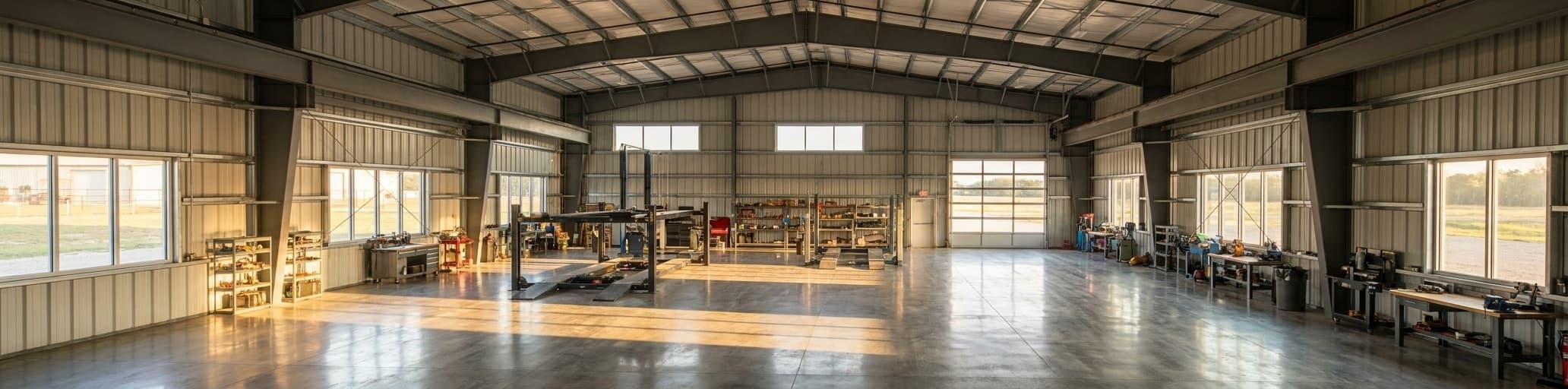

We walk you through workflow zones, door placement, permits, and material specs so your 30×40 metal building layout functions smoothly from day one. Clear-span construction and proper planning eliminate costly field modifications and keep your building flexible for future changes.
Understanding the Foundations of a 30×40 Metal Building Layout
Your 1,200 sq ft column-free interior lets you reconfigure zones anytime, so prioritize workflow efficiency and multipurpose spaces before committing to your layout.
Key Design Principles for Efficient Space Use
A 30×40 metal building delivers 1,200 sq ft of clear-span, column-free interior — which means your layout starts with zero structural obstacles blocking the floor plan.[1] That blank canvas is only valuable when you apply a few concrete principles before committing to door placement or interior partitions.
Start with workflow: production zones should sit adjacent to loading points, and storage should cluster near receiving areas so movement through the building follows a linear path rather than a cross-traffic tangle.[1] From there, cut redundancy aggressively — one consolidated storage zone outperforms three scattered ones, and a mezzanine level converts unused ceiling height into usable square footage without adding to the concrete slab footprint.[1] Multipurpose zones close the gap further: a staging area that doubles as a break room, or a workshop bay that shifts to overflow storage during slow seasons, means every corner of the 30×40 metal building layout earns its keep.[1] Wall height selection ties all of this together — standard eave heights run from 10 ft to 25 ft, and choosing additional height over additional footprint keeps perimeter wall costs lower while unlocking overhead storage and future mezzanine possibilities.[1] Clear-span construction makes this reconfiguration possible at any point because there are no interior columns locking your zones in place; multi-span designs with columns spaced 20-30 ft apart cost 20-30% less upfront but impose permanent layout constraints worth weighing against long-term flexibility needs.[2]
Assessing Site Conditions and Building Codes
Before your 30×40 metal building layout gets close to a permit office, the physical site drives your first round of decisions.
A licensed professional must identify existing power, water, and gas lines near the construction area before any ground is disturbed.[5] Soil bearing capacity and drainage patterns then determine your foundation approach — weak or poorly draining soils push you toward pier systems or deeper footings rather than a standard concrete slab, and getting soil conditions wrong at this stage means costly corrections after steel is already in the ground.[5] Site grading closes the loop: proper slope directs water runoff away from the building perimeter so moisture doesn't migrate under your slab and compromise it over years of use.[5]
Understanding permit requirements for metal buildings
Most metal buildings over 200 square feet require a building permit in incorporated areas, with fees running $200-$3,500 depending on jurisdiction and building size.[4] Your permit application will need PE-stamped engineered drawings designed for your location's specific wind loads (ranging from 90 to 180 mph in hurricane zones), snow loads, and seismic requirements under the International Building Code.[4] Plan review alone takes 1-12 weeks depending on jurisdiction workload, so starting the permit process 2-3 months before your target construction date is the simplest way to keep your project on schedule.[5] Skipping permits is a costly gamble: violations can trigger fines of $500-$1,000 per day, stop-work orders, and in non-compliant cases, required demolition — expenses that dwarf the original permit fee by orders of magnitude.[5]
Zoning, setbacks, and code layers to verify early
Zoning approval is a separate process from your building permit and must come first — it confirms your intended building use is allowed on the parcel before the permit office reviews a single construction document.[5] Setback requirements vary sharply by district: residential zones typically require 5-10 ft side setbacks, 15-25 ft front setbacks, and 10-20 ft rear setbacks, while agricultural zones are more lenient at 10-50 ft.[4] On top of the International Building Code, a 30×40 metal building layout may also fall under the International Energy Conservation Code for minimum insulation R-values, the National Electrical Code for service sizing and grounding, and the International Residential Code if the structure includes living quarters.[4] Each of these code layers should be confirmed in writing from your local building department before you finalize door placement or interior walls — changes forced after layout is locked cost far more than the phone call to verify requirements upfront.
For a state-by-state breakdown of how approval timelines and code adoption vary across jurisdictions, the warehouse addition permits state-by-state roadmap covers the key variables you'll encounter regardless of project type.
Aligning Layout with Quality and Service Goals
Layout decisions don't exist in isolation from the building's material spec — they reinforce each other.
A 12-gauge steel frame handles heavier point loads than lighter-gauge alternatives, which directly preserves the clear-span flexibility your floor plan depends on by reducing the need for interior supports.[6] Roofing systems backed by a 20-year warranty signal that panel performance under real weather stress has been engineered in, not hoped for — and a roof that won't leak or corrode means your storage zones, finished offices, or service bays stay protected without ongoing remediation costs eating into your operating budget.[6] Beyond materials, aligning your 30×40 metal building layout with service goals means building code compliance into the design from day one rather than retrofitting it later.[7] Suppliers with hands-on code experience size door openings, bay widths, and structural connections correctly the first time, keeping your layout locked so your schedule doesn't slip.[7] Customization choices — roll-up doors for vehicle access, windows positioned for natural light in a workshop bay, or color schemes that reflect your brand — aren't finishing touches; each one shapes how your zones function on a daily basis, and locking them in early prevents the field modifications that quietly inflate final project costs.[7] If you're still working through how all these specs translate into a realistic budget, the 30×40 prefab building cost guide breaks down exactly where each dollar goes from kit to completed structure.
Step‑by‑Step Planning Process for a Seamless Layout
Map your largest vehicle's full entry path before positioning doors and zones to eliminate the most common post-move regret.
Mapping Functional Zones and Workflow Paths
Zone planning starts before you pick a single door location. Divide your 1,200 sq ft into three distinct functional categories — active work areas (benches, lifts, or machines), a central access lane for vehicles or equipment, and perimeter storage walls — so every square foot has a defined job before concrete is poured.[9] The sequence of these zones drives whether your workflow runs in a straight line or degrades into constant reshuffling. Your primary work zone belongs adjacent to your main entry point; storage migrates to the perimeter so it never colonizes the center lane.[9] Maintain at least 3-4 ft of clearance around any machine or vehicle lift, since a single lift bay consumes roughly 200-250 sq ft of floor area before walk-around space is added.[9] Door placement is where most owners quietly lose this battle: a single overhead door positioned where it looks symmetrical on the façade often creates an approach angle that forces a multi-point turn every time a trailer or piece of equipment enters.[8] Mapping the full path of your largest vehicle — from the driveway apron to its parked position — and then designing zone placement around that path eliminates the most common regret reported after move-in.[8] The zones you need to define before committing to any framed opening are:
- Parking or equipment bay: the primary clear lane from the overhead door inward, sized to your widest vehicle with attachments included
- Active work zone: benches, tools, or a lift positioned off the main lane so work can proceed without blocking ingress or egress
- Receiving and staging area: a transition space between the door and the work zone where materials or parts land temporarily before moving deeper into the building
- Dedicated storage wall: shelving and racking anchored to perimeter walls so the floor stays open for maneuvering
Getting these four zones mapped on a simple sketch before ordering your 30×40 metal building floor plan prevents the single most expensive field modification — a door in the wrong wall.[8] People who skip this step frequently add shelves after the fact and conclude the building shrank; it didn't, they gave the floor away.[8]
Integrating Structural Elements and Pole‑Barn Features
The frame system you choose directly controls how much your 30×40 metal building layout can change over time. Solid I-beam primary framing paired with open-web secondary framing eliminates interior posts entirely, delivering 1,200 sq ft of unobstructed floor you can configure — and reconfigure — without structural penalties.[11] Interior modifications stay possible at any point without touching the outer shell's integrity, which means a parts counter or office partition added in year three doesn't require re-engineering the framing already in the ground.[10] Frame thickness and the precision of steel-to-steel connections also govern wind resistance, and those same specs determine whether your overhead door rough openings stay plumb and operational after a decade of weather cycles rather than binding shut because the frame shifted.[10]
Eave height is a structural decision that cascades directly into layout options. A 12-ft eave delivers roughly 11 ft of clear interior height — enough headroom for a single full-height vehicle lift or a box truck parked inside.[11] Step up to 14 ft and you gain the minimum clearance engineers recommend for hydraulic lifts rated for heavy trucks, plus usable overhead volume above a future mezzanine deck.[11] Height options on a standard 30×40 span 12 to 20 ft at the eave, and steeper roof pitches compound available ceiling volume while improving rain and snow shedding in high-precipitation regions — a dual structural benefit worth locking in before the order is placed rather than regretting afterward.[10]
Pole-barn buyers are drawn to lower upfront material cost, and that instinct has logic behind it — but a steel 30×40 lands within 10-15% of a comparable pole-barn installed cost once foundation and finish work are included in the comparison.[11] The structural trade-off is significant: wood posts carry termite risk, require recurring paint and stain cycles, and sag gradually in ways that tighten door clearances over years, while a steel frame holds its geometry without equivalent maintenance.[11] Where pole-barn thinking integrates productively into a steel envelope is in wall-mounted storage and overhead loft systems — both connect cleanly to steel girts and purlins without touching the primary frame — delivering the vertical storage density pole-barn users value, minus the long-term upkeep liability.[10] For a direct cost comparison on this footprint, the 30×40 pole barn price comparison across three states maps exactly where each system wins and loses on total installed dollars.
Using Single‑Source Solutions for Accurate Planning
Fragmented sourcing doesn't just create pricing complexity — it creates specification drift that corrupts a 30×40 metal building layout before construction begins.
When design, fabrication, delivery, and installation are split across separate vendors, each handoff introduces a margin for error no single party owns or corrects.[12] Providers who bundle delivery and installation alongside fabrication eliminate those gaps: the specs driving your door openings, framed bays, and anchor placement are validated once and carried to the field without translation errors.[12] Engineering certifications built into a single-source package add a second accuracy layer, since the team that sized your framing to local wind and snow load requirements is the same team delivering and assembling the structure — code compliance doesn't hinge on a subcontractor correctly reading another firm's drawings.[12] 3D design tools, when offered by the same provider handling fabrication, make pre-construction conflicts visible at the planning stage where changes cost nothing rather than in the field where they cost weeks.[13] For owners of commercial, agricultural, or aviation facilities, single-source accountability also compresses the decision chain: one contact resolves specification questions, one partner owns the schedule, and your layout stays locked from order to installation.
The prefab building kit delivery timeline shows why sequence matters here — engineering work begins the moment your order is placed, not after a chain of vendor handoffs finally aligns.
Optimizing Layout for Cost‑Effectiveness and Performance
A 30×40 metal building runs $52,000-$106,000 fully installed, with location and snow load requirements driving the largest cost swings.
Evaluating Material Costs within a 30×40 Metal Building Layout
The building kit is where your budget starts, not where it ends. A high-quality 30×40 metal building kit runs $18,000-$26,000 in 2026, covering primary framing, secondary framing, and roof and wall panels.[15] The concrete slab adds $8,500-$13,500 for a standard 6-inch reinforced pour — a number driven by local labor rates and site preparation depth, not just material volume.[15] Customization pushes costs further: framed openings, specialty trim packages, or non-standard end walls typically add 20-50% over the base kit price, while freight from supplier to site adds $500-$2,500 depending on distance and access conditions.[16] Erection labor runs $5,000-$15,000, shaped by local rates, building complexity, and jurisdiction-specific code requirements.[16]
| Cost component | Typical range |
|---|---|
| Building kit | $18,000-$26,000 |
| Concrete slab (6-inch reinforced) | $8,500-$13,500 |
| Erection labor | $5,000-$15,000 |
| Insulation | $2,000-$5,000+ |
| Freight | $500-$2,500 |
| **Full turnkey project** | **$52,000-$106,000** |
Two variables shift these numbers most sharply: location and structural engineering requirements. Buildings in high snow-load regions need heavier framing and steeper roof pitches, adding roughly 10-15% to structural costs.[15] Steel gauge is the other lever — heavier gauge handles greater point loads and preserves clear-span flexibility, but carries a higher kit price upfront.[16] For owners comparing options, a line-by-line breakdown of 30×40 metal building costs separates each component so you can see exactly where to prioritize budget and where there's room to flex. The long-run math still favors steel: lower insurance premiums, near-zero maintenance, and no rot or pest remediation offset the initial price gap compared to wood construction.[15]
Energy Efficiency and Insulation Strategies
Steel panels alone have essentially no insulating value, which means an uninsulated 30×40 metal building becomes a condensation trap the moment warm interior air contacts cold steel surfaces in winter.[17] That moisture corrodes metal fasteners, promotes mold in wall and roof finishes, and can mimic roof leaks — degrading the structure and anything stored inside.[17] The fix isn't insulation alone: fiberglass blanket insulation reduces heat transfer but does little to stop moisture-laden air from migrating through it.[17] You need insulation paired with a vapor retarder rated below 0.1 perms; retarders with a perm rating of 0.02 or lower provide the tightest protection for workshops, agricultural facilities, or any space generating interior humidity.[17]
Three insulation types cover most 30×40 applications, each at a different cost-performance point. Fiberglass blanket is the most common — fire-resistant, straightforward to install, and the most affordable at $0.70-$2.50 per sq ft installed — but thermal bridging at each purlin and girt cuts its effective R-value unless you add rigid insulation spacers.[17][18] Spray foam closes air gaps and delivers the tightest building envelope at $2.50-$4.50 per sq ft installed, though it lacks inherent vapor retardance and requires a professional applicator.[17][18] Insulated metal panels (IMPs) sit at the premium end with higher upfront cost but one-step installation and the best thermal performance for commercial, aviation hangar, or cold storage applications where climate control directly affects daily operations.[17] The table below maps each option against installed cost and primary trade-off:
| Insulation type | Installed cost (per sq ft) | Primary trade-off |
|---|---|---|
| Fiberglass blanket | $0.70-$2.50 | Thermal bridging at purlins reduces effective R-value |
| Spray foam | $2.50-$4.50 | No built-in vapor retardance; needs professional install |
| Rigid board | $2.00-$5.00 | Higher cost than fiberglass; loses some R-value over time |
| Insulated metal panels | Premium tier | High upfront cost; one-step install with top thermal performance |
The roof assembly is where most owners lose insulation performance without realizing it. A single fiberglass layer draped over purlins compresses at each purlin line, creating a thermal bridge along every run — a design that no longer meets most energy codes.[17] A fabric liner/multilayer system corrects this: a liner installs below the purlins on metal banding, then two layers of unfaced fiberglass stack over and between the purlins, delivering a continuous thermal barrier with a reliable air and vapor seal.[17] Your jurisdiction's International Energy Conservation Code sets the minimum R-values your assembly must hit, so confirming those requirements before ordering prevents field retrofits that cost far more than the original spec upgrade.[17] For a detailed breakdown of how R-values and U-factor specs translate to real energy savings on steel buildings, the steel building insulation guide covering R-values and vapor barriers maps every assembly option against long-term payback.
Future‑Proofing: Flexibility for Expansion and Adaptation
Future-proofing a 30×40 layout starts with how you treat the endwall from day one.
Steel buildings designed for bay additions need the endwall framed as a removable panel — not a finished wall — so a new bay bolts directly to the existing primary frame without re-engineering the structure.[20] Lean-to additions provide a second expansion path: attaching a covered lean-to along a sidewall runs $14-$18 per sq ft installed, a fraction of new standalone construction cost that leaves the current interior configuration untouched.[19] Clear-span construction keeps every other option open in parallel, since no interior columns freeze zone layouts in place — you can add a mezzanine deck, repartition the floor, or install a vehicle lift without structural penalties at any point in the building's life.[19] Eave height is the one spec genuinely difficult to correct later: a 14-ft eave keeps mezzanine and heavy-lift options viable for years, while a 10-ft eave closes both permanently.[20] Nail down doors, height, and endwall treatment together before the order is placed, and the 30×40 metal building layout you build today becomes a foundation you can extend rather than a constraint you're working around.
For a full breakdown of structural tie-in methods when you're ready to expand, the adding bays to steel buildings guide covers the connection specs that keep growth within budget and on schedule.
Implementation, Contractor Coordination, and Ongoing Support
Verify contractor credentials, insurance, and comparable projects before signing to prevent the preventable failures that derail metal building timelines and budgets.
Selecting Qualified Contractors and Clear Communication
Verifying credentials before you sign anything is the fastest way to protect your 30×40 metal building layout from the most preventable project failures. A valid state contractor's license confirms legal authorization to operate; certifications from recognized trade associations add evidence of ongoing technical training beyond the minimum.[21] Workers' compensation and general liability insurance aren't optional — they transfer accident liability off your property and onto the contractor, so confirming active coverage before groundbreaking is non-negotiable.[22] Portfolio review tells you what credentials alone can't: look for completed projects similar in scope, structure type, and use case to your own, and ask for references you can actually call rather than testimonials the contractor curated.[23] Contractors who can't supply comparable project examples are signaling inexperience with your building type, regardless of how competitive their quote appears.[22]
Clear communication is the mechanism that keeps your layout locked from order to installation — not a soft requirement. Before work starts, establish a single point of contact, confirm how change orders get documented in writing, and get a project schedule with defined milestones.[22] A contractor who clarifies scope, answers questions directly, and updates you on permit status or material delivery without prompting reduces the field surprises that push timelines past their original targets.[23] Equally, a contractor who listens to your workflow goals before offering structural solutions is more likely to deliver a building that functions the way you planned it.[23] For vetting local prefab contractors against these criteria before you commit, a structured evaluation saves far more time than discovering communication gaps after a contract is signed.
Detailed, itemized cost estimates are the third filter that separates capable contractors from risky ones. A trustworthy contractor breaks out materials, labor, freight, and jurisdiction-specific compliance costs as separate line items — not a single lump-sum figure.[21] Choosing the lowest bid without understanding what it excludes is how projects accumulate change orders that exceed the original cost gap between bids.[22] Confirm warranty terms for both materials and workmanship in writing before signing; contractors confident in their output provide warranties without negotiation, while those who resist warranty conversations are flagging the construction quality you'll encounter on site.[22]
Quality Assurance During Construction
Construction QA on a metal building isn't a single sign-off — it's a sequenced series of milestone gates, each of which must pass before the next phase can legally proceed. Inspections occur at foundation, anchorage, framing and erection, utilities, and final completion, and each milestone must clear before a certificate of occupancy is issued.[25] The most expensive QA failures trace back to poor site preparation or incorrect anchorage details, because both problems get buried under subsequent work before anyone notices — triggering rework on components that are already installed rather than corrections made before concrete is poured or steel is bolted down.[25] Scheduling each inspection before the crew moves to the next phase, not after, is the single habit that keeps your 30×40 metal building layout on schedule and within budget.
Material quality problems that enter the site unverified don't disappear — they get built in. A structured material control process applies receiving reports, inspection records, and clear accept/reject/hold labels at the point of delivery, so nothing moves deeper into the build without documented verification.[26] Materials that fail inspection get tagged and physically segregated immediately, rather than left in a staging area where they can be inadvertently installed.[26] Over-shortage-damage reports filed at delivery trigger replacement orders before the framing crew is standing idle waiting on missing components — not after the schedule has already slipped.[26] For a project where structural steel components form the primary load path, verifying every primary and secondary framing piece against the bill of materials before erection begins closes the most common gap between what was ordered and what actually gets raised.
Structural steel erection is where your layout either executes as engineered or deviates permanently. Fabrication inspection confirms steel components meet spec before they leave the shop; erection inspection then verifies that column plumb, connection engagement, and anchor bolt placement match the PE-stamped drawings on site.[26] Where field welding is required at connections, welder qualification records and daily field weld reports maintain full traceability across each joint — documentation that matters both for code compliance and for warranty enforcement if a connection fails years later.[26] A steel work installation checklist tied to your structural drawings gives the crew a concrete reference for every bolted connection and keeps field interpretation — the source of most erection deviations — out of the equation.[26]
Once framing clears inspection, the building envelope requires its own verification sequence before the interior is sealed. Roofing insulation installation, panel placement, and downspout and roof drain positioning each carry discrete inspection points that confirm the thermal and moisture protection system performs as specified — not as assumed.[26] A formal building inspection record documents completion of both external and internal work so the final punch list has a written baseline rather than a verbal understanding of what was agreed.[26] Field verification of the envelope — covering waterproofing, flashing, vapor barriers, and air infiltration details — is the QA layer that determines whether your steel building performs to spec for decades or requires remediation within the first few years of use.[24]
Post‑Build Services and Maintenance Planning
Your 30×40 metal building layout is standing and occupied — but the warranty coverage and service relationships you establish immediately after installation determine how the building performs over decades, not just the first season. Structural warranties on quality steel truss systems run as long as 50 years, covering defects in materials and workmanship from the delivery date forward.[28] That coverage only holds if you retain your original PE-stamped drawings, register the warranty correctly, and know exactly who to call when a connection question surfaces years later.[28] Weathertightness warranties add a second protection layer focused on panel moisture performance, and the strongest programs bundle pre-bid technical review, certified installer requirements, and post-installation inspection into a single process rather than treating each step as optional.[27] Both warranty types — structural and weathertightness — are worth confirming in writing before your original contract is signed, because recovering that documentation after build completion is rarely possible.
Post-installation support matters most when building use changes: a new overhead door position, heavier equipment creating unfamiliar point loads, or condensation appearing in a zone that was dry before. Manufacturers with active post-build programs assign technical specialists who stay reachable after move-in, not just during the sale.[27] Certified installer programs extend that protection further — when a manufacturer requires credentialed crews for warranty-eligible repair work, anyone touching your building has been trained specifically on the panel and framing system installed, not general metal construction in the abstract.[27] Architectural metal building designs demand precise installation to maintain integrity, which is why many owners now require manufacturer-certified installers as a condition of any post-build service engagement.[27] Understanding how metal roof panels perform under real weather stress helps you identify early warning signs — minor surface rust at fastener points, sealant gaps at penetrations — before moisture infiltration reaches the structural framing beneath.
Metal buildings demand less upkeep than wood-frame alternatives, but that advantage only holds when you have a qualified repair contractor identified before something fails. Repairs to metal and post-frame buildings fall outside the scope of most general contractors, who concentrate on new construction rather than structural remediation on existing steel envelopes.[29] The practical risk: a contractor unfamiliar with your building type may address visible panel damage without recognizing how that damage propagates through the full structure.[29] A specialist who understands how localized impact or moisture intrusion affects surrounding framing members catches secondary damage that a generalist misses entirely.[29] Repair estimates from qualified specialists typically require 2-4 weeks from the site assessment date, so scheduling an inspection at the first sign of deterioration — not after conditions worsen — keeps remediation within budget and prevents compounding damage from inflating what would have been a straightforward fix.[29]
- Clear-span 1,200 sq ft layout eliminates interior columns, enabling flexible reconfiguration without structural penalties.
- Zone planning–work areas, access lanes, receiving, and perimeter storage–must precede door placement to avoid costly field modifications.
- Site conditions, soil bearing capacity, and drainage patterns drive foundation approach before any steel reaches the ground.
- Building permits, zoning approval, and code compliance (IBC, energy, electrical, residential codes) must be confirmed in writing before finalizing layout.
- Single-source vendors bundling design, fabrication, delivery, and installation eliminate specification drift and validation errors across handoffs.
- Uninsulated steel buildings create condensation traps; fiberglass blanket with vapor retarder, spray foam, or insulated metal panels are required.
- Eave height (12-20 ft) locks in future expansion options; 14 ft minimum preserves mezzanine and heavy-lift viability for decades.
- https://www.buildingsguide.com/standard-sizes/?srsltid=AfmBOop2p2CzBO38JJyMITrYi8Hwnq3lDByvle7W0VW4O7dNzmOPijDc
- https://www.metal-buildings.org/metal-building-size-guide/
- https://www.buildingsguide.com/build/how-to-build-a-metal-home/?srsltid=AfmBOor2nIZmWcy1yER6uI7BiuJ4-0YZDxwDwjjQuOB6Utf_JKnxKomg
- https://www.metal-buildings.org/metal-building-permits-and-codes/
- https://metalbuildingshop.com/building-permit-requirements/
- https://www.americansteelstructures.com/30-x-40-buildings
- https://mavericksteelbuildings.com/steel-buildings/auto-shop-steel-buildings-kits/30×40/
- https://www.americanmetalbuildings.com/blog/30×40-vs-40×60-steel-buildings-real-space-cost-value-and-the-best-fit-for-you/?srsltid=AfmBOorZ977nPuNbyBTpFl0BqiiYTxzo0KNzyq6Xs-M-Szg89twWTkwm
- https://www.buildingsguide.com/design/shop-designs/?srsltid=AfmBOopC2j92-M69X3oek5F5khyoktZQIvFNf14TsoFI0HmJA_KC-J1g
- https://metal-america.com/30×40-metal-building-construction-facts/
- https://www.factorysteeloverstock.com/economy-model-30×40/
- https://www.coast-to-coastcarports.com/how-much-does-a-30×40-metal-building-cost?srsltid=AfmBOoqYjbTU6swtEOBJEC_m03lgP9yEc5knHX7Nzup-owXBzIkU722M
- https://gensteel.com/steel-building-kits/c-channel-building-packages/30×40-c-channel/
- https://americanmetalgarages.com/30×40-metal-garage-cost-breakdown-what-you-get-and-how-it-works/
- https://www.steelcobuildings.com/how-much-does-a-30×40-steel-building-cost-in-2026/
- https://www.uspatriotsteel.com/blog/how-much-does-a-30×40-metal-building-cost/
- https://www.buildingsguide.com/build/metal-building-insulation/?srsltid=AfmBOooP6FUjkzWAH7H6SpUv8gntmNUegVdmZ0C70DbgRBbPFw8e1bfe
- https://www.cascadingfallsinc.com/what-do-prefab-metal-building-cost-to-construct
- https://www.coast-to-coastcarports.com/what-are-the-most-economical-metal-building-sizes?srsltid=AfmBOopJnkkDpNF3UerEsqI4PP66sg2J3JU53xwayJVg2DAxaEedka-K
- https://www.aametalbuildings.com/blog/why-a-30×30-custom-metal-building-is-the-perfect-choice-for-a-metal-workshop-or-small-business?srsltid=AfmBOopZU_i2MyY9_L6QhzC2PltNaD73Eay7CCWXRqN5I8yLPbHxb40d
- https://www.beyonddiscoverycoaching.com/blog/how-to-choose-the-right-metal-building-contractor-without-costly-mistakes
- https://www.clarkroofingtx.com/how-to-choose-the-best-pemb-building-contractor-for-your-project/
- https://swfunk.com/news/prefabricated-steel-building-contractor/
- https://www.ftq360.com/construction-checklists/
- https://ibarraconstructionservices.com/essential-guide-to-permits-for-metal-building-construction/
- https://qaqc-construction.com/quality-control-inspection-check-sheets/
- https://www.mbci.com/blog/weathertightness-warranty-protection-a-comprehensive-commitment-to-your-metal-construction-project/?srsltid=AfmBOooVKjQtnmqTaVIl0tJA_z41XSrdF5r42MENw3mIsVuAxPx0Olk-
- https://www.worldwidesteelbuildings.com/about/50-year-structural-warranty/
- https://www.wickbuildings.com/metal-building-and-barn-repairs/