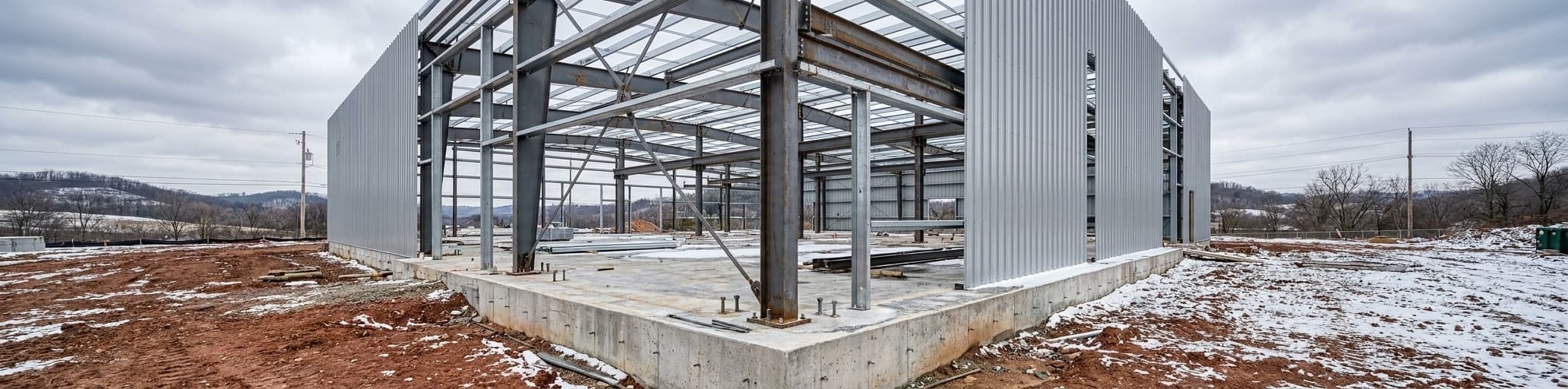

We help Pittsburgh owners navigate metal building contractor selection by clarifying how vertically integrated delivery prevents costly coordination failures across design, permitting, and erection. Choosing a single accountable team–verified through AC478 certification and regional experience–delivers projects on schedule and within budget.
What Makes a Qualified Metal Building Contractor in Pittsburgh
One integrated contractor eliminates coordination gaps and finger-pointing by routing design, engineering, and erection through a single accountable team from concept through closeout.
Single-Source Accountability: Design, Engineering, and Erection Under One Roof
When you split design, engineering, and erection across separate contractors, you multiply coordination risk at every handoff.
Mismatched specs, unexpected change orders, and schedule gaps all become more likely the moment responsibility is divided.
A vertically integrated delivery model solves this by routing design coordination, procurement, and on-site assembly through one team — creating a single point of accountability across the entire project scope.[1] That structure also reduces RFIs and downtime, because the people who engineered the building are the same people putting it up.[1] Under a true general-contractor model, one team assumes full responsibility from the early concept phase through permitting, structural execution, and final closeout — so you have one contact, one guarantor, and no finger-pointing between trades when a problem surfaces.[2] For Pittsburgh owners navigating western PA snow loads, clay soil conditions, and UCC permitting timelines, that kind of consolidated ownership isn't a convenience — it's the difference between a project that finishes on schedule and one that stalls waiting for three different firms to agree on who owns the issue.[1]
Local Code Compliance and Western Pennsylvania Snow Load Requirements
Pennsylvania enforces structural requirements through the Uniform Construction Code, which adopts the 2018 IBC and references ASCE 7 for all load calculations.[5] Ground snow load across the state is not uniform — it runs from roughly 25 psf in the southeast to 60 psf or higher in northwestern lake-effect zones, and western Pennsylvania occupies a demanding middle range that metal building contractors in Pittsburgh must engineer around precisely rather than approximate.[5] Critically, code does not allow engineers to apply ground snow load directly to the roof design.
Instead, ASCE 7 requires converting that ground figure into a roof snow load using exposure, thermal, and importance factors that shift based on building use classification and site-specific conditions.[5] Urban Pittsburgh adds another layer of complexity: parapet walls common on commercial structures create drift accumulation pockets where localized loads can substantially exceed uniform roof design loads — making drift calculations a mandatory design step, not a conservative add-on.[5] Pennsylvania sets a baseline 30 psf snow load for code compliance, and contractors must also confirm which IBC adoption cycle applies with the Authority Having Jurisdiction before any structural work begins, since using an outdated edition risks permit rejection or liability exposure.[4][5] For a detailed look at how western PA snow load specs translate into permit-ready building designs, the regional code variables are worth understanding before you finalize any structural package.
Proven Track Record: Why Experience with 1,480+ Buildings Matters
Experience with 1,480+ buildings is not a marketing claim — it is a proxy for solved problems, refined processes, and institutional knowledge that keeps your project on schedule.
A seasoned metal building contractor will have a proven track record of completed projects and the ability to handle unexpected challenges that arise in the field.[7] One objective way to verify that experience is AC478 certification, a third-party accreditation issued by the International Accreditation Service (IAS) that confirms a contractor meets rigorous standards for safety, training, and quality execution.[6] Fewer than 30 contractors in the United States hold AC478 status at the time of writing, which means requiring it as a precondition narrows your options to assemblers who have demonstrated consistent, standards-based performance — not just self-reported project counts.[6] Volume of completed work also directly affects schedule reliability: the biggest risks in pre-engineered metal building construction are not design failures but installation errors, inconsistent crews, and the absence of standardized field processes — all of which AC478 certification directly addresses by enforcing how work is performed, not just what is built.[6] Contractors who regularly work in the same regional market build supplier relationships that tighten material lead times and improve quality control, because they have firsthand knowledge of which products hold up under local conditions.[8] For Pittsburgh owners, that combination — verifiable third-party credentials, a large completed-project portfolio, and regional supplier depth — is the clearest signal separating a contractor who can quote your building from one who will deliver it on time and within budget.
Common Metal Building Projects Pittsburgh Contractors Handle
Steel warehouses compress construction timelines from months to weeks, letting your facility generate revenue sooner while remaining expandable as your operation grows.
Commercial Warehouses and Logistics Facilities
Commercial warehouses and distribution centers are among the most common steel building applications for metal building contractors in Pittsburgh, and the case for steel in logistics settings comes down to three practical factors: upfront cost, build speed, and long-term adaptability.[9] Steel costs less than wood and brick for large industrial footprints, and because modular components arrive at the job site with the bulk of fabrication already complete, a warehouse shell can be erected in weeks rather than the months a conventional structure requires.[9] Every week of compressed construction time is a week sooner the facility generates revenue — a direct line-item benefit for operators managing tight occupancy timelines.
When freight volumes grow and floor space becomes the constraint, steel's modular framing allows owners to expand by adding bays to an existing structure rather than absorbing the cost and disruption of relocating an active distribution operation.[9] Pittsburgh-area projects in this category span a wide range of end uses — automotive collision centers, pharmaceutical manufacturing facilities, bus transportation centers, and bulk storage buildings — all of which share a common demand for durable, clear-span interiors that steel delivers cost-effectively.[10] For owners weighing total project spend, an industrial warehouse cost breakdown by size puts real numbers behind these structural choices before you commit to a footprint.
Agricultural Storage, Equipment Barns, and Grain Facilities
Agricultural projects make distinct demands on a metal building contractor that commercial warehouse work simply does not.
Flat grain storage buildings — designed to hold anywhere from 500,000 to 5,000,000 bushels — require integrated conveyance systems running up to 60,000 bushels per hour, flush-floor or above-grade aeration systems, and end walls engineered for future expansion without disrupting active storage operations.[11] Dry fertilizer facilities add another layer of complexity: spacious drive-through alleyways, elevated control rooms, in-floor heat capabilities, multiple blending bays, and covered receiving and load-out areas all have to be designed into the structural package from the start, not retrofitted later.[11] Liquid fertilizer and bulk chemical storage buildings further require reinforced concrete containment areas, diked zones for spill control, tank-size flexibility, trench drains, and dedicated loading docks — all elements that affect column spacing, slab design, and roof load calculations before the first anchor bolt goes in the ground.[11] The common thread across grain, fertilizer, and equipment barn projects is that agricultural facilities punish contractors who treat them as standard steel kits with a few add-ons.
A qualified contractor approaches each build as a design-build problem, selecting between pre-engineered metal buildings and alternative structural systems based on the specific storage chemistry, throughput volumes, and expansion timeline the operation actually needs — not based on which system the contractor happens to prefer.[11] For Pittsburgh-area farm owners and agribusiness operators, understanding how steel frame farm building systems accept future add-ons without downtime is a practical starting point before you commit to a footprint.
Aviation Hangars and Maintenance Buildings
Aviation hangars occupy a distinct engineering category that sets them apart from standard commercial steel builds — and that distinction starts at the structural level before a single anchor bolt goes in the ground.
Pittsburgh-area projects in this category must satisfy both local building codes and requirements tied to airport authority standards or FAA-adjacent facility guidelines, which means permit-ready stamped engineering drawings aren't optional; they're the baseline.[12] Personal aircraft hangars demand clear-span framing to eliminate interior columns, since column placement that works in a warehouse becomes an obstruction the moment you're maneuvering a Cessna or a light twin through a 50-foot door opening.[12] Commercial projects compound those requirements: multi-bay layouts, ground support equipment storage zones, integrated office and maintenance areas, and higher occupancy classifications all affect structural specifications and must be designed into the building package from the outset — not accommodated through field modifications after erection.[12] Aviation facilities also require highly specialized experience that spans terminal support structures, maintenance hangars, cargo handling, ground equipment maintenance facilities, and emergency response stations, reflecting how operationally diverse an airport environment actually is.[13] For any Pittsburgh contractor quoting a hangar project, the ceiling height, door clearance, floor load capacity, and span dimensions aren't variables to approximate — they're fixed inputs that drive the entire structural design, and getting them wrong at the design phase means an expensive rework before the aircraft ever rolls inside.[12]
Metal Building Costs in Pittsburgh: What to Expect and How to Budget
Foundation and electrical work alone can cost $27,000 to $60,000 on a 40×60 metal building before the kit price, so pinning down these details early protects your budget.
Average Pricing for 20×20, 40×60, and 2000 sq ft Metal Buildings
Metal building budgets in Pittsburgh break into two distinct layers: the structural package itself and the site-work costs that rarely appear in a headline quote. Two of the largest line items outside the building kit are the concrete slab foundation and the electrical rough-in — and both scale directly with footprint. Concrete slab installation runs $4.34 to $7.73 per square foot for standard unreinforced work, rising to $9.29 to $10.04 per square foot when reinforcements such as rebar, wire mesh, or vapor barriers are added.[14] For a 20×20 footprint (400 sq ft), that puts the slab alone at roughly $1,736 to $4,016 depending on reinforcement level — a range wide enough to swing a small project's budget meaningfully if you don't pin it down early.[14] Electrical rough-in adds another layer: new construction commercial wiring costs $7 to $15 per square foot, while residential-use structures run $4 to $9 per square foot.[15] Across common Pittsburgh building sizes, those ranges compound fast.
| Building size | Sq ft | Slab cost (basic) | Slab cost (reinforced) | Electrical (commercial) |
|---|---|---|---|---|
| 20×20 | 400 | $1,736 – $3,092 | $3,716 – $4,016 | $2,800 – $6,000 |
| 40×60 | 2,400 | $10,416 – $18,552 | $22,296 – $24,096 | $16,800 – $36,000 |
| 2,000 sq ft | 2,000 | $8,680 – $15,460 | $18,580 – $20,080 | $14,000 – $30,000 |
The practical takeaway: a 40×60 metal building's slab and electrical work alone can represent $27,000 to $60,000 in costs before the building kit price or erection labor enters the equation.[14][15] Pittsburgh's clay soils and frost-depth requirements can push slab thickness beyond the standard 4-to-6-inch range, which shifts concrete from the basic tier into reinforced pricing territory and raises per-square-foot costs accordingly.[14] Commercial electrical in Pittsburgh also demands compliance with stricter code requirements than residential work, which is why the $7 to $15 per square foot commercial range — not the residential range — is the right planning benchmark for warehouse, hangar, or agricultural builds.[15] Getting both numbers into your budget model before you finalize a footprint keeps your total project spend within budget rather than surfacing as a mid-construction surprise.
Site Preparation, Foundation, and Permitting Costs Specific to Pittsburgh
Cost Comparison Tool: National Steel Buildings vs. Fragmented Contractor Approach Pittsburgh owners who divide metal building work across separate designers, engineers, and erection crews pay for that fragmentation in three predictable ways: coordination delays, unplanned change orders, and duplicated overhead. Prefab construction consistently costs less than conventional multi-party delivery — approximately 25 percent less than stick-built or fragmented approaches — and completes 30 to 50 percent faster because factory-fabricated components arrive site-ready rather than waiting on sequential handoffs between independent contractors.[19] Under a fragmented model, if any single party misses an element in the construction documents, the result is finger-pointing between trades and costly change orders that surface only after contracts are signed — making your final number unpredictable from the moment you break ground.[20] The disjointed nature of managing multiple independent parties means each one acts in its own interest rather than the project's: designers protect their specs, contractors protect their margins, and you absorb the gap between them.[20]
| Cost factor | Fragmented contractor approach | Single-source approach |
|---|---|---|
| Design-to-erection coordination | Multiple handoffs; gaps cause rework | One team, zero handoff gaps |
| Change order exposure | High — each trade prices only its own scope | Low — scope owned by one party |
| Schedule reliability | Delays compound across independent firms | Compressed; 30-50% faster delivery[19] |
| Overhead duplication | Separate markups per contractor | Single overhead structure |
| Value engineering | Difficult — late changes require renegotiating multiple contracts | Continuous — adjustments happen before steel is cut[20] |
Consolidating design, engineering, procurement, and erection under one entity creates a free flow of information from project start through substantial completion, with real-time cost adjustments before material is ordered rather than expensive retrofits after erection.[20] For Pittsburgh projects specifically — where western PA snow load specs, clay soil conditions, and Allegheny County permitting timelines all interact — having one team own every detail keeps your project within budget without requiring you to audit three separate invoices to find out where the money went. Understanding why Pittsburgh builders choose national buying power over local mills explains how contracted steel pricing compounds those coordination savings into a lower total project cost every step of the way.
How to Choose the Right Metal Building Contractor for Your Pittsburgh Project
Identify red flags like vague scope, missing stamped engineering, or excessive upfront deposits before signing, and you'll avoid costly change orders later.
Red Flags: What to Avoid When Vetting Local Contractors
The cheapest quote in a stack of Pittsburgh metal building contractor bids is usually the most expensive project you'll ever complete. When one bid lands dramatically below the others, something is missing — scope, equipment, materials, or field experience — and you absorb that gap through change orders after work has already started.[21] Beyond price anomalies, a specific set of behaviors reliably signals contractor risk before you commit to anything. Identifying them early costs nothing; discovering them after groundbreaking costs thousands.
The red flags that warrant either hard questions or a firm walk-away:
- Vague scope of work. If a proposal doesn't list materials, equipment provisions, and exclusions as line items, the contractor is leaving room to bill you for them later. No clear scope means no fixed price.[21]
- No stamped engineering documents. Every legitimate steel building project ships with county-rated, stamped engineered plans. A contractor who can't tell you who's stamping the drawings or what loads the structure is rated to is a contractor planning to cut corners on the structural package.[21]
- Abnormally large up-front deposits. A reasonable deposit covers material orders. A demand for 50 to 75 percent of the total contract before any work begins is a classic pre-construction warning sign, not a standard industry practice.[21]
- Pressure to sign immediately. Reputable contractors give you time to compare bids and verify credentials. A "today only" deadline is a sales tactic, not a project incentive.[21]
- Unresponsive communication before the contract. If a contractor takes more than 48 hours to return a pre-contract inquiry, assume post-contract responsiveness will be worse, not better.[22]
- Outdated or unavailable references. Experienced contractors maintain a current list of completed projects similar in scope to yours. If references skew more than two years old or can't be verified with a direct call, the quality of recent work is an open question.[22]
- No mention of permits. Any Pittsburgh metal building project that involves structural work requires permits through the Authority Having Jurisdiction. A contractor who frames permitting as an optional expense is exposing you to shutdown risk and liability.[22]
- Absence of third-party certifications. Credentials like AC478 from the International Accreditation Service verify that an erection crew meets documented safety and training standards — not just self-reported project counts. Contractors who pursue certifications invest in their crews; those who don't, often don't.[23]
For a deeper look at how to apply these criteria to actual contractor conversations, the guide on vetting local prefab contractors walks through the specific questions that separate qualified assemblers from contractors who will simply quote your building and disappear when problems surface.
Questions to Ask About Communication, Timeline, and Problem-Solving
Before you sign anything with a Pittsburgh metal building contractor, three conversation topics will tell you more than any portfolio photo: how they communicate, how they manage time, and how they handle problems when the unexpected happens. Poor communication is the root cause of most construction disputes, and the best contractors don't wait for you to call and ask what's happening — they keep you updated on milestones, flag potential issues early, and make you feel like a partner rather than a bystander.[24] Start by asking who your single point of contact will be and how accessible that person is during critical construction phases — if a problem surfaces on a Friday afternoon, you need to know exactly who picks up.[26] On timeline, ask for a realistic start date and a sequenced schedule that ties each phase to verifiable progress, not a single completion estimate that leaves every intermediate milestone undefined.[25] When asking about timeline, also confirm payment structure: industry-standard practice ties draws to verifiable milestones — materials delivered, structure erected, final walkthrough complete — and any contractor requesting fifty percent or more upfront before breaking ground is a contractor worth walking away from.[26] The third category — problem-solving — is where you separate contractors who have a process from those who improvise. Ask specifically how change orders are handled: whether changes are documented in writing, whether pricing adjustments follow a transparent formula, and whether you approve modifications before they are executed.[26] A contractor who cannot articulate a clear change order policy is a contractor likely to present surprise invoices after the work is already done.[26] The full question set worth covering before you commit:
- Who is my dedicated point of contact, and how quickly do they respond to field questions? Unresponsive communication before contract signing reliably predicts worse responsiveness after it.[24]
- How often will I receive project updates, and in what format? Progress reports, site meetings, or milestone notifications — get the cadence in writing.[24]
- What is a realistic start date given your current project load? Contractors running multiple simultaneous projects may quote optimistic starts that compress your schedule later.[25]
- How are change orders documented, priced, and approved? You need written confirmation that no scope change gets executed without your sign-off and a transparent cost basis.[26]
- What is your payment schedule, and how are draws tied to project milestones? Payments should track demonstrable progress — not calendar dates or contractor cash-flow needs.[26]
- How do you handle subcontractor disputes or non-performance mid-project? The answer reveals whether the contractor owns the problem or passes it to you.[24]
- Can you walk me through your full process from permitting through final walkthrough? A contractor who cannot narrate their own sequence clearly may not have a standardized one.[26]
These questions aren't adversarial — they create a framework that lets qualified Pittsburgh metal building contractors prove their competence through specifics rather than sales language.[26] The right contractor answers every one without hesitation.
Why National Steel Buildings' Turnkey Model Simplifies Your Decision
The turnkey model cuts through the coordination complexity that makes Pittsburgh metal building projects run over budget and past schedule.
In a turnkey delivery structure, a single contractor bears full responsibility for buying materials, managing labor, and coordinating every trade from foundation to final closeout — you sign one contract and receive a finished building rather than managing a collection of separate firms, each billing only for its own scope.[28] The practical advantage over fragmented delivery is measurable: design-build firms eliminate the communication silos that are the primary cause of budget overruns in commercial construction, and because procurement and site preparation can begin while final drawings are still being refined, projects break ground weeks or months earlier than traditional design-bid-build sequences allow.[27][29] Value engineering happens continuously inside a design-build process — meaning cost adjustments occur before steel is cut rather than after erection, when scope changes are expensive and disruptive.[29] Single-source accountability also eliminates the "blame game" between architects and contractors when western PA snow load specs, Allegheny County permit conditions, or clay soil surprises require mid-project decisions — one team owns the problem and resolves it without requiring you to audit which party's contract it falls under.[29] For Pittsburgh owners ready to compare what a single-source turnkey steel building delivery actually includes versus the multi-party alternative, the difference shows up first in schedule reliability and then on the final invoice — within budget, every step of the way.
- Vertically integrated metal building contractors reduce coordination risk and schedule delays by consolidating design, engineering, procurement, and erection under single accountability.
- Pittsburgh's western Pennsylvania snow loads range from 25 psf to 60+ psf, requiring precise engineering calculations including drift accumulation on parapets, not approximations.
- Concrete slab and electrical work costs $27,000 to $60,000 on a 40×60 building before the steel kit price, making these site costs critical to budget planning.
- Single-source turnkey delivery completes projects 30-50% faster and costs approximately 25% less than fragmented multi-contractor approaches with separate handoffs.
- Red flags including vague scope, missing stamped engineering, excessive upfront deposits, and unresponsive communication reliably predict contractor performance problems.
- AC478 certification from the International Accreditation Service verifies third-party standards for safety and training, with fewer than 30 U.S. contractors holding this credential.
- Agricultural and aviation projects require specialized design-build approaches tailored to specific operational needs, not standard steel kits with add-ons.
- https://m2steel.com/
- https://zeman-group.com/services/general-contractor/
- https://gundersonengineering.com/snow-load-requirements-pennsylvania/
- https://up.codes/viewer/pennsylvania/ibc-2018/chapter/16/structural-design
- https://metalbuildingsus.com/pennsylvania/
- https://www.flemingconstructiongroup.com/ac478_as_project_delivery_standard/
- https://www.thebigshedguy.com/how-to-find-a-reliable-metal-building-contractor-near-you
- https://www.rnkbuildings.com/why-hiring-local-metal-building-contractors-saves-time-money-and-headaches
- https://www.clarkcontractorinc.com/services/metal-building/
- https://www.steelsmithinc.com/
- https://www.greystoneconstruction.com/markets/agribusiness.html
- https://www.recordnet.com/press-release/story/36472/federal-steel-systems-announces-aviation-hangar-design-services-for-personal-and-commercial-use/
- https://www.thorntontomasetti.com/solution/aviation
- https://www.lawnstarter.com/blog/cost/concrete-slab-price/
- https://homeguide.com/costs/electrical-wiring-cost
- https://www.shannonstaleyandsons.com/blog/pittsburgh-new-home-building-cost
- https://www.opendoor.com/articles/how-much-does-it-cost-to-build-a-house
- https://www.houzeo.com/blog/how-much-does-it-cost-to-build-a-house-pittsburgh-pa/
- https://www.mobilemodular.com/blog/prefab-contruction-methods-difference
- https://dbconstructiongrp.com/blog/tag/commercial-construction/
- https://natmarbuilding.com/resources/finding-the-right-contractor/
- https://www.realtor.com/advice/home-improvement/hiring-contractor-red-flags/
- https://www.thisoldhouse.com/home-finances/how-to-vet-a-contractor
- https://www.korteluitjohan.com/10-questions-to-ask-before-hiring-a-general-contractor-in-southern-illinois-or-the-st-louis-metro-area
- https://thebuildersonline.com/4-questions-you-should-ask-a-general-commercial-contractor-before-hiring-2/
- https://texasmetalexperts.com/10-questions-to-ask-any-fort-worth-metal-building-contractor-before-you-sign/
- https://questarconstructiontx.com/blog/
- https://raghdan.sa/en/news/self-managed-construction-vs-turnkey-contracting-the-complete-2026-guide-to-choosing-right-and-protecting-yourself-with-contracts/
- https://albuilders.net/design-build/