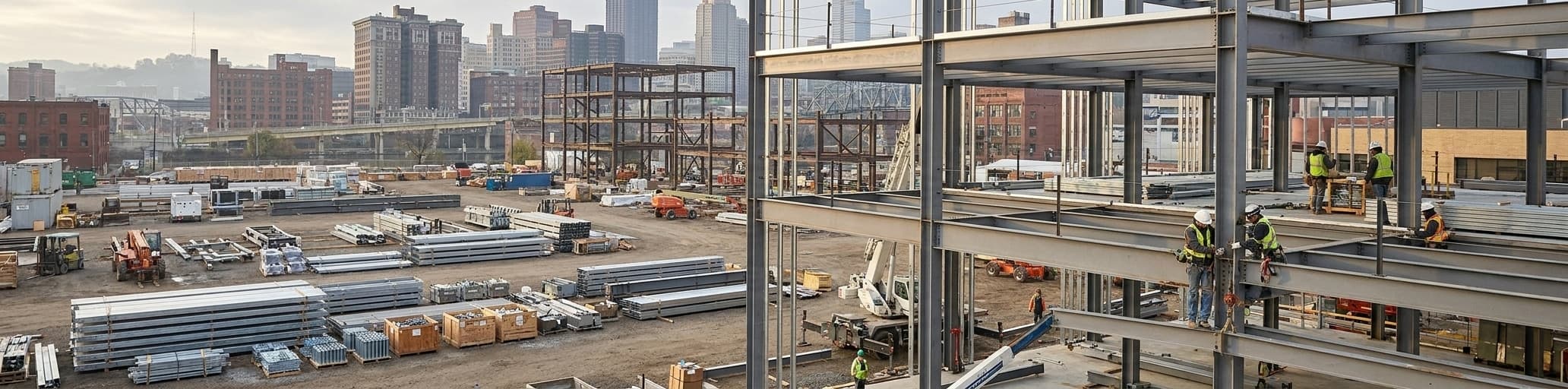

We guide Pittsburgh property owners through single-source steel building delivery, cost comparisons, and contractor vetting to avoid delays and hidden expenses. Pre-engineered steel cuts construction timelines from months to weeks while delivering 20-year ownership costs 50% lower than traditional framing.
Why Pittsburgh Property Owners Choose Steel Buildings Over Traditional Construction
One turnkey contractor eliminates handoff delays, surprise costs, and permitting headaches by managing design, fabrication, foundation, and installation under a single accountable contract.
Pittsburgh's Climate and Rust-Resistant Steel Advantages
Single-Source Turnkey Solutions vs. Managing Multiple Contractors When you split a steel building project across a separate designer, fabricator, foundation crew, and erector, every handoff between them is a potential delay.
A turnkey contractor takes complete responsibility for design, engineering, fabrication, foundation, installation, and finish under a single contract — collapsing all those handoffs into one accountable relationship.[4][6] The schedule benefit is direct: because one entity controls all phases, work moves without each trade waiting on the previous one to clear out.[4] The budget benefit is equally concrete — you receive a comprehensive quote upfront that covers every cost, removing the surprise invoices that surface when separate contractors miscommunicate scope or sequence.[4] Permitting is where single-source delivery earns its keep for Pittsburgh-area projects specifically; an experienced contractor already understands Allegheny County and local municipal code requirements and manages the approval process directly, cutting weeks off a timeline that owner-managed multi-contractor builds routinely lose to paperwork.[5] You also gain a single point of contact who carries the expertise and tools to keep the project on time and within budget — rather than spending your own hours chasing subcontractors for status updates.[5] If you want to see exactly what a single contract covers from dirt to door before committing to a delivery model, that breakdown clarifies which line items the owner typically absorbs under a kit-only purchase versus what transfers to the contractor under full turnkey.
How Design-Build Delivery Saves Time and Money in Western Pennsylvania
The schedule advantage of pre-engineered steel starts at the factory, not the job site. Steel framing and panels are manufactured off-site to exact specifications and delivered ready for assembly, cutting on-site construction from months to weeks — a 30×40 structure that takes 6-12 weeks in traditional wood framing can go up in 1-3 days once components arrive.[7] Traditional builds run multiple sequential trades on-site, and every handoff between them extends the timeline and adds labor hours at each phase.[8] Shorter schedules mean lower financing carry costs and faster occupancy — both of which affect how quickly your building starts paying for itself.[8]
The cost gap is equally concrete when you look at full project numbers. Pre-engineered steel for a 10,000 sq ft commercial structure runs $120,000-$250,000 installed, while comparable wood framing lands at $350,000-$500,000 and concrete at $500,000-$700,000 for the same footprint.[9] Annual maintenance on a steel building averages roughly 1% of initial cost; wood and concrete run 2-4%, excluding unplanned repairs like termite remediation or concrete cracking that rarely appear in original budgets.[9] Across 20 years, total ownership costs for that steel structure average around $350,000 — versus $670,000-$1.1 million for traditional materials once maintenance, energy use, and lifecycle replacement are included.[9] Pre-engineered construction also delivers cost predictability: precision fabrication reduces on-site variables and the surprise invoices that follow them, giving you a clearer path from signed contract to finished building.[8] For Western Pennsylvania owners who want to understand exactly how fast a steel project moves from contract to occupancy before committing to a delivery model, those lifecycle numbers make the math straightforward.
Steel Building Applications for Pittsburgh's Industrial and Commercial Economy
Pittsburgh's central location within an 8-hour drive of major manufacturing hubs positions your industrial project to capitalize on accelerating demand from supplier networks and regional population anchors.
Warehouses and Logistics Facilities Serving the Pittsburgh Region
Pittsburgh's location within an 8-hour drive of multiple major manufacturing centers puts it squarely in the demand zone that industrial analysts identify as generating additional leasing strength from supplier-network activity.[10] That geographic advantage compounds a structural one: 75% of U.S. logistics real estate demand is driven by proximity to population centers for domestic consumer deliveries, not by trade flows — meaning Pittsburgh's regional population base anchors warehouse demand regardless of tariff volatility or port disruptions.[12] National industrial leasing surged through the second half of 2025, surpassing pre-COVID record highs, while vacancy held flat for two consecutive quarters — the first time in the post-pandemic cycle it didn't rise quarter over quarter.[10][11] Manufacturing's share of new industrial leasing has climbed to 20%, up from 13% pre-pandemic, a trend with direct implications for western Pennsylvania given its existing manufacturing infrastructure and skilled labor base.[12] The supply picture adds urgency for anyone planning to build now: 2025 construction starts are running 25% below the 2017-2019 average, and 2026 deliveries are projected to land more than 70% below the pandemic peak — conditions pushing build-to-suit activity back toward its historical 20% share of new starts as occupiers stop waiting for suitable existing buildings.[12] For a warehouse or distribution facility in the Pittsburgh region, pre-engineered steel delivers the column-free clear spans and 24-to-40-foot eave heights that modern racking systems, dock configurations, and automation equipment require, on a build timeline measured in weeks rather than months.
If you want to map those specs against actual budget numbers, this industrial warehouse cost breakdown by size covers installed price ranges across common footprints before you commit to a design.
Agricultural Storage and Farm Buildings for Rural Western PA
The farmland extending through Greene, Washington, Butler, Armstrong, and Lawrence counties puts significant agricultural activity within an hour of Pittsburgh — and those operations carry building needs that differ sharply from commercial construction. Pre-engineered steel handles the full spectrum of farm building uses: grain and feed storage, dairy facilities, livestock barns, equestrian facilities, and equipment sheds, each configurable with purpose-specific ventilation, stall layouts, and door clearances before a single component ships.[13][14] The structural distinction between a steel building and a pole barn matters here specifically.
A pole barn uses wood post-frame construction with metal exterior panels; a pre-engineered steel building uses steel framing throughout.[13] In a western Pennsylvania climate — heavy snow loads, wet springs, humid summers — wood framing is vulnerable to rotting, warping, and pest infestations in ways that steel framing simply isn't.[13] Steel buildings engineered for Pennsylvania weather are also designed to carry the snow and ice loads common in the state's northern and central regions, so the structure performs correctly under the conditions your site actually sees.[14] For farm operations that expand in phases, steel frame farm building systems accept new bays without disrupting the existing footprint — a planning advantage that wood post-frame rarely offers cleanly. Pre-fabricated components arrive ready for assembly, so erection on a rural site runs days rather than weeks, and once the building reaches the end of its working life, the steel can be repurposed rather than demolished to landfill.[13][15]
Commercial Retail, Office, and Mixed-Use Steel Structures
Pittsburgh developers building retail centers, professional offices, and mixed-use projects face conventional construction costs that start at $200-$300 per square foot for office buildings and climb to $200-$400 per square foot for mixed-use structures in today's market.[18] Pre-engineered steel compresses that equation at the structural level: a fully installed steel building — kit, concrete slab, delivery, and erection included — runs $24-$43 per square foot, putting a weather-tight, code-compliant shell in place before interior fit-out begins at a fraction of what traditional framing commits upfront.[16] That cost gap is most consequential for retail and mixed-use owners because every week the shell sits incomplete is a week before tenants pay rent.
Clear-span steel framing handles the full range of commercial floor plates — open retail environments without interior columns interrupting sightlines, mezzanine office levels that capture vertical space without a second foundation pour, and storefront bays with large glazing openings that don't require the expensive structural headers a wood-framed wall needs.[17] For Pittsburgh's active mixed-use corridors — East Liberty, Lawrenceville, the Strip District — pre-engineered steel also moves through permitting faster than site-built alternatives because stamped engineering drawings and load calculations ship with the fabricated package rather than being assembled piecemeal by a local design team.[18] Geographic location and local building codes do affect final installed cost, so budget planning should account for Allegheny County's specific requirements alongside the base structure price.[17] If you want to see how a prefab retail steel building moves from signed contract to tenant-ready, the timeline and cost structure break down exactly where those weeks — and dollars — go.
Pittsburgh Steel Building Costs, Pricing, and Budget Planning for 2026
Pre-engineered steel locks opening sizes, loads, and connection details into factory drawings before fabrication, eliminating hidden change orders that plague site-built projects.
What Affects Steel Building Prices in Pittsburgh: Material, Labor, and Local Codes
Hidden Costs Avoided with Pre-Engineered Steel vs. Site-Built Alternatives The line items site-built projects hide best are the ones that never appear on the original quote.
In conventional construction, accessories like large overhead doors, storefront glazing, and mezzanine platforms aren't simple cutouts — each creates framed openings requiring headers, jamb reinforcement, and load re-routing back to the primary frame, adding engineering hours and field labor that surface as change orders after work begins.[19] Pre-engineered steel eliminates that exposure because opening sizes, loads, and connection details are locked into factory drawings before a single component ships, so the structural consequences of every door and window are priced into the original package rather than discovered on-site.[19] The scope-lock approach also removes material price exposure: once span, eave height, loads, and openings are approved, a deposit commits the steel tonnage at the agreed price and ends your vulnerability to weekly index movement — a hedge site-built contracts rarely offer because conventional framing doesn't work from a fixed engineered package.[19] Energy costs add another gap.
A properly insulated steel building cuts electricity bills 20-30% compared to a poorly insulated conventional structure, and correct insulation in a pre-engineered package is spec'd at the design stage rather than treated as a field decision made after the frame goes up.[19] Insurance premiums widen the comparison further: steel's resistance to fire, pests, and severe weather qualifies most steel structures for lower commercial insurance rates than equivalent wood-framed buildings, and those savings repeat every policy renewal.[19] Wood framing carries ongoing pest control, periodic repainting, and moisture remediation costs that never appear in a site-built initial quote but reliably appear in years two through ten of ownership — whereas steel panel coatings typically carry 25-year manufacturer warranties and require only basic cleaning to maintain finish durability.[25] For Pittsburgh property owners comparing pre-engineered steel against pole barn alternatives, the upkeep math is direct: wood post-frame carries maintenance liabilities steel framing simply doesn't accumulate.
Finding and Vetting the Right Steel Building Contractor in Pittsburgh
Ask your Pittsburgh steel contractor about panel gauge, hardware inclusion, written warranties, and local references before signing any agreement.
Questions to Ask Before Hiring a Local Steel Building Contractor
Not all steel building systems are equal — and neither are the contractors who install them. Before you commit to anyone for a Pittsburgh project, the first question to ask is what type of steel building system they supply. There are five distinct system types: arch (Quonset-style), web truss, weld-up field framing, light-gauge cold-formed studs, and pre-engineered I-beam construction.[26] Only pre-engineered systems arrive from the factory pre-cut, pre-drilled, and pre-painted — ready to assemble like a structural kit rather than fabricated piece by piece on your site.[26] That distinction affects your erection timeline, your labor cost, and your ability to get stamped engineering drawings that satisfy Allegheny County's permit office. Once you've confirmed the system type, the following questions separate contractors who can deliver from those who will cost you money finding out they can't:
- What panel gauge does your standard package include? Avoid contractors who supply 28- or 29-gauge "R" panels; quality pre-engineered buildings use 26-gauge PBR (Purlin Bearing Rib) panels that fully overlap and carry corrosion-resistant Galvalume coating.[26]
- Does the framing price include hardware? A complete package covers high-strength bolts, nuts, and self-drilling screws with EPDM washers — foundation anchor bolts are the only items sourced locally.[26]
- Do you carry a written warranty on the framing? A credible contractor guarantees in writing that steel framing will meet or exceed current local building codes for the life of the structure.[26]
- Can you provide references from projects similar in scope to mine? Ask specifically for references from commercial or industrial builds in Western Pennsylvania — and follow up with those contacts to confirm the contractor delivered on schedule and within budget.[26][27]
- Will you use subcontractors for erection, and how do you vet them? Who manages the site daily, and is that person the one you're talking to now?[27]
- What is your estimated timeline, and how do you handle bad weather delays? Pittsburgh's winters are a real schedule variable — a contractor without a documented weather contingency plan is a contractor without a real schedule.[27][28]
- How do you manage change orders once work begins? Get the change order process in writing before you sign anything; open-ended change order language is where Pittsburgh projects most commonly drift over budget.[27]
- What is your proposed payment schedule, and does it align with project milestones? Payments tied to measurable milestones protect you if work stalls; front-loaded payment schedules that don't correspond to completed phases are a warning sign.[27][28]
- Can you provide proof of valid contractor licensing and current insurance, including workers' compensation and commercial general liability? Pennsylvania requires both, and urban Pittsburgh site conditions — limited laydown areas, traffic control requirements — raise the liability exposure on any project.[28]
- Are the engineering drawings stamped by a licensed engineer for Pennsylvania? A building purchased online or from an out-of-state supplier may not account for Allegheny County's specific snow load, wind load, and seismic requirements under ASCE 7-22.[27]
Comparing quotes accurately requires confirming that every contractor is pricing the same scope — kit, slab, delivery, and erection — rather than letting a low-bid number obscure what it actually excludes.[27] A detailed line-item breakdown tells you what you're paying for; a lump-sum number only tells you what the contractor wants you to focus on. For a structured approach to vetting local prefab contractors before the first site visit, that framework covers the specific gaps most owner-managed vetting processes miss.
Why In-House Erection Capability Matters for Pittsburgh Projects
The erection phase is where Pittsburgh steel building projects most commonly go sideways — and the reason comes down to a skill gap most owners don't see until it's too late.
Pre-engineered metal building erection requires a dual skill set: the framing package demands iron worker expertise, and the sheeting and trim package requires sheet metal worker capability.[29] Hire one without the other — which happens frequently when a contractor subs out erection to whoever is available — and you get a crew that struggles with half the job.[29] Iron workers routinely stall on sheeting and trim installation; sheet metal workers hit their limit on the framing package.[29] Either way, the result is longer build time, higher labor cost, and finished work that doesn't meet the quality standard a permanent commercial or industrial structure requires.[29] A contractor who maintains an in-house erection crew eliminates that gap structurally: the crew trains together, works consistent projects together, and builds the team cohesion that tightens erection time and lifts craftsmanship across both scopes.[29] High crew turnover — the norm in subcontracted arrangements where crews can't sustain steady work — forces returning and new members to re-learn each other's roles on your timeline and your budget.[29] Specialty certifications sharpen the advantage further.
In-house crews certified for High R-Value insulation packages, standing seam roof erection procedures, and specialty door installations — sliding, bi-fold, and hydraulic systems — keep those scopes inside the original contract.[29] An uncertified subcontracted crew hands you a change order: pay separately for a qualified installer or absorb factory supervision costs the moment a specialty door goes on the schedule.[29] OSHA compliance closes the loop — a contractor who owns their erection crew controls safety training, PPE standards, and daily site supervision directly, which matters on Pittsburgh's constrained urban sites where limited laydown areas and traffic control requirements already raise liability exposure above what rural Western Pennsylvania counterparts face.[29][30] If you're still building your vetting framework, the steel building contractors near me guide covers how to confirm in-house erection capability before you sign anything.
Red Flags: What to Avoid When Choosing a Steel Building Partner
The questions in the previous section tell you what to ask.
These red flags tell you what to watch for when the answers don't hold up.
A bid that lands significantly below every other quote you've received is the first signal to investigate — a contractor who bids $30,000 below competitors on a Pittsburgh steel building project either hasn't priced the full scope or plans to recover margin through change orders after work starts.[31] Closely related: a contractor who insists on cash-only payment, offers a discount if you pay in cash, or can't accept a check or bank transfer is operating without the paper trail that protects you in a dispute — and often without the insurance that legitimate contractors carry.[32] Requests for more than 20% of the total project cost upfront are a documented warning sign; professional payment schedules tie each installment to a completed milestone, not to the contractor's cash flow needs.[32] A contractor with no permanent office address — one reachable only by cell phone or P.O. box — gives you nowhere to go if the project stalls or work fails inspection.[31] High-pressure tactics are equally telling: any contractor who claims their pricing is only valid if you sign today is preventing you from doing the due diligence that protects your investment.[32] Watch for vague or incomplete proposals too — if a quote doesn't specify panel gauge, framing system, included hardware, or opening sizes, the missing details will surface as change orders once work begins.[33] One red flag specific to commercial and industrial builds: if a contractor suggests you pull the permits in your own name rather than theirs, walk away — that arrangement shifts all code compliance liability to you and almost always means the contractor lacks the license or insurance to pull permits themselves.[33] Finally, ask directly whether all subcontractors and material suppliers on your project will be paid from project funds before you release final payment; an unpaid subcontractor can file a mechanic's lien against your property regardless of what you've already paid the primary contractor.[31] Any one of these signs warrants a harder look before you sign anything.
- Single-source turnkey contracts eliminate handoffs between trades, cutting project timelines from months to weeks.
- Pre-engineered steel costs $120k-$250k installed for 10,000 sq ft versus $350k-$700k for traditional materials.
- Steel buildings reduce 20-year ownership costs by 50% through lower maintenance, energy, and insurance expenses.
- Pittsburgh's industrial demand surge and tight supply conditions make build-to-suit steel projects urgent for warehouses and distribution.
- Erection failures stem from skill gaps–hire contractors with in-house crews trained in both framing and sheet metal work.
- Scope-lock pricing eliminates change orders by fixing opening sizes, loads, and details in factory drawings before fabrication.
- Red flags include bids 30% below market, requests for 20%+ upfront payment, and vague proposals lacking panel gauge specs.
- https://kta.com/weathering-steel-coated-uncoated/
- https://steelconstruction.info/Weathering_steel
- https://armstrongsteel.com/blog/weatherproofing-your-steel-structure-tips-for-extreme-climates
- https://www.gtasteel.ca/how-turnkey-steel-building-projects-streamline-your-construction-process
- https://seaconllc.com/news/steel-building-commercial-contractor-benefits/
- https://www.summitsteelbuildings.com/turnkey-building-solution
- https://bulldogsteelstructures.com/blog/exploring-the-cost-efficiency-of-metal-buildings-vs-traditional-construction/
- https://www.alliedbuildings.com/commercial-steel-building-vs-traditional-construction-costs/
- https://www.summitsteelbuildings.com/20-year-cost-comparison
- https://www.avisonyoung.us/us-industrial-market-overview
- https://www.commercialsearch.com/news/whats-next-for-industrial-real-estate/
- https://www.pwc.com/us/en/industries/financial-services/asset-wealth-management/real-estate/emerging-trends-in-real-estate-pwc-uli/property-type-outlook/industrial.html
- https://sunwardsteel.com/pennsylvania/
- https://masonsteelcorp.com/steel-buildings-in-pennsylvania/
- https://pioneerpolebuildings.com/services/agricultural-pole-buildings/
- https://www.buildingsguide.com/metal-building-prices/?srsltid=AfmBOoplE_Dcbeozqp9D431dr6KdACflIlJp_qnWPzt4MW9EE11aPRR5
- https://americansteelinc.com/blog/steel-building-costs-prices-guide/
- https://www.shannonstaleyandsons.com/blog/pittsburgh-commercial-remodel-or-build-cost
- https://www.tylerbuilding.com/post/2026-metal-building-cost-variables
- http://www.247pro.com/blog/your-state-by-state-guide-to-construction-costs-and-calculations-in-the-us
- https://www.pittsburghpa.gov/Business-Development/Permits-Licenses-and-Inspections/Fees
- https://www.shannonstaleyandsons.com/blog/pittsburgh-new-home-building-cost
- https://www.buildingsguide.com/metal-building-prices/?srsltid=AfmBOoodQtJV6_9gwD2sHFxTCpnh2BdOOa1GPagZApwBTajkCwK-umMp
- https://builtmammoth.com/how-much-does-a-steel-building-cost/
- https://www.steelcobuildings.com/metal-building-cost-a-comprehensive-guide-to-budgeting-and-planning/
- https://www.rhinobldg.com/blog/vetting-a-metal-building-company
- https://www.jbsteelconstruction.com/blog/what-to-look-for-when-hiring-a-metal-building-contractor
- https://www.bigrentz.com/blog/questions-to-ask-contractors?srsltid=AfmBOopNBzEE_1hglzLA-IE0w1FRNPm1i8rktZp4COwHwxxOH3945BiH
- https://www.steelsmithinc.com/2017/05/how-to-choose-the-right-erection-crew/
- https://swfunk.com/news/choosing-a-structural-steel-contractor-for-your-industrial-facility/
- https://staydryroofing.com/9-warning-signs-to-help-you-avoid-scam-contractors/
- https://todayshomeowner.com/home-finances/guides/avoiding-contractor-scams/
- https://realmhome.com/blog/questions-to-ask-general-contractor