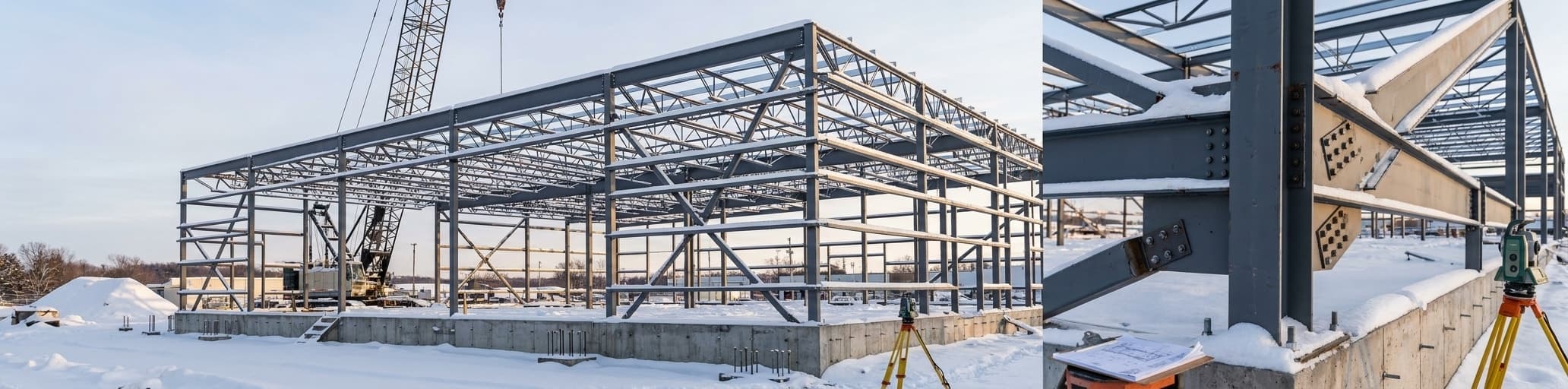

Western Pennsylvania's snow load requirements vary dramatically by location and elevation, requiring custom engineering that accounts for ground snow load, exposure factors, and load combinations specific to your exact address.
Western Pennsylvania Snow Load Requirements: What Inspectors Actually Check
Western Pennsylvania snow loads range from 21 to 40+ PSF depending on your exact location, so generic steel specs won't pass inspection without custom engineering.
Why Western PA's 50-75 PSF snow load demands custom steel engineering
Western Pennsylvania doesn't have a single snow load number — it has a range, and that range is wide enough to make generic steel building specs a liability. Pittsburgh's city code sets a ground snow load of 30 PSF, but that baseline is just the starting point.[1] Once engineers run the flat roof calculation using the ASCE 7-10 formula — accounting for exposure factor, thermal factor, and importance factor — the design roof snow load for a standard Pittsburgh structure comes out to roughly 21 PSF.[1] Move east into the Allegheny Plateau, climb in elevation, or build near Erie where lake-effect storms stack snow for weeks, and the certified load requirements climb to 35-40 PSF or higher.[2] That spread between jurisdictions is exactly why off-the-shelf steel packages routinely fail inspection in this region.
The code complexity compounds the raw numbers. Pennsylvania's Building Code Section 1608 governs snow loads, but it delegates the actual ground snow load value to local jurisdictions — meaning two properties 20 miles apart can carry entirely different design requirements.[3] Beyond the flat-roof baseline, engineers must also account for partial loading, unbalanced roof snow, drift accumulation on lower roofs, roof projections, and rain-on-snow surcharge loads.[1] Each variable can increase the demand on specific structural members well above the simple ground-snow figure, which is why a 30×30 steel frame in Pennsylvania requires certified engineering drawings that reflect your exact address — not a regional average. Custom steel engineering isn't an upsell in western PA; it's the only path to stamped, permitted plans that pass inspection.
How roof pitch, truss spacing, and member sizing work together in snow zones
Roof pitch, truss spacing, and member sizing interact as a single load path — change one variable and you change the demand on the others. Steeper pitches shed accumulated snow faster, which directly reduces the sustained load transferring to purlins, truss chords, and primary frames; metal barns in heavy-snow regions often use A-frame designs specifically because the geometry handles heavier snow loads while preserving interior clearance.[5] Commercial steel buildings in high-snowfall zones commonly require ratings from 50 to 100 PSF, and the roof form chosen at the design stage is one of the primary tools engineers use to hit those targets cost-effectively.[5] But geometry alone doesn't close the engineering loop.
Pennsylvania Building Code Section 1605 requires engineers to run multiple load combinations — pairing snow with dead loads, live loads, and wind simultaneously — because each combination can govern a different structural steel component along the load path.[5] Truss spacing determines how much tributary load each primary frame must carry; closer purlin spacing distributes demand across more members but increases fabrication complexity, which means the spacing decision is always a cost-versus-capacity trade-off tied directly to your certified snow load number. Under ANSI/TPI 1-2014 — the standard the IBC mandates for truss design — the Building Designer is explicitly responsible for ensuring all trusses act together as an integrated roof system, not just as individually-sized components.[4] That system-level obligation is where generic steel packages routinely fail inspection: member sizing gets optimized for simple uniform loading, but Pennsylvania code also requires engineers to model unbalanced snow distribution between adjacent frames, a condition that can push a correctly-sized rafter into overstress without changing a single input on the ground-snow map.[5]
National Steel Buildings's snow-load design process: From site conditions to certified plans
The design process that produces stamped, permit-ready plans in western PA starts with one input no generic package can supply: your exact address. Pennsylvania's Department of Labor & Industry places ground snow load determination squarely on the design professional — not the state — requiring engineers to pull values from Figure 1608.2 of the IBC or conduct full case-study analysis for locations Pennsylvania designates as such.[6] Western PA contains both mapped zones and case-study areas, so confirming which method applies is the first engineering decision, not an afterthought.
Once ground snow load is established, Pennsylvania's construction document requirements kick in: the certified plans submitted for permit must include roof snow load data and site geotechnical information as explicit line items, not assumptions buried in generic specs.[3] From there, the process runs through ASCE 7 exposure factor, thermal factor, and importance factor calculations to convert ground snow load into design roof snow load, followed by full load-combination analysis pairing snow with dead, live, and wind demands across every critical member.[3] Local jurisdictions build on these requirements with their own amendments, so the same IBC framework can produce different stamped outputs for two sites 15 miles apart — which is exactly why vetting your steel building contractor's engineering credentials before signing matters as much as the building package itself. The finished deliverable — calculations on file, drawings bearing an engineer's stamp, load data matching your specific municipality's adopted code edition — is what moves a steel building construction project in western PA from a quote to an approved permit without a rejection letter in between.[6]
Steel Building Specs That Meet Western PA County Codes: A County-by-County Breakdown
Allegheny County steel buildings require simultaneous design for snow load, wind uplift, and secondary effects like drift and rain-on-snow in your stamped documents.
Allegheny County (Pittsburgh area): Roof design, live loads, and wind uplift requirements
Allegheny County steel building projects start from Pittsburgh's municipality-amended ground snow load of 30 PSF — but that number is the input, not the design value.[1] Running the ASCE 7-10 flat-roof formula with standard exposure, thermal, and importance factors produces a design roof snow load of 21 PSF for a typical Pittsburgh-area structure, and sloped-roof loads drop further based on the pitch-specific slope reduction factor from ASCE 7-10 Sections 7.4.1-7.4.4.[1] What moves that number back up are the secondary effects engineers must layer on top: partial loading conditions, unbalanced snow distribution across adjacent bays, drift accumulation at parapets and lower roofs, and rain-on-snow surcharge — each of which can drive demand on a specific member well above the flat-roof baseline without changing the ground snow input at all.[1] Pennsylvania's Section 1607 then adds live load requirements on top of snow, and Section 1609 introduces wind design data as a separate line item that stamped construction documents must include explicitly.[7] Wind uplift is not a footnote in Allegheny County — it pairs with snow loading in the Section 1605 load combination analysis, meaning your primary frames, connections, and anchor bolts must satisfy both demands simultaneously, not in isolation.[7] Any permit-ready set of drawings for steel building construction in western PA must carry all of this on the face of the documents: roof snow load data, wind design data, and the geotechnical information the county's own development standards require for any site with soil or stability considerations.[7]
Washington, Greene, and Westmoreland Counties: Elevation-based snow load adjustments
Washington, Greene, and Westmoreland Counties each extend into terrain where elevation, topographic factors, and ground snow load interact to produce site-specific numbers that can't be borrowed from a Pittsburgh-area project.[1] Pennsylvania's Section 1608.2 places ground snow load determination squarely on the design professional, who must pull values from IBC Figure 1608.2 or run full case-study analysis for locations Pennsylvania designates as such — a requirement that hits especially hard in Westmoreland County, where ridge-and-valley terrain in the eastern portions sits at markedly higher elevation than the Mon Valley floor.[1] Roof snow load data must then appear explicitly on construction documents under Section 1603.1.3, not carried over as an assumption from a lower-elevation project in the same general region.[1] Westmoreland County adds a permit-structure layer on top: the county has no countywide zoning, and building permits are handled entirely at the local municipality level — with each municipality independently choosing to review permits in-house, contract with a building inspection company, or opt out and rely on the Pennsylvania Department of Labor and Industry.[8] That fragmentation means a steel building in one Westmoreland township can face a different reviewing authority — and potentially different adopted code edition amendments — than a project five miles away, even at comparable elevation.
Navigating that patchwork is where working with local prefab contractors who understand municipal permit structures pays off: certified drawings must anchor every snow load calculation to a specific address, not a county average, before any municipality's inspector will approve them.[1]
How National Steel Buildings aligns custom engineering with local inspection standards
The gap between a steel building that clears plan review on the first submission and one that bounces back twice comes down to documentation, not design quality. Certified steel buildings meet local building codes precisely because they carry an engineer's stamp tied to location-specific inputs — ground snow load, wind data, soil conditions, and the exact municipality's adopted code edition — while non-certified packages carry none of that proof.[10] Because building codes are enforced at the local level and project requirements routinely vary between municipalities that sit miles apart,[9] that documentation has to be built from scratch for every address.
Borrowing calculations from a neighboring county's approved project isn't a shortcut — it's a rejection letter waiting to happen. Running the full engineering sequence under one contract — pulling site-specific load values, applying ASCE 7 load combinations, producing stamped drawings matched to the reviewing authority's adopted code version — keeps the prefab building kit delivery timeline aligned with the permit timeline instead of creating a lag where a separately hired engineer falls behind the fabrication schedule.[9] The finished permit package covers every line item inspectors check: snow load data, wind design values, geotechnical information, and load combination calculations — all stamped, all address-specific, and all confirmed within budget before a shovel touches the ground.[10]
Roof Design & Material Selection for Heavy Snow Performance
Standing seam panels shed snow naturally and eliminate exposed fasteners that fail under western PA's freeze-thaw cycles, cutting maintenance from twice yearly to minimal upkeep.
Standing seam vs. corrugated panels: Snow shedding, accumulation, and maintenance trade-offsThe panel decision matters more in western PA's freeze-thaw climate than in milder regions because sustained snow load and repeated temperature swings expose every fastener, seam, and sealant point in a roofing system. Standing seam panels feature raised vertical ribs running the full length of the roof slope, which encourages snow to shed naturally before it can accumulate into dangerous structural loads.[12] More importantly for inspection-ready steel building construction in western PA, the concealed fastener design eliminates every penetration point where ice can expand under freeze-thaw pressure and force moisture into the building envelope.[13] Corrugated panels use exposed fasteners with gasket washers that must maintain compression through decades of thermal cycling — a reliability demand that the corridor from Pittsburgh to Erie's lake-effect zone will test every winter.[11] Once those gaskets begin to degrade under UV exposure and thermal contraction, heavy wind and driving rain common across western PA can lift loosened fasteners before the next scheduled maintenance visit.[11] For commercial and industrial property owners tracking maintenance budgets, corrugated roofs require inspection roughly every six months — tightening screws, replacing washers, and resealing suspect areas — while standing seam systems need minimal upkeep after installation because there are simply fewer penetration points to fail.[11] You can see those trade-offs side by side in this panel comparison:
| Factor | Standing seam | Corrugated |
|---|---|---|
| Snow shedding | Vertical ribs shed snow cleanly along slope[12] | Wave profile sheds on pitched roofs; less efficient than standing seam[11] |
| Ice dam risk | Concealed fasteners block ice infiltration at seams[13] | Exposed screws create entry points when gaskets degrade[13] |
| Maintenance cycle | Minimal; no exposed fasteners to inspect[11] | Every ~6 months: tighten screws, replace washers, reseal[11] |
| Thermal movement | Clip system allows panel expansion without buckling[12] | Rigid fastening fights thermal movement; risks oil-canning[12] |
| Expected lifespan | 50+ years with finish and structural warranties[11] | 30-40 years with proper maintenance[11] |
| Upfront cost | Higher due to heavier gauge and precision fabrication[11] | Lower materials and labor; faster installation[11] |
The lifespan gap between the two systems — 50-plus years for standing seam versus 30 to 40 for corrugated — directly reshapes the total cost calculation for any owner evaluating a steel building package.[11] A corrugated roof's lower quote looks attractive at signing, but six-month inspection cycles and gradual fastener replacement costs over a 30-year period close that gap faster than most budget projections account for. Standing seam also integrates cleanly with snow retention systems, because the same clip design that allows thermal expansion provides secure attachment points for snow guards without punching through the panel — which matters when you're managing controlled snow release from a commercial or agricultural rooftop where a sudden slide creates liability.[12] For anyone weighing these options against real performance data, this overview of metal roof panel pros and cons breaks down the system-level trade-offs that affect long-term ownership cost.
Truss design, purlin spacing, and load paths: What makes a roof pass snow-load inspection
What fails inspection in western PA snow-load reviews is rarely the primary frame — it's the secondary framing system where load paths break down.
Modern truss engineering has no prescribed spacing rule.
Software takes your specific span, bay spacing, and certified snow load and produces a truss sized for those exact conditions, which means a building can carry trusses 12 feet apart just as safely as one with trusses every 4 feet — provided each member is designed for its actual tributary load.[14] What makes wider spacing structurally viable is purlin orientation: purlins installed on edge develop substantially more bending resistance than flat-laid members, allowing primary trusses to be spaced further apart without exceeding deflection limits.[14] Purlins — horizontal steel members running perpendicular to trusses — are the direct load path between roof decking and the primary structure.[15] They collect panel load and distribute it evenly across rafters and trusses, which is precisely what prevents localized overload from manifesting as deck sag under weeks of accumulated lake-effect snow.[15] Profile selection sharpens that performance further: Z-purlins carry more load than C-purlins because their ridged cross-section adds bending strength and creates more secure attachment to rafters, making them the standard choice for heavy-duty applications like the 40×80 pole barn alternative builds that need steel trusses to outperform wood framing under sustained snow pressure.[15] Engineers derive purlin sizing from sectional properties — the cross-sectional shape and dimensions of the member — and calculate spacing based on the specific panel type, local snow load, and roof span for a given address.[15] Borrowing those calculations from a project 15 miles away at lower elevation isn't a shortcut; it's the specific condition that produces a rejection at plan review.
National Steel Buildings's structural engineering: Certified calculations and third-party verification
The certification chain that makes a western PA steel building approvable on first submission runs through three distinct checkpoints — and each one depends on the previous.
Pennsylvania's construction document requirements under Section 1603 treat roof snow load data, wind design data, and geotechnical information as mandatory line items on every permit package, not optional attachments.[16] A licensed engineer's stamp on those documents is the professional's legal attestation that the calculations governing every member, connection, and anchor bolt satisfy both the municipality's adopted code edition and the ASCE 7 load combinations that pair snow with dead and wind demands across each critical structural element.[1] What separates certified calculations from a generic load table is the verification layer that follows: independent plan review by the building department's own inspector or contracted engineer, who checks that submitted values trace back to a specific address, that load combinations weren't borrowed from a lower-elevation project in the same county, and that the design professional pulled ground snow load from IBC Figure 1608.2 or ran full case-study analysis for locations Pennsylvania designates as such.[16] Non-certified packages stall at precisely this stage — a regional wind mph claim or a county-average snow figure isn't traceable to a street address, so the reviewing authority has no basis for written approval.[16] For commercial, agricultural, or industrial owners pursuing steel building construction in Pennsylvania who need a facility operational on a fixed schedule, the gap between a first-submission approval and a rejection letter is measured in weeks and comes down entirely to whether the calculations on file were built for your specific parcel or someone else's.
Inspection Essentials: What Passes and What Fails in Western PA Steel Buildings
Soil geotechnical evaluation and frost-line compliance are non-negotiable first steps that prevent foundation failures and inspection rejections in western PA steel construction.
Pre-construction inspection: Site survey, soil bearing capacity, and foundation depth requirements
Pre-construction inspection for a western PA steel building starts well before any concrete is poured — it starts with the soil.
Pennsylvania's residential code mandates a geotechnical evaluation under Section R401.4.1, and commercial steel structures carry equivalent IBC requirements: the design professional must determine soil bearing capacity, moisture content, and settling potential before any foundation design moves forward.[17] That evaluation isn't a formality.
Different soil types impose entirely different demands on your foundation system — clay soils expand and contract with moisture changes and put sustained stress on footings, loose sands drain well but lack cohesive load-bearing strength, and peat or silt soils are prone to settling and often require reinforced concrete piles or raft foundations to prevent subsidence over time.[19] Soil characteristics, drainage patterns, and frost exposure can vary sharply within a single county, which is why foundation drawings that aren't anchored to a site-specific geotechnical investigation produce pre-construction rejections rather than permits.[18] Foundation depth requirements add another layer that western PA's climate enforces without exception: Pennsylvania code under Section R403.1.4.1 requires frost protection for all footings, meaning anchor bolts and perimeter footings must extend below the local frost line to prevent frost heave from shifting your primary frame.[17] Freeze-thaw cycles across the Pittsburgh corridor and the Allegheny Plateau make frost heave more damaging than property owners typically anticipate — water trapped in soil expands on freezing and can move an inadequately deep footing enough to misalign connections and void the building's structural certification.[19] The foundation construction sequence that survives pre-construction inspection covers every variable the inspector is trained to check: site clearing and grading for drainage, trench depth and width verified against frost protection requirements, formwork and steel reinforcement placed before concrete is poured, and concrete mix proportioned to the compressive strength the structural loads demand.[18] Skipping any step in that sequence — or borrowing specifications from a nearby concrete slab project at a different elevation or soil classification — is the condition that stalls a western PA steel building project before the first anchor bolt is set.[17]
During-construction inspection: Anchor bolt placement, connection torque, and bracing verification
During-construction inspection is where western PA steel building projects stall most often — not at plan review, but in the field, when a special inspector verifies that what's built matches what was stamped.
Pennsylvania's Chapter 17 requires a Statement of Special Inspections as a mandatory permit document, and steel construction falls under Section 1704.3, which mandates special inspection of both structural steel and cold-formed steel during erection.[20] Anchor bolt placement is the first checkpoint: bolt locations, embedment depths, and projections must match the structural drawings before any column base plate is set, because concrete that has already cured around a mispositioned bolt cannot be corrected without compromising the footing's load transfer path — the exact condition that fails inspection on steel building column installations that didn't verify placement before the pour.
High-strength bolt connections fall under Section 1704.3.3, which splits inspection into two distinct tiers: periodic monitoring covers standard connections, while continuous monitoring applies wherever the code or the engineer of record requires uninterrupted oversight of the tensioning sequence.[20] That distinction matters in snow-load applications because primary frame connections in a 50-plus PSF design zone carry combined snow-plus-wind demand, and an under-torqued bolt in a moment connection doesn't fail visibly — it fails progressively under cyclic loading across a series of western PA winters.[20] Bracing verification is the final field checkpoint before a frame can be considered structurally complete: Section 1710 requires structural observations to confirm that lateral bracing is installed per approved drawings before any temporary erection bracing is removed, because a partially braced frame cannot resist the ASCE 7 load combinations — snow paired with dead and wind — that the stamped calculations require.[20] Section 1709 places contractor responsibility explicitly on the erection crew to maintain code compliance throughout construction, not just at final inspection, which means the crew sequencing bracing installation and the special inspector verifying it must coordinate in real time rather than treating bracing sign-off as a post-erection formality.[20]
Post-construction inspection: Deflection limits, fastener count, and final load certification
Post-construction inspection is where western PA steel building projects either earn their certificate of occupancy or stall in a correction cycle — and the three checkpoints inspectors run through are specific enough that a single missed item restarts the clock. Pennsylvania's Section 1710 places structural observation obligations on the engineer of record that extend past erection into post-completion verification: the completed frame must be confirmed as performing per the stamped calculations before any occupancy approval issues.[20] Deflection is the primary performance metric at that stage.
In-situ load tests under Section 1714 apply a measured load to the completed structure and check that member deflection stays within the limits documented in the approved drawings, then confirm the structure recovers fully once load is removed.[20] A frame member that deflects within spec but doesn't return to position has taken on permanent deformation — a condition that indicates overstress and produces a rejection regardless of how intact the primary frame looks on a visual walk-through.[20] Fastener verification runs concurrently with deflection checks. Section 1704.3.3 governs high-strength bolt connections through periodic or continuous monitoring depending on connection type, and that obligation carries through to the final inspection stage — a special inspector confirms bolt count, placement pattern, and tensioning sequence against the approved connection drawings, not just a general assessment of whether bolts are present.[20] Section 1716 extends that verification to joist hangers and connectors, establishing test standards for the hardware transferring load between secondary and primary framing members, which means fastener sign-off covers every load-path connection the engineer specified — not just the primary frame bolts that get attention during erection.[20] Final load certification pulls all three threads together: Section 1713 identifies where test safe load procedures are required, and the completed documentation package — structural observation records, bolt verification logs, deflection measurements, and in-situ load test results — forms the written basis for the building official's approval and the engineer's final sign-off.[20] For commercial or agricultural owners running steel building construction in western PA on a fixed schedule, having all three documentation streams built in parallel during construction — rather than assembled reactively at the inspection appointment — is the difference between a same-day certificate and a two-week correction window.
- Western PA snow loads range from 21-40+ PSF depending on location, elevation, and local jurisdiction–generic specs fail inspection.
- Ground snow load must be determined by a licensed engineer for your exact address using IBC Figure 1608.2 or case-study analysis.
- Pennsylvania code requires stamped drawings that explicitly document roof snow load, wind design data, and geotechnical information before permit approval.
- Standing seam metal roofing outperforms corrugated panels in freeze-thaw climates with 50+ year lifespan versus 30-40 years and minimal maintenance.
- Purlin orientation, spacing, and profile (Z vs. C) directly affect load distribution and must match your certified snow load–borrowing calculations from nearby projects causes rejections.
- Special inspection of anchor bolt placement, high-strength connections, and lateral bracing during construction is mandatory under Pennsylvania Chapter 17.
- Deflection testing and fastener verification at final inspection confirm the completed frame performs within approved limits before occupancy approval.
- https://www.pittdes.com/post/snow-loads-on-roofs
- https://carport1.com/states-service-area/pennsylvania-pa/
- https://up.codes/viewer/pennsylvania/ibc-2018/chapter/16/structural-design
- https://www.structuremag.org/article/code-requirements-for-residential-roof-trusses/
- https://valuemetalbuildings.com/blog/snow-load-and-wind-speed-ratings
- https://www.pa.gov/agencies/dli/programs-services/labor-management-relations/bureau-of-occupational-and-industrial-safety/uniform-construction-code-home/advisories
- https://ecode360.com/26802891
- https://www.westmorelandcountypa.gov/1475/Subdivision-Development-Zoning
- https://torosteelbuildings.com/resources/building-codes-usa-states/
- https://www.probuiltsteel.com/blog/why-certified-metal-buildings-are-important-in-florida/?srsltid=AfmBOoquryRg3X5WKqafGdeSjmgK2J1Ya2TZJuf1tkwtwaqfZr3yo3RF
- https://www.windsormetalroofingoh.com/standing-seam-vs-corrugated-metal-roofing-for-commercial-properties/
- https://www.londonecometal.com/metal-roofing-ontario-blog/2025/09/which-metal-roof-type-survives-harsh-winters/
- https://www.westernstatesmetalroofing.com/blog/metal-roofing-in-snow-country
- https://www.hansenpolebuildings.com/2011/06/pole-barn-truss-spacing/?srsltid=AfmBOoqrydXOIVpH-e5GZWuxheP5BEQxEiXZXH0oRQhXmN2qIZTj_Qhi
- https://www.kloecknermetals.com/blog/the-ultimate-guide-to-purlins-in-metal-roofing-steel-frame-construction/
- https://www.engineeredmetalbuildings.com/blog/?srsltid=AfmBOorfelpS0lMPq1vPO0oi_rdeuD6kqsoEU2n1EwRpmH0hjkW-RGEw
- https://up.codes/viewer/pennsylvania/irc-2015/chapter/4/foundations
- https://www.hswilliams.com/blog/pre-engineered-metal-building-foundation-details
- https://armstrongsteel.com/blog/how-weather-and-soil-conditions-affect-the-installation-of-metal-buildings
- https://up.codes/viewer/pennsylvania/ibc-2009/chapter/17/structural-tests-and-special-inspections