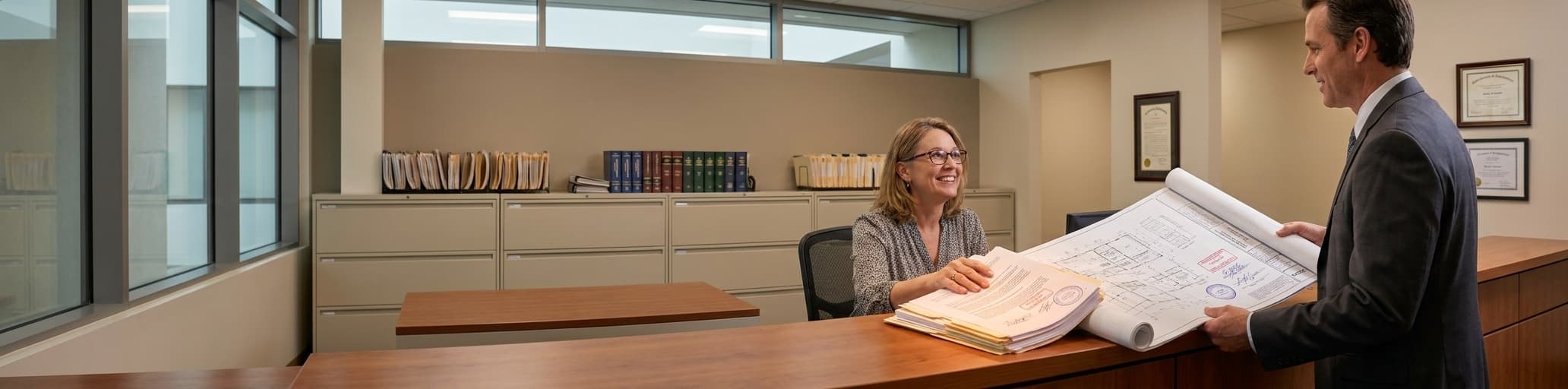

Pole barns and steel buildings face different permit pathways because their structural systems transfer loads differently, and building departments require documented proof of how each resists wind and seismic forces.
Why Pole Barns and Steel Buildings Face Different Permit Pathways
Building departments approve steel buildings faster because factory-stamped engineering plans eliminate the soil verification burden that delays traditional pole barn permits.
The structural difference that triggers different code requirements
The term "pole barn" covers more than one construction type, and building departments treat each differently. A traditional pole barn uses round wood poles buried directly in the ground as the primary load-bearing structure, while a post-frame building — often mislabeled as a pole barn — uses engineered laminated wood columns set into concrete footings or piers.[2] Pre-engineered steel buildings are built differently again: every structural member, from columns and girts to purlins and rafters, is fabricated from steel and bolted to a prepared foundation.[2] That difference in how each system transfers lateral loads to the ground is the root cause of diverging code requirements across the country.
Building departments focus on two things: how loads move through the structure and whether you can prove it with documentation. Soil-embedded wood poles resist wind and seismic forces through ground friction — a mechanism that's difficult to verify without site-specific engineering, which most pole barn kits don't include.[3] Pre-engineered steel buildings sidestep that problem entirely. Every column, girt, and rafter is cut, welded, and marked to a specific engineering spec before it leaves the factory, and the kit includes engineer-stamped plans you can hand directly to a building department.[2] Post-frame buildings hold a middle position: they meet UBC and IBC standards by design, giving them a permitting path that traditional pole barns often can't access in stricter jurisdictions.[1] The documentation gap — not building size or intended use — is what splits the pole barn permits vs. steel building permits conversation in nearly every state.
How local building departments classify pole barns versus pre-engineered steel structures
Building departments classify structures by occupancy — how the building will actually be used — not by what you call them on the permit application.[4] That single determination drives everything downstream: which IBC chapter governs the project, what inspection checkpoints are required, and whether fire separation, sprinkler requirements, or energy codes enter the picture.[5] A farm storage structure sits in a different occupancy category than a commercial shop or any building regularly accessed by the public, and moving between those categories changes the documentation burden significantly.[5] The classification also affects which code book applies at all.
The International Residential Code (IRC) does not govern post-frame buildings — only the IBC does — so any application that defaults to residential code assumptions gets flagged by a plan reviewer before structural review even begins.[6] Pre-engineered steel buildings avoid that classification problem because the factory-stamped package already assigns the correct occupancy category, wind exposure class (B, C, or D), seismic site class, and design ground snow load before you walk into the building department.[6] Beyond the primary structural permit, both building types can trigger separate sub-permits for electrical service, plumbing, mechanical systems, and site grading depending on scope — and each sub-permit has its own inspection schedule.[5] Understanding whether your project qualifies as an agricultural structure or an agricultural building is one of the first classification calls a building department will make, and it can determine whether a structural permit is required at all.
Why permit complexity matters to your project timeline and budget
Permit review alone accounts for 4 to 8 weeks within a pole barn's typical 18-to-24-week build cycle.[9] That window expands for predictable reasons: missing site plans, incorrect setback placement, unverified wind ratings, and foundation anchoring details left out of the application each pause review until the applicant responds.[8] Processing times also vary widely between jurisdictions — some approvals clear in days while others drag for several weeks — and there's no way to forecast which scenario applies until the application is already submitted.[9]
The scheduling ripple effect is where permit complexity converts directly into budget exposure. You need to commit a contractor to a start date before the building department has approved your plans — but if approval runs longer than expected, rescheduling that crew based on their new availability adds both delay and cost, particularly during peak construction season when crews carry full books.[7] Ordering the building before confirming local permit requirements is one of the most common triggers for mid-review stalls, compounding the timeline damage.[8] Confirming zoning, setbacks, and required documentation before any contracts are signed is the single step most likely to keep your project within budget and on schedule.
State-by-State Permit Requirements: Agricultural Exemptions and Commercial Rules
Farm buildings like barns and storage sheds typically skip state permits in agricultural exemption states, but zoning requirements always apply regardless.
Agricultural exemption states: Texas, Iowa, and the Midwest approach to farm buildings
Agricultural exemption states share a common logic: structures built on farmland for farming purposes are typically exempt from state-level permit requirements, as long as retail trade isn't conducted inside.[10] Michigan codifies this framework directly in MCL 125.1510(8), which exempts any building "incidental to the use for agricultural purposes of the land on which the building is located" from the permit requirement — and its definition of agricultural purposes is deliberately broad, covering farming, dairying, pasturage, horticulture, floriculture, viticulture, and animal and poultry husbandry.[11] Farm-heavy states across the Midwest, including Iowa, operate under comparable principle-based exemptions, as does Texas with its large agricultural economy, but the word "incidental" is where jurisdictions diverge sharply: a grain storage bin clears the threshold in virtually every farm county, while a livestock processing facility with food safety infrastructure almost certainly doesn't.[10] Building type determines exposure — barns, storage sheds, and equipment shelters typically qualify for agricultural steel buildings exemptions across the region, while processing facilities and structures regularly accessed by the public face the same commercial permitting requirements as any other IBC-governed project.[10] One consistent rule across all exemption states: a permit waiver doesn't cancel zoning requirements.[10] Setbacks, zoning districts, and land-use designations still apply regardless of whether a structural permit is required, so confirming zoning compliance before breaking ground is a non-negotiable step even on fully exempt agricultural projects.[10]
States with strict commercial permitting: California, New York, and Florida requirements
California operates under the California Building Code — an IBC-based framework layered with extensive state-specific amendments — and applies high seismic design requirements to every jurisdiction in the state, not just fault-adjacent counties.[12] Fire-resistance standards activate in wildland-urban interface zones, and Title 24 energy compliance applies to virtually every project.[12] Permit applications route through the California Building Standards Commission alongside local agency approvals, and the California Air Resources Board may add a separate permit layer for certain industrial uses.[13] Agricultural exemptions exist on paper but are narrow in practice: most California counties require permits even for farm buildings, a sharp contrast to the broad Midwest exemption framework discussed above.[12] Permit fees run from $800 to $3,500 — the highest range in the country — and seismic detailing combined with energy compliance documentation commonly triggers multiple review cycles before approval.[12] For any project that touches more than one jurisdiction or use category, reviewing the state-by-state commercial permitting roadmap for warehouse and industrial additions before submitting is worth the time.
Florida's permitting friction comes from wind, not seismic exposure. The state enforces statewide hurricane requirements, but the High Velocity Hurricane Zone covering Miami-Dade and Broward counties goes further: every structural component must carry enhanced testing and HVHZ-specific product approval before a permit will issue.[12] Design wind speeds across coastal areas run from 140 to 180 mph, structural work requires a state-licensed contractor by law, and the Florida Building Commission administers code adoption at the state level.[12] Permit fees typically fall between $800 and $2,500.[12] Pre-engineered steel buildings enter this process with a significant advantage — factory-stamped wind-load calculations are already embedded in the engineering package, directly addressing the documentation burden Florida plan reviewers impose on every structural submittal.[13]
New York's permitting weight comes from density and review volume rather than a single dominant hazard. Commercial and industrial permit applications go to the Departments of Buildings (DOB), and the New York State Department of Environmental Conservation may require additional permitting for projects that trigger environmental review thresholds.[13] Urban jurisdictions — New York City in particular — run multiple concurrent review tracks with high submission volume, meaning even a complete, well-documented application moves through the queue on the department's timeline rather than yours.[13] The documentation gap that stalls pole barn applications in California and Florida applies here too: incomplete structural packages cycle back through plan review, adding weeks per revision round. Pre-engineered steel buildings with occupancy-assigned, engineer-stamped drawings arrive pre-sorted for DOB review, reducing the most common source of back-and-forth before a single inspector ever visits the site.[12]
Mid-tier states with conditional exemptions: What triggers permit requirements in your region
States like Pennsylvania occupy the middle ground between broad Midwest agricultural exemptions and California's near-universal permit mandate.
Pennsylvania's Uniform Construction Code requires a permit for any commercial building construction, but carves out specific exceptions — shade cloth structures built for nursery or agricultural purposes that don't include service systems are exempt; add electrical, plumbing, or mechanical systems and the exemption disappears.[14] That single condition — the presence or absence of service systems — is one of the most common permit triggers across conditional exemption states, and it applies well beyond Pennsylvania.[14] Size is the other recurring threshold: most jurisdictions require permits for structures over 200 square feet, though agricultural buildings in rural zones frequently operate under different rules than commercial construction in the same county.[15] Intended use then determines which rulebook applies — a pure equipment storage shed on farmland faces fewer documentation requirements than the same footprint converted to a workshop with a subpanel.[15] Land designation adds another layer in some regions: Deschutes County, Oregon, for example, only extends agricultural exemptions to buildings on parcels zoned EFU, F1, F2, or MUA10 that also receive farmland or forestland tax deferral — meaning two neighboring properties with identical structures can face completely different permitting outcomes based solely on tax status.[15] Because these triggers stack — size, use, service systems, and land designation can each independently activate a permit requirement — the only reliable confirmation comes from a direct call to your local building department.[16] Pre-engineered steel buildings reduce exposure in conditional exemption states because the factory-stamped package assigns occupancy category, use classification, and service system scope at the outset, resolving the classification questions that stall wood-frame and traditional pole barn applications before a plan reviewer ever opens the file.[14] For Pennsylvania projects specifically, the 30×30 steel frame commercial building permit checklist covers the state-specific documentation required under the Uniform Construction Code.
Pole Barn Permits vs. Steel Building Permits: A Direct Comparison Table
Side-by-side permit requirements, timelines, and inspection checkpoints
The permit categories for both building types are identical — structural, electrical, plumbing, mechanical, and site grading — but the documentation burden at each checkpoint diverges sharply.[5] For a pre-engineered steel building, the factory package already contains state-stamped engineering drawings, occupancy classification, and site-specific wind and snow load calculations, meaning every plan reviewer question is answered before the application reaches the counter.[5] A traditional pole barn arrives without that package, so the owner must source site-specific engineering separately — a step that adds cost, introduces a revision cycle risk, and creates the kind of back-and-forth that pole barn and steel building comparisons rarely surface until a project is already mid-review.[5]
| Permit checkpoint | Traditional pole barn | Pre-engineered steel building |
|---|---|---|
| Structural permit | Required; owner must source site-specific engineering separately | Required; factory-stamped engineering drawings included in kit package |
| Engineering drawings | Produced separately; most kits ship generic drawings that still need state engineering review, adding cost and time | Licensed structural engineer stamp included, specific to your dimensions, local load requirements, and foundation design |
| Occupancy classification | Assigned during plan review; errors or mismatches flag the application and delay approval | Pre-assigned in factory package before submission, reducing classification disputes at the counter |
| Wind and snow load verification | Must be calculated and documented separately per ASCE 7 requirements for your specific location | Embedded in factory engineering drawings; accounts for design wind speeds and ground snow loads for your parcel |
| Electrical sub-permit | Required for any electrical service; separate from structural permit, involves inspection by a licensed electrician | Same requirement applies; separate permit and inspection track |
| Plumbing sub-permit | Required if the building includes any plumbing, including a basic utility sink | Same requirement applies regardless of building type |
| Mechanical sub-permit | Required for HVAC systems, heaters, and ventilation equipment | Same requirement applies |
| Grading/site work permit | May be required depending on scale of land disturbance or drainage work | Same requirement applies |
| Plan review timeline | Variable by jurisdiction; incomplete structural packages trigger revision rounds that extend baseline wait | Variable by jurisdiction; complete, stamped packages reduce the most common source of back-and-forth before any inspector visits |
| Framing inspection | Inspector verifies column embedment depth and bracing without factory-produced verification documents to cross-reference | Inspector compares part-marked components against approved stamped drawings, providing a clear verification trail |
| Final inspection | Requires sign-off on all sub-permits in addition to structural | Same multi-permit sign-off required |
Inspection checkpoints follow the same sequence for both systems — foundation, framing, rough mechanical and electrical, and final — but the framing inspection is where documentation gaps convert into scheduling problems.[5] Steel buildings arrive with part-marked components and engineer-stamped connection details that inspectors can verify on-site against approved drawings; buried-column pole barn systems require the inspector to accept or reject embedment depth and bracing without a factory-produced reference document.[5] Rural county building departments with limited staff compound this: plan check timelines vary widely across jurisdictions, some clearing in days while others run weeks, and an incomplete pole barn application layers revision rounds on top of that baseline wait — while even a complete steel package still moves on the department's schedule.[5]
Cost and documentation differences between pole barn and steel building applications
Permit fees break into three tiers based on intended use: agricultural buildings draw the lowest fees and sometimes face reduced requirements, residential and hobby structures fall in the middle, and commercial pole barn projects generate the highest costs because they require extensive plan review, separately sourced engineered documentation, and multiple inspection rounds.[17] For most jurisdictions, fees run anywhere from a few hundred to several thousand dollars — a range too wide to budget accurately without a direct call to your local building department before committing to any design.[18] The documentation cost sitting behind that permit fee is where steel creates a concrete advantage.
Pre-engineered steel buildings ship with three copies of engineer-stamped drawings and letters of certification included in the standard kit package, giving plan reviewers what they need without triggering revision requests.[19] A pole barn applicant sourcing equivalent site-specific engineering separately adds both out-of-pocket expense and an unpredictable lead time to a process that hasn't even reached the building counter yet — a front-end cost gap that compounds the longer-term cost difference between steel and pole barn construction when viewed across a full project budget.[18]
How National Steel Buildings's design-build approach simplifies the permitting process
The design-build model consolidates design, engineering, and construction under a single contract, which eliminates the communication gap between separate architects and contractors that triggers most mid-review document requests.[20] Because one team owns both the engineering drawings and the field execution, the permit package that reaches the building department is internally consistent — occupancy classification, load calculations, connection details, and foundation specs all align with the structure being built.[21] That consistency is what pre-engineered steel kits deliver by default, and it's why turnkey steel construction that keeps design and permitting under one roof clears plan review without the revision rounds that stall traditionally sourced applications.
The timeline advantage is equally concrete. Design-build projects complete significantly faster than traditional design-bid-build sequences because design and construction phases overlap rather than run end-to-end.[20] The catch-22 of committing a contractor to a start date before permit approval resolves naturally when the same organization manages both tracks — scheduling adjustments stay internal rather than requiring coordination across separate firms.[7] A company that handles permitting, site preparation, and construction from start to finish removes the handoff points where delays accumulate.[7] In permit-heavy states like California and Florida — where review queues run long even for complete applications — submitting a stamped, consistent package on the first submission is the clearest path to keeping your project within budget and on schedule.[21]
What Happens Without Permits, and Why Single-Source Steel Solutions Protect You
Unpermitted structures expose you to stacked penalties, demolition orders, and personal liability that insurance won't cover, making permits the irreversible foundation of protected ownership.
Legal and financial consequences of unpermitted pole barns and steel structures
The consequences of skipping permits aren't theoretical — they're documented, expensive, and nearly impossible to reverse cleanly once enforcement begins. Fines are the most immediate exposure: California jurisdictions can issue penalties up to $1,000 per day for each day a structure is found in violation of building codes, and tiered penalty systems in many areas accelerate that total with every day the owner delays bringing the building into compliance.[22] Demolition orders represent the worst-case outcome, and they do happen.
A Texas homeowner who built a large storage pole barn without a permit was ordered by the city to remove the entire structure after inspection — losing tens of thousands of dollars on removal costs, fines, and retroactive permits for a building that could have been approved from the start.[22] Future renovations compound the problem: a Florida business owner who built an unpermitted pole barn years earlier applied for an expansion permit only to be told the original structure had to be brought up to current code first, adding months of delay and significant cost before a single new square foot could be added.[22] Personal liability closes the loop on financial risk. An Ohio pole barn built without proper permits collapsed during a snowstorm due to absent structural reinforcement, and the owner bore direct responsibility for damages and the full cost of rebuilding to code.[22] What makes these consequences particularly damaging is that they stack — a single unpermitted structure can simultaneously trigger daily fines, a demolition order, and a personal liability claim, with no clear resolution path until each enforcement track is satisfied independently.[22]
Insurance, resale, and code enforcement issues that delay unpermitted projects
Insurance carriers treat permit status as a condition of coverage, not an administrative detail. An unpermitted pole barn or steel building that suffers storm damage, fire, or structural failure can trigger a full claim denial based on permit status alone — leaving you with a damaged structure, no payout, and a code enforcement problem still demanding resolution.[24] Resale creates a parallel trap: mortgage lenders and title companies flag unpermitted structures during due diligence, and in states like Indiana, a missing certificate of completion surfaces immediately when a buyer's lender orders a title search.[23] Sellers facing that discovery have two options — retroactively permit and bring the structure up to current code at their own expense before closing, or discount the sale price to compensate the buyer for inheriting the liability.[23] Either path costs more than the original permit would have.
Code enforcement compounds both problems by generating a lien trail that follows the property regardless of who owns it next. In Indiana, Carroll County violations run $500 per day with the Area Plan Commission empowered to file injunctions and property liens directly — liens that attach to title and block any sale or refinancing until each one is fully satisfied.[23] When a stop-work order is issued mid-construction, inspectors in both Michigan and Indiana can require you to uncover completed work — opening framed walls, excavating footings — to verify what's concealed, converting an avoided permit fee into a remediation bill that can run two to three times what the permit would have cost originally.[24] The documentation file that prevents every one of these outcomes is straightforward: permit application, approval letter, approved plans, all inspection sign-offs, and a certificate of completion — the exact record set that protects insurance claims, farm loan applications, refinancing, and resale at every future transaction.[23]
How National Steel Buildings ensures full code compliance and documentation from start to finish
The documentation gap that causes stalled pole barn applications across every state covered in this article — missing stamped drawings, unverified load calculations, misassigned occupancy classifications — is what a pre-engineered steel kit eliminates before anything reaches the building counter.
Reputable pre-engineered manufacturers produce stamped engineering drawings as part of the building package, generated by a licensed structural engineer and specific to your building's dimensions, local load requirements, and foundation design.[5] Those drawings are not generic — they account for your parcel's design wind speeds, ground snow loads, and seismic site class from the outset, covering the same ASCE 7 requirements that catch underprepared pole barn applications mid-review.[5] Working with a builder who knows the local permit process and the specific county requirements means load values are correct in the engineering drawings from day one — not flagged during plan review and corrected through revision rounds.[5] Partnering with a manufacturer that provides certified building plans and engineering documents streamlines permit approval and removes the back-and-forth that extends timelines and inflates budgets in states like California and Florida.[26] The complete documentation file that protects you at every future transaction — permit application, approval letter, approved plans, all inspection sign-offs, and certificate of completion — is the natural output of a process where one organization owns engineering, fabrication, and field execution simultaneously.[25] That single-source accountability is what prefab building kits from National Steel Buildings deliver: every structural member, load calculation, and connection detail pre-assigned to your site's code requirements so your permit clears the first time, within budget and on schedule.
- Pre-engineered steel buildings include factory-stamped engineering drawings that eliminate documentation gaps pole barns face during permit review.
- Traditional pole barns require site-specific engineering sourced separately, adding cost, delay, and revision cycles that steel kits avoid entirely.
- Agricultural exemption states like Michigan and Iowa exempt farm structures, but zoning requirements always apply regardless of permit status.
- California and Florida impose the highest permit fees ($800-$3,500) and strictest documentation requirements, making complete engineering packages critical.
- Unpermitted structures trigger daily fines up to $1,000, demolition orders, insurance claim denials, and title liens that block resale.
- Design-build consolidation under one contractor eliminates handoff delays and ensures permit packages arrive internally consistent on first submission.
- Permit review alone consumes 4-8 weeks of a typical 18-24 week build cycle, but complete steel packages clear faster than incomplete pole barn applications.
- https://mortonbuildings.com/blog/post-frame-versus-other-building-methods
- https://www.whirlwindsteel.com/2022/03/15/the-difference-between-post-frame-and-pre-engineered-steel-buildings/
- https://www.rhinobldg.com/metal-pole-barns-vs-rhino-steel-buildings
- https://www.buildingsguide.com/build/metal-building-codes-permits/?srsltid=AfmBOopvYFADTzDprro2ThIcRxvHTYQt2X-KmDWmS3ir6Vckp7u0M1Pk
- https://www.steelstructuresamerica.com/metal-building-permits-codes-and-engineering-requirements-what-you-need-to-know/
- https://www.hansenpolebuildings.com/pole-building-faqs/building-codes/?srsltid=AfmBOoppZsGd11nJAuGs-Ra_2JgdQdKzYoc2Xr_FkaD7VTH6eK641HMm
- https://www.peaksteelbuildings.com/5-things-can-delay-steel-building-project/
- https://directmetalstructures.com/blog/navigating-metal-building-permits-in-north-carolina-a-step-by-step-guide/?srsltid=AfmBOoqHRo059zYsHGAcCfI9-HWj0zNhgAYSS56X5Ru7AYj1UC1GSQJ7
- https://www.lesterbuildings.com/blogs/first-time-pole-barn-buyers-timeline-what-to-expect/
- https://www.steelcobuildings.com/building-permit-for-agricultural-building/
- https://www.michfb.com/agriculture/farming-resources/land-use-regulation/building-permit-exemption
- https://www.metal-buildings.org/metal-building-permits-and-codes/
- https://reichconstructionllc.com/united-states-pre-engineered-steel-buildings-50-states-guide-faqs/
- https://www.pacodeandbulletin.gov/Display/pacode?file=/secure/pacode/data/034/chapter403/s403.42.html
- https://www.outbuilders.com/do-pole-barns-require-building-permits/
- https://www.hansenpolebuildings.com/2019/10/ag-exemptions/?srsltid=AfmBOooMsXiejKH-PF41_vc2N5zbOd68XdVMstzzwtPs7lJakFxgskdy
- https://www.lesterbuildings.com/blogs/do-you-need-a-permit-to-build-a-pole-barn-what-to-consider/
- https://www.diypolebarns.com/learn/pole-barn-permit-requirements/
- https://www.rhinobldg.com/blog/do-you-need-building-permits-for-metal-buildings
- https://www.clarisdesignbuild.com/5-reasons-design-build-construction-is-growing-in-popularity/
- https://www.wrightbuildingsystems.com/blog/design-build-vs-traditional-approach-in-commercial-construction
- https://themetalshopllc.com/what-happens-if-you-build-a-pole-barn-without-a-permit/
- https://sunrisestructures.net/blog/pole-barn-permits-in-indiana-everything-you-need-to-know/
- https://greatlakespostframe.com/pole-barn-permits-michigan-indiana.html
- https://www.buildingsguide.com/build/metal-building-codes-permits/?srsltid=AfmBOorBd6y9-8TwAbEb07zATrkQTnzQZicHfBepXk4XJEr0xLpO1e72
- https://prestigesteelstructures.com/what-are-the-permits-and-building-codes-for-steel-buildings/?srsltid=AfmBOoruFH3nD6bpWttBviN8Potlo0x5U6UpPiT2uMewRcyFXrYer71d