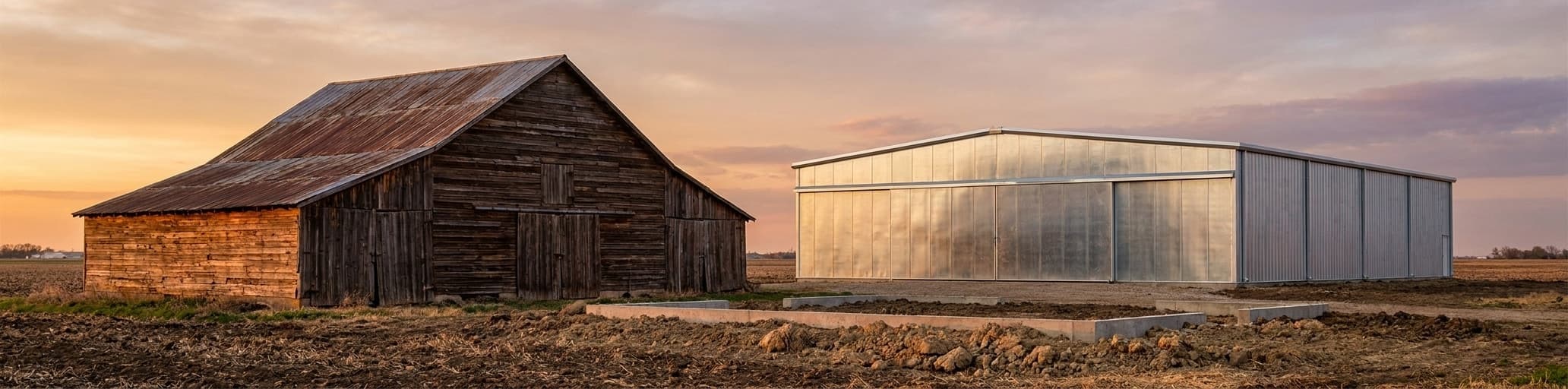

Steel buildings outlast pole barns by decades–50 to 100+ years versus 40 to 60 years–because engineered corrosion protection and dimensional stability eliminate the moisture, rot, and pest cycles that plague wood framing. We help you understand how this lifespan advantage collapses the long-term cost gap between the two building types entirely.
How Long Does Each Structure Last: Direct Lifespan Comparison
Steel buildings routinely last 50+ years or longer, while pole barns require replacement within your ownership window, making the structural choice a defining factor in your long-term investment.
Pole barns typically last 40-60 years; steel buildings can reach 100+ years with proper maintenance
If you're weighing how long a pole building lasts vs. a steel building, the gap is significant enough to change your entire ownership calculation.
The average pole barn lifespan runs 40 to 60 years–and hitting the high end of that range requires consistent, proactive maintenance throughout.[3] A well-engineered steel building, by contrast, can remain structurally sound well past 50 years, with pre-engineered systems routinely reaching into century-plus territory under proper upkeep.[2] That difference isn't a minor specification detail.
Over a 50-year ownership window, it's the difference between replacing your structure once and never having to.[3]
Why pole barn longevity plateaus: wood rot, termite damage, and foundation settling
Wood posts set directly in or near soil face three compounding failure modes that treated lumber and routine maintenance can slow but not stop.
Subterranean termites are drawn specifically to moist soil conditions–the same environment that surrounds in-ground poles year-round–making buried framing a persistent target.[5] Once established, termites and carpenter ants can reinfest wood structural members repeatedly until only a hollow outer shell remains, often without any visible surface damage during standard inspections.[5] Fungi compound the problem further: wood-decaying fungi cause roughly as much structural damage to buildings as termites do, and both organisms thrive under identical moisture conditions, meaning a damp post that attracts one almost always attracts the other.[5] Termite damage alone costs U.S. property owners more than $5 billion each year, the vast majority of it in wood-framed structures.[4] Pressure treatment buys time against these threats but doesn't eliminate them–sustained moisture exposure gradually defeats chemical preservatives, so the protection narrows with each passing season rather than holding steady.[4] Add seasonal soil movement around unanchored posts to the mix, and you get a structure where moisture, biological decay, and foundation instability reinforce each other until cumulative damage forces structural intervention–typically well before the upper end of the lifespan range that diligent pole barn maintenance might otherwise reach.
If you're weighing how climate and moisture interact differently across building types, the regional breakdown is worth reviewing before you commit to either framing system.
Steel building durability advantage: corrosion-resistant coatings and engineered load paths
Corrosion protection in steel buildings works through barrier coatings–paint or galvanization–that physically block the water and oxygen contact required to corrode the steel substrate.[6] The 2021 IBC (Section 2203.1) mandates this protection for any steel structure where corrosion could impair strength or serviceability, so compliant buildings come with engineered corrosion defense built into the design specification rather than treated as an optional upgrade.[6] Beyond coating chemistry, steel's dimensional stability adds a second layer of long-term reliability: unlike wood, steel doesn't expand or contract with changes in moisture content, which means primary framing members stay straight across decades of humidity cycling and freeze-thaw seasons without warping, cracking, or creeping.[6] Steel's isotropic nature compounds the structural advantage–load-bearing properties are consistent in every direction, so a pre-engineered frame routes wind, seismic, and snow loads uniformly across the entire system rather than concentrating stress at a handful of ground-contact points.[6] Non-combustible steel also resists fire spread in ways wood framing cannot, giving occupants more evacuation time and limiting structural damage when a fire does occur.[6] Each of these properties–chemical protection, dimensional stability, uniform load distribution, and fire resistance–stacks on the others, which is why a correctly specified and maintained steel building can exceed 100 years of structural integrity with repair events that stay cosmetic rather than structural.[6] If you want to understand how engineered load paths translate into fire ratings and insurance cost reductions for your specific project, the steel frame vs. wood frame breakdown connects the engineering directly to your bottom line.
Maintenance Requirements That Determine Real-World Lifespan
Seasonal inspections and timely sealant reapplication can extend your pole barn's lifespan well beyond the standard 20-30 year window for treated lumber.
Pole barn maintenance: annual inspections, wood treatment, and foundation monitoring
A seasonal inspection routine is the practical backbone of pole barn longevity. Each spring, check every post base at ground level for soft spots, dark discoloration, or crumbling wood–these are the first visible signs that moisture has overcome the original preservative treatment.[7] Walk the roof and look for loose or missing panels, rust spots on metal surfaces, and blocked gutters; water that can't drain properly pools against the structure and compounds soil saturation around buried posts.[9] Keeping a simple maintenance log of each inspection helps you track how quickly conditions deteriorate and tells you–before a contractor does–when you've crossed from cosmetic repair into structural intervention.[7]
Wood treatment is not a one-time fix. Preservatives leach gradually from pressure-treated lumber under sustained moisture exposure, so the protection shrinks with each season rather than holding steady.[7] Reapply sealant or paint to exposed wood surfaces in dry summer conditions, and pay specific attention to any junctions where different metals contact each other–galvanic corrosion accelerates at those points and can compromise fasteners before you see surface damage.[9] For posts already in the ground, plastic or metal post sleeves create a barrier between the wood and soil, eliminating direct moisture contact without requiring excavation; this single addition can meaningfully extend post service life past the standard 20-30 year window for treated lumber.[8]
Foundation monitoring is easy to deprioritize because the early symptoms appear nowhere near the posts themselves. When posts begin to shift from seasonal soil movement, the first signals are often doors that stick or windows that won't close–small frame distortions caused by settling pressure working its way through the structure.[8] Inspect post alignment each season, and treat a sagging roofline or visibly leaning wall as an immediate flag rather than a deferred maintenance note–those conditions indicate the soil around the base has either lost compaction or become saturated.[8] Sites with clay-heavy or frequently wet soil need active drainage solutions–grading the perimeter to move water away from post bases or installing French drains–because surface-level wood treatment alone can't compensate for chronically damp ground conditions.[8] Understanding where pole barn maintenance demands concentrate helps clarify exactly what steel building owners skip entirely by eliminating ground-contact wood from the equation.
Steel building maintenance: minimal upkeep with National Steel Buildings' design specifications
The maintenance checklist for a correctly specified steel building fits on half a page–and most items are visual checks, not repairs. Industry experts recommend biannual inspections: a spring walkthrough to assess winter stress and a fall check to clear gutters before freeze season.[10] During each pass, you're scanning for rust spots on panels or fasteners, displaced roof flashings, sealant deterioration around doors and penetrations, and any foundation cracking or settlement.[10] Overhead doors and walk doors are the highest-wear components in the envelope; lubricating tracks, replacing worn seals, and adjusting closers keeps weather tightness intact without escalating into structural work.[10] Promptly touching up scratched or chipped paint prevents exposed steel from beginning to corrode–in humid or coastal environments, that window can be as short as a few months, making a small can of touch-up paint a genuinely cost-effective maintenance tool.[10]
What makes this routine manageable is the specification work done before the first bolt is tightened. Pre-engineered buildings using ASTM A572 Grade 50 structural steel, Galvalume panels with 25- to 40-year manufacturer warranties, and factory-applied PVDF or SMP paint systems arrive on site with corrosion resistance engineered in rather than applied as an afterthought.[10] Galvalume coatings–a 55% aluminum, 43.5% zinc, and 1.5% silicon alloy–deliver typical service lives of 40-60 years on roof and wall panels in most environments, meaning the building envelope rarely drives unplanned spending.[10] High-quality stainless steel or mechanically galvanized fasteners with EPDM rubber washers extend fastener life further and prevent water intrusion at penetration points, which are statistically the first components to show corrosion in a steel building.[10] For agricultural owners who want a precise list of which inspection tasks actually matter across a full seasonal cycle, the agricultural steel building maintenance guide cuts through the noise.
National Steel Buildings builds these specification choices into every project from the design phase, so you're not retrofitting protection onto a building that was engineered without it. The outcome is a maintenance posture built around monitoring rather than intervention–twice-yearly walkthroughs, clean gutters, and periodic sealant checks–that keeps a well-built steel structure performing reliably for 50 to 100 years or more without the cyclical structural interventions that define pole barn ownership.[11] That difference compounds directly into your cost-of-ownership math, and it starts at the spec sheet, not the repair invoice.
Cost of ownership over time: how maintenance expenses compound for pole structures
The financial picture of pole barn ownership compounds in a way that isn't obvious at purchase.
Wood framing requires ongoing attention throughout the structure's life–not a single maintenance event, but recurring cycles of treatment and inspection that repeat every few years.[14] Early expenses focus on resealing post bases and checking for rot; later cycles layer in corrective work on components that weren't caught early enough.[13] Because these cycles don't align–wood treatment, roof panel checks, foundation monitoring, and pest inspection each run on different schedules–there's rarely a year in mid-to-late ownership where no maintenance spending occurs.[13] Pole barn specialists consistently recommend scheduling periodic inspections precisely because small issues compound quickly into costly repairs when missed.[13] That pattern of overlapping, recurring costs is why the 30-year maintenance comparison between pole structures and steel alternatives often closes the initial price gap between the two building types entirely.[12] For a decade-by-decade cost picture on a specific footprint, the 30×40 steel building versus pole barn cost gap translates this compounding dynamic into budget numbers you can plan against.
Environmental and Climate Factors That Shorten Building Life
Steel buildings eliminate the seasonal moisture and freeze-thaw damage that forces wood structures into constant repair cycles, delivering a service life more than double that of traditional pole barns.
Moisture exposure, freeze-thaw cycles, and UV degradation: pole barns vs. steel resilienceWood framing is vulnerable to moisture at every stage of a building's life, and pole barns face that threat from two directions at once: ground saturation at post bases and condensation cycling across interior framing throughout the seasons.[15] Each freeze-thaw season forces water deeper into wood grain, expanding and contracting fibers until surface checks and splits open new pathways for rot to follow.[2] Steel sidesteps moisture absorption entirely–it doesn't swell, check, or crack under thermal cycling, and factory-applied coatings block the water-oxygen contact that triggers surface corrosion before it begins.[15] The roof system tells the same story: pole barn metal panels are mechanically fastened with screws driven through the panel into wood framing, creating hundreds of potential leak points that multiply as wood shrinks and swells seasonally.[15] Standing seam steel roofs, by contrast, are engineered to accommodate thermal movement without puncturing the weather barrier, delivering a service life more than double that of a mechanically fastened system.[15] UV exposure adds a third degradation layer for wood-framed structures–solar radiation breaks down surface treatments and wood lignin, so sealants require periodic reapplication just to maintain baseline protection.[2] Steel buildings handle storms, snow, and heat without that cycle of patchwork because the building envelope's corrosion resistance is engineered into the material specification from the start, not reapplied season after season.[2] For farm and agricultural owners specifically, the 20-year cost math on steel versus wood shows exactly how these compounding climate vulnerabilities translate into dollar figures over a structure's operational life.
Pest and decay threats: termites, carpenter ants, and fungal growth in wood-frame structures
The Forest Products Laboratory identifies moisture content above 20% as the threshold where wood-decay fungi become active–a level that pole barn posts in ground contact regularly exceed after heavy rain seasons.[16] What makes fungal decay particularly damaging isn't the rot alone: softened, moisture-saturated wood becomes far easier for carpenter ants to excavate for nesting galleries, so the two threats compound each other once soil moisture climbs.[8] Unlike termites, which consume wood as a food source, carpenter ants cut galleries through structural members to nest–producing damage that reads as intact on the outside but carries almost no structural load until a failure event reveals the extent of the loss.[8] Even with chemical treatments, wood remains vulnerable throughout its lifespan; preservatives leach from treated lumber under sustained moisture exposure, and both insects and fungi can reestablish once that protection narrows.[16] Steel frames bypass this compounding failure cycle entirely–insects cannot consume or colonize steel framing, and no preservative schedule is needed to maintain that immunity across the building's lifespan, which is why agricultural steel building owners carry none of these recurring pest-control costs in their annual maintenance budgets.[16]
Salt air, high humidity, and extreme weather: where steel buildings outperform traditional pole barns
Salt air and coastal humidity don't just affect surface finishes–they attack the metal fasteners embedded in pole barn framing and keep post bases chronically damp, the same condition that defeats wood preservatives over time.[17] In Florida and along the Gulf Coast, steel frames dominate new construction because they can be engineered to handle wind loads up to 180 mph and earn Miami-Dade hurricane certification–benchmarks that pole barn construction in those same coastal zones requires substantial reinforcement and specialized design to approach.[17] Further inland, high-humidity climates such as the Carolinas see moss, algae, and mildew growth compound exterior degradation over time; anti-microbial paint systems factory-applied to steel panels suppress biological buildup without requiring structural intervention the way resealing weathered wood does.[18] In tornado-prone corridors from Texas through the Plains states, a steel primary frame is spec'd to local wind zone requirements before fabrication begins, giving you a documented load rating rather than wood-frame reinforcements added after the design is committed.[18] If you're building in North Carolina's coastal zone specifically, the regional guide to metal buildings and concrete foundations in NC covers how hurricane resistance and foundation moisture requirements work together.
Across every high-stress climate type, steel outperforms on the same principle: durability is engineered in at the spec sheet, not patched into a wood structure after the environment reveals what it actually demands.[17]
Making the Long-Term Investment Decision: Total Cost of Ownership Estimates
Steel buildings cost more initially but eliminate recurring wood maintenance expenses, often proving more economical over a 50-year ownership period.
Pole barn vs. steel building: initial cost vs. 50-year ownership expense breakdownPole barn construction typically costs less to start–wood posts and basic framing require fewer materials than engineered steel components, and a simpler construction process keeps labor costs lower.[20] A pre-engineered steel building carries a higher initial price that varies by design, size, and site conditions.[20] That upfront gap closes faster than most buyers expect. Wood structures require ongoing investment throughout their lifespan: exterior walls need periodic repainting or treatment, post bases can rot and require replacement, and pest control becomes a recurring expense.[20] Steel buildings carry none of those recurring costs–no rot to address, no insect damage to treat, no warping to correct.[20] Over several decades, a metal building often proves to be the more cost-effective choice, even when the initial price runs higher.[20] The table below maps where each building type spends money across a 50-year ownership window.
| Cost category | Pole barn | Steel building |
|---|---|---|
| Initial construction | Lower upfront | Higher upfront |
| Foundation requirement | Minimal (posts in ground or basic footings) | Engineered concrete slab with anchor bolts |
| Wood treatment and resealing | Recurring every few years | None |
| Pest control | Recurring throughout ownership | None |
| Structural repairs | Mid-to-late ownership as rot and settling accumulate | Rare; typically cosmetic only |
| Roof panel maintenance | Periodic as wood substrate expands and contracts | Minimal with standing seam systems |
| Structure replacement cycle | 40-60 years | 50-100+ years |
| Long-term cost trajectory | Compounds as overlapping maintenance cycles accumulate | Stays flat; monitoring replaces intervention |
Pole barns are more affordable up front, but the type of use and any customizations influence the overall budget–and maintenance expenses don't align on a single schedule.[13] Wood treatment, foundation monitoring, pest control, and roof checks each run on different cycles, so there's rarely a year in mid-to-late ownership where no spending occurs.[13] That pattern is why comparing pole barn vs. steel building costs at the purchase point alone produces a misleading picture. For a regional look at what pole barn kits actually cost before maintenance enters the equation, the 30×40 pole barn price comparison across three states shows how the starting gap varies before long-term costs are factored in.
When a steel building becomes the more economical choice despite higher upfront investment
National Steel Buildings' design-build approach: extending lifespan through custom engineering and single-source accountability Every component in a custom-engineered steel building is specified to work as a system–not assembled from off-the-shelf parts and reconciled on site.[22] That distinction matters because interface failures are where building lifespans erode: mismatched components, coating incompatibilities, and fastener-to-panel misalignments introduce the small vulnerabilities that compound into expensive repairs over decades.[23] When one team controls design, fabrication, and specification from the first drawing to the final anchor bolt, those gaps close before the structure leaves the factory.[23] Single-source responsibility means you have one point of contact accountable for the entire project–not a chain of subcontractors where each party's warranty stops at the boundary of the next.[22] Local and national building codes are factored into the engineering specification at the design stage, so the structure arrives on site already sized for your site's wind, snow, and seismic loads rather than relying on field modifications to meet code after fabrication.[24] The result is a building that performs as engineered–not as adjusted–across its full lifespan.
For owners who want that single-source accountability documented from groundbreak to handover, the turnkey promise behind a one-contract build explains how design, permitting, and construction stay under one roof every step of the way.
- Pole barns last 40-60 years; steel buildings reach 50-100+ years with proper maintenance.
- Wood posts face termites, fungi, and decay that cost U.S. owners $5 billion annually.
- Steel's dimensional stability prevents warping, cracking, and creeping across freeze-thaw cycles.
- Pole barn maintenance cycles overlap continuously; steel requires only biannual inspections and touch-ups.
- 30-year maintenance costs often close the initial price gap between pole and steel buildings.
- Coastal and high-humidity climates demand steel for hurricane resistance and corrosion protection.
- Single-source engineering eliminates interface failures and component mismatches that erode lifespan.
- https://www.clarkroofingtx.com/pole-barn-vs-metal-building-whats-the-right-choice-for-your-property/
- https://themetalshopllc.com/which-is-better-steel-building-or-pole-barn/
- https://www.diypolebarns.com/learn/how-long-do-pole-barns-last/
- https://www.steelcobuildings.com/steel-frame-vs-wood-frame-buildings-the-definitive-guide/
- https://entomology.ucr.edu/ebelingchapter5.1
- https://www.alliedbuildings.com/metal-building-life-expectancy/
- https://ilovepolebuildings.com/how-long-does-a-pole-barn-last/
- https://themetalshopllc.com/how-long-will-pole-barn-posts-last/
- https://woodfordbarnrepair.com/maintenance-checklist-essential-tasks-for-keeping-your-pole-barn-in-top-shape/
- https://www.steelcobuildings.com/steel-building-lifespan-how-long-do-metal-buildings-really-last/
- https://norsteelbuildings.com/steel-building-basics/how-long-do-steel-buildings-last/
- https://www.probuiltmetal.com/blog/pole-barn-vs-traditional-construction-cost
- https://www.omni-builders.com/home-tips/pole-barn-vs-metal-building-cost-maintenance-longevity-compared
- https://americanmetalgarages.com/red-iron-vs-pole-barn-vs-tubular-frame-cost-lifespan-best-uses/
- https://www.acebuildingservice.com/blog/metal-building-vs-pole-barn
- https://easttexascarports.com/news/metal-buildings-vs-wood-buildings-which-lasts-longer-in-southern-climates/
- https://www.jrhengineering.net/post/pole-barn-vs-metal-building-the-right-structure-in-tx-nc-fl
- https://americansteelinc.com/blog/climate-zones-building-material-choices/
- https://bargainmetalbuildings.com/pole-barn-vs-metal-building/
- https://renegadesteelbuildings.com/pole-barn-vs-metal-building/
- https://www.rhinobldg.com/blog/which-costs-less-over-time-a-metal-barn-or-a-pole-barn
- https://merrittassociatesgcinc.com/the-advantages-of-custom-engineered-steel-buildings-why-theyre-the-right-choice-for-your-next-project/
- https://pebsteel.com/en/pre-engineered-buildings-guide/
- https://norsteelbuildings.com/us/advantages-of-steel-series/advantages-of-steel-buildings/