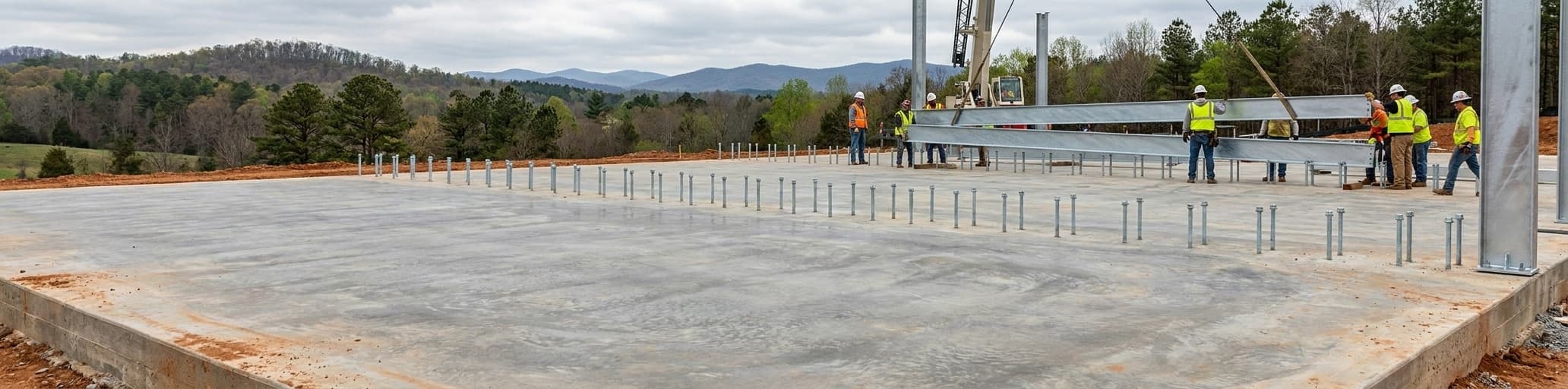

North Carolina's three distinct climate zones–coastal hurricanes, inland tornadoes, and mountain snow–demand metal buildings with concrete foundations that handle all three threats simultaneously. We help you navigate regional code requirements, foundation engineering, and turnkey contracting so your project stays on schedule and within budget from permit through installation.
Why North Carolina Property Owners Choose Metal Buildings with Concrete Foundations
Metal buildings with concrete foundations resist hurricanes, tornadoes, snow loads, and humidity-driven rot–the three climate threats that define North Carolina construction.
NC's Climate Demands Durable, Low-Maintenance Structures
North Carolina doesn't give you one climate to build for — it gives you three.
Along the Coastal Plain, hurricanes are not a question of if but when; the state absorbs a storm at hurricane intensity roughly once every three years, and coastal counties require wind-speed certifications of 130-150 mph for permitted structures.[1] Cross into the Piedmont and the threat shifts to severe thunderstorms and tornadoes — NC averages 31 per year, with spring straight-line winds capable of destroying wood-framed outbuildings with little warning.[2] Head west toward Asheville and Boone, and the concern becomes snow loads and sustained freezing temperatures that demand reinforced framing and steep roof pitches to shed wet mountain snow.[2] Layered across all three regions is a humid subtropical climate where summer humidity routinely exceeds 80 percent — conditions that accelerate rot, mold, and structural decay in conventional wood or composite construction.[2] Metal buildings with concrete foundations answer every one of these threats simultaneously: galvanized steel with protective coatings resists salt-air corrosion on the coast, engineered wind ratings match each county's specific hurricane or tornado zone, snow-load engineering handles the western highlands, and steel's smooth, non-porous surface prevents the mold and mildew growth that wood absorbs in NC's relentless humidity.[1] If you're comparing your options, the 20-year cost math between steel barns and wood barns makes the durability case concrete — the maintenance savings alone justify the switch before you ever factor in weather resilience.
Concrete Foundations Anchor Steel Buildings Against Wind and Moisture
The anchor system is where a concrete foundation earns its keep.
When you choose a concrete pad, holes are drilled directly into the cured slab and engineered anchor bolts bolt the steel frame columns down over them — transferring wind loads into the mass of the concrete rather than relying on soil grip alone.[5] Anchor bolt sizes are specified to match slab depth, so the deeper and thicker your foundation, the more load-bearing capacity each connection point delivers.[5] For NC coastal counties, that connection must hold against a minimum wind rating of 140 mph; in the western highlands, slabs must support steel frames engineered for 20 psf ground snow loads — and it's the concrete anchor system that keeps those certified ratings intact when a real storm tests them.[4] Moisture protection works through the same logic.
Concrete creates a continuous physical barrier between ground moisture and steel column bases, and when combined with a vapor barrier built into the slab assembly, it stops the condensation that quietly corrodes unprotected steel at ground level in NC's persistent humidity.[5] Soil-based foundations with auger anchors can earn wind certifications, but they provide no moisture separation — which is why concrete is the right base for any NC metal building where you need both wind performance and long-term corrosion resistance in one foundation.[5] If you're sizing a slab alongside a steel kit, choosing the right concrete thickness for your steel building directly affects how deep your anchor bolts must go and how much load each connection point can transfer to the foundation.
Single-Source Solutions Save Time and Money in NC's Competitive Market
In NC's construction market, coordinating a steel kit supplier, a separate concrete subcontractor, and an independent erection crew adds weeks to your timeline and introduces three separate points of failure on schedule and budget.
Installed turnkey metal buildings — where one contract covers the kit, concrete slab, delivery, and erection — run $24 to $43 per square foot, with a 40×60 footprint typically landing between $25,000 and $70,000 depending on materials, regional labor rates, and foundation specs.[6][7] That range sounds wide, but the tighter variable is who manages the handoff between concrete and steel: when your slab contractor and your building supplier aren't coordinating anchor bolt layouts directly, you absorb the rework costs when they don't match.[7] A turnkey contract that runs from site prep through final installation collapses that risk into a single accountable relationship — one schedule, one warranty, and one point of contact every step of the way.[8] In a state where permitting timelines vary county by county from the coast to the mountains, that accountability isn't a convenience; it's what keeps your project within budget and on schedule when local code requirements shift mid-permit.[7]
Understanding Concrete Slab Requirements for Metal Buildings in NC
Missing a single inspection within your permit's first year voids approval entirely, forcing you to restart the permitting clock from the beginning.
NC Building Codes and Permit Requirements for Metal Structures
In North Carolina, a building permit is required for any accessory structure with a dimensional measurement of 12 feet or more — which captures virtually every metal building project, from a farm equipment shed to a full commercial warehouse.[11] Permit applications trigger a plan review period of 10 to 14 working days in most NC jurisdictions, and starting work before approval carries a $150 Stop Work Order fee on top of standard permit costs — a small line item that signals the county's authority to halt your entire build mid-slab.[11] Once the permit is issued, you must schedule a first inspection within 6 months and log at least one inspection per year to keep the permit active; a missed inspection voids it and forces you to restart the clock.[11] The dollar thresholds matter just as much as the dimensional ones: any project valued at $40,000 or more requires a licensed NC General Contractor — a threshold raised from $30,000 effective October 1, 2023 — and that same figure triggers a mandatory lien agent designation before your permit can be released for construction.[11] Knowing whether your build crosses that line before you sign anything is how you avoid mid-project surprises; vetting a local prefab contractor's NC GC license status before the contract is signed protects your timeline and your budget.
On the structural side, NC's Chapter 18 Soils and Foundations code governs geotechnical investigation requirements, concrete placement standards, anchor bolt specifications, and dampproofing details — all of which feed directly into how your slab is engineered before the first anchor bolt is set.[9] Chapter 4 of the NC Residential Code layers on additional requirements for foundation anchorage, frost protection, and waterproofing that apply specifically to the concrete assembly beneath a steel frame.[10]
Concrete Thickness Standards for Common NC Metal Building Sizes
North Carolina's Building Code Chapter 19 governs minimum slab provisions under Section 1907, and those minimums are a floor — not a target.[12] Your actual thickness requirement is driven by three variables that shift across NC's three regions: building size, soil bearing capacity, and design wind speed.
A monolithic slab is the right call for smaller metal buildings with concrete in NC — footprints under 10,000 square feet on stable soils in moderate wind zones, which covers most inland Piedmont and mountain-area projects like a 30×40 workshop or a 40×60 equipment barn.[13] Move to the coast and the same footprint sits in Exposure Category D conditions with 130-150 mph design wind speeds, which pushes anchor bolt depth and slab reinforcement requirements beyond standard minimums regardless of square footage.[13] The Piedmont's kaolinite clay — lower plasticity than montmorillonite but still prone to movement during wet-dry cycles — means pier and beam systems become cost-effective for mid-size builds (5,000-20,000 square feet), since they isolate column loads from soil movement that a flat monolithic slab transfers directly into your frame.[13] In the western highlands, frost depth requirements add another layer: Section 1904 durability provisions and Chapter 4 foundation anchorage standards require that your slab assembly account for freeze-thaw exposure, which affects both concrete mix specification and minimum cover over reinforcing steel.[12] For a common 30×40 build, the concrete thickness decision starts with intended use and live load — then NC's regional soil and wind data tells you whether the code minimum gets you there or whether engineering calls for more.
Section 1906 of the NC code addresses structural plain concrete specifically, and any slab carrying column point loads from a pre-engineered steel frame is subject to those provisions, not just the residential minimums that contractors sometimes default to on smaller projects.[12]
Interactive Cost Estimator: Metal Building + Concrete Slab Pricing for NC Projects
NC's three climate regions don't just change what your building needs to survive — they change what it costs to build. Start with the steel kit: common sizes run $24,000 for a 30×40, $43,200 for a 40×60, and $75,000 for a 50×100, or roughly $15 to $20 per square foot for the kit alone.[14] Turnkey installed prices — covering the kit, concrete slab, delivery, and erection — land between $24 and $43 per square foot, which puts a 40×60 turnkey project somewhere between $57,600 and $103,200 depending on foundation type, regional labor, and wind/snow engineering requirements.[14] The concrete line item shifts the most across NC's regions.
A standard slab-on-grade runs around $4.00 per square foot; a floating slab with a perimeter thickening (the right call for Piedmont clay that moves through wet-dry cycles) runs about $4.50 per square foot; and a pier-and-beam foundation for mid-size builds on unstable soils runs approximately $5.20 per square foot.[16] Labor to pour adds another $2 to $3 per square foot on top of materials, and rebar reinforcement — mandatory for any slab carrying column point loads from a pre-engineered steel frame — adds cost above fiber mesh alternatives.[15] On the coast, where concrete pricing runs higher than the national middle-of-the-country average of $5.35 per square foot, you can expect to pay closer to $8.50 per square foot in coastal exposure zones.[15] That means a 40×60 coastal slab (2,400 sq ft) alone can run $20,400 before anchor bolt engineering and wind-rated frame upgrades are factored in. For a full line-by-line breakdown of what a 30×40 concrete slab actually costs across thickness options, including how reinforcement type and NC's regional soil conditions shift the final number, the math is worth running before you sign anything.
The most budget-reliable approach: price your building and slab together with one source that accounts for NC's regional code requirements upfront, so the anchor bolt layout, slab thickness, and wind rating are engineered as a single system — not reconciled after the concrete has already cured.[14]
Regional Metal Building Solutions for NC Agriculture, Commercial, and Industrial Use
Concrete foundations with properly anchored steel frames transfer wind loads safely into the slab, protecting your NC farm equipment through repeated seasonal stress cycles.
Agricultural Metal Buildings with Concrete Pads for NC Farms
NC farm operations put foundations through punishment that residential or light commercial builds never see — combines rolling in on wet days, grain augers cycling under point loads, and livestock shifting weight unpredictably across the floor.
Concrete is the right base for these conditions because it doesn't shift with frost or heavy rain the way gravel or compacted soil does; it holds anchor connections tighter and stays straighter under the kind of repeated heavy load cycles that farm equipment generates season after season.[17] A 40×60 footprint covers the most common NC agricultural building tasks — equipment storage, hay bales, livestock shelter, and grain handling — and typically runs $25,000 to $70,000 depending on materials, foundation type, and regional labor rates.[18] NC coastal counties require a minimum wind rating of 140 mph for permitted structures, while mountain-area builds must carry 20 psf ground snow loads, both of which drive anchor bolt depth specifications directly into the slab design.[18] Buildings constructed with 14-gauge tubing and 29-gauge steel sheeting — certified to 150 mph wind resistance — give coastal NC farms the structural margin that weather in those counties demands.[19] Once the slab is cured, anchor bolts are drilled into the concrete and steel frame columns are secured over them, transferring wind loads into the slab's mass rather than relying on soil grip that weakens through NC's wet-dry cycles.[17] Before the concrete is poured, getting farm equipment storage building dimensions right is the step that determines whether your combine clears the door frame and whether your equipment maneuvering room stays usable for the life of the building — because those decisions can't be corrected after the slab has cured.
Commercial Warehouses and Retail Spaces Built on Solid Foundations
Commercial warehouses and retail spaces impose column loads that agricultural builds rarely match — racking systems, forklift traffic, and concentrated floor inventory all transfer heavy point loads directly into your foundation system.[21] For buildings in this category, the most reliable foundation systems are moment-resisting designs or a slab on grade with perimeter grade beams extending below the frost line, with column pilasters where the steel frame meets the concrete foundation.[21] These systems resist both downward column loads and wind uplift simultaneously, which is the load combination NC weather events test hardest on commercial footprints.[21] OSHA requires a minimum of four anchor bolts per column on pre-engineered steel frames — up from the two once considered sufficient — and each bolt's diameter, length, and embedment depth must be engineered to match the specific force reactions your frame generates under dead, snow, and wind loads, which means your foundation engineer needs the building's engineered drawings before the anchor bolt layout can be finalized.[21] NC building codes require sealed foundation drawings from a licensed structural engineer as part of any commercial-scale metal building permit application, with ASCE 7 structural calculations confirming wind load compliance before the permit office will approve construction.[20] One detail that catches commercial and retail owners off guard: anchor bolt placement tolerances on pre-engineered steel frames are tight enough that being even an inch off means your steel columns won't seat correctly — and that rework cost is far higher than the expense of getting placement right the first time with qualified field engineers overseeing the pour.[21] If you're planning a prefab retail building or warehouse on a competitive opening timeline, designing the foundation to accommodate potential future expansion now — additional bays, mezzanine loads, or heavier racking — is significantly less expensive than enlarging or retrofitting foundations after the concrete has cured.[21]
Industrial Storage and Manufacturing Facilities Designed for NC Conditions
NC's industrial construction market runs along three corridors — the Research Triangle's tech and biotech sector, the Piedmont Triad's manufacturing and logistics hub, and the Charlotte metro's distribution operations — with military installations at Fort Liberty, Camp Lejeune, and Seymour Johnson AFB adding significant industrial demand across the state.[22] Inside these facilities, crane systems, heavy racking, and forklift traffic generate concentrated point loads that shift foundation requirements well beyond what standard commercial builds face: buildings over 20,000 square feet or sited on Piedmont's shrink-swell kaolinite clay require deep pile or drilled-shaft foundations that extend through unstable surface soils to competent bearing strata, handling those loads without the differential settlement that misaligns crane rails or cracks floor slabs under production equipment.[13] Clear-span rigid frames — spanning 200-plus feet without interior columns — keep manufacturing lines, equipment staging, and loading dock approaches fully reconfigurable as production needs change, and the same frame connection design supports future bay additions without structural rework at the column bases.[22] Frame gauge tracks the work being done inside: 12-gauge steel certified for 65 psf snow loads suits mountain-area production facilities in Avery and Watauga counties, while 14-gauge frames rated to 170 mph wind resistance cover coastal industrial builds in Wilmington and Jacksonville where wind exposure governs over gravity loads.[23] A 100×200 industrial footprint runs $185,000 to $275,000 for the steel package, with steel framing delivering 15 to 25% lower cost per square foot than tilt-wall or masonry at comparable spans — and the case for a prefab industrial warehouse gets stronger when you factor in the 30 to 50 percent faster construction timeline that keeps your operation moving in NC's competitive industrial real estate market.[22]
How to Get Your NC Metal Building Project Built Right, From Design Through Installation
A licensed NC design-build partner pulls permits directly and catches county-specific issues like setback placement and wind certifications before your application is submitted.
Working with a Design-Build Partner Who Understands NC Local Codes
NC's permit system is decentralized — each county runs its own inspections and planning department, which means requirements shift depending on whether your project sits in Wake, Brunswick, or Watauga County.[24] A design-build partner who holds an active NC General Contractor license can pull permits directly as the prime contractor of record, eliminating the coordination gap that sends most applications back for revisions.[25] The most common delay triggers — wrong setback placement, missing site plans, unverified wind certifications, and anchor bolt details omitted from the application — are all front-loaded problems that a partner familiar with NC's county-by-county requirements catches before the application is ever submitted.[24] Engineering documentation following ASCE 7 structural standards must accompany the permit application in most NC jurisdictions, and sealed drawings from a licensed structural engineer are required for any commercial-scale build — two requirements a design-build partner coordinates internally rather than leaving you to source separately.[26] That coordination has a direct impact on your timeline: understanding how a prefab building kit moves from engineering through delivery makes clear why anchor bolt specifications, slab thickness, and wind-load ratings need to be locked as a matched system at the design stage — not reconciled after the county sends your application back for revisions.[25]
Concrete Foundation Planning Before Steel Erection Begins
The window between concrete pour and the first steel column going up is where NC metal building projects stay on schedule or lose weeks.
Your slab needs 7-14 days to cure before the erection crew arrives — starting earlier risks damaging anchor bolt connections before the concrete reaches design strength.[27] Before the kit delivers, verify three things against your engineered drawings: anchor bolt positions match the layout exactly, bolt threads are free of concrete overspray, and the slab is level within specified tolerances.[27] Anchor bolt misalignment is the single most common cause of erection delays — when column base plates don't seat correctly, field-drilling new anchors can void the engineering, and waiting for a structural engineer to issue a deviation approval costs days you can't recover.[27] Squareness matters just as much as levelness: measure diagonally from corner to corner in both directions, and if those two measurements are equal your slab is square — catching that problem before columns are set is far cheaper than correcting it after steel is in the air.[28] On thickness, the minimum is 4 inches for standard loads, but NC farm and industrial operations running combines, forklifts, or loaded trailers across the floor need 5-6 inches to handle the point loads that heavy equipment generates on a repeated cycle.[28] Getting this sequence right — cured slab, verified anchor layout, confirmed squareness — is what lets the erection run fast and smooth from the first column to the final trim piece, and for a clear picture of how foundation curing slots into the full build sequence, the dependency chain from pour date to erection start is the variable most owners underestimate when reading a 30×40 steel building timeline.
Next Steps: Getting a Custom Quote for Your NC Metal Building Project
Before you contact anyone for a quote, have four things locked down: your footprint, your intended use, your county, and your budget ceiling.
These four variables — not a general size estimate — are what let a supplier generate an accurate number rather than a placeholder range.[29] Dimensions determine your kit price; intended use drives slab thickness and anchor bolt specifications; your county sets the wind or snow load certification your frame must carry; and your budget ceiling tells the supplier whether a turnkey contract or a kit-only quote is the right scope to price.[29] NC metal building costs run $5,000 to $100,000 depending on size and customization, but that range collapses sharply once your four variables are defined — and getting a personalized quote with those details specified is what converts a range into a real project number you can act on.[29] If your budget needs to stretch, financing options that close the gap on a steel build include flexible payment terms from 24 to 72 months and rent-to-own programs that require no credit check and deliver same-day approval — both structured to get your project moving without waiting on traditional lending timelines.[30] The most reliable path from quote to cured slab to finished building is a single-source contract where your steel kit, concrete foundation, delivery, and erection are priced together — one number, one schedule, one point of contact every step of the way.[29]
- Concrete foundations with anchor bolts transfer wind loads into slab mass and prevent moisture-driven corrosion that soil-based anchors cannot stop in NC's humid subtropical climate.
- Turnkey metal building contracts ($24-$43/sq ft) eliminate coordination gaps between concrete and steel suppliers that cause rework costs and schedule delays when managed separately.
- NC permits require licensed General Contractors for projects over $40,000 and sealed structural engineer drawings for commercial builds; county-by-county code variations demand early permit planning.
- Anchor bolt placement tolerances are tight enough that even one inch of misalignment prevents steel columns from seating correctly, making field verification before erection critical.
- Slab thickness varies by region and use: standard agricultural operations need 5-6 inches to handle repeated point loads from heavy equipment, not the 4-inch minimum code allows.
- Concrete must cure 7-14 days before erection crews arrive; verifying anchor bolt positions, thread cleanliness, and slab squareness before steel delivery prevents costly field delays.
- https://www.metal-buildings.org/north-carolina-metal-buildings/
- https://carport1.com/states-service-area/north-carolina-nc/
- https://www.americanmetalbuildings.com/north-carolina-metal-buildings/?srsltid=AfmBOoq9NEv0VPkkXZ2RLEB2L6Wn793y31Fdus8PZE5gEEuLJ5PWi87N
- https://hintonbuildings.com/metal-buildings-40×60/?srsltid=AfmBOops7Rrr5_Nl4IXD0uFh8z_Cn8lB5wkvtbMQbDzAXF31qcgtzPQx
- https://steelbuildingstores.com/north-carolina/greensboro/metal-buildings/
- https://www.buildingsguide.com/metal-building-prices/?srsltid=AfmBOoqfm1ly_5vMyUKgfrU4tOo0FApcRHGYnHRI1EikzAHYHsHuyioE
- https://hintonbuildings.com/metal-buildings-40×60/?srsltid=AfmBOori4FWIquHrkOL_HZWGMQy8oF0d_5EZs5trycvKgj1gxScvs32n
- https://www.aametalbuildings.com/north-carolina-metal-buildings?srsltid=AfmBOorQfHItyjusXNr1GSjLAbY92tIRNnYp13HCvjWQ5wNd144QU-a3
- https://up.codes/viewer/north_carolina/ibc-2021/chapter/18/soils-and-foundations
- https://up.codes/viewer/north_carolina/irc-2021/chapter/4/foundations
- https://www.townofforestcity.com/planning-code-enforcement/building
- https://up.codes/viewer/north_carolina/ibc-2021/chapter/19/concrete
- https://www.jrhengineering.net/post/the-complete-metal-building-foundation-guide-for-tx-nc-and-fl-in-2026
- https://www.buildingsguide.com/metal-building-prices/?srsltid=AfmBOoqhWlQRSe62Ca1asQQHSx-pTxvnycg-n9WK7VXS54G3K23-Um5r
- https://www.angi.com/articles/concrete-slab-cost.htm
- https://www.vikingsteelstructures.com/blog/what-is-the-average-cost-of-a-40×60-metal-building?srsltid=AfmBOooMCbD_ZnpGeWkys-G2NlGEs2X0gEizYJHFFWpKdrp08roNqQKd
- https://americanmetalgarages.com/best-foundation-for-a-metal-building-a-straight-shooters-guide-from-american-metal-garages/
- https://hintonbuildings.com/metal-buildings-40×60/?srsltid=AfmBOopf6hi3LGSjTl6zRldpKbgZ9k70Gl2MF3rKkMG_m1yObOeiNFZz
- https://alansfactoryoutlet.com/metal-buildings-north-carolina-nc/?srsltid=AfmBOorvxUenLDQoAxwqY4LTzhPQnk55cacDxJomQTAY1WF2qilkunf4
- https://directmetalstructures.com/blog/navigating-metal-building-permits-in-north-carolina-a-step-by-step-guide/?srsltid=AfmBOopq_t_3YtNj9LTdMtKFzIo1n8P_XAGQjmeb3Th6-HOkG7SAboy3
- https://www.buildingsguide.com/build/metal-building-foundations/?srsltid=AfmBOopBFFThAVlqxByiu92Q1FxxPnaaagxbujXJeGcCvec0ZgECbTJm
- https://redironbuildings.net/metal-buildings-north-carolina/
- https://www.vikingsteelstructures.com/commercial-metal-buildings-north-carolina-nc?srsltid=AfmBOoqGRGHyb2MNj15ZVpHhgE6aa8g6Lx7zE2bj12ILgAWt4cA5Biey
- https://directmetalstructures.com/blog/navigating-metal-building-permits-in-north-carolina-a-step-by-step-guide/?srsltid=AfmBOorvIzegmcPmkm2gQgwWXx8BLLw-et-5UoUxiUfe6DzVYyoINEh_
- https://incosteelbuildings.com/building-permit-verification/
- https://www.aametalbuildings.com/blog/permit-metal-building-nc?srsltid=AfmBOor0aA6hUI9TOA-BODrE8sexk25uzgsQbfWcqK7UoiFLPCJHxqkF
- https://metalbuildingsus.com/metal-buildings-north-carolina/metal-building-kits-north-carolina/
- https://champion-buildings.com/blog/how-to-erect-a-metal-building-by-champion-buildings
- https://hintonbuildings.com/metal-buildings-40×60/?srsltid=AfmBOooJnWbSDfrftAQZZjkzK3u3BQjdBph_pS41UMnIZawjOcYhd4VW
- https://www.vikingsteelstructures.com/metal-buildings-north-carolina-nc?srsltid=AfmBOorY7bs9snffPQ75RhbfuoLFJhLPERu7edncYOjoQt_8-VrxeFCq