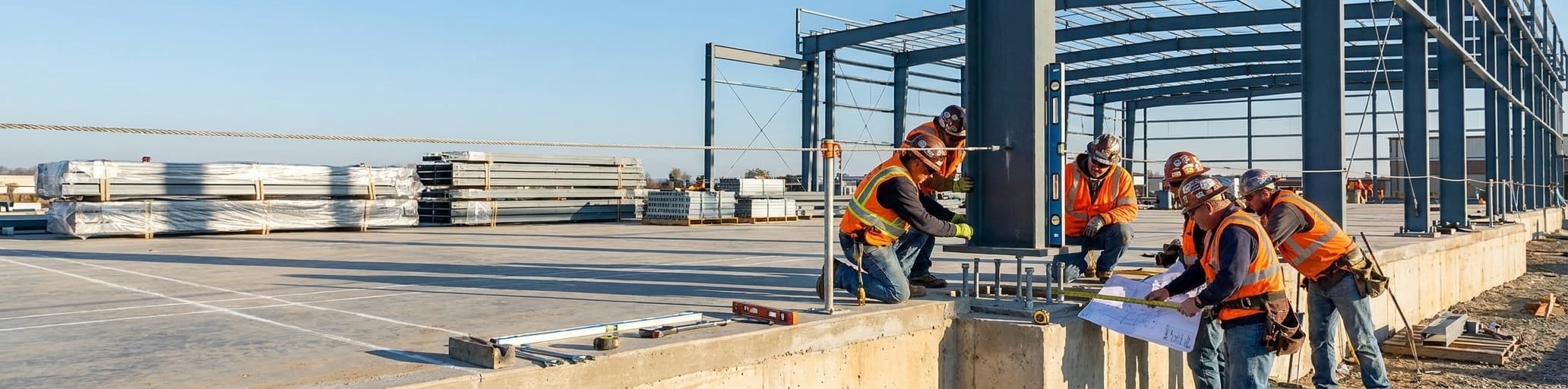

We walk you through every phase of steel building assembly–from verifying components and foundation layout to framing, sheeting, and final fastening–so you understand where precision matters most. Catching errors on paper or during early inspection costs nothing; catching them after steel is erected costs schedule delays and rework expenses that compound quickly.
Understanding Your Steel Building Kit Components Before Assembly Begins
Verify that your supplier lists every component–framing, panels, hardware, and state-stamped drawings–before you commit, then inspect twice upon delivery to catch missing items immediately.
What Comes in a Pre-Engineered Steel Building Kit and How to Verify Completeness
A complete steel building kit is a factory-engineered package where every component — primary framing (columns and rafters), secondary framing (purlins and girts), roof and wall panels, trim, and fasteners — arrives pre-cut, pre-drilled, and labeled for your specific building design.[1] The sizing, steel gauge, and component spacing are all calculated for your site's wind, snow, and seismic loads, which means no two kits from a reputable supplier are identical.[1] Engineered drawings are the most critical piece of the package — without them, your building cannot be permitted or constructed to code — yet they're the component buyers most often discover is missing only after the shipment lands.[1] Doors, windows, and insulation are typically add-ons rather than standard inclusions, so anything not specified upfront won't be in the crate when the truck pulls up.[1] If you're evaluating steel building kits near me, the clearest sign of a complete kit is a supplier who lists every line item — framing, panels, hardware, and state-stamped drawings — before you sign.
How to verify completeness on delivery
Your design and construction package should include a master inventory packing list; make several copies before the truck arrives, because you'll run two separate inspections.[2] The first happens while the carrier is still on site: as each pallet, box, and bundle comes off the truck, check it against the packing list and immediately file a written report with the driver for anything damaged or missing — you haven't officially accepted the shipment until this step is complete.[2] The second inspection is more detailed and can happen after the carrier leaves: recount quantities on a fresh copy of the packing list, open shrink-wrapped bundles to check for concealed damage, and confirm that hardware packages are all accounted for in one central staging area rather than scattered across the site.[2] If you find discrepancies after the carrier has gone, you have 14 days from receipt to file a claim with the manufacturer — missing that window forces you to absorb the cost of replacement parts and the schedule delay that comes with them.[2]
Reading Your Building Plans: Decoding the Blueprint for Successful Assembly
Your building plans arrive in a package of roughly 12 to 20 pages called approval drawings, and the first page you read should be the cover page — not because it's the most technical, but because it contains the two categories of information your building department cares most about: the structural specifications (panel types, finishes, intended use) and the load data (wind, snow, seismic, and collateral loads).[3] Every line item on that cover page was calculated for your specific site, and any discrepancy between what's listed and what your local code requires needs to be caught before fabrication begins, not after the steel lands on your lot.[3] The cover page also carries the engineer's seal and dated signature on your final permit drawings — that seal is your confirmation that the structure has been engineered to meet the load requirements printed right above it.[3]
Once you move past the cover, two symbols do most of the navigational work in your plan set. A diamond shape containing a number refers to a specific trim piece; a trim table in the upper right corner of the relevant page tells you exactly what that trim is and where it installs.[3] A circled number signals that the detail shown has expanded assembly instructions elsewhere in the drawing package — flip to those detail pages before you assume you understand how that connection goes together.[3] Alongside those navigation symbols, each structural member carries a notation describing its exact cross-section: a beam labeled UB 254x146x31, for example, tells you the depth, flange width, and weight per metre, and fabricating or substituting a component that doesn't match those numbers shifts the load path in ways the drawings did not account for.[4] For a deeper look at how primary and secondary members interact within a pre-engineered system, the overview of structural steel components explains the load-transfer logic behind what you're reading on the page.
Three drawing types do the heavy lifting during actual assembly. The anchor bolt plan is your starting point — it goes to your foundation engineer before any concrete is poured, and every column placement decision traces back to it.[3] Elevation drawings give you a side view of all four walls, showing column heights, door and window rough openings, and roof slope so you can verify that what's on paper matches your operational needs before steel goes vertical.[3] The roof plan shows the completed structure from directly above, which is where you confirm purlin spacing, ridge placement, and any penetrations for ventilation or skylights.[3] Your plan set's grid system ties all three drawing types together: horizontal axes are labeled with letters, vertical axes with numbers, and every beam and column in the building lands at a specific letter-number intersection.[4] Misplacing a single column by even one grid point redistributes load in ways that can conflict with mechanical, electrical, or plumbing rough-ins scheduled after framing — catching grid errors on paper costs nothing; catching them on-site costs schedule days and rework.[4]
Inspecting Materials on Delivery: Damage Prevention and Quality Assurance Essentials
Physical inspection needs to happen before the driver leaves — not after. Steel panels, trim, and framing arrive banded on wooden pallets wrapped in cardboard sleeves, corner protectors, and shrink-wrap, but none of those protections are fail-safe.[5] The FOB (Freight On Board) terms used by most suppliers mean the manufacturer's responsibility ends when the carrier picks up your kit; from that point forward, the freight company is accountable for the condition of your materials — but only if you document problems on the spot.[5] Note every dent, crush mark, or moisture stain on the carrier's delivery receipt before signing, and if the damage is significant, you have the right to refuse that portion of the shipment entirely.[6]
Concealed damage is the harder problem to catch and the costlier one to miss. Panel deformation, bent trim, and compromised fastener packages often only appear once you cut shrink-wrap and open cardboard, which is why you should open all packaging and complete a full interior inspection within 24 hours of delivery — carriers routinely deny claims filed after 36 hours.[6] If damage turns up after the carrier has left, retain every damaged item with its original packaging and call the carrier immediately to schedule a formal inspection before moving anything.[6] A complete freight claim requires five specific documents: the carrier's loss or damage form, the original invoice, the bill of lading, the original paid freight bill, and the carrier's inspection report.[6] Missing even one stalls or kills the claim. Building inspection time into your schedule from the start — rather than scrambling after the fact — is the difference between a smooth project and an expensive delay; understanding your kit's prefab building delivery timeline before the truck arrives lets you plan that window without disrupting the rest of your build sequence.
Site Preparation and Foundation Requirements for Metal Building Kits
A properly prepared concrete slab–with compacted gravel base and vapor barrier–prevents costly cracking and keeps moisture out of your building for decades.
Foundation Types That Work with Steel Building Kits: Concrete, Gravel, and Anchor Systems
The concrete slab is the default foundation for most steel building kits — and the reason is simple: one pour handles both the structural base and the finished floor.[8] A monolithic slab combines the footer and floor into a continuous pour, with the field area running 4-6 inches thick for most agricultural and light commercial uses and edges thickened to 12-18 inches to distribute column loads.[8] Vehicles or heavy equipment push that field thickness to 6-8 inches.[8] Before any concrete goes down, the site needs a 4-6 inch compacted gravel base for drainage and settlement prevention, and a 6-mil polyethylene vapor barrier over that gravel to stop ground moisture from migrating into the building interior.[8] Skipping either step is one of the fastest ways to crack a slab within the first few winters. If you're comparing slab thickness options for a specific footprint, the 30×40 concrete slab cost breakdown walks through how intended use drives every thickness decision.
When your building needs a dirt or gravel floor — livestock barns, open-air riding arenas, equipment shelters — concrete piers replace the slab entirely.[7] Each pier sits directly beneath a column load point, extends below the local frost line, and ties to adjacent piers below grade to eliminate lateral shifting.[7] On sloped terrain, piers cost less than the cut-and-fill work a slab would require, and they handle expansive clay soils better than continuous concrete because each pier can flex slightly with soil movement rather than transmitting that stress across an entire slab surface.[8] Pier spacing follows your building's engineered column layout, typically 20-40 feet on center.[8] A third option — the perimeter wall, sometimes called a stem wall — pours a continuous concrete barrier around the building's exterior footprint and performs best in climates with moderate frost exposure or sites where a standard slab struggles with grade changes.[7] Some applications combine perimeter walls with an interior slab pour, creating an elevated, well-drained floor that resists both frost heave and water intrusion.[8]
Regardless of which foundation system you choose, the anchor bolt layout is the physical connection that ties your steel kit to the ground — and it has zero tolerance for error.[8] Your kit's anchor bolt plan specifies exact bolt placement relative to each column grid intersection; a positioning error of even one inch can prevent the base angle from aligning during erection or introduce stress concentrations the engineering never accounted for.[8] Concrete must reach 3,000-4,000 PSI before column loads are applied, and most erectors wait 7-10 days after the pour before standing primary frames.[8] The fastest way to protect both your schedule and your anchor bolt accuracy is to use a bolt template or jig during the pour rather than placing bolts freehand — it costs almost nothing and eliminates the most common foundation mistake that derails steel building projects after the concrete has already cured.[8]
Measuring and Marking Your Building Footprint with Precision Tools
Layout is where your anchor bolt plan leaves paper and becomes physical marks on the ground — and a misplaced corner here means base angles won't seat during erection. Start by driving stakes at your first two corners to establish a baseline, then run taut masonry string between them.[10] From each corner, use the 3-4-5 method to create a true 90-degree angle: measure 3 units along the baseline, 4 units along the perpendicular direction, and if the diagonal between those two points equals exactly 5 units, the corner is square.[9] For footprints in the 40-to-100-foot range, scale up to multiples like 9-12-15 or 12-16-20 — larger triangles shrink the percentage error from tape imprecision before it compounds across the full perimeter.[9]
Once all four corners are staked, run both diagonals. Calculate the target length using √(Length² + Width²), then measure each diagonal on the ground; a true rectangle produces identical diagonals.[9] If they don't match, your layout is racked — shift the off-square corner until both diagonals equal the calculated value.[9] Set batter boards well back from each corner stake so string lines can come down and go back up during the foundation pour without disturbing your reference points; mark each string position on the batter board with a saw kerf so the exact layout is recoverable at any stage of the build.[9] On larger commercial or agricultural footprints, a layout laser that projects two perpendicular beams from a single point replaces the manual 3-4-5 process entirely and achieves the same result in a fraction of the time.[9]
The measurement error most likely to haunt you is cumulative offset from sequential measuring — marking 20 feet, then measuring another 20 feet from that mark rather than returning to a fixed reference point each time.[9] Acceptable tolerance for a steel kit foundation is diagonals within 1/4 inch of each other; anything tighter than that protects you during panel and trim installation downstream.[9] Before any concrete is placed, compare your staked footprint against the anchor bolt plan one final time, verifying that every column grid intersection falls on its correct string-line coordinate. If you're working from a kit designed around specific operational clearances — a wide-span agricultural building where equipment turn radius drives column spacing, for example — cross-checking your marked dimensions against your farm equipment storage building dimensions at this stage costs nothing and prevents a rework conversation after concrete has already cured.
Local Code Compliance: Permits, Setbacks, and Engineering Approval Before You Start
Every steel building project — regardless of size, use, or location — requires a building permit before work begins.[11] The permit requirement exists because your local building department uses it to verify that your structure meets code, load, zoning, safety, and size requirements, and that its placement doesn't conflict with easements, setbacks, watersheds, or sewer lines.[12] Homeowners associations add another layer: if your property falls under HOA jurisdiction, both the municipal permit and HOA approval are required before a single anchor bolt goes into the ground.[12]
To apply, you'll need four items ready before approaching the building department:
- Your property deed with the legal description of the parcel
- The intended use and dimensions of the structure
- Structural drawings stamped by an engineer licensed in your state
- A site plan showing exactly where the building sits on the lot[11]
Engineer-stamped drawings are non-negotiable — no building department will issue a permit without them, and any steel building supplier who can't deliver state-certified plans should disqualify itself from your shortlist immediately.[11] In large metropolitan areas, seismic zones, and high-wind coastal regions, expect the review timeline to stretch significantly; high-occupancy structures like churches and retail spaces face additional scrutiny regardless of geography.[11] Permit costs run from $150 in small rural jurisdictions to $7,500 in major cities, with most projects landing between $550 and $2,000 depending on building size and complexity.[12] Beyond the primary building permit, sub-permits for electrical, plumbing, drainage, foundation work, and fire suppression systems may also be required — confirm the full list with your local building department before locking in your project schedule, since a missing sub-permit discovered mid-construction stops work just as effectively as having no permit at all.[12]
The consequences of skipping permits are expensive enough to treat as a hard rule. An unpermitted metal building can trigger fines, a construction halt, insurance denial, complications at property sale, and in the worst cases, a demolition order that wipes out the entire investment.[12] Start the permitting process before spending any money on site preparation or the building itself — permit delays don't push just your groundwork back, they compress every downstream phase of the project.[11] If you're expanding an existing commercial or industrial facility rather than building new, approval sequences vary sharply by state; the warehouse addition permits state-by-state roadmap breaks down jurisdiction-specific requirements across all 50 states so you can build the right timeline from the start.
Step-by-Step Assembly Process: From Frame Erection to Final Fastening
Verify anchor bolt alignment before any steel leaves the ground, because misalignment at this stage cascades into out-of-plumb frames and compounded errors across every subsequent bay.
Assembling the Base Columns and Main Frame: Equipment Needs and Safety Protocols
The assembly sequence starts at the anchor bolts — verify each one aligns with its column grid intersection before any steel leaves the ground, because a misaligned base plate at this stage forces the entire frame out of plumb and compounds into misaligned secondary framing across every subsequent bay.[14] With anchor bolt positions confirmed, crews assemble the main I-beam columns and rafters on a clean, level surface, bolt the connections together according to the erection drawings, then raise the completed frame as a unit.[14] Temporary bracing isn't optional here: girts and sidewall bracing must be in place before any rafter is lifted, because an unbraced frame can twist or fail under its own weight before enough connections exist to self-stabilize.[13] Once the first braced bay is standing, erect adjacent frames progressively and tighten connections incrementally as the structure gains stability — torquing everything down before the next frame goes up creates stress concentrations the engineering didn't anticipate.[13] For a deeper look at how primary and secondary members transfer load through the full frame system, the guide to steel frame construction walks through the structural logic behind what you're executing on site.
The tool requirement splits cleanly into hand tools and heavy lifting equipment — you need both categories before the first column goes vertical. Hand tools for frame work include:
- Cordless drills, socket wrenches, and crescent wrenches for bolted connections
- Pipe wrenches, vice-grips, and pliers for alignment adjustments
- Chalk lines, plumb bobs, and tape measures for verification at every stage
- Tin snips, hacksaws, utility knives, and wire brushes for field cuts and surface prep[14]
For lifting and positioning primary frames, you need forklifts or cranes fitted with spreader bars, construction-strength nylon slings rated to the load, and scissor lifts for elevated connection work.[14] A single worker cannot safely raise primary I-beam frames — heavy column sections require a full crew for controlled positioning and immediate temporary bracing once the frame is vertical.[14] One tool-specific rule applies during fastening: avoid high-speed screw guns, which strip fasteners and undermine the clamping force that keeps connections weather-tight.[14]
Safety on frame day requires a written, site-specific erection plan completed before any steel moves — the plan identifies overhead hazard zones, fall areas, and the sequencing logic that keeps workers clear of active lifts.[14] Personal Fall Arrest Systems (PFAS) and perimeter safety cables are mandatory protection once crew members work above grade, and all rigging must be supervised by a qualified person who can verify sling angles and load ratings before each lift.[14] Every crew member needs a hard hat, steel-toed boots, heavy-duty work gloves, safety goggles, and a harness rated to their working height — no exceptions.[14] Site cleanliness matters as much as PPE: metal chips, loose fasteners, and misplaced components on the deck become serious trip hazards when the crew's attention is focused overhead on an active lift.[14]
Installing Purlins, Girts, and Roof Panels in Proper Sequence
Purlins (roof supports) and girts (wall supports) install progressively as each successive frame is erected — not in a single pass after all primary frames are standing.[13] Bay-by-bay installation ties adjacent frames together laterally, and connections tighten incrementally as the structure accumulates rigidity.[13] Cross bracing follows the same rule: install it frame-by-frame rather than retrofitting it across a fully erected but unbraced structure, which has nothing resisting racking loads from wind or equipment movement on site.[13] The goal at this stage is a building that gets stiffer with every bolt you torque — not one that stays flexible until the last bay is in place.
Before any sheeting touches the structure, the building must be plumbed and squared.[13] Time spent verifying plumb and diagonal measurements at this stage pays back directly during panel installation — a frame that's even slightly out of plumb telegraphs into every panel seam and trim joint above it, and no amount of fastener adjustment fixes a racked bay once sheeting is on.[13] With alignment confirmed, install end wall framing, attach eave plates and stabilizers, and verify base angles and closure placements against your erection drawings before moving forward.[13] These aren't optional checkpoints — they're the last opportunity to correct geometry without removing completed work.
The sheeting phase — roof panels first, then wall panels — determines both the building's structural rigidity and its weathertight finish.[13] Proper panel installation protects the building from weather, ensures insulation performs correctly, and produces the clean appearance your structure needs for long-term use.[13] If insulation is in your plan, the sequencing decision is critical: vapor barriers and insulation blankets must go in before interior panels close the wall cavity.[15] Adding insulation after the fact typically costs 60% more than integrating it during initial assembly — a cost difference large enough to treat timing as a hard rule, not a preference.[15] For roof panels specifically, each panel's lapping edge must seat fully against the preceding one before fastening begins; rushing panel placement to beat weather is the most common source of leak callbacks on DIY steel building projects.[13] If you want to understand how insulation layer choices interact with your specific panel assembly, the breakdown of steel building insulation R-values and vapor barrier specs gives you the layer-by-layer logic before you're standing on a roof deck making those decisions in real time.
Wall Panel Installation and Door/Window Frame Placement: Common Mistakes to Avoid
Wall panel installation starts at a corner — not because it's convenient, but because that first panel sets the reference point every subsequent panel aligns to.[17] Set it flush with the corner, verify it's plumb, hold it in position with temporary fasteners, then work systematically around the building before driving final screws.[16] Panels run bottom to top, with interlocking edges providing the weather seal when properly seated against each other.[17] Follow the manufacturer's fastening schedule for screw placement and spacing — the schedule exists because spacing affects both structural performance and weather resistance, and guessing at it undermines both.[17] The most common fastening error at this stage is running a high-speed screw gun, which strips fasteners and destroys the clamping force that keeps wall connections watertight; under-driving is equally damaging for the same reason.[14]
Corner and opening installations demand more precision than field panels because both require cutting, and a rough cut on a coated steel panel invites rust to work against the structure from day one.[16] Use cutting tools designed specifically for steel panels to maintain clean edges and protect the protective coating along the cut line.[17] At door and window openings, leave the rough opening clear during panel installation, then return with flashing and weather sealing after confirming the opening is plumb, square, and correctly dimensioned.[17] A spreader set at mid-height of a door opening during installation keeps the rough opening at its correct width while the surrounding wall progresses upward — remove it only after adjacent panels are fastened and the opening holds its geometry independently.[14] If you're designing a building with multiple access points or large overhead doors, locking in those opening dimensions during the planning stage rather than the installation stage is covered in detail in metal building design strategies.
Metal buildings are engineered systems built around pre-planned framed openings — you can't cut a door or window wherever you want the way you might in wood-frame construction, because doing so disrupts the load path the engineering calculated for that wall segment.[16] Standard walk-in doors and windows use a steel sub-frame fitted inside the wall girt opening to create a square, solid mounting point.[16] Roll-up garage doors are a different category entirely: their track systems, springs, and hardware must mount directly to the building's primary steel frame rather than to secondary framing, because the weight and operational loads exceed what girts are rated to carry.[16] Verify door dimensions against primary frame members during the design phase — a compatibility issue discovered after panels are installed forces removal and recutting of already-fastened work.[17]
The mistakes that derail wall panel phases trace back to three sources: skipping the plumb check on the first corner panel, applying fasteners at the wrong torque, and treating door and window rough openings as field-adjustable dimensions rather than engineered specifications.[14] Errors in measurement and alignment compound with every panel added after a misaligned one, turning a small initial drift into a wall that won't accept trim or allow doors to operate correctly.[14] Checking plumb at the first panel, again at the first corner, and again after every four to five panels costs minutes; finding cumulative drift after the wall is fully sheeted costs days of rework and replacement material.
When DIY Assembly Reaches Its Limits: Knowing When to Call Professional Erectors
Professional erection crews complete anchor bolt verification and structural sequencing before your steel arrives, reducing a multi-weekend DIY project to three to five days while eliminating costly field modifications.
Complexity Factors That Make Professional Installation Worth the Investment
How National Steel Buildings's ProTrades Erection Division Handles Assembly Challenges The work ProTrades completes before a single column leaves the ground determines whether erection goes smoothly or turns into a rework conversation. Every job starts with an independent anchor bolt survey — verifying each bolt's location, elevation, and projection against the erection drawings before the steel arrives on site, because a column base plate that doesn't align with the anchor bolts means field modifications, delays, and sometimes re-poured concrete.[21] ProTrades crews arrive pre-qualified on the specific hazards of steel erection work — fall protection, connector procedures, and the bridging and bracing sequences that keep an actively rising frame stable — rather than learning those sequences while your building is in the air.[21] That crew qualification isn't optional: OSHA Subpart R outlines specific training requirements for every worker involved in steel joist and metal building erection, and a crew that doesn't meet those standards puts both the build schedule and your liability exposure at risk.[21] A professional erection crew also brings the right lifting gear, safety equipment, and structural knowledge already in place — and can have a standard-sized building standing in three to five days, a timeline that stretches across multiple weekends for an inexperienced team.[16]
Sequencing is where professional erection delivers the most visible advantage over DIY. ProTrades raises the first bay at one end of the building — two columns connected by a rafter — installs temporary cable bracing across a minimum of two bays before releasing the crane, then erects adjacent frames progressively, installing purlins and girts bay-by-bay so the structure gains rigidity with every connection rather than remaining flexible until the last frame is in place.[21] Bolts at each connection stay slightly loose until an entire section is assembled and squared, because locking down connections before alignment is confirmed introduces stress concentrations that weren't in the original engineering.[16] Once plumb and diagonal measurements confirm the section is true, connections get torqued to the manufacturer's exact specifications — not estimated — because the right torque value is what guarantees structural integrity at every joint.[16] On buildings with crane runway systems, mezzanines, or clear-spans exceeding 60 feet — such as wide-bay agricultural steel buildings or aviation hangars — ProTrades applies the same sequencing discipline at a scale where a single misstep in the erection order can compromise an entire bay before the structural redundancy of secondary framing is in place.[21]
Quality control on a ProTrades job runs on built-in inspection holds, not end-of-project walkthroughs. Every delivery gets a documented inspection before the driver leaves — photographs, written discrepancy notes, and a comparison against the shipping list — because signing a clean delivery ticket and discovering fabrication errors afterward forces the manufacturer to push back on replacement costs.[21] During erection, holds occur at anchor bolt survey completion, after each bay's plumb and alignment check, after bridging is complete, after deck fastening, and again at final panel and trim.[21] Catching a frame that is a quarter-inch out of plumb before purlins go on is a 30-minute correction; catching it after roof panels are installed becomes a days-long rework problem.[21] Every erection day closes with a log recording pieces set, connections completed, bridging status, weather conditions, crew size, crane hours, and any safety near-misses — documentation that protects the project during disputes and supports warranty claims downstream.[21]
Getting a Local Steel Building Erector Quote: What to Expect and How to Compare
Professional steel erection runs $6 to $10 per square foot for most commercial, agricultural, and industrial projects in the U.S., with the full range spanning $5.50 to $12 per square foot.[24] Basic bolt-together structures land at the lower end; complex designs and custom-welded connections push toward the top.[24] Four factors move a quote toward either boundary: building type, design complexity, local labor rates, and the specific services the erector includes in their scope.[24] That erection figure is separate from your kit cost — when kit, concrete slab, delivery, and erection are combined into a turnkey package, installed prices for steel buildings run $24 to $43 per square foot.[23]
When comparing quotes, the line items matter as much as the total. A lump-sum number tells you nothing about what's included — or what isn't. Ask each contractor to itemize:
- Anchor bolt survey and pre-erection verification
- Primary frame erection and temporary bracing
- Secondary framing (purlins and girts) installation
- Roof and wall panel installation
- Door and window framing
- Equipment rental (crane or forklift hours)
- Final inspection holds and site cleanup
Quotes that omit equipment costs or anchor bolt surveys look cheaper on paper but deliver surprises at closeout. The most reliable comparison puts every erector on identical scope before price becomes the deciding factor.
Once you have itemized bids, use this matrix to evaluate them side by side:
| Quote line item | Why it matters |
|---|---|
| Anchor bolt survey | Catches foundation errors before steel arrives on site |
| Equipment costs (crane/forklift) | Often the largest single variable between competing bids |
| Sequencing plan | Confirms the erector understands your kit's load-path logic |
| Inspection holds | Protects you from hidden rework after panels are installed |
| Proof of insurance | Covers your liability exposure if an incident occurs on site |
An erector who can't break out scope by line item is telling you something important about how they'll manage your project once work begins. Price is the last filter, not the first — scope, sequencing discipline, and insurance documentation are the baseline every bid needs to clear before cost enters the conversation. For a structured framework to qualify local crews before requesting pricing, the guide on local prefab contractors covers the qualification criteria that separate a reliable erector from a liability.[24]
- Every steel building kit component arrives pre-cut and labeled; verify the complete package includes engineered drawings before the truck leaves.
- Inspect all materials within 24 hours of delivery and document damage immediately with the carrier to protect freight claims.
- Anchor bolt placement has zero tolerance for error–use a jig or template during concrete pour to prevent misalignment that derails erection.
- Plumb and square the frame before sheeting; geometry errors compound with every panel added and become expensive to fix afterward.
- Install insulation during initial assembly, not after–retrofitting costs 60% more than integrating it during the build sequence.
- Professional erection runs $6-$10 per square foot and includes anchor bolt surveys, sequencing discipline, and inspection holds that prevent hidden rework.
- DIY assembly requires OSHA-compliant crews, proper rigging equipment, and a written erection plan–missing any puts schedule and liability at risk.
- https://titansteelstructures.com/steel-building-services/whats-included-in-a-steel-building-kit-a-complete-checklist-for-first-time-buyers/
- https://www.buildingsguide.com/build/metal-building-delivery/?srsltid=AfmBOor1qnmSLvsgqLx56TuyMhbXmfhFRV_j2nYqJs4QokpcBMWw3emT
- https://armstrongsteel.com/blog/3-easy-steps-understanding-steel-building-blueprints
- https://www.jade-aden.co.uk/blog/how-to-read-steel-structural-drawings-a-step-by-step-guide
- https://www.accessfloorsystems.com/freight-receiving-instructions?srsltid=AfmBOoqxyD6kfxvyLMzWqaXxns6IwWeWTTlQmXF1ijkec1JGgiN8cBSe
- https://www.theceramicshop.com/content/2063/kiln-delivery-checklist/?srsltid=AfmBOoo_sbCAk87Isofyc0aHdIvKthuM7qsqm0Dw3L-pkAraepBgDVGC
- https://www.rhinobldg.com/blog/steel-building-foundations-facts
- https://mbmisteelbuildings.com/blog/steel-building-foundation/
- https://www.mytrigcalculator.com/blog/how-to-square-the-footings-of-a-building-a-complete-guide-us/
- https://www.popularmechanics.com/home/outdoor-projects/a25252769/deck-project-string/
- https://www.rhinobldg.com/blog/construction-permits-for-metal-buildings
- https://www.buildingsguide.com/build/metal-building-codes-permits/?srsltid=AfmBOooZa6WdQSyBs6QnPUSxG1liNjE2y3mWtHqt2z4FmWorsPWWDj1B
- https://norsteelbuildings.com/us/steel-building-design-and-construction/building-a-steel-building-step-by-step-assembly-guide/
- https://www.hcsteelstructure.com/assemble-prefabricated-steel-building-kit-yourself-guide/
- https://www.factorysteeloverstock.com/metal-building-assembly-instructions-4/
- https://iconsteelbuildings.com/how-to-erect-a-metal-building/
- https://www.arcosteel.com/a-step-by-step-guide-to-installing-a-bolt-up-steel-building/
- https://buildway.com/steel-building-kit-upgrade-installation-diy-vs-pro/
- https://adcometals.com/should-i-erect-my-own-metal-building-building-or-leave-it-to-the-pros/
- https://iconsteelbuildings.com/metal-building-home-shop/
- https://projul.com/blog/construction-steel-joist-metal-building-erection-guide/
- https://www.worldwidesteelbuildings.com/blog/cost-to-erect-a-metal-building/
- https://www.buildingsguide.com/metal-building-prices/?srsltid=AfmBOoo6m3MA3gjkyinGlrXHCc7frxRrawa-JDQo_1p16XzLnqrAWcEM
- https://swivl.tech/cost-guide-customer/steel-erection