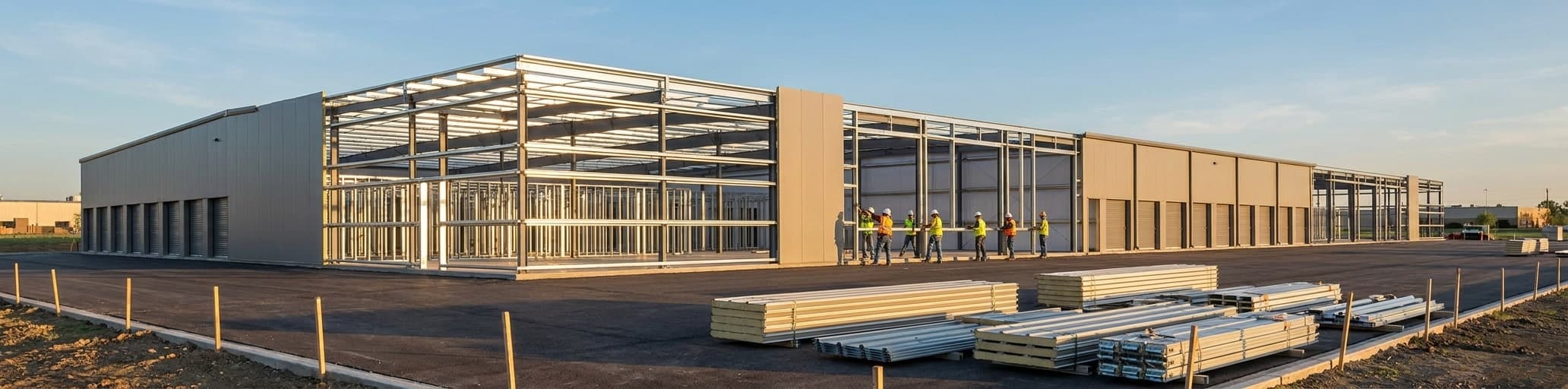

We help you navigate 2026 self-storage construction costs, from single-story drive-up facilities at $55-$85 per square foot to climate-controlled urban infill at $130-$180 per square foot. Understanding regional labor premiums and permitting timelines before land acquisition ensures your project pencils financially rather than facing costly surprises mid-construction.
Self-storage construction cost per square foot: current market rates (May 2026)
Single-story drive-up self-storage runs $55-$85 per gross square foot in May 2026, with regional costs varying 40% based on labor and permitting requirements.
Single-story drive-up ambient facilities: what you actually pay per square foot
Single-story drive-up ambient temperature self-storage is the lowest-cost product in the asset class.
In May 2026, hard costs for conventional single-story drive-up facilities run $55-$85 per gross square foot (GSF), covering a pre-engineered metal building (PEMB) or block-and-steel envelope, roll-up doors, and asphalt drives — no climate control.[1] PEMB shell pricing alone sits at $22-$38 per SF, with finished assembly reaching $55-$80 per SF, making it the default structural system for this facility type.[1] Net rentable efficiency for single-story drive-up runs 80-88%, meaning nearly nine out of ten square feet you build generate direct rental income — a significant advantage over multi-story products.[1] Three cost pressures are moving the needle upward in 2026: imported steel framing components are 4-7% more expensive after the latest tariff round, concrete prices are projected to rise 4-6% through year-end, and roll-up door lead times have normalized to a manageable 4-6 weeks after the 2025 backlog cleared.[2] That door stabilization matters — compromising on door quality to cut initial costs can generate service losses exceeding $200,000 in early operations.[2] To translate hard cost into a full project budget, add 25-40%: soft costs (permits, engineering, financing) run 15-22% of hard cost, and FF&E including security, gates, and access control adds another 4-8%.[1]
Regional cost variations and what drives them in 2026
The national $55-$85/GSF benchmark obscures a 40% regional spread that can make or break underwriting.[2] Midwestern markets come in at the lower end of the range, while Coastal California and the Northeast run 15-35% above national averages due to union labor requirements, strict seismic and energy codes, and permit timelines that stretch 9-18 months versus 3-8 weeks in suburban Texas and Florida.[1][2] Sun Belt labor costs for steel erectors are running $23-$38 per SF compared to $38-$62+ per SF in high-cost coastal jurisdictions, and that gap directly explains why identical footprints cost materially more depending on where you break ground.[2] Permitting adds another layer of financial risk: roughly 80% of self-storage projects require conditional use permits involving public hearings, and at least 15 states carry active development restrictions as of 2026 — delays that compound financing costs and push back your first rent check by months.[2] Soft costs tied to permits, plan reviews, and impact fees typically add $50,000-$150,000 on a 100-unit project, with zoning complications capable of adding $50,000-$150,000 more on top.[2] The practical implication: build your regional cost assumption before you negotiate land, not after you've committed to a site.
Climate-controlled interior facilities: the cost premium and when it pays
When ambient temperature isn't sufficient — typically in Sun Belt markets where summer heat accelerates tenant churn or in premium customer segments — single-story climate-controlled construction runs $80-$120 per GSF in hard costs.[1] The premium above conventional drive-up covers HVAC equipment with ducted distribution, a vapor retarder, an insulated wall assembly or insulated metal panel (IMP) envelope, upgraded electrical service, and dehumidification in humid markets.[1] That $20-$40 per GSF premium is typically justified by street rate premiums of 30-55% over ambient product, which is why climate-controlled construction dominates new Sun Belt starts.[1] For developers considering an RV storage building alongside traditional units, the same envelope logic applies: a tighter insulated assembly costs more upfront but drops HVAC operating expenses significantly over a standard hold period.
The envelope decision between IMP on structural steel versus a conventional PEMB assembly matters more for climate-controlled product: IMP combines the air barrier, vapor retarder, and continuous insulation into a single trade and product, reducing HVAC equipment sizing and cutting 4-8% off total project cost versus tilt-up concrete by speeding the dry-in date.[1]
Multi-story urban infill storage: cost structure and drivers
Multi-story urban infill self-storage represents the most capital-intensive product type, with hard costs running $105-$170 per GSF in May 2026.[2] The premium reflects structural steel or composite framing engineered for upper-level dead loads, NFPA 13 sprinkler systems, elevators, full envelope, ADA-compliant circulation, and MEP distribution throughout multiple floors.[1] New energy code requirements from IECC-adopting jurisdictions are adding $0.40-$0.90 per GSF specifically for PV-ready electrical service upgrades on multi-story projects.[2] Net rentable efficiency drops to 65-75% in multi-story products versus 80-88% for single-story, so per-net-rentable-square-foot cost is substantially higher than the GSF headline suggests — a detail that frequently causes pro forma errors when developers apply single-story efficiency assumptions to urban infill underwriting.[1] Electrical service must be sized to 800A-1,200A for modern multi-story facilities supporting security systems, kiosks, and EV-ready parking; under-sizing to a cheaper 600A design creates correction costs of $50,000-$150,000 during operations.[2] Permitting in dense urban jurisdictions — where 9-18 month timelines are common — makes multi-story the asset type most punished by schedule slippage, reinforcing the financial case for design-build delivery that compresses both permitting engagement and construction by 15-25%.[1]
Climate-controlled interior facilities with drive-up access: $110-$160 per sq ft
Climate-controlled units with individual exterior drive-up doors represent a distinct and more expensive product tier than interior-corridor climate-controlled storage.
Hard costs run $110-$160 per gross square foot in May 2026, a premium driven by a specific engineering problem: you must maintain conditioned air at each bay opening rather than sealing conditioned corridors behind a single entry vestibule.[1] That means each unit door requires insulated roll-up hardware, air-seal detailing at the threshold, and an HVAC plant sized to offset repeated door-opening infiltration loads — a fundamentally harder thermal envelope than corridor-access product.[1] The insulated metal panel envelope on a structural steel frame is the only assembly that consistently solves the air-barrier problem here: IMP delivers the vapor retarder, continuous insulation, and air barrier in a single product and trade, reducing HVAC equipment sizing and cutting lifecycle energy cost versus a batt-and-stud wall with standard roll-up doors.[1] HVAC equipment for conditioned drive-up units runs $9-$16 per SF — toward the high end of that range when you factor in the additional infiltration load from exterior bays — and the EPA AIM Act's A2L refrigerant transition is adding 6-10% to mechanical costs on climate-controlled projects started in 2026 that weren't priced into earlier pro formas.[3] The market offset is real: climate-controlled storage rents at a 25-50% premium to ambient drive-up product in the same submarket, and climate-controlled facilities reach 85% occupancy in 16-22 months on average versus 22-30 months for drive-up — a lease-up advantage that has meaningful NPV implications on a project with a 7.5% yield-on-cost target.[3] The prefab mini storage ROI guide covers how unit mix and lease-up timing interact with construction cost to determine whether the climate-controlled premium pencils for a given site.
Envelope and HVAC specifications that determine whether the cost premium pays back
The single largest risk on climate-controlled drive-up construction is an under-specified envelope that turns a $9/SF HVAC line into a $14/SF HVAC line across the project's operating life.[1] Saving $4 per SF on the wall assembly to hit a lower bid number costs approximately $1.20 per SF per year in HVAC operating expenses on conditioned space; over a 25-year hold, that payback runs 7-9 times in the wrong direction.[1] The correct specification for this product type: continuous insulation at the wall assembly (IMP at R-25 or better for humid Sun Belt markets), insulated roll-up doors rather than standard non-insulated steel curtains, and HVAC sized to ASHRAE 90.1 infiltration loads for storage occupancy — not office benchmarks, which consistently produce oversized and over-budget mechanical plants.[3] Storage occupant loads are near zero, so the dominant sizing variable is envelope infiltration, and a tight IMP assembly can reduce rooftop unit sizing by one to two tons per 10,000 SF of conditioned space.[3] FM-rated insulated metal panels frequently pay back inside year three through insurance premium reduction alone, making the higher panel cost a budget-neutral decision on a 10-year hold.[1]
Regional cost spread for climate-controlled drive-up construction
The $110-$160/GSF national range masks a regional spread of roughly 40% that directly affects whether a deal underwrites.[1] Gulf Coast markets (Texas, Louisiana, Alabama) sit near the lower end of the range — strong labor supply and competitive PEMB erector pools offset the hurricane wind-uplift framing premium of 4-7% that pushes panel and roofing costs up.[3] Southeast markets including Florida, Georgia, and the Carolinas run mid-range: humidity makes climate-controlled drive-up nearly mandatory for competitive facilities, which keeps demand for the product type high and contractor familiarity strong.[3] Mid-Atlantic and coastal Northeast markets add a labor premium and stormwater stringency that pushes total hard cost toward the upper end of the range, while California's Title 24 energy code, seismic detailing requirements, and prevailing wage exposure push the number 18-32% above the national average for an identical drawing set.[3] The practical implication for any climate-controlled drive-up project: validate the regional cost assumption before negotiating land, not after signing the purchase agreement — a 20% regional premium on a 60,000 GSF facility is $1.3M-$1.9M in hard cost alone.[1]
Multi-story urban infill storage: $140-$200 per sq ft
Multi-story urban infill self-storage is the most capital-intensive format in the asset class, with all-in hard costs running $130-$180 per square foot for climate-controlled product on dense 1-2 acre infill sites supporting 60,000-120,000 net rentable square feet across three to five stories.[4] The climate-control premium alone contributes $12-$25 per square foot of that figure, covering HVAC equipment, vapor barriers, NFPA 13 fire suppression, and elevators — line items that simply do not exist on single-story conventional product.[4] Site development costs of $4.25-$8.00 per square foot stack on top of the structural and envelope costs, pushing total delivered hard cost toward the upper boundary of the range in urban markets where grading, utility connections, and stormwater management are complex.[5]
Mixed-use mandates and what they do to the cost stack
Municipal pressure for activated streetscapes has introduced a structural cost multiplier that many multi-story pro formas miss entirely.
NYC, Miami, Charlotte, and Nashville all impose mixed-use requirements — ground-floor retail, residential, or industrial components — that force hybrid structural systems with transfer beams adding 15-25% to per-square-foot construction cost versus a pure-storage structural frame.[4] Those same jurisdictions frequently mandate masonry, architectural glass, façade modulation, and landscape screening in place of corrugated metal exteriors, and windows alone cost significantly more than any other wall construction method on a per-linear-foot basis.[5] The combined effect of transfer-beam framing, premium cladding, and complex MEP distribution across multiple floors is what differentiates multi-story urban infill from every other format on a cost-per-gross-square-foot basis — and it is why projects in supply-constrained coastal markets like New York City, Boston, and San Jose, where per-capita storage inventory runs roughly 2.1 square feet against a national average of 6.3-7.6 square feet, still pencil despite the construction premium.[5]
Lease-up timeline and stabilized economics for multi-story product
Construction for multi-story climate-controlled facilities runs 12-18 months, and lease-up in the current cycle has stretched to 24-36 months — materially longer in oversupplied Sun Belt metros — producing a 3-4 year total carry period from groundbreaking to refinancing eligibility.[4] Stabilized NOI margins for new-build trophy urban infill run 65-72%, which is strong but reflects higher property tax loads and lower scale than mature REIT portfolios operating at institutional density.[4] That NOI profile supports Class A climate-controlled product trading at cap rates of 5.0-6.0% — the tightest spreads in the self-storage asset class — but the extended carry timeline demands that construction cost discipline begin at schematic design, not after the GC is onboarded, because schedule slippage in dense urban jurisdictions compounds financing costs faster than any single material price increase.[5]
Regional cost breakdown across U.S. construction markets
The $55-$85/GSF national benchmark for single-story ambient storage obscures a roughly 40% regional spread that can shift total hard cost by millions on a single footprint.[1] A climate-controlled facility priced at $82/SF in the Mountain West would cost $96/SF in coastal California for an identical drawing set — a gap driven by labor markets, code stringency, and permit timelines rather than the building itself.[3] The table below maps the six major U.S. construction cost regions to their current self-storage pricing pressures:
| Region | States | Primary cost driver | vs. national average |
|---|---|---|---|
| Mountain West | CO, UT, WY, MT | Snow-load framing premium (+4-7%) | +10-20% |
| Gulf Coast | TX, LA, MS, AL | Hurricane wind-uplift ratings on panels and roofing | -5-15% |
| Southeast | GA, FL, NC, SC, TN | Humidity makes climate control mandatory; strong contractor supply | Near avg |
| Mid-Atlantic | VA, MD, PA, DE | Labor premium and stormwater stringency | +15-25% |
| Pacific Northwest | WA, OR, N. CA | Seismic detailing adds 3-6% on multi-story | +20-40% |
| California | All CA | Title 24 energy code, seismic detailing, prevailing wage | +18-32% |
Labor is the single largest variable within the regional spread.[1] Sun Belt steel erectors run $23-$38/SF; comparable work in high-cost coastal jurisdictions costs $38-$62+/SF, and that gap compounds across every trade on a multi-story project.[1] Permitting adds a separate financial risk layer: approximately 80% of self-storage projects require conditional use permits involving public hearings, at least 15 states carry active development restrictions as of 2026, and permit timelines stretch 9-18 months in coastal jurisdictions versus 3-8 weeks in suburban Texas and Florida — each additional month of carry directly erodes yield-on-cost.[1] The practical consequence shows up in preconstruction: on a 240,000 GSF Gulf Coast climate-controlled project, a second-look review identified excess circulation, an oversized HVAC plant, and a corridor width reduction that dropped the bid from $148/SF to $128/SF — a $4.8M swing on the same unit count.[3] Build the regional cost assumption before you negotiate land, not after you've committed to a site.[1][3] How Much Does It Cost to Build a Self-Storage Facility From the Ground Up?
Land acquisition and site preparation: 15-25% of total project cost
Land acquisition typically accounts for 25-30% of your total self-storage project budget — the single largest pre-construction line item you'll face.[6] Raw land pricing runs $8-$25 per square foot depending on location, and the footprint requirement is larger than it first appears: 100 units averaging 10×10 feet generates 10,000 sq ft of unit space, but you'll need roughly 14,000 sq ft of total site area once driveways, common areas, and parking are factored in, pushing acquisition cost to between $112,000 and $350,000 before construction begins.[7] Site development — grading, excavation, and stormwater management — adds $4.25-$8 per sq ft on top of land cost, which translates to $59,500-$112,000 for that same 100-unit footprint.[7] One figure that routinely derails early-stage budgets: site preparation costs can swing from $5 to $80 per sq ft depending on subsurface conditions — unstable soils, high water tables, or buried utilities can push site prep well above the baseline estimate and compress the return on a project that appeared to pencil on paper.[6] Location also drives the build-direction decision: high land costs in urban infill markets often force vertical development to justify the land basis, while lower-cost suburban and rural sites support single-story layouts at a lower total cost of entry.[7]
Material costs broken down by construction method (steel, tilt-up, masonry)
The structural and envelope system you select drives 35-45% of total hard cost, making it the most consequential early-design decision on any self-storage project.[1] Pre-engineered metal buildings (PEMB) deliver the lowest entry price for conventional single-story drive-up product: shell pricing runs $22-$38 per SF, with finished assembly reaching $55-$80 per SF, and predictable field labor keeps the erection schedule tight.[1] The core limitation is air tightness — PEMB envelopes leak at panel-to-frame interfaces without custom flashing, which disqualifies them as a default choice for climate-controlled product.[1] Insulated metal panels (IMP) on a structural steel frame solve that problem directly: IMP delivers the air barrier, vapor retarder, and continuous insulation in a single trade, cutting HVAC equipment sizing and lifecycle energy cost; 2026 IMP install pricing ranges $14-$26 per SF depending on R-value and panel finish.[1] For multi-story product specifically, IMP shaves 4-8% off total project cost versus tilt-up by accelerating the dry-in date and reducing crane time.[1] Understanding how structural steel components interact with envelope systems is what separates a cost-optimized design from one that defaults to whatever the local GC built last.
| Construction method | Wall system cost (2026) | Best application | Key limitation |
|---|---|---|---|
| PEMB | $22-$38/SF shell | Single-story drive-up, ambient | Air leakage at panel joints without custom flashing |
| IMP on structural steel | $14-$26/SF installed | Climate-controlled, multi-story | Higher upfront cost than PEMB shell |
| Tilt-up concrete (standard panel) | $14-$22/SF wall | Large ambient, 80,000+ SF Sunbelt | Slow envelope close-in; crane-intensive scheduling |
| Tilt-up concrete (insulated sandwich) | $20-$28/SF wall | Conditioned tilt-up applications | Difficult to value-engineer once panels are cast |
| CMU masonry | Highest labor cost per SF | Infill urban, Type II code-mandated | Labor-heavy; low thermal performance without continuous exterior insulation |
Tilt-up concrete runs $14-$22 per SF for standard ambient panels and $20-$28 per SF for insulated sandwich panels — and while it is durable and fire-resistive, the slow envelope close-in and intensive crane scheduling make it the wrong default below 80,000 SF, where PEMB consistently wins on per-SF cost.[8] Tilt-up earns its premium in Sunbelt markets with large ambient footprints where panel repetition compresses per-SF cost and the 100-year service life justifies the build premium on a long hold — a 410,000 SF Texas distribution center delivered at $138 per SF total shell illustrates the scale at which tilt-up becomes the price-discipline play rather than the premium one.[8] CMU masonry carries the highest labor cost and the slowest schedule of the three systems, but remains defensible on dense infill urban projects where local code mandates Type II non-combustible construction or hurricane wind-uplift ratings push masonry as the code-compliant path.[1] The practical decision rule: PEMB for single-story conventional drive-up, IMP on a steel frame for any climate-controlled or multi-story product, and tilt-up or CMU only where building scale or local code makes the cost premium genuinely defensible against total cost of ownership.[1]
Labor and construction timeline: what impacts your final price
Construction timelines for self-storage facilities run 6-16 months from groundbreaking to certificate of occupancy, with facility size and design complexity determining where your project lands in that range.[9] The most reliable crew productivity benchmark in the industry: an experienced five-person erection crew installs approximately 5,000 square feet of building per week — and that figure excludes roll-up door installation and interior hallway systems, which require separate scheduling and additional crew time.[9] Add a minimum of one week for punch-list completion regardless of total footprint size.[9] Multi-trade sequencing is where schedules most commonly break down — electrical rough-in, HVAC installation, and drywall each carry their own lead-time dependencies, and waiting for one trade to finish completely before the next begins can add weeks to a project that looked achievable on paper.[9] The solution is concurrent scheduling: overlapping trades wherever code and site safety allow, which requires a project manager with real authority to coordinate subcontractor crews across disciplines rather than deferring sequencing decisions to each individual trade.[9] Weather introduces a separate risk that most preliminary timelines underestimate — mud conditions slow site work more than snow or extreme heat, making active site maintenance during construction the only dependable mitigation.[9] On the cost side, every additional month of construction-loan carry compounds financing expense before the first tenant pays rent, which means schedule slippage is a direct financial loss, not just a logistics inconvenience.[10]
Permitting, engineering, and soft costs often overlooked in initial budgets
Soft costs add 15-22% to hard cost on a ground-up self-storage project — a figure most early-stage budgets omit entirely.[1] The breakdown matters: architecture and engineering fees run 5-8% of hard cost (storage design is highly repeatable, so A&E fees sit below hospitality and healthcare benchmarks), permits and impact fees consume 2-5% depending on jurisdiction, and financing costs — origination, appraisal, environmental, and title — absorb another 3-6%.[1] Insurance and bonding stack on 1-2% more.[1] FF&E and security technology are the most consistently under-budgeted line items: roll-up doors, hallway access systems, kiosk hardware, cameras, gates, fencing, and the management software stack collectively run 4-8% of hard cost on a typical climate-controlled project, though GC-led procurement through volume manufacturer relationships can compress that figure by 6-12%.[1] When land is factored in at 12-45% of total project cost depending on market type, the full all-in math for a 60,000 GSF Sun Belt climate-controlled facility lands at $132-$195 per gross square foot delivered — roughly 60-70% above the hard cost headline.[1] Two contingency items are routinely excluded from first-pass budgets: geotechnical surprises (unstable soils or high water tables can swing site prep from $5 to $80 per square foot) and elevator procurement lead times of 20-30 weeks, which become schedule-critical on multi-story projects if not ordered well ahead of shell completion.[11] Zoning complications — conditional use permits, variance hearings, and entitlement delays — can inflate total development costs by 10-20% beyond the base soft cost estimate, a risk that compounds financing expenses faster than any single material price increase.[11] Building a 4-8% construction contingency into the initial budget and aligning with a single-source design-build partner who can navigate permitting timelines from schematic design forward is the most reliable way to keep soft costs from becoming project-stopping surprises.[10][11] Steel Buildings vs. Alternative Construction Methods for Self-Storage: A Cost and Durability Comparison
Pre-engineered metal buildings (PEMB) for self-storage: speed, cost efficiency, and long-term value
Tilt-up concrete vs. steel: construction timeline and maintenance expenses over 30 years The construction timeline gap between tilt-up and steel is the sharpest practical difference between the two systems — and for self-storage, it directly affects how quickly your first rent check arrives. Tilt-up requires 4-8 weeks of foundation and slab preparation before any panels can be cast, followed by 7-14 days of curing per panel before crane operations can begin.[8] Once panels start going up, the pace is fast — 12-24 panels per day — but the slow start means tilt-up projects routinely run 3-5 months longer to envelope close-in than a comparable PEMB erection cycle.[8] A pre-engineered metal building reaches dry-in in 6-8 weeks on average, and that compression translates directly into earlier lease commencement and reduced construction loan carry.[13] Cold-weather markets compound tilt-up's schedule exposure: concrete pour windows in Mountain West and Northeast markets effectively close December through February without significant heating and protection costs, a risk that simply does not apply to steel erection.[8]
On a 30-year maintenance horizon, the two systems diverge in opposite directions depending on building size and climate. Tilt-up's concrete walls deliver a 100-year service life with minimal envelope maintenance — no paint cycles, no panel re-fastening, no corrosion remediation — and the Type II non-combustible classification produces insurance premium savings that a Texas owner underwriting a 410,000 SF facility found sufficient to justify a $42/SF construction premium over an initial PEMB estimate.[8] Steel buildings in humid coastal environments require more active corrosion management, and PEMB envelopes built for 25-30 year service life will reach re-roofing and re-skin decisions inside a typical self-storage hold period.[8] The maintenance calculus flips, however, for climate-controlled self-storage: a mid-Atlantic cold storage trade study found tilt-up with interior liner at $258/SF versus a native IMP steel assembly at $208/SF — a $4.6M gap on a $24M project — with IMP also outperforming on long-term thermal performance at panel-to-panel joints, which are the persistent weak point in tilt-up cold storage envelopes.[8] The decision rule for self-storage is clean: below 80,000 SF, PEMB wins on both first cost and schedule; above 80,000 SF in a Sunbelt market with long ownership intent, tilt-up earns its premium through insurance savings and service life; for any climate-controlled product regardless of size, steel with IMP envelope outperforms tilt-up on total cost of ownership.[8]
| Factor | PEMB steel | Tilt-up concrete |
|---|---|---|
| Envelope close-in timeline | 6-8 weeks | 12-20+ weeks (including cure time) |
| Full shell cost (2026) | $55-$80/SF | $115-$185/SF (industrial); $145-$235/SF (distribution) |
| Optimal building size | Under 80,000 SF | 80,000-800,000 SF |
| Service life target | 25-30 years | 100 years |
| Climate-controlled performance | Strong with IMP envelope | Weak at panel joints without liner |
| Cold-weather schedule risk | Low | High (pour windows close Dec-Feb) |
| Long-term maintenance | More active in coastal/humid climates | Minimal; no paint or re-skin cycles |
| Insurance classification | Standard | Type II non-combustible premium savings |
Masonry and CMU construction: higher upfront costs and climate control considerations
CMU masonry carries the highest labor cost per square foot and the slowest erection schedule of any structural system used in self-storage — and those two facts alone make it a poor default choice when steel or tilt-up can satisfy the same code requirement.[1] Where CMU earns its place is narrow but clear: dense urban infill projects where local code mandates Type II non-combustible construction, coastal hurricane markets where wind-uplift ratings push masonry as the compliant path, and multi-story facilities where interior stairwells require firewalls constructed of CMU block or fire-rated drywall as a life-safety requirement.[1][14] Multi-story operators also occasionally specify CMU on the first floor for structural and aesthetic reasons — giving the base of the building a heavier, more permanent appearance — while transitioning to metal panels or insulated metal panels on upper floors.[14] The critical thermal problem with CMU is that the material itself has near-zero insulation value: a standard CMU wall assembly delivers roughly R-1.5 to R-2.5, which means any climate-controlled self-storage product built with CMU requires continuous exterior insulation added as a separate trade and product to hit ASHRAE 90.1 compliance and achieve HVAC equipment sizing that doesn't blow the operating budget.[1] That exterior insulation layer adds cost and coordination to an already labor-intensive envelope system, reinforcing the rule: specify CMU only when local code genuinely mandates it, and pair it with continuous insulation from the outset rather than treating it as a value-engineering cut that gets added back after the mechanical engineer prices an oversized HVAC plant.
Why single-source design-build reduces hidden costs and project delays
Traditional design-bid-build keeps architects, contractors, and trade partners in separate silos — and those silos are where budget overruns originate.
When drawings are finalized before a contractor is engaged, contractors react to completed designs rather than shaping them, producing change orders, last-minute value-engineering cuts, and schedule delays that strain every relationship on the project.[16] A single-source design-build arrangement eliminates that fragmentation: one team carries accountability for both design and construction, so architects approach the project with a builder's perspective and contractors honor design intent from the first sketch forward.[16] The financial consequences of misalignment have intensified in 2026 — elevated interest rates mean every month of schedule slippage and every dollar of overrun compounds financing costs before the first tenant pays rent, making early cost certainty a structural project advantage rather than a preference.[15] Preconstruction collaboration within a unified team is where the real dollar value surfaces.
On one recent multi-story development, early coordination between design and field teams relocated the water-service entry to reduce required utilities, eliminated the need for a retaining wall by improving site conditions, and recovered rentable square footage from a misplaced utility closet — all before construction started, saving thousands without altering design intent.[16] GC-led procurement of doors, hardware, and security electronics captures a separate 6-12% savings through volume manufacturer relationships that disappear when owners source independently after contracts are signed.[2] The cumulative benefit is schedule compression: overlapping design, permitting, and procurement phases reduces general conditions costs, minimizes idle time, and stabilizes escalation risk — as one industry source summarized, "the compounding cost savings come from compressed schedule, reduced change orders, and earlier rent commencement — not from beating up a single line item."[2]
Self-Storage Unit Sizing and Cost Estimates: 100 Units, 50 Units, and 10 Units Broken Down
A realistic 100-unit facility costs $756,500-$1,252,000 all-in, with climate control and security systems adding $100-$10,000 per unit beyond the structural shell.
100-unit facility cost estimate: small (5×10), medium (10×10), and large (10×20) unit mix
A realistic 100-unit facility isn't built from a single unit size — it's built around what tenants actually rent. National demand data shows 10×10 units capture 26% of rental share, 5×10 units account for 22%, and 10×20 units represent 12%.[4] Translating that into a practical 100-unit mix: approximately 37 units of 5×10 (1,850 sq ft net rentable), 43 units of 10×10 (4,300 sq ft), and 20 units of 10×20 (4,000 sq ft) — producing roughly 10,150 net rentable square feet total. At single-story drive-up net rentable efficiency of 80-88%, your gross building footprint lands between 11,534 and 12,688 sq ft before driveways, common areas, and parking.[4] On a material-cost basis alone, 100 units of 5×10 run $42,500-$70,000, while 100 units of 10×20 run $170,000-$280,000 — so a blended 100-unit mix with the unit proportions above falls in the $90,000-$150,000 range for materials before construction labor, site work, doors, and envelope.[6] When you add land acquisition (typically 25-30% of total budget), construction, and all project costs, the all-in range for a 100-unit single-story drive-up facility runs $756,500-$1,252,000 depending on location, construction type, and unit configuration.[6] That figure does not include climate control, security systems, or access hardware, which can add $100-$10,000 per unit depending on specification level — a line item that routinely surprises first-time developers who budget only for the structural shell.[6]
| Unit type | Unit count | Net rentable sq ft | Material cost range |
|---|---|---|---|
| 5×10 (small) | 37 | 1,850 sq ft | $15,725-$25,900 |
| 10×10 (medium) | 43 | 4,300 sq ft | $73,100-$120,400 |
| 10×20 (large) | 20 | 4,000 sq ft | $34,000-$56,000 |
| **Mixed 100-unit total** | **100** | **10,150 sq ft** | **$122,825-$202,300** |
Note: Material costs above are proportional estimates derived from published per-unit ranges.[6] Full project cost including land, construction, site work, and soft costs runs $756,500-$1,252,000 for a typical 100-unit facility.[6]
50-unit and 10-unit project costs: how economies of scale affect per-sq-ft pricing
The per-square-foot cost of a 50-unit or 10-unit self-storage facility runs materially higher than a 100-unit project — not because construction materials price differently at smaller volumes, but because fixed project costs don't compress with building size. Hard construction costs for single-story drive-up self-storage run $55-$85 per gross square foot regardless of whether you're building 6,000 or 60,000 square feet.[1] What changes is what those hard costs have to carry. Architecture and engineering fees, permit and impact fee minimums, site survey work, environmental studies, and construction loan origination are largely fixed-dollar line items; on a 100-unit project they represent 15-22% of hard cost, but on a 6,000 GSF footprint those same dollar minimums can consume 25-35% of hard cost, pushing effective all-in per-square-foot cost 20-35% above the benchmark for larger facilities.[1] Turn-key budgeting benchmarks for small self-storage starts confirm this: $65-$100+ per square foot in hard costs alone, before soft costs and land are applied.[17]
For a 50-unit single-story drive-up facility, the proportional unit mix from the 100-unit analysis produces roughly 5,075 net rentable square feet and a gross footprint of approximately 5,800-6,350 square feet at 80-88% single-story efficiency.[1] Hard costs at $55-$85/GSF run $319,000-$540,000, but with soft costs rising toward the upper end of the 15-22% range at this scale, and land added at typical suburban pricing, total all-in cost lands approximately $450,000-$800,000.[1] A 10-unit project hits the penalty hardest: the same permitting, geotechnical, and engineering line items that spread across 12,000+ gross square feet on a 100-unit project now concentrate on a 1,000-1,250 gross square foot footprint, making the effective delivered cost per square foot the highest of any project scale.[17][1] The table below shows how hard cost, soft cost burden, and effective per-square-foot range shift across facility sizes.
| Facility size | Approx. net rentable sq ft | Gross footprint at 80-88% efficiency | Hard cost range | Soft cost burden | Effective delivered cost/GSF |
|---|---|---|---|---|---|
| 10 units | ~800-1,000 sq ft | ~910-1,250 sq ft | $50,000-$106,000 | 25-35% of hard cost | $100-$145+ |
| 50 units | ~5,075 sq ft | ~5,800-6,350 sq ft | $319,000-$540,000 | 20-30% of hard cost | $85-$120 |
| 100 units | ~10,150 sq ft | ~11,500-12,700 sq ft | $633,000-$1,080,000 | 15-22% of hard cost | $75-$105 |
Note: Hard costs based on $55-$85/GSF single-story ambient benchmark.[1] Soft costs include architecture, engineering, permits, financing, insurance, and bonding.[1] Effective delivered cost per GSF excludes land.[17][1]
The practical implication is clear: every additional unit you build dilutes the fixed-cost burden across more rentable square footage. On a 10-unit project, a $50,000 permitting cost represents nearly $40-$50 per gross square foot of fixed overhead; on a 100-unit project, the same dollar amount represents roughly $4-$5 per gross square foot.[1] Developers considering small self-storage starts should model the prefab mini storage ROI against stabilized occupancy and street rates before committing to a sub-50-unit footprint — the per-square-foot economics often favor phasing to 75-100 units from the start rather than building small and expanding later, which resets soft cost exposure on each phase.[1]
Cost factors: climate control, security systems, and access features that change your budget
Climate control is the single largest optional budget line on any self-storage project, adding $20-$40 per gross square foot to single-story construction — a premium that covers HVAC equipment with ducted distribution, a vapor retarder, an insulated wall assembly, upgraded electrical service, and dehumidification in humid markets.[1] The offset is real: climate-controlled facilities command street rate premiums of 30-55% over ambient drive-up product in the same submarket, which is why conditioned product dominates new Sun Belt construction despite the higher build cost.[1] Security technology and access hardware are the most consistently under-budgeted line items in the entire project — roll-up doors, hallway access systems, kiosk hardware, security cameras, gates, fencing, signage, and the management software stack collectively run 4-8% of hard cost on a typical climate-controlled project.[1] Collectively, these additions can range from $100 to $10,000 per unit depending on specification level, a spread that routinely catches first-time developers who budget only for the structural shell.[6] The lowest-cost end of that range reflects basic padlock hardware and a simple gate controller; the upper end reflects PTI or Noke smart-lock access on every door, full HD camera coverage, an outdoor kiosk with credit card processing, and a cloud-based management software subscription.[1] One mistake with lasting financial consequences: specifying cheap roll-up doors and discount access electronics to trim the initial budget.
Door failures and access-control glitches drive vacancy faster than nearly any other operational issue — the $80,000-$140,000 saved on a discounted package costs over $200,000 in early-life service calls and elevated move-out rates.[1] GC-led procurement of doors, hardware, and security electronics through volume manufacturer relationships can compress that specification cost by 6-12% versus owner-sourced purchasing after contracts are signed — capturing the savings without the operational risk.[1]
Real-world profitability: what rental rates support your construction investment
The U.S. self-storage market was valued at $45.33 billion in 2025 and is projected to reach $65.02 billion by 2034, growing at a 4.09% compound annual growth rate driven by urbanization, residential mobility, and rising demand for flexible storage solutions.[20] That trajectory matters for project underwriting: rental rates supporting your construction investment today are more likely to strengthen across a standard hold period than to contract.
In practice, self-storage facilities earn between $150,000 and $500,000 annually depending on location, unit mix, and operational efficiency.[18] Three factors consistently separate facilities that reach the upper end of that range from those that don't: a visible, high-traffic site with strong nearby residential density; a unit mix calibrated to actual local demand rather than generic averages; and investment in the right technology — automated access, surveillance, and management software — that keeps staffing lean without degrading tenant experience.[18] The recession-resistant demand profile of the asset class is a material risk modifier that belongs in every pro forma conversation.
Storage demand holds steady during economic downturns because the life events that drive rentals — moving, downsizing, business transitions — persist regardless of consumer confidence, which is why storage facilities maintain high occupancy rates even in contracting economies and carry lower income-volatility risk than most commercial real estate categories.[19] Low maintenance requirements and operating costs further protect the margin between gross revenue and net operating income across the hold period.[19] The practical implication for construction budgeting is direct: a facility built at the lower half of the regional delivered-cost range for its product type requires a meaningfully lower stabilized occupancy threshold to cover debt service than one built at the upper end — and that cost-discipline advantage compounds each month before full lease-up, when construction loan carry is still accumulating against a revenue base that hasn't yet matured.[18][19]
- Single-story drive-up ambient storage costs $55-$85/GSF in hard costs, but regional labor and code differences create a 40% pricing spread across U.S. markets.
- Climate-controlled facilities command 30-55% rental premiums and reach 85% occupancy in 16-22 months versus 22-30 months for ambient product, justifying the $20-$40/GSF construction premium.
- Soft costs add 15-22% to hard costs on large projects but consume 25-35% on small facilities, making fixed permitting and engineering expenses heavily penalize sub-50-unit developments.
- Insulated metal panels on structural steel outperform tilt-up concrete on total cost of ownership for climate-controlled product despite higher upfront costs due to superior thermal performance.
- Design-build delivery compresses construction and permitting timelines by 15-25% while eliminating change orders, directly reducing financing costs before first tenant occupancy.
- https://terrapincg.com/news/average-cost-to-build-self-storage-facility-usa
- https://www.oaksideco.com/2026-storage-construction-costs/
- https://terrapincg.com/news/self-storage-facility-construction-guide-2026
- https://www.mmcginvest.com/self-storage-feasibility-study
- https://www.analytics.loan/post/self-storage-development-feasibility-in-2026
- https://www.unwiredlogic.com/blog/cost-to-build-self-storage
- https://stora.co/blog/how-much-does-it-cost-to-build-100-storage-units
- https://terrapincg.com/news/tilt-up-concrete-construction-cost-per-square-foot-2026
- https://makorabco.com/blog/self-storage-facility-development-timeline-what-to-expect
- https://www.maxxbuilders.com/what-is-the-cost-of-construction-for-a-self-storage-facility/
- https://www.storagebuildingcompany.com/resources/2026/1/24/self-storage-pre-construction-planning
- https://forgebuildings.com/pre-engineered-metal-buildings-an-investment-alternative/
- https://trusteelbuildings.com/what-is-the-cost-to-build-a-storage-unit-building/
- https://www.insideselfstorage.com/multi-story-building/the-magnificence-of-multi-story-self-storage-design-to-guarantee-a-successful-project
- https://arcodb.com/resources/design-build-estimating-the-new-standard-for-self-storage-cost-predictability/
- https://www.insideselfstorage.com/self-storage-development/building-smarter-how-the-design-build-process-is-used-to-improve-self-storage-development-and-construction
- https://alertbuildingsystems.com/how-much-does-it-cost-to-build-100-storage-units/
- https://storeganise.com/blog/self-storage-building-costs
- https://www.bigtexstorage.com/about/blog/how-profitable-are-storage-units/
- https://www.marketdataforecast.com/market-reports/united-states-self-storage-market