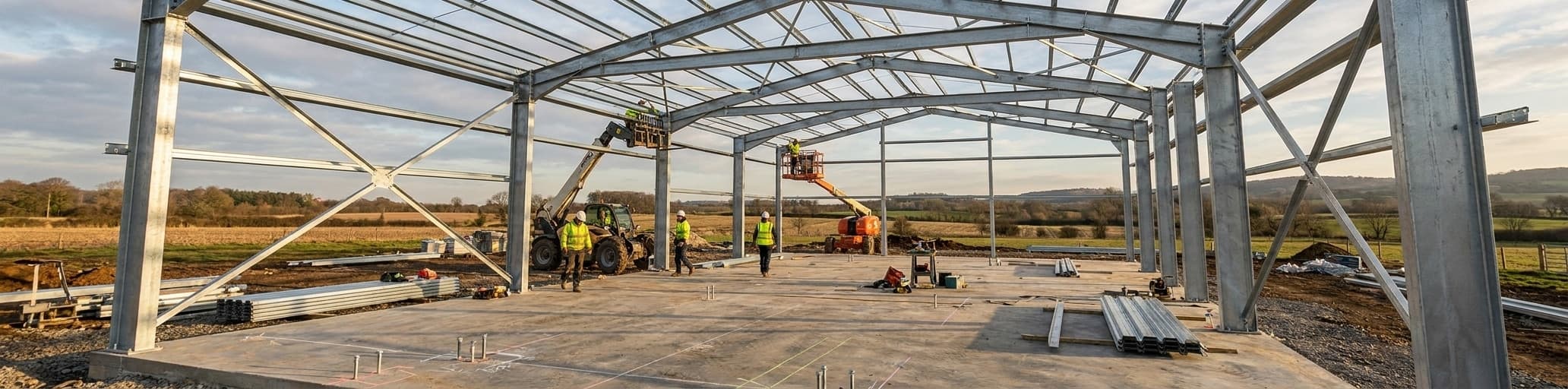

We walk you through steel gauge, foundation costs, labor rates, and tariff protection strategies so you can lock in accurate pricing before market shifts hit. Price-lock contracts and material escalation clauses let you control your budget against the tariff cycles reshaping steel costs in 2025.
Key Cost Drivers for a 30×40 Steel Agricultural Building
Choosing between 14-gauge and 12-gauge framing costs 10-15% more but adds five years to your rust-through warranty in demanding climates.
Material selection and steel gauge impact on price
Steel gauge is the single spec that most directly moves your steel agricultural building 30×40 price–and the numbering runs backward from what you'd expect: a lower gauge number means thicker, stronger steel.[2] Your building actually has two separate gauge systems to evaluate: framing gauge (the structural skeleton, typically 12-gauge or 14-gauge steel tubes) and panel gauge (the roof and wall cladding, typically 26-gauge or 29-gauge).[2] Confusing the two when comparing quotes is an easy way to end up with an apples-to-oranges price comparison.
For most agricultural uses–equipment storage, hay storage, livestock shelters–14-gauge framing is the certified residential standard, capable of handling wind and snow loads across most U.S. regions.[3] Where your site sits in a high-wind corridor, sees heavy seasonal snow, or involves longer clear spans, 12-gauge earns its place: at roughly 0.1046 inches thick versus 0.0747 inches for 14-gauge, the extra steel stiffens the frame against twisting and deflection under sustained load.[1] Expect that upgrade to add about 10-15% to the framing cost, but it also typically extends your rust-through warranty from 20 to 25 years because thicker galvanizing takes longer to wear down in damp or coastal conditions.[1] On the panel side, 26-gauge cladding costs roughly 10-15% more than 29-gauge but resists hail denting, handles wind uplift better, and avoids the wavy "oil canning" that thinner panels develop over time.[2] The caveat worth knowing before you spec anything: gauge alone does not guarantee performance.
A certified, properly engineered 14-gauge building outperforms a non-certified 12-gauge structure every time because the full design–anchors, trusses, and connections–is what actually determines how the frame performs under ASCE 7 load calculations.[2]
Site preparation and foundation costs explained
Gauge and panel specs determine what you're buying; site prep determines whether it stands up over time. Most advertised steel agricultural building 30×40 price quotes exclude site work entirely, which is why so many buyers hit sticker shock when actual turnkey bids come in.
Clearing a raw lot runs $1-$4 per square foot, and grading to a level, compacted surface adds another $0.40-$2 per square foot — meaning you can spend $4,000-$7,200 on ground work before a column anchor gets set.[6] The concrete slab is where the real variance lives. A standard 4-inch pour costs $4-$8 per square foot, but that number climbs once you factor in aprons, thickened edges, and finishing, which typically push the all-in slab cost to $6-$12 per square foot.[5] For most agricultural uses — hay storage, light equipment shelter, livestock — a 4-inch slab works.
If you're rolling combines, tractors, or any heavy machinery across the floor, a 5- or 6-inch reinforced slab isn't an upgrade; it's the correct specification.[4] Utility rough-ins (electrical, water, drainage) add another $2-$6 per square foot per service, and distance from existing connections is what actually drives that number on your specific site.[6] The stakes on getting this right go beyond cost: soft or poorly drained soil reduces anchor holding strength, and even minor foundation movement allows a steel frame to rack under sustained load. For a detailed look at how slab thickness maps to intended agricultural use, review the 30×40 concrete slab cost breakdown before locking in your foundation spec.
Labor, permits, and regional factors that affect the steel agricultural building 30×40 price
Labor is the second-largest line item after the kit itself, and it moves more than most buyers expect. Certified erection crews charge $5-$12 per square foot to assemble the base structure, but that range hides a 60% spread in actual labor rates depending on where you build.[7] The same 30×40 footprint costs noticeably less to erect in rural Tennessee than in coastal Florida or any major metro market, simply because wage floors and crew availability differ that sharply.[7] Labor shortages compound the problem: roughly 94% of contractors report difficulty filling skilled positions, which means markets with high demand for qualified crews see selective bidding and premium wages.[7] Hiring a general contractor to manage the full build adds another 10-20% on top of total project costs–a fee that's justified when local code complexity or tight timelines demand experienced oversight, but avoidable if you're willing to act as your own project manager on a straightforward agricultural build.[7] If you're evaluating crews in an unfamiliar market, a structured vetting process for local prefab contractors will surface licensing gaps, insurance coverage, and code familiarity before a contract is signed.
Permit costs vary just as widely as labor and are almost always excluded from advertised kit prices. For most agricultural jurisdictions, permit fees run $550-$2,000, but that number climbs to $7,500 or more in larger cities where the review process is more involved.[7] Rural permitting tends to be faster and lighter on documentation, while urban and suburban jurisdictions routinely require stamped engineering drawings, soil reports, environmental assessments, and staged inspections throughout construction.[8] Processing time runs anywhere from two weeks to three months, so starting the permit application before your kit delivery is scheduled–not after–is the only reliable way to prevent a completed structure from sitting idle on a cured slab.[8] Steel building permits in most jurisdictions cost $500-$3,000 for structure size and intended use, and getting that application in early is one of the few schedule levers entirely within your control.[8]
Region shapes the structural spec itself, not just the cost of labor and paperwork. A 30×40 steel agricultural building in a standard wind zone–Oklahoma, Tennessee, central Kansas–typically lands in the $16,000-$23,000 installed range, while the identical footprint in coastal Florida or North Carolina carries a 15-25% premium because stricter wind and load requirements force heavier steel and additional bracing into the design.[7] Snow-load zones add their own multiplier: the higher the ground snow load, the heavier the roof framing required to meet ASCE 7 calculations, and that directly raises both material weight and engineering cost.[8] Jurisdictions that have adopted the 2024 International Building Code also face new ASCE 7-22 tornado provisions for certain Risk Category buildings, meaning reinforced connections and heavier structural components are no longer optional in tornado-prone regions–a code change that is already affecting budgets across the Plains and Gulf states.[7] Before locking any quote, confirm which code edition your county enforces: the delta between a 2018 IBC build and a 2024 IBC build in the same wind zone can run several thousand dollars on a structure this size.[7]
Locking in Your Price Against Tariff and Market Volatility
Steel tariffs have climbed from 2.2% to 7.1% effective rates in 2025, with domestic prices rising nearly 100% of the tariff cost, so locking in your quote now protects against the next adjustment cycle.
Understanding tariff cycles and their effect on steel costs
Steel tariffs don't arrive once and hold–they cycle through policy shifts, and each cycle compounds the last. The 2018-19 round imposed a 25% tariff on imported steel, which covered only the imported share of U.S. consumption, but the pricing effect spread immediately across all domestic steel: the Producer Price Index for ALL domestic steel mill products climbed an average of 18% in 2018 because U.S. mills raised prices into the shelter the tariff created.[11] Domestic buyers paid the increase on steel they never imported.
The 2025 cycle is structurally larger. On March 4, 2025, a 25% tariff took effect on steel and aluminum from Canada and Mexico, followed on March 12 by a broader 25% covering all steel and aluminum imports globally and eliminating previous exemptions.[10] The average effective tariff rate–a single figure that weights all import duties across products and trading partners–rose from a 2024 baseline of 2.2% to 7.1% under that combined scenario, with fabricated metal products facing the highest sector-level exposure at above 30%.[9] That number carries direct weight for your budget because empirical research puts tariff pass-through near 100%, meaning domestic buyers absorb the cost, not foreign exporters.[9] By April 2025, Steel Mill Products PPI was already up 3.7% year-to-date versus the 2024 average, with a single-month April spike of 5.8%.[11] Steel costs had been climbing since December 2024, well before most buyers adjusted their budgets.[10] For anyone pricing a steel agricultural building 30×40, the consistent pattern across both tariff cycles is this: domestic mill quotes adjust within weeks of a policy announcement, and kit prices follow the same direction.
Understanding how price volatility tracks tariff announcements puts you in a position to act before the next adjustment rather than react after it.
Price‑lock contracts: how they protect your budget
A price-lock contract isn't a single document type–it's a set of specific clauses you negotiate before signing any steel building agreement, and each clause does a different job.
The most effective tool is a material price escalation clause, which defines exactly who absorbs cost increases when tariffs push steel prices above the level assumed at contract signing.[12] Depending on how it's drafted, the clause can assign all tariff risk to the owner, all of it to the contractor, or split it: a common structure has the downstream party absorbing the first 0-10% of price movement, the parties sharing increases between 10-20% equally, and the upstream party bearing anything above 20%–because the upstream party ultimately receives the value of the installed material.[13] The trigger matters as much as the split: an effective clause specifies a measurable event, such as the verified difference between the steel price on the contract date and the mill price on the delivery date, so neither party can dispute whether the clause applies.[13] Contingency clauses add a second layer of protection by creating a separate line item in the contract budget reserved for tariff-driven cost impacts, isolating those costs from normal project overruns and making them easy to track and document if a dispute arises.[13] Force majeure clauses, by contrast, offer far less protection against tariff costs specifically–courts construe them narrowly and they rarely entitle a party to additional compensation for market price fluctuations unless tariffs are explicitly named in the provision.[12] The most direct form of price certainty, however, doesn't rely on contract language at all: locking in material pricing with your supplier at order placement–before your kit ships–removes the tariff variable from your budget entirely for that purchase, though it does require storage capacity and ties up capital earlier in the project timeline.[13] For buyers working through a total project cost for a 30×40 steel building, confirming which of these mechanisms your supplier offers before signing is the single most actionable budget protection step available in the current market.[14]
Timing your order to maximize savings and avoid price spikes
The seasonal pricing window that once made winter ordering a reliable savings strategy is now competing with tariff cycles that don't follow the calendar. December through February historically delivers the most competitive metal building quotes, as demand drops and suppliers push to hit annual sales targets.[17] That advantage shrinks when tariff-driven cost increases hit mid-year: the June 4, 2025 escalation doubled steel and aluminum tariffs from 25% to 50%, immediately triggering fabricator announcements of 10-12% pre-summer price increases, with a second wave expected once the full tariff impact clears the supply chain.[15] Hot-rolled coil prices had already moved from $650 to $900 per ton following the March 2025 tariffs–and industry forecasts for 2025 point to 18-20% price increases for key steel products versus 2024 averages, driven partly by Infrastructure Investment and Jobs Act projects competing for the same domestic steel supply.[16] For anyone pinning down a steel agricultural building 30×40 price, that combination eliminates the traditional summer correction buyers used to count on.
Delaying into late 2025 or beyond exposed budgets to 20-30% increases if prices continued climbing toward $1,100 per ton.[16] The one timing lever still within your control is order placement: locking material pricing at the point of contract–before the next mill adjustment–protects your budget regardless of what season you're building in. If you're still working through line items before committing, reviewing how to budget a 30×40 metal build without cutting corners gives you a framework for identifying where costs are fixed versus where tariff exposure still exists.
Design Choices that Optimize Value and Performance
A 4:12 roof pitch gives you the snow and water drainage, heat dissipation, and vertical clearance that most agricultural operations need without significantly increasing your kit cost.
Choosing the right roof pitch and span for agricultural use
Roof pitch for a steel agricultural building is a functional decision, not a cosmetic one–and the spec you choose affects snow load accumulation, interior headroom, and heat buildup in unconditioned space.
Standard pre-engineered steel building kits ship with pitches ranging from 1:12 to 4:12, where the first number is inches of rise per twelve inches of horizontal span.[19] A 1:12 pitch produces the low-profile box shape common to basic storage structures: cheapest to frame, but it holds standing water, traps heat above the trusses, and compresses vertical clearance where you often need it most.[20] For most agricultural applications–hay storage, livestock shelter, equipment protection–a 4:12 pitch is the practical minimum rather than an upgrade, because it actively sheds rain and snow, dissipates heat in structures without mechanical ventilation, and adds usable cubic footage above the eaves without significantly increasing kit cost.[18][19] That vertical gain matters the moment you're maneuvering a round baler, a large tractor, or stacked hay bales through the interior.
On roof geometry, gable configurations slope on two sides and are the standard agricultural choice: they deliver maximum clear-span width, shed load symmetrically across the frame, and cost less to fabricate than hip roofs, which slope on all four sides and introduce additional framing complexity.[19] In heavy snow-load zones, a steeper pitch accelerates snow sliding off the panel surface, which can reduce the sustained accumulation load the frame must carry and potentially keep your structural spec at a lighter–and less expensive–framing tier.[20] For buyers working through how vertical clearance interacts with footprint dimensions on common farm uses, the sizing guidance in agricultural steel buildings provides a practical reference before you lock in your design.
Integrating doors, vents, and insulation for operational efficiency
Door configuration is where most agricultural building buyers lose time–not money–by speccing too late in the process. Eave height and door height are linked decisions: a 10-12 ft eave covers most pickup trucks with roof racks, but round balers, combines, and hay wagons need taller clearances, which means locking your door height before finalizing your eave spec, not after.[22] Walk-in personnel doors handle daily foot traffic, while roll-up or sliding openings sized for your widest load determine whether equipment moves in and out without repositioning. Doors, building height, and local structural load requirements are among the variables that push an installed project price furthest from the advertised kit figure, so specifying them early–before a quote is signed–keeps the final number accurate.[22]
Ventilation is the spec agricultural steel buildings most often get wrong at the design stage. Moisture trapped inside an enclosed structure without adequate airflow works against you regardless of how well the steel is galvanized: humidity accelerates condensation on interior panel surfaces, shortens the service life of stored feed and hay, and promotes conditions that damage equipment over time.[22] Ridge vents, sidewall louvers, and end-wall openings create passive cross-ventilation that exhausts heat and humidity without mechanical systems–an important cost advantage on unconditioned agricultural structures where running HVAC isn't practical.[22] The configuration that moves enough air depends on building orientation relative to prevailing winds, local humidity, and whether your primary use is dry storage, livestock shelter, or equipment protection–all details worth resolving on paper before the kit ships.
Insulation completes the package, and on a steel agricultural building 30×40, its primary job is condensation control rather than climate comfort.[21] Uninsulated steel panels in humid or high-humidity seasonal climates create interior drip points that damage stored crops and accelerate corrosion on equipment–a maintenance liability that shows up long after move-in.[22] Walk-in doors, skylights, and windows add both functionality and thermal bridging points that need to be accounted for in any insulation plan, since each penetration is a potential condensation site if not detailed correctly.[21] Taken together, doors, ventilation, and insulation aren't line-item upgrades you add after the base building is priced–they're the operational layer that determines whether the structure earns back its cost in daily use. For a practical breakdown of how R-value selection maps to actual payback in agricultural applications, the steel building insulation guide covering R-values and vapor barriers gives you the framework before you commit to a spec.
Future‑proofing with modular add‑ons and expansion options
The single decision that determines whether your 30×40 can grow with your operation is one you make before the kit ships: specifying load-bearing end walls at order time.[24] With that spec locked in, extending the building's length later is a matter of ordering additional frame lines and bolting them onto the existing end wall — no structural demolition, no engineered workarounds.[23] Width additions are a different calculation: every foot of additional width requires extending each rafter by the same amount, which is why most agricultural expansion plans run along the length axis rather than the width.[23] Clear-span interiors keep that path permanently open by eliminating interior columns that would otherwise restrict floor layout changes as your storage or livestock needs shift.[24] For operations expecting significant footprint growth, multi-span designs with interior columns offer a cost-effective alternative — standardized components allow manufacturers to cut production costs by up to 15% — while still delivering usable floor area at a lower per-square-foot build cost than a wider clear-span frame.[23] Beyond footprint, the same bolt-together system accepts vertical add-ons without touching the primary structure: mezzanine floor systems add overhead storage capacity, liner panels and partitions divide interior space for segregated livestock or feed areas, and lean-to carport attachments extend covered work area along the sidewall.[24][25] The structural guide to adding bays to steel buildings covers exactly what changes at the tie-in connection point and what carries over reusable from the original frame — worth reviewing before you finalize your initial spec if expansion is even a possibility.
Single‑Source Procurement and Service Excellence
One turnkey partner eliminates the miscommunication between architects, suppliers, and crews that typically derails agricultural builds mid-project.
Benefits of a turnkey solution from design to erection
The kit price you see advertised for a steel agricultural building 30×40 covers components: panels, beams, supports, and fasteners.[28] It does not cover shipping to site, equipment rental for installation, engineering fees, erection labor, or foundation work.[28] Each of those gaps becomes a separate contractor relationship to manage, a separate invoice to reconcile, and a separate schedule to coordinate — and every handoff between parties is a point where delays and cost overruns enter a project.[27] A turnkey solution collapses all of that into one contract and one phone call. From initial design through permitting, site preparation, foundation, and final erection, a single partner owns the entire sequence.[27] That single point of accountability eliminates the miscommunication between architects, suppliers, and crews that typically derails agricultural builds mid-project — before a slab is even poured.
The production timeline advantage is real and measurable. With a turnkey partner, site preparation and foundation work happen in parallel while your steel components are being fabricated in the plant — not sequentially after delivery.[27] That overlap alone compresses the schedule by 30-50% compared to traditional construction, where each phase waits on the previous one to close out.[27] Pre-engineered packages typically ship within 6-14 weeks of order, and because the engineering documentation is already stamped and prepared, permit submissions move faster through municipal review than custom designs requiring original drawings.[26] For agricultural operations with planting windows, livestock transitions, or equipment deadlines, that schedule compression isn't a convenience — it's the difference between a building that's useful this season and one that sits half-finished.
Permitting is where single-source procurement pays off most quietly. Rural agricultural jurisdictions are faster than urban ones, but every municipality still requires accurate load calculations, stamped drawings, and documentation matching the actual structure being built.[27] When your designer, fabricator, and erector are the same organization, the drawings that go to the permit office are the same drawings the crew uses on-site — no translation errors, no version conflicts, no inspector finding a discrepancy between submitted plans and installed components.[27] Erection quality follows the same logic: an expert crew that assembled the same frame system hundreds of times builds faster, with fewer field corrections, than a general labor crew working from a manufacturer's manual for the first time.[27] For a closer look at what actually changes when a professional erection team takes over versus a self-managed kit build, the 40×80 steel building erection breakdown covers the structural and schedule differences that apply equally to a 30×40 agricultural footprint.
Clear communication checkpoints throughout the project
Communication structure is what separates a predictable build from a reactive one.
Defining who receives which information, at what frequency, and through which channel–before a site is graded–keeps every stakeholder aligned when conditions change.[29] Field crews and on-site superintendents need daily briefings to stay coordinated; owners and project managers typically work better with weekly or biweekly progress summaries that track budget, schedule, and open items together.[29] The natural checkpoint cadence for a steel agricultural building follows the build sequence: design sign-off, permit submission confirmation, kit fabrication progress update, delivery and site readiness review, erection start, scheduled inspections, and final close-out.[30] Built-in approval stages at each of those milestones act as early-warning systems–catching a spec discrepancy before the steel ships costs hours, not days.[30] That discipline is measurable: poor data management drives an estimated 16% of all construction rework globally, while contractors using structured workflow checkpoints have recorded a 32% improvement in on-time project completions compared to teams operating without standardized communication protocols.[29][30] A simple documentation habit reinforces the whole system–a brief written summary of every verbal conversation, sent immediately after the call or meeting, eliminates later disputes about what was agreed.[29] Each checkpoint in the procurement sequence also functions as a verification pass on costs and timing, so budget variances surface while they're still correctable rather than after close-out.[31]
Problem‑solving support and post‑build maintenance guarantees
A post-build problem on a steel agricultural building reveals itself in one of two ways: you have a single accountable partner who designed, fabricated, and erected the structure and can diagnose the issue immediately, or you have no one to call because the kit supplier, the erection crew, and the foundation contractor are three separate entities with three separate liability positions.[32] DIY kit assembly compounds that exposure directly — most buyers underestimate both the hidden costs and the time commitment involved, and when installation errors surface after occupancy, the repair cost sits entirely with the owner.[32] That accountability gap is the core reason post-build support needs to be a contract term, not an assumption.
The warranty structure on a steel agricultural building actually has four distinct layers, each covering a different failure mode. Substrate warranties on materials like Galvalume steel can reach up to 45 years of corrosion perforation coverage — but not every manufacturer offers one, making it one of the first questions worth raising before a purchase decision is finalized.[33] Finish warranties cover the paint or coating applied over the substrate and specify both a coverage length and an acceptable degree of color fade and chalking; a long warranty period is worth little if the allowed color-change threshold means panels can look completely different before a claim qualifies.[33] Workmanship warranties from certified installers typically run 5 to 10 years and cover exactly what the crew executed — fastener placement, clip installation, and trim detailing — so improper installation gets remedied within the warranty window without additional cost.[33] Weathertightness warranties, guaranteeing the structure won't leak for a defined period (commonly around 20 years), are the least common tier and appear most often on higher-specification commercial builds rather than standard agricultural packages.[33]
Every one of those warranty tiers carries active maintenance requirements you must meet to keep coverage valid. Clearing debris, scheduling routine inspections, and logging service visits aren't optional housekeeping — they are the documented maintenance record that makes warranty claims succeed.[33] Choosing an installer who offers ongoing maintenance service after close-out solves two problems at once: it keeps your warranty compliant without managing a separate service relationship, and it gives a qualified technician who already knows your building's specifications the first look at any issue before it compounds.[33] For agricultural operations comparing steel barn cost vs wood barn over a 20-year horizon, the maintenance burden and warranty depth of each material type belongs in that calculation alongside the initial build price.
- Steel gauge thickness directly impacts price: 12-gauge costs 10-15% more than 14-gauge but extends warranty from 20 to 25 years.
- Site preparation and foundation work add $4,000-$7,200 before construction starts; concrete slab costs range $6-$12 per sq ft.
- Tariff pass-through reaches nearly 100%: domestic buyers absorb all costs from steel import duties, not foreign exporters.
- Material price escalation clauses protect budgets by defining who absorbs cost increases when tariffs spike between contract signing and delivery.
- Labor costs vary 60% based on region: rural Tennessee costs significantly less than coastal Florida or major metro markets.
- Single-source turnkey providers compress project schedules by 30-50% by running site prep and fabrication in parallel, not sequentially.
- Warranty layers include substrate (up to 45 years), finish, workmanship (5-10 years), and weathertightness coverage–each requires active maintenance documentation.
- https://www.engineeredmetalbuildings.com/blog/30×40-metal-building-prices/?srsltid=AfmBOoo2vzOGngdqki2UXk7bqomc622p0GSArUi1gViVVUG5Z17oOEYH
- https://www.probuiltsteel.com/blog/steel-gauge-guide-metal-buildings/?srsltid=AfmBOop9pnV1hU6qcaCTCGOIPcynC-iaOrdR0E-z3Ckda5CcduS6cN5U
- https://www.coast-to-coastcarports.com/14-gauge-vs-12-gauge-framing-which-is-better-for-your-next-florida-metal-building-project?srsltid=AfmBOoo44Ue4tEy6shQyoX7fD_v9Kyuu2PrXS5d-vnxgCuBPyQEovWN4
- https://www.probuiltsteel.com/blog/30×40-metal-building-cost/?srsltid=AfmBOooUxQEuc_Rue_XN4ghY3QjOxcimIdkkIjlRWYbIYcN2sdoKey4o
- https://www.engineeredmetalbuildings.com/blog/30×40-metal-building-prices/?srsltid=AfmBOooz06H_fC86SfIVGf96El-q3PZog_grT25Pwq5C4daKFsZhHDec
- https://www.cascadingfallsinc.com/what-do-prefab-metal-building-cost-to-construct
- https://ameribuilds.com/steel-building-costs-what-to-expect-2026/
- https://www.metal-buildings.org/metal-building-prices/
- https://www.richmondfed.org/publications/research/economic_brief/2025/eb_25-12
- https://www.saul.com/insights/blog/impact-steel-tariffs-construction-industry
- https://edzarenski.com/2025/02/21/construction-inflation-2025-2-21-25/
- https://www.consensusdocs.org/news/accounting-for-tariffs-in-construction-contracts/
- https://www.saul.com/insights/blog/tariff-construction
- https://cmicglobal.com/resources/article/The-Full-Impact-of-Tariffs-on-Construction-in-2025
- https://www.steelcobuildings.com/2025-steel-tariffs-and-rising-metal-building-costs/
- https://www.tylerbuilding.com/post/steel-market-trends-why-now-is-the-time-to-buy-a-metal-building
- https://thecarportco.com/buyers-guide/metal-building-market-analysis/?srsltid=AfmBOorihGiEB8thGdIoDN8OUHJsmzuCaD5VMpXEEk2di_5OinEusicE
- https://www.factorysteeloverstock.com/30-x-40-x-12-steel-building-sale/
- https://www.alliedbuildings.com/metal-building-roof-pitch/
- https://titansteelstructures.com/metal-structure-tutorials/what-roof-pitch-is-best-for-my-steel-building/
- https://www.probuiltsteel.com/blog/30×40-metal-building-cost/?srsltid=AfmBOoqKHTKeD_6H6Q-JALc8ZbD8tTVCWYGCkJK3VCe07Vwf8F_TzU0x
- https://www.engineeredmetalbuildings.com/blog/30×40-metal-building-prices/?srsltid=AfmBOoolEioefxdqiASpBQNsBnRnZvSPjvEJF0XdMidf4yPQAObc0PFu
- https://bulldogsteelstructures.com/blog/the-ultimate-guide-to-building-a-30×40-metal-structure-costs-design-and-more/
- https://www.buildingsguide.com/metal-building-kits/?srsltid=AfmBOoozyjdWD4CvsIojv51ms9mQEupyt_78dqhv1SKoMprKAizDGfaj
- https://www.rhinobldg.com/agricultural-steel-buildings
- https://www.steelstructuresamerica.com/pre-engineered-vs-custom-metal-buildings/
- https://americanwesternsteel.com/turnkey-steel-buildings-transform-san-antonio-businesses/
- https://www.summitsteelbuildings.com/the-hidden-costs-of-metal-building-kits
- https://premiercs.com/blog/how-to-create-a-construction-project-management-plan-a-step-by-step-guide-for-success
- https://contractorforeman.com/5-workflow-templates-for-construction-projects/
- https://www.netsuite.com/portal/resource/articles/erp/construction-material-procurement.shtml
- https://buildway.com/agricultural-steel-buildings-buyers-guide/
- https://blog.mcelroymetal.com/metal-roofing-contractors/what-warranties-or-guarantees-are-typically-offered-for-metal-roofing-and-what-do-they-cover