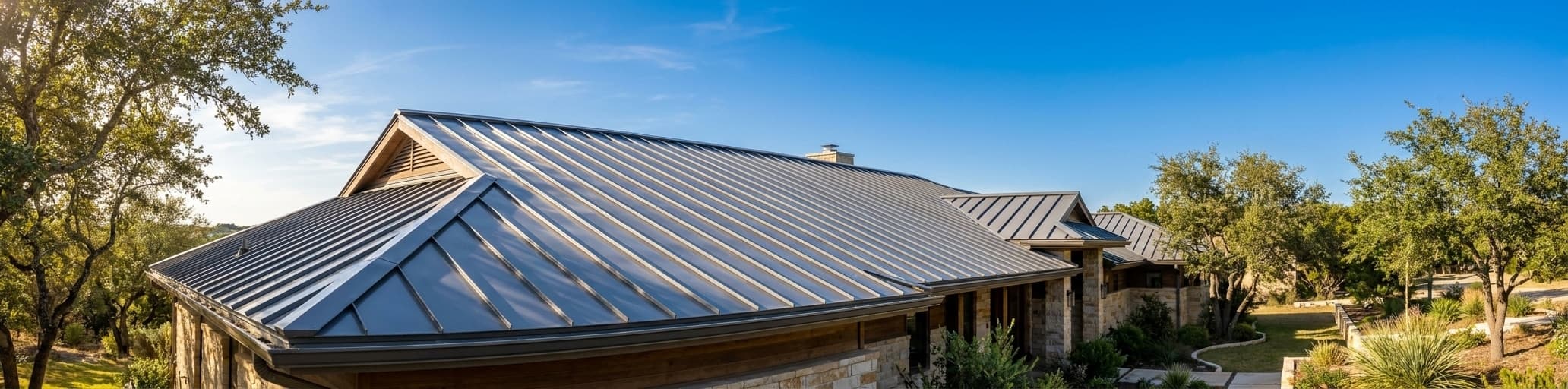

We show you how metal roofs deliver 40-80 years of protection while eliminating the repeated replacement cycles that drain budgets on warehouses, hangars, and agricultural facilities. Superior durability, weather resistance, energy savings, and Class 4 impact ratings combine to lower your total cost of ownership and boost resale value.
Unmatched Durability and Longevity Benefits
One metal roof installation outlasts three asphalt replacements, eliminating decades of re-roofing cycles, labor costs, and operational downtime for your facility.
Impressive Lifespan: 40-80 Years vs. 15-20 Years for Traditional MaterialsA single metal roof installation can outlive at least three asphalt shingle roofs, which need full replacement every 15-25 years.[1] Depending on the metal you choose, that covers 40-60 years for steel, 50-70 years for aluminum, and 70-100 years or more for copper or zinc.[1] For your warehouse, hangar, or agricultural facility, those extra decades eliminate multiple re-roofing cycles–each one carrying its own labor costs, operational downtime, and permitting headaches that pull your team off more important work.
The National Roofing Contractors Association reports that up to 40% of roofing failures trace back to installation quality rather than material defects, so pairing the right metal with a skilled contractor is what actually locks in that long-term metal roof durability.[1] Annual inspections and basic maintenance–clearing debris, checking fasteners, sealing minor penetrations–can add another 20-30% to an already-long service life, keeping your facility covered without unplanned capital expense.[1]
Different Metal Types and Their Durability Profiles
Choosing the right metal for your warehouse, hangar, or agricultural facility comes down to matching corrosion risk, structural load capacity, and budget to each material's actual performance. Steel is the most affordable and widely available option, lasting 40-60 years with strong fire and rot resistance built in–but it carries the lowest corrosion resistance of the four main types, a real concern if your building sits near a coastline or handles moisture-heavy operations.[4] If you want a deeper look at how steel stacks up on cost and longevity, the durable metal roofing vs. asphalt shingles breakdown puts the numbers in context. Aluminum closes the corrosion gap: at roughly 5 lbs per square foot it's the lightest roofing material available, resists salt spray without additional coatings, and routinely clears 50 years in coastal and high-rainfall environments.[4] It is softer than steel, though, making it more susceptible to denting from hail or falling debris–a tradeoff worth factoring in if your region sees frequent severe weather.[4] Zinc and copper occupy the premium tier. Zinc forms a zinc carbonate patina on exposure to moisture and carbon dioxide–a self-healing layer that actively repairs surface scratches and pushes service life to 80-100 years.[4] Copper matches or exceeds that range, with well-maintained roofs lasting well over a century, though both materials are expensive and carry limited supplier availability compared to steel or aluminum.[4]
| Metal | Typical lifespan | Corrosion resistance | Key trade-off |
|---|---|---|---|
| Steel | 40-60 years | Moderate | Most affordable; lowest corrosion resistance of the four |
| Aluminum | 50+ years | High | Lightest option; softer and more prone to denting |
| Zinc | 80-100 years | Very high | Self-healing patina; limited availability, higher cost |
| Copper | 60-100+ years | Very high | Longest-lived option; most expensive, dents under hail |
Quality Factors That Maximize Your Roof's Performance
Four variables determine where your metal roof lands within its potential lifespan range: panel gauge, protective coating, installation precision, and climate matching.
On gauge, lower numbers mean thicker steel — 24-gauge outperforms 29-gauge in hail resistance, wind uplift, and snow load capacity, and it delivers more substrate at field-cut edges where early corrosion typically originates.[6] The protective coating matters equally: Galvalume — a blend of 55% aluminum, 43.4% zinc, and 1.6% silicon — provides superior corrosion resistance over standard galvanized steel, especially in high-humidity environments like livestock facilities or coastal installations.[5] Installation precision is where most premature failures begin.
Fasteners driven at incorrect torque — over or under — compromise the neoprene washer seal at every penetration point, while poor flashing details and inadequate panel-lap sealing convert minor specification gaps into active leaks within a few years.[6] Finally, match your panel selection to your actual climate: mechanically seamed standing seam handles heavy snow loads best, aluminum or Galvalume-substrate panels resist coastal salt spray without additional coatings, and any panel installed below its minimum recommended pitch will pool standing water and degrade ahead of schedule.[7] Getting these four decisions right at the specification stage locks in the top end of your roof's performance range before a single screw is driven.
How Metal Roofs Stand the Test of Time: Real-World Examples
The numbers only mean something when you see what they translate to on an actual property. A warehouse owner who installs a metal roof today won't touch it again structurally until well past mid-century — while a neighbor on asphalt shingles faces a full tear-off and replacement every 15-25 years, sometimes twice before retirement.[8] Clay and concrete tile looks like a long-lived alternative, but the underlayment underneath fails every 18-20 years, and most owners replace the entire roof at that point rather than reroof over broken tiles — making the real-world lifespan of tile far shorter than advertised.[8] Wood shakes look attractive but demand annual reconditioning to prevent drying out, and still give out between 25 and 35 years.[8] Metal avoids every one of those failure modes.
Its physical properties don't degrade the way organic or composite materials do: a metal roof is just as structurally sound in year 20 as it is in year 1, with no brittleness from UV exposure, no rot, and no cracking under thermal cycling.[9] That consistent performance is what makes metal the right call for agricultural steel buildings, hangars, and warehouses where unplanned capital expense disrupts operations more than it does on a single-family home. Add the self-cleaning characteristics of metal panels — rain sheds debris instead of trapping it — and low maintenance stops being a marketing claim and becomes a verifiable ownership experience over decades.[8]
Superior Weather Protection Advantages
Metal roofs achieve wind ratings from 140 to 180+ mph depending on panel type and gauge, with standing seam designs eliminating thousands of potential failure points.
Wind Resistance: Withstanding Speeds Up to 140 MPH
Standard metal roofing systems are engineered to handle wind speeds up to 140 mph–enough to protect most warehouses, hangars, and agricultural facilities through severe regional storm events without structural compromise.[10] In hurricane or tornado corridors, the ceiling goes higher: properly engineered metal roofs routinely achieve ratings above 160 mph, and specialized systems can clear 180 mph or more.[10] The panel type you specify is what drives where your installation lands within that range.
Standing seam panels–where fasteners are concealed beneath raised seams rather than screwed through the panel face–achieve wind ratings between 140 and 180 mph by eliminating thousands of potential failure points across the roof deck.[11] For coastal or high-wind zones, mechanical seam profiles outperform snap-lock alternatives in uplift resistance, and specifying 24-gauge over 26-gauge adds meaningful rigidity at field-cut edges where wind pressure concentrates first.[11] Every wind rating traces back to a wind uplift test that measures how much force a roof assembly can sustain before failure–and knowing those values before you finalize specifications is what separates a metal roof that holds through a named storm from one that doesn't.[10]
Fire Safety Benefits and Reduced Risk to Your Home
Metal is non-combustible, which earns metal roofing a Class A fire rating–the top tier in the A, B, C classification system used to assess flame resistance across all roofing product types.[13] With roughly 70,000 wildfires occurring in the U.S. annually and more than 10 million residential properties already at high or extreme wildfire risk, that rating is increasingly a baseline expectation rather than a premium feature.[12] One distinction matters here: the Class A designation must apply to the full roof assembly, not just the panel.[13] If your assembly includes a combustible wood deck, achieving a Class A assembly rating requires adding fire-rated underlayment or a non-combustible gypsum board–products like DensDeck or GAF VersaShield–in compliance with UL 790 and IWUIC requirements.[13]
Metal's smooth surface adds a second layer of protection the fire rating alone doesn't capture. Wind-driven embers–burning debris that can travel more than a mile from an active wildfire front–find no crevices to lodge in on a metal panel, cutting off the ignition pathway responsible for most home losses in wildfire events.[12] For agricultural facilities, hangars, and warehouses where stored materials amplify the consequences of roofline ignition, that ember resistance is operationally significant.[12] There's also a firefighting access advantage worth noting: unlike tile roofs, which risk structural cave-in under a firefighter's weight during active suppression, metal roofs allow crews to work on the surface safely.[14] For a detailed look at how fire ratings translate into insurance and structural performance differences between frame types, the steel frame structure vs. wood frame fire ratings comparison covers the specifics. One maintenance step applies regardless of panel type: clearing debris from roof valleys, transitions, and areas behind chimneys removes the primary ignition risk metal roofing presents, since organic accumulation–not the metal itself–is what catches.[12]
Impact Resistance Against Hail and Falling Debris
Hail causes roughly $1.6 billion in damage to residential roofs in the United States every year, and commercial and agricultural facilities face the same exposure.[15] The industry standard for measuring that risk is the UL 2218 Impact Rating, a Class 1-4 scale developed by Underwriters Laboratories where Class 4 is the highest level of protection.[16] To earn it, a roofing material must survive two direct hits in the same spot from a 2-inch steel ball without cracking, fracturing, splitting, or any other evidence of structural opening.[15] Most metal roofing profiles–steel panel systems in particular–achieve Class 4 as a baseline, while the majority of standard asphalt shingle roofs have never been impact-tested at all.[17] A complementary test, FM 4473, uses compressed-air-launched ice spheres instead of steel balls and is considered more realistic because it replicates actual hailstone composition; a 2-inch hailstone falling at terminal velocity delivers more than 20 times the impact energy of a 1-inch stone, which is why the distinction between Class 3 and Class 4 matters far more than it might appear on paper.[15] For your warehouse, hangar, or agricultural facility, the practical benefit goes beyond the panel itself: a Class 4 roof keeps the assembly watertight after a storm, which eliminates the interior damage–insulation failure, inventory loss, equipment exposure–that compounds an already expensive roofline repair.[17] Many insurance carriers reward that durability with reduced premiums for buildings that specify Class 4 materials, and in hail-prone states like Texas, Colorado, and Oklahoma, building codes may require impact-resistant roofing for commercial structures anyway.[16] If you're evaluating roofing options and want a clear cost picture alongside performance specs, the metal roof installation cost breakdown covers what a Class 4 metal system actually runs versus lower-rated alternatives.
Winter Weather Performance: Snow Shedding and Ice Dam Prevention
Snow and ice create two distinct failure modes on a roof: structural overload from accumulated weight and water intrusion from ice dams. Metal addresses both more effectively than asphalt shingles or wood shakes. Ice dams develop when warm attic air melts the underside of roof snow, sending meltwater toward the colder roof edge where it refreezes into a ridge that blocks subsequent drainage and forces water under the roofline.[19] Metal's smooth, low-friction surface breaks the cycle — snow sheds faster, meltwater drains before it reaches the eave, and the panel face itself provides fewer obstructions than the granules and seams of asphalt shingles.[19] Metal's reflective properties also help maintain a more consistent roof deck temperature, and when paired with proper attic insulation and ventilation, the system eliminates the warm spots that trigger uneven melting in the first place.[19] Proper ventilation also keeps attic insulation dry throughout the season, preventing the moisture-driven insulation compression that compounds heat loss during prolonged cold snaps.[18]
One tradeoff demands upfront planning. Because snow releases quickly from metal surfaces, steep-pitched roofs over high-traffic areas can shed large volumes all at once — a hazard for walkways, driveways, loading doors, and equipment staged below the eave line.[19] Snow guards and snow retention rails solve this by holding accumulated snow on the roof surface and letting it melt gradually rather than releasing in one mass.[19] Bar-style rails, pad-style guards, and pipe-style systems are all available; the right choice depends on roof pitch, expected snow load, and the layout of traffic zones below.[19] Integrating snow retention at installation is the cost-effective approach — placement, spacing, and mounting technique all affect long-term performance, and retrofitting adds labor while complicating panel attachment.[19]
Energy Efficiency and Cost-Saving Benefits
A factory-applied cool coating reduces cooling costs by 7-15% for large facilities, delivering measurable savings without premium pricing.
How Metal Roofs Reflect Heat and Reduce Cooling Costs
On a summer afternoon, a standard dark roof surface hits 150 degreesF or higher — a properly coated metal roof under the same conditions stays more than 50 degreesF cooler.[20] That temperature gap directly reduces heat transfer into your warehouse, hangar, or agricultural facility, cutting mechanical cooling demand before your HVAC system even cycles on.[20] The mechanism isn't the metal substrate itself — it's the factory-applied PVDF coating, formulated with solar-reflective pigments that bounce the sun's energy back into the atmosphere rather than converting it to radiant heat inside your building.[21] White finishes reflect 60-90% of incoming sunlight, while darker cool-colored panels use special pigments targeting the invisible near-infrared portion of the solar spectrum, still returning 30-60% of solar energy and staying meaningfully cooler than conventionally pigmented panels.[20] One specification detail matters more than most buyers realize: unpainted metal absorbs heat reasonably well but releases it slowly, making it a poor thermal emitter — so a factory-applied cool paint coating is essential for energy performance, not a cosmetic upgrade.[21] For energy-efficient metal buildings running HVAC loads across large floor plates, that single coating decision can reduce total cooling costs by 7-15%, according to the Green Building Alliance — a measurable return on a specification that costs no more than a standard paint finish.[21]
Cool Roof Technology: Understanding Reflection and Emissivity
Understanding what makes a roof "cool" comes down to three measurable values.
Solar reflectance is a decimal from 0 to 1 that quantifies how much solar energy a surface bounces back into the atmosphere rather than absorbing — 0 represents the truest black, 1 the truest white.[21] Most dark roofing materials reflect only 5-20% of incoming sunlight, while light-colored options return 55-90%.[22] Emissivity, also measured on a 0-to-1 scale, captures something different: how quickly the surface sheds whatever heat it does absorb and returns to its baseline temperature.[21] The industry minimum for cool metal roofing emissivity runs between 0.70 and 0.85, meaning a qualifying panel releases at least 70% of absorbed heat efficiently rather than holding it and radiating it into your building.[21] Both values feed into the Solar Reflectance Index (SRI) — a combined 0-to-100 score where higher numbers indicate cooler surfaces under direct sun.[22] SRI is the figure that determines LEED compliance, and roof pitch changes the threshold: steep-slope assemblies with a pitch greater than 2:12 require an SRI of at least 29, while low-slope roofs at 2:12 or flatter must reach 78 because they face the sun at a more direct angle for longer periods each day.[22] For your warehouse, hangar, or agricultural facility, hitting the right SRI isn't just a sustainability checkbox — cool roofing also reduces the urban heat island effect and cuts power plant emissions by lowering how much cooling energy the grid needs to supply to your building and the surrounding area, according to the U.S. Department of Energy.[21]
Year-Round Energy Performance in Different Climates
The 20-40% cooling cost reductions cited for metal roofing are real–but they come from studies run in Phoenix, Miami, and Houston, where air conditioning runs eight or more months a year.[23] In those heat-dominated regions, a reflective metal panel with a factory-applied cool coating earns every bit of that figure by bouncing solar radiation before it reaches your HVAC system.[23] In mixed or heating-dominated climates–where heating degree days outpace cooling demand by three-to-one or more–the math shrinks considerably: realistic annual cooling savings from a reflective metal roof run $200-$500 per year for commercial and agricultural facilities, not a sweeping percentage of total energy spend.[24] That's still meaningful over a 40-to-60-year roof lifespan, but it's the right number to plan against before you commit to a specification.
Cold-climate performance has its own tradeoff worth understanding. Reflective coatings reduce heat conduction into the building in summer–which is the point–but the same property means less passive solar heat gain through the roof in winter, creating what the U.S. Department of Energy calls a "heating penalty."[20] In practice, the effect is modest in commercial buildings where equipment, lighting, and occupancy generate substantial internal heat loads, but it's a real consideration for unoccupied agricultural facilities or hangars with minimal internal heat generation during winter months.[20] Metal's ability to shed snow quickly and maintain more consistent roof deck temperatures still delivers meaningful cold-season value, just through ice dam prevention and reduced structural load rather than direct heating savings.[24]
The bigger lever in any climate is the system beneath the panel. A properly ventilated attic with balanced ridge and soffit vents cuts peak attic temperatures by 30-40 degreesF in summer, and upgrading ceiling insulation from R-13 to R-30 can reduce heat loss through the ceiling by more than half–gains that outperform what any roofing material delivers on its own.[24] For warehouses, hangars, and agricultural buildings running HVAC across large floor plates, pairing a reflective metal roof with correct attic ventilation and high-performance insulation is what closes the gap between manufacturer claims and your actual monthly utility bill–and the insulated metal warehouse U-factor spec breakdown shows exactly how those assembly decisions translate into measurable thermal resistance numbers.[24]
Long-Term Utility Savings: 10-40% Reduction in Energy Costs
The 10-40% energy savings range cited for metal roofing reflects genuine variability driven by location, panel type, and installation method — not a single average that applies to every building.[27] In warmer climates, pre-painted or granular-coated metal panels re-emit up to 90% of incoming solar radiation, pushing annual savings toward the upper end of that range.[27] In cooler regions, unpainted metal roofs absorb more solar heat passively, reducing heating loads during extended winter months and making them the more efficient choice where heating degree days dominate.[27] Installation method compounds the difference further: panels mounted on a batten system — which creates a ventilated airspace between the panel and the roof deck — improved measured energy efficiency by up to 48.7% over asphalt shingles in comparative testing, while direct-to-deck metal products still delivered a 30.3% improvement.[26] Above-sheathing ventilation drives that gap by keeping attic temperatures within five degrees of ambient air, while comparable shingle roofs in the same conditions ran nearly 40 degrees hotter — a direct reduction in mechanical cooling demand before your HVAC system cycles at all.[25] For a warehouse, hangar, or agricultural facility running HVAC across tens of thousands of square feet, that temperature differential compounds into meaningful operational savings every month over a 40-60 year roof lifespan — a return that far outpaces the incremental cost difference between metal and lower-performing alternatives.
Pairing your metal roof with the right insulation assembly is what converts panel performance into actual utility bill reductions, and the steel building insulation R-values and payback analysis shows how those assembly layers stack up in practice.
Environmental and Sustainability Benefits
Metal roofing panels contain 30-60% recycled content and are 100% recyclable at end-of-life, earning direct LEED credits while eliminating the 20 billion pounds of shingles sent to landfills annually.
Eco-Friendly Manufacturing and Recyclability (100% Recyclable Materials)
Metal roofing panels arrive at your facility already built from recycled material. Depending on the metal type, panels contain 30-60% recycled content — a specification that lowers manufacturing energy consumption and greenhouse gas output before a single panel reaches your roof.[28] For warehouses, hangars, or agricultural facilities pursuing green building certification, that recycled content qualifies toward LEED Materials and Resources Credit 4.1, a direct credit you can bank against certification requirements without added cost.[28] The panels also weigh 50-75% less than competing roofing systems, which means fewer truckloads from plant to jobsite and measurably lower transport emissions on every project — an often-overlooked benefit that compounds across a large commercial or agricultural installation.[28] Contractors can further cut job-site waste by using portable roll-forming machines to fabricate panels on-site, reducing both scrap material and lead time in a single step.[28]
The end-of-life story is where metal roofing separates from every alternative. Nearly 20 billion pounds of asphalt shingles enter U.S. landfills every year — metal contributes none of that.[29] Every pound of metal panel is 100% recyclable and re-enters the supply chain as new product without losing structural strength or material quality, which means the same metal can cycle through roofing systems and other applications indefinitely.[29] Recycling metal requires significantly less energy than extracting and processing raw ore, so each cycle compounds the environmental return rather than simply breaking even.[29] For your warehouse or agricultural steel building, that means decades of protection followed by a roof removal that puts recoverable material back into the supply chain — and many installers will issue a scrap credit at the time of removal, turning demolition into a recoverable asset rather than a disposal cost.[28]
Reduced Landfill Impact Compared to Traditional Roofing
The replacement cycle is what turns asphalt's landfill problem into a compounding one. Roughly 7 million U.S. homeowners replace their roof each year,[32] and the EPA estimates that generates 11-13 million tons of torn-off shingles annually.[30] Less than 10% of that volume gets diverted into road paving or other applications — the remaining 90% goes directly to landfill.[30] Asphalt shingles also contain carcinogenic compounds classified as environmentally toxic, which restricts recycling options and locks each new production run into fossil fuel dependency.[31] A metal roof removes your facility from that cycle entirely.
Because metal lasts 40 years or more versus asphalt's 15-20 year replacement window, a single installation eliminates two to four complete tear-off-and-disposal events over the same timeframe.[32] That means the landfill benefit isn't a one-time calculation at end-of-life — it multiplies with every replacement cycle your building skips. For warehouse, hangar, and agricultural steel building owners already thinking in 30-to-50-year horizons, choosing metal at installation is the single roofing decision with the clearest environmental math behind it.
Lower Carbon Footprint Throughout Roof Lifecycle
Metal roofing carries higher upfront embodied carbon than asphalt shingles — that much is accurate.[35] But a single-installation comparison misses how the math actually plays out over time.
A proper Life Cycle Assessment (LCA) evaluates total emissions across manufacturing, operation, and end-of-life disposal, and when you run those numbers over a 50-year period, asphalt's repeated replacement cycles stack up manufacturing emissions that eventually exceed what metal produces in one installation.[35] Although asphalt shingles have lower upfront embodied carbon, multiple replacements over 50 years increase their total footprint to the point where metal's durability produces a shorter carbon payback period — the point at which cumulative lifecycle emissions tip permanently in metal's favor.[35] Reflective coatings keep operational carbon low throughout the service life by reducing cooling demand, which translates directly to fewer grid emissions month after month for 40 to 70 years.[33] For your warehouse, hangar, or agricultural facility running HVAC year-round, that payback period closes faster than on a residence because higher cooling loads mean operational savings compound more quickly across a long ownership horizon.[34] The result is a roofing material whose environmental case gets stronger — not weaker — the longer you hold the building.
Compatibility with Green Home Improvements (Solar Panels, Rainwater Collection)
Metal roofing's geometry and material properties make it the most compatible surface available for both solar panel mounting and rainwater harvesting — two upgrades that reduce operating costs and resource consumption without requiring structural modification to your warehouse, hangar, or agricultural facility.[36] Solar panels sit cleanly on standing seam profiles using non-penetrating clamp systems that attach directly to the raised seam, preserving the roof deck's watertight integrity while supporting array weight across the full panel run.[36] Rainwater collection works just as cleanly.
Standing seam metal — specifically Galvalume or powder-coated enameled panels — delivers the highest collection efficiency of any roofing material currently available, and the American Rainwater Catchment Systems Association (ARCSA) approves it for potable-use systems when non-toxic finishes and appropriate post-tank treatment are in place.[37] The collection volumes are meaningful even at small scale: less than one inch of rainfall on a 10×10 surface fills a 55-gallon barrel, so even secondary outbuildings on your steel frame farm building become viable catchment points.[37] One specification detail matters for corrugated metal surfaces: most corrugated panels are galvanized, which can leach zinc into harvested water at levels high enough to affect plant growth, so testing collected samples is essential before directing that water toward irrigation or any potable system.[37] Standing seam avoids the zinc issue entirely, which is why it remains the first-choice surface when both solar and rainwater systems are part of the same green building plan.[37]
Aesthetic Appeal and Home Value Enhancement
Metal roofing's three distinct panel families–standing seam, stamped shingles, and corrugated–let you match your facility's architectural requirements while maintaining performance-grade durability.
Modern Metal Roof Styles for Every Architectural Design
Metal roofing today spans three distinct panel families, each suited to a different architectural context.
Standing seam — the preferred specification for architects working on commercial, industrial, and aviation structures — features concealed fasteners beneath raised vertical seams, producing the clean, continuous lines that suit modern and contemporary designs.[38] The system accommodates complex roof planes and irregular geometries that would challenge other panel types, and it's available in virtually any color, including custom matches, so it can follow any design intent without compromise.[38] Stamped metal shingles occupy the opposite end of the style spectrum: panels pressed to replicate the look of asphalt shingles, cedar shake, slate, or clay tile, making them the right call when HOA requirements or neighborhood character demand a traditional profile.[38] If your facility falls under strict appearance guidelines, a metal roof that looks like shingles delivers the familiar residential silhouette while still carrying PVDF coatings, metallic finishes, and matte options that performance-grade asphalt can't match.[38] A third category — agricultural panels, sometimes called AG or corrugated panels — uses a ribbed profile engineered for structural rigidity across large spans, originally specified for barns and industrial roofs.[39] Metal roofing is no longer reserved for commercial buildings or barns; today it's installed across all property types, and the ribbed AG silhouette has migrated into contemporary commercial and mixed-use designs where an industrial aesthetic is deliberate rather than incidental.[40] Each panel family supports a different architectural language, which means the style decision for your warehouse, hangar, or agricultural facility isn't cosmetic — it directly affects drainage performance, wind uplift ratings, HOA approval, and whether your assembly qualifies for a weathertight warranty.[38]
Extensive Color and Finish Options for Personalization
Metal roofing's color range has expanded well beyond the plain galvalume silver that once defined commercial and agricultural buildings. Today's factory-applied coating systems ship in dozens of standard colors — matte black, charcoal gray, forest green, terra cotta red, ocean blue, warm sandstone, and burnished slate among the most-specified — giving warehouse, hangar, and agricultural facility owners direct control over how a building reads from the road, a flight path, or an adjacent property.[42] Color choice affects more than aesthetics: lighter shades like galvalume silver, sandstone, and arctic white reflect more sunlight and reduce cooling demand in heat-dominated climates, while darker tones like charcoal gray and burnished slate provide visual contrast and modest passive solar benefit in cooler or mixed-climate regions.[43] The right color choice can also make your facility appear larger, align with surrounding structures, and satisfy HOA or local appearance codes before the first panel is installed.[41]
Beyond color, finish type determines both the visual profile and long-term maintenance burden of your roof system. Matte finishes — the current preference for most commercial and industrial applications — eliminate surface glare and project a clean, professional appearance that suits facilities where exterior presentation influences tenant, client, or municipal perception.[41] Gloss finishes amplify bolder colors and increase solar reflectivity further, while textured profiles give corrugated and ribbed panels additional visual dimension without any added upkeep requirement.[41] All three finish categories now rely on paint systems with UV-blocking pigments that prevent fading and chalking even after years of coastal salt exposure, high-humidity agricultural environments, or sustained UV load in sun-belt states — making color durability a performance specification, not just a warranty claim.[41] For a deeper look at how panel coatings affect both aesthetics and long-term performance, the advantages of metal roof panels breakdown covers the coating options that matter most at the specification stage.
The practical selection framework is straightforward. Match finish to function: matte for low-glare commercial and aviation environments, gloss where maximum reflectivity aids cooling loads, textured where the panel profile already creates visual interest at the roofline.[42] Match color to climate: light tones in heat-dominated regions where cooling cost reduction is the primary driver, mid-tones in mixed or heating-dominated zones where passive solar gain through the roof surface carries some value.[43] And verify local code or HOA restrictions before finalizing any color decision — some commercial districts and aviation zones carry appearance guidelines that narrow the available color range regardless of what the panel manufacturer offers.[42]
How Metal Roofing Enhances Overall Curb Appeal
The roof accounts for 50-60% or more of a building's visible exterior in many architectural configurations, making it the single design element with the most influence over how a property reads from the street, a flight line, or an adjacent parcel.[44] Most roofing materials have two distinct lives: an aesthetic life and a functional one.[44] Asphalt shingles and wood shakes can look presentable when new, but for most of their service life they're streaked, stained, and tired — a visual liability that undermines property presentation well before the roof needs structural replacement.[44] Metal sidesteps that cycle entirely.
Unlike asphalt, which fades and curls over time, a metal roof maintains its appearance for decades without cosmetic upkeep, giving your warehouse, hangar, or agricultural facility a consistently polished exterior year after year.[45] That lasting appearance directly affects buyer and tenant perception: a new metal roof can carry the same impact as a kitchen remodel or room addition — improvements that visitors register immediately during a walkthrough or site visit.[46] For commercial and industrial properties where exterior presentation influences tenant attraction, municipal approvals, and eventual resale positioning, that durability of appearance functions as an ongoing asset.
For a complete look at how panel selection affects both performance and long-term exterior quality, metal roof panels pros and cons covers the tradeoffs that matter most at specification time.
Return on Investment: Up to 6% Increase in Property Value
Property value return is where the benefits of a metal roof convert to concrete balance-sheet numbers for warehouse, hangar, and agricultural facility owners.
Angi reports metal roofs can increase resale value by up to 6% compared to asphalt shingles — on a $400,000 property, that's $16,000 to $24,000 in added sale price before factoring in any buyer negotiating leverage.[47] Industry data from DECRA puts the national ROI range at 48.1% to 85.9%, with East Coast markets recovering up to 95.5% of installation cost.[47] Where your property lands within that range depends on local market conditions and whether comparable buildings in the area carry similar or inferior roofing.[48] Appraisers assign value to materials with long service lives and minimal repair histories — both of which metal delivers — and insurance premium reductions from Class 4 impact and Class A fire ratings register as quantifiable financial benefits that future buyers can verify and carry forward.[49] On the transaction side, a metal roof eliminates the "how old is the roof?" discount that costs commercial sellers thousands: buyers have no basis for demanding a price reduction when the existing roof carries 40-plus years of remaining service life and substantial warranty coverage still in play.[47]
Practical Ownership Benefits
Standing seam metal roofs need only a few hours of annual maintenance–clearing debris, cleaning gutters, and inspecting after storms–versus recurring capital expenses on traditional roofing.
Low Maintenance Requirements Throughout Roof Lifespan
The biggest maintenance variable on a metal roof isn't the metal type — it's whether your panels are standing seam or screw-down.
Standing seam systems use concealed clips that let panels float freely through thermal movement, so expansion and contraction cycles never stress attachment points.[3] Screw-down panels work differently: fasteners penetrate the panel face directly, and repeated thermal cycling gradually compromises the neoprene washer seal at each penetration point, requiring periodic fastener inspection and replacement to keep the assembly watertight.[27] Both systems still qualify as low-maintenance compared to asphalt shingles or wood shakes, but that distinction matters when you're budgeting labor over a 40-year ownership horizon.[3] The annual checklist for a standing seam metal roof is short: clear debris from valleys, clean gutters, trim overhanging branches, and visually inspect for damage after severe weather events.[3] That's a few hours per year on a warehouse, hangar, or agricultural facility — not a recurring capital expense.[27] For property owners already comparing 40×80 pole barn alternatives where wood framing demands repainting, rot remediation, and structural inspections on a regular cycle, metal's ownership burden is lighter in both time and cost every single year.[3]
Initial Investment vs. Lifetime Value Analysis
The upfront price gap between metal and asphalt is real but only tells half the story. In 2026, standing seam metal roofing runs $9.50-$16.00 per square foot installed, while architectural asphalt shingles come in at $4.50-$8.50 per square foot — roughly a 2x to 2.5x difference on a like-for-like project.[50] Steel and aluminum tariffs enacted in early 2026 added another $3,000-$5,000 in material costs for a typical 2,000-square-foot installation, widening the gap compared to late 2025 pricing.[50] For warehouse, hangar, and agricultural facility owners running 50-year ownership horizons, though, the comparison that matters is total cost of ownership — not the day-one invoice. Asphalt shingles require full replacement every 20-30 years, meaning two to three complete tear-off-and-reinstall cycles over the period a single metal roof covers.[51] Factoring in those replacement events, plus $3,000-$7,000 in cumulative maintenance costs over 25 years for asphalt versus $500-$1,500 for metal, the 50-year total for asphalt runs $85,000-$100,000 against $60,000-$75,000 for metal — a difference that more than offsets the higher day-one spend.[52] The financial crossover lands between year 22 and year 27, after which every additional year of metal ownership compounds the return.[52] Insurance premium discounts of 5-20% for Class 4 impact and Class A fire ratings add further savings that the upfront cost comparison never captures.[52] For facility owners planning to hold a building 15 years or more, metal delivers better financial performance even at tariff-inflated 2026 prices; for shorter ownership windows below ten years, asphalt's lower initial outlay recovers a comparable percentage at resale.[50] The steel barn cost vs wood barn analysis runs the same math on structural framing and reaches the same conclusion: durability converts upfront premium into long-run savings when you hold the asset long enough to let the replacement cycles stack up against your lower-maintenance alternative.
| Cost factor | Metal roof (50 years) | Asphalt shingles (50 years) |
|---|---|---|
| Installed cost | $19,000-$32,000 (one installation) | $9,000-$17,000 x 2-3 replacements |
| Maintenance | $500-$1,500 | $3,000-$7,000 per 25-year cycle |
| Total 50-year spend | $60,000-$75,000 | $85,000-$100,000 |
| Break-even point | Year 22-27 | — |
| Resale value recovery | 60-85% of installed cost | 15-30% of installed cost |
Professional Installation Considerations and Best Practices
The single variable that determines where your metal roof lands within its potential lifespan range isn't the panel type or the gauge — it's installation quality.[53] Unlike asphalt shingles, which tolerate minor application errors, metal roofing demands precision at every phase: deck preparation, underlayment selection, flashing integration, and fastener technique.[53] A full tear-off of existing roofing is the right starting point for any replacement project, not because codes always require it, but because it exposes the deck for rot inspection and guarantees a flat, structurally sound substrate — both conditions that directly affect panel performance and warranty validity.[53] On the underlayment layer, high-temperature synthetic products are the only appropriate choice for metal roofs; standard felt paper wrinkles and degrades under the heat a metal panel generates, creating the kind of substrate irregularities that allow moisture to track laterally under panel laps over time.[53]
Fastener and flashing execution is where most premature failures originate. Exposed fasteners driven through the flat portion of a panel carry more leak risk than fasteners placed at ribs, and double-pinning panels — a misguided attempt at stability — prevents the thermal expansion and contraction the system is engineered to accommodate, accelerating failure at every penetration point.[55] Rivets placed in valleys compound the problem: each drilled hole is a potential leak, and locating fasteners where water naturally concentrates turns a minor specification error into an active moisture intrusion path.[55] Flashing around every roof penetration — chimneys, pipes, HVAC curbs — must be sealed completely, because even small gaps at these seams produce water intrusion that compounds over seasons rather than resolving itself.[55] Trim and edge metal are structural components, not finish details; leaving exposed panel edges without proper termination allows wind uplift to begin at the most vulnerable points of the assembly.[55]
Climate and location add a second layer of specification requirements that go beyond standard installation practice. In coastal zones within 3,000 feet of saltwater, fasteners and clips must be stainless steel to prevent the accelerated corrosion that standard galvanized hardware experiences in salt-spray environments.[54] Cold-climate and high-snow-load installations require self-adhering bituminous membrane along all roof eaves, extending at least 24 inches inside the exterior wall line, combined with balanced ridge-and-soffit ventilation to prevent condensation on the underside of metal panels during subcooling events.[54] High-wind and hurricane-prone regions require metal panel systems with verified design pressure ratings from certified test reports — not just manufacturer specifications — and those ratings are only valid when fastener type, size, and spacing match exactly what was tested.[54] Incompatible metals in contact with each other accelerate galvanic corrosion across the entire assembly, so every screw, clip, and accessory must match or be chemically compatible with the panel substrate specified.[54]
Vetting your contractor is the last quality lever you control before the work starts. The contractor you select should be able to perform on-site measurements and provide a material list before quoting — any roofing company offering a phone estimate without a hands-on site visit is skipping the step that catches deck conditions, penetration counts, and edge complexity that drive real project cost.[53] Ask about manufacturer certifications, pull references from completed commercial or agricultural projects of similar scale, and confirm they handle permitting in your jurisdiction before a contract is signed.[53] For warehouse, hangar, and agricultural facility owners evaluating contractors across multiple bids, the local prefab contractor vetting guide covers exactly the criteria that separate qualified installers from those who leave you with problems six months after they're off the job.[53] A professional metal roof installation on a commercial structure typically runs two to five days depending on roof complexity and whether a full tear-off is required — a fast and smooth timeline when the contractor arrives prepared with accurate material quantities and the right crew for the scope.[53]
Insurance Benefits and Potential Premium Discounts
Metal roofing's Class 4 impact resistance and Class A fire rating aren't just performance credentials — they're the specific certifications insurers look for when calculating risk, and they translate directly into annual premium reductions of 5-35% on dwelling coverage.[56] The discount range is wide because location drives the math more than almost any other variable: owners in hail-prone states like Texas, Colorado, Kansas, and Oklahoma see the largest reductions because metal's impact resistance eliminates the hail damage claims that represent one of the most costly and frequent loss categories for residential and commercial insurers in those regions.[56] A modest 15% annual discount on a $1,800 dwelling premium saves $270 per year — over a 50-year roof lifespan, that accumulates to $13,500 in premium reductions, a figure that meaningfully offsets the cost difference between metal and asphalt at installation.[56] Wildfire-exposed properties carry their own version of this math: in California and other western states with high or extreme fire risk, a Class A metal roof has shifted from a discount qualifier to a coverage requirement, with some insurers declining to write policies on wood shake roofs entirely.[56]
Three variables determine where your facility lands within that 5-35% range. First, your insurer's internal risk model — not all carriers apply the same discount structure, and getting quotes from three or four providers after metal installation regularly surfaces significant pricing differences for identical coverage.[56] Second, the roof's certification credentials: panels must carry verified Class 4 UL 2218 impact and Class A fire ratings from the manufacturer, and installation must be performed by a licensed contractor to qualify — insurers treat uncertified product or unlicensed installation as grounds to deny the discount entirely.[56] Third, the installation method itself matters: metal installed over existing shingles without a full tear-off fails to qualify with many carriers, because the condition of the underlying deck can't be verified and the assembly doesn't meet the standard the discount was priced against.[56] One exception worth knowing: replacement cost value policies price premiums against what the roof costs to replace, and metal's 2-3x higher replacement cost versus asphalt can partially offset durability discounts in some markets — verifying your policy's valuation method with your agent before installation prevents that surprise on the next renewal.[56]
The fastest way to capture the full discount is to make the call before the first panel goes up, not after.[57] Contact your agent to confirm discount eligibility and required documentation, specify panels that carry Class 4 and Class A certifications, and collect manufacturer product specifications and a contractor certificate of completion at project close.[56] Submit that documentation package as soon as installation is complete, then verify the discount appears on your next billing cycle rather than assuming it was applied automatically.[56] For warehouse, hangar, and agricultural facility owners already running the 50-year cost comparison covered in the previous section, the insurance premium reduction is an annualized cash return that compounds alongside utility savings — a real financial benefit that doesn't show up in the day-one invoice comparison but adds up every year the roof is in service.[58]
- Metal roofs last 40-100+ years vs. asphalt's 15-25 year lifespan, eliminating 2-3 replacement cycles over 50 years.
- Class 4 impact and Class A fire ratings reduce insurance premiums by 5-35% annually, compounding to $13,500+ in savings.
- 50-year total cost of ownership favors metal at $60,000-$75,000 vs. asphalt at $85,000-$100,000 despite higher upfront cost.
- Reflective coatings reduce cooling costs by 7-15% in heat-dominated climates through solar reflectance and thermal emissivity.
- Metal is 100% recyclable with zero landfill contribution, while asphalt shingles generate 11-13 million tons of waste annually.
- Installation quality determines actual lifespan more than panel type–standing seam systems outperform screw-down alternatives long-term.
- Metal roofs maintain appearance for decades without fading or curling, directly increasing property resale value by up to 6%.
- https://whaleroofing.com/types-of-metal-roofs/
- https://eriehome.com/blog/pros-and-cons-of-different-metal-roofing-materials/
- https://www.englertinc.com/articles/how-long-does-metal-roof-last
- https://mac-tech.com/articles/which-type-of-metal-roofing-will-last-the-longest/
- https://walkermetals.com/what-makes-a-high-quality-metal-roof/
- https://metalamerica.com/metal-roofing-lifespan-farm-buildings/
- https://www.westernstatesmetalroofing.com/blog/metal-roof-lifespan-factors
- https://vertexroofing.com/blog/metal-roof-lifespan/
- https://www.jd-metals.com/2024/08/durability-and-lifespan-of-metal-roofing/
- https://metalcon.com/blog/wind-load-resistance-how-does-it-impact-metal-roofing-systems/
- https://weathershieldroofers.com/blog/standing-seam-metal-roof-complete-guide-coastal-sc/
- https://www.ascbp.com/wildfire-prevention-with-metal-roofing/
- https://sheffieldmetals.com/learning-center/fire-ratings-for-roofs/
- https://www.mountaintopmetalroofing.com/blog/metal-roof-fire-rating/
- https://www.decra.com/pro/hail-understanding-impact-resistance
- https://blueteamcorp.com/hail-impact-ratings-what-they-mean-for-commercial-roofing-durability/
- https://blog.mcelroymetal.com/metal-roofing-and-siding/what-is-a-class-four-roof
- https://bakermetalworks.com/how-metal-roofing-improves-energy-efficiency-during-winter/
- https://www.sidingunlimitedmn.com/blog/can-snow-and-ice-damage-metal-roofs-winter-durability-explained
- https://www.energy.gov/energysaver/cool-roofs
- https://sheffieldmetals.com/learning-center/cool-metal-roofing-and-sri/
- https://www.westernstatesmetalroofing.com/blog/cool-metal-roofing
- https://gnexteriors.com/metal-roofing-energy-efficiency-utility-bill-savings-guide/
- https://modernexterior.com/blog/energy-efficient-roofing/
- https://blog.mcelroymetal.com/metal-roofing-and-siding/how-metal-roofs-drive-energy-efficiency-and-slash-utility-bills-for-commercial-properties
- https://www.decra.com/blog/are-metal-roofs-energy-efficient
- https://www.statefarm.com/simple-insights/residence/metal-roof-pros-and-cons
- https://www.drexmet.com/blog/how-are-metal-roofs-sustainable-lets-count-the-ways/
- https://www.metalroofing.com/recyclability
- https://www.gaf.com/en-us/blog/residential-roofing/recycled-shingles-are-keeping-asphalt-out-of-landfills-64a81c1a-df3b-4ed8-b928-ab7f41e1c86d
- https://gulfcoastsupply.com/sustainable-roofing-the-impact-of-your-metal-roof/
- https://elemental.green/how-your-roof-affects-the-environment-know-before-you-buy/
- https://ecobnb.com/blog/2024/06/metal-roofs-eco-friendly/
- https://www.edcoproducts.com/articles/how-steel-roofing-reduces-your-carbon-footprint-compared-to-asphalt-shingles.html
- https://rooflio.com/green-metal-roofing-and-the-environment/
- https://allovertxroofing.com/why-metal-roofs-are-green-choice/
- https://www.bluebarrelsystems.com/blog/roofing-materials-for-rainwater-harvesting/?srsltid=AfmBOooymn0-YyvcSTXdO5ftu6r2vBNVH5M5TXiZ0BMfisvIvcdzHSeU
- https://sheffieldmetals.com/learning-center/standing-seam-vs-stamped-metal-shingle-roofing/
- https://www.midtechstandingseam.com/the-best-roof-ag-panels-vs-shingles-vs-standing-seam
- https://mavcityrestoration.com/blog/metal-roof-vs-asphalt-shingles/
- https://ctaroofing.com/blog/metal-roof-colors/
- https://foxhavenroof.com/metal-roofing-colors/
- https://www.spartan-roofing.com/blog/p.241227001/top-colors-for-metal-roofing-to-consider/
- https://www.americanmetalroofswi.com/exterior-design-curb-appeal/
- https://larryhaightroofing.com/does-a-metal-roof-increase-home-value/
- https://www.decra.com/blog/increase-home-value-and-curb-appeal-with-decra-metal-roofing
- https://weathershieldroofers.com/blog/standing-seam-metal-roof-cost/
- https://www.iko.com/na/blog/does-a-new-roof-increase-home-value/
- https://mooseroofing.com/does-a-metal-roof-increase-home-value/
- https://roofvista.com/resources/guides/metal-roof-vs-shingles-2026
- https://ksinglecorp.com/blog/metal-roofing-vs-asphalt-shingles-which-is-the-better-long-term-investment/
- https://www.mightydogroofing.com/greater-west-chester-pa/resources/blog/categories/roof-lifespan-cost/metal-roofing-vs-asphalt-shingles-50-year-cost-c/
- https://paradigmroofs.com/metal-roof-installation-complete-guide/
- https://basc.pnnl.gov/resource-guides/metal-roofs
- https://www.metalsales.us.com/blog/how-to-ensure-a-successful-metal-roof-installation/
- https://roofquotes.com/blog/metal-roof-insurance-discount
- https://lindusconstruction.com/blog/does-a-metal-roof-really-lower-the-cost-of-home-insurance/
- https://tadlockroofing.com/save-money-on-insurance-with-a-metal-roof/