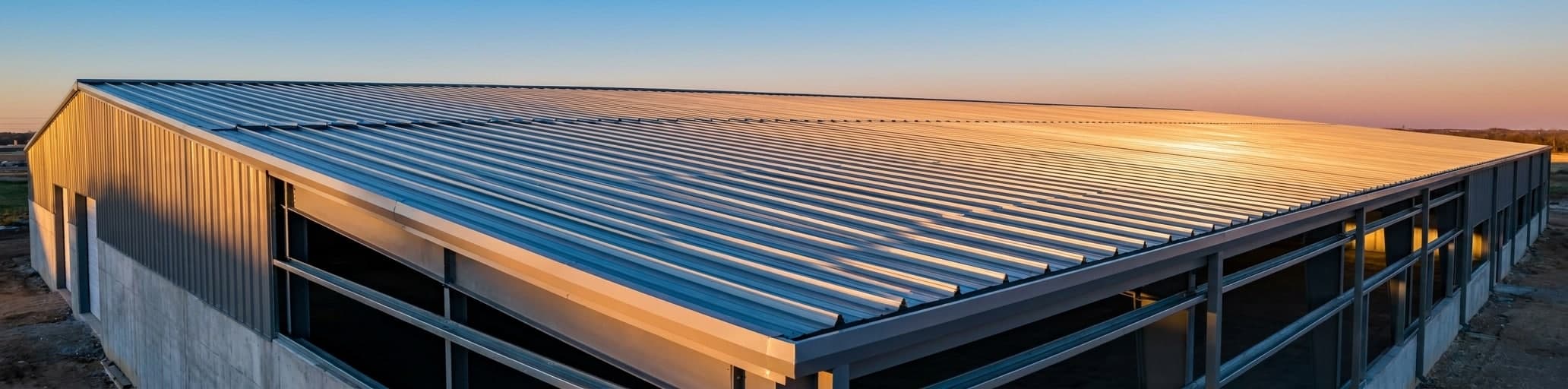

Metal roof panels deliver 40-70 years of service life with superior durability against weather, fire, and impact while cutting energy costs and maintenance demands compared to asphalt alternatives. We show you how the higher upfront investment compounds into the lowest cost-per-year option and stronger property valuations over decades of ownership.
Superior Durability and Weather Resistance
Metal roofing systems last 40 to 70 years–or over 100 years with premium metals–meaning you may never face a roof replacement during your ownership.
Exceptional Lifespan: How Long Metal Roof Panels Actually Last
For warehouse operators, farm owners, hangar developers, and commercial property managers, a roof replacement is one of the most disruptive capital events a building can face.
Metal roof panels largely take that event off the table.
Most metal roofing systems last between 40 and 70 years, with premium metals like copper and zinc exceeding 100 years when properly maintained.[1] Compare that to asphalt shingles, which top out at 15 to 30 years, and you're looking at a roof that may never need replacing during your ownership.[2] Panel system choice matters here too: standing seam systems, which allow the metal to flex with temperature changes, consistently reach the upper end of that 40-70-year range, while exposed-fastener screw-down panels run closer to 20-30 years and require more active maintenance to get there.[1] For a pre-engineered steel building housing valuable equipment, aircraft, livestock, or inventory, that gap in service life translates directly into fewer budget surprises and more predictable long-term operating costs.
Performance in Extreme Weather Conditions
The roof on your warehouse, hangar, or agricultural facility is the first thing a storm hits, and metal panels are engineered specifically for that reality. Certified systems resist wind uplift at up to 120 mph and are tested against standards including UL 580, TAS 125, UL 1897, ASTM E1592, and ASTM E1680.[5] The large, interlocking panel format matters here: unlike individual shingles that can catch wind at the edges, continuous metal panels are fastened across the full deck, leaving far fewer points where uplift can take hold.[4]
Rain performance comes down to surface and seam design. Metal's non-porous substrate repels moisture rather than absorbing it, and qualifying systems must pass the TAS 100 Wind-Driven Rain test — water delivered at 8.8 inches per hour while a wind machine generates speeds up to 110 mph — with zero infiltration through the deck sheathing.[5] Standing seam profiles take that further by raising seams above the runoff plane entirely, eliminating the primary entry point for water during heavy downpours.[4]
Snow and hail round out the threat matrix for property owners in northern or storm-prone regions. The smooth metal surface sheds snow accumulation before weight builds to a structural concern, and because standing seam panels continuously shed snow, ice dams — the freeze-thaw problem that traps water under traditional shingles at the eaves — are significantly less likely to form.[5] Against hail, metal roof panels carry a Class 4 rating under UL 2218, the highest impact-resistance classification available, meaning a hailstorm that cracks or punctures asphalt leaves your metal roof watertight.[5]
Protection Against Fire, Rot, and Pests
For warehouses, hangars, and agricultural facilities storing equipment, aircraft, livestock, or inventory, three threats quietly drive replacement cycles and inflate insurance premiums: fire, rot, and biological infiltration. Metal roof panels neutralize all three simultaneously.
On the fire side, metal is non-combustible and carries a Class A fire rating — the highest classification available — meaning panels won't ignite under direct flame exposure.[6] Wood shingles, by contrast, require chemical retardant treatments just to achieve marginal fire resistance, while metal's protection is inherent in the material itself.[6] That distinction matters to insurers: a Class A-rated metal roof can reduce fire-related risk enough to lower commercial and agricultural policy premiums — a benefit covered in more detail in our breakdown of steel farm building fire resistance.[7] Rot and pest resistance follow the same logic. Metal offers no organic material for mold, mildew, or insects to consume, so the conditions those threats require simply don't exist on a metal substrate.[7] Unlike asphalt or wood roofing, which absorbs moisture and creates habitat for fungal growth and insect infestation, metal panels are immune to both — no preservation treatments, no fungicide applications, no annual pest inspections needed.[8] For a pre-engineered steel building protecting high-value assets, that's three ongoing maintenance line items eliminated before the roof is even installed.
Impact Resistance and Structural Integrity
Knowing a roof carries a Class 4 rating is useful — understanding what that rating actually tests tells you why it holds up on a warehouse, hangar, or agricultural facility over decades of service. Two standards govern the testing.
UL 2218 uses a two-inch steel ball dropped from roughly two stories to simulate large hailstones at high velocity, while FM 4473 replaces the steel ball with ice spheres, making the simulation closer to actual hail composition and impact behavior.[9] Metal panels earn the highest classification under both systems, meaning they've been evaluated against the most demanding projectile conditions either protocol applies.[10] When hail does make contact, the realistic outcome is cosmetic denting rather than puncture — a distinction that matters structurally. Dents don't compromise the roof's ability to shed water, hold fasteners, or maintain seam integrity.[9] Punctures severe enough to cause infiltration require hailstones large enough to make news coverage, combined with substandard gauge metal or installation deficiencies.[9] What distinguishes metal from asphalt or wood here isn't just day-one performance — it's consistency over time.
A metal roof installed 20 years ago resists hail impact as well as the day it was installed, whereas asphalt shingles become progressively brittle and lose protective granules with each storm cycle, making older shingle roofs exponentially more vulnerable.[9] For commercial property owners in hail-prone states where insurers and building codes both factor impact ratings into coverage terms, that durability floor translates directly into budget predictability: fewer post-storm repair claims, lower risk profiles, and in many cases, premium discounts tied specifically to Class 4 certification.[10]
Energy Efficiency and Environmental Benefits
A factory-coated metal roof can reduce surface temperature by over 50 degrees Fahrenheit, directly lowering your cooling costs in hot climates.
Reflective Properties and Thermal Performance
On a clear summer afternoon, a conventional dark roof can climb to 150 degreesF — and that heat conducts straight into the space below, driving up cooling loads for warehouses, hangars, and agricultural facilities alike.[11] A properly specified metal roof panel cuts that surface temperature by more than 50 degreesF under the same conditions, which means less heat transferred into the building and real reductions in mechanical cooling demand.[11] The mechanism behind that performance is a two-part system: solar reflectance determines how much sunlight the panel bounces away, while thermal emittance determines how quickly the panel sheds any heat it does absorb by radiating it back out as infrared energy.[11] Factory-painted panels with cool-colored pigments — the ones designed to reflect near-infrared light that accounts for roughly half of all sunlight — typically reflect 30 to 60% of incoming solar energy, while white or light-colored factory finishes push that figure to 60 to 90%.[11] One specification detail matters here: unpainted bare metal is a strong solar reflector but a poor thermal emitter, meaning it actually gets hotter than a factory-painted panel of comparable reflectance because it can't shed absorbed heat efficiently.[11] For buildings in hot or mixed climates, a 40×80 metal barn's ventilation system works most effectively when paired with a factory-coated cool-color panel, since both systems are then working in the same direction.
One practical offset to plan for: in colder climates, a highly reflective roof absorbs less winter sunlight, which can modestly increase heating demand — so the net benefit depends on your local climate and how your building is insulated.[11]
Reduction in Heating and Cooling Costs Year-Round
The thermal advantage of a metal roof translates directly into lower utility bills, but the size of those savings depends on variables you can actually control. In hot climates, a cool-rated metal roof delivers its strongest return: reduced solar absorption cuts air conditioning demand in buildings that have mechanical cooling, and improves ambient conditions in uninsulated structures — a practical benefit for open-plan warehouses or agricultural facilities where full HVAC isn't feasible.[11] Four factors determine how much energy you actually save: your local climate, how well your roof assembly is insulated, the specific panel type you've selected, and the efficiency of your existing heating and cooling equipment.[11] Getting all four right means the roof and your mechanical systems are working in the same direction.
One tradeoff to factor into your climate analysis: in colder regions, a highly reflective roof absorbs less winter sunlight, which can increase mechanical heating demand — and if the annual heating penalty exceeds your cooling savings, the net energy benefit narrows.[11] For most commercial, agricultural, and industrial buildings in mixed or warm U.S. climates, the cooling savings outpace that penalty, but properties in northern states should model both sides of the equation before specifying a high-reflectance panel. The cost barrier to capturing these savings is lower than most property owners expect: cool-rated metal roofing products typically cost no more than standard roofing alternatives, especially when specified during new construction or a scheduled replacement — making the efficiency upgrade essentially free at the point of installation.[11]
Recyclability and Sustainable Materials
Metal roofing panels are manufactured with 30 to 60 percent recycled content, reducing the energy needed to produce them, cutting greenhouse emissions during manufacturing, and diverting material from landfills.[12] That recycled content also qualifies toward LEED certification — specifically Materials and Resources Credit 4.1 for Recycled Content — a useful credential if your warehouse, hangar, or commercial facility is targeting green building status.[12] Shipping carries its own sustainability dividend: metal panels run 50 to 75 percent lighter than competing roofing systems, which means fewer truckloads, less fuel burned per delivery, and a smaller transportation footprint before installation even begins.[12] Contractors can extend that efficiency on-site using portable roll-forming machines that fabricate panels from coil stock as needed, cutting waste and reducing the number of required shipments.[12] When the roof does finally reach end of service — 50 to 70 years from now — the material is fully recyclable, cycling back into the same recycled-content supply chain and staying out of landfills; some installers will also issue scrap credit when you recycle the old system.[12]
Reduced Carbon Footprint and Green Building Contributions
Metal's environmental advantage extends beyond recycled content into what it displaces.
Traditional asphalt roofing is fossil-fuel-based — it releases carbon dioxide into the atmosphere as it heats in the sun and leaches harmful chemicals into surrounding soil with every rainfall.[13] Metal panels do neither.
Rainwater running off a metal roof carries no significant contaminants, which means building owners can integrate collection systems directly into the design to harvest that water for agricultural or operational use.[13] That clean runoff also factors into LEED certification: metal roof panels accumulate points across multiple categories — energy and water efficiency, indoor environmental quality, and innovation credits — making a single roofing decision a meaningful contributor to your total certification score, not just one line item.[13] Metal roofs also function as the structural base for both thin-film and crystalline solar panel systems, and because the roof outlasts the solar equipment itself, you'll never need to pull panels off mid-system-life to replace a deteriorating substrate underneath.[13]
Economic Advantages and Return on Investment
A metal roof's $800 annual cost over 50 years beats replacing asphalt twice at $1,333 per year, before factoring in energy savings and maintenance reductions.
Initial Cost vs. Lifetime Value Analysis
Metal roofing costs more upfront than asphalt — typically $7 to $14 per square foot installed versus $3 to $6 for asphalt shingles — but that gap closes fast when you run the numbers over time. An asphalt roof on a commercial or agricultural building needs full replacement every 15 to 30 years. Each replacement cycle carries not just material and labor costs but disposal fees, potential interior damage during the re-roofing window, and lost operating time if the facility can't function at full capacity during the work.
A metal roof installed today on a warehouse, hangar, or farm building is realistically a one-time event for your ownership period — and when you divide that upfront premium across 50 or more years of service, the annualized cost of metal roofing drops well below what you'd spend cycling through two or three asphalt replacements. The cleaner way to evaluate this is cost per year of service rather than sticker price: a $40,000 metal roof that performs for 50 years costs $800 per year, while a $20,000 asphalt roof replaced twice over that same period costs $1,333 per year before accounting for the labor and disruption of each swap. Stack the energy savings, reduced maintenance, and insurance discounts covered elsewhere in this article on top of that baseline math, and the premium you pay at installation becomes one of the more straightforward investments you'll make in your building's long-term budget.
For a deeper look at how material choices compound across a building's lifespan, the steel barn cost vs. wood barn 20-year analysis walks through the same total-cost logic applied to structural framing.
Increased Property Value and Market Appeal
A metal roof doesn't just protect your building — it changes how the market prices it. Commercial appraisers factor remaining roof life directly into asset valuations, and a metal roof with 40-plus years of service life left on it represents a meaningful reduction in projected capital expenditure compared to an asphalt-roofed property that may need replacement within the next decade. For warehouse owners, farm operators, and aviation hangar developers, that distinction shows up in appraised value: a property with no near-term major roof replacement on the horizon carries a cleaner balance sheet and a more defensible asking price.
On the buyer and tenant side, the appeal is equally concrete. Commercial and industrial tenants evaluating lease options increasingly factor in occupancy costs — not just base rent — and a building with a metal roof signals lower utility bills, fewer maintenance disruptions, and predictable operating expenses over the lease term. That makes your property easier to lease at competitive rates and easier to hold at full occupancy. For agricultural properties, where prospective buyers are evaluating total farm infrastructure before making purchase decisions, a metal-roofed barn or equipment storage building communicates long-term operational readiness in a way that a weathered shingle or aged panel roof simply doesn't. If you're evaluating how roofing interacts with the full economics of a prefab retail or commercial build, the roof specification often has more downstream impact on lease rates and resale positioning than most owners initially account for.
Lenders notice too. Because metal roofing extends the useful life of the building envelope, properties with metal roofs carry lower deterioration risk as collateral — which can translate into more favorable financing terms at origination or refinance. For income-producing commercial and industrial properties, a longer-lived roof compresses cap rate risk, supports stronger net operating income projections, and gives buyers confidence that the asset won't require capital infusion immediately after closing.
Insurance Benefits and Potential Premium Reductions
Insurers price commercial and agricultural property policies around one core question: how likely is this building to generate a claim, and how large will that claim be? A metal roof with verified Class A fire, Class 4 impact, and UL 580 wind certifications answers that question favorably on three fronts simultaneously — and underwriters price that reduced risk directly into your annual premium. The mechanism isn't automatic, though.
To capture these savings, you need to submit documentation at policy origination or renewal: the manufacturer's certification sheets confirming your specific panel's ratings, the installer's completion certificate, and in some cases a third-party inspection report. Skipping that paperwork means your insurer underwrites the roof as a generic commercial system, which leaves money on the table every year the policy renews. In hail-prone states — Colorado, Texas, Kansas, Nebraska, and Oklahoma, among others — several state insurance regulators have pushed carriers to offer structured discounts for Class 4-rated roofs, and some states now mandate that carriers make those discounts available.
The savings in those markets can run 20 to 30 percent off the wind-and-hail portion of your premium, which on a large warehouse or agricultural facility represents a material annual reduction. The steel farm building fire resistance breakdown covers how the Class A fire rating interacts with agricultural policy underwriting specifically, but the broader principle applies across commercial, industrial, and aviation properties: each verified rating reduces the insurer's projected loss exposure, and carriers competing for low-risk accounts pass that reduction on through lower premiums. Stack all three ratings together on a single metal roof and you're not adding small discounts — you're shifting your property into a lower risk tier entirely, which compounds across every renewal for the life of the roof.
Minimal Maintenance Requirements and Associated Savings
Metal roof panels don't generate a maintenance calendar the way other roofing systems do. A full annual inspection takes roughly 30 minutes: clear debris from valleys and gutters, check sealant at penetrations and flashings, and verify fastener condition on exposed-fastener systems. That's it.
There's no recoating schedule, no granule loss to monitor, no wood treatment to reapply, and no pest inspection to schedule. For commercial warehouse operators, farm managers, and aviation hangar owners running lean maintenance budgets, that gap in labor hours compounds fast — a typical asphalt or wood-shake roof generates three to five service calls per decade just to address storm damage, granule loss, and biological growth, each one pulling your team away from core operations. Factory-applied Kynar 500 or Hylar 5000 PVDF coatings — the finish systems used on quality metal panels — are engineered to hold color and resist chalking for 30 to 40 years without recoating, which eliminates an entire category of scheduled work that would otherwise appear in every five-year capital plan.
The savings aren't just labor: when you're not buying sealant products, fungicide treatments, or emergency repair materials year after year, you're also not carrying the carrying cost of those materials in your maintenance budget. On a large agricultural facility or industrial warehouse, those eliminated line items can easily represent $500 to $2,000 per year — before you factor in the avoided cost of emergency repairs that wood and asphalt roofing systems generate with age.
Aesthetic and Design Versatility
Choose your panel profile based on application first–standing seam for watertight performance, R-panels for budget-conscious agricultural builds, architectural profiles for curb appeal–then refine the aesthetics.
Diverse Panel Profiles and Styles Available
The panel you specify does more than cover the roof — it determines how the building handles thermal movement, how it sheds water, how it looks from the road, and what installation method your crew or contractor will use. Three profile families cover the majority of commercial, agricultural, industrial, and aviation applications. Standing seam panels — available in snap-lock, mechanical-seam, and structural standing seam variants — hide all fasteners beneath raised seams that run vertically along the roof slope, making them the standard choice for prefab warehouse and hangar roofs where watertight performance over long spans is the priority.
R-panels and corrugated profiles use exposed fasteners and a lower material cost, making them practical for agricultural storage, equipment buildings, and secondary structures where budget drives the spec and access for re-fastening is straightforward. Architectural standing seam profiles — wider pan widths, tighter seam heights, factory-applied striated or flat textures — serve retail, church, and office applications where curb appeal matters as much as performance. Beyond profile, rib height and panel width control how the roof reads visually at distance: narrow ribs at tight spacing read as a fine texture suited to smaller commercial facades, while wide-rib panels with deep shadows read as boldly industrial and scale well on large-footprint warehouses and barns.
Match the profile to the application first, then refine for aesthetics — and you end up with a roof that works hard and looks like it was designed that way.
Color Selection and Finish Options
Color selection on metal roof panels isn't purely aesthetic — the color you specify directly affects solar reflectance, long-term thermal performance, and in some markets, insurer classification. Most panel manufacturers offer 40 or more standard colors organized into two functional groups: cool-color palettes (light grays, tans, and soft earth tones engineered with near-infrared-reflective pigments that bounce away the portion of sunlight responsible for surface heating) and standard palettes (deeper charcoals, barn reds, and earth tones that absorb more solar energy). For warehouses, hangars, and agricultural facilities in warm or mixed climates, selecting a cool-color panel from the Energy Star-qualified roster is the practical default — it cuts surface temperatures and supports thermal performance without adding to your material cost.
Finish type is the other half of the spec, and it determines how long your color holds. PVDF coatings — sold under the Kynar 500 and Hylar 5000 trade names — are the performance standard for commercial and industrial applications, carrying 30- to 40-year fade and chalk warranties and maintaining color consistency across the full roof plane over decades of UV exposure. SMP (siliconized modified polyester) finishes carry 10- to 20-year warranties and are a practical fit for agricultural storage and secondary structures where budget drives the decision more than long-term color fidelity.
Standard polyester finishes are entry-level and suited only to non-critical applications where appearance isn't a factor. For a prefab worship building or any facility where curb appeal affects how the public perceives your operation, PVDF is the only finish worth specifying — the cost difference over a 40-year roof life is negligible, and a roof that holds its color decade after decade needs no recoating budget line item.
Architectural Design Flexibility
Metal roof panels aren't locked into a single building geometry, and that's where their design advantage over asphalt or built-up roofing becomes most visible. Panels can be factory-formed or field-rolled into curved profiles — barrel vaults, arched canopies, tapered sections — without requiring custom framing that inflates structural cost.
Multi-pitch roof assemblies, where different slopes meet at a ridge or valley, are equally straightforward: panels are cut to fit each plane and transitioned with formed flashings that maintain watertight continuity across the geometry change. That same flexibility scales across building types without switching systems — the same standing seam panel family that covers a clear-span metal prefab building can also wrap a monitor roof on an agricultural facility, crown a clerestory section on a commercial structure, or form the canopy on a retail storefront entry.
Metal also integrates cleanly with other facade materials — brick, glass curtainwall, composite panels, board-and-batten steel siding — because the roof-to-wall transition is managed with formed trim rather than compatible chemistry, which is the constraint that limits asphalt and membrane systems in mixed-material designs. For property owners who want a building that reads as a deliberate architectural statement rather than a generic box, metal roofing is the system that keeps all those options open without pushing the project off budget.
Applications Across Residential, Commercial, and Industrial Buildings
The same roofing system that protects a 300,000-square-foot distribution center also works on a residential barndominium or a rural equipment shed — but what changes across those applications is how you specify it. Residential builds, including homes and barndominiums, favor steeper pitches where snap-lock standing seam panels deliver a refined, low-profile look that reads as architectural rather than industrial; homeowners get the durability and maintenance-free service life without the visual weight of exposed fasteners.
Commercial buildings — retail centers, churches, office campuses — shift the priority toward wider pan widths and longer uninterrupted roof planes, where architectural standing seam handles both the span and the curb appeal without specialty framing. Agricultural and industrial buildings land at the other end of the specification range: structural standing seam and deep-rib R-panel systems are engineered specifically for large footprints, heavy snow and wind loads, and the kind of long-term low-touch operation that warehouse operators, farm managers, and hangar developers actually need.
Across all three categories, the panel system, gauge, and finish are what differentiate a roof that just covers the building from one that actively reduces operating costs, holds its appearance for decades, and fits the budget you set at the start of the project.
Installation Considerations and Addressing Common Concerns
Proper deck preparation, laser-checked panel alignment, and calibrated fastener torque are the invisible details that determine whether your metal roof lasts 50 years or 15.
Professional Installation Best Practices
A metal roof panel performs exactly as well as the installation beneath it — and the details that separate a 50-year roof from a 15-year problem are mostly invisible once the job is complete. Deck preparation comes first: the substrate must be structurally sound, flat within manufacturer tolerances, and dry before any underlayment goes down. For standing seam systems, a self-adhering high-temperature underlayment is the professional standard — it bonds directly to the deck, seals around fasteners, and bridges minor surface imperfections that would telegraph through thinner peel-and-stick products.
Panel alignment sets every downstream detail: the first panel must be laser-checked for plumb and square before a single fastener is driven, because a panel that's off by a fraction of a degree compounds across 100 feet of roof into misaligned seams, uneven overhangs, and flashings that won't close cleanly. Fastener type and torque are non-negotiable on exposed-fastener systems — overtorqued screws compress the neoprene washer past its sealing diameter, while undertorqued screws leave the washer unseated and the hole open to infiltration; a calibrated torque screwdriver, not feel, is the right tool for this. Penetrations — pipes, HVAC curbs, skylights, conduit — require custom-formed flashing that follows the panel profile exactly, sealed with a manufacturer-approved sealant rather than generic caulk, which won't bond correctly to the PVDF coating.
For large commercial, agricultural, or industrial steel buildings where roof spans run long and thermal movement is significant, clip selection on standing seam panels matters as much as the panel itself: floating clips that allow panels to slide independently prevent the oil-canning and fastener stress that develop when a roof is locked tight against seasonal expansion.
Managing Noise, Expansion, and Contraction
Noise is the objection buyers raise most often about metal roofing — and it's largely a holdover from experience with thin corrugated panels on open-framed sheds. A modern metal roof installed over solid decking with a quality underlayment performs almost identically to asphalt for interior sound levels during rain. The underlayment does the work: a multi-layer acoustic or mass-loaded underlayment cuts impact sound transmission by 20 to 30 decibels compared to bare panels over open framing, and the insulation in your wall and ceiling assembly handles whatever's left.
Thermal movement is a real engineering variable — steel expands roughly 0.0000065 inches per inch of length per degree Fahrenheit, which translates to nearly three-quarters of an inch of travel across a 100-foot panel through a 100 degreesF seasonal swing — but it's designed out of the system before the first panel goes up. Standing seam panels with floating clips are the standard fix: the clip anchors to the deck while the panel slides freely above it, distributing movement across the entire roof plane instead of concentrating stress at individual fastener points. On exposed-fastener systems, slotted holes at mid-panel locations serve the same function, allowing controlled travel at each screw rather than letting fatigue cycling work fasteners loose over time.
Neither noise nor thermal movement is a liability on a properly specified metal roof — both are managed variables resolved at the design stage, not problems you troubleshoot after the building is occupied.
Performance Across Different Climates and Regions
No single roofing system gets specified the same way from Florida to Montana, and metal panels are engineered with that reality built in. In coastal and high-humidity regions — the Gulf Coast, Southeast, and Pacific seaboard — the relevant spec isn't wind rating alone; it's corrosion resistance. Galvalume substrate, which bonds a zinc-aluminum alloy directly to the steel surface, withstands salt-air exposure that would degrade standard galvanized panels within a decade, and PVDF finish coatings seal the panel face against the moisture cycling that causes edge creep and delamination in lesser finishes.
For agricultural and industrial facilities in those markets, that spec choice determines whether your roof holds its structural integrity for 40 years or starts showing flange corrosion within 15. Arid and high-UV climates — the Southwest, High Plains, and desert Southwest — present a different failure mode: thermal cycling. Panels on a Phoenix or Albuquerque facility can swing 80 degreesF between a winter night and a summer afternoon, and a roof that isn't engineered for that expansion range will fatigue fasteners and deform seam geometry over time; standing seam with floating clips solves this the same way it handles northern seasonal movement, making it the default spec in both climate extremes. In seismic regions — California, the Pacific Northwest, and parts of the Mountain West — the lightweight nature of metal panels directly reduces the lateral load transferred to the building frame during ground motion, a structural advantage that concrete tile and built-up membrane roofs simply can't offer.
Regional building codes reinforce these distinctions: the Florida Building Code, Texas Windstorm Insurance Association (TWIA) requirements, and California's Title 24 energy standards each impose their own testing and performance thresholds, and metal panel systems with the right certifications satisfy all three without custom engineering. For property owners comparing how structural and roofing material choices interact across climates, the steel barn vs wood barn agricultural climate guide walks through how regional exposure drives material selection decisions across the full building envelope.
Comparing Metal to Other Roofing Materials: An Honest Assessment
Every roofing material wins on at least one metric, and an honest comparison means acknowledging where metal costs more, where it performs differently, and where the tradeoffs genuinely matter for your building type. The table below covers the five systems most commonly specified on commercial, agricultural, and industrial projects — the same building types where the advantages of metal roof panels are most frequently weighed against competing options.
| Material | Lifespan | Installed cost ($/sq ft) | Fire rating | Impact rating | Maintenance demand | Recyclable |
|---|---|---|---|---|---|---|
| Standing seam metal | 40-70 years | $7-$14 | Class A | Class 4 | Low | Yes (fully) |
| Exposed-fastener metal | 20-30 years | $4-$8 | Class A | Class 4 | Moderate | Yes (fully) |
| Asphalt shingles | 15-30 years | $3-$6 | Class A (treated) | Class 3-4 | High | Minimal |
| TPO/EPDM membrane | 15-25 years | $5-$10 | Class A | Limited | Moderate | Limited |
| Concrete/clay tile | 30-50 years | $10-$20 | Class A | Class 3 | Low-moderate | No |
| Wood shake | 20-30 years | $6-$12 | Class B-C (treated) | Class 3 | High | Partial |
The table tells most of the story, but a few entries deserve plain-language context. Concrete and clay tile are the closest competitors to metal on lifespan and fire rating, and they beat metal on upfront cost in some markets — but their weight runs three to four times heavier per square foot, which can require structural upgrades that erase the cost advantage and make them a poor fit for pre-engineered steel frames. TPO and EPDM membranes dominate low-slope commercial applications for a reason: they're cost-effective and easy to install on flat decks, but their 15-to-25-year service life means a large warehouse or industrial facility will cycle through two or three replacements while a metal roof installed at the same time is still performing. Asphalt shingles are the default residential and light commercial choice because the entry price is low — but that low upfront cost is a financing decision, not a value decision; the higher maintenance burden, shorter replacement cycle, and fossil-fuel-based composition make them the most expensive option per year of service on any building intended to operate for decades. Wood shake carries the poorest fire profile of any system in this comparison and requires the most active treatment schedule to stay ahead of rot, mold, and insect damage — a maintenance overhead that commercial and agricultural operators rarely budget for accurately at the outset. For prefab steel vs. wood construction, the same total-cost math that favors steel framing over wood framing applies directly to the roof: a higher day-one number that compounds into the lowest cost-per-year option across any ownership horizon longer than a decade.
- Metal roofs last 40-70 years versus 15-30 for asphalt, eliminating costly replacement cycles during ownership.
- Class A fire rating and Class 4 impact resistance reduce insurance premiums by 20-30% in hail-prone states.
- Cool-color metal panels cut surface temperatures by 50 degreesF+, reducing cooling costs with no upfront material premium.
- Annualized cost drops below asphalt when divided across 50+ years of service, despite higher initial installation price.
- Standing seam systems require only 30 minutes annual maintenance versus multiple service calls yearly for asphalt roofs.
- Metal panels are fully recyclable with 30-60% recycled content, supporting LEED certification across multiple categories.
- https://www.englertinc.com/articles/how-long-does-metal-roof-last
- https://www.fbfs.com/learning-center/metal-roof-cost-durability-installation-guide
- https://www.drexmet.com/blog/how-metal-roof-and-wall-panels-perform-in-extreme-weather-conditions/
- https://themetalshopllc.com/metal-roofing/how-metal-roofing-performs-in-heavy-rain-snow-and-high-winds/
- https://www.gaf.com/en-us/blog/your-home/how-metal-roofing-materials-withstand-extreme-weather-87728dc5-6585-45d4-a794-8569f30bb533
- https://universalrfg.com/resources/blog/pros-cons-metal-roofing/
- https://www.aceroofingnc.com/why-homeowners-are-choosing-metal-roofing-for-long-lasting-protection
- https://www.kellyroofing.com/blog/metal-roof-pros-and-cons/
- https://adcometals.com/can-hail-damage-a-metal-roof/
- https://blueteamcorp.com/hail-impact-ratings-what-they-mean-for-commercial-roofing-durability/
- https://www.energy.gov/energysaver/cool-roofs
- https://www.drexmet.com/blog/how-are-metal-roofs-sustainable-lets-count-the-ways/
- https://www.metalsales.us.com/blog/how-metal-roofs-support-green-building-practices/