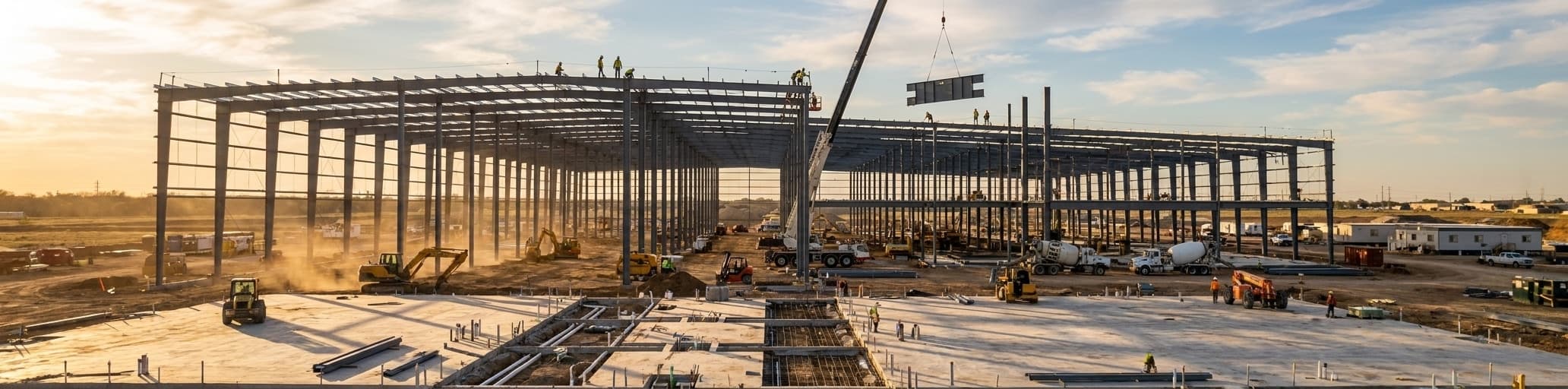

We help you understand 2026 warehouse construction costs across structural systems and project sizes, from $14 to $350+ per square foot depending on building type. Pre-engineered steel buildings deliver the fastest timelines and lowest costs while maintaining durability and insurance savings that compound over your facility's operational life.
Warehouse Construction Cost Per Square Foot in 2026: Current Market Rates
Your structural choice–PEMB at $14-$30, steel-frame at $20-$70, or tilt-up concrete at $25-$40 per square foot–sets your cost floor before permitting begins.
Average warehouse construction costs by building type and material
The structural system you choose sets your cost floor before a single permit gets filed. Steel-frame warehouses — the most common choice for dry storage — typically land between $20 and $70 per square foot for the shell, with costs climbing when clear spans exceed standard bay spacing or racking loads increase.[1] Pre-engineered metal building (PEMB) shells start lower, at $14 to $30 per square foot, though those figures exclude MEP systems, docks, and interior build-out.[2] Tilt-up concrete runs $25 to $40 per square foot for a standard shell, with premiums added for thicker panels, complex reinforcement, or integrated insulation layers.[1] Insulated concrete form (ICF) walls start slightly higher than tilt-up baseline but reduce long-term mechanical costs by limiting temperature swings and air infiltration — a meaningful tradeoff for climate-sensitive storage applications.[1] Cold storage is the outlier in every conversation: specialized insulation, vapor barriers, and refrigeration systems routinely push costs to $130-$350+ per square foot depending on temperature zone.[2]
| Building type | Typical cost per sq ft | Key notes |
|---|---|---|
| PEMB shell only | $14-$30 | Excludes MEP, docks, and interior build-out |
| Steel-frame dry warehouse | $20-$70 | Rises with clear span length and racking loads |
| Tilt-up concrete shell | $25-$40 | Premiums apply for added insulation or reinforcement |
| Full dry warehouse (installed) | $55-$175 | Includes structural system, MEP, and site work |
| ICF perimeter walls | Slightly above tilt-up baseline | Offsets mechanical and energy expenses over building life |
| Cold storage warehouse | $130-$350+ | Driven by refrigeration tonnage and insulation systems |
Building size cuts across all material types in a consistent pattern. Fixed expenses like mobilization, utility connections, and site preparation get spread over more square feet as a project grows, so a 10,000-20,000 sq ft warehouse averages roughly $140 per square foot while a 100,000+ sq ft facility drops to approximately $60-$80 per square foot.[1] Regional labor markets and local permitting requirements shift every figure in the table above by 25 to 50 percent depending on where you build.[2]
How steel warehouse construction compares to traditional methods in 2026
Steel outpaces tilt-up concrete and wood-frame construction on one metric that matters most to your schedule: erection speed.
Pre-engineered steel building kits cut construction timelines by as much as 30% compared to traditional wood or masonry methods, which means earlier occupancy and faster return on your capital.[4] On a pure shell-cost basis, steel-frame dry-storage warehouses ($20-$70 per square foot) and tilt-up concrete shells ($25-$40 per square foot) overlap significantly, so the structural system alone rarely decides the budget.[1] What separates them is long-term performance: steel's fire resistance and structural durability consistently produce lower insurance premiums — often 10-20% less — an ongoing savings that tilt-up rarely matches.[4] The 2026 market does add pressure to steel's upfront numbers.
Section 232 tariffs have imposed a 25-30% burden on imported steel from North America's major trade partners, hot-rolled coil is trading near $1,002 per ton, and nonresidential construction input prices jumped at an annualized rate of 7.1% in January 2026.[4] Those conditions have pushed basic insulated steel building packages to $20-$50 per square foot, compared to $15-$20 per square foot for uninsulated shells — a gap worth understanding before comparing quotes across system types.[4] If your warehouse needs a controlled interior environment, insulated metal wall and roof assemblies can close the performance gap with ICF at a lower installed cost while still delivering the erection-speed advantage steel carries over cast-in-place or tilt-up concrete.[1] A complete steel warehouse — shell, site work, MEP, and interior build-out — typically lands between $100 and $300 per square foot depending on use case and finish level, putting it in the same range as comparable tilt-up or ICF projects once you account for full scope rather than shell-only figures.[4]
Cost breakdown: What factors drive price per square foot today
Four cost categories determine what you actually pay beyond the shell: labor, permits, site preparation, and MEP systems.
Labor is typically the largest variable, accounting for 20-30% of total warehouse construction cost and ranging from $5 to $10 per square foot — though complex or custom designs push that figure higher.[5][6] Permits and inspections add $5,000 to $50,000 depending on location, zoning requirements, and environmental review scope — a line item that catches many first-time developers off guard.[5] Site preparation is just as unpredictable: flat, clear land can cost as little as $3 per square foot to prepare, while uneven or heavily wooded terrain can exceed $10 per square foot before a single structural member goes up.[5] Site work as a whole — grading, utilities installation, and clearing — typically adds another 10-20% to the total project cost.[6] Mechanical, electrical, plumbing, and HVAC systems layer on another $10-$30 per square foot, with the lower end of that range covering basic electrical and ventilation and the upper end applying to climate-controlled facilities.[6] Design and architectural fees generally run 5-10% of the total project budget — a cost that scales with project complexity and rarely shows up in early shell-only estimates.[6] Add these four categories to your structural system cost, and the gap between a $14-per-square-foot PEMB shell and a fully installed warehouse becomes clear fast.
Real-World Warehouse Cost Examples: 10,000 to 100,000 Square Feet
Small warehouses face inflated per-square-foot costs because fixed expenses like permits and utility connections spread across fewer square feet than larger facilities.
How much to build a 10,000 sq ft warehouse in 2026
A 10,000 sq ft warehouse is considered a small facility — large enough for a regional distribution point or light manufacturing operation, but small enough that fixed project costs hit the per-square-foot number hard. Early budget benchmarks for basic steel structures at this size run $350,000-$500,000 all in, or roughly $35-$50 per square foot including labor and standard customizations.[7] That figure rises steeply once you layer in site preparation, mechanical systems, and interior build-out.
Total installed costs for small warehouses in the 10,000-20,000 sq ft range average approximately $140 per square foot — meaning a fully equipped 10,000 sq ft facility can run $1.2 million to $1.5 million depending on dock count, clear height, and regional labor rates.[1] The gap between those two numbers isn't padding; it's the cost of everything that makes a building operational rather than just standing. Site mobilization, utility connections, permits, and general conditions costs are relatively fixed regardless of project size — spread across 10,000 square feet instead of 50,000, they inflate your per-square-foot cost significantly.[1] For a side-by-side view of how those numbers shift as footprint grows, the industrial warehouse cost breakdown by size shows exactly where scale economies start compressing the per-square-foot figure.
One practical way to keep costs within budget at this scale: pre-engineered metal building systems, which typically price between $17 and $35 per square foot for the primary structure and assemble faster than tilt-up or cast-in-place alternatives — reducing general conditions and labor exposure during the erection phase.[7]
Scaling costs: 30,000 sq ft, 50,000 sq ft, and 100,000 sq ft warehouses
As footprint grows beyond the 10,000-20,000 sq ft range, per-square-foot costs drop materially because the fixed burden of site mobilization, utility connections, and permitting spreads across more floor area. A 30,000 sq ft warehouse typically prices between $85 and $100 per square foot for a standard installed scope, putting the total project budget at approximately $2.55 million to $3 million.[1] A 50,000 sq ft warehouse holds in that same per-square-foot band — $85 to $100 — but the total commitment climbs to roughly $4.25 million to $5 million as structural, MEP, and site scopes scale proportionally.[1] At 100,000 sq ft, meaningful economies of scale emerge: basic pre-engineered metal building systems at this size start near $2 million, while tilt-up construction with enhanced material-handling equipment can reach $6 million — a per-square-foot spread of $20 to $60 depending on structural system and finish level.[8] Industrial construction cost data place fully installed 100,000-plus sq ft facilities at $60 to $80 per square foot once complete MEP scope, site work, and interior build-out are included — narrowing the gap between PEMB and tilt-up on a total-cost basis.[1]
| Warehouse size | Typical cost per sq ft | Estimated total project budget |
|---|---|---|
| 30,000 sq ft | $85-$100 | $2.55M-$3.0M |
| 50,000 sq ft | $85-$100 | $4.25M-$5.0M |
| 100,000 sq ft | $60-$80 (full scope) | $6.0M-$8.0M |
One variable that cuts across all three size brackets is the structural system chosen. Pre-engineered metal building packages can reduce structural costs by up to 30% compared to other construction methods at any of these sizes, and they compress the construction timeline by six to ten weeks — directly reducing financing costs that compound monthly during the build.[8] That schedule advantage matters more at 100,000 sq ft than at 30,000 sq ft: a longer construction window at larger scale means more interest exposure and a later date for operational revenue. For a detailed view of how warehouse costs break down by size category, regional labor and permitting premiums shift every figure in the table above by as much as 20% in either direction depending on where you build.[8]
Warehouse cost estimator: Calculate your project's likely range
A working warehouse budget starts with two known inputs and one variable that requires local research: footprint, structural system, and regional market conditions.
The most commonly cited baseline for standard warehouse construction runs $25 to $65 per square foot — putting a 10,000 sq ft building at $250,000 to $650,000 before land acquisition enters the picture.[11] Structural system choice is the second input: RSMeans tracks distinct cost models for pre-engineered metal buildings, metal panel with rigid steel framing, tilt-up concrete panels, and precast concrete — each carrying a different cost floor before site conditions or regional premiums apply.[10] Regional markets are where estimates most frequently break down.
Cushman & Wakefield monitors construction costs across 46 markets in the Americas and finds meaningful spreads between the most and least expensive locations, driven by local labor availability, permitting timelines, and supply chain proximity.[9] Trade uncertainty has added upward pressure in 2026: global suppliers are adjusting for higher operating costs, though a slower global construction pipeline has partially offset competition for materials and kept year-over-year price increases subdued.[9] Key soft costs to layer onto your structural baseline include finish quality, site preparation scope, permit fees, and operational system requirements — all of which consistently move the final number away from early shell-only estimates.[11]
Key Cost Drivers That Impact Your Final Warehouse Price
Tariffs and labor constraints are driving 4-8% cost increases, but suppliers with diversified sourcing and regional staging lock in more predictable final budgets.
Material costs, labor market conditions, and supply chain realities in 2026
Three converging forces — material pricing, labor constraints, and trade policy — are compressing warehouse construction budgets beyond what structural system choices alone can offset.
Tariffs drove aluminum prices up more than 30% and steel prices up 17% in 2025, and industry analysis estimates that tariff exposure can increase total construction costs by 4-8% depending on how heavily a project relies on imported inputs.[13] Copper wire and cable — essential for warehouse electrical systems, dock equipment, and automation infrastructure — climbed more than 22% year over year, adding a cost line that rarely surfaces in early structural estimates.[13] Approximately 70% of contractors are now affected by tariffs, making reliable cost forecasting at the bid stage significantly harder.[13] Labor hasn't relieved the pressure: subcontractor rates dipped slightly in North America during mid-2025 but remained elevated overall because skilled tradespeople are scarce and industrial construction competes for the same workforce as residential and manufacturing projects simultaneously.[12] On the demand side, e-commerce expansion, automation adoption, and reshoring initiatives continue to generate strong need for modern warehouse facilities, keeping construction markets tight even as some speculative starts were delayed or cancelled amid high interest rates and geopolitical uncertainty.[12] The construction industry's traditional just-in-time delivery model has proven fragile under these conditions — contractors who depend on single overseas suppliers or lack real-time shipment visibility are the most exposed to per-square-foot cost overruns and schedule slippage.[13] Builders who diversify their supplier base and stage materials regionally are absorbing disruption faster, which translates directly into more predictable final budgets for warehouse projects that depend on steel components procured through established national supply networks.[13]
Foundation, site prep, and location-specific expenses that add up fast
Interior finishing, customizations, and operational systems: Hard costs vs. soft costs Hard costs — structural work, slab, steel frame, envelope, and MEP systems — typically account for roughly 70% of a warehouse's total project budget, while soft costs (design and engineering fees, permits, legal, and financing) consume approximately 15%, with the remaining 7-10% held as contingency against material and schedule volatility.[15] That split clarifies where customization decisions land: every interior finish upgrade, dock addition, or technology integration hits the hard cost bucket, compounding directly against the structural baseline already established by your building type.
Interior finishes drive more budget variance than most owners anticipate. Fire suppression systems run $1-$4 per square foot depending on hazard classification and sprinkler spacing requirements.[15] Energy-efficient LED lighting adds $3.20-$4 per square foot, and floor treatments — densifiers, joint fillers, and epoxy topcoats for high-traffic forklift zones — typically fall in the $4-$7 per square foot range.[15] Interior finishes as a whole, including insulation, flooring, lighting, and specialty coatings, account for approximately 29.1% of total commercial construction costs — a line item that consistently exceeds what early shell-only estimates communicate.[16]
| Cost category | Type | Typical range |
|---|---|---|
| Slab, steel frame, MEP, envelope | Hard | ~70% of total project budget |
| Fire suppression | Hard | $1-$4 per sq ft |
| LED lighting | Hard | $3.20-$4 per sq ft |
| Floor finishes (densifiers, epoxy) | Hard | $4-$7 per sq ft |
| Interior finishes (total share) | Hard | ~29.1% of total construction cost |
| Design and engineering fees | Soft | 4-6% of hard costs |
| Permits and impact fees | Soft | 0.5-3% of total costs |
| A/E fees, legal, and financing | Soft | ~15% of total project budget |
| Contingency | Reserve | 7-10% of total budget |
Operational technology systems add a separate cost layer that sits on top of interior finishes and is increasingly non-negotiable for modern distribution facilities. A warehouse management system runs approximately $0.50-$1 per square foot, or $20,000-$50,000 for a mid-size installation; IoT sensor networks average $2-$7 per square foot; automated material-handling equipment spans $25-$120 per square foot depending on conveyor density and robotics integration; smart building controls add $5-$10 per square foot; and security and access control systems typically fall in the $2-$5 per square foot range.[15] Phasing automation — roughing in conduits, floor embeds, and roof-mount anchor points during the base build but deferring active equipment until throughput justifies the spend — keeps initial hard costs lower while preventing expensive retrofits when capacity demands expand.[15]
Soft costs are where first-time warehouse developers most often run short on budget. Design and engineering fees run 4-6% of hard costs on standard projects, rising steeply as design complexity increases — small projects may carry engineering fees of 1-2.5% of total project costs, while large or technically complex scopes can reach 4.5-16%.[16] Permits and impact fees vary by jurisdiction and add 0.5-3% of total project costs, while insurance, legal review, and financing expenses collectively push soft costs to the 15% benchmark, a share that doesn't shrink proportionally as building footprint grows.[15] Treating soft costs as part of the baseline budget from day one — rather than as add-ons discovered after the structural estimate is set — is the single most reliable way to prevent the gap between early estimates and final project cost from compounding into a funding shortfall.
Cut Warehouse Construction Costs Without Cutting Quality
Pre-engineered metal buildings cut warehouse construction costs by 20-40% and compress timelines by 30-50% through concurrent fabrication, material efficiency, and reduced field labor.
Why pre-engineered steel buildings deliver the lowest cost per square foot
Pre-engineered metal buildings account for roughly one-third of all new low-rise nonresidential construction in the United States, and the economics behind that market share are direct.[17] PEMB systems deliver 20-40% lower construction costs and 30-50% faster build timelines than conventional framing for most warehouse applications, with savings concentrated in three specific areas: schedule compression, material efficiency, and reduced field labor.[17] Schedule compression alone generates financial returns that shell-only quotes never capture: because PEMB components are fabricated concurrently with foundation work rather than sequentially, total project timelines shrink by 30-50% — and on a $2 million project carrying a 7% construction loan, trimming three months off the schedule saves approximately $35,000 in interest before the building earns a single dollar of operational revenue.[17] Material efficiency compounds those savings further: tapered steel members place mass where structural loads are highest and strip it where loads are lowest, using 15-30% less steel by weight than a conventional hot-rolled frame covering the same clear span — a meaningful cost advantage when Section 232 tariffs add 25% to imported steel costs and domestic mills have adjusted pricing to match.[17] Reduced field labor closes the gap: factory fabrication of pre-cut, pre-drilled, pre-welded components converts ironworkers from welders to bolt-up crews, cutting field labor hours by 25-40% — a direct cost reduction in markets where skilled ironworkers run $75-$120 per hour fully burdened.[17] Prefab steel kits priced between $20 and $40 per square foot reflect all three advantages and cut construction timelines by as much as 30% compared to site-built methods.[3] The installed shell for a standard warehouse PEMB — package, foundation, and erection combined — lands at approximately $25-$45 per square foot in mid-cost markets; once insulation, MEP systems, and site work bring the structure to operational condition, the warehouse building cost per square foot typically reaches $45-$75 per square foot for standard dry-storage applications.[17]
Design efficiency strategies that reduce material waste and labor time
Design efficiency on the construction side starts with a single uncomfortable statistic: waste generated on a typical job site equals as much as 30% of the total weight of building materials delivered.[18] For every truckload of steel, insulation, and fasteners arriving at your pad, nearly a third of what you paid for ends up in a dumpster rather than in your building. Prefabrication is the mechanical solution. Factory-built components shipped to exact specification take almost 70% less energy to manufacture than conventionally constructed equivalents, and because material is cut and formed under controlled conditions, on-site scrap generation drops to near zero.[18] There is no five-inch offcut from an eight-foot member, no cleanup labor, no dumpster haul — and no freight cost for transporting a waste fraction from the mill to your foundation.[18] Just-in-time (JIT) and lean production principles extend the same logic to delivery sequencing: ordering what you need, when you need it, in the exact quantity required keeps excess material off the site, frees staging area for active work, and eliminates the carrying costs and damage risk of stockpiling ahead of schedule.[18]
Clear-span structural systems amplify prefabrication's efficiency gains by removing interior support columns entirely. Truss and rigid-frame designs built to widths of 300 feet or more give erection crews unobstructed floor area where every square foot is usable — meaning crews are not working around posts, mid-bay footings, or bracing lines that interrupt workflow and force sequential rather than parallel trade activity.[19] Removing interior columns also reduces the number of foundation penetrations required, cutting concrete volume and the labor associated with setting anchor bolt patterns for mid-bay supports.[19] On the site-management side, eliminating non-value-added movement in the construction sequence — unnecessary material repositioning, redundant safety checks on in-field cuts, and waiting time caused by poor trade coordination — mirrors the lean warehousing principle of stripping every task that adds no direct value to the finished structure.[20] Applying 5S discipline (Sort, Set in order, Shine, Standardize, and Sustain) to the job site itself keeps tools, materials, and crews organized, which cuts the time lost searching for equipment or staging components in the wrong sequence.[20] Prefabrication, clear-span design, and lean site management are the three levers that compress your warehouse construction cost per square foot beyond what structural system pricing alone can deliver.
Single-source solutions: How turnkey partnerships save money from day one
The traditional design-bid-build sequence forces design, bidding, and construction to occur one step at a time — a linear process that consistently produces inefficiencies, budget overruns, and schedule delays.[21] In a turnkey partnership, those phases overlap strategically: permitting and early site work begin while final design packages are still being completed, compressing the overall schedule by months and accelerating your return on investment.[21] The financial benefit compounds quickly.
When a single organization holds responsibility for both design and construction, you stop managing two separate contracts — and you eliminate the gaps between them where scope disputes, change orders, and coordination failures tend to live.[21] Turnkey contractors assume financial risk at project award, lock in material pricing, and secure key components immediately — transferring budget exposure from your ledger to theirs before a shovel breaks ground.[21] That risk transfer translates directly into cost certainty: unlike the traditional model, where final pricing surfaces only after design completion and sometimes triggers costly redesigns, a single-source partner provides firm lump-sum pricing during the proposal phase, so what you agree to is what you pay, provided scope holds.[21] Early contractor involvement in due diligence catches site feasibility issues before they become mid-construction surprises: geotechnical surveys, entitlement timelines, and permit requirements all enter the budget conversation at the planning stage rather than after commitments are made.[22] Facilities designed through a single-source process are also built around actual workflow, equipment requirements, and future growth capacity — not around a set of drawings produced without operational context — which means the building performs correctly from day one rather than requiring costly retrofits to match how the operation actually runs.[21] For warehouse owners comparing turnkey vs. shell-only pricing structures, the difference isn't just convenience — it's the gap between a project that closes within budget and one that doesn't.
- Steel-frame warehouses cost $20-$70/sq ft for shell only, while fully installed facilities range $100-$300/sq ft depending on use case and finish level.
- Smaller warehouses (10,000-20,000 sq ft) average $140/sq ft installed due to fixed costs spread across less area, while 100,000+ sq ft facilities drop to $60-$80/sq ft.
- Tariffs increased steel prices 17% and aluminum 30% in 2025, with tariff exposure adding 4-8% to total construction costs for approximately 70% of contractors.
- Pre-engineered metal buildings reduce construction costs 20-40% and timelines 30-50% compared to conventional framing through schedule compression and reduced field labor.
- Interior finishes, operational technology systems, and soft costs (design, permits, financing) collectively account for 40-50% of total warehouse project budgets and are frequently underestimated.
- Material waste on typical job sites equals 30% of delivered building materials by weight, but prefabrication reduces on-site scrap generation to near zero.
- Turnkey single-source partnerships compress project schedules by months through overlapping design and construction phases while transferring budget risk and locking material pricing upfront.
- https://www.foxblocks.com/blog/warehouse-cost-per-square-foot
- https://terrapincg.com/commercial-construction-costs
- https://ameribuilds.com/steel-building-costs-what-to-expect-2026/
- https://builtmammoth.com/how-much-does-a-steel-building-cost/
- https://www.foxblocks.com/blog/cost-to-build-a-30000-warehouse
- https://vidtech.com/blog/what-does-it-cost-to-build-an-industrial-warehouse/
- https://www.ism.ws/logistics/how-much-does-it-cost-to-build-a-warehouse/
- https://redstagfulfillment.com/cost-to-build-a-warehouse/
- https://www.cushmanwakefield.com/en/united-states/insights/industrial-construction-cost-guide
- https://www.rsmeans.com/model-pages/warehouse?srsltid=AfmBOopNFtPv-H3hGjPZBfH9T-Z6j2k-j7-7YzufqfoslNfoAmnhlcNj
- https://homeguide.com/costs/commercial-construction-cost-per-square-foot
- https://www.procurementresource.com/resource-center/large-ware-house-distribution-centre-construction-cost-price-trends
- https://www.wsinc.com/blog/construction-supply-chain-disruptions-2026/
- https://wrightconstructioninc.com/post/industrial-facility-construction-guide/
- https://anchoredconstructiontn.com/warehouse-construction-cost/
- https://www.autodesk.com/blogs/construction/commercial-construction-cost-per-square-foot/
- https://terrapincg.com/news/pre-engineered-metal-building-cost-per-square-foot-usa
- https://www.gordian.com/resources/sustainable-construction-techniques/
- https://www.clearspan.com/news/planning-effective-warehouse-building/
- https://www.kardex.com/en-us/blog/improve-warehouse-efficiency
- https://www.arconational.com/design-build-difference/
- https://arcodb.com/industries/warehouse-distribution/