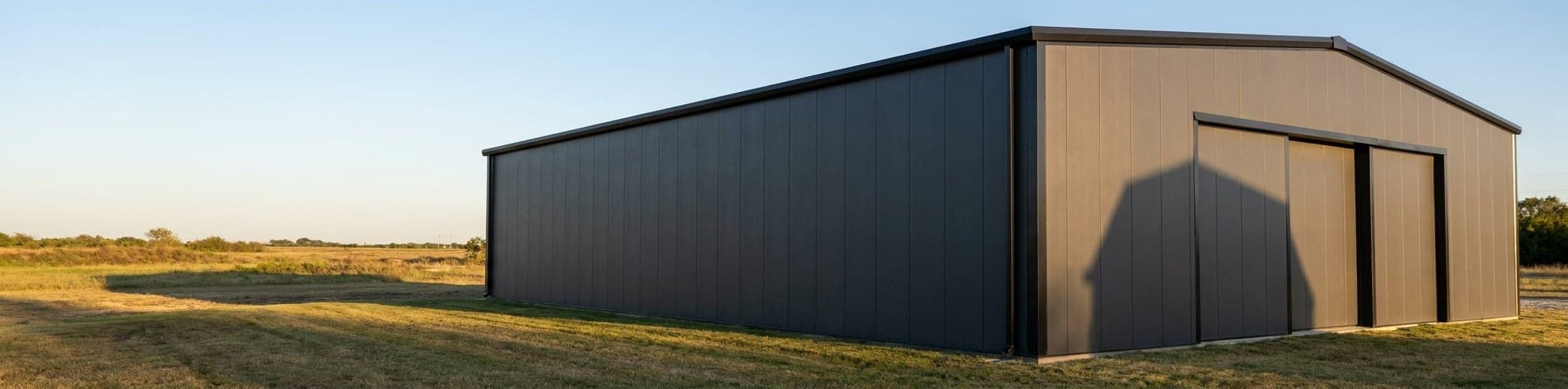

Charcoal gray dominates metal building specifications because it balances modern aesthetics with practical durability, hiding grime while projecting professional permanence across commercial, agricultural, and industrial applications.
The Rise of Charcoal Gray in Modern Metal Architecture
Modern charcoal gray metal coatings deliver 20 to 40 years of color retention while bridging contemporary minimalism with timeless design versatility.
Historical shift from traditional colors to darker tones
For most of the 20th century, metal buildings carried a reputation tied directly to their limited palette — utilitarian grays, standard beiges, and barn reds chosen for availability rather than design intent. The industry itself reinforced this perception, and the myth that metal structures are dull and confined to shades of gray stuck for decades.[1] What broke that pattern was a combination of advanced factory coating systems and a broader architectural shift toward darker, more deliberate exteriors. Today's manufacturers offer dozens of color options including modern charcoal and black tones, traditional barn reds, and two-tone combinations — all produced at scale with coatings that hold color for 20 to 40 years depending on the system specified.[1]
The movement toward darker tones has identifiable architectural roots. Classic colonial and traditional structures have long paired well with deep charcoal and dark gray, where the contrast against white or off-white exteriors reinforces clean, formal proportions.[2] Contemporary and minimalist buildings pushed adoption further — charcoal, graphite, and near-black finishes complement the deliberate simplicity those styles demand, making high-contrast dark exteriors a natural fit for mastering modern metal building design.[2] The design direction that dominated the past decade — cool grays and stark whites — is now giving way to deeper, warmer neutrals, with Sherwin-Williams' 2026 forecast pointing toward grounded, nature-inspired palettes that favor depth over brightness.[2] Charcoal gray sits squarely at the intersection of both eras: dark enough to satisfy contemporary minimalism, neutral enough to carry forward as trends evolve. That staying power is precisely why charcoal, ash gray, and burnished slate now rank among the most specified colors for commercial, agricultural, and industrial steel structures.[1]
Market data confirming why are charcoal gray metal buildings popular
The numbers back up what you see in the field. Wick Buildings' annual color survey named Charcoal Gray the single most popular metal building color for 2022, with White and Burnished Slate trailing at positions two and three.[4] Sheffield Metals confirmed the trend held through 2024, with gray shades — Charcoal Gray and Dove Gray leading the pack — consistently topping customer color requests for both metal roofs and wall panels.[5] A Metal Roofing Magazine industry-wide survey reinforced that signal: Black and Gray tied for the overall number-one spot nationally, with Gray claiming the top position in the South-Midwest region outright.[4]
By 2025, charcoal's grip on buyer preferences hadn't loosened — it had simply evolved. Wick Buildings' 2025 customer selection data shows warmer charcoal variants rising to the top, a shift that Sherwin-Williams Architectural Color Designer Brynn Wildenauer explains directly: stark black is giving way to warmer charcoal shades, with charcoal gray remaining a standout example of that transition.[5] The full 2025 top-10 list reinforces the point — Black, Crinkle Black, Burnished Slate, and Smoke Grey all made the cut, meaning four of the ten most-chosen colors fall within the same cool-to-warm dark neutral band that charcoal anchors.[5]
Three factors explain why this color holds its position year after year rather than cycling out like a trend color. Sheffield Metals identifies neutral versatility, a modern but understated appearance, and long-term cultural durability as the core drivers — customers building structures meant to last 40 to 60 years aren't gambling on a shade that may look dated in a decade.[5] For commercial property owners, agricultural operators, and industrial developers, that last point is the deciding one: charcoal gray earns repeat specification because it works across building types and ages without demanding a repaint to stay current.[5]
Influence of contemporary design trends in 2025
The 2025 design environment is reshaping metal building color choices through three converging shifts: lower contrast pairings, nature-grounded palettes, and matte over glossy finishes.[6] Sherwin-Williams Architectural Color Designer Brynn Wildenauer puts it plainly: "We're seeing lower contrast, even monochromatic, color schemes growing in popularity," with neutral colors warming up across all building sectors.[5] Stark black-and-white exteriors that defined the previous decade are fading out, replaced by warmer charcoal variants paired with sandstone, clay, or warm gray accents — combinations that read as deliberate without demanding visual attention.[5] The texture dimension adds another layer: crinkle and matte finishes reduce surface glare and mask panel wave on long wall runs, giving commercial builds, agricultural facilities, and barndominiums a polished, high-end appearance instead of the utilitarian look buyers want to avoid.[6] Beyond surface finish, buyers are increasingly choosing colors that complement their surrounding landscape — what Wildenauer describes as palettes that "mimic nature" — and charcoal gray satisfies that pull whether the building sits on open farmland or an industrial corridor.[5] You can see the full convergence of these forces in how thoughtful color and texture choices reshape metal building design: charcoal gray isn't riding a trend so much as anchoring the intersection where minimalism, warmth, and durability all meet at once.
Design Benefits: Aesthetic and Functional Appeal
Charcoal gray delivers composed, contemporary appeal for 40-to-60-year building lifespans without requiring ornamental additions or ongoing design updates to stay current.
Modern sophistication and visual impact of charcoal gray exteriors
The sophistication of charcoal gray on a steel exterior isn't accidental — it's a function of how the color manages contrast, light, and scale at once.
Unlike lighter neutrals, a dark charcoal field forces trim lines, window frames, and panel seams to register with precision, giving a commercial warehouse, agricultural building, or retail facade the kind of composed appearance typically associated with high-end architectural finishes.[8] Specialty metallic finishes in the charcoal range add a "modern and industrial look" with a "sleek and contemporary appearance" that requires no ornamental cladding or add-ons to achieve.[8] That visual economy is precisely why black and gray combinations have built consistent traction over the past decade: the pairing delivers a contemporary aesthetic without demanding complex design moves.[9] The dark neutral does the compositional work on its own — accent materials like wood trim or glass register as intentional contrasts rather than afterthoughts, and the overall structure reads as resolved rather than assembled.[7] For owners building commercial, industrial, or farm structures meant to stand 40 to 60 years, charcoal gray earns its specification because it projects permanence and intention through color alone, without demanding ongoing design investment to stay current.[8] You can see how thoughtful exterior color choices translate into lasting building appeal across building types — charcoal gray sits at the intersection of restraint and impact, which is exactly what long-term owners need from a single finish decision.
How charcoal gray complements diverse architectural styles
Charcoal gray earns specification across building types because it operates equally well as the anchor in high-contrast schemes and the base in low-contrast, tone-on-tone compositions.[11] High-contrast pairings — charcoal siding with ash gray or pewter roofing — trace their origins to Farmhouse, Colonial, Georgian, and Spanish/Mediterranean architecture, where a strong visual break between roof plane and wall plane is fundamental to each style's proportional logic.[11] Modern and minimalist structures pull charcoal in the opposite direction: alongside white trim and near-black accents, it achieves the bold-yet-uncluttered exterior those styles require without applied ornamentation or cladding add-ons.[11] Agricultural applications land in between — a charcoal gray metal roof over light-colored siding gives a traditional pole barn or agricultural steel building a current appearance while preserving the rustic proportion that suits open farm landscapes.[10] For owners managing mixed-use properties with multiple structures — a workshop beside a barndominium, or grain storage flanking a farm store — charcoal gray's position within a neutral dark band lets dissimilar buildings read as a unified campus rather than an assemblage, a practical advantage that supports property value and visual cohesion regardless of regional aesthetic norms.[10][11]
Psychology of color: conveying strength and professionalism
Color carries measurable weight in how observers form first impressions of a building.
Research on color and psychological functioning confirms that associations with specific shades influence attention, perception, and lasting quality appraisals — the associations people form with colors have downstream effects on how they evaluate what they see.[12] Gray occupies a precise psychological band: it communicates balance, neutrality, and serious corporate credibility, fitting naturally in professional sectors including construction, finance, and law.[13] Within that band, depth matters — lighter grays signal neutrality, but charcoal signals authority, a distinction with real consequences for how clients, buyers, and partners read your property on first approach.[13] The territory charcoal occupies also borders black, which carries associations with strength, sophistication, tradition, and formality — qualities that translate directly into perceptions of permanence and operational seriousness on any commercial, industrial, or agricultural structure.[13] Color-in-context theory explains why the effect holds reliably at the building scale: the meaning a color carries shifts with its physical and psychological context, so charcoal gray on a steel exterior operates within an environment where durability is already expected — reinforcing the structure's purpose rather than creating visual noise around it.[12] For property owners whose buildings serve as a first point of contact with clients, tenants, or customers, that alignment between color psychology and building function is exactly why charcoal gray earns repeat specification on warehouses, farm facilities, retail buildings, and industrial campuses alike.[13]
Energy Efficiency and Advanced Coating Technologies
WeatherXL and other PVDF coatings with solar-reflective pigments maintain 70% heat reflectance for 20-30 years, directly reducing your cooling costs without sacrificing the dark neutral finish you want.
Solar Reflectance Index (SRI) improvements for dark panels
WeatherXL(TM) and other high‑performance coatings that reduce heat gain High-performance coatings like WeatherXL(TM) belong to the same class of 70% PVDF resin-based systems that have defined architectural metal since their introduction in 1965.[19] The chemistry behind that durability is specific: carbon-fluorine bonds — among the strongest chemical bonds available — give PVDF coatings their resistance to chalking, erosion, and harsh atmospheric pollutants, preserving both surface appearance and reflective properties over decades of UV exposure rather than allowing gradual degradation to compound your heat-gain problem.[19] Two of the most widely recognized PVDF resins in the U.S. market are Kynar(R) by Arkema and Hylar(R) by Solvay Solexis, both engineered to meet the same industry benchmarks for weathering — and metal roofing coated with Kynar 500(R) PVDF can achieve solar reflectance above 70%.[17][19] That performance advantage carries real weight for a warehouse, hangar, or farm structure in a high-sun climate: a roof maintaining high solar reflectance transfers less heat into the building below, cutting the cooling load your HVAC system handles every day that roof is in service.[17] The finishing move for charcoal gray specifically is solar-reflective pigment formulation — SR coatings engineered with reflective pigments resist heat absorption without compromising color depth, meaning you get the dark neutral exterior the market favors without paying for it on your monthly energy bill.[18][19] For property owners evaluating long-term operating costs on a metal building insulation and envelope assembly, the coating spec and insulation system work together — but the coating is the first line of defense, and choosing a PVDF-based system with certified solar-reflective pigments is what keeps that defense effective 20 or 30 years from now.[19]
Durability, fade resistance, and low‑maintenance advantages
The stakes for fade resistance are higher on charcoal gray panels than on lighter colors — dark surfaces show uneven fading far more visibly, and a wall face that takes direct afternoon sun will look noticeably duller than the shaded side within a few years if the coating system can't hold color consistently across the full panel run.[20] PVDF coatings hold that consistency because inorganic pigments combined with premium resins provide color stability that organic-pigment systems can't match under extended UV exposure — organic pigments allow ultraviolet light to penetrate and break chemical bonds, while inorganic formulations resist exactly that degradation.[19] The field evidence is direct: side-by-side comparisons of Kynar 500 PVDF and SMP panels installed on the same building show the PVDF surface still looking new at the eight-year mark while the SMP panels have experienced significant fade and chalk.[21] Chalking — the powdery residue that forms as paint resins break down under sun exposure — is delayed substantially by PVDF because its formulation resists harsh atmospheric pollutants and erosion, keeping a low-maintenance steel building surface clean without pressure washing or spot repainting cycles to stay presentable.[19] The warranty terms quantify the durability gap: SMP systems typically cover chalking and fading for 10 to 20 years before color degradation becomes a contractual concern, while PVDF warranties extend that protection further — and although PVDF runs 15 to 35% more upfront than SMP, for a commercial warehouse, agricultural facility, or industrial building spec'd to stand 40 to 50 years, that premium is what keeps a charcoal gray exterior maintenance-free across its full lifespan instead of triggering a recoating project on your budget every decade.[20][21]
Versatile Applications Across Industries and Climates
Charcoal gray hides grime and maintenance issues across contractor shops, warehouses, and retail spaces while pairing seamlessly with any trim or signage without costly redesigns.
Commercial and industrial projects leveraging charcoal gray aesthetics
In working environments — contractor shops, distribution warehouses, light manufacturing facilities, and aviation hangars — charcoal gray delivers a practical advantage lighter colors simply can't match: dark panels hide surface contamination, oil residue, and atmospheric grime better, keeping the exterior presentable between cleaning cycles without extra upkeep effort.[23] That functional edge aligns directly with how commercial color decisions are actually made: brand identity, local code compatibility, and a professional appearance that holds without constant maintenance are the three factors that drive most commercial metal roofing and siding specifications — and neutral gray families consistently top the list for exactly those reasons.[23] For retail pads, medical offices, and multi-tenant industrial parks where the façade is a client-facing brand asset, charcoal's compatibility with almost any trim color or signage palette makes it the finish that doesn't demand redesign when a tenant changes or a brand refreshes.[22] Contractor shops and industrial buildings get an added payoff that goes beyond grime tolerance: a charcoal gray exterior reads as intentionally sharp rather than merely utilitarian, a distinction that directly affects how clients, vendors, and prospective tenants assess your operation on first approach.[23]
Residential garages, workshops, and farm structures
form the core of charcoal gray's repeat customer base — and the reasons are practical, not just visual.
Charcoal gray is explicitly identified as the top color recommendation for modern residential garages and workshops, pairing cleanly with white, black, barn red, or natural wood trim without requiring a custom specification or premium finish upgrade.[22] The maintenance argument is equally direct: mid-tone colors like charcoal gray hide both light dust and water spots better than very light or very dark alternatives, keeping a 30×30 metal garage or workshop presentable between cleaning cycles without pressure washing or touch-up repaints.[22] On residential properties with an existing home already on site, matching or coordinating with the main structure's palette is the fastest path to visual cohesion — and charcoal gray's neutral range makes it compatible with brick, stone, wood siding, and stucco without demanding a custom color match.[22] Farm structures follow the same logic: a charcoal gray panel gives pole barns, equipment storage buildings, and multi-bay farm facilities a current, composed appearance against open pasture or cropland, while popular shop combinations — charcoal gray siding with black trim — translate directly to farm workshops where a sharp exterior signals operational seriousness rather than the purely utilitarian look owners want to move past.[24]
Regional performance: adapting to hot, cold, and humid zones
Your climate zone is the variable most buyers underestimate when specifying a panel color for a steel building.
In hot regions, charcoal gray's energy performance depends on the coating system: conventional roofs can reach 150 degreesF or more on a summer afternoon, but a reflective roof surface stays more than 50 degreesF cooler under the same conditions, cutting cooling loads and protecting insulation from chronic heat cycling.[26] Cold-climate buyers face the opposite trade-off — a highly reflective surface reduces solar heat gain in winter as well as summer, creating a heating penalty that can exceed warm-season savings in heating-dominated climates, which means insulation specification matters more than color choice alone.[26] Darker shades like charcoal absorb more solar radiation than lighter alternatives in any climate, so pairing them with proper insulation and ventilation is what keeps both seasonal energy costs in check rather than leaving color to fight physics on its own.[25] Humid zones introduce a third variable worth factoring in: in warm, moist regions where biological growth accumulates on roof surfaces, dark finishes conceal algae and mold far better than light-colored alternatives, meaning a charcoal gray building stays presentable between cleaning cycles without chemical treatment or pressure washing.[26] Your color choice directly shapes indoor comfort and your building's environmental footprint year-round — which is why climate-specific panel and insulation specs like those built for Pennsylvania's humidity and snow loading treat color and building envelope as a unified system, not two separate decisions.[27]
Cost, Maintenance, and Long‑Term Value
Over 20 years, a steel structure costs roughly $350,000 total while wood or brick runs $670,000 to $1.1 million for the same 10,000-square-foot facility.
Initial investment versus lifecycle savings
The most common budgeting mistake on a steel building project is treating the day-one quote as the full cost comparison.
It isn't.
Pre-engineered steel building kits run $10 to $25 per square foot for materials, with installation adding another $10 to $20 per square foot — putting a 10,000-square-foot steel structure in the $120,000 to $250,000 range depending on complexity.[28] Comparable wood construction for the same footprint runs $350,000 to $500,000, and concrete climbs to $500,000 to $700,000 — before you factor in what those materials cost you every year after delivery.[28] Steel's annual maintenance burden lands around 1% of initial cost, roughly $1,500 to $2,500 per year on a 10,000-square-foot facility; wood and masonry carry 2 to 4% annually, translating to $7,000 to $20,000 every year, and that figure doesn't include the unbudgeted hits — a wood-framed commercial building in a pest-prone region can face $30,000 in termite damage alone.[28] The energy side compounds the advantage: insulated steel panels with proper thermal detailing cut annual energy bills by 10 to 20%, saving a typical commercial setup $2,000 to $5,000 per year versus $1,000 to $2,500 for traditional construction.[28] The real number that matters for your decision is the 20-year total: steel comes in around $350,000 all-in for a 10,000-square-foot facility including all operating costs, while wood or brick runs $670,000 to $1.1 million across the same period.[28] A second misconception worth correcting is depreciation — a well-maintained steel structure retains structural integrity for 40 to 50 years or longer, which drops your annual cost of ownership with every passing decade rather than accelerating repair cycles the way wood does after 15 to 25 years.[29] For commercial, agricultural, and industrial owners evaluating a steel barn versus wood barn over 20 years, the math consistently favors steel once maintenance, insurance, and energy costs enter the equation — and the payback period on the initial investment compresses further when construction speed is factored in, since pre-drilled, pre-engineered components cut weeks to months off the on-site phase and move you from capital outlay to first revenue faster than site-built alternatives.[28][29]
Maintenance best practices and cost‑effective upkeep
Charcoal gray's practical edge over lighter panel colors starts on the first day of service: mid-tone dark finishes hide airborne dust, water spots, and surface grime better than white or light beige walls, so your annual maintenance routine addresses structural protection rather than cosmetic rescue.[30] The baseline upkeep task is an annual wash — low water pressure, wide fan tip, no harsh detergents that strip the coating's protective chemistry.[31] In coastal environments, that rinse schedule is non-negotiable; salt particles settle on metal surfaces and degrade paint binders over time, and skipping routine rinsing can void your finish warranty faster than UV exposure alone.[31] For agricultural facilities, contractor yards, or any building on a gravel drive where mud splash is a daily reality, specifying a darker wainscot panel on the lower three to four feet of each wall absorbs the grime that accumulates after every rain — a practical spec decision that cuts how often the full wall face needs cleaning.[30]
Two additional practices protect your finish investment beyond routine washing. Inspect panels after every significant weather event and immediately touch up any scratches, chips, or coating breaks with manufacturer-approved touch-up paint — exposed bare metal corrodes quickly, and a small repair caught early costs a fraction of what rust remediation or panel replacement runs six months later.[31] For buildings in high-UV climates or near industrial air pollution, applying a protective sealant or restoration coating to aging panels can extend the original finish's useful life by 10 to 15 years before a full repaint becomes necessary, which is far more cost-effective than replacing structurally sound panels ahead of schedule.[31] Pair that discipline with charcoal gray's inherent grime-masking depth and you have a low-maintenance steel building envelope that stays presentable across a 40-to-50-year service life without demanding constant cosmetic intervention.
Resale appeal and market differentiation of charcoal gray buildings
Color choice lands on your balance sheet at resale whether you account for it upfront or not.
Deep charcoal and black shades carry strong resale value in the metal building market — an advantage that runs from distributors managing inventory risk down to property owners who need a finish that holds buyer appeal across multiple ownership cycles.[32] The market signal heading into 2026 is unambiguous: charcoal shades are dominating metal roofing and siding demand, meaning a building finished in charcoal gray already aligns with what buyers and tenants look for when they evaluate a property rather than working against prevailing preferences.[32] At the specification level, matte charcoal variants are driving a 30%+ increase in planning-cycle inquiries among coil coating distributors — a leading indicator that charcoal gray will remain a defensible market position, not a color future buyers need to explain away or discount around.[32] For owners of prefab retail buildings, multi-tenant industrial parks, and commercial campuses competing for tenants in high-visibility corridors, that demand concentration is what separates a charcoal gray structure from lighter, more utilitarian neighbors — no facade upgrades or repositioning spend required to stay competitive.
Choosing the Right Charcoal Gray Finish for Your Project
Match charcoal gray walls with black trim to define every architectural edge with precision, or choose white trim for balanced contrast that highlights structure without visual aggression.
Selecting trim, accent, and complementary colors
The practical starting point for any charcoal gray building is a three-layer color system: wall panel as the primary field, roof as the secondary plane, and trim plus wainscot as the accent tier.[18] Each layer does a distinct job — the wall establishes tone, the roof manages contrast and energy performance, and trim defines architectural edges where panels meet doors, windows, and cornices.[18] Trim and wainscot are where two-tone combinations come into play, and where the difference between a composed exterior and an assembled one becomes visible from the road.[9]
With charcoal gray walls as the anchor, several combinations have dominated commercial, agricultural, and industrial specifications heading into 2026. The table below maps the most-specified pairings to building type so you can match palette to purpose without guesswork.[18][9]
| Wall color | Roof color | Trim color | Best fit |
|---|---|---|---|
| Charcoal gray | Galvalume (silver) | Black | Commercial, light industrial |
| Charcoal gray | Charcoal gray | Matching charcoal | Low-contrast architectural, barndominium |
| Charcoal gray | Ash gray | White | Balanced contrast, farm workshop, retail |
| Charcoal gray | Pewter gray | Pewter gray | Refined, tone-on-tone campus buildings |
| Charcoal gray | Black | Black | High-contrast urban industrial, hangar |
Black trim on a charcoal gray field is the most direct path to a modern, intentional exterior — the pairing has built consistent traction across the past decade precisely because the color delta between charcoal and black is small enough to feel cohesive while still defining every panel edge and door frame with precision.[9] White trim pulls the composition in the opposite direction, producing balanced contrast that highlights structure without visual aggression — an approach well-suited to steel frame farm buildings where a sharp exterior matters but competing with the landscape does not.[18] For owners building multi-structure campuses — a warehouse beside a maintenance shop, or equipment storage flanking a processing facility — specifying the same charcoal gray wall with pewter gray trim across every building creates visual cohesion that holds regardless of footprint differences between structures.[18]
Wainscot adds a fourth color opportunity that most buyers underuse. Running a contrasting wainscot panel on the lower three to four feet of each wall — black wainscot against charcoal gray siding, for example — gives a working building layered visual depth while protecting the most abuse-prone surface area from mud splash and equipment contact.[9] That functional dimension is what separates wainscot from purely decorative trim: on a contractor yard, distribution facility, or agricultural building on a gravel drive, a darker lower wainscot absorbs the grime that accumulates after every rain, extending the intervals between cleaning cycles without demanding a color scheme that hides dirt everywhere.[9] Before finalizing any combination, confirm your selections against the manufacturer's official color charts rather than digital previews alone — minor batch-to-batch variation is normal in painted steel products, and sun angle and surface reflectivity will both shift how any color reads once panels are installed at scale.[18]
Integrating lighting and interior design with dark exteriors
Charcoal gray panels absorb ambient light that lighter surfaces scatter, so exterior lighting isn't optional on a dark metal building — it's what keeps the structure from disappearing after sunset.[34] Wall-mounted sconces flanking the main entry create symmetry and frame the building's face at night, while LED strip lighting along the roofline or around doorways delivers a contemporary edge that reinforces the dark exterior's intentional character rather than competing with it.[34][35] Pathway lights and spotlights aimed at corner trim, panel transitions, and overhead doors do double duty: they improve site safety and give the same façade that reads as composed during daylight hours a deliberate, well-defined presence after dark.[34]
Windows carry more design weight on charcoal gray structures than on lighter buildings. On a dark exterior, windows are the primary source of natural light relief along long wall runs, so placement matters more than quantity — larger windows on the primary façade or concentrated near work zones admit the most usable daylight without interrupting panel geometry.[34] For commercial workshops, hangars, and agricultural facilities where sidewall space is occupied by equipment or racking, skylights and glass panels are a direct substitute: they flood floor areas with natural light without consuming the wall real estate operational layouts depend on.[34] On the thermal side, pairing a dark siding specification with a light-colored or reflective roof counterbalances solar heat absorption at the wall level, keeping indoor comfort in check without placing that burden on the window strategy alone.[33] The same window logic applies to barndominiums and residential metal shops with living quarters, where larger openings concentrated on the primary façade let natural light compensate for what dark exterior panels absorb.
Inside a charcoal gray building, the guiding principle is deliberate contrast. Bright LED fixtures eliminate the dark corners that limited natural light and dark cladding can produce together, and installing clean, light-colored interior wall panels maximizes light reflectance off every interior surface.[35] Organized wall-mounted shelving and cabinet systems reinforce that effect by keeping floor space clear and surfaces reflective rather than letting clutter absorb the light your fixtures put out.[35] For commercial and industrial owners, a well-lit, cleanly organized interior does more than improve working conditions — it confirms the professionalism the charcoal gray exterior signals from the road, delivering a consistent impression from first approach to first handshake.
Step‑by‑step decision framework for architects and owners
Every charcoal gray specification decision starts in the same place: a clear picture of what the building needs to do and for how long. The AIA Framework for Design Excellence sets this up as a foundational principle — good design adds value for owners, occupants, and the broader community regardless of project size or budget, and good design is resilient and adaptable, enhancing usability and value over time.[36] That means your color and coating decisions aren't decorative afterthoughts; they're performance specifications with 40-to-50-year consequences. Work through the following steps before you finalize any charcoal gray spec.
- Define use, occupancy, and service life. A contractor shop, an aviation hangar, and a farm equipment building each impose different grime loads, maintenance cycles, and occupant expectations on a finish. Nail down the primary use, secondary uses, and how long you expect the building to operate before any renovation — this number drives every downstream coating and color decision.
- Map your climate zone. Hot-dry, cold, and humid regions each shift the energy performance math for dark panels. In heating-dominated climates, insulation and ventilation carry more weight than color reflectance alone. Good design reduces energy use and eliminates dependence on fossil fuels while improving building performance — that outcome requires matching your panel spec to actual climatic conditions rather than assuming one coating solves every zone.[36]
- Establish your aesthetic intent before reviewing color chips. In the hierarchy of design decision-making, knowing the look and character you're after comes before material selection — not after.[37] Decide whether you're targeting high-contrast (charcoal walls, light trim), monochromatic (charcoal on charcoal), or tone-on-tone (charcoal with pewter) before opening any color catalog. Choosing a finish direction first keeps the spec process efficient and prevents scope creep driven by indecision at the color stage.
- Select your coating system based on service life, not upfront cost. Good design applies informed material selection that balances priorities to achieve durable, safe, and healthy projects.[36] For charcoal gray specifically, that means choosing between PVDF (Kynar 500-class) for 40-to-50-year service life and SMP for shorter-horizon projects where the 15-to-35% cost premium doesn't pencil out. Run a lifecycle cost analysis — LCCA accounts for both initial cost and expected useful life, and a higher-quality system that lasts twice as long carries a lower total cost even when its first price is higher.[37]
- Build your three-layer color system in order. Specify wall panel first, roof second, then trim and wainscot as the accent tier. Each layer has a distinct job: wall establishes tone, roof manages contrast and energy performance, and trim defines architectural edges. Confirm all selections against the manufacturer's physical color charts — digital previews don't account for sun angle or surface reflectivity at panel scale.
- Pressure-test the spec against local code and permit requirements. Energy codes, cool-roof mandates, and local aesthetic guidelines vary by jurisdiction and building type. Checking your coating's SRI rating against any applicable cool-roof ordinance before submitting for permits is faster and cheaper than discovering a compliance gap during plan review. For projects in regions with specific snow load, humidity, or coastal exposure requirements, coordinating your panel and insulation assembly as a unified envelope system at this stage prevents costly redesigns later.
That sequence — use, climate, intent, coating, color system, code check — keeps every charcoal gray specification grounded in performance rather than trend, which is exactly why the color holds its position year after year across commercial, agricultural, industrial, and aviation building types.
- Charcoal gray ranks as the #1 specified metal building color for 2022-2025, consistently outpacing white and other neutrals.
- PVDF coatings (Kynar 500) maintain 70%+ solar reflectance and resist fading for 20-40 years, cutting energy costs vs. cheaper SMP systems.
- Dark charcoal hides grime, dust, and water spots better than light colors, reducing maintenance cycles on commercial and farm structures.
- Charcoal gray works as both high-contrast anchor (with white/ash trim) and monochromatic base, adapting to colonial, modern, and minimalist styles.
- A three-layer color system–wall, roof, trim–creates intentional design; black trim on charcoal walls is the most-specified modern pairing.
- Steel buildings cost 50-70% less over 20 years than wood or concrete when maintenance, energy, and lifespan are factored in.
- Charcoal gray retains strong resale value and buyer appeal, protecting your investment against color trend cycles through 2026 and beyond.
- https://www.steelcobuildings.com/choosing-the-right-colors-for-your-metal-building/
- https://blog.mcelroymetal.com/metal-roofing-and-siding/how-to-choose-metal-roof-color
- https://sheffieldmetals.com/learning-center/2024-metal-roof-color-trends/
- https://readmetalroofing.com/regional-color-trends/
- https://www.wickbuildings.com/blog/most-popular-pole-barn-colors/
- https://www.americanmetalbuildings.com/blog/color-trends-for-metal-building-exteriors-2025/?srsltid=AfmBOop4mRKjfz_PEdyh2p2eNX6XVwHe5TnjAXNyOFlNnyUqtlASFJGs
- https://iconsteelbuildings.com/metal-building-design-ideas/
- https://www.metalbuildingoutfitters.com/top-12-custom-steel-building-exterior-features/
- https://www.legacycarports.com/post/10-trending-color-combinations-for-metal-buildings
- https://www.metal-buildings.org/charcoal-gray-metal-building/
- https://www.buildingsguide.com/design/metal-building-colors/?srsltid=AfmBOoo4D8KFqKSAnGQAU2vcdwSjvsdRvLe03dhNioVQyU76Y8lUcED4
- https://pmc.ncbi.nlm.nih.gov/articles/PMC4383146/
- https://www.vistaprint.com/hub/color-psychology?srsltid=AfmBOoomhJr8q_eg9nz4sgCPcGD9DKjW-TpPw-V4Gz1rmgR0YPvuucQO
- https://www.reimagineroofing.com/blog/best-metal-roof-color-for-hot-climate/
- https://www.arcroofingco.com/best-metal-roof-color-for-hot-climate/
- https://gnexteriors.com/metal-roofing-energy-efficiency-utility-bill-savings-guide/
- https://kynar500.arkema.com/en/product-information/cool-metal-roofing/
- https://norsteelbuildings.com/us/steel-building-planning-design/steel-building-colours-choosing-the-right-combination/
- https://industrial.sherwin-williams.com/na/us/en/coil-extrusion/media-center/articles/pvdf-coatings-guide.html
- https://www.westernstatesmetalroofing.com/blog/kynar-pros-and-cons
- https://metalcon.com/blog/what-is-the-best-coating-for-a-metal-roof/
- https://bulldogsteelstructures.com/blog/what-are-the-most-popular-metal-building-colors-for-2025/
- https://metalamerica.com/how-to-choose-metal-roofing-color/
- https://www.buildingsguide.com/design/metal-building-colors/?srsltid=AfmBOoq655EO97ExlY7Q6Jmxmr1FlQwu4hgS-6THWqbeodBbRquRyi48
- https://www.hfmetalroof.com/knowledge/gray-metal-roofing-pros-cons
- https://www.energy.gov/energysaver/cool-roofs
- https://adcometals.com/metal-roof-colors-can-have-a-serious-impact-on-energy-efficiency/
- https://www.summitsteelbuildings.com/20-year-cost-comparison
- https://globalsteelconstruction.com/is-a-steel-building-a-good-investment/
- https://www.americanmetalbuildings.com/blog/color-trends-for-metal-building-exteriors-2025/?srsltid=AfmBOorXQ7b8QE3snfIwRDLUMfmRYroAV8sW5KTWQpgb9mLmmtLZBbAu
- https://rayproroofing.com/blog/metal-roof-color-longevity/
- https://www.millsteel.com/blog/top-metal-building-color-trends-for-2026
- https://watsonmetals.com/why-charcoal-and-black-metal-siding-are-dominating-design-trends/
- https://qebuildings.com/2025/10/how-to-make-a-metal-building-look-better/?srsltid=AfmBOooE6LcbHesnNBBAAZB_mNDVC89W3tTd2g05MgmQuIV8IyaLcKjb
- https://bullbuildings.com/10-creative-ways-to-make-your-metal-garage-look-good/
- https://www.aia.org/design-excellence/aia-framework-design-excellence
- https://continuingeducation.bnpmedia.com/architect/courses/marvin/frameworks-for-success