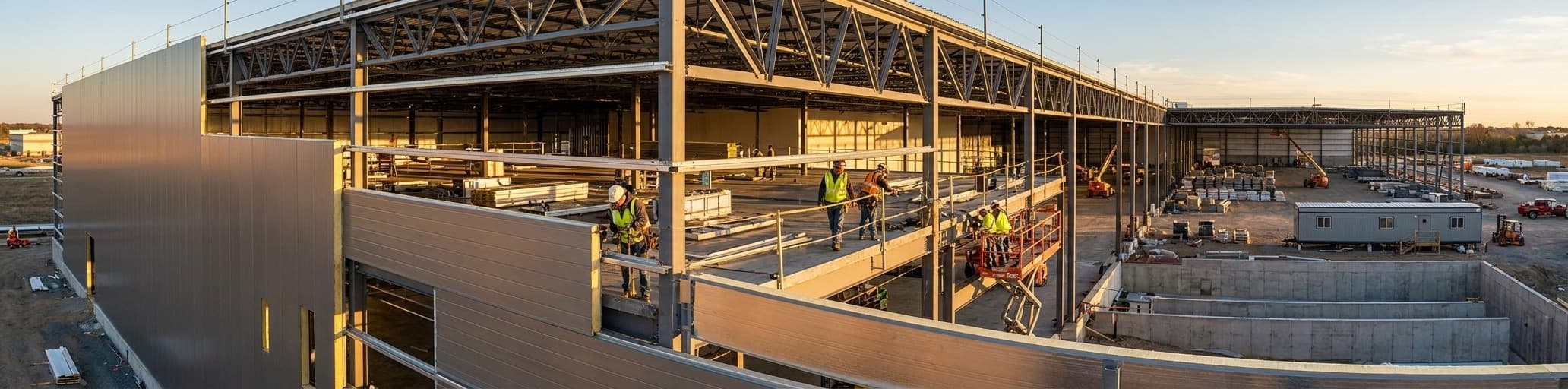

Cold storage construction costs range from $130 to $350+ per square foot in 2026, varying significantly by temperature zone and facility size. We help you understand how refrigeration systems, insulated envelopes, and regional factors compound these costs so you can budget confidently before breaking ground.
Cold storage warehouse construction costs in 2026: the direct answer
Cold storage construction costs $130-$350+ per square foot in 2026, with operating temperature as the primary driver of that wide range.
Current cost range for cold storage warehouse construction
Cold storage warehouse construction cost per square foot runs $130 to $350+ in 2026, depending on the temperature zone your facility must maintain.[1] The International Institute of Ammonia Refrigeration puts a tighter working range at $150-$250/sq ft for typical industrial cold storage, with refrigeration systems alone accounting for 25-35% of that total.[3] Both figures confirm a consistent market reality: cold storage costs two to three times more per square foot than standard dry warehouse construction, which runs $55-$175/sq ft.[2]
The widest variable in that range is operating temperature. Each step down in temperature requires heavier insulation, more powerful refrigeration equipment, and more complex vapor barrier systems, all of which compound the cost.
| Temperature zone | Operating range | Cost per sq ft |
|---|---|---|
| Refrigerated | 35-50 degreesF | $130-$210 |
| Frozen | -10 to 32 degreesF | $200-$285 |
| Blast freeze | Below -10 degreesF | $285-$350+ |
Soft costs add another 15-30% on top of hard construction, meaning architecture and engineering fees, permitting, insurance, and financing carrying costs are not captured in the per-square-foot figures above.[2] Budget for them separately before committing to a project number.
Why cold storage costs 2-3x more than standard warehouses
The premium over dry warehouse construction compounds from three distinct cost layers, not just one.
The refrigeration system is the most visible driver: high-efficiency units using CO2 or ammonia refrigerants carry substantial upfront capital costs, and refrigeration systems alone account for 25-35% of total hard construction costs in a typical cold storage build.[1] On top of that, the building envelope requires materials that standard warehouses never touch — insulated metal panels, polyurethane foam, high-performance vapor barriers, and continuous thermal breaks at every penetration.[5] None of these are interchangeable with conventional wall assemblies; each component must meet specific thermal performance and durability thresholds set by energy codes and, in food storage applications, local health department approval requirements.[1] The mechanical load then radiates outward into the rest of the building's infrastructure: refrigeration can account for up to 70% of a cold storage facility's total energy consumption, which forces a larger mechanical room footprint, heavier electrical service, and more complex power distribution than a comparable dry warehouse would ever require.[5] Cold storage demands insulated enclosures, high-performance vapor barriers, and specialized mechanical systems that push costs well above $150 per square foot — a floor that standard dry storage rarely approaches.[4] Put those layers together and the 2-3x multiplier isn't surprising; it's the arithmetic result of every major building system operating at a higher specification simultaneously.
How National Steel Buildings reduces per-square-foot costs through design-build efficiency
Design-build consolidates architecture, engineering, and construction under a single contract, eliminating the sequential design-then-bid timeline that adds 6-12 months to a cold storage project before the first structural column arrives.[6] When the same firm designs the building and manages construction, the structure gets engineered for efficient assembly from the start — rather than generating change orders when builders discover constructability problems post-bid.[7] Pre-engineered metal building (PEMB) frames, custom-manufactured to site-specific loads, cost 15-30% less than conventional steel framing and erect significantly faster, directly reducing the labor hours that inflate per-square-foot totals.[6] The Construction Industry Institute confirmed this dynamic across more than 350 projects: design-build outperforms design-bid-build on unit cost, cost growth, and schedule reliability, with design-build delivery now projected to account for 47% of U.S. construction spending during the 2022-2026 forecast period.[8] For cold storage specifically — where structural frames, refrigeration systems, insulated metal panel envelopes, and MEP infrastructure must all coordinate precisely — single-source accountability removes the gaps between subcontractors that generate a project's most expensive surprises, and design-build delivery compresses total project schedules by 15-30% compared to traditional methods.[6]
Cost Breakdown: What You're Actually Paying For in Cold Storage Construction
Insulated metal panels add $12 to $30 per square foot, but skipping proper thermal breaks costs you condensation, corrosion, and catastrophic floor failure within years.
Structural steel and insulation: The foundation of temperature control
The pre-engineered steel frame establishes the structural shell, but in cold storage construction the insulation envelope is where temperature control is actually built — and where a substantial share of your per-square-foot budget goes.
Cold storage facilities require insulated metal panels (IMPs) with polyurethane (PU) or polyisocyanurate (PIR) foam cores: typically 4 to 6 inches thick for cooler applications and 5 to 8 inches for freezer environments, factory-laminated between two steel skins.[9] These systems are not interchangeable with standard wall assemblies.
Every panel joint, penetration, and structural connection must incorporate a continuous thermal break; without it, condensation forms at cold spots, degrading insulation performance and accelerating steel corrosion from the inside out.[9] Understanding how insulation interacts with your metal wall and roof assembly is critical before you lock in a building spec, because IMP systems add $12 to $30 per square foot of wall and roof area compared to single-skin panels with batt insulation — which on a 20,000-square-foot building translates to $180,000 to $450,000 in envelope cost alone, before any refrigeration equipment enters the budget.[9] The floor assembly adds another layer of cold-specific cost: freezer rooms require a sub-slab heating system using glycol pipes or electrical resistance cables to prevent frost heave, because ice forming beneath an unheated slab can lift and fracture the entire floor within two years, generating repair bills that dwarf the original preventive installation cost.[10] Vapor barriers complete the thermal system; a continuous, properly sealed barrier at every wall, roof, and floor interface is the only defense against warm humid air infiltrating the conditioned space, condensing, and destroying insulation value while corroding the structural frame.[9] The steel frame itself — a pre-engineered rigid system — carries these cold-specific combined loads at 15 to 30% lower cost than conventional structural steel, and its factory-fabricated components integrate precisely with IMP panels when the frame and envelope are co-designed.[9] A frame specified in isolation from the panel system creates expensive field-fit problems; it is one of the clearest arguments for single-source design-build delivery on any cold storage project.
Refrigeration systems and controls: The largest variable cost component
Refrigeration systems account for 25-35% of total cold storage hard construction costs — the single largest variable in any project budget — with installed refrigeration running $65-$130 per square foot before structural, envelope, or site work enters the calculation.[11] That spread reflects three compounding decisions made in early design: refrigerant selection, compressor technology, and system sizing relative to actual thermal load.
On refrigerant choice, the regulatory math now strongly favors natural refrigerants.
HFC systems priced at $5-$8 per pound in 2015 now cost $20-$25 per pound as the EPA's AIM Act phases down HFC production 85% through 2036; a 10,000-pound refrigerant charge that was once a routine maintenance line has become a $100,000+ annual exposure for facilities locked into HFC equipment a decade ago.[11] Ammonia and CO₂ systems carry higher upfront capital costs but face no regulatory phase-down, and their efficiency advantage compounds over time: modern ammonia screw compressors deliver energy efficiency ratios 20-30% higher than older reciprocating designs, translating to $45,000-$65,000 in annual savings on a facility consuming 3 million kWh annually — a $1.1-$1.6 million differential over 25 years from one equipment decision.[11] Refrigeration also dominates operating cost: it accounts for 60-70% of a cold storage facility's total energy consumption, pushing annual utility costs above $400,000-$600,000 for a 100,000-square-foot building.[11] Controls represent a budget line that compressed bids frequently understate — a basic DDC panel runs roughly $2 per square foot while a full building automation system with fault-detection diagnostics reaches $5-$6 per square foot, a gap equal to $150,000-$200,000 on a 50,000-square-foot facility that typically gets decided in mechanical schematic before anyone has priced it explicitly.[11] Because the refrigeration plant must be sized to the building envelope's thermal performance, envelope and mechanical specs must be co-designed from the start: one Mountain West project demonstrated that upgrading wall panels from 4-inch to 6-inch insulated metal panels cut the refrigeration plant by 45 tons, saving $210,000 in equipment cost and more than covering the $140,000 envelope upgrade — a net budget reduction with better long-term operating efficiency built in.[11]
Electrical, HVAC, and specialized infrastructure: Hidden costs that add up fast
MEP systems — mechanical, electrical, and plumbing — represent 30-40% of total industrial construction cost, and cold storage amplifies every line item within that range.[12] The electrical service requirement alone separates cold storage from standard warehousing: refrigeration compressors, sub-slab heating systems, and automated controls pull substantially more power from the grid than conventional distribution facilities, which forces a larger transformer, heavier switchgear, and more complex power distribution infrastructure from the utility connection inward.[12] Transformer lead times have become a significant pre-construction risk — utility capacity must be confirmed during site selection, not design development, because a transformer procurement delay can hold up occupancy by months regardless of how quickly the building itself goes up.[12] Ductwork is another line that compressed bids routinely understate: standard galvanized sheet metal duct runs $7-$10 per square foot in an open warehouse, but cold storage and food-processing environments require coated or stainless-steel duct priced at $16-$24 per square foot — a gap of $6-$14 per square foot across every linear foot of distribution in the facility.[11] On a 50,000-square-foot building, that differential reaches $200,000 or more before anyone flags it explicitly in a budget conversation.
Beyond mechanical and electrical line items, cold storage carries a category of purpose-built infrastructure that standard cost-per-square-foot benchmarks rarely capture: glycol loop sub-slab heating systems, ammonia or CO₂ piping networks, blast freezer room assemblies, and the dedicated electrical circuits each of those systems requires.[13] These components frequently get depreciated on a 39-year schedule when they actually qualify for 5-year or 15-year cost recovery under IRS rules — meaning the financial impact of underestimating them extends well beyond the construction budget into long-term tax planning.[13] Reviewing your metal building HVAC and utility rough-in plan before structural design locks in is one of the clearest ways to prevent the retrofit costs that arise when conduit runs, equipment pads, and mechanical room footprints aren't sized to actual cold-storage loads from the start.
Cold Storage Cost Per Square Foot by Facility Size and Temperature Zone
Larger facilities spread fixed costs across more square footage, making a 50,000 sq ft cold storage build substantially cheaper per square foot than a 20,000 sq ft facility.
20,000-50,000 sq ft facilities: Per-square-foot pricing and economies of scale
Building size is the single largest lever on cold storage construction cost per square foot because fixed expenses — sitework, utility connections, project management, and soft costs — spread across a larger floor plate, pulling the unit cost down as square footage increases.[15] A 20,000 sq ft cold storage build carries a materially higher fixed-cost burden per square foot than a 50,000 sq ft facility sharing the same site, temperature zone, and structural system. For context on how that baseline shifts, a standard dry warehouse at the 50,000 sq ft scale in a market like greater Houston targets a hard construction cost of roughly $80 per square foot for shell and core systems before any cold storage infrastructure enters the budget.[15] Layering in refrigeration equipment, insulated metal panels, vapor barriers, and sub-slab heating systems pushes the all-in total substantially above that dry-warehouse floor — landing in the ranges by temperature zone established earlier in this article, with frozen applications at the higher end of the spectrum.
The 20,000-50,000 sq ft window also falls squarely within the size range where pre-engineered metal building (PEMB) systems deliver their strongest cost advantage: PEMB frames are fastest and most cost-effective for buildings under 50,000 sq ft, and faster erection compresses the labor hours on the critical path.[15] For cold storage specifically, that matters because refrigeration equipment, IMP envelope systems, and electrical infrastructure costs are largely fixed by specification — labor hours are one of the few line items you can meaningfully reduce through delivery method. Operators sizing into this range can also expect strong utilization once built: vacancy in sub-50,000 sq ft last-mile facilities sits near 4%, well below the 7.4% national industrial average, and refrigerated warehousing leads all warehouse types with a projected 9.85% CAGR through 2031 as pharmaceutical cold-chain mandates and fresh-food e-grocery flows drive demand.[14] Cold storage lease premiums reinforce the build case — refrigerated space commands $12-$15 per square foot in rent against ambient storage's $8-$10, a spread that accelerates payback on the higher per-square-foot construction investment.[14] Before locking in a footprint, comparing a mezzanine addition against a full building expansion can significantly affect your per-square-foot cost basis; this mezzanine vs. building addition ROI comparison breaks down how each approach changes long-term unit economics for cold storage capacity decisions.
100,000+ sq ft mega-warehouses: How bulk purchasing power drives down unit costs
At the 100,000-square-foot threshold, cold storage construction enters a different cost tier — one where fixed expenses stop punishing you and start working in your favor. For standard dry warehouse construction, large projects average roughly $75 per square foot compared to approximately $142 per square foot for smaller facilities, a gap of nearly 50% driven almost entirely by fixed costs spreading across a larger floor plate.[16] Cold storage never gets that cheap — refrigeration systems, insulated metal panel envelopes, and sub-slab heating don't scale away — but the same fixed-cost dilution effect meaningfully compresses the per-square-foot total at mega-warehouse scale.
Mobilization costs, project management overhead, utility connection fees, and engineering expenses are largely constant regardless of whether you're building 20,000 or 120,000 square feet; at six-figure square footage, those line items become a minor fraction of the total budget rather than a budget-distorting fixed charge.[17] Bulk material procurement amplifies the savings further: structural steel orders at mega-warehouse volume unlock manufacturer pricing tiers, panel runs become more efficient as crews hit repetitive rhythm on identical bays, and erection labor productivity improves measurably as ironworkers develop installation flow across thousands of identical connections.[9] Pre-engineered metal building frames reinforce every one of these advantages — factory-fabricated components reduce field labor by 25-40% compared to conventional structural steel, and that labor reduction compounds harder at larger square footages where labor hours represent the most variable line item in the budget.[9] The result is that while a 20,000-square-foot blast-freeze facility might land at the upper end of the $285-$350+ per square foot range, a 100,000-square-foot refrigerated distribution center with a sophisticated PEMB frame can realistically target the lower half of its temperature zone's cost band — provided the building is designed from the start to exploit repetitive bay spacing, consistent clear heights, and co-designed structural and envelope systems that eliminate costly field-fit corrections. For a realistic benchmark at this scale, the industrial warehouse cost breakdown by size shows how increasing square footage shifts the per-unit cost curve across facility types, which provides useful context before layering in cold storage premiums.
Cost estimator: Calculate your facility's likely construction range
Building a cold storage facility without a realistic cost range in hand before you talk to contractors is how budgets blow up before groundbreaking. Cold storage construction runs from US$241 to US$344 per square foot when converted from international benchmarks, and US$250 to US$350 per square foot in domestic industry data — a range that holds across most U.S. markets before regional adjustments are applied.[18][20] To translate those figures into a working budget, two variables matter most: the temperature zone your facility must maintain, and the total square footage you're building. Smaller buildings carry higher per-square-foot fixed costs; larger ones dilute site work, utility connections, and project management across more floor area, pulling the unit cost toward the lower end of each zone's band.[18] The table below applies the cost bands established by industry data to common facility sizes across all three temperature zones, giving you a starting range before regional factors are layered in.
| Facility size | Refrigerated (35-50 degreesF) | Frozen (-10 to 32 degreesF) | Blast freeze (below -10 degreesF) |
|---|---|---|---|
| 10,000 sq ft | $1.8M-$2.8M | $2.5M-$3.5M | $3.3M-$4.5M+ |
| 20,000 sq ft | $3.4M-$5.2M | $4.8M-$6.4M | $6.0M-$8.0M+ |
| 50,000 sq ft | $7.5M-$12.0M | $11.0M-$15.5M | $14.0M-$19.0M+ |
| 100,000 sq ft | $13.5M-$22.0M | $20.0M-$29.0M | $26.0M-$36.0M+ |
Region adjusts every number in that table — sometimes materially. California, which holds approximately 17% of U.S. cold storage capacity, carries above-average construction costs driven by high energy prices, strict building codes, and constrained land near port logistics corridors in Los Angeles and Oakland.[18] Texas, by contrast, offers relatively lower land costs and sits at approximately 7% of national cold storage revenue, with construction economics that favor new development near Dallas-Fort Worth and the Houston Gulf Coast hub.[18] The Southeast — particularly Georgia and Florida — benefits from strong port infrastructure at Savannah, Jacksonville, and Miami, with construction pricing that generally falls between the California premium and the Texas discount.[18] Rental rate benchmarks for cold storage operations run $8 to $25 per pallet per month depending on location and temperature zone, providing a useful cross-check when modeling the revenue side of a build-vs-lease decision.[20] Dry warehouse storage averages $1.73 per square foot per month nationally, against which cold storage commands a significant premium that reinforces the investment case for new construction in undersupplied markets.[19]
Reducing Cold Storage Construction Costs Without Sacrificing Performance or Durability
Engaging fabricators during early planning eliminates costly redesign penalties and delivers 15-35% material savings without compromising thermal performance.
Single-source design-build approach: Why it saves money compared to traditional multi-contractor models
The multi-contractor model has a built-in cost problem: design gets completed first, then contractors price it, then value engineering rewrites it.
Owners who follow that sequence routinely absorb 15-25% redesign penalties as late-stage specification changes force rework that an earlier-engaged construction partner would have caught during schematic design.[21] The procurement gap compounds the damage.
On a real 50,000-square-foot cold storage project, sourcing the structural frame directly from the fabricator rather than routing through an intermediary general contractor eliminated approximately $315,000 in markup — roughly 15% of total hard construction costs on that line item alone.[21] Direct manufacturer relationships for insulated metal panels and mechanical systems can deliver an additional 15-35% in material savings across the envelope and refrigeration package.[21] Engaging fabricators during early planning also opens value engineering conversations that cut specification costs without sacrificing thermal performance — conversations that never happen when design locks before contractors see it.[22] For cold storage specifically, where the refrigeration plant, insulated panel envelope, and structural frame must be co-designed to hit the right thermal load targets, single-source accountability means one team owns all three systems simultaneously, eliminating the gap-filling change orders that inflate multi-contractor budgets most severely.
Pre-engineered steel structures: How they cut labor time and material waste
Pre-engineered steel frames — whether truss-based or I-beam — compress the construction timeline because each component is manufactured off-site, delivered to specification, and assembled in sequence without the field-fabrication delays that inflate labor hours on conventional builds.[23] For cold storage, that speed matters: every day the structure isn't enclosed is a day refrigeration installation is pushed back on the critical path.
Beyond schedule, the structural geometry itself eliminates waste.
Truss frames require no interior support posts, which reduces the total material volume the project requires while simultaneously freeing the floor plate for rack systems, refrigeration equipment, and high-density pallet storage — none of which can be positioned around a column.[23] That clear-span capability scales without a corresponding cost penalty: truss structures can reach 300 feet in width at virtually any length, meaning you can size the facility to your actual operational need rather than constraining layout to whatever clear span a conventional framing system can deliver at your budget.[23] The combined effect — faster erection, less material, and a fully usable interior — is what makes pre-engineered steel the default structural system for operators trying to hold cold storage construction cost per square foot to the lower end of their temperature zone's range.
Regional cost variations: What to expect in California, Texas, and other key markets
Region is the multiplier that can swing your cold storage construction cost per square foot by 20-40% from the national baseline — and the direction of that swing depends almost entirely on three local factors: energy pricing, land availability near logistics infrastructure, and the depth of the regional subcontractor pool. California sits at the expensive end of this spectrum. The state holds approximately 17% of U.S. cold storage capacity, driven by Central Valley agricultural output and massive port complexes at Los Angeles/Long Beach and Oakland — but that dominance comes at a cost.[18] High energy prices and strict building codes for industrial refrigeration push construction economics above the national average, and cold storage lease rates in Los Angeles reflect the premium: triple-net rents run $28-$32 per square foot annually, the highest of any major U.S. market.[18] Texas occupies the opposite position. With roughly 7% of U.S. refrigerated storage revenues and relatively low land costs, the state offers more favorable new-development economics — particularly in the Dallas-Fort Worth corridor, where a deep subcontractor pool produces predictable cost structures, and in secondary markets like San Antonio and McAllen, where land and regulatory timelines are more forgiving than in core metros.[18][15] Dallas cold storage leases bear that out: triple-net rents run $15-$19 per square foot — roughly half the Los Angeles rate — which compresses required returns and makes new construction pencil at a lower pre-lease threshold.[18] The one Texas exception worth pricing explicitly is Houston, where floodplain requirements, windstorm ratings, and stormwater detention engineering add several dollars per square foot to structural and civil costs compared to inland Texas markets.[15]
Beyond California and Texas, the Southeast and Midwest form two distinct tiers that most cold storage developers underweight in early budgeting. Georgia and Florida together represent more than 10% of U.S. refrigerated storage revenue, with construction economics that generally fall between the California premium and the Texas discount — strong port infrastructure at Savannah, Jacksonville, and Miami drives consistent demand, but land costs and labor depth in secondary Southeast markets keep per-square-foot construction totals more manageable than coastal California.[18] The Midwest cluster — Illinois at approximately 5.4% of industry revenue, Wisconsin at roughly 4.8%, and Pennsylvania at around 6.2% — anchors the national food manufacturing and dairy cold chain, with construction pricing shaped by stable labor markets and proximity to Great Lakes trade corridors rather than port-driven land scarcity.[18] Washington state, at approximately 6.6% of revenue, represents a niche but material market driven by apple and potato exports and Pacific seafood cold chain volumes through Seattle-Tacoma.[18] Across all of these markets, the structural dynamic is the same: construction cost per square foot responds most to local energy rates (which directly size the refrigeration plant), land scarcity near port or distribution infrastructure (which affects site development cost), and subcontractor availability (which shapes labor productivity on the critical path). The table below captures the directional cost positioning of major U.S. cold storage markets before project-specific adjustments.
| Market | Cold storage rent (NNN/SF/yr) | Construction cost pressure | Key demand driver |
|---|---|---|---|
| Los Angeles, CA | $28-$32 | Highest | Port imports, Central Valley ag |
| San Francisco Bay Area, CA | Above average | High | Tech/pharma cold chain, port |
| Dallas-Fort Worth, TX | $15-$19 | Moderate | Sun Belt distribution, cross-border trade |
| Houston, TX | $15-$19 | Moderate-high (flood/wind premium) | Gulf Coast port, petrochemical exports |
| Atlanta, GA | Below CA average | Moderate | Port of Savannah, Southeast distribution |
| Miami/Tampa, FL | Below CA average | Moderate | Latin America produce imports |
| Chicago, IL | Near national average | Moderate | Food manufacturing, rail crossroads |
| Philadelphia/NJ, PA | Near national average | Moderate | Port of Philadelphia, NYC supply chain |
| Seattle-Tacoma, WA | Above national average | Moderate-high | Pacific seafood, apple/potato exports |
- Cold storage construction costs $130-$350+ per square foot in 2026, varying primarily by temperature zone and running 2-3 times higher than dry warehouse construction.
- Refrigeration systems account for 25-35% of total hard construction costs and 60-70% of operating energy consumption, making equipment selection a critical long-term financial decision.
- Building size significantly impacts per-square-foot costs: fixed expenses like site work and utilities spread across larger facilities, reducing unit costs by up to 50% at 100,000+ sq ft.
- Design-build delivery compresses project schedules 15-30% compared to traditional design-bid-build methods by eliminating coordination gaps between structural, envelope, and mechanical systems.
- Regional construction costs vary 20-40% from national baseline, with California's $28-$32/sq ft lease rates reflecting premium energy and building code costs versus Texas's $15-$19/sq ft rates.
- Soft costs add 15-30% to hard construction expenses for architecture, engineering, permitting, and financing, requiring separate budgeting beyond per-square-foot hard cost estimates.
- https://www.clarionconst.com/understanding-cold-storage-construction-costs-in-2025
- https://terrapincg.com/commercial-construction-costs
- https://irpros.com/the-true-cost-of-cold-storage-beyond-the-bid-price/
- https://www.foxblocks.com/blog/warehouse-cost-per-square-foot
- https://ticold.com/cold-storage-construction-cost-per-square-foot/
- https://terrapincg.com/news/cold-storage-construction-cost-2026
- https://www.korteco.com/construction-industry-articles/guide-warehouse-construction-costs/
- https://www.gray.com/what-is-design-build-delivery/
- https://terrapincg.com/news/pre-engineered-metal-building-cost-per-square-foot-usa
- https://www.durgesta.com/en/articles/cold-storage-warehouses-requirements-and-costs
- https://terrapincg.com/news/commercial-hvac-cost-per-square-foot-2026
- https://wrightconstructioninc.com/post/industrial-facility-construction-guide/
- https://www.senecacostseg.com/cost-segregation-refrigeration-buildings/
- https://www.mordorintelligence.com/industry-reports/north-america-warehousing-and-storage-market
- https://www.maxxbuilders.com/cost-per-square-foot-build-warehouse-texas/
- https://blog.pulpowms.com/warehouse-construction-cost
- https://www.maxxbuilders.com/texas-commercial-construction-cost-2025-2026/
- https://www.mmcginvest.com/post/refrigerated-storage-industry-analysis-in-the-us-current-market-and-outlook
- https://www.thefulfillmentadvisor.com/pallet-storage-costs-and-warehouse-storage-costs-per-month/
- https://olimpwarehousing.com/gulf-southeast-us-cold-storage-locations/
- https://www.ibeehivesteelstructures.com/blog/warehouse-building-cost/
- https://www.bigdirector.com/knowledge/cold-storage-steel-warehouse-benefits-design-cost-guide
- https://www.clearspan.com/news/reduce-warehouse-construction-cost-improve-efficiency/