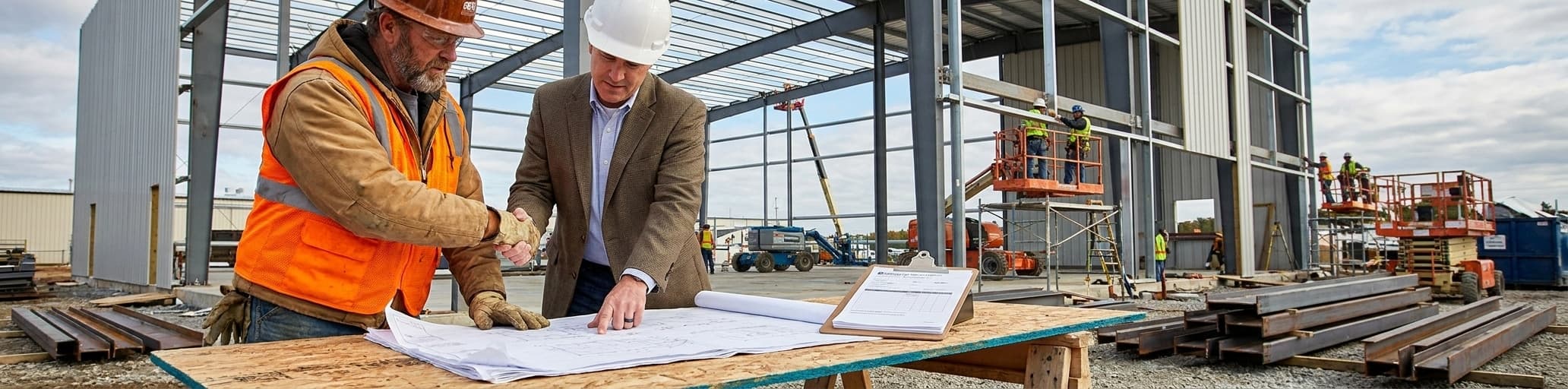

Vetting metal building contractors before hiring requires checking their supply chain control, communication responsiveness, licensing, insurance, and client references to avoid costly change orders and delays. Single-source design-build firms eliminate subcontractor handoffs, keeping your project accountable, on schedule, and within budget.
Why Local Metal Garage Builders Aren't All Equal–And Why Vetting Matters
Poor vetting leads to change orders, schedule delays, and permit violations that transform your initial quote into far costlier reality.
The hidden costs of hiring the wrong metal building contractor
The original quote is rarely the final cost. Change orders, schedule delays, and permit violations are the three budget killers that follow poor contractor selection — and none of them show up in the bid you sign.
The root cause is almost always inadequate pre-construction planning: when a builder skips thorough site evaluation or fails to nail down clear project specifications, problems that could have been caught on paper become expensive field corrections.[1] For property owners running commercial warehouses, agricultural facilities, or industrial operations, those corrections compound fast. An unplanned delay extends equipment rental periods, pushes back your operating timeline, and can trigger permit re-submissions or code-compliance redesigns you never budgeted for.[2] Contractors who depend on subcontractor networks instead of owning their crews introduce a second layer of exposure: every handoff is a point where communication breaks down, accountability gets diffused, and costs quietly shift onto you.[2] The consequences go beyond budget — structural problems from incorrect material selection, energy inefficiency from improper installation, and even legal disputes from unresolved subcontractor issues are all documented outcomes of hiring without proper vetting.[3] If you're evaluating local metal building contractors and the conversation never gets beyond price per square foot, that's your first warning sign.
How single-source design-build firms differ from general contractors juggling subcontractors
The structural difference between a design-build firm and a general contractor comes down to who controls the handoffs — and how many of them exist. In the traditional model, also called design-bid-build, your project moves through separate phases: a design team creates the plans, the GC puts the job out to bid, and subcontractors execute.
The GC has no contractual relationship with the designer and doesn't enter the picture until plans are finalized, which means field problems discovered during construction can't be caught earlier when they're cheap to fix. [4] A single-source design-build firm works differently: one contract covers design, engineering, fabrication, and erection, with all communication flowing through one point of contact. Because the builder is engaged from the first concept conversation, engineering decisions get made with real-time input on cost, constructability, and local site conditions — not flagged during a permit review weeks later. [4] That early integration matters more than it sounds.
When design and construction teams work together from the start, you get concurrent work, faster decision-making, and a clear accountability chain that runs straight to one firm rather than scattering across a subcontractor network. Studies have found the design-build approach can reduce project costs by 5.2% compared to design-bid-build — and for a commercial warehouse, agricultural facility, or industrial building where scope creep compounds fast, that gap adds up quickly. [5]
Building Your Pre-Hire Checklist: What to Ask Before You Sign
Ask your builder whether they fabricate components in-house or source through distributors, because supply chain control directly determines whether you face surprise costs and timeline delays.
Questions that reveal whether a builder owns their supply chain or relies on middlemen
The most revealing questions aren't about price per square foot — they're about where the steel actually comes from and who controls the schedule when global markets shift. Ask any builder you're considering: "Do you fabricate your own components, or do you source through a distributor?" and "How do supply disruptions affect your project pricing and delivery dates?" Steel prices currently remain roughly 50% above pandemic-era lows, and shipping delays can push timelines weeks or months beyond original projections — costs that flow straight to your budget when a builder buys materials on demand rather than managing procurement strategically. [6] Builders who own their supply chain will answer with specifics: mill relationships, inventory levels, and a clear explanation of how they lock in pricing between bid and delivery.
Builders relying on middlemen will hedge. The follow-up question — "Can you customize the building for my specific site conditions, or are you working from a fixed product catalog?" — reveals whether you're getting an engineered solution or an off-the-shelf kit presented as one. [7] Most buyers underestimate both hidden costs and the timeline exposure that comes with skipping this line of questioning altogether. [8] A builder who can name their steel source, describe their procurement approach, and give you a firm lead time isn't just more transparent — they're structurally less likely to hit you with a change order six weeks into your warehouse, hangar, or agricultural facility build.
Red flags in communication patterns that predict project delays or change orders
The pre-construction phase reveals more about a builder's communication habits than any contract will. If calls go unanswered, emails take weeks to receive responses, or appointment requests get rescheduled repeatedly before you've signed anything, those patterns don't improve once crews are on your site — they compound. [9] For commercial warehouse owners, agricultural facility operators, or aviation hangar developers, that translates directly into schedule disruptions during your most time-sensitive build phases, when delays are costliest to absorb. Vague scope definitions are the most reliable predictor of change orders you'll see.
A credible builder's proposal clearly outlines what's included, what isn't, and exactly how mid-project changes get handled — because unclear or incomplete project instructions cause mistakes and rework that hit both your timeline and your budget. [9] The concern isn't that change orders happen at all; unforeseen site conditions are a reality in metal building construction. The red flag is when a builder's pre-construction communication consistently produces surprises that a thorough planning conversation would have caught and priced upfront. If the scope of work reads vague before you sign, expect to see it monetized after.The pattern most property owners miss is the gap between a builder's office staff and their field crews — and how that gap widens when subcontractors enter the chain.
Poor information flow has delayed construction projects by as much as 302 days in documented cases, with the root cause almost always traced back to missed messages between office and field teams. [10] Ask any builder you're evaluating a direct question: how do scope changes get communicated to crews in real time, and does that process run through a single system or scatter across texts, emails, and calls from different parties? A builder who can answer that with specifics — named tools, defined roles, clear escalation paths — is structurally less likely to hit you with a change order six weeks into your build. One who hedges is telling you something important.
How to verify certifications, insurance, and past project references in your area
Certification verification takes minutes when you know where to look. Ask any builder you're considering for their state contractor license number, the exact license classification, and the expiration date — then confirm those details directly through your state's licensing portal rather than taking their word for it. Most states publish real-time license status online; Connecticut's eLicense portal, for example, lets you search active and inactive licenses by individual or business name in seconds. [12] For pre-engineered metal building systems specifically, manufacturer erector certifications carry equal weight — they affect both warranty validity and installation standards. You can verify whether a builder holds current International Code Council (ICC) credentials through the ICC's public certification search, which tracks renewal status since certificates must be updated every two to three years through retesting or professional development. [13] A builder who can hand you their license number, certification references, and expiration dates without hesitation is structurally more accountable than one who tells you to trust the bid.Insurance documentation follows the same rule: get it in writing before any site work starts.
Request a certificate of insurance (COI) that explicitly lists general liability coverage for third-party property damage and workers' compensation for on-site injuries — then verify the policy limits and effective dates directly with the insurer listed on the document. [11] Uninsured or underinsured contractors can transfer liability for accidents, structural failures, or on-site injuries directly to you as the property owner, which is a risk no commercial warehouse operator, agricultural facility owner, or aviation hangar developer should absorb. Keep the COI, the insurer's contact details, and your verification confirmation together in your project file so there's no ambiguity if a claim arises months into the build.References tell you what contracts can't. When you contact past clients — and you should contact at least two or three from local metal building contractors you're seriously evaluating — skip the general satisfaction questions and focus on specifics: How did they handle permit submissions and inspections? When an unexpected site condition appeared, what did resolution look like and did it come with surprise charges?
Were punch-list items closed without a fight? [11] The most revealing reference question is about warranty claims: who handled them, how fast, and whether the contractor made the process easy or difficult. A builder with 10 completed warehouse projects and three references who describe consistent follow-through on warranty service is telling you far more than any credential on paper.
Why National Steel Buildings Stands Out in the Metal Garage Builder Market
One project manager and unified ownership eliminate costly design-build gaps, cut field fitting time by 40%, and keep budgets and timelines intact through permit approval.
Single-source turnkey advantage: design, fabrication, and in-house erection under one roof
The single-source model eliminates the most expensive variable in metal building construction: the gap between what one party designs and what another party builds. When design, fabrication, and in-house erection run under one contract and one project manager, engineering decisions get made with real-time input on constructability and cost — not flagged during a permit review or discovered once crews are already on your site. Pre-engineered components arrive numbered, pre-drilled, and ready to bolt together, cutting field fitting time by 40% compared to structures assembled from separately sourced materials. [14] That speed is structural, not incidental — it comes from owning the entire process rather than coordinating between parties with competing schedules and diffuse accountability chains. A sole-source contractor takes over the entire project coordination, so you don't deal with various subcontractors, suppliers, and planners yourself — which is what keeps both budget and timeline from fracturing. [15]For commercial warehouse operators, agricultural facility owners, aviation hangar developers, and retail or religious property owners searching for metal garage builders near me — from New Jersey to Philadelphia and beyond — that distinction matters most when variables stack up.
Site conditions shift. Permit requirements vary by county. Snow load specs differ by region. A builder who controls design through erection can absorb those variables without generating change orders, because the same team that engineered the solution is the one putting it up. [14] Beyond erection, that single-source structure extends to permitting: pre-engineered steel buildings produce stamped engineering drawings and component specs before you file, giving building departments exactly what they need for fast approval — and catching zoning conflicts during design, not after you've paid for drawings that won't work. [14] Running site prep and fabrication in parallel — while steel fabricates over three to six weeks, crews clear, grade, and set anchor bolts — means your pad is ready the moment components arrive.
No idle foundations. No steel sitting in storage. [14] If you want to understand how that coordination plays out at the foundation level before erection begins, the slab-and-erection sequencing guide for a 20×40 footprint breaks down the five-phase timeline in detail. Every handoff — from the engineer's drawing to the field crew's wrench — runs through one accountable team, which is the clearest structural guarantee that your project stays within budget and on schedule. [15]
1,480+ completed buildings and the difference constant communication makes
The BBB complaint record for the metal building industry reveals a consistent pattern: the same three communication failures appear in nearly every dispute. A property owner reports a leak and calls twice a week for over a month, only to receive repeated promises with no crew showing up — answers that amount to 'when we get done with the next job.' [16] Foundation dimensions get passed incorrectly from a sales rep to a customer, resulting in a six-inch concrete gap around the building's entire perimeter, with the builder deflecting responsibility instead of fixing it — leaving the owner unable to move forward at all. [16] Color specifications travel from a sales team through a subcontractor the buyer didn't know was involved, and when the wrong panels go up, there's no direct accountability chain to resolve it cleanly. [16] These aren't isolated incidents — they're the predictable outcome of a model where sales, office, and field crews operate as separate parties with no single communication thread running through all of them.What 1,480+ completed buildings represents is the accumulated result of solving that problem at the structural level, not project by project.
Every building in that count means a permit filed and approved without a surprise county rejection, a crew that showed up on the scheduled date, a phone call answered when site conditions shifted unexpectedly, and a warranty issue addressed before the owner had to mention legal counsel. The difference isn't effort — it's architecture.
When design, fabrication, erection, and post-construction service all run through one team and one accountable contact, the communication chain stays short enough to actually function. Subcontractor handoffs are where information distorts; eliminating them is what keeps your warehouse, agricultural facility, or hangar project on schedule and within budget rather than generating the disputes that a fragmented model produces at scale. [16]
How to start your vetting process with a builder you can trust
The fastest way to separate credible metal building builders from noise is to ask for three things before any technical conversation starts: a current BBB rating, written warranty documentation, and two to three references from completed projects similar in scope to yours. [17] A builder who stalls on any of those three items has already answered your most important question.
Once you clear that baseline, shift to timeline exposure — what's the current lead time from signed contract to component delivery, and how does that window hold when steel markets shift? [18] Most buyers underestimate both hidden costs and time commitment when they skip this line of questioning early, and the gap shows up in change orders rather than the original bid. [8] When you do contact references, the single most useful question is about warranty follow-through: who handled the claim, how fast, and whether the resolution required a fight.
A builder with consistent, documented warranty service across completed warehouses, agricultural facilities, or commercial builds tells you more about their accountability structure than any credential on paper. [17] If you're searching for metal garage builders near me and want to start that process with a team that controls design, fabrication, and erection under one roof — with one phone number, one contract, and one accountable contact from site evaluation through final inspection — that's exactly how National Steel Buildings is built to work.
- Poor contractor selection leads to change orders, schedule delays, and permit violations that don't appear in initial bids due to inadequate pre-construction planning.
- Design-build firms reduce project costs by 5.2% compared to traditional design-bid-build models by integrating design and construction teams from the start.
- Verify contractor licenses, certifications, and insurance directly through state portals and insurers rather than accepting builder claims at face value.
- Communication patterns during pre-hire vetting predict on-site performance; unresponsive builders typically worsen after contract signing.
- Builders who fabricate components in-house and control their supply chain avoid costly change orders from material sourcing and pricing disruptions.
- References should focus on specific outcomes like permit handling, warranty claims resolution, and how unexpected site conditions were managed.
- Single-source contractors eliminate costly gaps between design and construction by keeping all handoffs within one accountable team.
- https://ddcon.co/metal-building-failures-common-mistakes-in-metal-building-construction-and-how-to-avoid-them/
- https://mccowngordon.com/beware-of-budget-breakers-the-hidden-costs-of-hiring-the-wrong-contractor/
- https://pro.houzz.com/pro-learn/blog/startup-guide-residential-construction-common-mistakes
- https://bciconstruction.us/design-build-and-general-contractors-whats-the-difference/
- https://southwestdesignandconstruction.com/Blog/Post/2624/General-Contractor-vs-Design-Build-Contractor
- https://metalcon.com/blog/metal-supply-chain-disruptions-how-contractors-and-fabricators-can-manage-market-volatility/
- https://cbfcontractinginc.com/top-8-questions-to-ask-a-prefabricated-metal-building-contractor/
- https://buildway.com/questions-to-ask-a-metal-building-supplier/
- https://www.homeauthorityinc.com/resources-contractor-red-flags/
- https://contractorforeman.com/from-missed-messages-to-construction-project-delays-breaking-the-cycle/
- https://ibarraconstructionservices.com/10-proven-tips-for-choosing-trusted-metal-building-providers/
- https://portal.ct.gov/dcp/verify-a-license
- https://www.iccsafe.org/search-for-certified-professionals/
- https://nationalsteelbuildingscorp.com/blog/turnkey-farm-building-construction-that-keeps-you-in-the-field
- https://www.elkayinteriorsystems.com/blog/the-benefits-of-a-single-source-general-contractor
- https://www.bbb.org/us/fl/stuart/profile/steel-distributors/us-national-steel-0633-92035465/complaints
- https://www.rhinobldg.com/blog/vetting-a-metal-building-company
- https://solidstatesteel.com/10-essential-questions-to-ask-before-starting-your-steel-building-project/