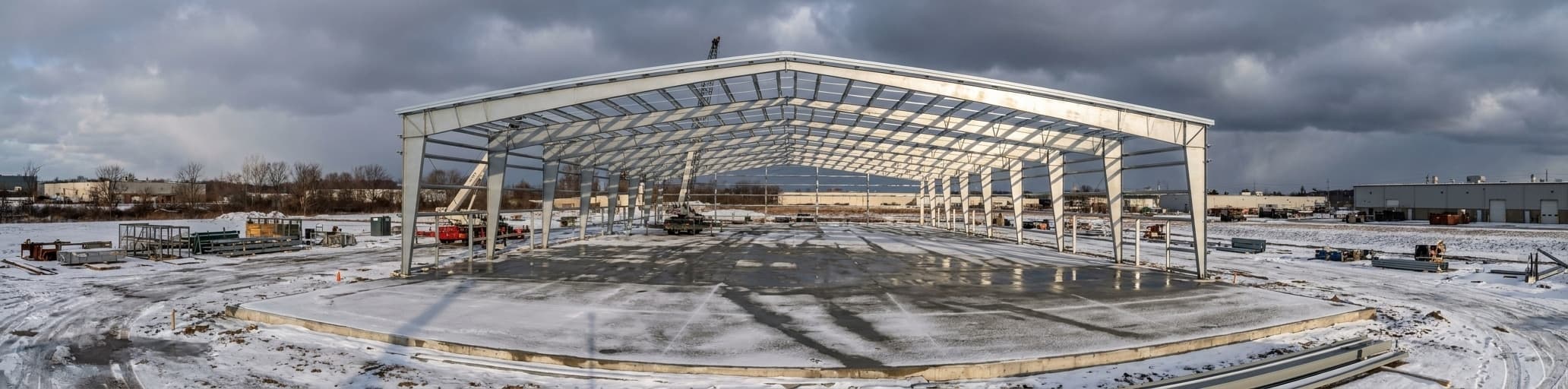

Erie property owners can compare steel building costs and benefits against traditional construction while understanding local permitting and site-specific requirements. We help you budget accurately by breaking down all cost components upfront, eliminating surprise invoices and ensuring your project stays on schedule.
Why Erie, PA Property Owners Choose Steel Buildings for Commercial & Industrial Projects
Erie's multiple-contractor licensing requirement inflates traditional builds, but pre-engineered steel cuts trade coordination costs by reducing on-site licensing dependencies and scheduling conflicts.
Erie's Climate & Environmental Demands on Building Materials
Cost Advantages of Pre-Engineered Steel vs. Traditional Construction in Northwestern PA Traditional construction in Erie carries a coordination cost that rarely appears on an initial bid. Erie's contractor licensing ordinance requires separately licensed master contractors for each trade involved in a project — general construction, mechanical, electrical, plumbing, structural steel, sheet metal, concrete, and more — with each firm carrying a minimum of $500,000 in general liability insurance per occurrence.[3] Every licensed trade added to a job site introduces its own scheduling dependencies, overhead markups, and potential for costly delays when one contractor's timeline slips into another's.
Pre-engineered steel buildings cut through that layered cost structure directly. Because the primary structure arrives as a factory-engineered kit, the number of on-site trades required to complete the building envelope drops sharply compared to a wood-frame or masonry build — fewer permits, fewer licensed contractor mobilizations, and fewer opportunities for coordination failures to inflate the final invoice.[3] For Erie property owners comparing steel buildings prices against conventional construction bids, that reduction in trade count is often where the most significant budget relief appears, and it's a factor that quoted cost-per-square-foot figures rarely make visible until a project is already underway.
Single-Source Solutions: From Design to Erection in the Erie Region
Coordinating separate vendors for materials, fabrication, and installation is where Erie projects lose time and money.
The regional supply chain for metal roofing and structural components in Northwestern Pennsylvania is well-established — suppliers serving Erie County deliver steel panels and roofing materials in as little as two days — but a fast parts supplier is not the same thing as a coordinated build partner.[4] A single-source approach means one point of contact owns the entire sequence: engineering drawings, permit-ready fabrication packages, material delivery, and erection crew scheduling.
When a standing seam panel needs to be field-cut to minimize waste on a non-standard eave condition, or when an installation crew hits an unexpected site constraint, a single-source partner resolves it in hours rather than waiting for three separate vendors to respond.[4] For Erie property owners who want the project done right the first time, working with a Pennsylvania steel builder who controls design, fabrication, and erection under one contract eliminates the coordination gaps that inflate budgets and extend timelines on multi-vendor builds.
Steel Building Types & Applications for Erie Businesses
Erie's 39,400 manufacturing and logistics jobs drive demand for steel buildings that clear-span warehouses and erect faster than conventional construction when seasonal deadlines demand speed.
Commercial Warehouses & Distribution Centers: Meeting Erie's Industrial Growth
Erie's industrial sector creates direct, measurable demand for large-span warehouse and distribution space.
Trade, transportation, and utilities employ 20,300 workers across the metro area, while manufacturing — anchored by Wabtec's rail equipment production and advanced operations in plastics and transportation components — accounts for another 19,100 jobs, both figures stable as of September 2025.[5] Erie County's GDP reached $14.2 billion in 2023, with active freight and logistics movement underpinning that output.[5] Pre-engineered steel buildings match what those operations need: clear-span framing removes interior columns that restrict equipment movement, standard bay depths align with pallet racking and forklift clearance requirements, and a factory-fabricated shell erects faster than concrete tilt-up — a meaningful advantage when a logistics operator is racing a seasonal freight deadline or a manufacturer needs added capacity mid-production cycle.
For Erie businesses evaluating steel buildings prices against the cost of conventional warehouse construction, the speed advantage alone often justifies the comparison before a single square-foot cost is calculated.
Agricultural Storage & Equipment Buildings for Western PA Farms
Farms across Erie County and western Pennsylvania need structures that handle multiple functions without compromise — feed and hay storage, machinery housing for tractors and combines, and livestock shelter often need to coexist under one roof.[6] Post-frame pole barns have filled that role since the 1930s, and farmers continue to choose them because they deliver large-span space at a relatively low entry cost.[6] The real issue for Erie-area operations, though, is long-term performance under lake-effect conditions.
Wood posts set in soil absorb ground moisture through freeze-thaw cycling, and the cumulative maintenance load — straightening posts, repainting panels, replacing rotted sills — adds up faster in Erie's climate than in drier agricultural regions.[6] Pre-engineered agricultural steel buildings address that directly: steel-framed structures carry the same clear-span footprint that farm work demands, eliminate the rot and pest vectors that shorten wood frame service life, and arrive as factory-engineered kits with customization built into the original design — oversized sliding doors for wide equipment, ventilation configurations for livestock, lean-to additions for covered staging — rather than field modifications that require re-engineering after the fact.[6]
Aviation Hangars & Specialized Structures for Erie International Airport
General aviation operations at municipal airports in the Erie region share a consistent set of structural demands that steel buildings are engineered to satisfy. Airport data from Erie's municipal facility indicates most flight operations consist of light single-engine aircraft and some helicopter activity, with a larger turbo-prop such as a King Air or Cheyenne representing the upper end of typical traffic — aircraft rated against a 12,000-pound single-axle load limit.[7] That operational profile defines the hangar footprint directly: clear-span steel frames in the 60- to 80-foot width range accommodate those aircraft without interior columns obstructing tug paths, wing clearance zones, or maintenance access from either side.
The FAA formula applied to Erie's municipal airport yields approximately 35,000 annual takeoffs and landings, with most movements concentrated on weekends, meaning hangar doors and apron access points absorb repeated daily cycling through Erie's full seasonal range — lake-effect snow, spring freeze-thaw, and summer humidity — all conditions that accelerate corrosion and joint fatigue in non-steel frames.[7] Pre-engineered steel envelopes with factory-applied coatings hold up against those cycles without the paint and sealant regimen that wood or aluminum-clad structures require on an annual basis. Beyond the primary hangar bay itself, aviation facilities typically incorporate attached office and pilot lounge space, parts storage rooms, and separate bays for avionics or maintenance work — all configurations that cold-formed steel framing accommodates as integrated additions rather than field-modified afterthoughts, keeping the building permit package unified and the project timeline on schedule from the start.[7]
Retail, Religious & Residential Steel Structures in Erie
Steel frames aren't limited to warehouses and hangars in Erie. Retail owners, religious congregations, and residential builders are increasingly choosing steel for the same core reasons industrial operators do.
Steel-framed structures are significantly more energy-efficient than traditional wood-framed buildings, which reduces operating costs on heated retail spaces and year-round occupied church facilities.[8] For a congregation managing a fixed budget, that gap in energy bills compounds meaningfully across decades of occupancy. Clear-span framing opens sanctuary floor plans and retail showrooms without load-bearing interior walls — giving designers flexibility that wood framing can only match with expensive engineered beam packages.[8] Cold-formed steel also resists the fire, moisture, and pest exposure that shortens wood-framed residential service life under Erie's lake-effect humidity.
Custom steel-framed homes and commercial structures arrive as factory-engineered kits tailored to specific project requirements, whether that means a storefront with a full glass frontage, a church addition matched to an existing facade, or a residence built to meet current Pennsylvania energy codes — all without field modifications that require re-engineering after fabrication.[8]
Steel Building Costs in Erie, PA: What to Expect & How to Budget
Budget $42,468-$92,600 total for a 40×60 steel building in Erie, including the kit, concrete slab, labor, and insulation.
Pricing Breakdown: 40×60 Metal Building with Slab Installation
A 40×60 steel building gives you 2,400 square feet of clear-span space — enough for a mid-size warehouse, farm equipment bay, commercial shop, or aviation maintenance area.[9] The structure itself is only one line item. Before you can use the building, you also need a concrete slab, erection labor, insulation, and any access and utility rough-ins specific to your Erie operation. Quoting only the kit price and comparing it against a traditional construction bid is how Erie projects end up with surprise invoices at the halfway mark.
The major cost components for a standard 40×60 pre-engineered steel building with slab break down as follows:
| Cost component | Typical range | Notes |
|---|---|---|
| Steel building kit | $22,868 – $48,000 | Varies by gauge, door package, and certification level |
| Concrete slab foundation | $10,000 – $14,000 | $4-$6 per sq ft; engineered to match building spec |
| Erection labor | $7,200 – $24,000 | $3-$10 per sq ft depending on complexity and location |
| Insulation (fiberglass vinyl-faced) | $2,400 – $6,600 | R-13 single-layer to R-30 double-layer system |
| Doors, windows, and trim extras | 5-10% of kit cost | Each window or door package adds roughly 5% to total |
The steel kit price drops on a per-square-foot basis as footprint grows. A 30×40 structure runs roughly $9.60 per square foot for the basic frame, while a 40×60 typically lands near $7.50 per square foot — a direct benefit of economies of scale in fabrication.[9] That reduction matters in Erie, where snow load engineering adds structural requirements that would push a smaller building's per-square-foot cost higher. Transportation is a separate variable: manufacturers sometimes bundle freight costs when delivery aligns with nearby shipments, which can reduce total freight expense by approximately 6-8% if timing is flexible.[9]
The concrete slab is non-negotiable for a 40×60 structure and must be professionally engineered to match the anchor bolt pattern in your building's stamped drawings.[9] Slab scope in Erie carries additional site considerations — clay-heavy soils common to Erie County affect bearing capacity, and frost depth requirements for Northwestern Pennsylvania drive slab thickness and reinforcement specs beyond what warmer-climate estimates reflect.[10] Budget the foundation as a separate, site-specific line item rather than applying a national average and expecting it to hold.
Insulation is the cost component Erie buyers most frequently underestimate. A basic R-13 single-layer vinyl-faced fiberglass system runs roughly $0.50 per square foot in materials, while a high-performance R-30 double-layer system reaches $1.50 per square foot — putting total material cost for a 40×60 between $1,200 and $3,600 before labor.[11] Add installation labor at $0.50 to $1.25 per square foot and the all-in insulation cost for the building lands between $2,400 and $6,600.[11] For a heated Erie shop or warehouse, proper insulation typically pays back in energy savings within two years — a meaningful return in a climate where lake-effect winters drive heating loads significantly higher than statewide averages.[11]
30×50 Steel Building Costs & Erie-Specific Factors That Affect Price
Finding Quality Used Steel Buildings vs. New Construction in Erie Used or surplus steel buildings show up on the Erie market periodically, and the entry price looks attractive until you examine what condition-related discounts actually cost you at installation.
The durability case for new pre-engineered steel is straightforward: factory-applied wall and roof coatings on new buildings are designed to retain color, resist dirt, and extend service life without repainting — and steel itself does not support mold growth, warp, split, crack, or creep under load.[13] A used building's coatings, fasteners, and sealants may have already degraded, particularly under Erie's lake-effect humidity and freeze-thaw cycles.
Simpson Steel's maintenance framework applies here as a diagnostic lens: inspecting fasteners, sealants, and flashing annually and addressing scratches with approved touch-up, primer, and paint is standard ongoing care for any steel structure — but with a used building, you're inheriting whatever inspection history the previous owner kept, or didn't.[14] A new pre-engineered kit eliminates that uncertainty: labeled components fit as intended, engineering drawings are current and permit-ready, and the structure is calibrated to your specific site loads from the start rather than adapted from a footprint designed for a different location.[14] Erie Brewing Company's 19,000-square-foot metal building in Erie — housing a brewery, main bar, pizzeria, gift shop, and event area — illustrates what a correctly specified new steel structure delivers over the long term: a facility built to a program, not a compromise between what was available and what was needed.[13] For most Erie property owners, the gap between a used structure's discounted price and the cost of re-engineering, re-coating, and re-permitting it to meet current Pennsylvania code closes faster than the initial quote suggests.
Choosing the Right Steel Building Partner in Erie: National Steel Buildings' Advantage
National buying power cuts material costs while local erection expertise navigates Erie's tight seasonal window and permitting requirements without delay.
Local Permitting, Code Compliance & Inspection Timelines in Erie County
National Buying Power + Local Erection Expertise: ProTrades LLC Advantage National buying power changes the material cost equation before a single panel ships to your Erie site.
When a steel building manufacturer operates at national volume, contracted pricing on mill-direct steel — rather than spot-market procurement — reduces the kit cost by a measurable margin, and freight consolidation further trims per-project delivery expense when your order ships alongside other regional builds.[14] What national sourcing cannot replace, however, is the local code familiarity and crew scheduling that determine whether a kit erects cleanly once it arrives.
Pre-engineered kits are specifically designed so labeled components fit as intended and installation crews spend more time installing and less time improvising in the field.[14] That efficiency matters acutely in Erie, where the erection window between late freeze-thaw cycles in spring and early lake-effect snow in fall is narrow, and choosing a steel erection crew that already knows Northwestern Pennsylvania's permitting conventions — stamped submittals, local authority review timelines, UCC compliance documentation — keeps a project on schedule rather than waiting for back-and-forth between an out-of-state fabricator and a local building official.[14] Erie Brewing Company's 19,000-square-foot metal building in Erie — housing a brewery, main bar, pizzeria, gift shop, event area, and barrel room, built into a hillside to capture Lake Erie views — is a concrete example of what a correctly coordinated national-supply, local-erection build delivers: a facility built to a specific program and finished to a consistent standard, not adapted from components designed for a different site.[13]
How to Request a Custom Quote & Start Your Erie Steel Building Project
Before you contact a steel building supplier, gather four pieces of information that determine how accurate your first quote will be: your Erie County parcel address (which fixes the municipal jurisdiction and zoning district), your intended use (warehouse, hangar, agricultural, retail, or mixed), your required clear-span footprint and eave height, and any known utility or access rough-in requirements.
With those details in hand, a supplier who operates under one roof — handling design, fabrication, and erection as a single coordinated scope — can deliver a tailored solution rather than a generic kit price that unravels when site-specific factors enter the picture.[18] The goal is to work closely with a partner who understands your specific needs and provides custom solutions that enhance operational efficiency from the outset, not after costly field modifications are already underway.[18] For Erie projects in particular, confirm upfront that the quote reflects current Pennsylvania snow load requirements for Erie County's lake-effect zone, the correct municipal permit track for your address, and full erection labor — not just the material kit.
A quote built on those four inputs gives you a number you can budget against with confidence, not a placeholder that grows by 30% once site conditions are priced in.
- Erie's contractor licensing requirements for multiple trades add significant coordination costs that pre-engineered steel buildings reduce by requiring fewer on-site contractors.
- Steel buildings cost $7.50 per square foot for a 40×60 structure, but total project costs including slab, labor, and insulation typically range from $42,468 to $92,600.
- Erie's lake-effect climate causes wood-frame structures to deteriorate faster than in drier regions, making steel's corrosion-resistant properties more valuable long-term.
- A complete steel building quote must include concrete slab, erection labor, insulation, and utilities–kit price alone underestimates total project cost by 30% or more.
- Working with a single-source builder who handles design, fabrication, and erection eliminates coordination gaps and resolves field issues in hours rather than days.
- Proper insulation in heated Erie buildings typically pays back in energy savings within two years due to higher lake-effect winter heating demands.
- New pre-engineered steel buildings eliminate uncertainty from used structures by providing current engineering drawings, factory coatings, and permit-ready specifications.
- https://carport1.com/states-service-area/pennsylvania-pa/erie-pa/
- https://www.reimagineroofing.com/blog/pennsylvanias-2025-2026-building-code-update/
- https://ecode360.com/40593696
- http://hillsidemetals.com/
- https://grokipedia.com/page/economy_of_erie_pennsylvania
- https://pioneerpolebuildings.com/services/agricultural-pole-buildings/
- https://www.erieco.gov/faq
- https://gdiengdesign.com/steel-structure/
- https://quonsethutkit.com/40×60-metal-building-cost-prices/
- https://www.northtexassheds.com/steel-building-cost-guide
- https://steelbuildinginsulation.com/40×60-insulated-metal-building-cost/
- https://homeguide.com/costs/pole-barn-prices
- https://ruralbuildermagazine.com/crafting-metal-building-systems-for-breweries-and-distilleries/
- https://simpsonsteel.com/ohio-steel-buildings/
- https://ecode360.com/44157635
- https://www.pa.gov/agencies/dli/programs-services/labor-management-relations/bureau-of-occupational-and-industrial-safety/uniform-construction-code-home/ucc-municipal-code-change-ordinances
- https://www.lawrenceparktwp.org/ordinances/part-12-planning-and-zoning-code/1286-supplementary-regulations/
- https://www.amgindustries.com/erie-metal-fabrication/