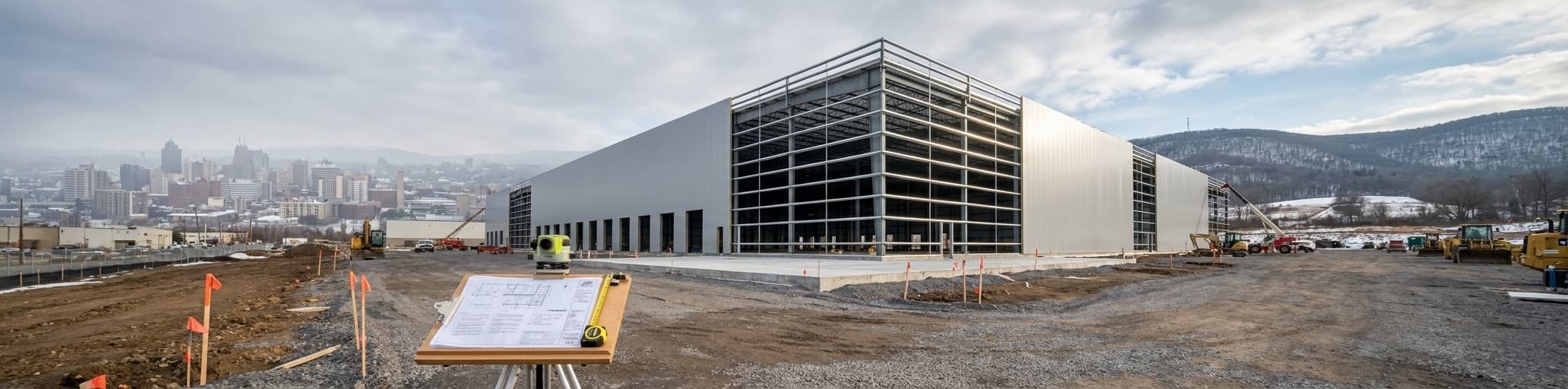

Pennsylvania steel building costs range from $15 to $45 per square foot based on size, county location, and weather-driven load requirements that directly affect frame specifications. We help you lock material pricing, navigate permit timelines, and avoid costly redesigns by confirming snow loads and engineering requirements before fabrication begins.
Pennsylvania Steel Building Prices & Cost Factors
Pennsylvania steel building costs range from $15 to $45 per square foot, with your county location and project size determining where you'll land within that range.
County-by-County Price Ranges for Popular Sizes
Pennsylvania steel building prices range from $15 to $45 per square foot depending on size, materials, and local market conditions.[1] That spread is wide enough to matter at budget time, and the county you build in — urban Philadelphia versus rural Sullivan, for example — directly affects where your project lands within it. Labor rates, material availability, and local permitting processes all influence the final number.[1] The table below maps commonly requested sizes to their realistic Pennsylvania price ranges.
| Building size | Sq ft | Base kit range | Turnkey installed (PA est.) |
|---|---|---|---|
| 30×40 | 1,200 | From ~$12,000 | $18,000-$36,000 |
| 40×60 | 2,400 | ~$48,000 | $60,000-$108,000 |
| 60×80 | 4,800 | ~$96,000-$115,000 | $120,000-$216,000 |
| 100×150 | 15,000 | $375,000-$525,000 | $525,000+ |
Small shells — roughly 30×40 — start around $12,000 for a basic structure, while medium buildings in the 40×60 range sit near $20 per square foot for materials and climb toward $25-$45 per square foot once foundation and installation are included.[2] Large-footprint structures like a 100×150 warehouse or hangar carry a steel-package price of $25-$35 per square foot, which puts the kit alone between $375,000 and $525,000 before any site or labor costs.[3] You can review how Pennsylvania's climate specifications — particularly snow and humidity requirements — compound these base prices in the Pennsylvania steel building climate specs guide.
Beyond size, county location is the biggest lever on your final number. Metro counties like Allegheny and Philadelphia carry higher labor rates and permit fees than agricultural counties such as Lancaster or Centre.[1] Site preparation — clearing and grading — runs $1,000-$5,000 statewide, but expect costs toward the upper end in denser counties.[1] Permit fees in Pennsylvania range from $200 to $2,000, and commercial projects in high-density counties routinely hit that ceiling.[1] Building wider also costs more than building longer, so a 60×40 footprint will carry a higher price tag than a 40×60 footprint at the same square footage — a detail worth flagging before you finalize dimensions.[2]
Snow Load & Wind Speed Upcharges Explained
Snow loads and wind speeds translate directly into fabrication costs — not vague "local conditions" line items on your quote.
Because steel building pricing moves with factors like local wind and snow loads, frame strength, and geographic location, the same footprint can cost meaningfully more or less depending on your county.[4] Fabricators adjust frame weight, column spacing, and connection strength to hit the required load ratings, so heavier specs mean more steel and a higher kit price.[5] For a structure in the 60×80 range, weather factors including wind load and snow load rank among the top cost drivers alongside roof style and wall height.[5] PA's northern and central regions require roofs engineered for heavy snow and ice accumulation — adding to material weight and therefore to your steel package price — while lower-elevation southeastern counties fall into lighter load categories.[6] A building spec'd for a standard wind zone elsewhere will need heavier steel to clear a Pennsylvania inspection in a high-snow county; when your site sits in those northern tiers, budget toward the upper end of any quoted range rather than the floor.[4] Knowing your county's required load values before you order is what keeps the project within budget once the engineering drawings come back stamped — the 30×30 Pennsylvania permit code checklist shows exactly which load figures inspectors verify during plan review.
How to Lock-In 2024 Steel Prices & Avoid Tariffs
The Section 232 tariff on imported steel doubled from 25% to 50% in June 2025, then expanded in August 2025 to cover derivative products including pipes, tubes, wire, and fasteners.[8] Even buildings sourced from U.S. mills aren't shielded: when imported steel costs more, domestic producers face less competition and raise their own rates — that pass-through effect lands on your quote regardless of origin.[8] A 40×60 building that priced below $35,000 before the original tariffs climbed to around $40,000 as costs worked downstream, and prices have shifted again since.[8] Waiting for rates to fall rarely saves money; tariffs tend to stay in place for years, and supplier prices often hold even when policy softens.[8] The practical answer is to lock your material price before fabrication starts rather than bet on a reversal that may never arrive.[8] Three actions protect your Pennsylvania steel building budget:
- Confirm how tariffs appear in your quote before signing. Reliable suppliers disclose exposure upfront; others advertise pre-tariff pricing and recover the difference through change orders after you've committed.[8]
- Ask about fixed-price contracts or staged-purchase agreements that freeze steel costs before engineering drawings are finalized.[7]
- Request a written price-hold window from your supplier and track material pricing regularly so you know exactly when a quoted figure expires.[9]
Building a long-term relationship with a steel building manufacturer in Pennsylvania who communicates tariff exposure clearly — and backs quotes with transparent contract language — is the most effective hedge available to a property owner without a commodities desk.[7]
Pennsylvania Snow Loads & Engineering Requirements by County
Your engineer–not your county–determines the ground snow load value that drives your steel frame weight and column spacing across Pennsylvania's snow gradient.
Eastern PA Snow Load Map (Philadelphia to Scranton)
Ground snow load — the code term for the weight of snow your roof must structurally carry — is the number that drives frame weight, column spacing, and ultimately your steel package price. Pennsylvania enforces these values through the Uniform Construction Code, which adopts the International Building Code statewide via the Department of Labor & Industry.[10] Under IBC Section 1608.2, ground snow loads for Pennsylvania are established through ASCE 7, and design professionals are required to pull values from Figure 1608.2 of the IBC or develop site-specific loads for any county designated a "Case Study" area — the state does not publish its own supplemental load tables.[12] That means your engineer, not your county assessor, is the one who stamps the load value on your drawings.
Across eastern Pennsylvania, load requirements shift dramatically on a south-to-north axis. Southeastern counties in the Philadelphia metro region fall at the lighter end of the state's range — approximately 25 psf — while moving northeast toward Scranton and Lackawanna County pushes ground snow loads substantially higher as elevation rises through the Pocono foothills and ridge-and-valley terrain.[10] The table below maps that gradient across the eastern corridor so you can see at a glance where your county sits before engineering drawings are ordered.
| Region | Representative counties | Approximate ground snow load (Pg) |
|---|---|---|
| Philadelphia metro | Philadelphia, Delaware, Montgomery | ~25 psf |
| Greater Reading / Lehigh Valley | Berks, Lehigh, Northampton | Confirm via ASCE 7 Fig. 1608.2 |
| Pocono highlands | Monroe, Pike, Carbon | Confirm via ASCE 7 Fig. 1608.2 |
| Scranton / northeast PA | Lackawanna, Wayne, Susquehanna | Higher — Case Study area likely applies |
Two engineering details matter more than the raw Pg figure when you're specifying a steel building in Pennsylvania. First, ground snow load is not the same as roof snow load — ASCE 7 converts Pg into a roof design load by applying exposure, thermal, and importance factors that can push the final number higher or lower depending on your building's use and site characteristics.[10] Second, drift loads created by parapet walls, roof step-downs, or adjacent structures can exceed the uniform roof snow load by a wide margin and are a documented cause of partial roof collapse in commercial projects.[10] For eastern PA steel buildings from the Philadelphia suburbs northward through Scranton, design your frame for both the uniform snow case and the drift case — not just the simpler number on the map.
Western PA Snow Load Map (Pittsburgh to Erie)
Western PA's load environment differs from the eastern corridor in one critical way: lake-effect snow. Erie County sits directly downwind of Lake Erie, and as cold air masses cross open water they pick up moisture that dumps far above regional averages when the air hits land.[10] The City of Erie has written that reality into its municipal construction ordinance — the local minimum ground snow load for structural design is 40 psf, codified alongside a 48-inch frost depth requirement.[13] Counties in the northwestern tier that share lake-effect exposure can reach or exceed 60 psf, placing them among the highest-load jurisdictions in Pennsylvania.[10] Pittsburgh's Allegheny County sits at considerably lower values given its inland position and southwestern elevation, but urban density creates its own hazard: parapet walls common in Pittsburgh commercial districts concentrate drift loads that can exceed the uniform roof snow load by a wide margin, and ASCE 7 demands separate drift calculations any time roof geometry or adjacent structures create accumulation potential.[10]
The table below maps the western corridor from Pittsburgh north to Erie so you can see where your county lands before engineering drawings are ordered.
| Region | Representative counties | Approximate ground snow load (Pg) |
|---|---|---|
| Pittsburgh metro | Allegheny, Beaver, Washington | Confirm via ASCE 7 Fig. 1608.2 |
| Central western PA | Butler, Lawrence, Mercer | Confirm via ASCE 7 Fig. 1608.2 |
| Erie city (locally amended) | Erie | 40 psf (municipal minimum) |
| Lake-effect northwestern tier | Crawford, Venango, Forest | Up to 60 psf+ — Case Study area likely applies |
For steel buildings in Pittsburgh and the surrounding metro, the drift case is often the governing design condition — not the uniform snow value on the ASCE 7 map — because IBC Section 1608.2 and the underlying ASCE 7 methodology apply exposure, thermal, and importance factors that can push the final roof design load above the raw Pg figure depending on building use and site characteristics.[11] Two steps protect your budget in this corridor: first, confirm whether your municipality has locally amended the minimum ground snow load above the statewide IBC baseline, as Erie has done and other lake-belt jurisdictions may have as well;[13] second, if your structure includes a parapet wall, a roof step-down, or sits adjacent to a taller building, require your engineer to run a full ASCE 7 drift analysis alongside the uniform snow case before fabrication begins — drift loads are a documented cause of partial roof collapse in commercial projects.[10]
Certified vs. Non-Certified Buildings–What Inspectors Want
The distinction Pennsylvania inspectors draw first is whether your building package includes PE-stamped engineering drawings. Under the state's Uniform Construction Code, steel buildings require engineering drawings and foundation plans demonstrating compliance with structural, fire, energy, and occupancy codes — a kit sold without that stamp is a materials order, not a compliant building.[14] The International Building Code, which Pennsylvania adopts statewide, assigns every structure a Risk Category that determines exactly which load thresholds your certified drawings must prove.[16] Category I covers low-occupancy structures such as open carports, farm storage sheds, and barns not intended for regular human use.[16] Category II is the standard for enclosed garages, workshops, and retail or commercial spaces with regular occupancy.[16] Category III governs high-importance facilities — churches, gyms, fire stations — and carries the strictest wind, snow, and seismic compliance requirements of the three.[16] Inspectors use the assigned category to verify that your frame was engineered to the correct load resistance; submit the wrong category and you face plan-review rejection, mandatory redesign costs, or outright permit denial before a single anchor bolt is set.[16]
A non-certified building — sold without PE-stamped drawings — shifts that compliance burden onto you after purchase, and it costs more to fix than to avoid. Getting drawings stamped retroactively requires an engineer to reverse-engineer the kit's actual load capacities and confirm they meet local requirements, a process that adds both time and fees on top of what you've already spent.[14] Pennsylvania municipalities and counties manage permitting directly, and code officials routinely reject plan submissions that lack professional-engineer certification on structural, foundation, and load documents.[14] Before you commit to any package, confirm that certified, PE-stamped drawings are included — not available as an add-on — and ask your supplier which Risk Category the building is engineered for and whether that matches your intended use.[16] For a quick look at how those code requirements translate into a real permit checklist, the 30×30 commercial building code checklist for Pennsylvania permits maps out exactly what plan reviewers verify during submission.
Pennsylvania Building Permits & Zoning by County
Misclassifying your steel building as agricultural versus commercial at permit application triggers costly corrections, so verify your structure's designation against both zoning and intended use before submitting.
Permit Essentials for Allegheny, Philadelphia, Lancaster & York Counties
Agricultural vs. Commercial Classifications–Tax & Permit Differences The classification your steel building carries — agricultural or commercial — splits your project into two different regulatory tracks before a single anchor bolt is set. In Pennsylvania, agricultural zoning authority derives from the Municipalities Planning Code of 1968, which allows local governments to designate parcels A-1 (agricultural) and restrict non-agricultural construction on those properties.[20] A steel equipment barn or grain storage building on A-1 land typically moves through a lighter permit path than a commercial warehouse at the same footprint — but the classification isn't automatic, and misidentifying your structure at the application stage costs time and money to correct.[20]
On the tax side, holding an agricultural zoning designation alone doesn't qualify a property for farming tax exemptions.[20] Pennsylvania's Clean and Green program lowers property tax assessments on qualifying agricultural, woodland, or open-space parcels — but enrollment is voluntary, requires a minimum of 10 contiguous acres, and doesn't prevent the eventual sale or development of the land.[22] The IRS defines a farm as property actively cultivated for profit, while the USDA sets its baseline at $1,000 in annual agricultural product sales.[20] Your steel building's intended use needs to align with whichever definition governs the exemption you're claiming — a structure used for commercial storage on A-1 land can trigger reassessment if the use doesn't match both the zoning designation and the active tax election.[20]
The permit gap between the two classifications is sharpest at plan review. Commercial building permits require construction documents signed and sealed by a registered Pennsylvania design professional, plus review by a certified third-party agency before the municipality will accept a permit application.[21] Agricultural structures — open equipment sheds, livestock barns, and storage buildings not designed for regular human occupancy — often fall below that threshold under local ordinances. Lancaster and York counties, where Agricultural Protection Zoning districts are most concentrated, apply these distinctions consistently across their 65-plus APZ municipalities.[22] The table below maps the key differences so you know what to confirm with your township before drawings are finalized.
| Factor | Agricultural classification | Commercial classification |
|---|---|---|
| Zoning designation | A-1 under Municipalities Planning Code | Commercial, industrial, or mixed-use zone |
| Property tax program | Clean and Green (voluntary, 10-acre minimum) | Standard assessment; no agricultural reduction |
| PE-stamped drawings required | Often not required for exempt farm structures | Required — signed and sealed by PA-registered design professional |
| Third-party plan review | Typically not required for exempt structures | Required before municipal permit application |
| Occupancy standard | Low or no regular human occupancy | Regular occupancy; full UCC compliance required |
For agricultural steel buildings in counties like Lancaster, York, Berks, and Chester — where APZ districts cover hundreds of thousands of acres — confirming your structure's classification before engineering begins is the single step most likely to keep your project within budget and on schedule.[22]
Timeline & Cost to Get a PA Building Permit (Real 2024 Data)
Pennsylvania routes commercial steel building permit applications through the Department of Labor & Industry or the administering municipality, and the clock starts the moment you submit — incomplete drawings reset it.[24] Standard commercial projects in incorporated cities typically take 3-6 weeks for plan review and approval, while complex projects or those requiring variances stretch to 8-16 weeks.[23] High-volume metro counties run 6-12 weeks even for routine structures, and each resubmittal cycle adds another 2-4 weeks on top of the original queue.[23] Expedited review is available in some jurisdictions for 50-100% above the standard fee, cutting the queue to 3-5 business days where the option exists — worth asking about if your delivery window is fixed.[23] The table below maps realistic review timelines by project type so you can align contractor scheduling and steel delivery without building in false assumptions.
| Project type | Jurisdiction type | Realistic plan-review window |
|---|---|---|
| Residential accessory structure | Rural or unincorporated | 1-2 weeks |
| Small commercial (under 5,000 sq ft) | Suburban municipality | 3-6 weeks |
| Standard commercial or industrial | Incorporated city | 3-6 weeks |
| Large commercial or complex structure | High-density metro (Allegheny, Philadelphia) | 6-12 weeks |
| Projects requiring variance or conditional use | Any jurisdiction | 8-16 weeks |
Permit fees in Pennsylvania follow three structures depending on the municipality: valuation-based fees at roughly $8-$15 per $1,000 of construction value, square-footage-based fees running $0.10-$0.50 per square foot, and flat fees of $300-$800 for smaller jurisdictions.[23] A $150,000 commercial steel building project in a valuation-based county produces a base permit fee of approximately $1,200-$2,250 at those rates — before zoning, stormwater, or utility review fees, which often run as separate parallel processes that add time regardless of how fast the structural drawings clear.[23] Total permitting costs for steel buildings range from $200 to $3,500 statewide, with rural agricultural counties at the lower end and dense urban counties near the ceiling.[23] Locking in your prefab building kit delivery timeline before permit submission keeps the project within budget and on schedule: engineering drawings are typically completed 2-4 weeks after order placement, which means you can open the permit window before fabrication begins and avoid idle time waiting for steel once the permit clears.[23]
Why National Steel Buildings Wins in Pennsylvania
Skip the regional distributor markup and get factory-direct pricing, shorter lead times, and a single accountable contact for your Pennsylvania steel building project.
Factory-Direct Delivery to All 67 PA Counties
Factory-direct delivery removes the regional distributor from your supply chain — and with it, the markup layer that compounds an already tariff-pressured quote.
Steel building kits ship as prefabricated, pre-cut components directly to your installation site, whether your county is in the Philadelphia metro, the Pocono highlands, or rural Sullivan.[25] Suppliers with statewide PA reach cover every corner of the state, from dense urban counties like Allegheny down to low-density agricultural counties like Fulton or Forest, without routing materials through a middleman who adds cost without adding value.[26] For commercial, industrial, and agricultural buyers, that directness translates into three concrete advantages: predictable material pricing locked at the factory rate, shorter lead times because components aren't staged at a regional warehouse, and a single point of contact accountable for both the kit and the delivery schedule.[27] If you choose to erect the building yourself, prefab kits arrive with pre-marked components and step-by-step instructions — no installation crew to schedule, no coordination lag.[25] If you want turnkey installation, factory-certified contractor networks cover all 67 PA counties with licensed, insured crews who already know your building's engineering drawings before they arrive on site.[26] Either path keeps the project within budget and on schedule from the day your order is placed.
Free On-Site Consultations with PA-Licensed Engineers
Pennsylvania requires all third-party agencies providing Uniform Construction Code services to be certified by the Department of Labor & Industry before performing commercial plan approvals or inspections — and that certification applies to the engineers backing those approvals, not just the firms submitting paperwork.[28] Structural engineering licensing exists specifically to protect public safety and uphold professional standards, with individual licensure requiring verified education, examination, and experience — not simply a PE credential issued in another state.[29] Firms providing structural engineering services in Pennsylvania must also satisfy state-level firm licensing requirements separate from individual licensure, which means verifying credentials at both levels before your project starts.[29] Your building certifications confirm that structural quality has been verified by an engineer licensed for your jurisdiction — without that stamp, a commercial permit submission is rejected before plan review begins.[30] What an on-site visit captures that a phone quote can't: soil conditions that drive foundation depth and slab specification, roof geometry exposing your structure to drift loads from adjacent buildings or parapet walls, and any locally amended load minimums above the statewide IBC baseline your township enforces.[28] Resolving those variables before engineering drawings are ordered eliminates redesign fees and resubmittal cycles that add weeks to your schedule — which is exactly the kind of detail covered in our steel building contractors near me vetting guide if you're still assembling your project team.
Getting it right the first time keeps your steel buildings Pennsylvania project within budget and on schedule from the day fabrication starts.
Rent-to-Own & 100% Financing with No Credit Check
Rent-to-own (RTO) is the right path when a Pennsylvania steel building project makes financial sense but traditional bank financing is off the table due to a low credit score.[33] The program works as a lease-purchase agreement: you pay a small upfront amount, then split each monthly payment between a lease service fee and the building's base price — the lease portion runs roughly 20% of the total cost.[33] No credit check is required, approvals come the same day, and you can start using your building immediately after installation without waiting for all payments to clear.[31] Payment terms run from 36 to 48 months, and you can pay off early at any point with no penalty — every early payment reduces the lease fees you'd otherwise owe.[31] Delivery and installation are included in the final quoted price, so the figure you agree to at signing covers everything that shows up on site.[31] For buyers with stronger credit who prefer conventional lending, a same-as-cash option is available on buildings up to $50,000 with 3-, 6-, and 12-month terms — worth comparing against your bank's offer before you commit.[32] The table below maps the two paths side by side so you can identify which fits your situation before drawings are ordered.
| Factor | Rent-to-own (RTO) | Same-as-cash / conventional |
|---|---|---|
| Credit check | Not required | Required |
| Approval speed | Same day | Days to weeks |
| Payment term | 36-48 months | 3, 6, or 12 months (same-as-cash) |
| Early payoff | Anytime, no penalty | Per agreement terms |
| Building access | Immediate after installation | Immediate after funding |
| Delivery & installation included | Yes | Yes |
| Max building price (same-as-cash) | N/A | Up to $50,000 |
One detail worth flagging before you sign any RTO agreement: read the full contract, not just the monthly payment figure.[33] Lease service fees vary by supplier, and the total amount you pay over 36 months will exceed the building's base price by the fee percentage — knowing that number upfront is what keeps the project within budget and avoids sticker shock mid-contract.[33] Customization options — roof style, insulation, door configurations, color — are available regardless of which payment method you choose, so the financing path doesn't limit what you can build.[33]
- Pennsylvania steel buildings cost $15-$45/sq ft; county location and snow loads are the biggest budget drivers.
- Ground snow loads vary dramatically across PA: Philadelphia metro ~25 psf, northeast highlands much higher, Erie County 40 psf minimum.
- Drift loads from parapets and roof geometry often exceed uniform snow loads and are a documented cause of roof collapse.
- PE-stamped engineering drawings are required for all commercial permits; kits without them shift compliance costs onto you retroactively.
- Steel tariffs doubled to 50% in mid-2025; lock material prices before fabrication rather than waiting for rates to fall.
- Agricultural vs. commercial classification splits your permit path; confirm before engineering to avoid costly redesigns.
- Plan review timelines range 3-6 weeks for routine projects to 6-12 weeks in metro counties; expedited review costs 50-100% more.
- https://rockymtncontractors.com/blog/what-are-average-expenses-for-custom-pole-buildings/
- https://www.vikingsteelstructures.com/blog/what-is-the-average-cost-of-a-40×60-metal-building?srsltid=AfmBOorWfznjATY-QUo7_1zC2n0sdKX5ry9XC7q90eYU3GbtirTnLucz
- https://titansteelstructures.com/steel-building-services/how-much-does-a-100×150-steel-building-cost/
- https://www.aametalbuildings.com/metal-buildings/metal-building-prices?srsltid=AfmBOoom3063gnEHjclY14gd9DSMLdlsXJ1NUTODyndiZt4D34EwplYm
- https://sunwardsteel.com/pennsylvania/
- https://masonsteelcorp.com/steel-buildings-in-pennsylvania/
- https://eoxs.com/new_blog/the-ultimate-guide-to-mitigating-steel-price-volatility-in-2024/
- https://gensteel.com/resources/infographics/how-steel-tariffs-affect-your-building-price/
- https://www.procore.com/library/construction-tariffs
- https://gundersonengineering.com/snow-load-requirements-pennsylvania/
- https://up.codes/viewer/pennsylvania/ibc-2018/chapter/16/structural-design
- https://www.pa.gov/agencies/dli/programs-services/labor-management-relations/bureau-of-occupational-and-industrial-safety/uniform-construction-code-home/advisories
- https://ecode360.com/33839313
- https://reddirect.com/blog/zoning-permitting-steel-buildings-pa-oh-wv/
- https://www.iccsafe.org/
- https://www.getcarports.com/metal-building-risk-categories-explained?srsltid=AfmBOoqlrOuKQwiVAyS_tzwaRbuqiR0–6aw79sr1q3HPzmr5xYpl9cb
- https://www.pa.gov/agencies/dli/programs-services/labor-management-relations/bureau-of-occupational-and-industrial-safety/uniform-construction-code-home
- https://www.pittsburghpa.gov/Business-Development/Permits-Licenses-and-Inspections/Building-Codes
- https://www.permitvelocity.com/resources/pennsylvania-building-permits
- https://extension.psu.edu/farmland-zoning/
- https://www.northfayettepa.gov/434/Residential-Building-Permits
- https://library.weconservepa.org/guides/67-agricultural-protection-zoning
- https://www.metal-buildings.org/metal-building-permits-and-codes/
- https://reichconstructionllc.com/united-states-pre-engineered-steel-buildings-50-states-guide-faqs/
- https://www.americanmetalbuildings.com/pennsylvania-metal-buildings/?srsltid=AfmBOopCi4b73SdITuQB_h5Rp0-6Z3tn-cBve5P06EgyzMaM5GHaad3B
- https://ironbuiltbuildings.com/steel-buildings-pennsylvania-2/
- https://www.metalbuildingoutlet.com/pennsylvania/
- https://www.pa.gov/agencies/dli/programs-services/labor-management-relations/bureau-of-occupational-and-industrial-safety/tpa-buildings
- https://www.harborcompliance.com/structural-engineering-license
- https://www.vikingsteelstructures.com/blog/how-to-obtain-metal-building-permits-and-certifications?srsltid=AfmBOoocS5WftgOvYaafsLTHgmV7HLVFpGgGIqVOe6GXnW06CfA67uUa
- https://www.vikingsteelstructures.com/clear-span-metal-buildings-pennsylvania-pa?srsltid=AfmBOopJiBFw0_xhjHZhxjC0gArrw3aOkX8fjIm2r6EufFWLGZ0HOIY1
- https://www.vikingsteelstructures.com/metal-barns-pennsylvania-pa?srsltid=AfmBOoqoZNLtD_WTRddsKsGSKxxuEo66G92WAnvmTmUoQ8OP8kT7zeSm
- https://www.vikingbarns.com/blog/rent-to-own-the-flexible-way-to-own-a-metal-building