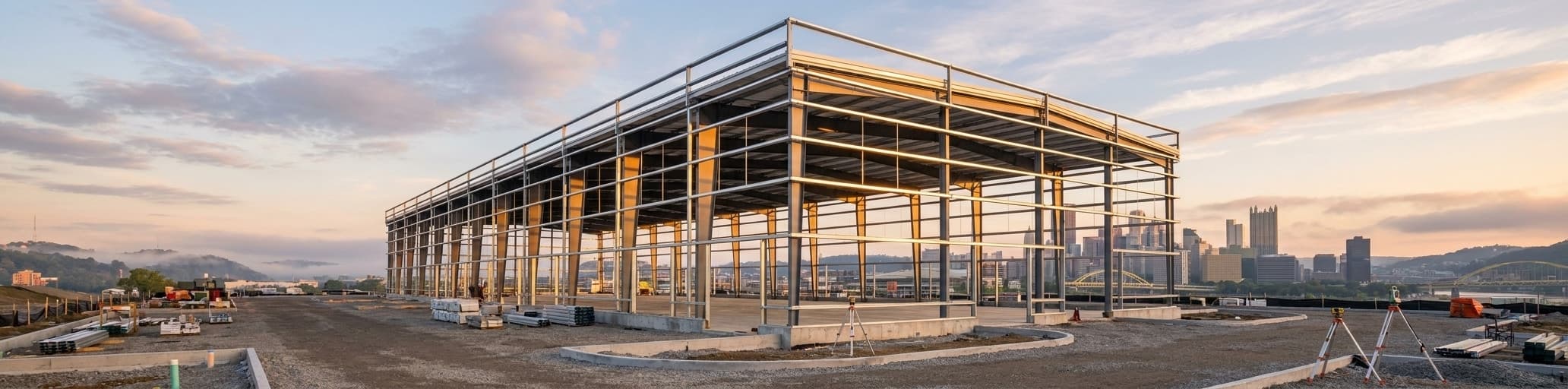

Pittsburgh property owners can compare steel buildings against traditional construction methods and understand local cost factors, permits, and timelines. We help you secure faster erection schedules, lower long-term maintenance costs, and single-source accountability that keeps projects on budget.
Why Pittsburgh property owners are choosing steel buildings over traditional construction
Steel buildings in Pittsburgh deliver economy of scale at $25 to $40 per square foot, with prefabricated designs that lock in costs before construction begins.
Pittsburgh's climate demands durable, low-maintenance structures
The economics of steel vs. wood and concrete in Western Pennsylvania The cost comparison between steel, wood, and concrete in Western Pennsylvania involves both upfront construction costs and total cost of ownership (TCO).
Initial cost studies of multi-residential structures found that projects using concrete masonry units with precast concrete flooring were the least expensive structural system compared to steel or wood frames at the point of construction–though concrete's fire and damage resistance can offset that initial advantage over a building's lifetime.[4] Wood frame construction moves faster and draws on widely available labor, but it lacks concrete's damage resistance and carries higher long-term maintenance exposure in Pittsburgh's freeze-thaw cycles.[6] For commercial and industrial owners who need to maximize volume and cubic footage per dollar, steel delivers the best economy of scale: a pre-engineered steel shell runs roughly $25 to $40 per square foot, with a fully installed building–including site prep, foundation, and finishes–ranging from $100 to $300 per square foot depending on local conditions, labor rates, and customization level.[5] Pittsburgh-specific factors like snow load requirements and complex site conditions add cost to any structural system, but prefabricated steel designs incorporate those engineering specs before fabrication rather than resolving them as change orders after work begins–keeping your project within budget from the start.[5]
How National Steel Buildings delivers single-source solutions locally
The core value of a single-source model is what it prevents.
When one provider manages design, fabrication, and erection under a single contract, it eliminates the scheduling conflicts and finger-pointing between suppliers and subcontractors that routinely drive up costs on multi-vendor builds.[8] Self-performing the key scopes gives that provider direct control over project management, cost, and quality from the first pre-construction meeting through the final inspection — rather than depending on separate trades to interpret engineering drawings independently.[7] A dedicated project manager stays engaged at every phase, coordinating with architects, general contractors, and other parties on-site even when portions of the scope involve additional specialists.[8] In Pittsburgh, where UCC compliance, heavy snow-load engineering, and site complexity add friction at every project phase, that streamlined accountability keeps your build on a firm schedule and within budget — without requiring you to manage coordination between competing vendors yourself.[7]
Steel Building Applications for Pittsburgh Businesses and Farms
Steel buildings compress your Pittsburgh warehouse timeline by eliminating the 4-to-8-week concrete foundation lead time while maximizing usable floor space without interior columns.
Commercial Warehouses and Distribution Centers
Pre-engineered metal buildings hold a clear cost and schedule advantage for Pittsburgh warehouse and distribution projects under roughly 80,000 square feet — the size range where tilt-up concrete's panel-repetition economics simply don't kick in.[9] For most commercial warehouse builds in that range, the national average construction cost runs $80 to $150 per square foot, with a 50,000-square-foot facility typically landing between $4 million and $7 million depending on specifications, site conditions, and regional labor rates.[10] Labor alone accounts for 20 to 30 percent of total warehouse construction cost, and utilities — electrical, HVAC, water, and waste systems — add another $10 to $30 per square foot on top of the structural shell.[10] Steel's advantage in Pittsburgh's warehouse market comes down to three concrete factors: faster erection timelines that compress labor exposure, a clear-span interior that maximizes usable floor area without internal columns interrupting rack layouts or dock staging, and a building envelope that doesn't require the 4-to-8-week foundation-and-casting-bed lead time tilt-up concrete demands before vertical structure can begin.[9] For distribution operators managing tight occupancy deadlines or e-commerce tenants who need to be operational before peak season, that schedule compression is often worth more than the per-square-foot cost differential alone.
You can see how warehouse construction costs scale by building size to understand where a pre-engineered steel shell delivers the sharpest per-square-foot value for your specific footprint.
Agricultural Storage, Barns, and Equipment Buildings
Farm operators in Western Pennsylvania face a specific version of the durability problem: machinery, hay, and livestock can't wait through a mid-season structural repair, and a roof failure during a February ice storm isn't a theoretical risk.
Steel barns engineered for regional snow and wind loads arrive with stamped pre-engineered plans ready for permitting–structural calculations resolved before fabrication, not negotiated on-site after the footings cure.[11] A 100% clear-span interior with zero interior posts means a 40×60 steel barn can store 250 to 300 round bales or park a full-size harvester without routing around support columns that would otherwise interrupt bale stacks and equipment lanes.[11] Steel also resists the fire, pest, and mold damage that compound repair bills on wood-frame barns exposed to Pittsburgh's wet winters and humid summers–a difference that adds up: steel typically saves 30 to 50% in lifetime maintenance costs compared to wood-frame construction.[11][12] For equipment shelters and hay storage where a dirt or gravel floor works, a pier foundation system reduces excavation cost by anchoring columns to concrete piers rather than a full poured perimeter, which keeps site-prep budgets in check on rural properties.[12] From initial order to completed structure, the design-to-installation process for a pre-engineered agricultural steel building typically runs under eight weeks–short enough to hit a planting-season or harvest-season deadline without scheduling risk.[11]
Aviation Hangars for Pittsburgh-Area Airports
Pittsburgh's aviation infrastructure is actively expanding, and hangar demand is following.
The Allegheny County Airport Authority has pursued state grant funding specifically for a hangar project at Pittsburgh International, signaling that private and charter operators near the region are outpacing existing covered aircraft storage capacity.[13] Allegheny County Airport (AGC), located roughly 10 miles southeast of Downtown Pittsburgh in West Mifflin, handles exclusively noncommercial flights–general aviation, charter, and business aircraft–making it a direct market for private hangar construction by fixed-base operators and individual aircraft owners.[14] State-level investment reinforces that trajectory: PennDOT has committed nearly $10 million across 10 Pennsylvania airports for facility improvements, infrastructure preservation, and development, backed by a statewide aviation industry that generates a $34 billion annual economic impact and employs more than 226,000 people.[15] Pre-engineered steel buildings are the standard structural choice for aviation hangars precisely because the clear-span framing eliminates interior columns that would otherwise obstruct aircraft movement, while wide-door openings and high eave heights accommodate everything from single-engine pistons to mid-size business jets without the structural compromises that wood or concrete framing impose.
For Pittsburgh-area property owners and FBOs looking to capture hangar lease revenue or protect their own aircraft assets, a steel buildings Pittsburgh solution delivers the column-free footprint, fast erection timeline, and code-compliant engineering that airport authorities and local municipalities require before a certificate of occupancy is issued.
Pittsburgh Steel Building Costs, Permits, and Timeline Expectations
A 2,000 sq ft pre-engineered steel building in Pittsburgh runs $60,500-$140,500 installed, with location alone driving up to 70% of your total project cost.
Transparent Pricing: What a 2,000 Square Foot Steel Building Actually Costs
For a 2,000 square foot pre-engineered steel building, the shell and structure component runs approximately $20-35 per square foot for total project completion, which places the base range at $40,000-$70,000 depending on specifications and regional labor rates.[17] That figure includes the structure, foundation, site work, and installation for a standard commercial-grade build — not just the kit price.[17] Traditional steel-frame warehouse construction (as opposed to pre-engineered) costs significantly more at $45-60 per square foot, so the pre-engineered approach delivers the same structural performance at a lower installed cost.[17] Pittsburgh layers on additional cost variables that matter: site prep in Allegheny County can run $1,500-$10,000 or more depending on grading complexity, permit fees typically fall between $2,000 and $6,000 for commercial projects, and utility connections to the site can add $9,000-$34,500 depending on proximity to existing infrastructure.[18] Location alone can represent as much as 70% of the total cost driver for a single-story commercial building — meaning two identical structures can differ by tens of thousands of dollars based purely on where they're built.[16] The table below summarizes the key cost layers for a 2,000 sq ft steel building in the Pittsburgh market so you can budget each line item independently.
| Cost component | Estimated range (Pittsburgh) | Notes |
|---|---|---|
| Pre-engineered steel shell & erection | $40,000-$70,000 | Structure, panels, installation |
| Foundation / concrete slab | $8,000-$20,000 | Varies with soil conditions |
| Site preparation & grading | $1,500-$10,000+ | Clay soils and grades add cost |
| Permits & inspections | $2,000-$6,000 | Allegheny County + municipal |
| Utility connections | $9,000-$34,500 | Depends on proximity to infrastructure |
| **Total installed estimate** | **$60,500-$140,500+** | Before interior finish or HVAC |
Finishes and interior fit-out are priced separately from the shell. At a standard commercial finish level, total construction costs in Pittsburgh start at roughly $178 per square foot for new construction — a reference point drawn from the residential market that reflects regional labor and material costs and applies directionally to light commercial builds as well.[18] A 2,000 square foot steel building finished to basic office or light industrial standards should therefore be budgeted in the $150,000-$200,000 range all-in, while a stripped utility shell with no interior finish can land well below that ceiling. Steel's long-run cost advantage compounds after construction: annual maintenance runs 0.5-1% of building value, compared to 2-3% for wood-framed structures, which means a $75,000 steel building costs roughly $22,500 to maintain over 30 years versus $67,500 for an equivalent wood building — a $45,000 difference that shows up as real money on your operating budget.[17]
Navigating Allegheny County and Municipal Permits
Pittsburgh overhauled its permitting process in June 2024 when OneStopPGH launched the Building and Development Application (BDA), consolidating the Building Permit and Zoning approval into a single submission.[19] Before that change, PLI (Permits, Licenses, and Inspections) and Zoning ran as separate bureaucratic tracks — the BDA now covers projects requiring PLI review only, Zoning review only, or both, depending on the scope.[19] Certain work categories are exempt from both PLI and Zoning regulation and don't require a BDA at all, but the city specifically notes that every situation is subject to individual interpretation by the Building Code Official.[19] In practice, that means scope ambiguity on a new steel structure gets resolved faster by contacting PLI directly at PLIAppTech@pittsburghpa.gov than by assuming an exemption applies — a wrong assumption can stall a project after footings are already poured.[19] For new commercial or agricultural steel builds, expect both structural and zoning review to apply, which puts you squarely in the full BDA path; having stamped pre-engineered drawings ready at submission compresses the documentation back-and-forth that stretches permit timelines when engineering deliverables arrive piecemeal.
Design-to-Completion Timeline with National Steel Buildings
For a straightforward pre-engineered steel building, the path from first conversation to finished structure typically runs 2 to 3 months from design through erection, with design alone averaging roughly 3 weeks on standard projects.[20] More complex builds requiring custom engineering, extensive permitting, or large footprints can extend that window: preconstruction planning alone runs 3 to 8 months on complicated commercial projects, the design phase adds another 3 to 8 months depending on scope, construction itself takes 4 to 12 months, and post-construction closeout adds 3 to 6 weeks for punch list, documentation handover, and certificate of occupancy.[21] The variables that most commonly push Pittsburgh projects toward the longer end aren't structural — they're administrative: permit delays, failed soil borings, and scheduling gaps between trades arriving out of sequence.[20] A single-source provider compresses most of those gaps because stamped engineered drawings arrive at permit submission ready to review, not as a follow-on deliverable that holds the application open while weeks pass.[22] In Western Pennsylvania, where Allegheny County's BDA process and UCC compliance add review steps that don't exist in simpler jurisdictions, having PA steel building permits and county timelines mapped out before fabrication begins is what keeps erection on the summer schedule most Pittsburgh builders target — the three-month window from June through August when weather interruptions are least likely to extend your construction cost exposure.[20]
Pittsburgh's Steel Legacy and Modern Prefabricated Solutions
Pittsburgh's advanced manufacturing economy–now home to nearly 3,000 companies employing over 91,000 people–continues expanding facility demand across the metro area.
Is Pittsburgh Still a Steel Town? The Modern Reality
The short answer is yes — but the industry has transformed in ways that matter for anyone making construction decisions in the region today.
U.S. Steel generated $5.6 billion in total economic impact across Pennsylvania in fiscal year 2024, supported 13,687 jobs statewide, and contributed $216 million in combined local and state tax revenues.[23] Nippon Steel's acquisition brought a direct capital commitment to match: the company is investing $2 to $2.5 billion at Mon Valley Works to replace the hot-strip mill equipment, with construction slated to start this year and run approximately three years.[25] That is not the profile of a declining industrial base.
Zooming out, Pittsburgh now hosts nearly 3,000 manufacturing companies employing more than 91,000 people — and former steel sites like Hazelwood Green and the historic Bethlehem Steel factory have been repurposed into advanced manufacturing and robotics hubs, drawing investment from GE Vernova, Westinghouse, and a cluster of AI and autonomy companies that announced over $90 billion in regional investments at a single summit.[24] Pittsburgh's steel identity didn't disappear; it evolved into a broader advanced manufacturing economy that is actively expanding and generating facility demand across the metro area.
Why local steel mills differ from prefabricated building systems
The steel U.S. Steel produces at Mon Valley — advanced high-strength sheet for automotive, verdeX(R) low-emission coil, ultra-thin InduX(TM) for electric vehicles — is industrial feedstock destined for manufacturers, not a material source for prefabricated building packages.[23] Local steel production has no direct bearing on prefabricated building costs or lead times for Pittsburgh property owners.
Pre-engineered building systems use cold-formed and structural steel sourced through national supply chains with contracted pricing, and understanding why Pittsburgh builders choose national buying power over local mill proximity explains why a nationally sourced building package routinely lands lower than a locally assembled alternative — the volume leverage simply isn't available at the regional level.
Pittsburgh's manufacturing resurgence also signals that the regional construction market will remain active and competitive, which makes locking in fabrication pricing earlier in the project cycle a straightforward way to protect your budget.
Why Local Steel Mills Differ from Prefabricated Building Systems
The confusion is understandable but worth clearing up: steel manufacturing and steel fabrication are two distinct stages in the supply chain, and local mills perform only the first.[26] Steel manufacturing converts raw materials — iron ore, coal, or recycled scrap — into finished mill products like structural sections, plates, and coiled sheet.[26] That output is industrial feedstock.
Steel fabrication is the separate downstream process where fabricators cut, weld, and assemble manufactured steel into actual structural components — beams, columns, frames — built to a specific engineering design.[26] Pre-engineered building systems operate entirely within the fabrication stage: factories receive mill-produced steel and manufacture complete building packages — primary frames, secondary structural members, wall and roof panels — designed to precise load and span specifications before a single component ships to your site.[27] The steel U.S. Steel produces at Mon Valley Works goes to automotive stamping plants and industrial manufacturers, not to prefabricated building fabricators.[26] Pre-engineered building packages draw on national supply chains with contracted volume pricing, which is why a nationally sourced building package typically lands lower than a regionally assembled alternative — the volume leverage that drives fabrication pricing simply doesn't exist at the local mill level.[27] Understanding this distinction also explains why steel structure buildings differ from broader "metal buildings": a steel structure uses specialized high-strength steel as the primary load-bearing frame, engineered to meet structural codes, while the metal building category covers a wider range of materials and applications — including lighter cladding and accessory systems — that don't carry the same load-path requirements.[28] When you're pricing a warehouse, hangar, or agricultural structure in Pittsburgh, you're buying a fabricated building system, not raw mill output — and sourcing that system through a provider with national buying power is what keeps the project within budget.
Choosing National Steel Buildings for Expert Engineering and Rapid Delivery
Selecting the right provider for a Pittsburgh steel building project comes down to three things you can actually verify before signing a contract: customization depth, single-source accountability, and fabrication speed.
Pre-engineered metal buildings offer a wide range of customizable options that allow a structure to be precisely designed around your operational requirements rather than adapted from a generic template after fabrication begins.[29] A design-build model — where one team owns architecture, engineering, and construction under a single contract — is what keeps a project aligned with both the original timeline and the original budget, because there is no handoff point where scope can drift between a designer who has moved on and a contractor interpreting drawings independently.[30] Fabrication speed compounds that advantage: because the bulk of construction work is completed offsite before components arrive, a modular steel building can be erected in as little as a few weeks once site prep is complete, compressing the labor exposure window that drives cost overruns on conventional builds.[31] For Pittsburgh-area property owners — whether building a distribution warehouse in Allegheny County, an equipment barn in Washington County, or a corporate facility anywhere in Western PA — that combination of engineered-to-spec customization, single-source project management, and rapid erection is what keeps your build within budget and on the schedule Pittsburgh's active construction market demands.[30][31]
- Steel buildings cost $25-40 per square foot for the shell, with fully installed commercial structures ranging $100-300 per square foot depending on customization and site conditions.
- Pre-engineered steel delivers superior cost efficiency for Pittsburgh warehouses under 80,000 square feet compared to tilt-up concrete due to faster erection and no foundation lead time.
- Steel barns save 30-50% in lifetime maintenance costs versus wood-frame construction due to superior resistance to Pittsburgh's freeze-thaw cycles, pests, and moisture damage.
- Pittsburgh's June 2024 Building and Development Application consolidates permit and zoning approval into a single submission, reducing administrative delays for steel building projects.
- Pre-engineered steel buildings sourced through national supply chains cost less than regionally assembled alternatives because volume pricing leverage doesn't exist at local mill level.
- Standard project timeline runs 2-3 months from design through erection for straightforward builds, with permit delays and soil conditions as primary variables extending schedules.
- Pittsburgh's manufacturing sector now includes 3,000 companies employing 91,000 people, signaling sustained facility demand and competitive construction market conditions.
- https://masonsteelcorp.com/steel-buildings-in-pennsylvania/
- https://homegeniusexteriors.com/blog/the-best-roofing-material-for-pittsburgh/
- https://www.weathersealhomeservices.com/choosing-the-right-types-of-metal-roofs-for-your-pennsylvania-home/
- https://nitterhouseconcrete.com/precast-concrete-vs-steel-framing-vs-wood-framing/
- https://builtmammoth.com/how-much-does-a-steel-building-cost/
- https://www.foxblocks.com/blog/concrete-block-vs-wood-frame-cost
- https://www.steelsmithinc.com/about-us/
- https://www.steelsmithinc.com/services/self-performed-construction-concrete-services/
- https://terrapincg.com/news/tilt-up-concrete-construction-cost-per-square-foot-2026
- https://vidtech.com/blog/what-does-it-cost-to-build-an-industrial-warehouse/
- https://agribilt.com/metal-barn-buildings/
- https://harpersteelbuildings.com/steel-farm-buildings
- https://www.post-gazette.com/news/transportation/2025/10/20/allegheny-county-airport-authority-million-grant-hangar-racp/stories/202510200065
- https://flypittsburgh.com/allegheny-county-airport/
- https://www.pa.gov/agencies/penndot/news-and-media/newsroom/statewide/2024/shapiro-administration-invests-nearly-10-million-to-improve-10-pennsylvania-airports
- https://evstudio.com/cost-per-square-foot-of-commercial-construction-by-region/
- https://metal-america.com/steel-commercial-buildings-beat-wood-every-time/
- https://www.shannonstaleyandsons.com/blog/pittsburgh-new-home-building-cost
- https://www.pittsburghpa.gov/Business-Development/Permits-Licenses-and-Inspections/Permits/Work-Not-Requiring-a-Permit
- https://www.steelsmithinc.com/2017/03/time-to-start-planning/
- https://cbfcontractinginc.com/what-is-the-timeline-for-a-design-build-project/
- https://www.steelsmithinc.com/location-page/
- https://www.ussteel.com/media/newsroom/-/blogs/u-s-steel-powers-pennsylvania-economy-with-jobs-local-investment-and-community-impact
- https://industrytoday.com/steel-citys-next-industrial-revolution/
- https://nam.org/u-s-steels-mon-valley-works-gets-a-major-makeover/
- https://pebsteel.com/en/steel-fabrication-vs-steel-manufacturing/
- https://www.hcsteelstructure.com/pros-cons-prefabricated-steel-buildings-vs-traditional-construction/
- https://xtdsteel.com/blogs/structural-steel-vs-metal-buildings-key-differences-you-should-know/
- https://cdmg.com/metal-building-pa
- https://stevensec.com/warehouse-construction/pennsylvania/pittsburgh
- https://www.clarkcontractorinc.com/services/metal-building/