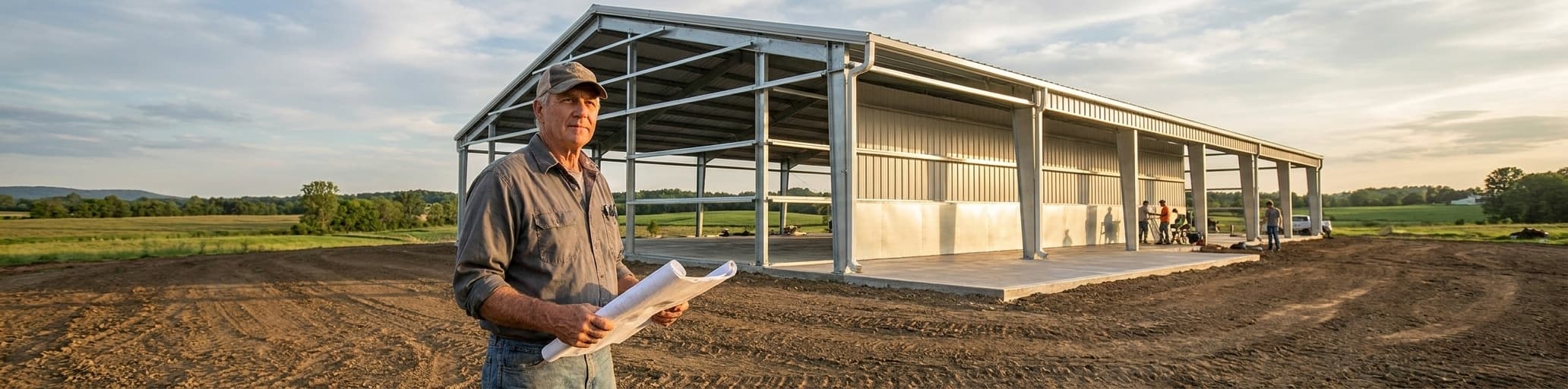

Steel agricultural buildings cost $18-$28 per square foot in 2026, with total project budgets ranging from $53,000 to $139,000 depending on site conditions and finish level. We help you lock in fixed pricing through transparent design-build contracts that protect your farm budget from cost overruns and material price swings.
What Agricultural Builders Actually Pay Per Square Foot in 2026
Steel agricultural buildings cost $18-$28 per square foot in 2026, with eave height and location as the two variables that push your price toward the higher end.
Current cost range for steel agricultural buildings: $18-$28 per sq ft (2026 baseline)
Steel agricultural buildings run $18-$28 per square foot in 2026 for a standard unfinished shell — primary frame, roof system, and wall panels included.
That figure sits within the lower half of the broader barn construction market, which spans $15-$45 per square foot depending on finish level and site conditions, with total project budgets ranging from $20,000 to $120,000 nationally.[1] Two variables reliably push your number toward $28 rather than $18: wall height and location.
Eave heights beyond 14 feet — common when you need combine or large-equipment clearance — require larger structural columns and additional metal siding, raising both material and erection costs.[1] Geographic position compounds the effect: rural sites often carry lower daily labor rates but higher freight costs for heavy steel packages, so the per-square-foot figure is always a combined product of materials, delivery, and installation.[1] If you want to see how those upfront costs compare against wood construction across a full ownership cycle, the steel barn cost vs. wood barn 20-year breakdown shows exactly where the long-term savings accumulate.
Why agricultural steel costs less than commercial or industrial buildings
The gap between agricultural and commercial construction cost per square foot comes down to one thing: finish requirements. Agricultural buildings — equipment barns, hay storage, commodity sheds — need a weathertight shell and clear-span space.
That's it. No HVAC systems, no insulated metal panel enclosures engineered to R-50, no fire suppression, no interior buildout, no three-phase electrical service.
A basic agricultural storage building or equipment barn runs $25-$45 per square foot fully installed.[3] Compare that to a standard commercial warehouse at $45-$75 per square foot, a manufacturing facility with crane loads at $55-$100, or a cold storage building at $120-$300 — cost tiers driven almost entirely by what goes inside the shell, not the shell itself.[3] The structural steel frame and enclosure represent a consistent baseline across all building types. What escalates commercial and industrial costs is everything layered on top: MEP systems, specialized flooring, vapor barriers, thermal breaks, and code-driven interior requirements that agricultural use simply doesn't trigger.[3] Pre-engineered steel building materials for commercial purposes run $10-$25 per square foot, with installation adding another $10-$20 — but agricultural projects sit at the lean end of those ranges precisely because engineering complexity stays low and crew productivity stays high on repetitive, unobstructed framing.[3] That structural simplicity, combined with national buying power on steel packages, is what keeps the agricultural building construction cost per square foot well below every other commercial category.
How single-source design-build pricing differs from fragmented bidding
Fragmented bidding — where you engage separate contractors for foundations, steel erection, site work, and inspections — creates a coordination problem that shows up directly in your final cost.
When the employer engages different contractors for construction work and installation work separately, each contractor prices their scope in isolation, adding their own allowances for supervision, overhead, insurance, contingencies, and profit.[4] Each gap between those scopes becomes a negotiation point, and incomplete documentation causes frequent negotiations to decide on details and variations that usually involve additional expenditure.[4] A turn-key contract — where planning, design, and construction are all included under one agreement — eliminates those gaps by definition: one team manages supplier coordination, foundation sequencing, erection, and field decisions so owners are not left managing disconnects between separate teams.[5] The fixed-price advantage of a turn-key arrangement is concrete: you know at an early stage what the construction is going to cost, rather than absorbing running-account surprises as trades discover what the previous contractor left undefined.[4] On an agricultural steel building, where budgets are tight and farming operations can't absorb schedule delays, that cost certainty is not a convenience — it's a direct protection for your bottom line.
Single-source coordination also protects schedule: early planning around steel packages, foundations, site conditions, and inspections reduces downtime once work reaches the field, because one accountable team controls sequencing rather than waiting on handoffs between disconnected vendors.[5]
Cost Breakdown: What's Included (and What Isn't) in Your Per-Square-Foot Quote
Foundation and site prep costs consume 10-20% of your agricultural building budget, making early soil evaluation essential before the frame package ships.
Foundation, site prep, and soil conditions: The hidden variable in agricultural projects
The foundation and site prep portion of an agricultural building budget deserves more scrutiny than most quote sheets provide.
These costs routinely consume 10-20% of a total project budget before a single steel column is set.[7] Land grading runs $1-$2 per square foot, a standard concrete slab adds $4-$8 per square foot, and pier foundations — necessary on sloped lots or unstable ground — push that number to $7-$12 per square foot.[7] On farm sites specifically, soil conditions create the widest cost variance in the entire project: heavy clay expands and contracts with moisture cycles, sandy loam shifts under point loads, and both conditions may require engineered footing designs that add cost and lead time before the frame package ships.[8] Site development costs can sometimes exceed the building cost itself, making early soil evaluation non-negotiable rather than optional.[6] Drainage compounds the risk further — agricultural sites built in low spots without proper grading, gutters, and downspouts face foundation erosion that no structural upgrade can correct after the fact.[8] For a detailed look at how slab specifications interact with total project cost, the 30×40 concrete slab cost breakdown shows exactly how foundation variables shift the final installed number on a real agricultural footprint.
Steel frame, roof, wall panels, and standard features bundled into base pricing
The building package — what most quotes lead with — includes the primary rigid frame (columns and rafters), secondary framing (purlins, girts, eave struts), roof and wall panels, trim and flashing, and all structural fasteners.[2] In 2026, standard configurations from established manufacturers price at $14-$22 per square foot for the package alone, with smaller buildings under 5,000 square feet landing at the higher end of that range because fixed engineering and mobilization costs spread across less area.[2] Enhanced specifications — wider clear spans, elevated wind or snow loads, crane loads, or architectural wall panels — push package pricing to $35-$55 per square foot.[2] The number that trips up most agricultural buyers, though, isn't the package cost itself. It's the gap between what the package covers and what a finished building actually requires.
That online quote pulling $15 per square foot is pricing the kit — steel, panels, fasteners, trim — and nothing else. The kit typically represents only 40-60% of your total project cost before foundation, erection labor, insulation, doors, and site work are factored in.[9] On a 40×60 agricultural barn, that distinction between package price and installed-shell price can mean the difference between a $42,000 budget and a $90,000 reality.
Steel market conditions add a second variable: U.S. hot-rolled coil has swung from roughly $650 per ton at the 2025 low to over $2,000 per ton at the 2021 peak, and locking in a building package price when steel is favorable is one of the most effective cost-management tools available on any agricultural project.[2]
Labor and erection costs: Why in-house installation teams protect your budget
Labor and erection typically consume 20-30% of your total agricultural building budget — a line item large enough to collapse an otherwise accurate plan if you treat it as secondary.[7] Skilled labor shortages have pushed professional assembly costs higher in 2026, with erection now accounting for a larger share of total project cost than in prior years.[10] For custom steel structures, erection labor runs $12-$20+ per square foot.[11] On a 2,400 square foot agricultural storage building, that translates to $28,800-$48,000 in erection costs before equipment rentals or site complications — elevation, tight access roads, or short weather windows — are factored in.[11] Hiring a general contractor to manage erection adds another 10-20% of total construction cost as overhead and supervision fees, meaning a $90,000 agricultural project absorbs $9,000-$18,000 in coordination costs that a single-source supplier's own crew folds directly into the contract price.[7]
The DIY erection calculation looks clean on paper and rarely survives contact with an actual job site. What the "I'll save on labor" math omits: a crane operator billing by the hour while the crew figures out framing sequence, a county inspector flagging missing flange braces mid-erection, and the complete absence of the documentation trail that insurance carriers require — bolt torque logs, plumb certifications, and sequencing records that owner-assembled or general-labor crews cannot produce.[11] A building put up by a qualified erection crew carries that paper trail; one assembled without it carries the risk of a denied claim years after the building is in use.[11] In-house installation teams employed directly by the building supplier resolve both the cost problem and the accountability problem simultaneously: they work from the same engineering drawings used to fabricate the steel package, they know the specific connection details by design, and there is no handoff gap between the fabricator and the crew in the field where scope disputes and change orders typically originate.[7]
Real-World Agricultural Building Costs: 40×60 Barn, 30×40 Storage, 10,000 Sq Ft Facility
A 40×60 steel barn runs $53,000-$139,000 fully installed, with concrete, grading, and permits included–well below the typical barn market average.
40×60 agricultural barn: Total project cost and cost-per-square-foot breakdown
A 40×60 steel agricultural barn gives you 2,400 square feet of clear-span floor space — enough for a four-row combine, a full hay inventory, or mixed livestock and equipment use. At the prefab metal barn rate of $15-$40 per square foot for materials and installation, the building shell alone runs $36,000-$96,000 for that footprint.[12] But the shell is only part of the budget. Add a concrete slab at $5-$10 per square foot ($12,000-$24,000), site grading at $0.40-$2.00 per square foot ($960-$4,800), spray foam insulation at $1.50-$5.00 per square foot if your storage use requires it ($3,600-$12,000), and permits at $500-$2,000, and total installed cost lands in the $53,000-$139,000 range.[12] The table below shows how those line items stack against each other for a 2,400-square-foot footprint.
| Line item | Cost per sq ft | 40×60 total (2,400 sq ft) |
|---|---|---|
| Steel building package + erection | $15-$40 | $36,000-$96,000 |
| Concrete slab | $5-$10 | $12,000-$24,000 |
| Site grading | $0.40-$2.00 | $960-$4,800 |
| Spray foam insulation (if specified) | $1.50-$5.00 | $3,600-$12,000 |
| Building permits | — | $500-$2,000 |
| **Total installed estimate** | **$22-$58** | **$53,060-$138,800** |
The range is wide because two variables dominate: finish level and soil conditions. A basic equipment storage shell with a gravel base, one overhead door, and no insulation lands near the floor of that range. Add full concrete, insulation, multiple access doors, and engineered footings on difficult soil, and the number climbs toward the ceiling.[12] The per-square-foot cost for a 40×60 configuration — typically $22-$58 fully installed — sits below the general barn market average of $25-$100 per square foot, primarily because prefab metal construction eliminates the high labor hours and custom cutting that drive wood barn costs higher.[12] That installed cost-per-square-foot advantage also compounds at 40×60: fixed project costs like mobilization, crane setup, and permit fees spread across 2,400 square feet rather than the smaller footprints where those overhead items push the per-square-foot figure up regardless of material selection.[12]
30×40 equipment storage building: What farmers typically spend and why
A 30×40 steel equipment storage building delivers 1,200 square feet of clear-span space — enough for a small tractor, an ATV fleet, or a season's worth of bagged feed — and it's the most common footprint farmers price first because it fits a single-implement operation without overbuilding. Steel building packages for this size start around $16,000 in most U.S. markets, with the package covering the primary frame, roof and wall sheeting, trim, fasteners, anchor hardware, stamped engineering drawings, and standard installation on a prepared and level pad.[14] That price does not include concrete, permits, grading, insulation, or additional doors — each of which is a separate line item.[14] A pole barn comparison is a useful baseline since both structures solve the same storage problem: fully installed 30×40 pole barn versions run $18,000-$24,000 before site work, which tracks closely with steel package-plus-erection pricing at the same footprint.[13]
| Line item | Cost per sq ft | 30×40 total (1,200 sq ft) |
|---|---|---|
| Steel building package + erection | $13-$22 | $15,600-$26,400 |
| Concrete slab | $5-$10 | $6,000-$12,000 |
| Site grading | $0.40-$2.00 | $480-$2,400 |
| Insulation (if specified) | $1.50-$5.00 | $1,800-$6,000 |
| Building permits | — | $500-$2,000 |
| **Total installed estimate** | **$20-$41** | **$24,380-$48,800** |
The finished number routinely surprises buyers who budgeted around the package price alone. Once you fold in concrete, grading, and permits, a complete ready-to-use 30×40 steel equipment barn typically lands in the $28,000-$42,000 range for most farm sites — considerably above the structure's starting price.[14] The per-square-foot cost on a 1,200-square-foot building also runs $2-$5 higher than the same construction type at 2,400 square feet, because fixed project costs like engineering, mobilization, and permit fees spread across fewer square feet at smaller footprints.[14] Two specification decisions drive farmers toward the upper half of that range more than any other: adding a concrete floor instead of a compacted gravel base, and specifying electrical service for lighting and equipment charging — both of which increase utility and, notably, property value.[13] For a 30×40 agricultural building checklist covering dairy, hay, and horse applications, the decisions around roof pitch, ventilation, and door placement need to happen before the quote is finalized — not after — because each one changes both the package price and the erection scope.
10,000 sq ft agricultural complex: Scaling costs and economies of scale
A 10,000 sq ft agricultural complex — a multi-use facility combining equipment storage, commodity handling, and covered work areas — sits at the footprint where economies of scale shift the per-square-foot math decisively in your favor. Pre-engineered steel building materials run $10-$25 per square foot for the package alone, with installation adding $10-$20 per square foot, placing the initial investment for a 10,000 sq ft steel structure in the $120,000-$250,000 range depending on complexity and customization.[3] Larger footprints yield higher economies of scale, enabling a much larger building at a lower overall cost per square foot than smaller configurations using the same material category.[3] That compression happens because fixed project costs — engineering fees, mobilization, crane setup, permit processing — spread across ten times the floor area compared to a 1,200 sq ft storage barn, dropping the overhead contribution to each square foot substantially.[9]
| Line item | Cost per sq ft | 10,000 sq ft total |
|---|---|---|
| Steel building package | $10-$25 | $100,000-$250,000 |
| Erection/installation | $10-$20 | $100,000-$200,000 |
| Concrete slab | $5-$10 | $50,000-$100,000 |
| Site grading | $0.40-$2.00 | $4,000-$20,000 |
| Insulation (if specified) | $1.50-$5.00 | $15,000-$50,000 |
| Building permits | — | $2,000-$5,000 |
| **Total installed estimate** | **$12-$45** | **$120,000-$450,000** |
The range in the table above reflects two variables more than any others: finish level and span configuration. A basic open storage shell with a gravel base lands near the floor. A fully finished facility with concrete, insulation, multiple overhead doors, and engineered footings on variable soil approaches the upper bound. What the per-square-foot math confirms is the scale advantage: a 10,000 sq ft steel building package typically prices between $10-$25 per square foot, while smaller structures at 1,200-2,400 sq ft rarely dip below $13-$22 per square foot for equivalent specifications — and the kit itself still accounts for only 40-60% of total project cost at any size.[9] The long-term numbers reinforce the build decision even further. Annual maintenance on a 10,000 sq ft steel structure runs approximately 1% of initial cost — roughly $1,500-$2,500 per year — while comparable wood construction carries annual maintenance of 2-4%, translating to $7,000-$20,000 per year for the same footprint.[3] Across a 20-year ownership period, total costs for a 10,000 sq ft steel facility (including all operating costs) run approximately $350,000, compared to $670,000-$1.1 million for traditional wood or concrete construction of equivalent size.[3] For operations that have outgrown column-interrupted post-frame structures and need clear-span space at scale, large-span agricultural steel buildings unlock up to 300 feet of column-free floor area — a configuration that only becomes cost-rational at footprint sizes where economies of scale compress the per-square-foot figure enough to justify the structural investment.
How to lock in your agricultural building cost: National Steel Buildings's transparent pricing model
Fixed-price design-build contracts protect your farm's operating capital by locking costs upfront, eliminating the risk of mid-project overruns that could compromise your seasonal operations.
Fixed-price design-build contracts vs. open-ended bids: Why certainty matters on farmsA fixed-price contract — also called a lump-sum or turnkey contract — sets the total project cost before work begins and holds it there, regardless of material price shifts, labor complications, or schedule extensions.[15] The service provider absorbs any additional costs that arise during the project; if the project completes under budget, the contractor keeps the savings rather than returning it to the owner.[15] That risk allocation is the defining structural difference from open-ended cost-plus bidding, where actual costs plus a fee or percentage are billed as incurred with no ceiling — a format that transfers all cost-overrun risk directly back to you.[16] On a farm, that distinction has immediate operational consequences. Farming revenue is seasonal and committed months in advance to input purchases, equipment loans, and lease obligations. A cost-plus building contract that runs 20% over estimate mid-project doesn't just strain a budget — it competes directly with operating capital that cannot be redirected without downstream consequences for the growing or harvesting season.
Change orders are the mechanism through which open-ended bids most reliably exceed their opening estimates, and they are also what fixed-price design-build contracts are specifically structured to suppress. On commercial construction projects, change orders represent the single largest source of cost overruns.[16] A fixed-price contract addresses the problem at the source by requiring the scope of work — tasks, deliverables, and specifications — to be clearly defined before work begins, minimizing ambiguity about what is and is not included in the price.[15] In fragmented open-bid projects, scope gaps between separate contractors create the conditions for constant negotiation; in a fixed-price design-build arrangement, one entity owns both design and construction, so gap disputes between trades represent genuine scope additions rather than arguments about what the original contract covered.[16] Design-build also compresses schedule by 15 to 25 percent compared to design-bid-build delivery — a compression that matters on farms where construction windows are narrow and tied to planting calendars, harvest windows, or winter close-in deadlines that don't move.[16] For a detailed look at how turnkey farm building construction keeps agricultural projects on schedule without pulling the operator away from field operations, the mechanics of single-source sequencing make the schedule advantage concrete.
The one genuine cost attached to fixed-price certainty is that the contractor builds a contingency buffer into the price to account for unforeseen complications, which can make a fixed-price quote appear higher on paper than an opening cost-plus bid for the same scope.[15] That premium deserves context before it changes a decision. Cost-plus and open-bid projects on commercial construction regularly exceed their initial estimates, with change orders compounding across disconnected trade scopes until the final invoice looks nothing like the original proposal.[16] The relevant comparison for an agricultural owner is never the opening bid — it's the final invoice. Only a fixed-price design-build contract gives you control over what that number will be before the first column is set.
Customization options that don't blow your budget: Ventilation, doors, and interior layouts
Doors drive more agricultural building customization variance than any other line item, and the decision that saves money is straightforward: match the door to the task it will perform. A standard walk-in personnel door adds only a few hundred dollars to a project.[9] A single overhead or roll-up door for equipment access carries a higher price, and specifying multiple bay doors — combines entering from one end, grain carts from another — compounds that cost quickly.[17] Over-engineering for the application wastes money: a high-wind-rated overhead door on a grain storage building in a calm inland region is an unnecessary premium; a lightweight door on a livestock facility in a high-wind zone is a structural liability.[9] Door types and counts must be finalized before the quote, because frame openings are engineered into the steel package at fabrication — relocating or adding them after the package ships is a change order with its own cost, not a field adjustment.[17]
Ventilation is where agricultural buildings recoup customization spending most efficiently. Ridge vents, sidewall louvers, and powered exhaust fans prevent the condensation cycles that corrode steel panels from the inside, damage stored hay and grain, and create ammonia buildup in livestock applications — failure modes no structural upgrade corrects after the fact.[9] Because ventilation components integrate into roof and wall panel design at fabrication, specifying them at the quote stage costs significantly less than retrofitting them post-erection.[17] Interior layout decisions follow the same sequencing logic: clear-span steel frames provide an uninterrupted floor plate, but decisions about partition walls, overhead utility runs, and equipment lanes must be made before the package ships, because penetrations and blocking need to be engineered into the frame from the outset to maintain structural integrity.[17]
The practical rule on agricultural building customization: accessories and add-ons can increase total project cost by 20-30%, but that range includes both function-critical specifications and avoidable upgrades.[17] The distinction between the two comes down to operational consequence. Ventilation in a hay storage barn isn't optional — inadequate airflow creates spontaneous combustion risk in green hay, a loss that dwarfs any ventilation line item. A polished concrete floor in the same barn is optional. Prioritizing function-driven specifications over aesthetic upgrades keeps customization cost within a range that adds genuine utility without eroding the per-square-foot efficiency that makes steel the cost-effective choice across agricultural applications.[9]
Financing agricultural buildings: Options and how upfront transparency saves money over time
Agricultural building financing splits into two practical tracks: conventional loans for structures that meet residential or commercial building codes, and farm-specific credit programs. Code-compliant pre-engineered steel buildings with stamped engineering drawings qualify for standard financing rather than niche commercial products — a material advantage because conventional loan rates are typically lower and qualification criteria are broader.[19] The connection between code compliance and financing eligibility is direct: lenders require that structures meet local wind, snow, and zoning standards before approving construction loans, making a permit-ready package both a construction convenience and a financing prerequisite.[19] Itemized packages that break out materials, labor, foundation, and permitting separately give lenders a clear picture of total investment, and that clarity is what converts a bank's conditional interest into an approved loan.[19]
On the tax side, the IRS classifies single-purpose agricultural structures — livestock housing, grain storage bins, and purpose-built horticultural enclosures — as qualifying Section 179 property, which permits farmers to expense up to $2,500,000 of qualifying property placed in service in 2025 in a single tax year rather than recovering costs through decades of depreciation.[20] Grain bins are specifically cited as qualifying Section 179 property because they are used in connection with the production of grain or livestock for the bulk storage of fungible commodities.[20] For agricultural buildings placed in service after January 19, 2025, the 100% special depreciation allowance is fully restored, meaning the entire cost of a qualifying structure can be deducted in the year it enters service — a cash-flow benefit that fundamentally changes the net cost of building in the current tax year.[20] A farmer who understands these provisions before financing closes can structure the purchase to maximize the deduction, which directly reduces the effective cost of the building.
Upfront pricing transparency is where long-term savings accumulate most reliably. Labor typically represents 40% of total project costs, and budgets built around vague single-line estimates regularly produce final invoices that exceed original figures by 15% or more through scope additions and mid-project change orders.[19] That cost overrun compounds when financed — a $15,000 unplanned addition on a 10-year farm loan adds interest cost on top of the principal, making a poorly scoped project more expensive year over year than a properly quoted one.[19] Planning the project in detail before ordering steel packages also hedges against material price volatility: locking in a confirmed package price eliminates exposure to steel market swings that can move costs substantially between quote and delivery.[18] The farmer who enters a building project with every line item defined — scope fixed, material price locked, contract set before ground breaks — pays a predictable number. Every other approach transfers cost risk to the farm's operating budget, where it competes directly with seasonal inputs that cannot be deferred.
- Steel agricultural buildings cost $18-$28 per square foot for unfinished shells in 2026, with wall height and location as primary cost drivers.
- Agricultural buildings cost significantly less than commercial structures because they require only weathertight shells without HVAC, insulation, or specialized systems.
- Foundation and site preparation consume 10-20% of total project budgets, making early soil evaluation critical to avoid cost overruns.
- Turn-key contracts eliminate cost uncertainty by consolidating planning, design, and construction under one agreement, protecting against change orders.
- A 40×60 steel barn totals $53,000-$139,000 installed, while a 10,000 sq ft facility achieves $12-$45 per square foot through economies of scale.
- Fixed-price design-build contracts compress schedules by 15-25% and suppress change orders by clearly defining scope before work begins.
- Section 179 tax provisions allow farmers to deduct up to $2,500,000 of qualifying agricultural structures in a single tax year, significantly reducing net costs.
- https://www.btsteel.net/blog/how-much-does-it-cost-to-build-a-barn
- https://terrapincg.com/news/pre-engineered-metal-building-cost-per-square-foot-usa
- https://www.summitsteelbuildings.com/20-year-cost-comparison
- https://www.fao.org/4/s1250e/S1250E0p.htm
- https://bobbreeding.com/
- https://midweststeelerector.com/blog/f/what-factors-impact-the-cost-of-a-steel-building-2026-guide
- https://iconsteelbuildings.com/commercial-metal-building-cost/
- https://www.btsteel.net/blog/the-ultimate-beginners-guide-to-agricultural-metal-buildings-for-modern-farms
- https://iconsteelbuildings.com/how-much-are-steel-buildings/
- http://www.247pro.com/blog/step-by-step-guide-to-estimating-the-cost-of-pre-engineered-metal-buildings-pembs-and-steel-structures
- https://mammoth.build/resources/custom-shop-cost-colorado/
- https://homeguide.com/costs/cost-to-build-a-barn
- https://matadorstructures.com/blog/pole-barns-increase-property-value/
- https://www.northtexassheds.com/steel-building-cost-guide
- https://www.icertis.com/contracting-basics/fixed-price-contract/
- https://terrapincg.com/commercial-construction-process-project-delivery-2026
- https://norsteelbuildings.com/steel-building-news-industry-trends/how-much-do-steel-buildings-cost/
- https://iconsteelbuildings.com/how-much-are-metal-buildings/
- https://ezbuildings.biz/steel-building-contractor-near-me-613443/
- https://www.irs.gov/publications/p225