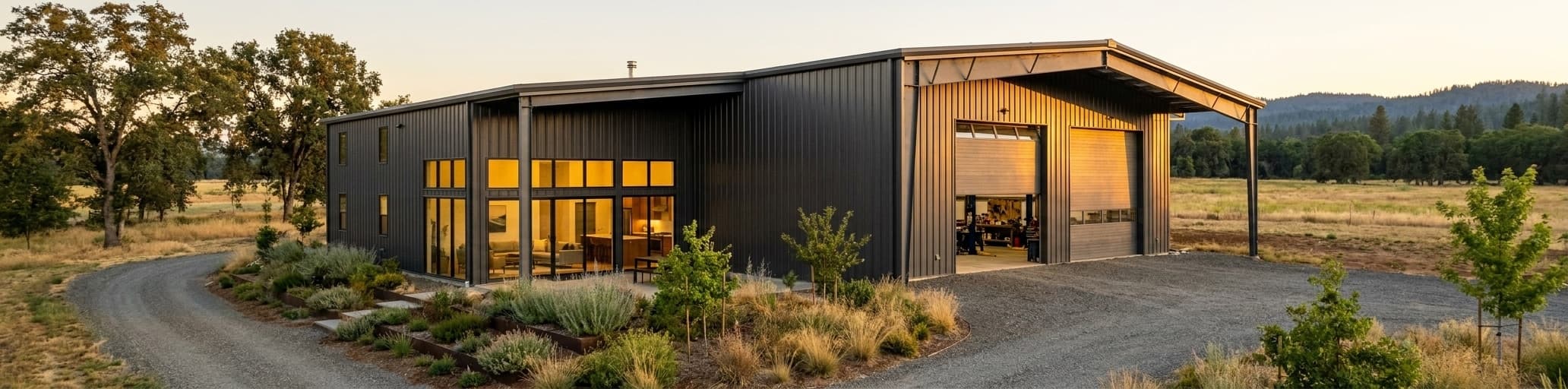

We help you navigate metal building barndominium costs, layouts, and timelines from design through move-in. Steel structures deliver 50-100 year durability, lower maintenance costs, and layout flexibility that wood cannot match, making them the practical choice for combined living and utility space.
What a Metal Building Barndominium Is and Why Steel Works Best
Steel barndominiums resist termites, mold, rot, and splitting while lasting 50 to 100 years with minimal upkeep, outpacing wood structures significantly over time.
Defining the Modern Barndominium: Living Space Meets Functional Storage
A metal building barndominium blends residential living space with functional utility, workshop, or storage areas under one steel roof — that combination is the entire concept.[1] The term merges "barn" and "condominium," first used by real estate developer Karl Nilsen in 1989 and pushed into mainstream awareness after HGTV's *Fixer Upper* introduced it to a national audience.[2] What makes it structurally distinct from a conventional home is the clear-span steel frame: without load-bearing interior walls, you control how every square foot is divided, whether that means an open-concept great room beside a three-bay garage or a metal building with living quarters that reserves half the footprint for equipment storage.[1] What surprises most first-time builders is the regulatory weight of that living space: once your building includes a kitchen, bath, or bedroom, it shifts from agricultural or storage classification to fully residential, regardless of how the exterior looks.[3] That shift triggers stricter permitting, insulation standards, fire ratings, and structural load calculations — and overlooking it early is exactly how projects stall at the permit office months after design work begins.[3]
Why Steel Outperforms Wood and Hybrid Barn Conversions
Steel's advantages over wood and pole-barn hybrids are most visible over time, not at contract signing. Steel frames resist termites, mold, rot, and splitting — problems you can slow in wood but never fully engineer out — and their higher strength-to-weight ratio makes them significantly more resistant to high winds and heavy snow loads.[5] On fire resistance, stray sparks rarely ignite a metal-clad structure, and some insurers offer homeowner's coverage discounts for steel buildings as a result.[5] Lifespan tells the long-game story clearly: steel barndominiums routinely last 50 to 100 years with minimal upkeep, while wood structures — even with consistent sealing, pest treatment, and weatherproofing — typically reach 30 to 50 years before requiring major structural intervention.[6] Over a 20-year window, properly maintained steel barndominiums can save up to 30% on maintenance and repair costs compared to wood counterparts.[6] Hybrid pole-barn conversions sit at the bottom of the durability ladder: the embedded wooden posts are especially prone to moisture intrusion and structural drift, and most pole barns exhaust their usable life around 40 years.[4] Construction speed adds another margin — a prefabricated steel 30×48 shell can be assembled in roughly one week versus three to four weeks for conventionally framed wood, reducing labor costs directly.[5] The real tradeoff with steel is thermal performance: it conducts heat and cold more readily than wood and requires spray foam or rigid board insulation to close the gap.[6] That upfront insulation investment pays back measurably; a properly insulated metal building barndominium can cut annual heating and cooling costs by up to 25% compared to an uninsulated structure.[6]
| Factor | Steel frame | Wood frame | Pole-barn hybrid |
|---|---|---|---|
| Expected lifespan | 50-100+ years | 30-50 years | ~40 years |
| Pest and rot resistance | Inherent | Requires treatment | High vulnerability |
| Fire resistance | High | Low to moderate | Low |
| 20-year maintenance savings | Up to 30% vs. wood | Baseline | Highest ongoing cost |
| Shell assembly speed | ~1 week (prefab) | 3-4 weeks | Varies |
| Thermal performance (uninsulated) | Poor conductor | Natural insulator | Poor (wood posts degrade seals) |
Single-Source Steel Solutions: Design, Engineering, and Erection in One Partnership
The coordination problem in barndominium construction catches more owners off guard than the cost. Weld-up shell builders — the craftspeople who custom-fabricate steel frames on site — typically build the shell only and do not act as general contractors, meaning owners must separately hire a finish-out team and manage the handoff between them.[7] Bolt-up pre-engineered systems solve part of that problem through factory precision: every framing member arrives labeled, fabricated, and ready for assembly, with structural specs already engineered to your site's wind, snow, and seismic load requirements.[7][4] But even with a bolt-up kit, many owners still face a split: an erector crew stands up the shell, then a general contractor takes over for everything from insulation to mechanical rough-in, with no single party owning the full scope.[4] That gap is where projects run over budget and over schedule.
A turnkey single-source approach closes it — design, engineering, fabrication, and erection under one contract means one set of drawings, one accountability chain, and no finger-pointing when a detail falls between trades. The efficiency payoff is concrete: prefabricated steel construction cuts on-site timelines by 30% to 50% compared to traditional stick-built methods, requires a smaller crew, produces less material waste, and keeps components protected from weather exposure during fabrication.[8] For a structure that will carry residential occupancy loads, those aren't just schedule wins — they're the difference between a building that passes inspection the first time and one that doesn't.
Metal Building Barndominium Cost Breakdown: What You'll Actually Spend
Metal barndominiums range from 450-square-foot studios to 3,300-square-foot homes with shops, so you can find a realistic floor plan within your budget tier.
How Much Does a Metal Barndominium Cost? Real Numbers for Popular SizesSize determines the starting point for every metal building barndominium budget, and the range is wider than most buyers expect.
Floor plans from the 25-foot-wide category begin at just 1,250 square feet of living space — a two-bedroom, two-bathroom layout — while 50-foot-wide configurations scale up to 3,300 square feet of finished living area with a shop attached.[9] A compact entry point like a 30×42 floor plan (roughly 1,260 square feet of living quarters paired with an 840-square-foot shop) fits comfortably into a smaller budget and still delivers two bedrooms, two bathrooms, and a mudroom.[9] Move to a 40×50 configuration and you're looking at 2,000 square feet of residential space plus a 1,200-square-foot shop — enough for four bedrooms and two bathrooms without feeling cramped.[9] The important nuance: square footage of living area and total building footprint are two different numbers. A 40×60 layout like the Maria plan provides 2,400 square feet of finished living and 1,800 square feet of shop under one roof — the structural footprint is 2,400 total square feet, but the complete square footage under steel is significantly larger.[9] Understanding that split matters when you request quotes, because contractors price steel shell, finished living space, and shop area at different per-square-foot rates.
You can explore how metal building home layouts handle that split across common configurations before your first design conversation.
Comparing price points: $100K, $200K, and $300K barndominium builds
Budget tier shapes which size and configuration is realistic, and the floor plan data maps those tiers clearly.
Studio and small single-bedroom plans — a 30×15 studio at 450 square feet or a 30×20 layout at 600 square feet — represent the entry level, often built as temporary living quarters during a larger construction project before being repurposed as a guest house or game room.[9] A true entry-level barndominium with full residential function starts closer to the 30×30 or 30×42 footprint: 900 to 1,260 square feet of living, one to two bedrooms, and a shop component that doubles as usable utility space.[9] The mid-range tier — where most buyers land — corresponds to 40-foot-wide plans between 1,600 and 2,400 square feet of finished living, typically three to four bedrooms, two bathrooms, and an attached shop ranging from 840 to 1,600 square feet.[9] Upper-tier builds occupy the 50-foot-wide category: the Beulah plan at 3,000 square feet of living space with a loft, three bathrooms, and a 3,000-square-foot shop represents a project scope that drives material, finish, and mechanical costs proportionally higher.[9] Architectural floor plans are a prerequisite for accurate pricing at every tier — they are specifically required for the planning, loan, and contractor quoting processes, and starting with a stock plan and modifying it costs less than designing from scratch.[9]
Hidden costs that catch barndominium buyers off guard
The floor plan itself is one of the first cost line items buyers overlook — it is not included in a steel kit price and must be secured before contractors can generate accurate bids or lenders can approve financing.[9] Beyond plans, two-story configurations introduce structural requirements that standard wood trusses cannot accommodate; most two-story barndominium designs — including popular layouts like the Virginia (4,061 square feet, two stories) and the Stella (3,600 square feet) — require a metal-framed building specifically engineered for a second floor, which adds cost relative to a single-story footprint of comparable square footage.[9] Customization scope creep is another common budget pressure: features like wraparound porches, loft additions, panoramic bi-folding doors, pet washing stations, and upgraded master suite configurations all appear as optional upgrades in stock plans, and each one affects both material cost and finish-out labor.[9] The practical protection is locking in a complete scope before fabrication begins — every element from eave height and roof pitch to door size and location affects the structural engineering package, and changes made after fabrication starts cost multiples of what the same decision would cost at the design stage.[9]
Comparing Price Points: $100K, $200K, and $300K Barndominium Builds
Budget tier sets the realistic size ceiling before site conditions, finish level, or design complexity even enter the picture. A $100K budget typically supports a finished barndominium in the 800-to-1,000 square foot range — small enough that design efficiency has to stay aggressive and every line item carries real weight.[10] Move to $200K and the conversation shifts: that budget commonly supports 1,500 to 2,000 square feet of finished living space, which is enough for a practical family layout without stripping out core amenities.[11] A $300K budget moves the realistic planning range to 2,000 to 3,000 square feet, where spacious family-friendly configurations and attached shop layouts become achievable without losing financial discipline.[10] The cost-per-square-foot range that underlies all three tiers runs roughly $80 to $160 for a finished barndominium, with most projects landing between $100 and $150 per square foot depending on finish level and site conditions.[10][12]
| Budget | Realistic finished size | Typical layout | Key constraint |
|---|---|---|---|
| $100K | 800-1,000 sq ft | Studio or 1-bedroom, minimal shop | Design must stay highly efficient |
| $200K | 1,500-2,000 sq ft | 2-3 bedrooms, practical family layout | Finish level and site work must stay controlled |
| $300K | 2,000-3,000 sq ft | 3-4 bedrooms with attached shop | Customization and site complexity pull size down fast |
The most important distinction across all three tiers is the difference between shell cost and finished cost.[11] A shell budget covers the structural package and some part of the exterior envelope — it gets the building under roof, not move-in ready.[11] A finished budget adds the slab, insulation, electrical, plumbing, HVAC, drywall, cabinets, flooring, fixtures, and all labor required to actually occupy the space.[11] Conflating the two is the most common reason buyers arrive expecting 2,000 square feet and leave with a scope they cannot afford. Beyond that core distinction, two variables move any tier toward its upper or lower boundary: finish level and site conditions.[10] Builder-grade to mid-range finishes keep the math workable; premium kitchens, luxury baths, designer windows, and specialty materials consume square footage quickly at any price point.[10] Site work — clearing, grading, septic, driveway access, and utility runs — can hit the budget hard before the structure itself begins, and buyers who do not evaluate land conditions early often watch their realistic size range shrink by several hundred square feet before design is even finalized.[11]
Hidden Costs Competitors Don't Mention (And How National Steel Buildings Prevents Them)
The shell-to-finished-cost gap is the most consistently misrepresented number in barndominium marketing. A steel shell typically runs $15 to $25 per square foot for the metal structure itself — frame, panels, framed door openings, and trim — while a fully finished, move-in-ready barndominium lands between $100 and $150 per square foot complete.[14] That math means the shell accounts for only 15% to 25% of your total project budget.[14] The 75% to 85% that competitors leave out of headline pricing is where the real surprises live. Site preparation on undeveloped rural parcels — clearing, grading, soil testing, and drainage — can add thousands before a single structural component is set.[13] Utility infrastructure compounds the exposure on remote sites: electrical service extensions are billed per linear foot, drilled wells vary with regional groundwater depth, and septic systems require perc tests, engineering approvals, and full installation — all of it before vertical construction begins.[13] Permitting adds another layer: fees are often calculated on square footage and total project value, some counties impose additional charges specifically for metal structures, and many jurisdictions require engineer-stamped plans before issuing a residential permit.[13] Site-specific engineering drawings alone run $1.40 to $1.80 per square foot depending on local snow load requirements, with high-load zones pushing that figure higher.[14]
Interior systems are where even experienced builders get caught. Spray foam is the correct insulation choice for metal buildings — it seals air gaps, prevents condensation inside the steel envelope, and outperforms batt insulation on thermal performance — but it costs meaningfully more per square foot at install.[13] Open-concept layouts with tall ceilings require properly sized and zoned HVAC systems; selecting an undersized unit to reduce upfront cost generates higher energy bills and early equipment failure.[13] Interior wall framing remains a separate expense even though the metal shell forms the building envelope, because every interior partition still needs framing in wood or light-gauge steel.[13] Plumbing layout must be finalized before the slab is poured — moving a kitchen or bathroom location afterward requires concrete cutting and rework.[13] Budget a 10% to 15% contingency reserve on top of all those line items: site conditions, permit delays, and material price movement affect nearly every rural build, and a contingency is professional standard practice, not pessimism.[13]
A single-source approach removes most of these surprises before they become change orders. When design, engineering, fabrication, and erection operate under one contract, structural drawings already incorporate local wind, snow, and seismic requirements — eliminating the mismatch between a stock kit and a site that demands heavier specs.[14] Every element from eave height to door placement is locked when the price is locked, and scope changes made before steel is cut cost a fraction of what the same decision costs once fabrication starts.[13] That accountability structure — one contract, one set of drawings, one party who owns the outcome — is precisely what prevents a $200K expectation from landing as a $280K reality.[13]
Popular Metal Barndominium Sizes and Floor Plan Options
Steel's clear-span design lets you arrange bedrooms, living zones, and work spaces around how your household actually functions, without permanent walls locking you into one configuration.
Best-Selling Sizes: 40×60, 50×75, and 60×70 Layouts Explained
Open-Concept vs. Divided Living Spaces: Design Flexibility in Steel Steel's clear-span structural system is what makes layout flexibility genuinely meaningful — without load-bearing interior walls, you divide the footprint around how your household functions rather than around where the framing allows.[17] Open concept in a metal building barndominium doesn't mean one undivided room; the strongest plans still build in zones, traffic patterns, acoustic separation, and dedicated storage — they just do it without walls that permanently lock in a configuration you may outgrow.[18] The classic center-hall great room places the kitchen, dining, and living core in the middle of the building with bedrooms pushed to opposite ends, delivering a genuine gathering space while keeping bedroom noise isolated.[18] A split-bedroom variation refines that logic further: the primary suite occupies one side, secondary bedrooms anchor the other, and the open living core acts as the buffer between them — a layout that works cleanly for families with children, multigenerational arrangements, or frequent guests without reducing the main living area's square footage.[18] An entertainer layout inverts the priority entirely — the kitchen island becomes the functional center of the building with direct sightlines into both dining and living spaces — but it only works when cabinet and pantry planning stays disciplined, because an open kitchen is permanently on display.[18]
Shop-connection layouts introduce a separate design challenge: controlling the transition between residential and utility space without creating a dead zone at the boundary.[18] A mudroom, utility hall, or flex corridor handles that separation by absorbing noise, dust, and work traffic before they reach the living side.[18] When a single-story footprint runs out of room to expand horizontally, two-story barndominium configurations add vertical space instead — the ground floor carries the open living core while bedrooms, a loft, or a bonus room occupy the upper level, adding conditioned square footage without expanding the building's site footprint.[18] Lofts and mezzanines inside taller single-story structures accomplish something similar by converting the vertical volume that vaulted ceilings produce into usable bedroom or office space rather than leaving it as dead air.[17]
The two most common planning mistakes undercut both layout approaches equally. Confusing open with empty is the first: purpose-built spaces for pantry storage, laundry, entry control, and utility functions cannot be absorbed into the main living area without creating a clutter problem that no amount of square footage solves.[18] The second is poor bedroom placement — doors that open directly into the main living room eliminate the acoustic buffer every household eventually needs, and correcting that relationship once framing has started costs multiples of what the same decision would cost on paper.[18] Window distribution compounds both issues: a large open room needs balanced natural light across multiple wall faces, and concentrating glass on a single exposure creates overheated zones on sunny orientations while leaving the opposite side dim and underlit.[18] The practical check before locking a floor plan is behavioral — trace your daily movement through the layout and confirm that groceries, work gear, guests, and shop traffic each move through the building without crossing the living space uninvited.
Custom Engineering for Your Specific Lifestyle: Workshop, Studio, or Multi-Unit Options
The shop-first configuration is the most structurally demanding lifestyle layout in the barndominium category — and the one where generic stock plans fail buyers most predictably. Serious utility capacity means engineering the shop bay from the structural frame outward: eave heights tall enough for RV or tractor clearance, floor loading rated for heavy equipment, bay widths sized for drive-through access, and door openings framed before the steel is cut.[21] A layout like the Hammond plan allocates nearly 2,000 square feet of shop space engineered specifically for collectors and craftsmen who need full drive-around clearance for up to eight vehicles — that level of capacity cannot be retrofitted into a residential shell that wasn't originally designed for it.[21] Home-based trade businesses and studio users need a different priority: direct exterior access for clients, deliveries, or students that routes entirely outside the residential side of the building, while the shared slab and utility infrastructure keeps the total project cost well below two separate structures.[19] Many plans accommodate dedicated studio areas and extra-tall garage bays precisely for hobbyists and home-based businesses that need professional-grade space without sacrificing residential comfort.[19] Multi-generational and in-law suite layouts solve a third structural challenge — two independent households inside one steel envelope.
The configurations that actually work include a private kitchen, laundry, and a separate exterior entry point, so both households operate without sharing a front door or a daily traffic pattern.[21] Bypassing the cost of assisted living or high-rent markets is a documented financial benefit of these designs, and the shared steel shell keeps construction cost per square foot meaningfully lower than building two detached structures.[21] Across all three configurations — workshop, studio, and multi-unit — the structural decisions that make each one functional must be resolved at the design stage. Clear-span framing dimensions, eave height, bay spacing, and door placement are all locked when the engineering package is finalized; changing any of them after fabrication begins costs multiples of what the same decision costs on paper.[20]
How to Plan Your Metal Barndominium Project from Concept to Move-In
Get your pre-construction planning right the first time, because every decision you make on paper cascades through all seven phases of your barndominium project.
Design-Build Process: From Your Vision to Turnkey Completion
A metal building barndominium project moves through seven sequential phases, and the dependency between them is what makes early decisions so consequential.[22] Pre-construction planning — floor plans and design guides, site surveys, zoning approvals, and structural engineering — must be complete before any ground is disturbed, because every phase after it inherits either the clarity or the gaps from that first stage.[22] Site access work and civil grading follow immediately; weather delays and drainage complications have their biggest schedule impact at this stage, pushing every downstream milestone including foundation prep and steel delivery.[22] In a well-managed project, fabrication and foundation work run concurrently — the steel package is manufactured to your structural specs while concrete cures on-site, which is how a pre-engineered system trims the overall timeline without compressing quality-sensitive work.[22] Erection of the structural frame takes only two to three weeks for a standard five- to six-person crew, but that phase is a small fraction of the total six-to-eight-month timeline running from initial design through move-in.[22] Interior buildout adds another six to eight months on top of structural erection for a fully finished residential occupancy; buyers who plan around the erection phase alone consistently underestimate the full project schedule.[22] A turnkey builder who coordinates plans, permits, subcontractors, and scheduling under a single contract removes the most common source of delay — the sequencing gap between trades when no single party owns the full scope.[23] Delays in permitting or unresolved structural decisions during pre-construction create cascading schedule impacts that compound through every downstream phase, which is why the most expensive mistakes in barndominium construction almost always originate on paper, not on the job site.[23]
Financing, Permits, and Timeline Expectations with a Dedicated Partner
Financing a metal building barndominium requires a construction loan, not a standard purchase mortgage — a purchase mortgage funds a completed existing property in a single closing, while a construction loan releases money in staged draws as inspected milestones are reached.[24] Most conventional lenders decline barndominium files because they are unfamiliar with the appraisal nuances, the registered builder approval process, or the residential building codes that apply to non-traditional construction — not because of the borrower's credit or the build itself.[24] Five program paths cover the financing spectrum: VA construction (zero down for qualifying veterans, up to $1.5M standard with an exception pathway to $3M), FHA construction (3.5% down at a 640 minimum FICO), Conventional (5% down on primary residence builds), Jumbo (up to $4.5M for a 720-plus FICO), and Portfolio programs for files that fall outside standard agency guidelines.[24] Land doesn't need to be owned before closing — construction loans can fund the land purchase and the build simultaneously, roll an existing land loan balance into the new loan, or apply free-and-clear land equity as a down payment substitute that reduces or eliminates out-of-pocket cash at closing.[24] Lenders typically require a contingency reserve of 5% to 10% of the construction budget, a draw schedule tied to five to eight inspected milestones, and a registered builder with verifiable state licensing, insurance, and project history — a builder who cannot pass the approval review is the single most common reason barndominium files do not proceed.[24]
Permits follow the structure's occupancy classification, not its exterior aesthetic, which means a metal building barndominium with a kitchen, bath, and sleeping quarters is treated as a residential structure and must satisfy all local residential building codes regardless of how much the shell resembles a barn.[25] Zoning classification and HOA covenants are the first verification step — rural counties generally permit barndominiums with minimal overlay beyond setbacks and septic rules, but suburban counties and HOA-governed subdivisions frequently restrict metal cladding, minimum home values, or barn-style roof profiles, and a parcel that cannot be permitted cannot be financed under any residential construction program.[24] Verifying both zoning compliance and HOA restrictions before signing a builder contract is the highest-leverage pre-application step on any barndominium project; catching a covenant conflict on paper costs nothing, while catching it after a builder contract is signed costs earnest money, design fees, and schedule.[24] Insurance adds a related wrinkle: some carriers classify metal-clad residential structures as agricultural or commercial and decline standard homeowner coverage, so confirming that a carrier will write residential policy on the finished structure before the construction loan closes removes one more variable from the back end of the build.[24]
Timeline expectations for a metal building barndominium run longer than the erection phase alone suggests. Planning and design — floor plans, site surveys, zoning approvals, and structural engineering — consume one to three months before ground breaks.[25] Site preparation follows at one to two months, construction runs three to six months, and final inspections and landscaping add another one to two months, bringing the total from concept to move-in to roughly six to twelve months.[25] Initial closing on the construction loan, once a complete file is in underwriting, typically takes 30 to 45 days — after which the construction phase draws against the approved budget until the final inspection triggers permanent loan conversion.[24] Builds with pre-approved registered builders, complete documentation packages, and confirmed zoning approvals consistently close faster and run fewer surprises through underwriting; the delays that push projects past twelve months almost always trace back to unresolved decisions on the front end — a builder who cannot be approved, a zoning issue discovered after land closes, or a structural scope that wasn't locked before fabrication started.[24] A single-source partner who coordinates design, fabrication, erection, and builder documentation under one contract removes the coordination gap between trades that creates those delays, and a lender who handles barndominium construction loans as standard production rather than an exception handles the financing side with the same accountability — keeping the project on schedule and within budget from the first draw to the final certificate of occupancy.[24][25]
Next Steps: Getting a Custom Quote and Project Timeline from National Steel Buildings
Four decisions make a quote actionable rather than approximate: footprint, wall height, door layout, and intended use.[26] Lock those before the first conversation and the discussion moves directly to real numbers rather than planning ranges. Steel buildings are consultation-driven — the published price ranges set expectations, but the accurate figure gets built after reviewing your site conditions, local code requirements, and finish-out plan.[26] Locking price at order confirmation matters here because steel material pricing moves with tariff cycles and mill supply shifts; a deposit at order locks your steel price, starts engineering, and reserves your build slot while you complete pre-construction steps.[26] Buyers who defer that commitment waiting for a lower number often find the number they were waiting for has moved in the wrong direction.
The quote-to-installation sequence runs four steps, each of which depends on the one before it.[26] First, scope the full project: footprint, wall height, door count and placement, and actual intended use — that conversation is where the budget framework gets set, not adjusted later.[26] Second, confirm the permit path before scheduling concrete or install crews; review timelines at the local level are outside any builder's control, and starting permit verification in parallel with design prevents it from becoming the rate-limiting step once the slab is ready.[26] Third, complete the foundation to engineered spec — delivery and erection crews cannot proceed without a slab that matches the structural drawings, and rework at this stage compounds into schedule delays across every downstream milestone.[26] Fourth, erection: once materials, permits, and slab readiness align, structural installation moves quickly.[26] The calendar time that surprises most buyers isn't the erection phase — it's the span between initial design and a permit-ready, slab-complete site. Budget the full sequence honestly, account for a contingency reserve on both cost and schedule, and the project stays predictable from the first call through the final certificate of occupancy.[26]
- Metal building barndominiums last 50-100 years with 30% lower maintenance costs over 20 years compared to wood structures.
- Once a metal building includes kitchen, bath, or bedroom, it requires full residential permitting and building codes regardless of exterior appearance.
- Finished barndominium costs range $100-$150 per square foot, with shells accounting for only 15-25% of total project budget.
- A $200K budget typically supports 1,500-2,000 square feet of finished living space; $300K enables 2,000-3,000 square feet with attached shop.
- Single-source turnkey builders who coordinate design, fabrication, and erection eliminate coordination gaps that cause schedule delays and cost overruns.
- Site preparation, utility infrastructure, and permitting can consume thousands before structural construction begins on undeveloped rural parcels.
- Total project timeline runs 6-12 months from concept to move-in, with planning and design consuming 1-3 months before ground breaks.
- https://trusscore.com/blog/everything-you-need-to-know-about-barndominiums.html
- https://www.theplancollection.com/blog/what-is-a-barndominium?srsltid=AfmBOopQyiqIh6c_EQWNMohGkHG8nW93zEArFXD00NPBQ3lFz3GCo3qq
- https://norsteelbuildings.com/steel-building-applications/what-is-a-barndominium/
- https://dcstructures.com/blog/wood-framed-vs-steel-framed-barndominiums-which-is-better/
- https://buildmybarndo.com/steel-frame-barndo-post-frame-barndo-whats-the-difference/
- https://cascadecustomconstruction.com/steel-or-wood-which-is-the-right-materials-for-your-barndominium/
- https://thebarndominiumcompany.com/what-is-a-barndominium/
- https://www.houseplans.com/blog/is-it-cheaper-to-build-a-house-or-barndominium-in-2025
- https://barndominiumfloorplans.com/
- https://buildmax.com/how-big-of-a-barndominium-can-i-build-for-300000/?srsltid=AfmBOooDLG-rEtHchJIanYVHVcU4A-33L0GFiHGonoP1p6k9Xp8BL7ZE
- https://buildmax.com/how-big-of-a-barndominium-can-i-build-for-200k/?srsltid=AfmBOoqMxhS7WxllzgrP7RvaAh1-MpdAD54h05QJhDaV_b-Fs3ypDm5Y
- https://giantbuilderswa.com/lp/barndominium
- https://barndoplans.com/blogs/hidden-costs-of-barndominium-construction
- https://metal-america.com/why-barndominiums-cost-less-than-you-think/
- https://thebarndominiumco.com/barndominium-floor-plans/?srsltid=AfmBOoqZ1cpnV7qD75Lrx7p-MbWKW53Xm484nmbv-f7qwlWgPJbzsi2m
- https://www.houseplans.net/barn-house-plans/?srsltid=AfmBOoocnZFVqadAU39n7E-cVHJgOPqoUEmvhGbWJG4heSXE5DiQvdx8
- https://www.mtnssb.com/what-is-a-barndominium-everything-you-need-to-know-about-this-popular-trend/
- https://turnkeybuildingfinder.com/top-open-concept-barndominium-designs/
- https://advancedhouseplans.com/collections/barndominiums
- https://www.houseplans.com/collection/s-barndominiums-with-shops
- https://mybarndoplans.com/best-barndominium-floor-plans-for-2026/
- https://incosteelbuildings.com/timeline-metal-building-construction/
- https://summertownmetals.com/barndominium/how-to-build-a-house/
- https://www.buildbuyrefi.com/barndominium-construction-loans-best-lender-for-building
- https://crosscountrymortgage.com/mortgage/resources/what-is-barndominium/
- https://www.northtexassheds.com/steel-building-cost-guide