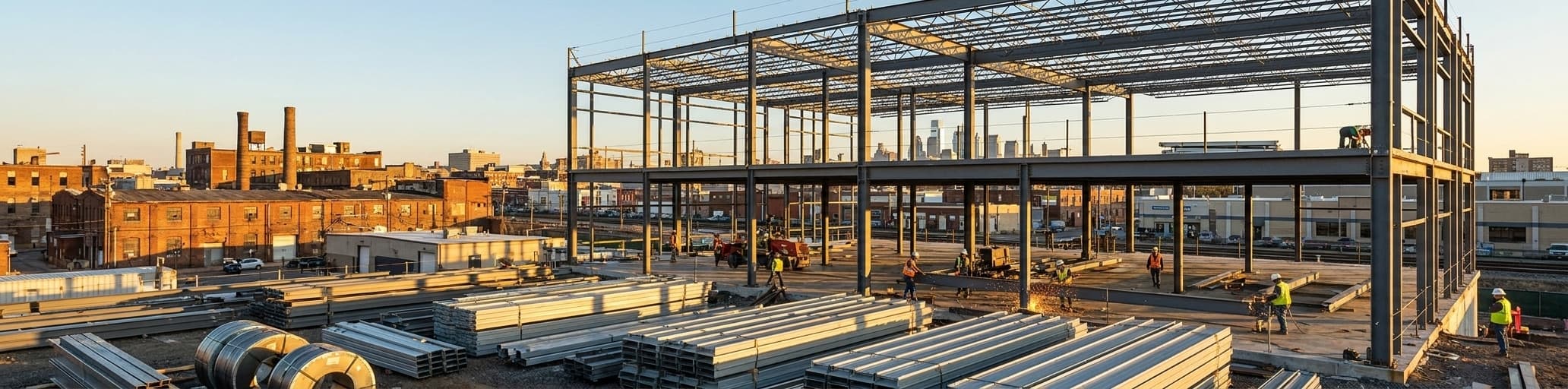

We help Philadelphia businesses understand why pre-engineered steel buildings finish 30% faster and cost significantly less over 20 years than traditional construction. Clear-span steel frames eliminate costly delays, reduce maintenance expenses, and deliver the structural durability your region's demanding climate requires.
Why Philadelphia Businesses Choose Steel Buildings Over Traditional Construction
Steel buildings cut your Philadelphia project timeline by up to 30% through parallel off-site fabrication, saving $75,000 in financing costs on typical commercial loans.
Speed to Market: How Pre-Engineered Steel Cuts Philadelphia Project Timelines
For anyone developing steel buildings in Philadelphia, construction delay is a direct cost — not just an inconvenience. Pre-engineered metal buildings (PEMBs) cut total build time by up to 30% compared to traditional stick-built or masonry methods, and sometimes more.[1] The core reason is parallel production: structural frames, wall panels, and roof systems are fabricated off-site in a controlled manufacturing environment while your site is being graded and your foundation is being poured.[1] Those two tracks run simultaneously instead of sequentially, and that overlap alone collapses the schedule by weeks.
A full PEMB project — design through erection — typically finishes in 10 to 20 weeks.[2] Traditional construction can stretch several months to over a year for comparable square footage.[3] At the erection phase specifically, a 50,000 sq ft steel warehouse goes up in 6-8 weeks, while a comparable traditional structural shell takes 12-16 weeks.[1] Components arrive pre-cut and pre-drilled, bolting together without field modifications or specialty on-site welding — two of the most common sources of schedule slippage on Philadelphia commercial jobs.[1] The Pennsylvania steel building permitting and local code landscape adds its own complexity, but a national builder who front-loads site-specific engineering eliminates the late-stage redesigns that routinely stall traditional builds.
The financial upside compounds fast. On a $5 million construction loan at 6% interest, trimming three months off the timeline saves roughly $75,000 in interest payments alone.[1] For a 100,000 sq ft distribution facility leasing at market rates, being operational three months ahead of schedule generates $75,000 in additional rental income before competitors open their doors.[1] In Philadelphia's logistics and commercial corridor, that kind of schedule advantage means locking in strong tenants and early contracts — not competing for what's left.
Philadelphia's Climate & Code Demands: Steel Building Durability in Northeast Conditions
Philadelphia's ground snow load sits at 25 pounds per square foot under the International Building Code — a structural threshold that must be engineered into every roof system before a permit clears.[4] That number is a floor, not a ceiling.
Wet, packed snow weighs 12-20 pounds per cubic foot, and a single inch of ice equals roughly one foot of fresh snow in load.[4] Stack two feet of heavy accumulation with a refrozen ice layer and you can blow past the design threshold quickly.
Ice dams compound the risk: Philadelphia winters bring repeated freeze-thaw cycles that partially melt rooftop snow, which then refreezes at cold eave edges and forces water backward under roofing materials.[5] Freeze-thaw stress also widens existing cracks in facades and flashing details, accelerating moisture intrusion even when no active leak is visible.[5] Wind-driven rain adds another layer of exposure — coastal storm systems push rain horizontally against building facades and roof transitions, overwhelming traditional parapet walls and flashing at precisely the points most difficult to seal on masonry or wood-frame structures.[5] Pre-engineered steel addresses each of these stressors by design rather than by field repair: Philadelphia's own building code mandates specific corrosion protection for all cold-formed steel wall framing members (Section R603.2.2), and quality pre-engineered steel packages meet or exceed that standard before the first panel is shipped.[6] Dimensional stability under thermal cycling, factory-applied protective coatings, and clear-span frames with no interior wood elements prone to rot or warping give steel structures a durable edge over traditional construction in Pennsylvania's demanding Northeast climate — a structural advantage that shows up in lower maintenance costs and fewer emergency repairs over the life of the building.
Single-Source Accountability: Why Local Contractors Often Fall Short
Philadelphia's construction labor market is one of the most structurally complex in the Northeast, and that complexity lands directly on your project timeline when you're managing multiple local contractors.
The city has historically used project labor agreements (PLAs) — documents that mandate workers on covered projects join specific Building and Construction Trades Council locals as a condition of employment.[7] The practical result: contractors whose workforce belongs to unions outside that consortium have faced exclusion from city-adjacent and publicly influenced projects, and when disputes escalate to litigation, the first casualty is your schedule.[7] The city's own response to one federal lawsuit was to strip PLAs from two named projects solely to "allow those two urgent projects to move forward without delays," which tells you exactly how quickly union jurisdictional conflicts can freeze a job.[7] When you coordinate across a half-dozen local specialty contractors — each with its own labor affiliations, subcontractor chains, and compliance obligations — you absorb all of that fragmentation risk yourself.
A single-source builder consolidates design, fabrication, and erection under one contract and one point of contact, so jurisdictional disputes, coordination gaps, and finger-pointing between trades become the builder's problem to solve, not yours.
Steel Building Types That Solve Philadelphia's Most Common Space Challenges
Steel buildings engineered for Philadelphia's fragmented industrial geography deliver faster construction and lower occupancy costs than leased alternatives across tight urban and suburban sites.
Warehouse & Logistics Buildings for Philadelphia's Distribution Corridor
The Philadelphia metro sits inside one of the most active industrial corridors in the country — the Northeast I-95 market stretching from Boston to Washington D.C., where 60 million people live within a five-hour drive of the Port of New York and New Jersey.[9] That population density, combined with average household incomes running 13.7% above the national average, sustains persistent consumer demand that keeps warehouse absorption strong and vacancy tight across the entire region.[9] Philadelphia's industrial geography reflects this pressure directly: the city's 140 square miles contain industrial pockets spread across neighborhoods from Northeast Philadelphia to Manayunk and East Falls, each with different highway access profiles, rent levels, and operational trade-offs for logistics tenants.[10] Pre-engineered steel buildings are the practical answer to that geographic fragmentation — engineerable to tight urban infill lots or wide suburban parcels, scalable across a wide range of square footage without structural redesign, and erected faster than any masonry or tilt-up alternative.
The broader Pennsylvania distribution market adds a compelling cost context: Class A industrial space in northeastern Pennsylvania leases at $8-9 per square foot including real estate taxes, compared to $18-19.50 per square foot in comparable New Jersey submarkets — a gap exceeding $980,000 annually on a 100,000 sq ft footprint.[8] That cost pressure drives distribution operators deeper into the Pennsylvania side of the corridor, where build-to-suit steel facilities increasingly outperform leased finished space on total occupancy cost over a standard lease term.
Commercial Retail & Office Structures in Dense Urban & Suburban Markets
Philadelphia's commercial real estate geography has been in motion for half a century. Beginning in the 1970s and 1980s, major firms left Center City for suburban corridors in Malvern, Conshohocken, Radnor, Exton, and along City Avenue — drawn by lower corporate taxes, cheaper land, and reduced employee commute times.[11] That migration built a ring of low-rise office parks and retail campuses now facing a structural reckoning: post-pandemic vacancy. The national office vacancy rate approached 18 percent in Q4 2023, with suburban rates climbing from 12.1 percent in late 2019 to 16.4 percent by the same quarter.[12] Tenants across the region are consolidating into less square footage in higher-quality Class A space and shedding older Class B and C inventory rather than renewing.[13] That shift leaves developers in suburban Philadelphia markets — Horsham, Cherry Hill, Conshohocken, and the Route 202 corridor — facing a practical question: when existing stock is obsolete and new tenant requirements demand open, flexible floor plans, what do you build, and how fast can you get it leased?
Pre-engineered steel answers both parts of that question. Clear-span frames eliminate interior load-bearing columns entirely, giving retail and flex-office tenants the open floor plans they require without custom structural engineering on every new deal. Modular wall and facade systems let you adapt a building's exterior program — storefront glazing, canopies, entry configurations — without touching the primary structure, which matters when a suburban mixed-use project needs to accommodate a pharmacy, a regional fitness chain, and a medical office suite under one roof. The broader trend toward blending office, retail, and residential space in a single walkable footprint — a model Philadelphia's own Liberty Property Trust was already planning for its Great Valley campus by 2015 — reinforces this demand for structural adaptability.[11] For developers working Pennsylvania's suburban commercial markets on tight lease-up timelines, a pre-engineered steel shell that erects in weeks rather than months isn't a compromise — it's the competitive edge that determines whether a tenant signs your lease or a competitor's.
Agricultural & Equestrian Buildings for Philadelphia Region Farms
The Philadelphia region's agricultural footprint stretches well beyond city limits into Chester, Montgomery, and Bucks counties — and west into Lancaster County, which anchors one of the most productive farming corridors in the country.
Pennsylvania ranks among America's most agriculturally productive states, with dairy, grain, poultry, and horse farming concentrated across this corridor, and metal buildings have become the standard solution for crop storage, livestock shelter, equipment protection, and agricultural processing across these operations.[14] Southeast Pennsylvania and the Philadelphia metro see fully installed metal building costs in the $8-12 per square foot range, with permitting timelines running 2-4 weeks — a relatively fast track compared to more heavily regulated urban jurisdictions.[14] The climate risk is concrete: Pennsylvania's cold, wet winters demand structures engineered to handle snow load, wind, and persistent moisture without the rot, warping, or structural fatigue that wood-frame alternatives accumulate over time.[14] For equestrian facilities specifically — operations requiring stall layouts, feed rooms, hay bays, and ventilation airflow — steel clear-span construction eliminates interior posts that complicate stall configurations and block equipment movement.[15] A well-designed agricultural steel building can consolidate equipment bays, grain storage, livestock shelter, and hay storage under one roof, engineered to your load requirements from day one, without the ongoing maintenance burden that post-frame alternatives typically accumulate after year five.[16]
Philadelphia Steel Building Costs: What to Budget & Where You Actually Save Money
Steel buildings cost 30-50% less upfront and run $5,500-$17,500 cheaper annually in maintenance and energy than wood or concrete alternatives over 20 years.
True Cost Comparison: Pre-Engineered Steel vs. Stick-Built & MasonryInitial quotes don't tell the full story — the 20-year ledger does. For a 10,000 sq ft commercial structure, pre-engineered steel materials run $10-$25 per sq ft, with installation adding another $10-$20 per sq ft, putting total initial investment at $120,000-$250,000.[17] Wood framing averages $35 per sq ft before siding or brickwork is factored in, while concrete reaches up to $50 per sq ft — pushing comparable wood-frame projects to $350,000-$500,000 and concrete structures to $500,000-$700,000 for the same footprint.[17] Residential builds confirm the same spread: completed metal building homes run $65-$160 per sq ft against $150-$250 per sq ft for standard stick-built construction, a 20-30% savings driven by lower framing costs, faster build cycles, and reduced finishing complexity.[18] Annual maintenance compounds the advantage. Steel buildings run roughly 1% of initial cost per year — $1,500-$2,500 annually on a 10,000 sq ft commercial facility — while wood and concrete demand 2-4%, or $7,000-$20,000 per year, because wood rots, warps, and attracts pests, and concrete cracks.[17] Energy performance adds another layer: steel buildings with insulated panels save 10-20% on energy bills annually, translating to $2,000-$5,000 per year for a modest commercial footprint, versus $1,000-$2,500 for traditional construction.[17] The 20-year cost math consistently favors steel — all-in costs for a pre-engineered steel building run approximately $350,000 over two decades for a 10,000 sq ft facility, compared to $670,000-$1.1 million for comparable traditional construction.[17] That difference is wide enough to fund an entirely separate building.
| Cost category | Pre-engineered steel | Wood (stick-built) | Concrete/masonry |
|---|---|---|---|
| Materials per sq ft | $10-$25 | ~$35 (framing only) | Up to $50 |
| Total initial cost (10K sq ft) | $120K-$250K | $350K-$500K | $500K-$700K |
| Annual maintenance | ~1% of build cost | 2-4% of build cost | 2-4% of build cost |
| Annual maintenance (10K sq ft) | $1,500-$2,500 | $7,000-$20,000 | $7,000-$20,000 |
| Annual energy savings | $2,000-$5,000 | $1,000-$2,500 | $1,000-$2,500 |
| Estimated 20-year total (10K sq ft) | ~$350,000 | $670K-$1.1M | $670K-$1.1M |
How National Buying Power Reduces Philadelphia Project Costs
Philadelphia sits squarely in the most expensive construction region in the country. The Northeast commands costs 30-50% above national benchmarks, driven by urban density, union labor requirements, and complex permitting processes that collectively inflate every line item from framing through finishing.[19] That regional premium doesn't disappear — but it can be meaningfully offset through procurement strategy.
Steel is a global commodity, and its price responds directly to purchasing volume and timing.[20] A national builder with contracted mill relationships and high-volume purchase commitments bypasses the spot-market pricing that local contractors face on individual Philadelphia jobs. The gap is not theoretical: direct manufacturer relationships at national scale deliver 15-35% material savings on structural components and building envelope systems.[21] On top of that structural advantage, Section 232 steel and aluminum tariffs currently running at 50% are embedded in every commercial build — structural framing, MEP rough-in, electrical service — making the difference between contracted pricing and open-market procurement even wider than it was two years ago.[21] Annual cost escalation running 3-8% compounds the risk further for buyers who price materials after design rather than locking rates during preconstruction.[21] A national builder who engages early, sequences procurement against fabrication timelines, and absorbs volume-based discounts converts Philadelphia's regional cost premium from a fixed liability into a negotiable variable — one that a local single-project contractor simply cannot move.
Hidden Savings: Maintenance, Insurance & Long-Term Operating Expenses
The costs that never appear in an initial construction quote often exceed the ones that do. Annual maintenance for metal buildings averages $0.25-$0.45 per square foot, against $1.10-$1.80 for wood-frame equivalents — a gap that compounds into a 30-year savings of $1.42 million on a 50,000 sq ft warehouse compared to wood construction.[23] Specific expense categories clarify how those numbers build: steel eliminates the $5,200 every 5-7 years that wood-frame owners pay for rot and insect repairs, and cuts the $3,800 per decade masonry owners spend on repointing — before accounting for emergency service calls.[23] Over a 10-20 year ownership period, pest and rot repairs alone can add 10-20% to the original construction cost of a wood-frame structure.[22] Steel carries no organic material, so it doesn't support mold growth, attract termites, or accumulate the moisture-driven deterioration that quietly inflates maintenance budgets on traditional builds year after year.[22]
Insurance is the savings category most owners fail to price at the design stage. Steel's non-combustible properties and resistance to weather-related claims translate directly into lower premiums: fire-resistant steel structures reduce insurance costs by 18-25% compared to wood-frame alternatives, and insurers charge 12-15% less for metal buildings across the board due to fewer weather and pest-related claims.[23] For Philadelphia commercial properties where fire ratings and storm exposure drive underwriting decisions, those annual savings compound into tens of thousands of dollars over a standard loan term. The resale picture confirms the long-term advantage: commercial metal buildings retain 17-23% more value after 25 years than comparable wood-frame structures, because appraisers increasingly factor in documented structural integrity and predictable maintenance records — advantages steel buildings carry by design, not by renovation.[23]
Getting Your Philadelphia Steel Building Built: Permits, Timeline & Next Steps
Philadelphia's amended 2021 IBC standards and Delaware County's layered review process require your steel building design to address all jurisdictional requirements upfront, preventing costly conflicts at plan review.
Philadelphia & Delaware County Permit Requirements for Steel Structures
Pennsylvania's Uniform Construction Code (UCC) is administered and enforced locally by over 90% of the state's 2,562 municipalities — meaning Philadelphia and each Delaware County township sets its own enforcement posture, fee schedule, and inspection sequence on top of the statewide baseline.[25] Philadelphia recently proposed amendments to the 2021 editions of the International Building Code, International Residential Code, International Plumbing Code, International Mechanical Code, and International Energy Conservation Code; Pennsylvania's Department of Labor and Industry found those changes compliant and issued an approval letter in May 2026.[25] In practical terms, any new commercial steel structure in Philadelphia must be engineered to the amended IBC 2021 standards before a permit application will be accepted — and your drawings need to reflect those local amendments, not just the base code.
Delaware County adds another layer: all subdivision and land development plans must conform to county design standards, be consistent with the Delaware County 2035 Comprehensive Plan, and comply with all applicable federal, state, and county codes simultaneously, with the most restrictive provision governing wherever conflicts exist.[24] That means a steel warehouse or agricultural building in Upper Darby or Haverford Township isn't just a state UCC filing — it's also a county land development review, a municipal zoning check, and potentially a stormwater management submission under Act 167, all running on different timelines.[24] Skipping or shortcutting any layer carries hard consequences: unpermitted construction triggers fines, forced removal of completed work, complications at resale, and the real possibility that a certificate of occupancy is withheld until violations are corrected.[26] A national builder who front-loads all of those jurisdictional requirements into the design package — rather than discovering conflicts at plan review — keeps your Pennsylvania steel building permit process moving on a predictable schedule instead of stalling at a desk in the county courthouse.
From Design to Erection: What to Expect in the Build Timeline
Knowing the phase breakdown before you break ground is what separates projects that finish on schedule from ones that stall at the permit desk. A Philadelphia steel building moves through five distinct stages, and the critical variable isn't any single phase — it's whether your site work and fabrication run concurrently rather than sequentially. Design and engineering typically consume one to three weeks when client decisions arrive quickly, though complex commercial programs with mezzanines or custom facade requirements can push that window to six weeks.[27] Fabrication follows immediately after drawing approval: standard clear-span frames take three to four weeks in the factory, while highly customized structures budget up to six.[27] Delivery and site staging add roughly one week once components leave the plant, assuming access roads and staging areas are pre-arranged.[27] The erection phase — columns, beams, bracing, purlins, wall and roof panels — runs one to three weeks for structures in the 10,000-50,000 sq ft range, with erection representing roughly 40-60% of total project time on simple pre-engineered buildings.[27] Final inspections and occupancy clearance add another one to two weeks after the punch list closes.[28] The total realistic window for a straightforward Philadelphia commercial steel build runs three to six months from first design meeting to certificate of occupancy, though smaller projects finish faster and large industrial facilities exceeding 50,000 sq ft can run longer depending on scope.[28]
| Phase | Typical duration | Key dependency |
|---|---|---|
| Design & engineering | 1-3 weeks (up to 6 for complex programs) | Client decisions, local code compliance |
| Fabrication | 3-6 weeks | Drawing approval, material lead times |
| Delivery & site staging | ~1 week | Site access, staging area readiness |
| Site prep & foundation | 1-4 weeks (run concurrent with fabrication) | Soil conditions, weather, anchor bolt precision |
| Erection (frame, panels, doors, windows) | 1-3 weeks | Site readiness, crew experience, weather |
| Final inspection & occupancy | 1-2 weeks | Punch list completion, inspector availability |
The single most powerful schedule lever is parallelism: running site preparation and foundation work at the same time fabrication is underway at the factory.[27] Projects that sequence these steps lose three to four weeks of calendar time before the first column arrives on-site. Weather and crew experience are the two variables that most frequently compress or expand the erection window — wet ground halts foundation work, high-wind days pause lifting operations, and a less experienced erection team faces learning curves that a seasoned crew does not.[28] Communication failures between design, fabrication, and erection teams cause a disproportionate share of late-stage change orders, which add both cost and delay regardless of how well the earlier phases went.[29] Fleming Steel Erectors completed a 1.1 million square foot Walmart facility in 31 days — an extreme example, but one that illustrates what pre-coordination between engineers, erectors, and site teams makes possible.[29] For Philadelphia-area projects, front-loading jurisdictional engineering requirements into the design package and submitting permit applications concurrently with fabrication keeps the critical path moving instead of stacking approvals after the steel is already ready to ship.
How to Partner with a National Steel Builder Who Understands Local Requirements
Before you sign anything, verify that any contractor you're considering is actively licensed through Philadelphia's Department of Licenses and Inspections (L&I).[31] The city maintains an online lookup tool that lists all licensed contractors and any violations on record — use it, because an unlicensed contractor on your project creates personal liability for permit violations that land on the property owner, not the contractor.[31] Once you've confirmed licensing, the contract itself becomes your first schedule protection tool: in Pennsylvania, structural plan items must be reviewed and approved within 15 days of contract execution, otherwise the permitting process stalls unnecessarily.[30] A national builder who understands that clock will front-load the structural engineering so drawings are ready for municipal submission the moment signatures are exchanged — not weeks later. After submission, the township has up to 15 business days to approve or return the permit application with requested changes, and the County Conservation District has up to 30 business days to respond to grading plan submissions.[30] On a Philadelphia-area commercial steel project, those two review windows can run sequentially or overlap depending on how well your builder sequences the submission package.
The practical vetting question isn't whether a builder has done steel before — it's whether they've navigated Pennsylvania's multi-agency review process enough times to know which submissions to file simultaneously and which to sequence. A vetted steel building contractor who treats permit coordination as a core deliverable — not an afterthought — keeps your project moving on a predictable calendar while you focus on your business.
- Pre-engineered metal buildings cut construction time by 30% compared to traditional methods through parallel off-site fabrication and on-site foundation work.
- Philadelphia's 25 pounds per square foot snow load, freeze-thaw cycles, and wind-driven rain require steel structures engineered with factory-applied protective coatings and corrosion protection.
- Steel buildings cost $120K-$250K initially for 10,000 sq ft versus $350K-$700K for wood or concrete, with 20-year total costs of $350K versus $670K-$1.1M for traditional construction.
- Steel structures reduce annual maintenance to 1% of initial cost compared to 2-4% for wood and concrete, eliminating rot, pest damage, and concrete cracking over time.
- Insurance premiums for steel buildings are 18-25% lower than wood-frame alternatives due to non-combustible properties and reduced weather and pest-related claims.
- Running site preparation and foundation work concurrently with off-site fabrication is the critical schedule lever that prevents three to four weeks of sequential delays.
- https://www.tylerbuilding.com/post/speed-to-market-how-pre-engineered-metal-buildings-cut-construction-time-by-30
- https://www.builtbyad.com/learning/how-long-does-it-take-to-build-a-metal-building
- https://www.hcsteelstructure.com/pros-cons-prefabricated-steel-buildings-vs-traditional-construction/
- https://valleypeakroof.com/blog/berks-county-winter-snow-loads
- https://roofdesign.com/areas-we-serve/pennsylvania/philadelphia/
- https://up.codes/viewer/philadelphia/irc-2015/chapter/6/wall-construction
- https://whyy.org/articles/lawsuit-seeks-to-break-building-trades-hold-on-city-construction-contracts/
- https://www.mericle.com/distribution/
- https://www.cushmanwakefield.com/en/united-states/insights/tri-state-industrial-report
- https://warespace.com/articles/local-guides/philadelphia-warehouse-neighborhood-guide
- https://philadelphiaencyclopedia.org/essays/office-buildings/
- https://www.americanprogress.org/article/converting-vacant-office-space-into-housing/
- https://www.lincolninst.edu/publications/articles/2023-05-office-residential-conversions-are-on-the-rise/
- https://missourimetal.com/pennsylvania
- https://www.fettervillesales.com/barn-builders-in-philadelphia
- https://buildingsbytimberline.com/
- https://www.summitsteelbuildings.com/20-year-cost-comparison
- https://www.vcstar.com/press-release/story/11641/americans-turning-to-metal-buildings-for-affordable-living/
- https://revizto.com/resources/blog/average-commercial-construction-costs
- https://www.ibeehivesteelstructures.com/blog/steel-warehouse-building-cost/
- https://terrapincg.com/commercial-construction-costs
- https://primesteelmanufacturing.com/blog/the-hidden-costs-of-traditional-construction/
- https://www.jysteelstructure.com/blog/low-upkeep-costs-of-metal-buildings-saving-money-over-time
- https://ecode360.com/32032423
- https://www.pa.gov/agencies/dli/programs-services/labor-management-relations/bureau-of-occupational-and-industrial-safety/uniform-construction-code-home/ucc-municipal-code-change-ordinances
- https://americanremodeling.net/zoning-permits-101-pennsylvania-homeowners/
- https://metalprobuildings.com/pre-engineered-steel-building-timeline/
- https://gravitycontractors.com/how-long-does-it-take-to-erect-a-steel-building/
- https://fse-ok.com/how-long-does-it-take-to-erect-a-steel-building/
- https://rotelle.com/permitting-process-explained/
- https://www.phila.gov/services/permits-violations-licenses/find-a-licensed-contractor-and-contractor-information/