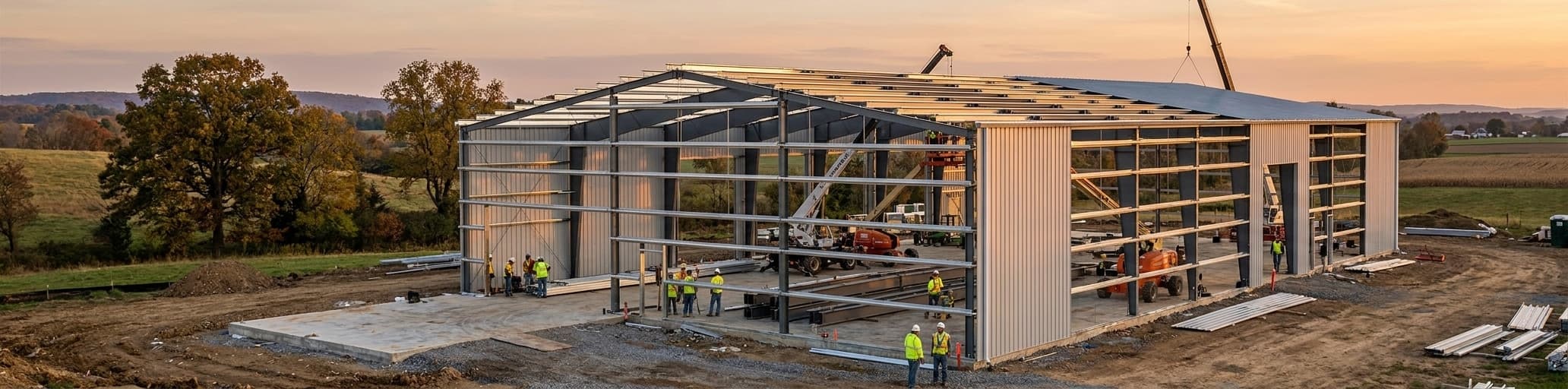

We help Pennsylvania builders avoid hidden costs and accountability gaps by combining turnkey design, engineering, and erection into a single contract with transparent pricing. You get cost certainty upfront, credentialed local crews, and a complete project timeline from permit to final inspection.
Why Pennsylvania Builders Choose National Steel Buildings Over Local-Only Manufacturers
One contract covers everything from permit drawings through final inspection, so you know exactly what you're paying before you commit.
Single-Source Accountability: Design, Engineering, and Erection Under One Roof
When design, engineering, and erection sit with separate vendors, accountability vanishes the moment something goes wrong. The biggest shock for many buyers isn't the final price — it's what the original contract quietly left out.
Foundations, permits, site prep, and even unloading steel from the delivery truck are routinely excluded from the "all-in" quote, so a $50,000 package can balloon fast once those gaps surface.[3] That's the structural flaw in working with a kit-only supplier: you become the project manager, coordinating between a manufacturer, a local engineer, and an erection crew while absorbing every scheduling conflict and cost dispute between them. A turnkey single-source model closes that gap — one contract runs from permit drawings through final inspection, so there's no ambiguity about who owns each problem.
Pre-engineered steel makes this practical because local and national code requirements are built directly into the structural design from day one, every member is precision-engineered for the specific site conditions, and the complete package ships in a single delivery with no waiting on multiple manufacturers.[1][2] You get cost certainty before you commit, not after.
National Buying Power Meets Pennsylvania-Specific Code Compliance
ProTrades Erection Division: Local Installation with National Standards The erection crew is where most kit-only projects quietly unravel. You receive a steel delivery, then spend weeks sourcing a local crew, verifying their credentials, and hoping their schedule aligns with your site-prep completion date — all while absorbing any delays between them.
ProTrades closes that gap by keeping erection in-house, with crews trained to the certification benchmarks that separate accountable erectors from day-labor alternatives. The Metal Building Contractors and Erectors Association's AC478 accreditation sets the bar: it's an independently verified standard requiring documented assessment of a company's management systems, assembly processes, internal safety protocols, ongoing training programs, and periodic job-site inspections.[7] AISC Erector Certification adds another layer, examining complete quality management systems from training records through product delivery — confirming that crews do what they say they do, not just that they say the right things.[8] Within the first year, a credentialed erection crew should carry OSHA 10, rough terrain forklift safety, and aerial work platform certification; foremen add OSHA 30 and first aid/CPR by year two.[8] For Pennsylvania sites specifically, those credentials matter beyond paper compliance: freeze-thaw cycles, winter erection windows, and ice-load conditions compress the margin for error on every lift.
Knowing your erection crew operates under a documented safety and training framework — not a handshake arrangement — means your project stays on schedule and within budget even when Pennsylvania weather doesn't cooperate. If you want a practical framework for evaluating any erection crew before you commit, local prefab contractor vetting tips covers the five questions that separate qualified crews from risky ones.
Steel Building Applications Pennsylvania Owners Actually Need
Steel farm sheds cost $12-19 per square foot versus $45-65 for wood, while delivering column-free interiors and decades longer durability in Pennsylvania's freeze-thaw climate.
Agricultural Storage and Equipment Barns for PA Farming Operations
Pennsylvania agriculture covers a wide range of operations — from Lancaster County dairy farms to Erie County grain production — and the equipment behind all of them is expensive to store carelessly. The list of what needs covered, protected space is long: tractors, combines, balers, plows, mowers, and sprayers, alongside feed, hay, and harvested produce.[9] Wood was the traditional answer for farm sheds, but clear-span construction is difficult to achieve in wood framing, which forces interior columns into the floor plan and eats usable floor space.[9] Labor-intensive wood construction compounds the problem when skilled carpenters are scarce, and the material cost reflects it: traditional wood machine sheds run $45-$65 per square foot, while prefab steel farm machinery sheds land between $12-$19 per square foot — a gap explained by precision-cut kit assembly and a construction timeline roughly 33% shorter than conventional methods.[9]
The structural case for steel goes beyond the initial price. Heavy-duty steel beams deliver column-free interiors wide enough to drive a combine through without threading around obstructions, and clear-span widths can run from a compact 20 feet up to 300 feet of unobstructed space.[9] Steel doesn't rot, doesn't attract pests, and doesn't absorb moisture — the three failure modes that quietly drive up wood barn maintenance costs year after year.[11] For PA farming operations specifically, where freeze-thaw cycles accelerate wood decay and winter ice loads stress structural connections, the durability gap between steel and wood closes your maintenance budget faster than most owners expect. Over 60% of new agricultural buildings in North America are now built using steel, a shift driven by long-term cost performance rather than any single feature.[10] If you're planning a new equipment barn and want to nail the dimensions before committing to a footprint, farm equipment storage building dimensions that account for your largest equipment — door heights, bay widths, turning radius — determine whether the building actually saves you time every day or costs it.
Commercial Warehouses and Retail Spaces Across Pennsylvania
Pennsylvania's commercial corridors — distribution hubs along I-78 and I-81, retail strips in suburban Philadelphia, light manufacturing in the Lehigh Valley — share one pressure: conventional construction costs eat too far into the revenue a building needs to generate. Steel resolves that gap with numbers you can act on.
A pre-engineered steel warehouse kit runs $12-$19 per square foot, versus $22-$39 for wood-framed construction and $28-$48 for tilt-up concrete.[14] On a 20,000-square-foot distribution facility, that differential puts the total build between $240,000 and $380,000, well below what competing structural methods produce.[14] Installed turnkey pricing — kit, concrete slab, delivery, and erection by a credentialed crew — lands between $24 and $43 per square foot for commercial-grade steel I-beam frames.[13] Speed compounds the savings: steel assembly runs roughly 33% faster than conventional methods, which shortens your carry costs and moves your opening date forward.[14] For retail specifically, clear-span framing removes the interior columns that force merchandise layouts around structural obstructions — a floor-planning advantage that tilt-up and wood-frame buildings rarely match without costly workarounds. Ongoing costs stay predictable too: annual repair and maintenance on a steel commercial building averages $1.40-$1.85 per square foot, and unlike wood-framed retail shells, steel doesn't rot, warp, or require periodic repainting to maintain structural integrity.[14] Soft costs — permits, engineering, insurance, legal — run roughly 30% of the total project budget regardless of structural material, which makes the lower hard-cost base of steel even more valuable when you're holding a fixed development budget.[14] For a detailed look at how warehouse costs scale across common footprints before you commit to a size, the industrial warehouse cost breakdown by size covers real 2026 numbers across the square footages most Pennsylvania commercial buyers are actually pricing.
Aviation Hangars and Industrial Facilities in PA's Manufacturing Belt
Pennsylvania's manufacturing corridor — stretching from Pittsburgh through the Monongahela Valley into the Lehigh Valley — demands buildings that handle continuous heavy use without flinching.
Pre-engineered steel serves aerospace, automotive, logistics, energy, and food processing operations because the structural system delivers the unobstructed interior space heavy machinery requires while carrying the load industrial operations impose.[16] Aviation hangars need that same clear-span logic in a more specific form: wide, column-free interiors that accommodate aircraft movement and maintenance access without structural members interrupting the floor plan.[15] Both applications share a cost advantage over traditional construction methods — steel builds faster, generates less material waste, and carries lower labor costs, which matters when a production facility delay directly costs revenue.[16] Scalability is another practical factor: the system can accept new bays as operations expand without rebuilding the original structure from scratch, so your initial footprint doesn't cap your growth.[16] Pennsylvania's industrial sites also carry site-specific durability pressures — freeze-thaw cycling, winter snow loads, and the corrosion exposure common to older industrial zones all accelerate wear on conventional materials faster than owners anticipate.[15] Steel's resistance to corrosion, fire, and extreme weather directly addresses those failure modes, and fully insulated wall and roof assemblies can be built into the original spec to maintain climate-controlled conditions for manufacturing processes or sensitive aerospace components.[16] For a breakdown of how clear-span sizing scales for different aircraft and what a hangar kit actually covers, prefab aviation hangar kits gives you the numbers before you commit to a footprint.
Pennsylvania Steel Building Pricing: What You'll Actually Pay in 2026
Stop comparing package-only quotes to installed prices–Pennsylvania shell costs run $35 to $55 per square foot, 25 to 45% above the national average.
Cost Breakdown by Building Type and Size (Comparison Table)
Before any number in the table below means anything, you need to know which tier of cost you're looking at. The building package — frame, panels, trim, and fasteners — covers only 40 to 50% of total project cost.[18] Add foundation, erection labor, and basic weatherproofing and you reach the installed shell. Add insulation, HVAC, electrical, plumbing, interior finishes, and site work and you reach the fully finished project.[18] Every misleading quote you've seen was a package-only number dressed up as a complete price. The table below separates all three tiers so you can compare apples to apples.
Pennsylvania sits in the Northeast construction region, where installed shell costs run $35 to $55 per square foot for a standard commercial or industrial PEMB — 25 to 45% above the national average, driven by labor rates, permit fees, and compressed construction seasons.[18] Package-only pricing from the manufacturer runs $14 to $22 per square foot for standard configurations, rising to $35 to $55 per square foot when enhanced specs are required — higher wind or snow loads, wider clear spans, crane capacity, or architectural wall panels.[18] Turnkey installed pricing (kit, concrete slab, delivery, and erection by a credentialed crew) lands between $24 and $43 per square foot nationally for commercial-grade I-beam frames, with the Northeast premium pushing Pennsylvania projects toward the upper end of that range or beyond.[17]
| Building type | Package only ($/sqft) | Installed shell — PA ($/sqft) | Fully finished ($/sqft) | Common PA application |
|---|---|---|---|---|
| Agricultural / equipment barn | $14-22 | $35-55 | $25-45 | Lancaster County dairy, Erie County grain |
| Warehouse / distribution | $14-22 | $35-55 | $45-75 | I-78 / I-81 logistics corridors |
| Self-storage (single-story) | $14-22 | $35-55 | $35-55 | Suburban Philadelphia, Lehigh Valley |
| Manufacturing / industrial | $14-22 | $35-55 | $55-100 | Pittsburgh-Monongahela-Lehigh belt |
| Retail / office (PEMB shell) | $14-22 | $35-55 | $85-150+ | Suburban retail strips, light commercial |
| Cold storage / refrigerated | $35-55 | Higher — envelope-driven | $120-300 | Food processing, cold-chain distribution |
| Aviation hangar | $14-22 | $35-55 | $40-70 (shell); MEP drives total | Regional airports, private airfields |
Building size shifts the per-square-foot cost in a predictable direction: larger footprints spread fixed engineering, permitting, and mobilization costs over more area, lowering the unit price.[18] As a general guide for installed shell costs in mid-cost markets — before applying the Pennsylvania premium — a 30×40 (1,200 sqft) runs $34 to $42 per square foot, a 50×100 (5,000 sqft) drops to $28 to $36, a 100×100 (10,000 sqft) lands at $25 to $33, and a 100×200 (20,000 sqft) falls to $22 to $30 per square foot.[18] Apply the 25 to 45% Northeast premium to those figures and you have a working Pennsylvania baseline before your site-specific variables — soil conditions, snow load zone, local permit fees — adjust the number further. Steel prices add another layer: hot-rolled coil is currently trading around $950 to $1,050 per ton, nearly double 2018 levels, and prices have moved up roughly 4 to 8% since January 2026 with no meaningful decline on the horizon.[17] Locking in your building package price when a favorable quote is available is one of the most effective cost controls available — waiting typically costs more than it saves, as one buyer discovered when a 90-day delay turned a $27,400 quote into a $31,200 quote once freight and crew scheduling tightened.[17] For a granular look at how 30×40 prefab building costs stack up line by line across all three tiers, that footprint is a practical reference point before you scale up or down.
How Pennsylvania Snow Load and Wind Codes Affect Your Final Price
Pennsylvania's ground snow load ranges from 20 to 25 psf — one of the heavier ranges among Mid-Atlantic states — and that figure isn't uniform across the state.[19] Western and northern counties frequently push toward the upper end, meaning a quote built around a statewide average is almost certainly under-engineered for your site.[19] Pennsylvania's Building Code Chapter 16 mandates specific structural design thresholds under Section 1608 for snow loads and Section 1609 for wind design data, and every permit submission has to demonstrate compliance with both before an inspector signs off.[21] Where those thresholds are elevated, the structural response is direct: thicker steel members, heavier connection hardware, and reinforced bracing — all of which add to material cost.[20] Areas with high snow or wind requirements can carry a 15 to 25% premium over comparable builds in low-load regions, and Pennsylvania's snow zone puts many projects squarely in that range.[20]
The wind side of the equation is separate but simultaneous. Pennsylvania's statewide average wind speed sits at 18 mph, but local exposure — open farmland versus a sheltered valley, elevated ridge versus river basin — shifts the actual design pressure considerably.[19] Snow load and wind load are distinct engineering problems: snow load measures the vertical weight a roof structure must carry in pounds per square foot, while wind load measures the horizontal pressure the entire frame must resist.[19] Both feed into your primary frame specification at the same time, so a site with elevated readings on either variable increases the steel spec across the whole building, not just the roof.[19] Understanding the difference matters because it prevents buyers from assuming a lighter roof pitch solves the entire problem — it addresses one load path, not both. Roof pitch does, however, offer a meaningful trade-off in high-snow regions: steeper pitches shed accumulated snow faster, reducing the sustained vertical load the frame must carry, which can lower the required steel weight and trim material cost.[19] That calculation is worth running with your engineer before you finalize your building dimensions, since structural steel component weight is one of the few variables in a PEMB spec you can influence through design choices rather than site conditions.
Financing Options and Payment Plans for PA Steel Building Projects
The cost of a PA steel building project doesn't have to land in a single payment. Steel building financing runs through five main paths: personal loans, home equity loans, home equity lines of credit (HELOCs), cash-out refinancing, and rent-to-own programs.[24] Personal loans are the most accessible — no collateral required, up to $100,000 available, and for borrowers with strong credit, APRs as low as 6.99% with repayment terms stretching to 12 years.[24] For context, a 10,000-square-foot PA warehouse project can approach six figures before site work and finishing costs enter the budget, so choosing a term that keeps monthly payments serviceable without straining operating cash flow is often the decision that determines whether a project actually closes.[23]
For PA property owners with existing home equity, HELOCs and home equity loans deliver lower rates than unsecured alternatives — but both use your property as collateral, which adds risk if cash flow tightens mid-project.[24] A cash-out refinance is a third secured route: refinance your existing mortgage above the outstanding balance and redirect the difference toward your building budget.[24] All three secured options carry better rates for the same borrower profile than personal loans, but approval timelines are longer and documentation requirements are heavier. One practical workaround on larger commercial or industrial projects is phased financing — drawing funds in stages as site prep, erection, and finishing complete in sequence — which limits carry costs and aligns loan draws with actual project milestones.[24] Minimum credit score thresholds for personal loan approval typically sit between 610 and 640, though lenders weigh the full financial picture — income, debt-to-income ratio, and payment history — alongside the score itself.[24]
For buyers who don't qualify for traditional financing, rent-to-own removes the credit barrier entirely. RTO programs require no credit check, offer same-day approvals, and structure payments across 36-month terms with the option to pay off early and own the building outright.[22] Monthly installments are calculated against the full delivered price including installation, so there's no residual balance at the end of the term.[22] RTO costs more in total than a cash purchase, but for a Lancaster County farming operation or a Lehigh Valley contractor who needs covered storage now, getting the building up and generating value immediately outweighs the financing premium. For a side-by-side look at how each financing structure performs on a standard project footprint, financing options that close the gap on a 30×40 build walks through real numbers across each route before you commit to one.
How to Choose a Steel Building Manufacturer in Pennsylvania: The NSB Vetting Essentials
Run every Pennsylvania steel builder through seven essential questions about licensing, quote transparency, payment terms, and warranties before signing anything.
Seven Questions to Ask Before Committing to Any Pennsylvania Steel Builder
Choosing the wrong steel building manufacturer in Pennsylvania rarely shows up on the original quote — the real cost surfaces later as missed permit submissions, mismatched snow-load specs, or an erection crew that walks off after delivery. Before you sign anything with any Pennsylvania steel builder, run every candidate through these seven questions. A qualified partner answers all of them without hesitation; evasive or vague responses are a reliable signal to keep looking.
- Can you provide your state contractor license number and a current certificate of insurance? A valid license means the contractor has met minimum competency standards and can be held accountable through the licensing board.[27] Require proof of both general liability coverage (minimum $1 million per occurrence) and workers' compensation — without workers' comp, an injured worker on your site can file claims directly against you.[27]
- What does your quote actually include? Hidden charges not clearly identified in a quote are a red flag; a reliable contractor knows the real costs upfront and doesn't surface them later as change orders.[26] Ask for separate line items covering the building package, foundation, permits, delivery, erection labor, and site work — any lump-sum figure that doesn't break these out is hiding something.[27]
- What is your payment structure? Milestone-based is the standard: a deposit of 10-30% to cover material procurement, progress payments tied to specific completion milestones, and a final holdback retained until the project passes inspection.[27] Any contractor who demands 100% upfront should be removed from consideration immediately.[27]
- What warranties cover both materials and workmanship? Demand both a manufacturer material warranty and a separate contractor workmanship warranty — the manufacturer warranty covers material defects but does not cover installation errors, so without both you have a dangerous gap in coverage.[27] Confirm whether the workmanship warranty is transferable if you sell the property.[27]
- How long have you operated in Pennsylvania, and can you provide three local references? Local longevity indicates stability and accountability — a contractor who has worked in your county understands the specific permit offices, snow-load zones, and inspection timelines your project will encounter.[27] Willingness to share verifiable local references shows confidence in recent work.[27]
- Who performs the erection — your own crew or subcontractors? A contractor's own trained crew delivers more consistent quality and clearer accountability than a subcontracted arrangement where scheduling conflicts and cost disputes fall back on you.[26] Ask specifically whether the erection crew carries OSHA certifications and documented training records.[27]
- What does your complaint history look like, and how do you resolve disputes? Check the Better Business Bureau for complaint patterns before signing anything — one resolved complaint rarely disqualifies a contractor, but repeated unresolved complaints reveal how the company actually behaves when problems arise.[27] Search the contractor's name alongside terms like "complaint" or "lawsuit" and verify directly with your state's contractor licensing board for any disciplinary actions.[27]
For a deeper framework on evaluating any erection crew specifically — beyond the licensing and insurance basics — steel building contractors vetting guide covers the additional screening steps that separate qualified crews from risky ones before a single bolt is set.
Red Flags That Separate Turnkey Partners from Kit Suppliers
The gap between a turnkey partner and a kit supplier rarely announces itself — it hides inside the quote structure. The clearest early signal is a single headline price with no line-item breakdown: any quote that shows one number without separating the structural package, engineering drawings, delivery, and installation labor is a marketing figure, not a real cost.[28] A legitimate turnkey quote lists every component separately so you can verify scope — and understanding what's optional at quote versus essential later is exactly how you catch the difference before you commit. Closely related is vague steel specification language: if a quote says "steel frame included" without naming the gauge, you have no way to verify what arrives on site.[28] Reputable suppliers specify gauge on every structural component, and evasiveness on that point almost always means lighter material used to hit a lower headline number.[28]
Two more quote-level signals are worth catching early: engineering drawings listed as an add-on cost, and no mention of wind or snow load certification.[28] PE-stamped drawings are required for a permit in most Pennsylvania counties — a supplier who excludes them from the base price isn't saving you money, they're hiding a cost you will always pay.[28] A quote that skips wind and snow load certification may not meet your county's code requirements, and discovering that after the steel delivers is an expensive problem to fix.[28] On the contract side, resist any arrangement that isn't fully written out — vague or single-page agreements that skip applicable building code version, loading criteria, and compliance statements shift all the risk onto you.[29] A contractor who pressures you toward a verbal or loosely worded agreement is protecting their own flexibility, not your project outcome.[29] Finally, watch the quote validity window as a signal in both directions: a 7-14 day window reflects actual steel market conditions, while a 30-day-or-longer window often means the supplier has padded the price to protect their margin — meaning you're paying for their risk buffer upfront.[28]
Next Steps: Getting a Custom Quote from National Steel Buildings
Before you call or submit a quote request, pull together four pieces of information that determine every meaningful number in your quote: your site's ZIP code and county (for snow load and wind zone data), your intended use and largest equipment or vehicle that needs to fit inside, your approximate footprint, and your target timeline.
Multiple factors drive final building price — size, customization options, insulation specification, and finish level all move the number, and an accurate quote depends on accurate inputs from the start.[31] A free quote is the standard entry point, but what separates a useful quote from a marketing figure is line-item separation: building package, foundation, permits, delivery, and erection labor should each appear as distinct costs, not a single total.[32] The final delivered price should include installation so you know the complete project cost upfront before committing to anything.[32] If you're working against a tight timeline, note that steel prices have moved up through early 2026 with no meaningful decline forecast — locking in your package price when a quote is available is one of the few cost controls entirely within your reach.[30] Once you have your inputs ready, the prefab building kits delivery timeline walks through exactly what happens between order placement and steel delivery, so your site prep and erection scheduling align with the actual production sequence rather than a best-case estimate.
- Turnkey single-source contracts eliminate cost gaps by covering permits, engineering, erection, and site prep in one agreement.
- Pennsylvania's 20-25 psf snow load and wind requirements add 15-25% to steel specs in high-load zones versus low-load regions.
- Pre-engineered steel farm barns cost $12-19/sqft versus $45-65/sqft for wood, with 33% faster construction timelines.
- Installed shell pricing in Pennsylvania runs $35-55/sqft (25-45% above national average) due to labor rates and permit fees.
- Credentialed erection crews with OSHA 10, AC478, and AISC certifications ensure schedule reliability despite Pennsylvania's freeze-thaw cycles.
- Hidden costs surface in quotes missing line-item breakdowns for package, foundation, permits, delivery, and labor–demand itemized pricing.
- Steel prices have risen 4-8% since January 2026; locking in quotes immediately prevents delays from costing thousands more.
- https://norsteelbuildings.com/advantages-of-steel-series/advantages-of-steel-buildings/
- https://www.buildingsguide.com/metal-building-kits/?srsltid=AfmBOor-PL69ZqvsAJ3rkOlxBEKgf-V32MeGgYiFaCoFiWtOM5t_De52
- https://metalprobuildings.com/steel-metal-buildings-what-you-need-to-know-before-signing-a-contract/
- https://www.alliedbuildings.com/pemb-building-codes/
- https://titansteelstructures.com/steel-building-engineering/designing-for-disaster-2026-wind-and-snow-load-requirements-for-metal-buildings/
- https://www.engineeredmetalbuildings.com/blog/?srsltid=AfmBOor4sj6iD0cV6E2p7ymsG_q7blS5Nk3-VpzuiaPD5YECCVM3iQRQ
- https://www.mbcea.org/
- https://www.metalconstructionnews.com/articles/metal-building-erector-certifications/
- https://www.alliedbuildings.com/farm-sheds/
- https://www.steelcobuildings.com/essential-features-of-farm-storage-buildings/
- https://futurebuildings.com/blog/steel-agricultural-sheds-and-barns.html
- https://sunwardsteel.com/pennsylvania/
- https://www.buildingsguide.com/metal-building-prices/?srsltid=AfmBOorI2D4mdESB4kj1g9Pgqome3nEIsrnFXpzwRbTE5VPZFmH1kmlR
- https://www.alliedbuildings.com/20000-square-feet-warehouse/
- https://reichconstructionllc.com/united-states-pre-engineered-steel-buildings-50-states-guide-faqs/
- https://norsteelbuildings.com/us/buildings/industrial-metal-buildings/
- https://www.buildingsguide.com/metal-building-prices/?srsltid=AfmBOooa4XS_lIkLnGC-8mdRbofz8CLzgIttNqOhS9WcbR8cKW9K-rQN
- https://terrapincg.com/news/pre-engineered-metal-building-cost-per-square-foot-usa
- https://americanmetalgarages.com/snow-load-vs-wind-speed-metal-buildings/
- https://ameribuilds.com/steel-building-costs-what-to-expect-2026/
- https://up.codes/viewer/pennsylvania/ibc-2018/chapter/16/structural-design
- https://www.vikingsteelstructures.com/metal-buildings-pennsylvania-pa?srsltid=AfmBOopLsl20_evPZLZHLoArsR1B9GQcTM0qMYPKeyi2xW6QqRFexL4g
- https://www.americanmetalbuildings.com/financing-metal-buildings/?srsltid=AfmBOopFQ6pCDCwJwcqxQL1UrMKfGsDnC3uY5xbjeaxsh2tVPCMDDebc
- https://www.acornfinance.com/outdoor/pole-barn-financing/
- https://www.alpinepaintingandrestoration.com/services/steel-building-painting/
- https://www.pacaweb.org/blog/what-to-look-for-in-a-concrete-contractor
- https://roofvista.com/resources/guides/how-to-choose-roofing-contractor
- https://www.aametalbuildings.com/blog/why-do-two-steel-building-quotes-for-the-same-size-come-back-so-different?srsltid=AfmBOorRYIuP9ZEfigXQfznwGm63fh7FchdDgwOUvmHmtXNPuq_OtLmG
- https://www.hansenpolebuildings.com/tag/building-contractor-2/?srsltid=AfmBOooij7kOzyCr2SWRvvgFOoq0yqug2odlGQlQ4qZR2n6yh8qsbC7R
- https://www.worldwidesteelbuildings.com/states/pennsylvania/
- https://www.americanmetalbuildings.com/pennsylvania-metal-buildings/?srsltid=AfmBOopzdn-phb_e28JgE8yAWwUYWMF-3MsBX0dlSKkNu64PEPl6sJMX
- https://www.vikingsteelstructures.com/metal-buildings-pennsylvania-pa?srsltid=AfmBOooqPPLtoYEAKt3j7xusacaTf7zQQqiQv9wvZ6Mvzff8PVyDZ85O