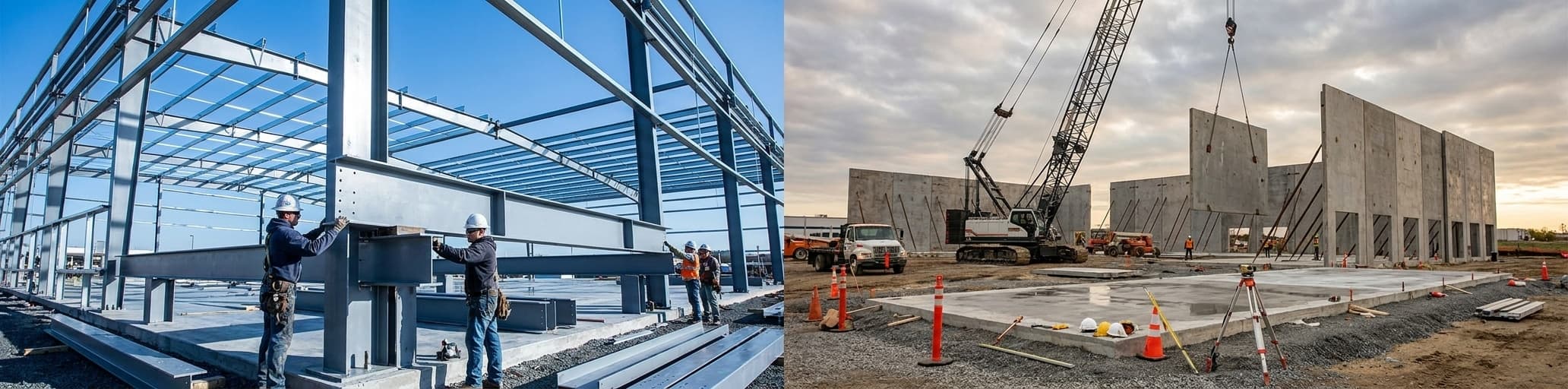

We help you understand why prefab steel warehouses cost 20-30% less and build 30-50% faster than tilt-up concrete, with dramatically lower maintenance over 25 years. The math proves prefab steel wins for most projects under 80,000 square feet unless fire code or architectural requirements specifically demand concrete.
Warehouse Addition Cost Per Square Foot in 2026: Direct Comparison
Prefab steel warehouses cost $20 to $50 per square foot installed, while tilt-up construction runs $115 to $235 depending on your specifications and location requirements.
Prefab steel warehouse kits: $35-$50 per square foot installed
A prefab steel warehouse kit costs $20 to $50 per square foot installed — covering the kit, concrete slab, delivery, and on-site construction.[1] Commercial warehouse builds with standard dock doors, insulation, and code-required engineering typically land in the $35 to $50 per square foot range, where the structural complexity justifies the position in that band.[2] Breaking that down: steel materials run $7 to $11 per square foot, and labor adds another $5 to $9 per square foot — accounting for 20 to 40 percent of your total budget.[3] That puts a 20,000-square-foot warehouse at $240,000 to $380,000 for the structure alone, before site prep, HVAC, or interior finishing.[3] What pushes your number toward $50 is specific engineering requirements — seismic zones, heavy snow loads, or refrigeration add-ons — not the base steel frame.[3] Steel prices also fluctuate daily, so locking in a quote close to your project start date protects your budget from mid-project material swings.[3]
Tilt-up concrete construction: $85-$140 per square foot installed
Tilt-up's price premium over prefab steel is real and consistent across project types.
Full warehouse shell pricing for tilt-up — covering envelope, conventional steel joist roof, and slab-on-grade — runs $115 to $185 per square foot for standard industrial use, with distribution and light manufacturing facilities pushing into the $145 to $235 range.[4] Panel costs alone break down by spec: standard 6-to-7-inch reinforced panels run $14 to $22 per square foot of wall area, insulated sandwich panels land at $20 to $28, and architectural finishes push to $24 to $32.[4] The gap between panel cost and total building cost reflects what you're actually buying: four to eight weeks of foundation and slab prep before any panels can pour, a seven-to-fourteen-day cure window per panel, and crane plus erection labor that runs two to four weeks on a 200-panel project.[4] A real 2025 data point anchors the range — a 410,000-square-foot e-commerce distribution center in central Texas delivered at $138 per square foot total, covering foundations, slab, 168 wall panels averaging 28 feet tall, roof structure, and basic MEP rough-in.[4] That owner originally budgeted PEMB at $96 per square foot and chose tilt-up only after a 25-year hold analysis justified the $42-per-square-foot premium.[4] That calculus only works at scale: tilt-up's per-square-foot cost compresses through panel repetition, making it cost-competitive between 80,000 and 800,000 square feet.[4] Below roughly 80,000 square feet, pre-engineered metal buildings consistently win on installed cost — and below 30,000 square feet, the economics shift toward masonry.[4] For cold storage warehouse construction, tilt-up carries an even steeper penalty: a mid-Atlantic cold storage trade study in 2025 put tilt-up at $258 per square foot versus $208 per square foot for native insulated metal panel construction — a 24 percent gap on a $24 million project.[4]
Why the 60-70% cost difference matters for your budget
The 60-70% base cost gap between prefab steel and tilt-up concrete doesn't stay contained to the hard cost line — it compounds across every soft cost category in your budget. Design and engineering fees run 4-6% of hard construction costs, permits add 0.5-3% depending on jurisdiction, builder's risk insurance tacks on roughly 1%, and most lenders now require a 7-10% contingency buffer against material price swings.[5] Apply those multipliers to a tilt-up base price that already runs $40-$90 per square foot higher than prefab steel, and the gap widens before a single panel is poured.
Financing makes it worse: with the Federal Reserve holding rates at 4.25-4.50%, construction loans add 2-5% to total project cost — and tilt-up's longer build window means more months of interest accruing before you reach occupancy.[6] Extended timelines can add $10-$30 per square foot to final project costs purely through carrying costs, a penalty prefab steel largely sidesteps by compressing erection to weeks rather than months.[6] On a 50,000-square-foot prefab warehouse project, even a conservative $40-per-square-foot hard cost advantage for steel translates to $2,000,000 in base savings — capital that funds racking systems, dock levelers, HVAC, or reserve against lease-up risk. The tilt-up premium earns its keep under a narrow set of conditions: a 25-year hold strategy, panel repetition across 80,000+ square feet, and a tenant profile or zoning requirement that explicitly demands concrete construction.[7] Below that threshold, the payback period on tilt-up's cost premium runs 12-20 years through rent differential alone — before accounting for higher maintenance costs and insurance exposure.[7] For most industrial warehouse buyers building between 10,000 and 80,000 square feet, prefab steel keeps the project within budget while leaving room for the operational infrastructure that actually drives returns.
Speed to Occupancy: How Prefab Steel Warehouses Cut Timeline by Months
Prefab steel warehouses reach weather-tight status in 18 days because 70-90% of construction happens in the factory before steel arrives on your site.
Prefab steel erection timeline: 4-8 weeks from delivery to weathertight
The 4-8 week on-site erection window is possible because roughly 70-90% of construction work happens in the factory before a single piece of steel reaches your site.[8] Components arrive pre-cut, pre-punched, and pre-welded — the crew's job on arrival is assembly, not fabrication.[9] A 15,000-square-foot commercial structure reaches weather-tight status in 18 days using pre-engineered wall and roof assemblies; a 100,000-square-foot distribution center closes structural erection in 12 weeks, 67% faster than conventional framing methods.[8] Where your project lands in that range depends on footprint, crew certification level, and customization depth — certified crews finish 20% faster than uncertified teams, and standardized kit configurations shorten assembly by 12-18 days compared to fully custom designs.[8] One scheduling move that consistently compresses the overall timeline: run site prep and foundation work concurrently with factory fabrication, so your slab is cured and inspected before the first steel delivery arrives.[10] For a closer look at how kit delivery scheduling connects to your full project window, the prefab building kits delivery timeline covers what happens between order approval and first steel on site.
Tilt-up concrete: 12-18 weeks from foundation to occupancy
Tilt-up's timeline is long because the process is inherently sequential — each phase must finish before the next can start.
The slab-on-grade foundation has to be poured and cured first, since panels are cast directly on that slab surface.[11] Once the casting bed is prepped and rebar installed, concrete placement begins, but panels can't move until they reach at least 75% of design strength — typically 7 days in summer and 10-14 days in winter.[11] On a 100,000-square-foot warehouse, the casting, curing, crane erection, bracing, and connection grouting sequence runs 6-9 weeks for the tilt-wall package alone.[11] Stack foundation work in front of that, and a comparable traditional tilt-wall build takes 12-16 weeks just to reach a weathertight structural shell.[12] Climate adds another variable: North Texas summer pours require retarding admixtures to prevent premature setting, while winter pours need insulated blankets or temporary enclosures — either condition stretches the curing window and can push the upper end of the schedule.[11] A 210,000-square-foot logistics expansion in Plano with 62 panels still required 9 weeks from casting to substantial completion under favorable conditions, with night pours required to coordinate around an active adjacent tenant.[11] Cold storage adds even more time: insulated tilt-up sandwich panels cure for a full 28 days before crane lifting, and on a 150,000-square-foot cold storage shell, that cure window alone puts tilt-up 2-4 weeks behind insulated metal panel construction.[13] For owners comparing warehouse addition cost per square foot across methods, every extra week of tilt-up's construction window is a week of construction loan interest accruing before you generate any revenue from the building.
Hidden delays in tilt-up that prefab steel eliminates
The curing windows and sequential phase dependencies covered above are the delays tilt-up owners plan for. The ones that derail schedules are harder to see coming.
Weather interruptions during outdoor casting are chief among them: rain, excessive heat, or high humidity during the pour phase forces a restart, since tilt-up panels cure directly on the casting bed in open-air conditions.[14] Winter construction amplifies the problem — northern projects require insulated blankets, heated enclosures, or chemical accelerators just to keep the cure window manageable, all of which add cost and time.[15] Cement supply chain disruptions hit tilt-up harder than any other method because panels are batched and poured on-site; a delivery failure doesn't delay one trade — it halts the entire casting phase.[16] Then there's crane scheduling: tilt-up erection requires heavy lifting equipment for weeks, and if that crane gets held on another job, your panel erection sequence stalls with no workaround.[14] Each of these delays extends the construction loan accrual window, running up financing costs, site overhead, and equipment rental fees that don't show up in the original estimate.[16] Prefab steel sidesteps all four exposure points — components fabricate in climate-controlled facilities unaffected by site weather, steel supply chains carry fewer single-point-of-failure risks, erection uses standard mobile equipment rather than project-critical cranes, and the overall build runs 33% faster than conventional methods, compressing the window in which any delay can compound.[15] For owners comparing warehouse addition cost per square foot across methods, those avoided delay costs belong in the total project budget alongside the hard cost difference — they're not a footnote. Durability, Maintenance & Long-Term Cost: Steel vs. Concrete Over 25 Years
Steel warehouse durability: Low-maintenance, code-compliant, 50+ year lifespan
Modern prefab steel warehouses carry a minimum 50-year structural design life per American Institute of Steel Construction standards, with hot-dip galvanized buildings routinely reaching 60-70 years in real-world service.[17] That lifespan isn't a marketing claim — it's an engineered outcome determined by steel grade selection, welding quality verified by a Certified Welding Inspector, and structural frame configuration.[17] The single biggest factor that shortens the service window is corrosion, and hot-dip galvanizing controls it at the source: components are immersed in molten zinc at 65-100 microns of coating thickness, creating a self-healing sacrificial barrier that outlasts standard paint systems by decades — especially in coastal, high-humidity, or industrially polluted environments.[17] On weather resilience, properly engineered steel frames handle Level-12 to Level-14 gale-force winds through rigid frame and bracing networks that distribute load across the full structure, while steel's ductility allows the building to absorb and dissipate seismic energy in magnitude 8-8.5 earthquake zones — a performance advantage over concrete, which lacks that energy-dissipating flexibility and can suffer hidden internal rebar corrosion that's difficult to detect until damage is already structural.[17] Your ongoing maintenance commitment stays predictably light: annual visual inspections of coatings, bolt-tightening verification, and drainage system cleaning cover the core requirements, with repainting cycles running every 10-20 years on painted systems — and galvanized structures often going decades with no recoating at all.[17] When it does come time for repairs, the structural steel components in a prefab warehouse are individually inspectable and replaceable, so you address a specific connection or panel rather than facing the whole-system remediation that aging reinforced concrete eventually forces.[18]
Concrete tilt-up durability: Cracking, spalling, and weather exposure costs
Tilt-up panels face cracking risk from two distinct phases: construction and long-term service. During erection, forces exceeding 1g can develop as panels lift off the casting slab — inadequate bond breaker application or geometry problems at large openings generate bending stress that produces horizontal or vertical cracks aligned at reveals and opening edges.[19] Once standing, drying shrinkage introduces a second mechanism: as moisture exits the concrete over years, friction restraint at setting pads generates tensile forces that produce radiating cracks across the lower quarter of panel height, while re-entrant corners at windows and doors develop diagonal cracks from long-term stress concentration.[19] Neither failure mode is automatically structural, but both create open pathways for water infiltration — and water intrusion in a reinforced concrete panel is a slow-moving cost that accelerates everything else on this list.
Surface degradation runs parallel to cracking over a tilt-up panel's service life. Rust stains bleed through when embedded rebar, tie wires, or iron ore deposits in the concrete mix begin corroding — cosmetic in early stages, but corrosion that reaches structural reinforcement shifts the repair from a coating job to a structural intervention.[20] Efflorescence — the white, chalky residue that forms when moisture migrates through unsealed concrete — is a predictable maintenance cost in any humid or high-rainfall climate, requiring removal and resealing on a recurring basis.[20] Urethane joint sealants between panels dry out and lose elasticity with age, creating gaps that allow water, air, and debris infiltration; on any maintenance cycle, sealant removal and replacement is mandatory work, not an optional upgrade.[20] Paint systems add another recurring line item: tilt-up panels cast in uncontrolled site conditions with lower-psi concrete are more prone to coating failure than precast panels cured in controlled facilities, which means recoat intervals arrive earlier and cost more per square foot than initial project estimates reflect.[20] Individually, each of these issues is manageable. Stacked across a 25-year hold — crack repair, rust treatment, efflorescence removal, sealant replacement, and recoating cycles — the cumulative maintenance cost is real, recurring, and absent from the original construction budget.
Total cost of ownership: Why prefab steel wins in real dollars
The 20-year ownership math removes any ambiguity about which method delivers better value. Steel's annual maintenance runs roughly 1% of initial construction cost — around $1,500 to $2,500 per year on a 10,000-square-foot facility.[22] Concrete demands 2-4% annually, or $7,000 to $20,000 per year for a comparable footprint, before any unplanned structural intervention.[22] Compounded across two decades alongside steel's 10-20% annual energy savings advantage over conventional construction, a 10,000-square-foot prefab steel facility lands at roughly $350,000 in total 20-year costs — while the concrete equivalent runs $670,000 to $1.1 million.[22] A single mid-size project carries a $320,000-$750,000 ownership gap that no per-square-foot headline ever captures.
| Cost category | Prefab steel (10,000 sq ft) | Concrete/traditional (10,000 sq ft) |
|---|---|---|
| Annual maintenance | ~1% of build cost ($1,500-$2,500/yr) | 2-4% of build cost ($7,000-$20,000/yr) |
| Annual energy savings | $2,000-$5,000 | $1,000-$2,500 |
| 20-year total all-in cost | ~$350,000 | $670,000-$1,100,000 |
| Projected resale value gain | 20-30% over 20 years | Lower — deferred maintenance compresses exit valuations |
Speed compounds the financial advantage in a way hard costs alone don't show. PEMB construction runs 30-40% faster than concrete tilt equivalents, and a documented project comparison put PEMB delivery at 130 days versus 190 days for a baseline concrete tilt build — giving the steel owner 8 weeks of additional revenue or lease-up time before a single rent check arrives.[21] Steel does not warp, rot, or attract pests, which dramatically reduces long-term repair frequency and makes ownership costs predictable year over year — a quality concrete simply can't match as panels age, crack, and require recurring sealant replacement.[23] For owners focused on energy-efficient metal buildings that satisfy institutional buyer requirements, prefab steel's 25-year roof warranties and ASHRAE compliance path represent durable asset characteristics that support stronger exit appraisals — while concrete's visible maintenance history does the opposite at sale time.[21]
Prefab Steel Warehouse Decision Framework: When to Choose Each Method
Prefab steel cuts construction timelines by 30-50% and costs 20-30% less than conventional methods when your project spans 10,000 to 80,000 square feet.
Use prefab steel when: Speed, cost, and customization matter most
Three conditions define the prefab steel decision: your footprint falls between 10,000 and 80,000 square feet, your schedule can't absorb four-plus months of concrete curing and sequential phase work, and your building type fits commercial, industrial, or agricultural use rather than a project that demands unique architectural form. When all three align, the case for tilt-up collapses — and the math throughout this article proves it. Prefab steel builds 30-50% faster than conventional construction and costs 20-30% less across comparable project types, meaning the savings don't require sacrifice on structural performance or service life.[24] For owners running prefab warehouse projects across multiple facilities or phased expansions, modular steel components add new bays or extend footprints with minimal disruption to ongoing operations — something poured concrete simply cannot match without significant redesign cost and downtime.[24] The use cases where prefab steel consistently outperforms are worth naming directly:
- Schedule-driven projects where every week before occupancy is a week of construction loan interest or lost lease revenue — prefab steel compresses erection to weeks, not months.[24]
- Cold storage, distribution, and industrial shells where corrosion resistance, fire performance, and pest immunity are built into the material rather than added through surface treatments.[24]
- Phased or expandable facilities — warehouses, hangars, farm equipment storage, and self-storage — where modular components let you grow the footprint without halting operations.[24]
- Projects under 80,000 square feet where tilt-up's panel repetition economies never fully activate, keeping concrete's per-square-foot cost persistently higher than steel's installed price.[24]
- Multi-site or budget-constrained developments where a 20-30% hard cost advantage on each building compounds into capital that funds operational infrastructure rather than construction overruns.[24]
If your project hits even two of those five triggers, prefab steel keeps you within budget while tilt-up adds cost without adding proportional value. Components arrive pre-punched, numbered, and ready to assemble — the on-site crew handles installation, not fabrication, which removes an entire category of weather-related and labor-related delay risk from your schedule.[25]
Use tilt-up concrete when: Specific architectural or zoning requirements apply
Tilt-up is the right call in a specific subset of conditions — and knowing exactly what those conditions are keeps you from paying the concrete premium on a project that doesn't need it. The most consistent trigger is a project governed by fire-rating requirements that specify concrete construction: concrete withstands sustained fire exposure without warping or structural compromise, a property steel cannot match without applied intumescent coatings, and some occupancy classifications or local jurisdictions write that distinction directly into their code.[26] Aesthetic mandates run a close second — tilt-up panels accept exposed aggregate finishes, form-liner textures, and reveal patterns that some municipalities, business park covenants, or master-planned development agreements require for visual consistency, and steel cladding replicates that surface profile imperfectly at best.[27] Security-classified facilities represent a third condition: detention buildings, evidence storage, or controlled-access distribution centers benefit from tilt-up's panel mass and surface continuity in ways steel framing with standard cladding simply cannot match.[26] High-clearance walls exceeding 24 feet also favor concrete — incremental tilt-up panel thickness costs less than the progressively larger block sizes masonry requires at equivalent heights, making tilt-up the cost-competitive wall system in that height band.[27] Beyond those four specific triggers, your warehouse addition permits and zoning review process are just as achievable with a prefab steel structure — and you'll complete them weeks faster. Tilt-up's conditions for use are:
- Fire-rating or occupancy mandates where concrete construction is specified in local code or tenant requirements, removing the option to substitute steel without variance.[26]
- Architectural surface requirements from zoning overlays, development agreements, or institutional design standards that require concrete panel aesthetics steel cannot replicate.[27]
- High-security occupancies — detention, controlled-access storage, evidence facilities — where panel mass and wall continuity define the intrusion resistance specification.[26]
- Wall heights exceeding 24 feet where tilt-up panel thickness scales incrementally while masonry requires larger block dimensions that drive cost up faster.[27]
- Projects above 50,000 square feet with a long hold period, where panel repetition compresses concrete's per-square-foot cost enough to justify the premium alongside a genuine architectural or zoning requirement — not as a standalone economic argument.[26]
Outside those five conditions, concrete's cost premium and schedule penalty don't deliver proportional return. If your project triggers only one of these conditions, get a comparative analysis before committing to tilt-up — in most cases, prefab steel satisfies the underlying requirement at lower cost and with a shorter path to occupancy.
National Steel Buildings's single-source advantage for prefab warehouse projects
The biggest hidden cost in any warehouse project isn't materials or labor — it's coordination failure. When your engineer, fabricator, and erector work for different companies, gaps between their scopes become your problem: mismatched anchor bolt patterns, late drawing approvals, and accountability disputes when a component arrives wrong. A specialist provider closes that gap by keeping design, engineering, fabrication, and erection under unified responsibility — ensuring optimal material use, seamless coordination, and a single point of accountability for the entire structural system, which directly mitigates risk and prevents cost overruns.[18] In a design-build model, one entity manages subcontractors for foundations, structural steel, and building enclosure, minimizing conflict and eliminating the coordination gaps that derail schedules on multi-vendor projects.[18]
How components arrive on site reflects whether that integration actually exists. When all kit elements are tested together — not validated as individual pieces — components fit precisely on arrival, with no field modification, no fabrication corrections, and no crew standing idle.[29] Prefab metal warehouses erect at up to 1,500 square feet per day under those conditions; any fit problem stops that clock and compounds across your construction loan window.[29] The efficiency of on-site erection depends entirely on the accuracy of off-site fabrication, which is why single-source control over both stages produces faster, more predictable delivery than splitting those scopes between vendors.[28]
National Steel Buildings brings that model to prefab warehouse projects from the first quote through occupancy. In-house engineers handle load calculations and code compliance before fabrication begins, national buying power keeps steel procurement costs below what a local general contractor can negotiate independently, and a vetted erection network puts certified crews on your slab — not whoever was available. The result is a warehouse project that stays within budget and on schedule, with one team responsible for every phase and no gaps between scopes for delays or cost overruns to find.
- Prefab steel warehouses cost $20-$50/sq ft installed versus $115-$185/sq ft for tilt-up concrete construction.
- Steel warehouses reach weather-tight status in 4-8 weeks; tilt-up requires 12-16 weeks due to sequential curing phases.
- Over 25 years, a 10,000 sq ft steel facility costs ~$350,000 total while concrete runs $670,000-$1.1 million all-in.
- Prefab steel wins economically below 80,000 sq ft; tilt-up only justifies its premium above that threshold with long hold periods.
- Steel's 50-70 year service life with minimal maintenance (1% annually) outperforms concrete's 2-4% annual maintenance demands.
- Prefab steel is ideal for schedule-driven projects, cold storage, phased expansions, and multi-site developments under 80,000 sq ft.
- Tilt-up's concrete construction only makes economic sense when fire codes, zoning aesthetics, or security requirements mandate it.
- https://homeguide.com/costs/metal-building-cost
- https://www.buildingsguide.com/metal-building-prices/?srsltid=AfmBOoolReIU421ICp03_idCI_oDyCSORvSb2bHIMQ5sOdCC23pTzyZ-
- https://www.alliedbuildings.com/20000-square-feet-warehouse/
- https://terrapincg.com/news/tilt-up-concrete-construction-cost-per-square-foot-2026
- https://redstagfulfillment.com/cost-to-build-a-warehouse/
- https://revizto.com/resources/blog/average-commercial-construction-costs
- https://www.kelaiii.com/steel-building-vs-precast-concrete/
- https://www.prefabsteelpro.com/blog/how-fast-can-a-prefabricated-steel-structure-building-be-built
- https://www.mtnssb.com/how-quickly-can-a-metal-building-be-erected-when-done-correctly/
- https://www.builtbyad.com/learning/how-long-does-it-take-to-build-a-metal-building
- https://concretecontractorsplano.com/services/tilt-wall-construction
- https://www.tylerbuilding.com/post/speed-to-market-how-pre-engineered-metal-buildings-cut-construction-time-by-30
- https://terrapincg.com/news/imp-vs-tilt-up-cold-storage-comparison
- https://mbmisteelbuildings.com/blog/commercial-steel-buildings-vs-tilt-up-construction/
- https://mbcmusa.com/choosing-between-tilt-up-and-pre-engineered-warehouses/
- https://constructtwo.com/design-and-construction/tilt-up-construction-vs-traditional-construction-real-cost-time-benefits/
- https://www.ibeehivesteelstructures.com/blog/lifespan-of-steel-warehouse-buildings/
- https://sanliansteelstructure.com/steel-warehouse-buildings-the-ultimate-guide-to-design-cost-and-construction/
- https://www.structuremag.org/article/crack-control-measures-for-tilt-up-concrete-panels/
- https://www.imageworkspainting.com/blog/pittsburgh-tilt-wall-concrete-painting
- https://www.naiop.org/research-and-publications/magazine/2023/winter-2023-2024/development-ownership/the-holy-grail-of-warehouse-design-speed-to-market-and-energy-efficiency/
- https://www.summitsteelbuildings.com/20-year-cost-comparison
- https://americansteelinc.com/blog/steel-building-vs-wood-concrete/
- https://www.hcsteelstructure.com/pros-cons-prefabricated-steel-buildings-vs-traditional-construction/
- https://armstrongsteel.com/blog/custom-steel-buildings-vs-traditional-construction-a-side-by-side-comparison
- https://www.alliedbuildings.com/pre-engineered-steel-vs-tilt-up/
- https://www.maxxbuilders.com/concrete-tilt-up-vs-masonry-buildings-comparison/
- https://steelbuildinfra.com/prefab-factory-vs-traditional-construction-a-cost-benefit-analysis-of-an-industrial-factory-building/
- https://www.aiwusa.com/9-benefits-of-prefabricated-metal-warehouse-construction/