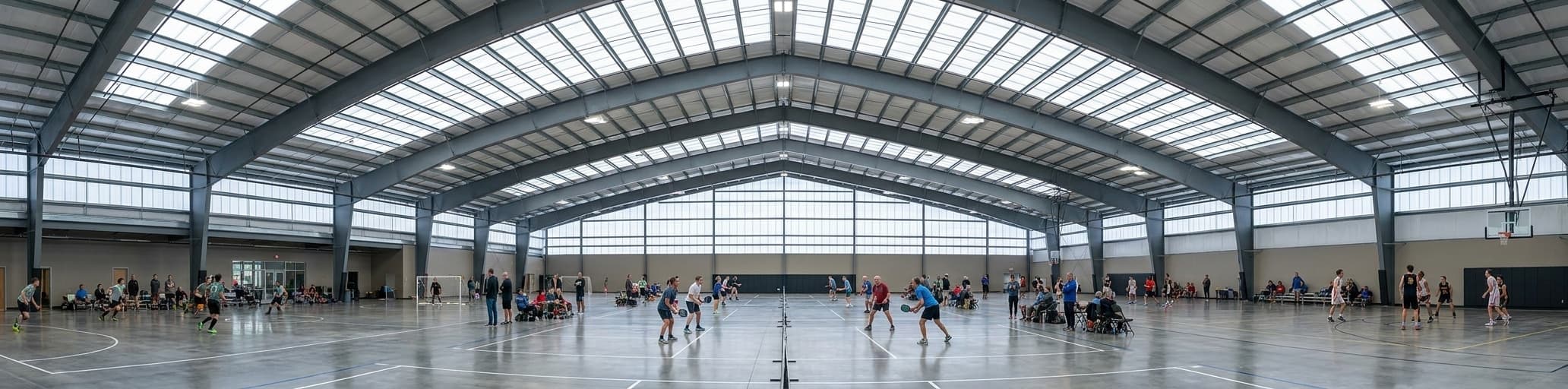

We help you right-size a clear-span steel building for soccer, tennis, pickleball, or multi-sport use by matching facility dimensions to sport-specific clearance and span requirements.
Right-Sized Recreational Steel Buildings for Every Sport
Clear-span steel buildings eliminate interior columns, giving you unobstructed 20-foot ceiling height across the entire field–something wood-framed alternatives simply cannot achieve cost-effectively.
Indoor Soccer Field Dimensions & Layout Options
The U.S. Indoor Soccer Association sets regulation field dimensions between 140-210 feet long and 60-90 feet wide, with a standard playing surface of 180 feet by 75 feet and corners rounded at a 28-foot radius.[2] If you're targeting USSF-sanctioned play, the floor requirements are slightly tighter: a minimum field of play 175 feet long by 75 feet wide, with a recommended build-out of 200 by 85 feet to accommodate penalty areas, referee creases, and player benches.[1] That 200×85-foot footprint is your practical baseline when sizing a recreational steel building for a single regulation pitch.
Building size scales predictably with your program mix. A 100×200-foot clear-span steel shell covers one full-size field with functional sideline buffer zones, while a 100×300 footprint opens the door to two side-by-side youth fields or one regulation field paired with spectator seating and locker rooms.[2] For training academies or youth leagues, field lengths can drop as low as 25 feet depending on age group and game format, which means a 100×100 steel building can host multiple small-sided pitches under one roof without structural modifications.[2] Clear-span systems can reach up to 300 feet wide with custom engineering, so even a multi-field tournament complex stays within reach.[2]
The dimension most facility owners miscalculate at the planning stage is vertical clearance. A minimum of 20 feet of clear ceiling height is the accepted standard for any facility hosting sanctioned matches, ensuring the ball stays in play rather than hitting structural elements.[3] Steel's I-beam framing delivers that clearance across the entire field — not just the center bay — because there are no interior columns interrupting the envelope.[1] That column-free interior is what separates a steel recreational building from wood-framed alternatives, which simply cannot achieve comparable unobstructed spans at a competitive cost.[1]
Tennis Court Clearances & Multi-Court Configurations
Tennis is the most demanding indoor court sport to size a building for. A single court requires a minimum 60×120-foot footprint with 35-40 feet of clear interior height — well into commercial warehouse territory and significantly taller than any other court sport.[4] That pairing of wide span and extreme ceiling height is exactly why a pre-engineered rigid steel frame system is the right structural choice for tennis; standard post-frame construction can't deliver comparable structural economy at those dimensions.[4] The shell alone for a single indoor tennis facility runs $280,000-$420,000 before court surface, sport-spec lighting, or HVAC are added to the budget.[4]
Multi-court configurations give you more usable value per dollar. A 74×118 steel building with 28-foot eave height fits a full basketball court and four pickleball courts on the same concrete slab, with lines painted for each sport — no structural modifications needed between uses.[4] If tennis is part of your program mix, sizing the building to tennis clearances automatically satisfies the height and span requirements for every smaller court sport under the same roof, so you're not leaving revenue on the floor.[5] Two pickleball courts alone fit inside a 64×84 footprint at a standard 20-foot eave height, coming in at roughly a third the cost of a single tennis facility — which means a multi-sport steel shell is often the most cost-effective path to a diversified, year-round program without building multiple standalone structures.[4]
Multi-Sport Flex Spaces: Basketball, Pickleball, Volleyball
Basketball, pickleball, and volleyball share one structural requirement that makes them ideal for a single recreational steel building: none of them need the extreme ceiling heights that tennis demands, which keeps your build cost in check without sacrificing playability.
A 74×118 steel shell with a 28-foot eave height fits a full basketball court and four pickleball courts on the same concrete slab, with sport-specific lines painted for each use — no structural changes needed when you flip between programs.[4] For pickleball-only builds, two courts fit in a 64×84 footprint at a standard 20-foot eave height, and a single court drops to just 40×64 — dimensions that overlap with agricultural and light commercial metal buildings you may already be pricing.[4] That size efficiency is no accident: four pickleball courts fit inside the footprint of one tennis court, which means a single multi-sport steel shell can generate the rental revenue of multiple facilities without multiplying your land or construction costs.[6] Volleyball fits the same 20-28-foot eave window as basketball and pickleball, so sizing your building to basketball clearances automatically satisfies the overhead requirements for all three sports under one roof.[4] The one non-negotiable across every sport in this category is a fully column-free interior — a post or beam in the court footprint is a safety hazard that makes the space unusable, and clear-span steel rigid-frame systems eliminate that risk across spans well beyond what any of these sports require.[4] Because the structure handles multiple revenue streams year-round, indoor pickleball facilities in particular have drawn attention from operators and private property owners who want a weather-proof recreation asset that also doubles as an event or community gathering space when the courts aren't booked.[4] Pickleball's growth trajectory reinforces that bet: with organizations like USA Pickleball and Major League Pickleball expanding the player base nationally, demand for quality indoor courts continues to outpace available supply in most markets.[7]
Clear-Span Advantages for Athletic Performance
Clear-span steel buildings eliminate interior columns entirely, giving you wall-to-wall usable court space and the flexibility to reconfigure your facility as program needs shift season to season.
Column-Free Interiors Maximize Usable Square Footage
A clear-span steel building eliminates interior columns by routing all structural load through heavy-duty I-beams and rigid steel frames, allowing the structure to span large distances — sometimes exceeding 300 feet — without a single internal obstruction.[8] For a recreational facility, every interior post is a problem: it consumes court space, introduces a collision hazard, and locks your floor plan in place the moment concrete cures around it.[9] Engineered clear-span designs can push beyond 200 feet in width, which covers every multi-court configuration covered in this guide — full-size soccer pitches, multi-court tennis facilities, and mixed basketball-pickleball layouts — on a single slab where every square foot generates revenue.[9] Truss-framed alternatives do cost less upfront, but their interior support columns segment the floor plan and make reconfiguration expensive over time; for a sports facility where program mix shifts by season, that tradeoff rarely pays off.[9] The practical result is straightforward: a clear-span steel shell gives you wall-to-wall usable space with no dead zones around posts, no wasted buffer clearance, and no areas players physically can't enter — which means the building you size on paper is the building you actually operate.[8]
24-60 ft. Eave Heights That Satisfy League Standards
Eave height is the single spec that either unlocks or kills a sport inside your building, and the 24-to-60-foot steel range maps almost exactly to every organized league's clearance mandate.
A 25-foot clear height from playing surface to ceiling is the practical threshold for multi-sport use — it satisfies basketball, indoor soccer, lacrosse, and hockey in a single shell without any structural upgrades.[10] USA Volleyball's domestic competition standard sits at 23 feet, which a standard 24-foot eave clears comfortably for recreational and practice programs, though NCAA-level tournament play now carries a recommended 41-foot clearance — a spec that pushes the building into tennis territory.[10] Tennis itself requires 30 feet of clear space at center court per USTA guidelines, with full facility builds running 35 to 40 feet of interior height once side clearances and structural framing depth are factored in.[4][10] That transition from 30 to 35 feet matters financially: once a facility's roof structure climbs above 32 to 34 feet, the cost curve rises sharply, with roughly a 20 percent premium attached to each additional 20 feet of height.[10] At the far end of the range, softball and baseball indoor practice facilities need to push past 60 feet of clear height to allow meaningful fly-ball and pop-up work beyond infield drills — a ceiling demand that places those projects firmly in custom commercial engineering territory.[10] The practical takeaway for facility owners is straightforward: size to 24-28 feet for any court sport short of competitive tennis, step to 36-40 feet to satisfy tennis and high-level volleyball, and reserve 60-foot eaves for baseball and softball training programs where ceiling contact would otherwise shut down a meaningful portion of the workout.
Roof Pitch & Lighting Plans That Eliminate Glare
Roof pitch and fixture placement are the two variables that determine whether athletes compete in clean, even light or fight glare and shadows all session.
For indoor sports surfaces, indirect lighting produces the least glare, while LED fixtures mounted above baselines — rather than directly overhead at center court — cut the shadows that distort ball tracking and complicate referee sight lines.[11] Steel's continuous, uninterrupted roof plane gives you an even surface to work with, so translucent panel systems and tubular daylighting devices (TDDs) can be spaced for consistent daylight distribution across the entire playing surface without dead zones.[12] TDDs capture daylight at the rooftop and route it through a highly reflective interior tube, delivering glare-free illumination deep into the building without compromising the roof's thermal performance — a direct benefit for any facility running climate control year-round.[12] At larger court footprints where single-point skylights leave coverage gaps, polycarbonate translucent panel assemblies provide diffused, glare-free daylight with built-in thermal insulation across the full span.[12] The energy impact of that combination is measurable: buildings using integrated daylighting systems see lighting energy use drop 32% and cooling requirements fall 25% versus conventionally lit structures, producing an overall operating cost savings of 22%.[12] For evening and tournament play, LED fixtures with minimal flicker and adjustable dimmer controls handle every intensity level — from early-morning open court to championship competition — from the same fixture grid without a rewire, and they reach full brightness instantly when games run long.[11]
Fast-Track Project Delivery & Budget Control
Parallel fabrication and site prep compress construction timelines by roughly one-third, letting you open your facility weeks sooner than traditional building methods allow.
Prefab Timeline vs. Traditional Construction
The single biggest schedule advantage of a pre-engineered steel building is that your structure is already being fabricated while your site is being prepared — both tracks run in parallel instead of in sequence.[14] That overlap, combined with factory-precision components that arrive pre-cut and pre-drilled, eliminates the measuring, cutting, and field welding that eat weeks on a traditional job site.[15] The net result: a pre-engineered metal building system generally cuts total construction time by approximately 33% compared to conventional building methods.[15] For a recreational facility, that compression is worth real money — every week a soccer pitch or court complex sits unfinished is a week of missed rental revenue and membership fees.
Weather disruption, one of the most unpredictable cost drivers in traditional construction, is a smaller risk here too; steel components are less vulnerable to rain delays and temperature swings than wood-framed or masonry builds.[15] The one variable that eats into that time advantage faster than anything else is late-stage design changes — every revision after engineered drawings are finalized triggers a re-approval cycle that adds both time and cost, so locking in your building specs before fabrication begins is the single highest-leverage planning decision you'll make on the project.[15] Building size and complexity still matter: a clear-span shell wider than 80 feet requires additional erection time to manage the heavier rafter beams, and a larger, more experienced crew offsets that premium more than any other job-site variable.[15] The practical takeaway is straightforward — a prefab recreational steel building gets you operational faster, with fewer weather-driven surprises and a predictable schedule you can actually plan programming around.[13]
Accurate Cost-per-Square-Foot Estimates for 2024
The $25-$40 per square foot figure that circulates for prefab steel buildings reflects the kit price alone — not a completed, occupancy-ready facility.[16] For recreational buildings intended for human occupancy, an accurate budget must account for every CSI specification division: concrete, thermal and moisture protection, plumbing, HVAC, electrical, and interior finishes, all of which stack substantially on top of the base shell price.[17] That distinction matters because suppliers who quote shell-only pricing can make a project look affordable right up until the contractor walk-through reveals everything that was left out of the original number.[17] Compared to traditional on-site construction — which runs $100-$200+ per square foot for equivalent structures — a fully built-out steel recreational facility still lands 20-30% below conventional construction costs, and that gap widens as the building gets larger: bigger footprints benefit from economies of scale that pull the per-square-foot figure down even as the total project value climbs.[16][17] The variables that push any estimate toward the top of its range — high seismic or wind-load zones, complex permitting jurisdictions, specialty court surfaces, or multi-sport mechanical systems — are all controllable when identified early in the design phase, and predictable when you start with a complete cost breakdown before fabrication begins rather than discovering gaps after drawings are stamped.[17]
Engineering, Approvals & Construction Under One Roof
The coordination gap between separate engineering, permitting, and construction vendors is where recreational steel building projects most commonly lose time and money.
When your structural engineer hands off stamped drawings to a permit expeditor who hands off to a general contractor, each handoff introduces a lag — and any discrepancy between what was engineered, what was approved, and what gets built triggers a re-review cycle that can run weeks.[17] Different jurisdictions compound this: seismic and wind-load zones across the U.S. carry their own code requirements that affect structural design, and a permit office catching an engineering oversight after drawings are submitted adds both cost and delay to a project that was already scheduled.[17] A single-source provider that handles engineering, local permitting, and construction under one contract eliminates those handoffs entirely — the same team that sized your clear-span frame for local snow and wind loads is the team tracking the permit through the authority having jurisdiction and managing erection on site.[17] That integration is what lets an experienced design-build operation complete the design and approval process faster than competitors who assemble the same capabilities from separate vendors.[18] For facility owners on a programming schedule — a league season start, a membership launch, a community center opening — that compression is the difference between opening on time and losing your first revenue cycle before a single court is booked.
If you want to understand how single-source accountability plays out from contract to keys, the turnkey construction process applies the same logic to every project phase, within budget and every step of the way.[17]
Built to Last with Low Lifetime Maintenance
Galvalume-coated steel roof panels cut maintenance cycles by decades, backed by a 25-year rust perforation warranty that protects your facility's operational uptime.
Galvalume Frames Backed by 50-Year Structural Warranty
The material under your roof panels determines how much maintenance your facility actually needs over its life — and Galvalume changes that math decisively.
Galvalume coating applied to steel roof panels adds direct rust protection, extends service life, and cuts the maintenance cycle that plagues conventional metal roofing in high-humidity and freeze-thaw environments.[19] That isn't a marginal upgrade for a recreational building; it's the difference between a facility that stays operational year-round and one that loses revenue days to inspections, patch repairs, and panel replacements that accumulate quietly over a decade.[20] Pre-engineered recreational steel buildings with Galvalume roofing also carry a 25-year warranty against rust perforation on those panels, with lifetime coverage on wall and roof sheeting fasteners — the two failure points that drive most long-term envelope maintenance.[19] Color-coated panel systems add a further layer of protection, with Energy Star-rated panels carrying a 40-year warranty and delivering superior temperature control that directly reduces HVAC operating costs inside the building.[19] Steel's non-combustible frame rounds out the durability picture: a structure that won't burn, rot, or attract pests is a structure that holds its insurance profile and its asset value without demanding attention between programming seasons.[21] For facility owners who want to understand how structural steel components work together in a pre-engineered system, the framing logic behind long-span recreational buildings follows the same load-path principles that make these warranties credible — the structure is engineered for the warranty, not the other way around.
Energy-Smart Insulation Systems Reduce HVAC Load
HVAC is typically the largest ongoing operating expense inside a recreational steel building, and insulation is the most direct lever you have to reduce it.
A proper thermal barrier slows heat transfer between your building's interior and exterior, which means your mechanical system runs shorter cycles, consumes less energy, and lasts longer before replacement.[23] Without it, energy loss is continuous — the building can't hold temperature, condensation accumulates on interior surfaces, and you're paying to condition air that's escaping through your roof and walls.[22] For recreational facilities, four insulation systems cover the full performance range.
A single-layer fiberglass blanket maxes out at 6 inches and delivers R-19, sufficient for mild-climate programs with lower occupancy.[22] A double-layer system raises thermal resistance substantially and is the correct specification when your facility operates through seasonal temperature swings or when local energy codes set a higher baseline requirement — both common realities for year-round sports programs.[22] The energy saver system takes performance further: two layers of unfaced fiberglass held within a steel banding and seamless fabric liner network delivers some of the highest thermal values available in pre-engineered steel construction, and the liner fabric carries OSHA certification for fall protection during installation.[22] At the top of the range, foam-insulated metal panels function as both exterior skin and thermal barrier in a single assembly, reaching R-values up to R-48 with no additional framing depth.[22] For a targeted upgrade without full envelope replacement, thermal spacer blocks placed between roof sheets and purlins isolate the outer shell from the inner steel frame and have demonstrated payback periods as short as 12 to 18 months from energy savings alone, based on tested field results.[22] The combined effect of a well-specified insulation system is straightforward: lower utility bills, a consistent interior climate for athletes and staff, and a smaller mechanical system at the design stage that costs less to procure, install, and service over the life of the facility.[23]
Custom Color & Cladding Options That Fit Your Brand
Color and cladding choices are where your recreational steel building shifts from a structural decision to a brand decision — and the two don't need to be in tension.
Steel building providers offer a range of color options for both wall and roof panel systems, so a youth soccer complex, tennis club, or multi-sport facility can carry consistent brand colors across the entire envelope rather than defaulting to a generic panel run.[24] Customization extends well beyond color: window placement, door configurations, panel profiles, and exterior trim can all be specified to match both the facility's operational layout and its visual identity.[24] That means the building your members see on opening day — with school colors on the walls, logo-friendly signage bays above the entry, and trim details that signal a purpose-built athletic facility rather than a repurposed warehouse — was locked in at the design stage, not painted over after the fact.
Steel building solutions are engineered to deliver that combination of durability, functionality, and style in a single package, so you're not trading performance for appearance.[25] The practical result: a recreational steel building that works as hard as your program does, looks the part from the parking lot, and holds its brand identity for decades without a repaint cycle eating into your operating budget.[24]
- Regulation soccer fields require 200×85 feet minimum; clear-span steel buildings eliminate interior columns that waste court space and create safety hazards.
- Multi-sport facilities maximize ROI: one 74×118 steel shell fits a basketball court and four pickleball courts on the same slab with no structural modifications.
- Tennis demands 35-40 feet of ceiling height; sizing to tennis clearances automatically satisfies all smaller court sports under one roof without wasted investment.
- Pre-engineered steel construction cuts build time by 33% versus conventional methods, with parallel fabrication and site prep eliminating weeks of schedule delay.
- Fully built-out recreational facilities cost 20-30% less than traditional construction; shell-only pricing masks true project costs for HVAC, electrical, insulation, and finishes.
- Galvalume-coated steel roofing carries 25-year rust perforation warranty; proper insulation reduces HVAC operating costs by leveraging thermal barriers that pay back in 12-18 months.
- Single-source design-build providers eliminate coordination gaps between engineering, permitting, and construction–the difference between opening on schedule and losing your first revenue cycle.
- https://gensteel.com/recommended-use/indoor-soccer-field/
- https://www.alliedbuildings.com/indoor-soccer-field/
- https://gaxtent.com/blog/faq/indoor-soccer-fields/
- https://www.steelstructuresamerica.com/indoor-sports-court-building/
- https://www.steelcobuildings.com/indoor-sports-complex/
- https://www.steelcobuildings.com/how-to-start-an-indoor-sports-facility-costs-building-types-and-revenue-models/
- https://www.clearspan.com/news/ultimate-guide-building-indoor-pickleball-facility/
- https://titansteelstructures.com/metal-building-types/advantages-of-clear-span-buildings/
- https://alansfactoryoutlet.com/blog/clear-span-building/?srsltid=AfmBOopCTuALtCIArNvrynFpmh_3_ca9uHoYWWbgVMWja5RNdm_fomlb
- https://www.athleticbusiness.com/facilities/fitness/article/15140955/tall-order
- https://mavericksteelbuildings.com/building-a-pickleball-facility-what-you-need-to-know/
- https://www.metalconstructionnews.com/articles/innovations-in-daylighting-for-metal-buildings/
- https://nordicsteel.construction/recreational-metal-building-construction/
- https://www.advancedbuildingcorporation.com/blog/pros-cons-pre-engineered-metal-buildings/
- https://stevensec.com/blog/how-long-does-it-take-to-erect-a-metal-building
- https://titansteelstructures.com/metal-structure-tutorials/should-i-buy-a-prefab-steel-building-or-build-on-site-pros-and-cons/
- https://reichconstructionllc.com/cost-of-pre-engineered-steel-recreation-buildings/
- https://ecosteel.com/ecosteelprefab/eco-status/under-construction/
- https://ironbuiltbuildings.com/metal-building-types/recreational-metal-buildings/
- https://gensteel.com/steel-building-kits/recreational/
- https://armstrongsteel.com/blog/play-train-excel-how-recreational-metal-buildings-elevate-athletic-facilities
- https://sunwardsteel.com/insulation/
- https://www.clearspan.com/news/everything-you-need-insulated-steel-buildings/
- https://www.uspatriotsteel.com/recreational-steel-buildings/
- https://atlanticsteelstructures.com/steel-buildings/prefabricated-steel-sports-buildings/