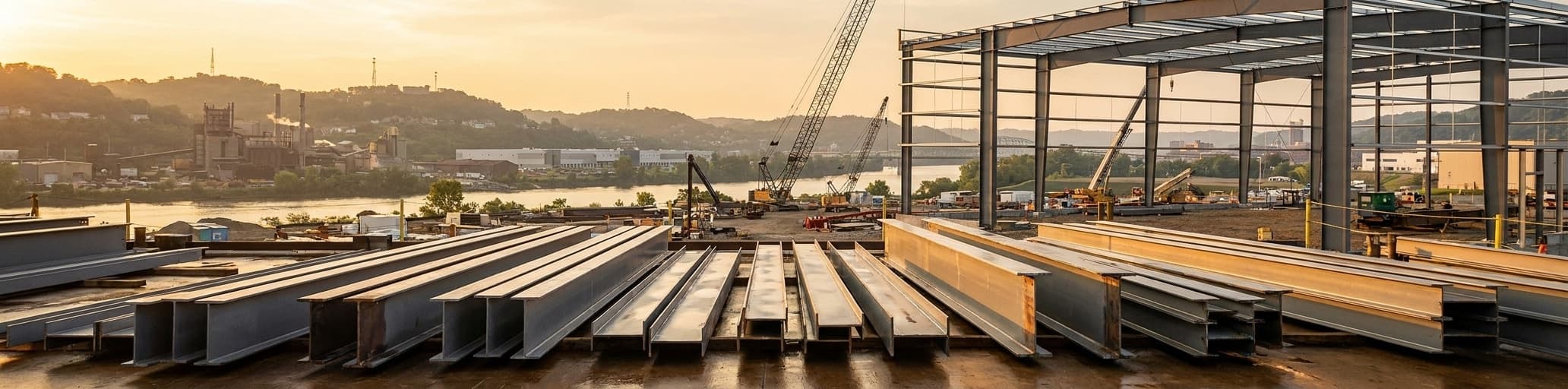

We help Pittsburgh property owners navigate steel building decisions by explaining why steel outperforms wood in harsh regional climates and tight industrial markets. Single-source contracts covering design through erection keep your project on schedule and within budget while delivering structural integrity that lasts decades.
Why Pittsburgh Needs Steel Buildings: Regional Climate & Industrial Demand
Pittsburgh's freeze-thaw cycles and lake-effect snow demand steel's superior corrosion resistance and dimensional stability over wood's moisture-prone degradation.
Pittsburgh's Weather Challenges and Why Steel Outperforms Wood
Pittsburgh sits in one of Pennsylvania's most punishing weather corridors–heavy lake-effect snow from Lake Erie, nor'easters, persistent humidity, and aggressive freeze-thaw cycles that repeat dozens of times each winter.[2] Those conditions are exactly what accelerates wood degradation: wood absorbs moisture and degrades over time, while galvanized steel resists corrosion and mold regardless of how wet the season gets.[2] Where freeze-thaw cycles split and warp wood joists, steel's stable expansion properties keep structural integrity intact year after year without intervention.[2] Steel is also manufactured to exact dimensional tolerances–no twisting, no knots, no defects–whereas framing lumber quality varies batch to batch and region to region.[3] That consistency matters when you're engineering a building to carry Pittsburgh's snow loads.
Beyond moisture and dimensional stability, steel is non-combustible and naturally resistant to insects, two performance advantages that wood simply cannot match in a climate where both risks are real.[3] Climate change is raising the bar further: building codes are tightening to require structures that can handle more extreme temperatures, heavier precipitation, and higher wind events, pushing commercial and industrial owners toward materials built for those conditions from the start.[1] If you're comparing materials across a 20-year horizon, the steel barn vs wood barn maintenance math consistently favors steel in climates like Pittsburgh's–lower upkeep, fewer repairs, and no rot cycles eating into your operating budget.
Industrial & Commercial Growth Driving Local Steel Building Demand
Pittsburgh shows up by name in Avison Young's Q4 2025 national industrial market coverage–and the data behind that inclusion is worth paying attention to.[4] Net absorption hit its highest level since early 2023 during Q4 2025, as deals stalled earlier in the year closed once federal trade and tariff policy direction became clearer.[4] Industrial leasing volumes surged through the second half of 2025, topping both 2024 totals and pre-COVID record highs, driven by resilient consumer spending and a manufacturing sector energized by OBBBA-driven project announcements.[4] That manufacturing wave matters for Pittsburgh specifically: Avison Young's report notes that supplier-network demand will concentrate in markets within an eight-hour drive of major production centers–a radius Pittsburgh sits squarely inside.[4] On the supply side, the construction pipeline is expanding again after nearly two years of developer pullback, with groundbreakings expected to accelerate in early 2026 in markets where speculative development has been limited.[4] For commercial and industrial owners in the Pittsburgh metro, that convergence of rising demand and constrained supply means build timelines are a competitive advantage–pre-engineered steel buildings get you operational faster than conventional construction, at a lower cost per square foot, without sacrificing the structural performance that Allegheny County's permitting requirements demand.
How National Steel Buildings Serves the Pittsburgh Market with National Buying Power
Section 232 steel and aluminum tariffs currently sit at 50%, baked into every structural frame on Pittsburgh commercial and industrial projects.[6] That's the cost environment every local contractor quotes against–and where national buying power changes the math entirely. Organizations with sustained purchase volume command measurably stronger bargaining leverage and lower unit prices than contractors sourcing steel project by project; consolidating orders across multiple builds captures bulk discounts that single-project procurement simply can't reach, and those savings flow directly into your quote rather than a distributor's margin.[7] Pre-engineered metal building shells start at $14-$30 per square foot at the shell level,[6] but the gap between a tight number and an inflated one traces to procurement scale, not design choices alone.
Pittsburgh also sits within three hours of the regional manufacturing and supply infrastructure serving Cleveland, Columbus, Detroit, and Buffalo,[5] which compresses delivery lead times and stabilizes material availability in ways that insulate your schedule from the disruptions hitting markets without that geographic advantage. For Pittsburgh owners where industrial demand is accelerating and build timelines are a direct competitive edge, that combination–national buying power on materials, regional proximity on delivery, and a single-source prefab process that owns every step–keeps your steel building Pittsburgh PA project within budget and on schedule without trading away the engineering specificity Allegheny County permitting demands.
Steel Building Applications Across Pittsburgh Industries
Pre-engineered steel warehouses eliminate interior columns entirely, giving your distribution operation the unobstructed floor plan that high-throughput logistics demands while cutting construction timelines by months.
Warehouses & Logistics Facilities for Pittsburgh's Distribution Hub
Pittsburgh's position inside that eight-hour production-center radius means warehouse demand here is structural, not cyclical–and capital is already moving to match it.
The Shapiro administration's recent $21 million food supply chain investment included a $750,000 infrastructure grant to expand Turner Dairy Farms' Pittsburgh distribution center, specifically adding cold storage, loading docks, and automation to keep goods moving efficiently.[9] That's one visible data point in a broader pattern of logistics investment concentrating in the Pittsburgh metro.
Pre-engineered steel warehouses are the format distribution operators keep returning to for good reason: steel joists, girders, and columns engineered to carry substantial roof loads leave the entire floor plan open for racking systems, conveyor lines, and high-throughput dock operations–no interior columns eating into your usable square footage.[8] The offsite fabrication model sharpens that advantage further, because structural components are manufactured to precise tolerances before ground breaks, which cuts on-site labor requirements and compresses the timeline between permit approval and your first shipment out the door.[8] A prefab clear-span warehouse engineered for Pittsburgh's snow loads and Allegheny County's permitting requirements gives you the column-free interior that distribution workflows demand–without the schedule delays or cost overruns that come when procurement, fabrication, and erection aren't managed under one roof.
Agricultural & Farm Buildings for Western Pennsylvania Operations
Western Pennsylvania's agricultural counties–Butler, Lawrence, and Mercer among them–run farm operations where building durability connects directly to margin protection.
More than 60% of U.S. farms already use at least one prefab building, a number that reflects how cleanly steel's cost-to-benefit math beats traditional construction for operations where every dollar is accounted for.[11] Wooden barns invite the problems Pittsburgh's climate amplifies: rot from persistent humidity, pest infestations that wooden rafters turn into nesting sites, and moisture damage that compounds through each freeze-thaw cycle.[10] Galvanized steel farm buildings cut that maintenance cycle entirely–corrosion-resistant panels need no post-storm repairs, and without wooden structural members, your grain storage and livestock areas won't harbor termites, birds, or bats.[10] The practical advantage on a working farm is the clear-span interior: steel's structural system removes the interior columns and cross-beams that traditional barns require, so your combine, hay wagon, or full-size loader moves in and out without clearance constraints.[10] Steel frames also accept the insulation specs you need for livestock comfort through Western Pennsylvania winters and grain temperature control through summer, with the same system accepting future bay additions as your operation scales–a design flexibility covered in detail in steel frame farm building systems engineered to Pennsylvania snow loads and local permitting requirements.[12]
Aviation Hangars & Industrial Structures for Manufacturing Centers
Aviation hangars and industrial manufacturing facilities share a structural requirement that conventional framing can't reliably deliver at scale: column-free interior spans wide enough to maneuver aircraft, heavy equipment, and full production lines without obstruction.
Structural steel is the format western Pennsylvania operators consistently choose for industrial and commercial facilities for exactly this reason–and manufacturing plants, distribution centers, and storage facilities across the Pittsburgh region already rely on modular steel building components to achieve it.[13] For aviation applications, clear-span steel delivers the eave heights and unobstructed door widths that different aircraft classes require, with roof systems certified to withstand Pennsylvania's heavy snowfall and high winds without interior columns cutting into your usable floor plan.[14] The same modular system that produces those column-free spans also handles production line growth: when your manufacturing contract expands, adding bays to an existing steel structure sidesteps the gut-renovation costs that come with conventional construction, because modular metal constructions accept new bays without the structural complications that would force a complete rebuild elsewhere.[13] Across both applications, steel building components are easy to repair or replace, which means a hangar or manufacturing center built today carries a lifespan that extends almost indefinitely–a performance window that wood-framed industrial facilities simply can't match over the decades your Pittsburgh operation needs to remain competitive.[13]
Pittsburgh Steel Building Costs & Pricing Transparency
Single-source steel building procurement catches material errors before fabrication and absorbs engineering revisions internally, protecting your budget from the compounding costs that split-contractor projects face.
What Affects Your Steel Building Quote in Pittsburgh
National Steel Buildings Cost Comparison: Single-Source vs. Multiple Contractors The core problem with splitting procurement, fabrication, and erection across separate contractors is that mistakes at each handoff compound — and engineers bill each time they're brought back to resolve them.[20] If your fabricator quotes against specs that drift from the original drawings, or your erector discovers missing components on delivery day, the correction cost lands in your budget before a single structural member goes vertical.[20] Pre-engineered metal building systems are built on the opposite principle: because every construction detail is resolved before the job starts, fewer mistakes occur — and that's where the real savings are found.[20]
A single-source model also compresses labor requirements directly. Pre-engineered components are designed for fast on-site assembly, which cuts the need for specialized labor across multiple trades and reduces total hours billed.[19] Steel structures go up quickly once everything is in place, but that speed advantage depends entirely on having procurement, engineering, and erection coordinated before ground breaks — not negotiated between separate parties during construction.[18] Avoiding changes to orders after engineering has started matters just as much: if a change forces the engineering team to rework previously completed drawings, you're billed in full for the new work — and if material has already been ordered, you're on the hook for both the wrong material and the right replacement.[20]
The table below shows where the cost gap between single-source and multiple-contractor approaches typically opens on a Pittsburgh steel building project:
| Cost factor | Single-source | Multiple contractors |
|---|---|---|
| Engineering revisions | Absorbed internally | Billed per revision [20] |
| Material ordering errors | Caught before fabrication | Discovered at delivery [20] |
| Labor coordination | One schedule, one crew | Cross-contractor schedule drift [18] |
| Change order exposure | Minimal | High — wrong material + replacement [20] |
| Specialized labor hours | Reduced via pre-engineered components [19] | Higher due to coordination gaps |
| Insurance cost profile | Lower — non-combustible, durable structure [19] | Varies by subcontractor mix |
For Pittsburgh owners, that gap compounds fast when Allegheny County permitting requires engineering certification at multiple project stages. A turnkey steel building contract closes that exposure by placing design, fabrication, and erection under one agreement — one point of contact when anything needs to change, and one team absorbing the fix rather than billing it back to you.[20]
Interactive Pittsburgh Steel Building ROI Calculator
The numbers behind a Pittsburgh steel building project move across three categories that conventional quotes rarely show side by side: materials, labor, and schedule compression. Use the calculator embedded below to enter your building size and use type–warehouse, agricultural, aviation, or general industrial–and see how a pre-engineered steel shell stacks up against conventional construction across all three. The benchmark data feeding the calculator reflects current market inputs: PEMB shells start at $14-$30 per square foot at the shell level, while installed dry warehouses run $55-$175 per square foot depending on fit-out complexity.[6] Conventional commercial construction labor runs 20-40% of total project cost, with materials adding another 17.3-25%–and soft costs (permitting, engineering fees, insurance, financing carry) adding 15-30% on top of hard construction totals.[21] Those percentages are where pre-engineered steel consistently narrows the gap: because structural components arrive fabricated to spec, on-site labor hours compress and the coordination overhead between trades shrinks.[22] Annual cost escalation is running 3-8% industry-wide right now, which means every month your project sits in design-bid cycles costs you real money–not a rounding error.[6] The calculator converts that escalation rate into a dollar figure against your specific square footage so the timeline savings show up as a concrete number, not a talking point.
| Cost category | Conventional construction | Pre-engineered steel | Where savings appear |
|---|---|---|---|
| Shell materials (per SF) | Market rate, project-by-project procurement | $14-$30/SF with national buying power [6] | Bulk procurement vs. single-project pricing |
| Installed warehouse (per SF) | $55-$175/SF depending on complexity [6] | Lower end of range via compressed labor | Fabrication-to-erection coordination |
| Labor (% of total cost) | 20-40% of total construction [21] | Reduced via pre-engineered assembly | Fewer on-site trades, shorter schedule |
| Soft costs added to hard construction | 15-30% additional [6] | Reduced change orders, fewer revision cycles | Single-source engineering absorbs revisions |
| Annual cost escalation exposure | 3-8% per year [6] | Compressed by faster build timeline | Weeks saved = escalation dollars avoided |
The ROI calculator below applies these benchmarks to your Pittsburgh project inputs. Enter your square footage, select your building type, and choose your timeline priority–the output shows your estimated material cost range, projected labor savings versus conventional construction, and how many weeks a pre-engineered steel approach shaves off your schedule compared to a traditional build sequence.[22] A 30×40 prefab building cost breakdown gives you a detailed line-item reference if you want to pressure-test the calculator output against a specific footprint before you request a formal quote.
Choosing the Right Local Steel Building Partner in Pittsburgh
When one team handles design, fabrication, and erection, tolerance problems surface before components ship, keeping your Pittsburgh project on schedule and budget.
Local Codes, Permits & Engineering Compliance in Allegheny County
Single-Source Advantage: Design, Fabrication & Erection with ProTrades The single-source advantage is not a marketing phrase–it's a structural fact about how fabrication quality improves when the people cutting and welding steel know they'll also be the ones bolting it together on your site.
As Advantage Steel & Construction, an AISC-certified Pittsburgh-area fabricator, puts it plainly: "we use the best methods and highest quality materials during fabrication because we are steel constructors."[25] That logic runs in both directions–fabricators who own erection catch tolerance problems before components ship, and erectors who own fabrication don't accept sloppy work from themselves.[25] The practical result shows up on the schedule: when Advantage Steel handled both fabrication and in-house repairs on the Swindell Bridge rehabilitation, the project finished ahead of schedule, directly because a single team controlled every handoff.[25] Pre-engineered metal building kits built for the Pennsylvania market compound this advantage further, since customizable components are engineered as a system from the start rather than assembled from mismatched vendor quotes.[26] For Pittsburgh owners navigating Allegheny County's permitting sequence, that system-level coordination matters at every approval stage–a single erection crew working from the same fabrication drawings that already passed engineering review eliminates the re-submittal cycles that add weeks and cost when separate contractors disagree on who owns a dimensional discrepancy.
ProTrades brings that erection capability into NSB's single-source model, meaning the structural components designed in our engineering office are built to the tolerances our field crew expects to work with–and every step of the way, you have one phone number, one schedule, and one team absorbing the fix if anything needs to change.
Why Pittsburgh Builders Choose National Steel Buildings for Reliability
For complex builds–industrial facilities, aviation hangars, multi-bay warehouses–the margin for error on a structural steel project shrinks to near zero, which means a contractor's documented track record of solving problems before they compound matters more than the opening number on their quote.[28] Vetting a contractor for a Pittsburgh project comes down to three factors that separate reliable execution from expensive uncertainty: experience with projects of comparable complexity, verified quality control measures tied to recognized certifications, and communication systems that keep your project moving without requiring you to chase updates.[28] Contractors who invest in advanced fabrication capabilities and adhere to standards set by organizations like AISC are better equipped to manage tight tolerances and complex geometries–exactly the engineering demands Allegheny County's permitting process surfaces at every approval stage.[29] Reputation and references matter here too: speaking directly with past clients about how a contractor handled unexpected issues reveals more than any portfolio, because a strong contractor is transparent and proactive when problems arise, not defensive.[28] Prioritizing the lowest bid consistently produces the wrong outcome–compromised quality or unexpected costs downstream–while experienced contractors who demonstrate value through expertise, quality assurance, and project management capability deliver measurably better long-term results.[29] NSB brings those criteria together in a single contract: national buying power on materials, in-house engineering certified to Pennsylvania snow loads, ProTrades erection working from the same fabrication drawings that cleared Allegheny County review, and a prefab building kits delivery timeline that starts engineering the moment your order is placed–so your steel buildings Pittsburgh PA project stays within budget, on schedule, and never waiting on separate contractors to agree on who owns the next step.[29]
- Pittsburgh's freeze-thaw cycles, heavy snow, and humidity make steel buildings superior to wood, which warps, cracks, and absorbs moisture over time.
- Pittsburgh's industrial vacancy at 6.5% is below the national average of 7.6%, creating urgent demand for fast-erecting prefab structures.
- Pre-engineered steel buildings cost 20-30% less than conventional construction, with additional savings when design, fabrication, and erection are managed by a single contractor.
- Steel clear-span designs eliminate interior columns, maximizing usable floor space for warehouses, farms, and manufacturing without structural compromise.
- Single-source contracts eliminate coordination gaps between separate designers, fabricators, and erectors that typically cause schedule delays and cost overruns.
- Pittsburgh's location within 500 miles of half the U.S. population and multimodal freight access makes industrial rents competitive at $7.80 NNN per square foot versus the national average of $9.12.
- https://tbicontracting.com/climate-change-impact-on-construction-practices/
- https://agribilt.com/coverage-areas/pennsylvania-quonset-huts/
- https://www.buildinggreen.com/feature/steel-or-wood-framing-which-way-should-we-go
- https://www.avisonyoung.us/us-industrial-market-overview
- https://nationalhousingcrisis.org/toolkit/construction/pre-purchasing-to-increase-modular-capacity/
- https://terrapincg.com/commercial-construction-costs
- https://www.cmu.edu/cee/projects/PMbook/04_Labor,_Material,_And_Equipment_Utilization.html
- https://stevensec.com/warehouse-construction/pennsylvania/shaler
- https://www.pa.gov/agencies/pda/newsroom/shapiro-admin-announces–21m-to-strengthen-food-supply-chain—-
- https://www.newmartbuildersinc.com/blog/benefits-of-steel-farm-buildings/
- https://www.vikingbarns.com/blog/metal-agriculture-buildings-good-for-farmers-and-ranchers
- https://daytonbarns.com/agriculture-steel-building-in-pennsylvania-pa/agriculture-steel-building-in-west-chillisquaque-pa/
- https://www.clarkcontractorinc.com/services/metal-building/
- https://www.vikingsteelstructures.com/metal-carports-pittsburgh-pa-pennsylvania?srsltid=AfmBOort9XYi629_aPfb98UFYjI7psjuXXrdnSyWcjhiSIKxZ92wM8re
- https://cbfcontractinginc.com/blog/
- https://www.aametalbuildings.com/pennsylvania-metal-buildings/metal-buildings-pittsburgh-pa?srsltid=AfmBOorePihWMcT4Xv9jL4ixnZNmnsv4KXRfnsf9LHydzui9Frt2XJeI
- https://www.shannonstaleyandsons.com/blog/pittsburgh-commercial-remodel-or-build-cost
- https://towersteelbuildings.com/blog/turnkey-vs-partial-steel-building-construction/
- https://singlesourcesystems.com/blog/cost-saving-benefits-of-steel-frame-buildings/
- https://simpsonsteel.com/2020/01/21/reduce-metal-building-construction-costs/
- https://www.autodesk.com/blogs/construction/commercial-construction-cost-per-square-foot/
- https://www.cushmanwakefield.com/en/united-states/insights/industrial-construction-cost-guide
- https://ecode360.com/26802891
- https://www.pa.gov/agencies/dep/newsroom/2025-12-02-shapiro-administration-and-us-steel-reach-agreement-to-resolve-clean-streams-law-violations
- https://www.advsteel.com/
- https://cdmg.com/metal-building-pa
- https://westernsteel.com/how-to-choose-steel-building-contractors-in-your-area/
- https://construction-today.com/news/how-to-vet-structural-steel-contractors-for-complex-projects/
- https://pebsteel.com/en/essential-considerations-when-choosing-steel-structure-contractors-2/