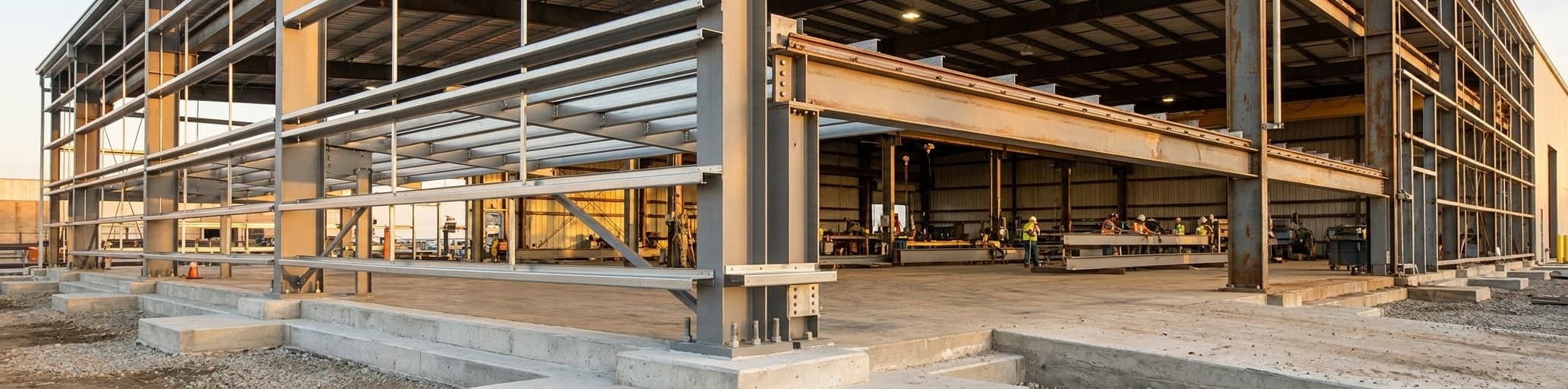

We help you navigate the structural engineering, permitting, and erection requirements that turn a bay addition into a unified expansion rather than two disconnected buildings. Planning the tie-in correctly from the start saves you foundation rework, crane load path failures, and permit delays that cost far more than getting the design right upfront.
Why Adding Bays to Existing Steel Buildings Beats Relocating
Adding a bay to your existing steel building costs far less than relocating operations, land acquisition, and new utility infrastructure combined.
The Real Cost of Expansion vs. Starting Over
When you're deciding between adding a bay to your existing 40×80 steel building with crane and starting fresh on a new site, the cost gap is larger than most owners expect. Pre-engineered steel building kits run $10-$25 per square foot for materials, with installation adding another $10-$20 per square foot — putting a new 10,000-square-foot steel structure between $120,000 and $250,000 before you factor in land acquisition, new utility hookups, permitting on an undeveloped lot, and the lost productivity of relocating operations.[1] A bay addition sidesteps every one of those costs. You're engineering into an existing foundation system, tying into utilities that already run to the building, and keeping your operation on-site throughout construction. The delta between "add a bay" and "start over" isn't just the steel price — it's site work, permitting, infrastructure, and downtime stacked on top of each other.
The structural math also favors expansion when you plan for it from the start. Pre-engineered metal buildings are modular by design — their resale value appreciates 20-30% over 20 years, and that modularity is a direct driver.[1] Owners who design foundations and endwall framing to accept future bays at the original build stage preserve that flexibility without paying to rework structure later.[2] Compare that to conventional wood construction, where a comparable new facility runs $350,000-$500,000 for the same footprint, and concrete pushes $500,000-$700,000 — with 20-year total costs reaching $670,000 to $1.1 million once you factor in higher maintenance and energy expenses.[1] Even if your expansion requires some foundation reinforcement at the tie-in point, you're still operating well inside the cost of abandoning your existing asset and breaking ground elsewhere. For a deeper look at how 40×80 metal building kit prices break down line by line, the numbers confirm the same conclusion: phased expansion consistently outperforms new-build economics when your existing structure is steel.
How Structural Tie-Ins Preserve Your Original Investment
The real payoff of a structural tie-in isn't just the square footage you gain — it's that your original building keeps earning its keep throughout the expansion.
Steel resists rot, pests, and moisture, so your existing framing arrives at the tie-in point with the same structural integrity it had on day one.[4] Annual maintenance on a steel facility runs roughly $1,500-$2,500 per year, versus $7,000-$20,000 for comparable wood or concrete structures, and any new bay you add inherits that same low-maintenance profile.[1] Traditional construction handles expansion very differently: structural changes typically require demolition and reinforcement, driving up cost and extending downtime.[4] Steel's modular design skips both problems — length extensions attach without disturbing the original framing, so your operation stays live while the new bay goes up.[4] You also carry forward the energy efficiency already embedded in your insulated panels; steel frame farm buildings designed for future add-ons consistently confirm that properly insulated bay additions extend annual energy savings of $2,000-$5,000 rather than resetting them.[1] The result is an asset that compounds value on both ends — lower operating costs on the original structure, and a new bay that steps into the same cost envelope from day one.
When a 40×80 Building Needs a Second Bay: Common Scenarios
The trigger for a second bay is almost always the same: the operation outgrows the space it was built for.[5] For a 40×80 steel building with crane, the pressure points are predictable.
Distribution centers and warehouses hit throughput limits first — floor space fills up, and crane travel lanes get blocked by overflow inventory, turning a functional layout into a daily bottleneck.[6] Agricultural operations reach the wall when equipment fleets expand: a combine or header added years after the original build won't fit in a bay dimensioned around older machines, and forcing the fit kills workflow across the whole facility.[5] Commercial and industrial shops face a third version of the same problem — a new product line, a contract that doubles production volume, or a piece of equipment that demands its own dedicated bay with a separate load path.[6] In every case, the original 40×80 footprint is still earning its keep; the structure isn't the problem.
The operation has simply scaled past the original square footage, and a bay addition restores the fit without displacing anything that already works.[5]
Structural Tie-In Fundamentals: What Engineers Must Design
Grade beams distribute lateral loads and prevent the new bay from settling independently, protecting tie-in connections from unplanned forces.
Foundation and Grade Beam Connections for New Bays
When you add a bay to an existing steel building, the new columns impose concentrated loads at specific ground points — loads your original foundation almost certainly wasn't engineered to carry.[8] Before a single anchor bolt gets set, your structural engineer needs the building's reaction data: the forces each primary frame exerts under dead, snow, and wind loads.[8] That data determines footing size, anchor bolt specification, and whether the existing perimeter can absorb any shared load at all.
Each new column connects to its footing the same way your original bays do — a base plate pre-punched to fit over embedded anchor bolts, transferring the column's load into the concrete and down into the soil.[7] Placement tolerance is strict: bolts set even an inch off their specified position mean columns won't align, forcing expensive remediation before erection can begin.[8] Grade beams are the right tool for tying new column footings to the existing foundation perimeter — a continuously reinforced concrete beam runs between the new piers, distributes lateral loads, resists soil movement, and keeps the new bay from settling independently of the original structure.[7] That differential settlement risk is exactly why engineers specify grade beams over isolated footings on bay additions: if the new section shifts even slightly, the structural steel components at the tie-in connection absorb forces they were never designed to handle.[8] If your original build didn't account for future expansion, plan for foundation reinforcement costs — enlarging foundations after the fact is significantly more difficult and expensive than designing for it upfront.[8]
Roof and Wall Framing Alignment Between Old and New Sections
The tie-in point between your original building and the new bay is where secondary framing alignment determines whether the expansion performs as a unified structure or as two buildings bolted together. Roof purlins are Z-shaped cold-formed members that support roof panels and transfer loads down to the primary rafters — at a bay addition, those purlins must lap continuously over the tie-in rafter, the same way they lap at every interior frame throughout the original building.[9] That overlap is structural, not incidental: the lapped splice allows the purlin to act as a continuous beam, sharing load between the existing bay and the new one rather than treating each span independently.[9] If your new bay requires a different purlin depth or gauge than the original, your engineer must verify that the lap detail still delivers the same load path — a mismatch in section depth prevents proper nesting at the splice, which breaks the continuous beam behavior the whole roof system depends on.[10]
Wall framing follows the same logic. Girts — the horizontal Z-shaped members spanning between columns — must align vertically with the original building's girt layout to maintain wall diaphragm continuity across the tie-in.[10] Bypass girts attach to the outside flange of columns and lap at each frame, including at the first interior frame from the endwall; when you add a new bay, that lap sequence must extend cleanly from the original framing into the new section without any height offset.[9] The eave strut at the junction point carries the combined load of both rooflines meeting at the same eave height, providing the attachment and bearing points for the end of both the roof sheets and the wall sheets at the transition.[9] Secondary members — purlins on the roof, girts on the walls — also contribute to diaphragm action, distributing lateral wind and seismic loads across the structure; a framing mismatch at the tie-in creates a gap in that load path that your engineer has to explicitly address in the structural calculations.[10]
Whether all of this aligns cleanly comes down to a decision made when your building was first ordered: expandable versus non-expandable endwall framing. An expandable main frame endwall is engineered to carry a full bay of roof load — equivalent to any interior mainframe — and stays in place when you extend the building, converting from an endwall to an interior frame with no structural rework required.[9] A non-expandable mainframe endwall only carries half a bay of load and cannot serve as an interior frame; extending past it means removing and replacing the endwall framing before the new bay goes up.[9] A standard bearing frame endwall costs less upfront but creates the most framing-level complexity on expansion — it's the most common complication in 40×80 steel building bay additions, and it typically surfaces during permit review rather than during erection, when remediation costs the most.[9]
Load Path Continuity: Why Crane Loads Matter in Multi-Bay Buildings
Crane loads are classified as auxiliary loads — dynamic live loads that stack on top of standard dead, snow, and wind loading — and they introduce engineering complexity that static loads simply don't.[11] A bridge crane imposes at least four distinct forces on the runway system at once: a vertical wheel load from the lifted weight, a vertical impact allowance from the dynamic effect of hoisting, a lateral thrust from the trolley pulling against the rail, and a longitudinal braking force from the bridge traveling the full runway length.[12] Each force follows its own path through the structure — vertical wheel loads travel from the crane rail through the runway beam, into the runway bracket, and down the column to the foundation, while lateral crane thrust transfers out through brace rods into the wall and roof planes before reaching the ground.[11][13] In a single-bay building, your engineer traces those paths and sizes every member accordingly. Extend the runway into a new bay, and the column at the junction now receives runway bracket reactions from both spans simultaneously — a combined loading the original frame was never designed to carry.[11]
That junction column is where multi-bay crane buildings get under-engineered most often on bay additions. The original column was sized for one runway span's crane reactions. When the runway crosses into the new bay, that column — or its replacement at the tie-in frame — must absorb the full runway bracket load from both sides, plus lateral thrust from crane operation in both directions.[13] Brace rods are what transfer crane thrusts laterally through the structure to the foundation; if the bracing bay adjacent to the tie-in isn't explicitly relocated or supplemented in the new bay's structural package, crane lateral forces pile up at the junction without a defined exit path to the ground.[13] The load path discontinuity stays invisible until the crane operates at rated capacity, at which point the unresolved forces surface as column base movement, runway rail misalignment, or connection fatigue at the tie-in frame — all of which are far more expensive to fix under load than to engineer correctly before the first anchor bolt is set.[11]
Load path continuity under crane loading means your engineer must confirm three things before finalizing the bay addition design: that the tie-in column is sized for the combined runway bracket reaction from both bays, that a bracing bay in the new section provides a clear lateral path for crane thrust all the way to the foundation, and that the runway beam splice at the expansion joint is detailed to transfer longitudinal braking forces without creating a stress concentration.[11][13] None of these failures are immediate — each one creates a fatigue accumulation point that degrades across thousands of crane cycles. For a 40×80 steel building with crane expanding under active production load, getting the load path right at the tie-in is what separates a unified structure from two buildings waiting to diverge.
40×80 Steel Building Bay Addition: Real-World Design Essentials
Essential and functional tolerances must be satisfied simultaneously during erection to prevent secondary forces and ensure proper fit-up between members.
Structural Tie-In Requirements Essentials
Every bay addition involves two categories of tolerance your erection team must satisfy simultaneously: essential tolerances, which govern strength and stability, and functional tolerances, which govern fit-up between members.[14] Essential tolerances ensure that imperfections in the as-built frame don't generate secondary forces beyond what your structural calculations allow, and they limit lack-of-fit to levels that packing can resolve without compromising connection performance.[14] Functional tolerances address how components align with each other and with following trades like cladding; Class 1 functional tolerance applies to standard bay additions, while Class 2 — a tighter specification — applies only where a critical interface demands it, such as the tie-in column location itself.[14] Column base connections follow the same cast-in-place anchor bolt protocol as your original build: bolts set before the concrete pour, with lateral adjustment scope built in, so your erector can plumb and shim the new frame without post-drilled remediation delays.[14] Once columns are set, the erection team lines, levels, and plumbs the bay frame using wedges, jacks, and pulling devices before final bolt tightening — correcting accumulated tolerance variation before it propagates through the tie-in connection into your existing structure.[14] Site connections throughout the tie-in are bolted rather than welded wherever the design allows: bolted joints are faster, less weather-sensitive, and carry lighter access and inspection requirements than field welds, all of which matters when you're expanding an active 40×80 steel building with crane operations continuing on the existing runway.[14] The erection method statement — covering sequence, crane selection, and temporary stability provisions — must be worked out before the first anchor bolt is set, not improvised on site, because decisions made at design stage directly determine whether vetted local prefab contractors can execute the tie-in safely, on schedule, and within budget.[14]
How Crane Capacity Affects Bay Addition Engineering
Crane capacity class is the single variable that determines how much of your bay addition budget goes to structure versus steel skin. The CMAA classifies cranes from Class A (standby, infrequent use) through Class F (continuous severe service at near 100% capacity), and each step up that scale adds structural cost to every component in the expansion.[15] Light-duty cranes under 10 tons impose minimal reinforcement requirements on the bay addition — your engineer is typically working with a 15-25% cost premium over a non-crane bay, and the runway can often attach to the existing roof structure.[15] Step into medium-duty territory (10-50 tons), and the engineering scope shifts entirely: dedicated crane columns, heavier runway beams, and a 25-30% impact allowance built into every hoisted load calculation drive structural costs 30-50% higher than a standard bay addition.[15] Heavy-duty cranes above 50 tons cross a different threshold — at that capacity, the crane load effectively dominates the entire structural design of the new bay, meaning column sizes, foundation depths, and bracing layouts are all derived from crane reactions first, with wind and snow loads as secondary inputs.[15] Knowing your crane's CMAA class before the bay addition goes to engineering is not optional; it's the input that sets every other member size in the design package.
Deflection limits tighten as crane capacity rises, and that tightening directly controls what runway beam sections your engineer can specify for the new bay. For Class A through C cranes, the maximum vertical deflection of the runway beam under rated load is L/600, where L is the column-to-column span.[16] Class D through F cranes require L/800 to L/1000 — a standard that eliminates many rolled wide-flange sections and often forces the design toward built-up plate girders.[16] Lateral deflection of the runway beam's top flange under crane lateral loads is limited to L/400 across all classes, and that limit frequently controls beam selection more than vertical deflection on deep sections with narrow flanges.[16] For a bay addition on an existing 40×80 metal warehouse with a Class C or higher crane, your engineer must also run a full fatigue evaluation on every connection detail in the new bay — weld categories, bolt group configurations, and column bracket details all require stress-range checks against the expected number of load cycles over the structure's service life.[16] A runway beam that satisfies bending and shear strength checks can still fail fatigue criteria; that's a failure mode unique to crane structures, and it's the reason serviceability drives crane bay design while strength governs almost everything else in a steel building.[16]
Two load inputs shift dramatically as crane capacity increases, and both of them land on the tie-in column during a bay addition: lateral thrust and impact. Lateral crane force — the horizontal load perpendicular to the runway caused by trolley acceleration, crane skew, and accidental contact — is calculated as 20% of the combined lifted load and trolley weight for CMAA Class C cranes, a percentage that applies to the maximum rated capacity, not some reduced operating load.[15] Longitudinal braking force along the runway runs at 10% of the maximum wheel load on the driven wheels, and that force transfers from the rail through rail clips into the runway beam and out through the building's longitudinal bracing system — a load path that must be explicitly extended into the new bay rather than assumed to carry through the tie-in connection passively.[16] On top of those horizontal forces, impact factors inflate every vertical wheel load calculation: cab-operated and powered-hoist cranes carry a 25% impact allowance on top of static wheel loads, while pendant-operated cranes use 10%.[15] At 40-ton capacity — a common specification for fabrication shops and heavy equipment repair bays — a maximum static wheel load of 45,000 pounds becomes a 56,250-pound design load once impact is applied, and the tie-in column bracket must absorb that load from both the existing bay and the new span simultaneously.[16] Get the capacity class confirmed from the crane manufacturer before design begins; a capacity upgrade after the bay addition drawings are stamped means column resizing, foundation reinforcement, and new runway beam calculations from scratch.
Common Mistakes That Delay Tie-In Approvals and How to Avoid Them
Most tie-in approval delays trace back to documentation gaps that show up at the permit counter, not on the job site. Building codes set minimum standards for public safety, and every jurisdiction interprets those standards through a lens of local climatic, geological, and topographic conditions — meaning the same bay addition drawing package that sailed through review in one county may stall for weeks in the next one over because of a local amendment the applicant never checked.[17] The single most common trigger is submitting structural drawings that address the new bay in isolation: plan reviewers will flag any package that doesn't show how the tie-in column and foundation connect to the existing structure, what the anchor bolt pattern and base plate specification are, and whether the anchor bolt layout was verified in the field before the pour.
Foundation inspection happens after reinforcing steel, hold-downs, and anchor bolts are set in forms — and before concrete is poured.[17] Skipping or rushing that stage because the concrete truck is scheduled produces the costliest delay possible: an anchor bolt pattern buried in hardened concrete that doesn't match the approved drawings. Special inspections compound the risk further.
Structural additions involving welding, anchorage, shear systems, and engineered concrete typically require a formally approved statement of special inspections, qualified inspectors with recognized credentials, and stage reports available at each inspection milestone — and no work in those categories can be covered until the documentation is complete and accepted by the building official.[17] A bay addition that reaches the tie-in frame without that statement in hand stops cold. The fix on all three fronts is identical: treat the permit package as the first deliverable, not the last, and confirm local amendment requirements for your specific jurisdiction before the engineering drawings are finalized rather than after the plan reviewer returns them with comments.
Getting Your Bay Addition Approved: Timeline and Next Steps with National Steel Buildings
Bringing as-built drawings and anchor bolt patterns to your engineering kickoff cuts 2-3 weeks off the design phase and keeps your bay addition on track.
How Long Does a Structural Tie-In Design Take?
A bay addition moves through the same phase sequence as any new steel building project, but two phases expand because you're engineering into an existing structure rather than a blank site.
Planning and design runs 2-6 weeks for a standard pre-engineered build; a tie-in lands at the upper end of that window because your engineer needs the original building's reaction data, foundation drawings, and field-verified anchor bolt layout before producing anything stamped.[19] Permitting adds 3-6 weeks in rural or agricultural jurisdictions and 4-6+ weeks in commercial or urban zones — and any documentation gap in the tie-in package resets that clock rather than pausing it.[19] Once drawings are approved and the bay components are ordered, fabrication typically runs 6-8 weeks for a standard kit, though peak construction seasons can stretch lead times to 10 weeks or longer.[19] Foundation work and site prep add another 1-3 weeks, followed by 1-3 weeks of erection once steel arrives on site — putting a clean, well-documented bay addition at roughly 10-20 weeks from your first engineering conversation to a closed structure.[19] Tie-ins with crane runway extensions, non-expandable endwall rework, or special inspection requirements routinely push toward 6 months total.[20] For context on how fabrication and delivery timelines stack against each project phase, the prefab building kits delivery timeline breakdown shows where lead-time risk concentrates for most steel projects.
The variable you control most directly is how prepared you are at the engineering kickoff: owners who arrive with as-built drawings, the original anchor bolt pattern, and a confirmed crane CMAA class consistently cut 2-3 weeks off the design phase before a single calculation is run.[18]
Working with Local Building Departments on Multi-Bay Expansions
Local building departments don't just rubber-stamp permits — they evaluate your multi-bay addition against code, load requirements, zoning, safety standards, and site-specific conditions like easements, setbacks, and sewer line locations.[21] For a bay addition on an existing structure, that review is more involved than a new standalone building because the department must assess both the new construction and how it connects to what's already there. Before you submit anything, check whether your neighborhood building association imposes separate structural or aesthetic limitations that fall outside the municipal code — those restrictions exist in parallel with permit requirements, not instead of them, and a plan that clears the city counter can still stall if the association objects.[21] Metropolitan jurisdictions and areas with elevated seismic or wind load requirements run significantly longer review cycles than rural counties, so your timeline expectations need to reflect your specific location, not an industry average.[21] If you're expanding a facility in a high-wind coastal zone or a seismic region, plan for the upper end of the permitting window and build that buffer into your construction schedule before you commit to an occupancy date.
The documentation package that moves fastest through review is one that treats the building department as a technical audience, not a bureaucratic checkpoint. Most departments are familiar with pre-engineered steel building systems, and engineer-stamped drawings with letters of certification address the structural questions that would otherwise generate comments and resubmittals.[21] For a multi-bay expansion, your submittal must include certified structural plans stamped by an engineer licensed in your state, a site plan showing the addition's exact location relative to existing structures and property boundaries, and the size and intended use of the new bay.[21] Many departments also require certified foundation plans as a separate deliverable — soil conditions, frost depth, and bearing capacity vary enough between sites that a generic foundation detail won't satisfy a reviewer in most jurisdictions.[21] Submitting all of these documents as a coordinated package, rather than piecemealing them in response to comments, compresses review time and avoids the clock-reset that comes with an incomplete application. For expansions with crane runway extensions or special occupancy classifications, confirm with the department upfront whether your project triggers a formal inspection program — on-site inspections occur at defined construction milestones, and the permit isn't closed until every stage is documented and accepted.[22] Working with vetted local steel building contractors who already have standing relationships with your jurisdiction's plan reviewers is the fastest way to anticipate what your specific department will flag before the drawings are submitted, not after.
Why Single-Source Design-Build Simplifies Bay Additions
The most common source of bay addition delays isn't a structural problem — it's a coordination gap between parties who each own a piece of the project but none of whom own the whole thing.
When your original building's reaction data sits with one engineer, the anchor bolt plan with a second firm, and the stamped drawings with a third, the permit package almost always arrives incomplete on the first submission.
Incomplete documentation is the leading cause of permit review restarts, and every restart resets the clock rather than pausing it.[23] A single-source design-build relationship closes that gap: one entity holds the original building records, produces the engineer-stamped structural plans and letters of certification the building department requires, and delivers the anchor bolt plan alongside the structural drawings as a coordinated package — not as separate deliverables that have to be reconciled after the fact.[21] Most building departments are already familiar with pre-engineered steel systems, and engineer-stamped plans with certification letters resolve the structural questions that would otherwise generate comment letters and resubmittals before review can advance.[21] That familiarity matters on a bay addition because reviewers are evaluating both the new construction and the tie-in to what already exists — a package that clearly shows the connection between old and new, with certified plans from the same source that engineered the original structure, moves through review faster than a package assembled from multiple independent sources.[23] Experienced professionals who understand local code requirements navigate the process more efficiently and catch jurisdiction-specific requirements before the drawings are finalized, not after the plan reviewer returns them.[23] And when you eventually need another expansion, proper documentation from the original design-build relationship makes that future modification significantly simpler — the records exist, the load paths are documented, and the next bay addition starts from a position of complete information rather than field investigation.[23]
- Bay additions cost 50-70% less than new construction when you factor in land, utilities, permitting, and downtime.
- Expandable endwall framing designed at original build eliminates costly rework during future bay additions.
- Tie-in columns must be sized for combined runway loads from both bays; undersizing creates fatigue failures after thousands of crane cycles.
- Grade beams between new footings and existing foundation prevent differential settlement that can damage structural connections.
- Purlin and girt lap sequences must extend continuously across tie-in points to maintain roof and wall diaphragm load paths.
- Incomplete permit documentation is the leading cause of review delays; submit structural plans, foundation details, and site plans as one coordinated package.
- Single-source design-build relationships eliminate coordination gaps and produce faster permit approval with complete, verified anchor bolt patterns.
- https://www.summitsteelbuildings.com/20-year-cost-comparison
- https://www.tylerbuilding.com/post/2026-metal-building-cost-variables
- https://armstrongsteel.com/blog/are-steel-buildings-expensive
- https://www.alliedbuildings.com/commercial-steel-building-vs-traditional-construction-costs/
- https://cfsteelbuildings.com/metal-building-add-ons-are-they-a-good-idea/
- https://cdmg.com/building-faqs/add-on-to-a-metal-building
- https://norsteelbuildings.com/steel-building-foundations/an-introduction-to-building-foundations/
- https://www.buildingsguide.com/build/metal-building-foundations/?srsltid=AfmBOoqfiljMkY9pVSCvMiwl-AeOEbmUl7Y_gYVow1nKUoGmIwphHHiL
- https://rapidsetbuildings.com/below-is-an-expanded-explanation-of-the-metal-building-parts/
- https://www.steelcobuildings.com/modern-pre-engineered-metal-buildings-design-trends-and-performance-advantages/
- https://xtdsteel.com/steel-structure-building/steel-building-load-path/
- https://up.codes/viewer/new_york_city/nyc-building-code-2008/chapter/16/structural-design
- https://www.muellerinc.com/glossary
- https://steelconstruction.info/Construction
- https://ztsteelstructure.com/overhead-crane-requirements-for-steel-workshops/
- https://projul.com/blog/construction-overhead-crane-runway-beam-guide/
- https://www.globalarchconstruction.com/insights/building-codes-and-inspections-remodeling-addition–adu
- https://idadevelops.com/how-long-does-steel-building-construction-take/
- https://www.builtbyad.com/learning/how-long-does-it-take-to-build-a-metal-building
- https://gravitycontractors.com/how-long-does-it-take-to-erect-a-steel-building/
- https://www.rhinobldg.com/blog/construction-permits-for-metal-buildings
- https://www.steelcobuildings.com/navigating-construction-permits-for-steel-buildings-requirements-and-things-to-know/
- https://www.arcosteel.com/what-permits-and-codes-are-required-for-steel-buildings/