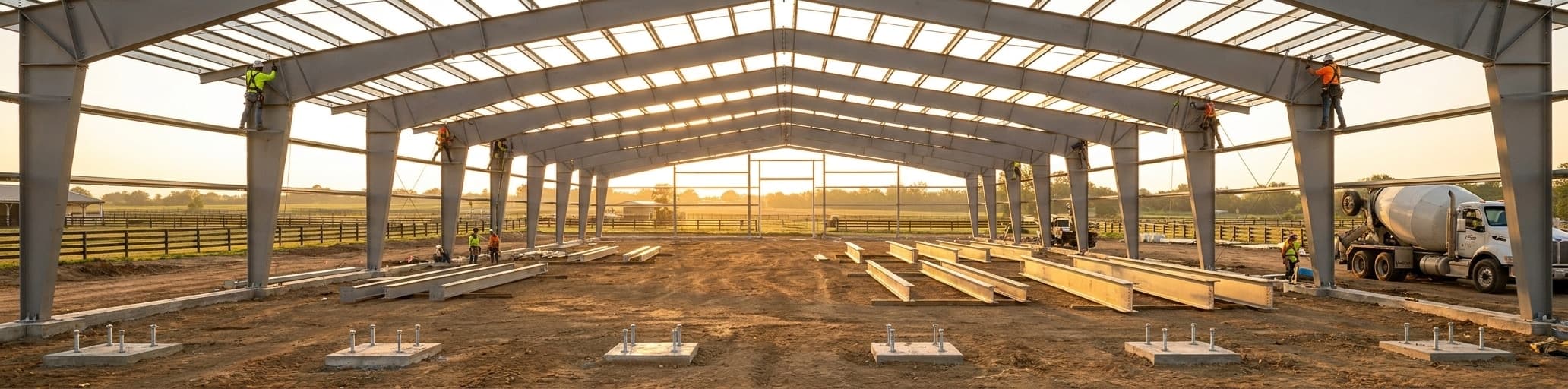

We help you build a realistic 150×250 covered arena budget by breaking down steel frame costs, foundation requirements, and regional variables that drive your final price. Understanding these cost drivers lets you control specifications strategically and lock in accurate quotes before committing to construction.
What Is the True Cost of a 150×250 Covered Arena in 2026?
A 150×250 covered arena installed by National Steel Buildings costs $85,000-$175,000, with per-square-foot pricing that improves because fixed overhead spreads across your full 37,500 sq ft footprint.
Direct pricing for National Steel Buildings 150×250 arena packages: $85,000-$175,000 installed
A 150×250 covered arena gives you 37,500 sq ft of clear-span space — enough for full riding circuits, shows, and multi-use events without a single interior column breaking up the floor.[1] National Steel Buildings' installed packages for this footprint run $85,000-$175,000, a range that reflects real differences in specification level, not arbitrary padding. Where you land in that range depends on the structural loads your site demands, the door and ventilation configuration you choose, and how much finishing is included in the scope.
That context matters because industry-wide, kit-only steel building packages are typically priced in the mid-teens to mid-twenties per square foot, while fully installed turnkey projects — covering slab, freight, labor, and accessories — commonly reach $24-$43 per square foot once every line item is accounted for.[2] For a covered riding arena, open sidewalls and a simpler structural profile hold costs well below a fully enclosed commercial shell, which is what keeps NSB's installed number competitive against the broader market range. One important caveat: quotes that show only a base kit price are not the same as an installed price.[3] A real budget includes the engineered frame, roof and wall panels, delivery to your site, and erection labor — and any honest supplier will break those lines out clearly so you know exactly what you're buying before you commit.
How square footage, materials, and local labor affect your final invoice
Square footage is the most visible cost driver, but it works in your favor at this scale. Per-square-foot cost drops as building size increases because engineering fees, permitting, and crew mobilization are largely fixed expenses — the same overhead spread across 37,500 sq ft of a 150×250 footprint delivers better unit economics than a smaller build carries.[5] A basic steel building kit typically runs $15-$25 per sq ft, while installed turnkey projects — covering slab, freight, labor, and accessories — commonly land at $24-$43 per sq ft once every line item is accounted for.[5] The 150×250 footprint sits at the larger end of the scale where those fixed costs get diluted, which is part of why the per-square-foot number stays competitive despite the build's sheer size.
Material choices are where you have the most direct control over your invoice. Roof design, insulation specification, door configuration, and wall panel selection each add to both material cost and engineering complexity.[5] An open-sidewall arena profile — common for covered riding arenas — requires less panel material and simpler framing than a fully enclosed commercial shell, which is a meaningful cost advantage at this footprint. Add translucent roof panels for natural light, sliding end doors sized for arena equipment, or a perimeter insulation package, and each decision layers additional cost onto the base frame price.[5] For a breakdown of how insulation and ventilation choices interact with the structural spec, the recreational steel buildings sizing guide covers the same tradeoffs for comparable clear-span footprints.
Local labor rates and site-specific engineering requirements are where two identical specs can produce very different invoices. Wind, snow, and seismic loads vary by region, and buildings in coastal, northern, or earthquake-prone areas require heavier framing systems that push both material weight and fabrication cost higher.[5] Beyond the frame, site conditions — soil type, drainage, slope, distance from electric service, and local permit review timelines — all affect what you pay before the first anchor bolt is set.[4] A turnkey build in a low-cost labor state like Texas runs materially less than the same project in California or the Northeast, not because the steel is different, but because labor pools, permit paths, and site prep costs diverge sharply by region.[5] Budgeting against your local market rather than a national average is the single most reliable way to avoid the gap between the number you planned on and the invoice you receive.
Why steel structures deliver better ROI than traditional wood or fabric alternatives
Steel runs $20-$40 per sq ft installed — below wood's $30-$50 range and structurally more robust than fabric's $10-$30 option.[6] That upfront gap is just the opening entry in the ROI ledger.
Steel arenas require significantly less upkeep than wood or fabric structures over their service life, cutting routine expenses like rot remediation, repainting, and fabric panel replacement that erode an owner's annual operating budget.[7] Fire resistance adds another recurring advantage: steel's non-combustible classification can reduce insurance premiums by 10-15% annually compared to combustible-framed buildings, a saving that compounds every year the structure stands.[8] The clear-span design removes interior columns, which directly determines what riding disciplines and events the floor plan can accommodate without structural retrofitting — a practical constraint wood and fabric post-frame systems impose that steel eliminates by design.[6] For buyers tracking long-term returns, well-built indoor arenas in active equestrian markets recover 50-70% of construction cost in property value appreciation, a figure that reflects the market's preference for permanent, low-risk structures over lower-cost temporary alternatives.[6] For a detailed look at how fire ratings and load paths translate into concrete insurance and financing advantages, the steel frame vs. wood frame breakdown covers the structural math in full.
Breaking Down the 150×250 Covered Arena Budget: Steel Structure, Foundation, and Labor
Steel frame costs dominate your arena budget because engineered I-beams must carry full roof loads across 150 feet without interior supports, plus arena-specific column design adds material beyond standard commercial construction.
Steel frame and roof system costs: what you're actually paying for
The steel frame is the largest single cost line in any covered arena budget, and understanding what drives that number helps you evaluate quotes accurately. For clear-span construction beyond 60 feet, steel becomes the structurally and economically dominant choice — wood trusses at comparable widths require double- or triple-ply members that close the cost gap quickly while adding complexity.[11] At 150 feet of clear span, a rigid commercial-grade I-beam frame is doing serious engineering work: primary rafters, columns, and the connections between them are sized to carry the full dead load of the roof plus regional wind and snow demands without a single interior support.[9] That load path is what you're paying for when you see the frame line item — not just steel tonnage, but the engineered system that makes 37,500 sq ft of unobstructed floor possible.
Arena-specific column geometry adds cost that standard commercial quotes don't reflect: riding arena columns must rise straight to 9 or 10 feet before tapering, rather than tapering from the base as in a warehouse frame, so horses don't spook at the narrowing profile low on the column.[11] That straight-rise "supermarket column" profile uses more steel per column than a standard taper, and the difference shows up in both material weight and fabrication time. Bay spacing compounds this: steel arena frames typically place anchor bolts 25 feet apart, and footing placement must match the engineered bay layout exactly — there is almost no tolerance for field adjustment, which means coordination between your concrete contractor and the building supplier is a hard budget requirement, not optional.[11] The roof system itself layers additional cost onto the primary frame: purlins, standing-seam or R-panel roof cladding, ridge vents, and any translucent daylighting panels each carry their own material and installation cost.
For a large-footprint arena, the steel package for the frame and roof assembly — before foundation, labor, or accessories — can range from $12 to $25 per sq ft depending on current steel market conditions and design complexity, with finished installed projects landing higher once every line item is counted.[10] Choosing commercial I-beam framing over cheaper tubular alternatives costs more upfront but delivers the load capacity and service life a permanent 150×250 structure demands.[9] For a deeper look at how primary frame components carry loads through the full structure, the structural steel components overview covers the engineering logic behind each member type.
Foundation, site prep, and permitting: the hidden line items that add up fast
The steel frame gets the attention, but foundation, site prep, and permitting are where budgets quietly break down — because none of them appear on a kit price quote. Site grading, drainage installation, and soil preparation alone run $10,000 to $50,000, depending on how much topography work your lot requires and whether environmental conditions complicate the clearing process.[12] If you're building where an older barn or previous arena stood, add demolition and site clearing: removing existing structures costs $5,000 to $30,000 before a single new anchor bolt is set.[12] Choosing a level site with established drainage is the single most actionable way to hold site prep costs down — owners who start with good ground conditions routinely save thousands compared to those who don't.[13] For a 150×250 covered arena footprint, where the riding surface typically stays as compacted native material or engineered footing rather than poured concrete, the concrete scope focuses on perimeter footings and anchor placements. For any concrete work involved, budget $8-$12 per square foot based on soil conditions and structural load requirements, as those numbers shift significantly with regional soil variability.[14]
Permitting adds both cost and schedule risk that most first-time arena owners underestimate. Building permits for a structure of this type run $1,000 to $10,000 depending on jurisdiction, and a single project may require separate permits for building, electrical, plumbing, and zoning compliance — each carrying its own review timeline.[12] Approval can take several weeks to several months in areas with strict local regulations, and that clock doesn't start until your engineered drawings are submitted.[13] You'll also want to budget for a structural engineer's design review and code compliance check, which typically runs $2,000 to $8,000 — an expense that protects you from costly rework during inspections.[12] Working with a single-source provider who manages permit submissions and coordinates with your local jurisdiction keeps the process fast and smooth; without that coordination, schedule slippage between permit approval, site work, and delivery sequencing is one of the most common causes of cost overruns on arena projects. For a closer look at how foundation specs and concrete thickness decisions interact with building loads, the slab cost breakdown covers the thickness-versus-use tradeoffs that apply across steel building footprints.
Labor and erection costs when you choose a single-source provider like National Steel Buildings
Steel vs. fabric structures: durability, insurance, and weather resilience Fabric structures come in at $15-$35 per sq ft installed — the lowest entry point in the covered arena market — but that upfront advantage dissolves quickly once you examine what fabric can and can't do under real operating conditions.[21] Weather tolerance is where the comparison turns: fabric membranes perform inconsistently under heavy snow loads and sustained high winds that a pre-engineered steel frame handles without structural consequence.[22] Insulation performance and climate control efficiency also differ significantly between the two systems, with fabric envelopes requiring more active management to maintain stable interior conditions — a gap that compounds into measurable operating cost every season.[4] Steel's non-combustible classification is where the insurance math breaks hardest against fabric: underwriters price fire risk by material, and steel's rating produces a fundamentally different premium than a fabric membrane generates — a savings that recurs on every renewal for the life of the structure.[22] For horse safety and training consistency, the practical gap matters as much as the financial one: covered steel arenas dampen wind noise and block visual distractions at the perimeter, creating a controlled environment that directly reduces spook risk — conditions a fabric shell, which moves and amplifies sound in wind events, cannot reliably replicate.[22] On a 37,500 sq ft footprint where a single weather-canceled clinic or show represents direct revenue loss, a structure engineered to maintain interior performance through rain, snow, and high winds is the operational baseline a serious arena operation requires, not an upgrade to weigh against a cheaper alternative.
| Performance category | Steel frame | Fabric structure |
|---|---|---|
| Installed cost per sq ft | $20-$40[22] | $15-$35[21] |
| Snow and wind load tolerance | Engineered for full regional loads[22] | Performs inconsistently under heavy loads[22] |
| Insulation and climate control | Metal panel systems — consistent performance[4] | Weaker envelope — higher active management cost[4] |
| Fire classification | Non-combustible — lower insurance premiums[22] | Combustible classification — higher risk pricing[22] |
| Interior environment stability | Dampens wind noise; blocks visual distractions[22] | Moves and amplifies sound in wind events[22] |
| Maintenance requirement | Virtually none over service life[22] | Fabric panel replacement cycles required[22] |
Covered arena cost per square foot: how 150×250 stacks up against smaller and larger sizes
Per-square-foot cost drops predictably as building size increases because engineering fees, permit costs, and crew mobilization are largely fixed — spread across more square footage, they become a smaller fraction of each dollar you spend.[25] Kit-only packages for popular smaller footprints run $15-$20 per sq ft, with installed turnkey projects landing at $24-$43 per sq ft once concrete, freight, and labor are included.[23] At 37,500 sq ft, the 150×250 footprint sits well up the scale curve where those fixed overhead items are heavily diluted — meaning each square foot you're buying carries less of the mobilization and engineering burden than a 50×100 or 45×60 build absorbs.[25] The practical result: the per-sq-ft cost at 150×250 scale is consistently more competitive than what smaller arena footprints deliver, even before you account for the open-sidewall profile that reduces panel material and installation scope versus a fully enclosed commercial shell.[23]
The table below puts the scaling relationship in concrete terms, using kit price benchmarks from market data alongside installed project ranges:
| Building footprint | Square footage | Kit price range (per sq ft) | Installed turnkey range (per sq ft) |
|---|---|---|---|
| 35×40 | 1,400 sq ft | ~$17[23] | $24-$43[23] |
| 45×60 | 2,700 sq ft | ~$16[23] | $24-$43[23] |
| 50×100 | 5,000 sq ft | ~$15[23] | $24-$43[23] |
| 150×250 (covered arena) | 37,500 sq ft | Low end of kit range[24] | Competitive within installed range — open-sidewall profile reduces scope[23] |
What the table makes clear is that buyers choosing a 150×250 covered arena are operating at a scale where fixed project costs stop dominating the per-sq-ft number. The $25-$40 per sq ft shell-only range applies to fully enclosed commercial structures; an open-sidewall riding arena with a simpler panel scope lands below the midpoint of that band.[25] For a deeper look at how scale affects per-sq-ft economics across different building types, the industrial warehouse cost breakdown by size runs the same math at comparable footprints and shows where the per-sq-ft curve flattens out. The takeaway for arena buyers is straightforward: at 37,500 sq ft, you're past the steepest part of the scaling curve — and that's where the unit economics of a large clear-span steel structure work hardest in your favor.[24]
How to Lock in Your 150×250 Arena Budget: National Steel Buildings Pricing Transparency Tool and Next Steps
Control your 150×250 arena budget by mastering three specification decisions–wall profile, roof panels, and door configuration–that directly determine whether you land at $15 or $43 per square foot.
Cost estimator: plug in your specifications and get an instant budget range
For a 150×250 covered arena, your final number comes down to three variables you control at the quote stage: structural specification level, finish scope, and whether you're pricing a kit or a fully installed project. Kit-only steel building packages run $15-$20 per sq ft; installed turnkey projects — covering the kit, concrete, delivery, and construction — land at $24-$43 per sq ft.[26] At 37,500 sq ft, those ranges translate to a wide dollar spread, so understanding which specification decisions move you up or down the band is the fastest way to build a budget you can actually hold. Location is the variable you can't override: your zip code determines the snow loads, wind speeds, and seismic conditions your frame must be engineered to handle, and buildings in coastal, northern, or seismic zones require heavier framing that pushes both material weight and fabrication cost higher.[27] Once you know your regional load requirements, the remaining levers — open-sidewall vs. enclosed profile, insulation package, door count and size, and roof panel type — are where you actively steer the number. The table below maps specification choices to their budget impact so you can see exactly where each decision takes your 150×250 covered arena cost before you commit to a formal quote.
| Specification variable | Lower-cost choice | Higher-cost choice | Budget impact |
|---|---|---|---|
| Project scope | Kit only: $15-$20/sq ft[26] | Installed turnkey: $24-$43/sq ft[26] | Largest single variable in total project cost |
| Wall profile | Open sidewall | Fully enclosed commercial shell | Open sidewall reduces panel material and installation scope |
| Regional load requirements | Low wind/snow zone | Coastal, northern, or seismic zone | Heavier framing required in high-load regions[27] |
| Roof panel type | Standard R-panel | Standing-seam or translucent daylighting panels | Each upgrade adds material and installation cost |
| Door configuration | Minimal framed openings | Multiple large sliding or overhead doors | Door count and size directly affect both framing and labor[27] |
| Insulation package | Uninsulated | Full perimeter insulation system | Adds material cost; reduces long-term operating expense |
| Roof pitch | Standard low pitch (1:12) | Higher pitch for heavy snow regions | Higher pitch increases building price[27] |
The most reliable way to use this table is to identify your non-negotiables first — regional load requirements aren't optional, and an open-sidewall profile is a structural decision, not just an aesthetic one. From there, price your framed openings at the outset and source doors, windows, and insulation components separately once the base frame is quoted; that sequencing keeps your initial quote clean and lets you add finish scope incrementally without repricing the entire structure.[27] A prefab buildings cost and speed overview covers how the same specification logic applies across footprints, with concrete numbers on where kit vs. installed pricing diverges as building size scales up.
Customization options that affect price: insulation, ventilation, doors, and interior finishes
Insulation is the customization decision with the longest financial tail. On an open-sidewall arena, it's optional — but in cold-climate regions, a well-insulated roof and wall system keeps horses comfortable through winter training sessions and controls condensation drip onto the riding surface, which degrades footing quality faster than almost any other factor.[29] Insulated arenas also require active heating equipment that uninsulated structures don't, so the capital cost of the insulation package is only part of the equation — you're also committing to an HVAC or radiant system that carries its own installation and operating cost.[29] For owners weighing whether to insulate at build time or add it later, the answer is almost always at build time: retrofitting insulation around a completed frame costs significantly more than integrating it during initial panel installation. A detailed look at R-value selection and vapor barrier specs for metal building envelopes is covered in the steel building insulation guide, which applies directly to arena footprints.
Ventilation splits into two categories with meaningfully different price points. Natural ventilation — delivered through doors, windows, and vented ridge systems — costs less upfront and works well for open-sidewall arenas where ambient airflow is part of the structural design.[29] Mechanical ventilation gives you active control over air exchange rates and is the standard specification for insulated, heated buildings where the envelope limits natural airflow, but it carries higher installation cost and adds an ongoing energy expense that passive systems avoid.[29] The practical rule: if you're insulating and heating, budget for mechanical ventilation from the start. If you're staying open-sidewall, natural ridge venting and operable end-wall openings handle the load at a fraction of the cost.[29]
Door configuration has a direct structural cost beyond the door hardware itself. Every framed opening interrupts the primary frame's load path and requires additional structural members to redistribute that load — so door count, size, and placement affect both material weight and engineering complexity from the first design iteration.[28] Large sliding end-wall doors sized to admit tractors and arena maintenance equipment are the most common specification for covered riding arenas, and they drive more frame cost than a standard personnel walk door because the opening width requires heavier header members and additional bracing.[30] Fixing your door layout early locks those structural requirements into the initial quote rather than generating change orders after the frame is engineered.
Interior finishes are where preference drives the budget range rather than structural necessity. A basic arena leaves the steel frame exposed and wall panels unfinished — low cost, easy to clean, and perfectly functional for training use.[29] Adding wainscoting, rubber kick boards, viewing areas, or a finished tack room each layers material and labor cost onto the base structure, and none of those elements appear in a kit-only quote.[29] Lighting deserves separate attention: consistent, glare-free lighting eliminates the shadow zones that trigger spooking, and roughing in the electrical conduit during frame erection costs a fraction of what a post-build retrofit runs.[30] The table below maps each customization category to its budget behavior so you can sequence decisions before committing to a formal quote.
| Customization category | Lower-cost choice | Higher-cost choice | Budget behavior |
|---|---|---|---|
| Insulation | Uninsulated open-sidewall | Full roof and wall insulation system | Adds material cost at build; avoids retrofit expense later[29] |
| Ventilation | Natural — ridge vents, operable doors and windows | Mechanical — powered air exchange system | Mechanical adds installation and operating cost; necessary for heated, enclosed arenas[29] |
| Doors | Single personnel walk door | Multiple large sliding or overhead end-wall doors | Each framed opening adds structural members and engineering complexity[28] |
| Interior finishes | Exposed frame, unfinished panels | Wainscoting, rubber kick boards, tack room, viewing area | No structural requirement — entirely preference-driven cost layering[29] |
| Lighting and electrical | Minimal rough-in at erection | Full conduit runs and fixture layout integrated at build | Retrofit electrical after erection costs significantly more than build-time integration[30] |
How to request a formal quote and timeline from National Steel Buildings's design-build team
A formal quote moves fastest when you arrive with three inputs that determine structural specification: your zip code, your intended wall profile, and your door and framed-opening count. Those three items let the design-build team size the primary frame and produce a line-item proposal rather than a range estimate — and a proposal is the only number you can build a contract around. To get a complete estimate, include dimensions, intended use, desired features, location, and any special add-ons at the outset; the more complete your input, the more accurate your first-round quote.[32] Getting at least three contractor quotes is also standard practice before awarding any scope — and knowing what a complete proposal looks like is how you compare them honestly.[32]
A complete structural steel proposal should address every phase from initial review through final installation.[31] When you receive NSB's proposal, confirm that frame engineering, material specifications, delivery sequencing, and erection labor all appear as distinct line items — not bundled under a single turnkey number.[31] Proposals that price the easy elements clearly while leaving coordination questions unanswered are the most common source of change orders and schedule disputes on arena projects.[31] A low number that doesn't account for the full scope isn't a competitive bid; it's a placeholder for a cost conversation you'll have after your leverage has dropped.[31] Material specifications deserve the same scrutiny: a proposal that lists "structural steel" without referencing applicable ASTM designations or acknowledging the engineer's specifications leaves you guessing about whether what arrives on site matches what was designed.[31] For a practical checklist of what separates a reliable design-build contractor from one who will generate gaps mid-project, the local prefab contractor vetting guide covers the five questions that reveal how a supplier handles the phases most proposals leave vague.
The table below maps what to have ready when submitting a quote request and what each input unlocks in the proposal:
| Input you provide | Why it matters at quote stage |
|---|---|
| Zip code | Determines regional wind, snow, and seismic load requirements — sets structural weight and frame cost[32] |
| Wall profile (open sidewall vs. enclosed) | Drives panel scope and engineering complexity — largest single lever on installed cost |
| Door count, type, and placement | Each framed opening interrupts the primary load path and adds structural members — must be fixed before frame engineering begins[31] |
| Intended use and building dimensions | Lets the team confirm clear-height requirements and bay spacing before fabrication drawings are started[32] |
| Site address and soil conditions | Required for footing design and delivery sequencing — affects both foundation spec and freight routing |
| Budget range and timeline target | Allows the team to flag specification decisions that will push your number outside your window before you're committed |
Once your request is submitted, the construction timeline moves in sequence. Planning and design runs first: engineered drawings are prepared, submitted for permit review, and approved before fabrication begins — fabrication does not start until drawings are confirmed, because schedule pressure that pushes a supplier to cut steel before approval is confirmed is a documented source of costly rework.[31] Site preparation and foundation work proceed in parallel once permits are in hand. Prefabricated components arrive in installation sequence after the foundation sets, frame assembly begins with columns and beams bolted and secured to the foundation, and roofing and wall panels follow in order.[33] Most steel building projects complete in weeks to a few months, which is materially faster than a comparable traditional structural shell — and that timeline compression reduces both construction loan interest and total billable labor hours on-site.[33] Fixing your specification, door layout, and site address before submitting keeps the initial proposal clean, the permit clock starting on time, and the number you plan on matching the one on your final invoice.
- A 150×250 covered arena costs $85,000-$175,000 installed, or $20-$40 per sq ft for steel versus $15-$35 for fabric structures.
- Fixed costs like engineering, permitting, and crew mobilization spread across 37,500 sq ft, making per-sq-ft pricing more competitive than smaller buildings.
- Regional load requirements for wind, snow, and seismic conditions determine structural weight and cost; coastal and northern zones require heavier framing systems.
- Site preparation, foundation work, and permitting can add $18,000-$88,000 beyond the steel frame cost and are commonly underestimated by first-time arena owners.
- Steel arenas provide 10-15% annual insurance savings through non-combustible fire classification and require virtually no maintenance versus fabric or wood alternatives.
- Door count and placement directly affect structural requirements; large sliding end-wall doors require heavier headers and additional bracing beyond standard openings.
- Insulation should be installed at build time rather than retrofitted later, as integrated installation costs significantly less than post-completion addition.
- https://titansteelstructures.com/steel-building-services/how-much-does-a-150×250-metal-building-cost/
- https://www.buildingsguide.com/metal-building-prices/?srsltid=AfmBOooDv6hlKKeWZjhYPobUH74BJQrxRguKJfAtc91VO_lfrhk6Pylm
- https://torosteelbuildings.com/blog/steel-building-prices/
- https://foleyconstruction.net/indoor-riding-arena-cost/
- https://www.uspatriotsteel.com/blog/how-much-does-it-cost-to-build-an-indoor-riding-arena/
- https://homeguide.com/costs/indoor-riding-arena-cost
- https://reichconstructionllc.com/cost-of-pre-engineered-steel-indoor-horse-riding-arena/
- https://chinasteelbuildsales.com/indoor-arena-cost/
- https://www.buildingsguide.com/metal-building-prices/?srsltid=AfmBOor0Zsjgn9GWxw2eRgAQG1mS8vbH5OYIoXQRT41AKivaAfsTpvRV
- https://reichconstructionllc.com/cost-of-a-100000-square-foot-prefab-steel-building/
- https://ruralbuildermagazine.com/creating-big-span-riding-arenas/
- https://www.angi.com/articles/indoor-riding-arena-cost.htm
- https://www.homeadvisor.com/cost/additions-and-remodels/indoor-riding-arena/
- https://titansteelstructures.com/price-guides/the-2026-steel-building-price-guide-what-to-expect-this-year/
- https://titansteelstructures.com/metal-structure-tutorials/how-much-does-labor-cost-to-erect-a-steel-building/
- https://www.robertsonbuildings.com/blogpost/2025-steel-building-cost-estimator-a-contractors-guide-to-pemb-pricing/
- https://www.tylerbuilding.com/post/speed-to-market-how-pre-engineered-metal-buildings-cut-construction-time-by-30
- https://www.buildingsguide.com/build/pole-barn-vs-metal-building/?srsltid=AfmBOorCx86aj3Ggmcfh0xdsI2kmeA66azIG-3dSoNmtH9Fc9He7x39f
- https://norsteelbuildings.com/us/steel-building-basics/steel-vs-wood/
- https://finehomekeeping.com/riding-arenas-101-why-steel-is-the-go-to-choice-for-serious-equestrians/
- https://megadomebuildings.com/coverall-fabric-building-cost/
- https://www.arcosteel.com/the-benefits-of-a-covered-metal-horse-riding-arena/
- https://www.buildingsguide.com/metal-building-prices/?srsltid=AfmBOooZM7-HNQwc7ZHYIpyVekNA40aAW3DNswUxr4GoeiKvYTXXnyLR
- https://americansteelinc.com/blog/steel-building-costs-prices-guide/
- https://builtmammoth.com/how-much-does-a-steel-building-cost/
- https://www.buildingsguide.com/metal-building-prices/?srsltid=AfmBOopttQBJswV6A39CY0fl-uet8BSPDxiTz5kzk5mTdODqo_19eNmb
- https://gensteel.com/price-your-building-online/
- https://www.buildingsguide.com/metal-building-prices/?srsltid=AfmBOoo94VRYzbz04cmGISqW6yyJLnkq5P4qQwRnWBKFsdgVbGUHXArc
- https://www.alliedbuildings.com/indoor-horse-riding-arena-cost/
- https://mavericksteelbuildings.com/steel-buildings/horse-arena/200×400/
- https://www.agwelding.com/what-a-structural-steel-proposal-should-include-and-how-to-evaluate-one
- http://www.247pro.com/blog/the-ultimate-guide-to-steel-building-cost-estimation-from-initial-quote-to-grand-projects
- https://www.gramsconstruction.com/step-by-step-guide-to-the-steel-building-construction-process