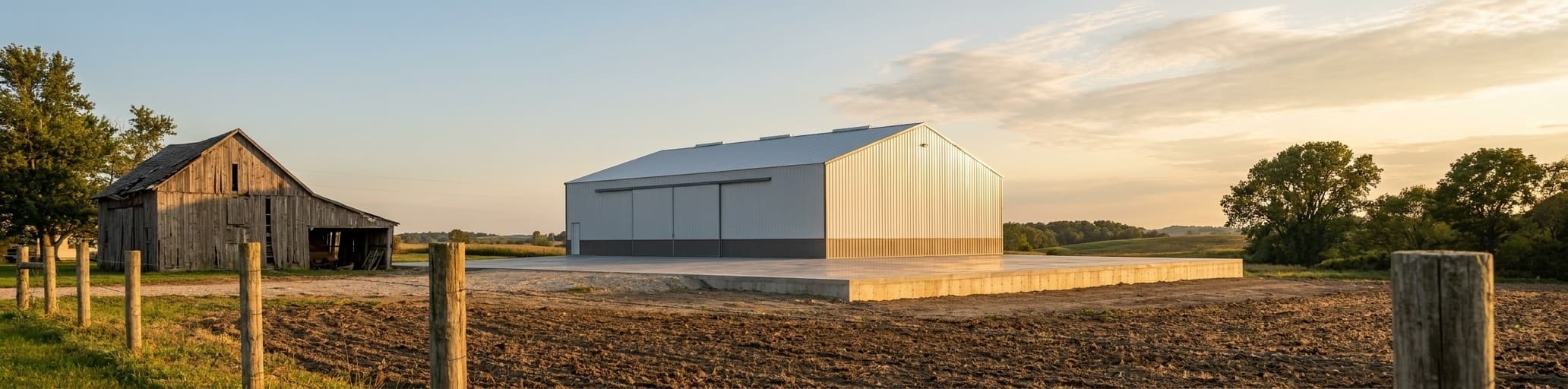

We help you understand how material specs, site prep, maintenance costs, and insurance premiums compound over a decade to reveal the true cost difference between steel and pole barns. Investing 15% more upfront in engineered steel typically recovers its premium through avoided repairs, lower insurance, and stronger resale value before year ten.
Understanding the True Cost Drivers
Stepping up from 29-gauge to 26-gauge panels costs 10-15% more upfront but prevents storm damage repairs that routinely cost several times that premium over a decade.
Material Choices and Steel Gauge Impact
The gauge system for steel panels works backward from intuition: lower numbers mean thicker, stronger metal.[2] When you're comparing 30×40 farm building vs pole barn cost over a full decade, you need to track two separate gauge specs — panel gauge (walls and roof) and frame gauge (the structural skeleton) — because confusing them leads to under-built structures and avoidable repair bills.[2] Standard post-frame pole barn construction defaults to 29-gauge panels, which average .0172 inches thick with a minimum of just .0142 inches; 26-gauge panels run .0217 inches minimum and hold up meaningfully better under snow weight, hail impact, and wind uplift.[3] That gap compounds fast when weather enters the picture: stepping up from 29- to 26-gauge adds roughly 10-15% to panel cost upfront, but storm damage repairs on thin-gauge roofs routinely dwarf that premium several times over across a ten-year window.[2] Yield strength — the force required to cause permanent deformation — matters as much as raw thickness; high-yield steel can be nearly twice as hard as standard sheet at the identical gauge number, making it the more reliable indicator of dent resistance than gauge alone.[3] The frame spec follows the same logic: a certified 12-gauge I-beam engineered to specific wind and snow loads outperforms a non-certified 14-gauge tube-steel frame regardless of which gauge number is numerically lower, because engineering precision and proper installation drive structural performance more than thickness by itself.[2] Understanding how these specs interact is foundational before comparing sticker prices — which is exactly why agricultural steel buildings buyers who dig into material specs consistently land on better long-term value. At the kit level, commercial-grade I-beam steel buildings run $15-$20 per square foot, higher than cheaper tubular-framed alternatives, but that spread narrows considerably once you factor in avoided repairs and longer service life.[1]
| Spec | 29-gauge panels | 26-gauge panels | Frame: 14-gauge tube | Frame: 12-gauge I-beam |
|---|---|---|---|---|
| Avg. thickness | .0172 in. | .0217 in. | Thinner wall | Thicker, engineered |
| Best for | Light-duty, calm climates | Barns, farms, most regions | Basic loads | Certified wind/snow loads |
| Upfront cost | Lower | ~10-15% more | Lower | Higher |
| 10-year risk | Denting, uplift, leaks | Low with proper coatings | Deflection under load | Low with engineering cert |
| Verdict | Short-term savings only | Cost-effective long-term | Acceptable for mild use | Recommended for farm builds |
Foundation and Site Preparation Expenses
Site prep is the line item that catches most buyers off guard, and the two building types handle it differently enough to shift your total budget by several thousand dollars before a single panel goes up.
Pole barns embed their structural columns directly in the ground, so a full concrete slab isn't always required — but you still need proper grading, compaction, and drainage to prevent post rot and settling over time.[5] Steel buildings, by contrast, almost always sit on a poured slab: a 4-inch pour handles workshops and light storage, while heavy equipment or loaded vehicles warrant a 5- or 6-inch reinforced slab that costs meaningfully more.[4] Both systems need site prep, but steel can also work on engineered compacted gravel depending on your use case and local code.[6] What drives costs higher than most buyers expect is fill dirt and land leveling — a lot that looks flat often needs significant grading before either structure can go up, and that work is billed separately from the building kit entirely.[4] Rural properties add another variable: running electricity to a building on the far end of a farm costs more per linear foot than tying into a city utility grid, so factor distance to power when comparing bids.[5] On the permitting side, engineer-stamped steel building plans simplify the approval process because the documentation inspectors need is already packaged with the kit; pole barn permits vary more by county and depend heavily on who drafted the structural plans — which can slow your timeline and add design fees if the initial submission gets kicked back.[6] A detailed look at 30×40 concrete slab costs shows how thickness, soil type, and reinforcement spec interact — worth reviewing before you lock in a foundation budget.
Finish Levels, Insulation, and Utilities
The gap between a shell-only price and a fully functional 30×40 building is where the 30×40 farm building vs pole barn cost comparison gets expensive fast.
Pole barn shell prices start around $20,000-$30,000, but adding interior steel liners, concrete floors, and additional windows pushes the total toward $45,000 or higher.[5] Insulation, drywall, electrical, plumbing, and HVAC sit on top of that shell price as a completely separate budget layer — and skipping them at the design stage almost always means paying higher retrofit costs once the structure is already standing.[7] Door and window specs carry more long-term weight than buyers typically expect: thermal-barrier steel walk doors block condensation and heat loss at the frame, while insulated glazing with a sealed spacer system cuts energy transfer enough to produce measurable reductions in heating and cooling bills over a decade.[5] Planning your steel building insulation spec before the kit order — rather than retrofitting panels later — is one of the cleaner ways to control that cost.
On the utility side, running electricity, water, or gas to a rural 30×40 farm building costs more per linear foot than connecting to city infrastructure, so two identical kit prices can produce meaningfully different finished project totals depending on how far your property sits from existing service lines.[5] Customization items like skylights, additional walk-in doors, and windows transform a bare metal shell into a ready-to-use workspace, but each addition needs to be budgeted explicitly — none of it comes standard in a base kit price.[8]
Comparing 30×40 Farm Building vs Pole Barn Cost Over 10 Years
A complete 30×40 pole barn typically costs $26,985 to $45,000 installed, but site prep, permits, and concrete can add $5,700 to $10,500 more to your final bill.
Initial Investment Breakdown
A 30×40 pole barn shell starts at $20,000-$30,000 for the basic kit, but adding concrete, interior steel liner, and windows pushes the finished project toward $45,000 or higher.[5] Kit prices from budget suppliers run as low as $12,000, while engineered packages with certified trusses and stamped truss plates land at $26,000 or more before tax and delivery.[5] Professional installation of a complete pole barn starts around $26,985 at the base level, with most projects settling between $15,000 and $50,000 depending on features, regional labor rates, and whether the builder manages permitting.[9] Per square foot, pole barn construction averages $15-$40 for the full spectrum of market options, though high-spec engineered builds track toward $35-$50 once labor and materials are fully accounted for.[5][9] Steel building kits at the commercial I-beam level run $15-$20 per square foot — roughly $18,000-$24,000 for a 1,200-square-foot package — with installed costs following a similar curve, but the practical difference at quote time is that engineer-stamped drawings typically come bundled in a steel kit price, while pole barn permit documentation depends on who drafted the structural plans and can add design and resubmission fees if the initial submission gets rejected.[5] Site prep adds $1,200-$8,000 to either building type, permits add $500-$2,500, and a concrete slab runs $4-$8 per square foot on top of whichever structure you choose — costs that live completely outside the kit price on any quote you receive.[9] Running every cost line before you commit to a path is the clearest way to keep your project within budget; a 30×40 metal building cost breakdown maps each phase so nothing appears as a surprise on invoice day.
| Cost item | 30×40 pole barn kit | 30×40 pole barn (constructed) | Context |
|---|---|---|---|
| Shell / kit price | $12,000-$26,000+ | $26,985-$45,000+ | Engineering spec drives the range[5] |
| Per sq ft installed | $15-$40 | $35-$50 | Regional labor rates shift this[5][9] |
| Site prep | $1,200-$8,000 | $1,200-$8,000 | Rocky or sloped sites hit the upper end[9] |
| Permits | $500-$2,500 | $500-$2,500 | Stamped plans speed county approval[9] |
| Concrete slab | $4-$8 per sq ft | $4-$8 per sq ft | Required for most finished builds[9] |
| Engineer-stamped plans | Extra / varies | Sometimes included | Confirm before accepting any quote[5] |
Maintenance and Operating Cost Differences
The wood framing inside a pole barn generates recurring repair costs that compound fast once a decade of weather cycles through. Wooden posts embedded directly in the ground shift over time and typically need straightening every five to seven years — a correction that runs thousands of dollars per cycle.[12] That movement also loosens nail and screw connections, which creates gaps in the building envelope and multiplies leak exposure as the frame continues to settle.[12] On top of structural drift, wood surfaces require periodic painting, and the chemically treated lumber used to resist rot and termites cannot be recycled and raises biosafety concerns in livestock applications.[10] Steel framing anchored to a concrete slab with engineered bolted connections stays straight for the life of the structure and requires virtually zero maintenance by comparison.[10][12]
Insurance is where the 30×40 farm building vs pole barn cost gap becomes most tangible on an annual basis. Steel is non-combustible, so it cannot contribute fuel to a structural fire the way wood framing does — and insurers price that difference directly into premiums.[10] Properly grounded steel barns also carry lower lightning-fire risk than wood-framed pole structures.[12] The result: steel building owners routinely pay 30% less in annual premiums than owners of comparable pole barns.[10] Steel does not rot, mold, or feed termites, eliminating the chemical treatment and pest-control costs that follow wood framing throughout its service life.[12] Investing roughly 15% more upfront in an all-steel structure can therefore recover the entire premium through reduced maintenance and lower insurance costs before year ten.[10]
| Cost category | 30×40 pole barn (10-year) | 30×40 steel building (10-year) | Notes |
|---|---|---|---|
| Post straightening | $2,000-$5,000+ per cycle, every 5-7 years | $0 | Slab anchor eliminates drift[12] |
| Painting and surface upkeep | Periodic, ongoing | Minimal | Steel panels need little upkeep[10] |
| Annual insurance premium | Standard rate | Up to 30% less per year | Fire-resistant framing drives savings[10] |
| Pest and rot treatment | Ongoing | $0 | Steel doesn't rot or feed termites[12] |
| Structural repairs from frame shift | Elevated risk over time | Low | Bolted connections stay true[10] |
Lifetime Value and Return on Investment
The ROI gap between a steel farm building and a pole barn opens wide once you look past the five-year mark. A 30×40 pole barn with electrical service and concrete flooring can add $25,000-$35,000 to your property's appraised value, but appraisers value outbuildings at 50-70% of construction cost — meaning a $30,000 pole barn may add only $15,000-$21,000 to your assessment.[13] Properties with functional outbuildings sell 20-40% faster than comparable bare land, so faster sales reduce carrying costs and provide greater timeline certainty when purchasing your next property.[13] Steel compounds more aggressively on both fronts: pre-engineered steel structures see resale value increase 20-30% over a 20-year horizon, while wood-framed alternatives produce lower ROI because ongoing maintenance and remodeling costs erode the gain.[14] The lifespan difference drives that spread — a pole barn's structural lifecycle typically runs 15-20 years before significant decline, while a properly spec'd steel building remains sound for decades longer, giving you more ownership cycles during which the speed-to-sale advantage and appraisal premium keep paying out.[12] Insurance savings stack directly on top of property value gains: steel building owners save 30% or more annually on premiums because fire-resistant framing cannot contribute fuel to a structural fire, a risk factor insurers price into every wood-frame policy.[12] Avoided storage fees add another layer — at $100-$200 per month, 10 years of off-site storage costs $12,000-$24,000 that a covered steel building eliminates entirely.[13] The 20-year math on steel barn cost vs wood barn confirms the same pattern at every building size: lower maintenance, stronger resale, and compounding insurance savings make steel the cost-effective choice over any full decade of ownership.
| ROI metric | 30×40 pole barn (10-year) | 30×40 steel building (10-year) | Source |
|---|---|---|---|
| Appraised value added | $15,000-$35,000 at 50-70% of build cost | 20-30% resale increase over 20 years | [13][14] |
| Days on market impact | 20-40% faster sale | Same advantage, sustained longer | [13] |
| Building lifespan | 15-20 years typical | Decades longer | [12] |
| Annual insurance premium | Standard rate | 30%+ savings per year | [12] |
| Avoided storage fees (10-yr) | N/A if already built | $12,000-$24,000 cumulative | [13] |
| End-of-life material value | Landfill disposal | Recyclable steel | [12] |
Optimizing Your Budget with Single-Source Solutions
Lock in your 30×40 steel building costs upfront at $52,000-$106,000 with one contractor owning every phase from design through final inspection.
Benefits of Turnkey Packages from National Steel Buildings
A turnkey 30×40 steel building package bundles the kit, concrete slab, delivery, erection, insulation, doors, and permits into a single contracted scope — and that structure produces three concrete advantages over a piecemeal build approach.
First, cost certainty: a complete turnkey 30×40 project runs $52,000-$106,000 in 2026, with every phase pre-priced before ground breaks, so no surprise invoice appears mid-project when you're least positioned to absorb it.[15] Second, construction speed: pre-engineered steel builds 30-50% faster than wood or tilt-up concrete, compressing the window between permit approval and a functional building — which directly reduces carrying costs and gets equipment under cover sooner.[15] Third, single-point accountability: one contractor owns the outcome from design approval through final inspection, eliminating the change orders that multiply when a kit supplier, a foundation crew, and an erection team each operate on separate contracts with separate scopes.[17] Installed turnkey steel averages $24-$43 per square foot, covering the kit, slab, delivery, and construction without hidden line items appearing after the fact.[16] Buyers who compare at least three itemized turnkey proposals before committing have reduced final project costs by as much as 28% — a savings figure that only becomes visible when every cost line appears in the same document rather than scattered across multiple vendor quotes.[17] For farm owners weighing the 30×40 farm building vs pole barn cost decision, turnkey farm building construction keeps you in the field instead of refereeing subcontractors, which is the operational advantage a single-source build delivers every step of the way.
Leveraging Market Monitoring for Cost Efficiency
Steel pricing behaves like a globally traded commodity, not a local supply purchase — and that distinction changes how you budget a 30×40 farm building project.[19] Mill utilization rates, freight surcharges, scrap availability, and trade policy shifts can all move the delivered cost of your building package within weeks.[18] In 2026, service centers are running leaner inventories than in previous cycles, which means any sudden spike in construction demand pushes prices higher faster than historical patterns suggest.[19] Lead times are the clearest early signal of where pricing is headed: when lead times extend, buyers rush to secure tonnage and spot pricing follows.[19] Watching that signal — rather than waiting for your quote to expire — is the most actionable form of market monitoring available to farm building buyers.
The most reliable hedge against price whiplash is a deposit-and-lock strategy: once your scope is finalized — span, height, loads, openings, insulation — a deposit commits the supplier to your material package at a defined price, removing the steel portion of your budget from weekly index movement.[19] Don't evaluate quotes on price per ton alone. A lower-priced package with a 12-week lead time can cost more in total than a premium-priced package with a 2-week delivery window, once labor standby costs and construction financing carry charges are factored in.[18] Contractors and farm owners who track predictive analytics platforms — tools that monitor Hot-Rolled Coil prices, scrap metal trends, and mill capacity data — gain enough forward visibility to time purchases during off-peak construction periods and lock fixed-price contracts before a demand surge absorbs available mill capacity.[18] The Pole Barn Price Comparison: 30×40 Budgets Across Three States shows how regional labor and material timing can shift budgets significantly, which is exactly why locking material costs early matters as much as the design decisions themselves.
Value engineering works as a parallel cost-control lever alongside market timing. Optimizing bay spacing and specifying tapered members — which place steel only where structural stress demands it — reduce overall tonnage and shrink the raw materials exposure that commodity volatility actually affects.[19] Pre-engineered metal buildings use roughly 30% less steel than conventional construction, and that leaner material profile means market price swings hit your budget less hard than they would on a wood-framed pole barn where labor and material complexity add unpredictability at every phase.[19] Building scope that is engineered precisely — loads confirmed, geometry simplified, spans optimized — produces quotes that hold because fewer surprise variables are buried in the details waiting to surface as change orders.[19]
Financing, Tax Incentives, and Bulk Discounts
The tax side of the 30×40 farm building vs pole barn cost decision shifted significantly in 2025. The One Big Beautiful Bill Act permanently restored 100% bonus depreciation for qualifying property acquired and placed in service after January 19, 2025.[22] At the same time, the Section 179 expensing limit climbed from $1 million to $2.5 million — with a phaseout threshold raised to $4 million — effective for property placed in service after December 31, 2024, with both figures indexed for inflation going forward.[22] The IRS Farmer's Tax Guide confirms the 2025 Section 179 ceiling at $2,500,000, and single-purpose agricultural structures — buildings specifically designed, constructed, and used to house, raise, and feed a particular livestock class — qualify directly as eligible property.[20] Steel livestock barns that meet those criteria placed in service this calendar year can be entirely expensed in year one rather than depreciated over decades.[20] The placed-in-service deadline is non-negotiable: your building must be fully built and ready to use by December 31 — not just ordered or under construction.[21] On the financing side, interest you pay on farm mortgages and other farm obligations used to build qualifying structures is deductible as an ordinary farm business expense, which offsets your carrying cost every year the loan runs.[20] Stacking a full Section 179 deduction against the annual interest write-off compresses your true net cost well below any kit quote on paper — and reviewing your financing options for a 30×40 build before you sign anything ensures the lender structure you choose preserves eligibility for both deductions rather than inadvertently surrendering one.
Practical Planning Essentials for Your 30×40 Project
Walk your site alone to map topography, drainage, and utility distances before requesting any quote, because poor placement can add thousands in unforeseen grading and drainage costs.
Site Evaluation and Permit Preparation
Walk the site before opening any quote — no documents, no distractions — and note topography, sun and wind orientation, drainage patterns, and the distance from existing utility connections.[23] Those observations shape building placement in ways that directly affect your budget: a poorly sited structure on a sloped or low-lying lot demands more grading, more fill, and potentially a drainage system that won't appear on any kit quote.[23] If your parcel has varied elevation, sits near a stream, or falls under design review board oversight, commission a basic survey with 2-foot contour intervals; the surveyor will locate property lines, wetland setbacks, easements, and buried utility routes that must appear on your site plan before any permit application can be submitted.[23] Pull your deed before anything else to check for restrictions on the number of allowable structures, access easements, and utility rights — those terms bind you legally regardless of what your county building department knows or enforces.[23]
Zoning approval and a building permit are separate documents, and both are required before construction starts.[24] A zoning permit confirms that your intended use is allowed on your specific parcel — minimum setbacks from property lines and roads, height limits, lot coverage maximums, and any HOA restrictions all live in zoning, not the building code.[24] The building permit then covers the technical side: structural integrity, foundation engineering, electrical systems, fire safety, and access requirements.[24] For a 30×40 steel building, most jurisdictions require engineer-stamped structural drawings, stamped foundation plans, and a scaled site plan showing exact building placement, setbacks, utilities, and drainage.[24] Agricultural zones often carry more lenient requirements than residential or commercial classifications — but confirm locally rather than assuming your parcel qualifies for an exemption, because building without a required permit can result in stop-work orders, substantial fines, and forced demolition that dwarf the original permit fee several times over.[24] Start the process 2-3 months ahead of your construction target; incomplete submissions get rejected immediately and restart the review clock, so a state-by-state permit approval roadmap is worth reviewing before your first visit to the building department.[24]
Selecting the Right Design and Custom Options
Door placement is the single design decision that separates a functional 30×40 farm building from one you're constantly reorganizing. A single wider overhead door typically makes daily use easier, but two doors improve parking flow when you're cycling multiple vehicles or pieces of equipment in and out.[26] The catch: every opening erodes the most valuable asset in a 30×40 footprint — uninterrupted wall space for tool storage, shelving, and work benches.[26] Pepper both long walls with doors and windows, and the building feels cramped regardless of construction quality, so plan your walls first and position openings around them rather than the reverse.[26] Custom add-ons like skylights, 3070 man doors, and insulated horizontal or vertical sliding windows transform a bare shell into a ready-to-use workspace — but each one needs a deliberate position in your layout before the kit order is placed, not retrofitted after the panels go up.[27]
Eave height is where most buyers register their biggest regrets, and it costs far less to get right at the design stage than to correct after the concrete is poured. A 10-12 ft eave height clears most pickup trucks fitted with roof racks, but farm equipment — combines, grain carts, taller utility vehicles — often requires 14 ft or more to move in and out without threading the entry on every pass.[25] Clear-span framing is what makes that height useful: no interior columns means full floor-to-ceiling access from any angle, which directly affects how efficiently you can stage, maneuver, and store equipment across a 1,200 sq ft floor.[25] If you anticipate taller machinery or a vehicle lift at any point in the next decade, locking in the correct eave height now costs a fraction of what a structural modification runs once the slab is already set. For a detailed look at how building dimensions interact with real equipment clearances, the farm equipment storage building dimensions guide maps turning radii, approach paths, and height requirements for common agricultural machinery so nothing surprises you on delivery day.
Timeline, Communication, and Project Handover
Design decisions made late are the most consistent cause of construction delays on any 30×40 farm building project — each undecided item becomes a pause point, and those pauses compound fast across multiple stages.[29] Flooring specs, door placements, electrical point locations, and insulation grades all need confirmation before the relevant stage starts rather than mid-build negotiation, because a two-week decision gap at a structural stage can translate into four to six weeks of lost project time once material supply and labor attendance are factored in.[29] A prefab building kit delivery timeline starts the moment your order is placed, which is exactly why locking your full spec — span, height, loads, openings — before that clock starts is the single most reliable way to keep the entire schedule intact every step of the way.
# Communication that keeps the project on track
A builder who manages timelines seriously prepares a written stage-by-stage construction schedule before work begins, links payment milestones to verified construction milestones, and communicates proactively whenever any stage is running ahead of or behind schedule — with a clear explanation of why and what is being done about it.[29] Before you sign any contract, ask specifically how many active projects the contractor is simultaneously managing and how many qualified site supervisors are assigned; a builder managing too many projects with too few supervisors cannot give your build the attention it requires, and decisions get deferred until small delays compound into weeks of lost momentum.[29] Centralizing project information in a shared dashboard — current drawings, action checklists, permits, contracts, and invoice milestones — eliminates the ad hoc phone calls and texts that consume time on both sides of a build and gives every stakeholder one place to check status rather than creating version-control problems across scattered email threads.[28]
# Project handover and final inspection
Never pay ahead of work completed — milestone-based payment schedules exist to align cash flow with verified progress, ensuring money releases only when each construction stage is confirmed done, which protects you from the most common contractor overpayment mistake in farm building projects.[30] A thorough pre-handover snag walkthrough covers every installed system, structural element, finish surface, and access point; doing it properly takes one to two additional weeks that are worth keeping in the schedule rather than rushing the final sign-off.[29] Every construction contract must include a written timeline with milestone completion dates and a defined clause addressing delays — without those terms documented before work begins, you have no contractual recourse if a stage runs over, and your remediation options narrow considerably once steel is already up.[30]
- Steel panel gauge and frame engineering matter more than thickness alone–26-gauge outperforms 29-gauge across a decade despite higher upfront cost.
- Pole barn wood framing requires post straightening every 5-7 years at $2,000-$5,000+ per cycle; steel anchored to concrete needs virtually zero maintenance.
- Steel building owners pay 30% less in annual insurance premiums due to fire-resistant framing that cannot fuel structural fires.
- Section 179 expensing allows qualifying agricultural steel structures placed in service in 2025 to be entirely deducted in year one rather than depreciated.
- Turnkey steel packages ($52,000-$106,000 for 30×40) eliminate hidden costs by pre-pricing every phase and compress construction 30-50% faster than wood alternatives.
- Site prep, permits, and concrete slab costs ($1,200-$8,000 + $500-$2,500 + $4,800-$9,600) live outside kit prices and must be budgeted separately.
- Locking eave height, door placement, and full specifications before kit order prevents costly mid-build delays and structural modifications.
- https://www.buildingsguide.com/metal-building-prices/?srsltid=AfmBOoqGOa2xY7Qk4nluIj-XvF9q5jeknNoNMgQkPJ36TwviFPRPZwCi
- https://www.probuiltsteel.com/blog/steel-gauge-guide-metal-buildings/?srsltid=AfmBOopyMEh3s-t2Efoi3dqPcHCf0udq102L1uV0OQwJ7pvcLGqkTkQv
- https://info.fbibuildings.com/blog/pole-barn-steel-gauge
- https://www.probuiltsteel.com/blog/30×40-metal-building-cost/?srsltid=AfmBOopJGUMjZO3GF8lBoq07U3EAzZWCjeqwHEy79LDaGftDscoTPpf5
- https://info.fbibuildings.com/blog/30-x-40-pole-barn-costs-diy-kits-vs.-construction
- https://www.northtexassheds.com/guides/pole-barn-vs-steel-building
- https://www.dutchbuilders.com/complete-guide-to-pole-barn-design-plans-materials-costs
- https://www.probuiltsteel.com/blog/30×40-metal-building-cost/?srsltid=AfmBOoqFVHGvNCNKD75nU_ttrZrxjtLh4uUvxZOd1E9r2W25_MNdWKO_
- https://www.angi.com/articles/how-much-does-it-cost-build-pole-barn.htm
- https://www.buildingsguide.com/build/pole-barn-vs-metal-building/?srsltid=AfmBOoos_DPnuJUxU-LaUlQZ1N6wkdVKHwr_ipGevqHUdg8s47t2oGic
- https://www.omni-builders.com/home-tips/pole-barn-vs-metal-building-cost-maintenance-longevity-compared
- https://www.rhinobldg.com/blog/which-costs-less-over-time-a-metal-barn-or-a-pole-barn
- https://matadorstructures.com/blog/pole-barns-increase-property-value/
- https://www.summitsteelbuildings.com/20-year-cost-comparison
- https://www.steelcobuildings.com/how-much-does-a-30×40-steel-building-cost-in-2026/
- https://www.buildingsguide.com/metal-building-prices/?srsltid=AfmBOor18LBiq9NpntD5BpJ-sV2t6AIIrevcD0HlK5vDw-6-uMBlbYqp
- https://ameribuilds.com/steel-building-costs-what-to-expect-2026/
- http://www.247pro.com/blog/analyzing-factors-influencing-steel-price-fluctuations-and-their-impact-on-final-structure-cost
- https://www.tylerbuilding.com/post/2026-metal-building-cost-variables
- https://www.irs.gov/publications/p225
- https://astrobuildings.com/maximize-farm-building-section-179-farm-building-tax-write-off/
- https://bcocpa.com/2025-year-end-tax-planning-guide-for-private-companies/
- https://thirtybyforty.com/blog/siting-your-home-an-architects-tutorial
- https://metalbuildingshop.com/building-permit-requirements/
- https://www.engineeredmetalbuildings.com/blog/30×40-metal-building-prices/?srsltid=AfmBOorbKs-3auCEr5_dogEsZ0QmUCkofwcR8nh78EgnF9j3Gsrarm4p
- https://www.americanmetalbuildings.com/blog/30×40-vs-40×50-metal-building-expert-comparison-and-what-actually-works-in-2025-2026/?srsltid=AfmBOopNSntaKD3LKW7R1Q1qKP5HpsWM5vIOKPaarSONt5FmAu37ma6C
- https://gensteel.com/recommended-use/farm-building/
- https://thirtybyforty.com/blog/category/Work
- https://doddamaneconstructions.com/how-long-does-it-take-to-build-a-house-in-mysore/
- https://www.studiomatrx.org/guides/building-house-india