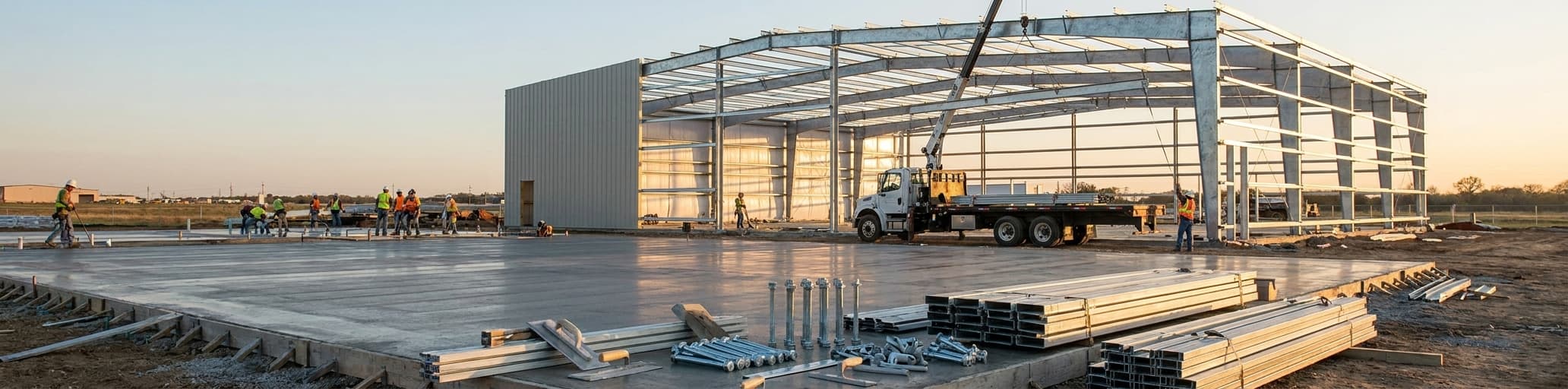

A 30×40 metal building with concrete slab typically costs $29,000 to $50,000 fully installed, with our site-specific engineering and turnkey approach eliminating costly coordination gaps between separate vendors. We handle design, fabrication, delivery, and erection under one contract, so you get transparent pricing, a single warranty, and a weather-tight structure in weeks instead of months.
Base Cost Breakdown for a 30×40 Metal Building with Concrete Slab from NSB
A 30×40 metal building shell costs $15,000-$26,000 and includes engineer-stamped drawings calculated for your site's specific wind and snow loads.
Itemized price of the 30×40 pre‑engineered steel shell (engineering, customization, and NSB's standard finish)
The pre-engineered steel shell for a 30×40 footprint–1,200 sq ft of clear-span space–costs between $15,000 and $26,000 for the kit, depending on specifications and current steel market pricing. [1] [2] [3] That price covers four specific components: the primary frame (tapered I-beam columns and rafters), secondary framing (purlins and girts that carry wall and roof loads), steel roof and wall panels, and all fasteners and trim. [1] Nothing beyond those structural elements is assumed–doors, windows, insulation, and utilities are line items you price separately.
For a clear view of what a standard kit does and doesn't include, see what a 30×40 metal package doesn't include before you compare quotes.
How engineering and customization shift the number
Every NSB shell ships with engineer-stamped drawings calculated for your site's actual wind and snow loads–not generic specs–which is what your building department needs for permit approval. [3] That engineering is baked into the kit price for standard configurations.
When you move outside standard parameters–custom roof pitches above 4:12, specialized door openings wider than 14 feet, or non-standard eave heights above 16 feet–expect structural recalculations that add roughly 15-20% to the base shell cost. [1] Steel gauge selection also moves the number: dropping from 14-gauge to 12-gauge framing raises material cost but pays back in load capacity and longevity, especially for workshops running heavy equipment or buildings in high-wind coastal zones. [2]
NSB's standard finish and what it protects
NSB's standard shell finish is a Siliconized Modified Polyester (SMP) coating applied over a Galvalume steel substrate.
The coating resists UV fading, chalking, and surface corrosion under normal conditions, and it carries a 40-year warranty against peeling and cracking when properly maintained. [2] For projects near salt-air coastlines or in high-humidity agricultural environments, upgrading to a PVDF (Kynar) finish adds a modest premium but extends corrosion resistance significantly–worth factoring into your budget if your site faces those conditions. [2] Color selection is included at no extra cost across NSB's standard palette; south-facing walls fade faster regardless of finish, so avoid high-gloss dark colors on that exposure to keep the building looking right without additional maintenance cycles. [2]
Concrete slab cost details: material mix, reinforcement, labor, and site‑prep specific to a 30×40 footprint
Total turnkey price including NSB's ProTrades erection service and post‑construction inspection Erection labor is the final major line item before your 30×40 metal building with slab cost is complete. Professional erection runs $5-$10 per square foot–$6,000-$12,000 for a 1,200 sq ft footprint–and that range moves based on site accessibility, local labor rates, and the complexity of your door and window configuration. [4] NSB's in-house ProTrades erection crew handles this phase as part of a single-source contract, getting the structure up in days rather than the weeks that come with coordinating independent subcontractors. [2] A standard 1,200 sq ft steel building takes a professional crew 3-5 days to erect once the slab has cured–meaning your building goes from a flat pad to a closed, weather-tight shell inside a single work week. [3] Stack all three primary costs–shell kit ($15,000-$26,000), installed slab ($8,000-$12,000), and ProTrades erection ($6,000-$12,000)–and your realistic turnkey range for a complete, erected 30×40 lands between $29,000 and $50,000 before optional finishes like insulation ($2,000-$4,000) or electrical rough-in ($2,000-$5,000). [4] [2]
Post-construction inspection is built into the NSB process rather than treated as an afterthought. Every building ships with engineer-stamped drawings calculated for your site's actual wind and snow loads, which is exactly what your local building department requires to issue a certificate of occupancy. [2] That documentation covers wind exposure, roof geometry, snow drift patterns, and risk category–site-specific calculations, not generic load ratings that invite permit rejections. [2] Having certified drawings in hand from day one means your inspection doesn't stall the project; the paperwork is already aligned with what the inspector will check. For a detailed view of how each cost line fits together and where single-source turnkey contracting saves money versus managing separate vendors, that breakdown is worth reviewing before you finalize your quote.
Key Drivers That Can Raise or Lower Your Final Quote
Poor soil quality and limited site access can each independently push foundation costs from $8,000-$12,000 to $27,000 or more, so get a soil test and confirm road access before finalizing specs.
Design selections that impact cost – roof pitch, door size/type, insulation, and interior fit‑outs
Site‑specific variables – soil bearing capacity, access road length, local permitting fees, and climate zone requirements Soil bearing capacity is the site variable that surprises budgets most often, because it's invisible until a contractor probes the ground. Poor soil quality–clay, fill dirt, or saturated subsoil–can require additional compaction, soil replacement, or deeper footings to meet the load requirements of a 1,200 sq ft steel structure. In northern climates, frost lines compound this problem: specialized footings engineered for deep freeze-thaw cycles can push foundation costs for a 30×40 to $27,000, well above the $8,000-$12,000 range that flat, well-drained sites typically land in. [6] Rocky terrain adds a different cost: excavation requires specialized equipment that runs by the hour, not the square foot. Budget a 15-25% contingency on your foundation line if site conditions are uncertain, and get a soil test before you finalize your slab specs–it costs far less than redesigning a foundation after the pour. [6]
Access road length and site accessibility hit your budget in two places at once: delivery and installation. A tight or unpaved access route means your building components arrive on smaller vehicles making more trips, and your erection crew needs compact equipment that works slower than full-size machinery. For remote locations, transportation costs alone increase substantially when specialty delivery equipment is required. [6] The fix is straightforward–confirm before you order that your site has a clear, load-rated access road wide enough for a flatbed, and that the foundation area has enough surrounding clearance for a forklift or crane to operate safely. Skipping that check upfront is one of the more common reasons a project runs over budget on labor without any change to the actual building specs. [6]
Permit fees vary more by jurisdiction than most buyers expect, and treating them as a single line item is where budgets go sideways. For a 30×40 metal building, base permit costs typically run $1,200-$2,000, but that's before separate permits for electrical ($50-$500), plumbing ($50-$500), and HVAC ($250-$400) if those systems are included. [6] Some jurisdictions calculate fees as a percentage of total project valuation–0.5% to 2%–which means every upgrade you add to the building also adds to the permit cost. [6] Metropolitan areas consistently charge more than rural ones, and coastal or seismic zones require additional engineering documentation that triggers separate plan review fees before the permit office even processes your application. [7] Climate zone is the variable that touches every cost line simultaneously: snow-heavy regions require reinforced frames and steeper roof pitches that add roughly 10-15% to your shell cost, coastal sites need corrosion-resistant coatings beyond the standard SMP finish, and seismic zones mandate specialized connection details between the foundation and the steel frame–requirements that aren't optional, they're what gets you permitted and what keeps your building standing. [3] For a full picture of how local permitting fees and site conditions interact with your overall 30×40 metal building budget, that breakdown is worth reviewing before you finalize your quote.
Optional NSB upgrades – thermal coating, mezzanine platforms, integrated lighting, and fire‑rating packages
Four optional upgrades consistently deliver the strongest return on a 30×40 build when locked in during original construction: thermal coating, mezzanine platforms, integrated lighting, and fire-rating packages. Retrofitting any of them after the fact costs significantly more–either because finished panels must be disturbed, structural recalculations must be reopened, or the electrical rough-in has already been closed up.
Thermal coating is the exterior upgrade that works hardest in warm climates. Cool metal roofing with high solar reflectance reduces cooling costs by 20% or more by reflecting radiant heat before it enters the building envelope. [8] That benefit compounds over decades, and unlike insulation, thermal coating requires no interior access to apply–but applying it after initial panel installation adds a mobilization cost that makes upfront specification the obvious choice.
Mezzanine platforms depend entirely on the eave height decision you make at the design stage. Taller structures–14 feet and above–open genuine opportunity for mezzanine storage or secondary work levels that double your usable square footage without expanding the footprint or the slab. [8] Specifying the mezzanine during the original build means the primary frame is engineered for those additional loads from day one; adding one post-construction requires a full structural reanalysis and new stamped drawings.
Integrated LED lighting is the operational upgrade with the fastest payback. LED systems use 75% less energy than traditional lighting and last 25 times longer, with most installations recovering their cost within 18 to 24 months through reduced electricity and replacement expenses. [8] Wiring the lighting package into the building during electrical rough-in costs a fraction of what a post-construction retrofit runs once finished walls and ceilings are in place.
Fire-rating packages address both code compliance and long-term insurance cost. Steel's non-combustible nature already positions it favorably with insurers–most carriers offer 20 to 30% lower premiums for steel structures compared to wood-framed equivalents because fire is one of the primary drivers of insurance claims. [8] A formal fire-rating package adds tested assemblies and documentation that satisfies the most demanding occupancy classifications, including commercial, agricultural, and light industrial uses, and it's the documentation your insurer and building department need to confirm those savings. For projects where mezzanine space and fire compliance intersect, getting both designed into the same engineering package eliminates the separate plan review that standalone upgrades require.
NSB Exclusive Cost Calculator & Printable Project Checklist
Download the interactive calculator to generate a vendor-ready estimate by entering your building specs, footprint, location, and slab details.
How to use the NSB Interactive Cost Calculator worksheet (required inputs and where to download)
The NSB Interactive Cost Calculator worksheet turns the pricing variables covered in this guide into a single, editable number you can take into a lender, a permit office, or a contractor meeting. To generate a useful estimate rather than a ballpark, you need six inputs ready before you open it: your building's footprint (30×40 for this guide), intended use (storage, workshop, commercial, agricultural, or industrial), desired eave height, door and window count with rough dimensions, insulation preference, and your zip code for climate zone and freight distance.
That last input matters more than most buyers expect–freight alone represents 3 to 7 percent of total project cost, and delivery distance directly affects that line. [10] The calculator also prompts for slab specification (4-inch versus 6-inch, wire mesh versus rebar), because the installed slab is a major variable in your 30×40 metal building with slab cost and shouldn't default to a generic number. [9] Once you've entered those inputs, the worksheet produces a line-by-line estimate covering the steel kit, slab, erection, and optional upgrades–the same cost structure a contractor uses to build a real quote, so you can compare vendor proposals against a number you actually understand. Download the worksheet directly from the NSB cost calculator page, where you'll also find the printable checklist covered in the next section.
Printable pre‑project checklist that captures hidden expenses and keeps the project on budget
Sample itemized quote for a typical 30×40 NSB building with slab, showing each cost line and savings from single‑source sourcing The sample itemized quote below covers a standard 30×40 NSB workshop build–a 12-foot eave height, two 10-foot roll-up doors, one walk door, rebar-reinforced 4-inch slab, and standard SMP finish–showing exactly where every dollar goes before you talk to a vendor:
Sample itemized quote — 30×40 NSB workshop build
| Line item | Cost range |
|---|---|
| Pre-engineered steel shell kit (primary frame, secondary framing, panels, trim, hardware) | $15,000-$26,000 |
| Engineer-stamped drawings (site-specific wind/snow loads, permit-ready) | Included |
| Two 10-ft x 10-ft insulated roll-up doors | $2,000-$4,000 |
| One 3-ft x 7-ft walk door | $400-$700 |
| Site prep (excavation, grading, compaction, forming — 1,200 sq ft) | $1,200-$3,000 |
| Concrete material — 15 cu yd at $125-$150/cu yd | $1,875-$2,250 |
| Rebar reinforcement | $1,800-$3,000 |
| Vapor barrier | $600-$1,200 |
| Slab labor (forming, pouring, finishing) | $4,800-$9,600 |
| Concrete sealer | $1,200-$3,600 |
| ProTrades erection labor — 1,200 sq ft at $5-$10/sq ft | $6,000-$12,000 |
| **Total before optional upgrades** | **$34,875-$65,350** |
| Fiberglass insulation (roof and walls) | $1,200-$3,300 |
| Electrical rough-in | $2,000-$5,000 |
| **Fully optioned turnkey total** | **$38,075-$73,650** |
Most buyers with standard soil conditions, a straightforward site, and mid-range specifications land between $38,000 and $52,000 fully installed. [1] The single-source advantage shows up in two places on that quote. First, NSB's volume purchasing power compresses the steel kit cost compared to what a local GC pays when sourcing from a regional distributor with its own markup layered on top. [1] Second, coordinating your own slab contractor, steel erection crew, and delivery logistics separately introduces scheduling gaps that cost real money–rain delays, crews waiting on cured concrete, and separate mobilization fees from each trade. Buyers who manage that themselves often pay 10-15% more in total project cost than the quote suggested, purely from coordination friction. [1] A single contract that covers design, fabrication, delivery, slab, and erection eliminates those gaps entirely–one schedule, one point of accountability, and a warranty that doesn't get passed between vendors the moment something needs fixing. For a deeper look at how single-source turnkey contracting compares to managing separate vendors on a 30×40 build, that breakdown is worth reading before you finalize your approach.
Why Choose National Steel Buildings for Your 30×40 Project
One contract eliminates scheduling delays between trades, duplicate fees, and vendor disputes–covering everything from foundation to erection under a single warranty.
Single‑source, turnkey advantage: design, engineering, fabrication, delivery, and erection all under NSB's umbrella
Managing multiple vendors on a 30×40 metal building with slab cost means managing multiple contracts, multiple schedules, and multiple points where something can go wrong between trades.
When a slab contractor and a steel erection crew operate under separate agreements, delays compound: a pour that runs long pushes your erection window, your erection crew reschedules, and a rain week in between costs you labor days nobody reimbursed. [13] A single-source contract eliminates that friction entirely–design, engineering, fabrication, delivery, and erection move under one schedule, one set of drawings, and one party accountable if anything needs to be fixed. [14] The cost savings from bundled services are real: no duplicate mobilization fees, no markup layered through a general contractor sourcing your steel from a regional distributor, and no change-order disputes about whose scope a problem belongs to. [14] What you get instead is a line-by-line quote that covers every phase from dirt to door–and a warranty that doesn't get passed between vendors the moment something needs attention.
For a direct look at how that single-contract structure plays out across the full build sequence, the 30×40 turnkey promise breakdown is worth reading before you finalize your approach.
Long‑term value: durability, low maintenance, insurance discounts, and resale benefits of NSB steel structures
The price you pay on day one is only part of the financial story. Steel structures consistently outperform wood and concrete on total cost of ownership because the gap compounds every year — through lower maintenance bills, reduced insurance premiums, and a building that holds its value instead of deteriorating toward it. A pre-engineered steel frame resists the problems that quietly drain traditional building budgets: no rot, no termite damage, no warping, no moisture infiltration that ruins stored inventory or forces structural repairs. [15] With proper care, a steel building lasts 50 years or more while wood structures can begin requiring major repairs in as little as ten years without consistent upkeep. [15] That durability advantage isn't theoretical — it's the reason the 10-year cost gap between a 30×40 steel building and a pole barn consistently favors steel once you account for what each material actually costs to own.
Maintenance cost is where the 20-year math becomes undeniable. Steel buildings typically run annual maintenance at roughly 1% of the initial construction cost — around $1,500 to $2,500 per year for a typical commercial structure. [15] Traditional wood construction demands 2-4% annually because of repainting, pest control, and material replacement, translating to $7,000-$20,000 per year on a comparable footprint — and that figure excludes surprise events like termite damage, which can add $30,000 in a single repair cycle. [15] Over 20 years, those maintenance differentials compound into a total cost gap that makes the steel building's initial investment look like the conservative choice, not the premium one.
Insurance premiums reflect what underwriters know about material risk. Steel is non-combustible, pest-resistant, and engineered to certified wind and snow load ratings — the exact characteristics that reduce claim frequency and severity. [15] The result is lower annual premiums compared to wood-framed structures, and that discount runs for the life of the policy, not just the first year. On the resale side, steel buildings maintain structural integrity longer than traditional materials, which makes them attractive to buyers across commercial, agricultural, and industrial uses. [16] Their adaptability — the ability to reconfigure interior layouts or add bays without compromising the original frame — further expands the buyer pool. Resale value for steel structures increases approximately 20-30% over a 20-year period on top of underlying property appreciation, while traditional buildings see that ROI compressed by higher maintenance costs and remodeling expenses that erode returns over the same timeline. [15]
Next steps: schedule a free NSB design consultation, get an instant customized quote, and lock in 2026 pricing
Steel prices in 2026 have stabilized compared to the volatility of 2021-2022, but that stability isn't permanent–tariff policy shifts and seasonal demand can push mill pricing higher with little notice. [17] Most quotes are held for 30-60 days, and prices rarely move backward once the construction season hits full swing in late spring. [18] That window is your practical deadline: a confirmed quote with a down payment locks your steel cost at today's rate, regardless of what the market does between order and delivery. [17] The free NSB design consultation is where that process starts–bring your zip code, your intended use, your preferred eave height, and a rough door count, and you'll leave with a line-by-line quote built for your site's actual wind and snow loads, not a generic per-square-foot estimate that falls apart the moment a contractor checks your county's code.
If financing is part of your plan before you lock in, reviewing your 30×40 building financing options before the consultation means you arrive knowing exactly what you can commit to–and that conversation moves faster when the numbers are already in hand.
- A 30×40 metal building shell kit costs $15,000-$26,000, with total turnkey costs including slab and erection ranging from $29,000-$50,000 before optional upgrades.
- Soil bearing capacity and frost lines are the most common hidden cost drivers, potentially raising foundation costs from $8,000-$12,000 to $27,000 in northern climates.
- Poor site access and long delivery distances increase both transportation and installation costs by requiring smaller vehicles and slower equipment mobilization.
- Permit fees vary significantly by jurisdiction, typically $1,200-$2,000 base cost, plus separate fees for electrical, plumbing, and HVAC that can add $350-$1,400.
- Steel buildings cost 1% annually to maintain versus 2-4% for wood structures, creating a 20-year cost advantage of $100,000+ despite higher initial investment.
- Specifying upgrades like thermal coatings, mezzanines, LED lighting, and fire-rating packages during original construction costs significantly less than retrofitting them later.
- Single-source turnkey contracts eliminate 10-15% in coordination costs compared to managing separate vendors for design, slab, and erection independently.
- https://nationalsteelbuildingscorp.com/blog/30×40-metal-building-with-slab-cost-the-complete-pricing-guide
- https://nationalsteelbuildingscorp.com/blog/2025-price-guide-30×40-metal-building-costs-explained
- https://www.steelcobuildings.com/how-much-does-a-30×40-steel-building-cost-in-2026/
- https://nationalsteelbuildingscorp.com/blog/30×40-metal-building-cost-a-complete-pricing-breakdown
- https://nationalsteelbuildingscorp.com/blog/breaking-down-30×40-metal-building-cost-line-by-line
- https://nationalsteelbuildingscorp.com/blog/how-much-does-a-30×40-metal-building-with-slab-cost
- https://www.engineeredmetalbuildings.com/blog/30×40-metal-building-prices/?srsltid=AfmBOophxfDzoleQSGytGyhF0wDAFw_Dxk4GvW7bOitl0rqxG6698pXN
- https://nationalsteelbuildingscorp.com/blog/the-ultimate-guide-to-30×40-metal-building-price-2025-cost-breakdown
- https://www.buildingsguide.com/metal-building-prices/?srsltid=AfmBOooPkm7cc76J6cdWNamON-cdNxEe49w20PXLJUM__yxNWQPTea2y
- https://www.starbuildings.com/blog/case-studies/2025-steel-building-cost-estimator-a-contractors-guide-to-pemb-pricing/
- https://www.worldwidesteelbuildings.com/blog/pre-construction-checklist-for-metal-buildings/
- https://projul.com/blog/free-construction-budget-templates/
- https://www.summitsteelbuildings.com/turnkey-construction-eliminates-hassles-of-building-kits
- https://www.buildingsguide.com/metal-building-prices/?srsltid=AfmBOopsCbgJV_C6j-AQc2MdULdT5SCbFtUYY2Au7Pfj4cs0mS5nvi8H
- https://www.summitsteelbuildings.com/20-year-cost-comparison
- https://www.hswilliams.com/blog/commercial-metal-buildings-cost-vs-value-analysis
- https://titansteelstructures.com/price-guides/the-2026-steel-building-price-guide-what-to-expect-this-year/
- https://www.aametalbuildings.com/metal-buildings/metal-building-prices?srsltid=AfmBOoqbfP2PY_M-KL-vSvFELnJvS4YqT2eZaNfMgjIHu-E-HMLhWrrG