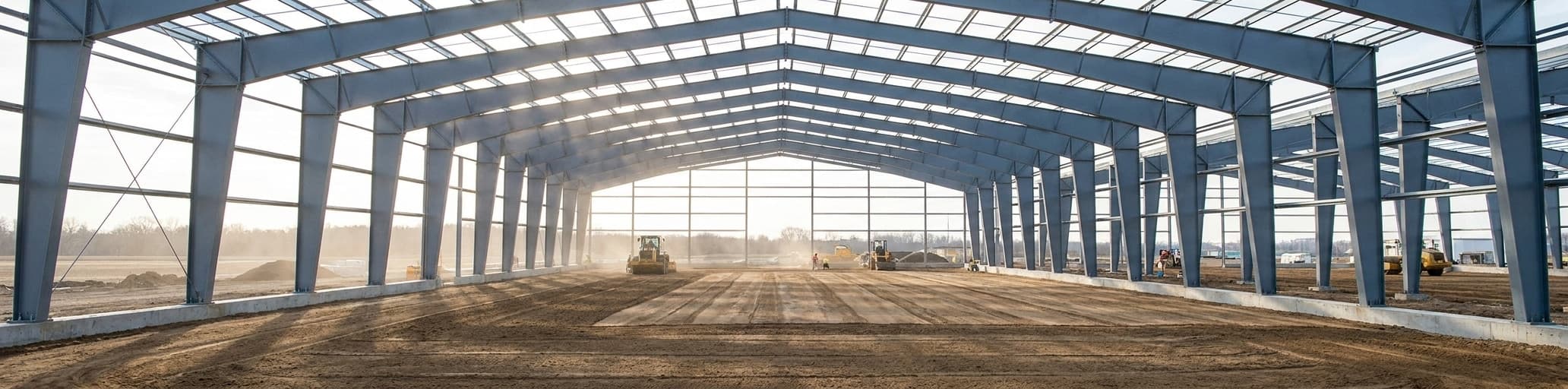

We help you understand that indoor riding arena costs range from $72,000 to $700,000, with steel frames delivering the best long-term value through durability and low maintenance. Locking in your material choice early and budgeting for hidden site costs prevents expensive surprises that commonly derail projects.
What Does an Indoor Riding Arena Cost in 2026?
Your material choice–fabric, steel, or wood–drives the entire budget, so locking it in early determines whether your arena costs $72,000 or $700,000.
Direct cost range: $40,000 to $400,000+ depending on size and materials
The indoor riding arena cost typically falls between $72,000 and $700,000 total, with most projects averaging around $325,000.[1] On a per-square-foot basis, costs range from $10 to $125 depending on material choice and customization level — and that wide spread is driven almost entirely by two variables: what you build with and how large you build.[2] Size multiplies every per-square-foot decision across thousands of square feet, which is why locking in your material tier early is the single most consequential budget decision you'll make.
The three primary structural materials each occupy a distinct price tier:
| Material | Cost per sq ft | Key trade-off |
|---|---|---|
| Fabric over steel frame | $10-$30 | Most affordable entry point; lower long-term durability than rigid structures |
| Steel frame | $20-$40 | Clear-span construction possible; weather-resistant; low maintenance |
| Wood frame | $30-$50 | Traditional aesthetic; higher upkeep; susceptible to horse chewing |
Prefabricated kits compress costs further, running $5 to $20 per square foot and representing the fastest path to a functional arena within a tight budget.[3] Fully custom builds, by contrast, can push past $50 per square foot and reach $125 or more when HVAC, premium footing, observation rooms, and specialty lighting are added.[2] For owners weighing the prefab route, the prefabricated steel riding arena kit cost breakdown details what a standard package includes and what typically remains as a separate line item.
Why steel structures deliver the best value for equestrian facilities
Steel is the dominant choice for modern indoor riding arena construction because it solves the core structural problem: horses and riders need wide, unobstructed interiors, and steel frames achieve clear spans without interior columns.[4] That column-free design is not just a comfort preference — interior posts are a safety hazard that forces layout compromises and limits usable square footage regardless of how large the footprint is.[4] Beyond the open span, steel frames are engineered to carry heavy snow and wind loads without degrading over time, which directly protects your investment against the repair cycles that plague wood structures.[4] Wood requires periodic treatment to maintain structural integrity, while steel needs only routine inspections, cutting annual maintenance costs significantly.[4] Timber-frame construction — often confused with steel in cost comparisons — is actually the most expensive structural option and is rarely used for riding arenas precisely because the cost-to-performance ratio is poor.[4] Pre-engineered steel arena kits further compress costs by delivering pre-cut, code-ready components that assemble faster than any site-built alternative, and experienced builders consistently note that steel packages secure better material pricing while delivering a finished result that holds long-term property value.[1] With proper care, a steel arena can exceed 50 years of service life, meaning the per-year cost of ownership drops steadily the longer the building stands.[4]
How National Steel Buildings' design-build approach reduces hidden costs
The kit-to-turnkey gap is where most arena budgets collapse.
A $40,000 steel kit for a 60×120 routinely becomes a $150,000-$250,000 finished project once foundation work, site grading, lighting, electrical service, footing material, and permits are added — a 2x to 3x multiplier that catches owners who budgeted against the manufacturer's quoted number.[5] The critical distinction is who manages the gap: an owner who hires a single design-build firm gets a bundled price with one point of accountability, while an owner who self-manages as the general contractor saves 15-25% on paper but absorbs every subcontractor dispute, scheduling conflict, and unforeseen site charge personally.[5] A design-build approach collapses that exposure by embedding the most common hidden line items — soil testing, permit fee research, footing freight calculations, concrete pump charges for sloped or restricted sites — into the project scope before a contract is signed.[5] The most expensive surprises on arena builds aren't structural failures; they're logistical oversights: a $200 soil test before signing can prevent $5,000-$15,000 in unexpected excavation costs, and a pre-project call to the county permit office routinely uncovers separate stormwater, electrical, and fire-marshal fees that never appear on any kit quote.[5] Knowing where every dollar is going and why — from first drawing to final bolt — is what separates a project that finishes within budget from one that stalls on raw dirt halfway through construction.[6]
Key Cost Drivers: Size, Structure Type, and Footing
Steel-frame arenas deliver 50-plus years of service with only routine inspections, while fabric structures require costly, unpredictable cladding replacements throughout their lifespan.
Steel frame vs. fabric structures: durability and long-term cost advantage The price gap between fabric-covered and steel-frame arenas closes faster than most buyers expect once maintenance cycles enter the picture. Fabric structures combine a steel subframe with polyethylene sheeting that admits natural light — up to 12% translucency — and muffles rain and hail noise, both real advantages that reduce horse-spooking incidents and cut artificial lighting costs.[9] The structural vulnerability is the cladding itself: fabric requires frequent replacement due to tears and weather damage, a recurring expense steel does not carry.[8] Steel roofing systems introduce their own failure point — thousands of fasteners and seam intersections, each a potential drip source that damages footing and surprises riders mid-session.[9] Galvanized steel-frame buildings sidestep both problems: protective coatings block rust from humidity exposure, frames resist warping under fluctuating temperatures, and no periodic painting, sealing, or re-treatment is needed to hold structural integrity.[8] A steel arena can deliver 50-plus years of service with only routine inspections, while fabric cladding replacement introduces cost spikes at irregular, difficult-to-budget intervals.[8] Fabric also cannot be insulated effectively, which limits year-round utility in cold climates where riding continues through winter.[7] Steel accepts insulation on both roof and walls, making it the only structural type that fully supports climate control without compromising core building performance.[7] For a closer look at how prefabricated steel riding arena kits translate those durability advantages into faster project timelines, the benefit breakdown covers what experienced builders consistently report from field data.
The table below summarizes where each structural type wins and where it creates long-term exposure:
| Factor | Steel frame | Fabric over steel |
|---|---|---|
| Lifespan | 50+ years with minimal intervention | Variable; cladding replacement required periodically |
| Insulation compatibility | Full roof and wall insulation possible | Difficult to insulate effectively |
| Clear-span width | Up to 200 ft or more | Up to 200 ft |
| Noise dampening | Amplifies rain and wind sounds | Fabric muffles exterior noise |
| Natural light | Requires windows or skylights | Up to 12% translucency through fabric |
| Maintenance cost | Low; no painting, sealing, or re-treatment | Moderate; fabric repairs and replacement add recurring cost |
| Leak risk | Fastener holes and seams require monitoring | Fabric provides a continuous waterproof barrier |
| Cold-climate suitability | High with insulation package | Limited without effective insulation |
For most owners prioritizing a 20-plus-year ownership horizon, the steel frame's low annual maintenance cost and insulation compatibility make it the cost-effective choice — fabric's natural-light and acoustic advantages are real, but neither offsets the long-term budget exposure from cladding replacement or the operational limit of an uninsulated structure in a cold-weather region.[7][8]
Footing materials and installation: from basic arena mix to premium cushioned surfaces
Arena footing is a multi-layer system, not a single product spread over bare ground. Penn State Extension is clear on this: a successful riding surface is only as good as the base and sub-base beneath it, because loose footing that slides over a poorly compacted foundation defeats every dollar spent on surface materials.[10] The standard stack runs three layers — a compacted crushed-stone base of at least 4-6 inches to handle drainage and prevent shifting, a cushion layer of sand or a sand mix above it, and a top layer amended with rubber, fiber, or geotextile material to tune traction and shock absorption for the intended discipline.[11] Getting the base wrong makes the footing above it irrelevant, which is why experienced builders price and specify all three layers before quoting an installed total.
Sand is the backbone of most arena surfaces and the most affordable raw material, but particle specification is the variable that separates serviceable footing from veterinary problems. Hard, angular, washed sand — specifically sub-angular mined material, not rounded river or beach sand — provides the particle interlocking that gives horses lateral stability without compacting into a hard surface over time.[10] Depth is equally consequential: loose sand deeper than 3 inches places chronic strain on tendons, and going past 4 inches under collected work or jumping is one of the most frequently cited causes of suspensory issues on brand-new arenas.[5] Sand dries rapidly in an enclosed steel structure, so indoor installations require regular watering to control dust; fine particles below 0.1 millimeters in diameter are the primary respiratory irritant for both horses and riders, and keeping fines below 5 percent of the mixture is the practical target.[10]
Premium additives change what a sand base does without replacing it. Shredded rubber mixed into sand reduces particle-on-particle abrasion, extends footing life, and adds measurable shock absorption — particularly valuable in jumping and reining arenas where hoof impact is high and consistent.[11] Synthetic geotextile fibers and manufactured wood fiber knit sand particles together across the full depth of the footing profile, reducing the surface shift that causes loose dry patches between watering events and lowering dust without introducing the organic breakdown that raw wood chips bring over a two-to-three-year cycle.[10][11] For commercial training barns and competition facilities, branded engineered blends — GGT, Pinnacle, Attwood — deliver guaranteed particle-size specifications independent of local quarry variability, which matters when horses work six to eight hours daily and footing consistency directly affects training outcomes.[5] The table below shows how installed cost and maintenance load shift across the main footing tiers:
| Footing type | Installed cost per sq ft | Best use case | Primary maintenance demand |
|---|---|---|---|
| Basic washed angular sand | $1.50-$2.50 | Private arena, light use | Frequent watering, weekly harrowing |
| Sand with synthetic fiber | $2.50-$4.50 | Private to training barn | Regular dragging, periodic sand top-up |
| Sand with rubber crumb | $4.00-$6.00 | Jumping, reining, high-impact work | Rubber reincorporation after rain events |
| Branded engineered blend | $6.00-$10.00+ | Competition, commercial daily use | Certified installation, automated watering system |
For a 100×200 competition-tier build, the footing line alone runs $30,000-$60,000 installed — a figure that surprises owners who budgeted only the kit price and assumed footing was a minor add-on.[5] Freight accounts for a meaningful share of that total: a truckload of washed silica sand runs $300-$800 in delivery above material cost, and a 60×120 arena typically requires roughly 20 truckloads, so the per-ton delivered price — not the per-ton material price — is the number to compare when evaluating suppliers.[5] Cheaper material from a more distant quarry nearly always costs more in total once freight is included, which makes sourcing a local, specification-grade material the first practical step in any footing budget.
Site Preparation, Foundations, and Labor Costs
Skipping proper site drainage costs thousands more in repairs than installing it upfront, especially on clay-heavy soils where water pooling causes footing failure.
Excavation, grading, and drainage: why proper site prep prevents expensive future repairs
Site preparation is the most consistently underestimated line item in any arena budget — and the one where cutting costs creates the most expensive downstream failures. Basic grading on a flat, already-level site runs $1,000-$2,000, but a site requiring clearing, contouring, and soil stabilization before structural work can begin reaches $5,000-$15,000 or more.[12] The variable driving that gap is rarely visible on a surface walkthrough: clay-heavy soils don't drain through natural percolation, so water shed from the arena surface has nowhere to go and eventually works back under the base layer, causing footing migration, uneven settlement, and compaction failure that costs far more to correct than the drainage system would have cost to install.[13]
The riding surface itself must be engineered to a precise grade — a 1% to 2% slope or a crowned center — so runoff sheds to the perimeter rather than pooling in the riding zone.[13] Hitting that tolerance requires precision excavation, not rough grading; a contractor without equestrian drainage experience will produce a surface that looks level but drains poorly. Subsurface drainage — perforated pipe buried beneath the base layer — adds $2,000-$10,000 to the project, but on clay-heavy sites it's not optional.[13] Without it, the arena becomes unusable after significant rain regardless of footing quality. For indoor builds, traditional drainage system installation runs $5,000-$15,000+ depending on layout complexity and the site's natural water flow patterns.[12] For a more detailed look at how site conditions translate into total build budgets, the cost to build a steel horse arena breakdown covers how terrain type shifts line items across the full project scope.
A complete site evaluation before any contracts are signed should cover existing terrain, soil conditions, natural water flow, equipment access routes, and how the arena footprint interacts with drainage patterns on the rest of the property.[14] That assessment is where the most expensive surprises get caught at the lowest cost — a soil test or topographic review that reveals a clay layer or a subsurface water table changes the entire drainage specification before a single cubic yard of earth moves.[13]
Foundation and structural support systems for indoor arenas
Labor and erection: single-source advantage vs. coordinating multiple contractors The erection phase is where single-source project delivery separates most visibly from multi-contractor coordination.
Pre-engineered steel arena components arrive factory-punched so every connection bolts together without in-field modification or fabrication, and in some cases a facility reaches operational status in half the time required by conventional site-built methods.[19] That speed advantage is structural, not incidental — when the same firm that engineered the kit also manages the erection crew, component tolerances and assembly sequence are already aligned before the first truck arrives.
The failure mode of the multi-contractor model is well-documented: a design-build approach that overlaps design and construction phases prevents the blame game between architects and contractors, eliminating months of overhead cost that accumulates when a general contractor coordinates separate design, fabrication, and erection firms against independent schedules.[17] Owners who self-coordinate those relationships absorb every scheduling conflict, subcontractor dispute, and unforeseen site charge personally — a 15-25% apparent savings on paper that frequently disappears into change orders and extended timelines.[18] Builders who consistently report successful projects share one common practice: engaging a design-build team early enough that the team's experience gets embedded into scope, schedule, and budget before any subcontract is signed.[19] For equestrian builds specifically, where foundation anchor-bolt placement, clear-span frame delivery, and footing installation all follow a tight dependent sequence, a single-source firm managing that chain eliminates the coordination gaps where the most expensive surprises accumulate.
Building Your Budget: Cost Breakdown and Next Steps
Your arena budget scales predictably from $150,000 for a private facility to $1.2 million for competition venues, with regional costs and climate needs shifting final numbers meaningfully.
Indoor riding arena cost per square foot: realistic 2026 benchmarks
Per-square-foot figures only become useful once they're anchored to a specific owner type and use case. A private owner riding three to five days a week in a 60×120 to 70×140 steel arena will realistically spend $150,000-$220,000 turnkey in most U.S. regions — roughly $21-$31 per square foot all-in.[5] A lesson or training barn running horses six or more hours daily needs an 80×200 minimum, pushing the realistic 2026 budget to $350,000-$500,000 turnkey, or approximately $22-$31 per square foot at that larger scale.[5] Competition and commercial facilities at 100×200 or larger land at $500,000-$1,200,000, with engineered footing, full HVAC, and viewing galleries accounting for most of the upper range.[5] Across all three tiers, the per-square-foot number compresses as footprint grows because fixed costs — engineering fees, permit applications, mobilization charges, and foundation crew minimums — stay roughly constant while the denominator gets larger.[1][5]
| Owner type | Typical footprint | Realistic 2026 turnkey range | Approx. cost per sq ft |
|---|---|---|---|
| Private owner, 1-2 horses | 60×120 to 70×140 | $150,000-$220,000 | $21-$31 |
| Lesson or training barn | 80×200 minimum | $350,000-$500,000 | $22-$31 |
| Competition or commercial facility | 100×200 or larger | $500,000-$1,200,000 | $25-$60+ |
Regional labor and material costs shift those figures meaningfully. The same 80×200 steel shell that turns over at $300,000-$350,000 in Texas or Oklahoma can reach $400,000-$450,000 in the Pacific Northwest or Northeast, driven by higher labor rates, more stringent permit paths, and snow-load engineering requirements that add steel tonnage to the frame.[5] Climate also determines which line items owners can responsibly skip: mild southern regions often forgo insulation and HVAC, trimming $15,000-$40,000 from the budget, while northern builds treat both as non-negotiable to protect footing from frost and riders from condensation dripping off an uninsulated roof.[1][5] For owners planning a larger covered footprint, the 150×250 covered arena cost breakdown shows how line items shift at commercial scale, where engineering and footing alone represent a substantial share of the total.
The figure most budgets ignore is the 15-year ownership cost. Annual running costs for a private 60×120 to 80×200 indoor arena land between $5,000 and $20,000 depending on footing type, lighting configuration, and climate — meaning a 15-year window adds $75,000-$300,000 to the original build cost.[5] Premium footing carries a higher upfront price but holds up through more maintenance cycles before replacement is needed; budget sand requires more frequent harrowing and top-up loads that compound into a larger total over time.[5] The arena that appears cheapest at contract signing frequently costs more over the first decade than a mid-range build with better drainage and durable footing, which makes calculating the 15-year number a more reliable budget anchor than the per-square-foot kit quote alone.[1][5]
Optional features and amenities that add value without breaking the budget
The most cost-effective approach to arena amenities is sequencing them by operational necessity rather than bundling everything into the initial contract. Lighting sits at the top of that sequence because a dark arena is an unusable arena — LED fixtures deliver even, glare-free coverage that reduces horse-spooking incidents, carry the lowest lifetime energy cost of any lighting option, and are far easier to install during initial construction than as a retrofit.[1] Side lights — windows placed along the long walls — cost less than skylights and admit comparable daytime illumination, making them the practical first choice for owners who want to reduce artificial lighting hours without the structural complexity of roof penetrations.[1] Doors sized at a minimum of 12 feet high and 16 feet wide allow mounted riders to pass through safely and must be specified at the design stage, not added later; barn door installation runs $600 to $3,000 depending on hardware and configuration.[1] From there, the features that generate the clearest return on investment split cleanly into two groups: those that protect the building envelope and those that increase commercial utility. Vapor barriers prevent moisture infiltration that degrades footing and steel fasteners, gutters direct roof runoff away from the foundation, and kickboards shield the lower wall panels from hoof impact — all three are inexpensive during construction and expensive to retrofit.[1][6] Ventilation, whether through strategically placed ridge vents and sidewall openings or a mechanical system, is non-negotiable for horse health: inadequate air exchange drives ammonia and particulate levels that create respiratory problems for horses and riders alike, and the more enclosed the structure, the more critical the ventilation specification.[7] A tack room carved out of one end bay adds roughly $5,000-$15,000 depending on size and finish level and transforms a standalone arena into a self-contained training facility — the kind of upgrade that directly supports boarding and lesson revenue without requiring additional site footprint.[6] Viewing areas and attached stables sit at the top of the cost ladder and are best treated as phase-two additions; designing the initial structure to accommodate them — stub-out conduit for future electrical, a designated wall section for a future door connection to stabling — costs almost nothing at construction time and avoids the expensive structural modifications that come with unplanned additions.[1][6] For owners weighing which design configurations deliver the most usable space per dollar, the design options for prefabricated steel riding arena kits breakdown covers how bay layout, door placement, and add-on sequencing interact with overall project cost.
The table below ranks common amenities by installation timing and relative value contribution:
| Feature | Best installed | Primary value driver |
|---|---|---|
| LED lighting | At initial build | Safety, year-round usability |
| Side lights / windows | At initial build | Reduced operating cost, horse comfort |
| Doors (12 ft H x 16 ft W min.) | At initial build | Safety, operational access |
| Vapor barriers | At initial build | Structural protection, footing longevity |
| Gutters and perimeter drainage | At initial build | Foundation protection |
| Kickboards | At initial build | Wall protection, horse safety |
| Ventilation system | At initial build | Horse and rider health |
| Tack room | At initial build or phase two | Revenue-enabling, facility completeness |
| Viewing area | Phase two | Commercial appeal, spectator safety |
| Attached stables | Phase two | Direct arena access, boarding capacity |
How to get an accurate quote and avoid surprises during construction
The most reliable signal that a quote is complete is specificity on every line item — not just the steel kit. Some builders lead with a low number hoping to win the contract, then layer on forklift charges, crane fees, engineering stamps, and permit application costs once the project is underway.[20] A quote worth signing specifies concrete mix strength, anchor bolt size and spacing, footing material volume and freight, permit fee estimates by county, and the code reference with site-specific load inputs.[20] If a proposal says only "we'll handle the foundation" without naming the mix specification, that gap will cost you money after the contract is signed. Steel building prices also shift frequently with steel market fluctuations, engineering requirements, and regional labor rates, which means locking in a fixed contract price — rather than accepting an open-ended materials-escalation clause — is a meaningful financial protection.[21] Before you sign anything, verify the contractor's previous equestrian builds directly: call references, ask specifically whether the final invoice matched the original quote, and confirm the builder provides engineer-stamped drawings regardless of whether your county requires them for agricultural structures.[20] A contractor who balks at providing stamped plans for a structure where horses and riders will work daily is not one to hire.
Permit verification belongs on your pre-contract checklist, not your post-contract task list. Consulting your local Building Officer before finalizing scope routinely surfaces stormwater fees, separate electrical permits, and fire-marshal requirements that appear nowhere in a kit quote.[7] The timeline reality is equally important to set correctly: an indoor arena project from initial planning through operational footing realistically takes a year or more, and compressing that schedule by skipping soil testing or accelerating foundation cure time creates exactly the surprises the timeline was meant to prevent.[20] For guidance on vetting a contractor's scope commitments and specifications before the ink dries, the full-service agricultural building contractor checklist covers the specific questions and documentation to require before any deposit changes hands. Two line items that consistently disappear from early budgets deserve explicit attention: the building's insurance replacement value should be updated immediately after construction is complete, and appropriate liability coverage for the facility's intended use — lessons, boarding, clinics — is a separate policy consideration from the structure itself.[20] Budget both before the project starts, not after the certificate of occupancy arrives.
- Indoor riding arena costs range from $72,000 to $700,000, averaging $325,000, with per-square-foot costs of $10-$125 driven by material choice and size.
- Steel frame construction is the dominant choice because it enables clear-span designs without interior columns, lasts 50+ years with minimal maintenance, and supports insulation for climate control.
- Arena footing is a three-layer system requiring proper base compaction and drainage; getting the foundation wrong makes expensive surface materials irrelevant and causes structural failure.
- Single-source design-build firms eliminate 15-25% in hidden costs and scheduling delays compared to self-coordinated multi-contractor projects by embedding scope details before construction begins.
- https://www.homeadvisor.com/cost/additions-and-remodels/indoor-riding-arena/
- https://www.angi.com/articles/indoor-riding-arena-cost.htm
- https://homeguide.com/costs/indoor-riding-arena-cost
- https://www.crockattcontracting.com/the-best-building-options-for-horse-riding-arenas-steel-or-wood-framing/
- https://www.uspatriotsteel.com/blog/how-much-does-it-cost-to-build-an-indoor-riding-arena/
- https://reichconstructionllc.com/cost-of-pre-engineered-steel-indoor-horse-riding-arena/
- https://www.alliedbuildings.com/indoor-horse-riding-arena-cost/
- https://www.technology.org/2025/07/17/why-steel-riding-arenas-are-the-top-choice-for-equestrian-facilities/
- https://blog.legacybuildingsolutions.com/better-riding-arena
- https://extension.psu.edu/riding-arena-footing-material-selection-and-management/
- https://www.spartonenterprises.com/blog/the-best-footing-for-horse-arenas
- https://foleyconstruction.net/indoor-riding-arena-cost/
- https://jdisite.com/how-much-does-a-riding-arena-cost/
- https://bedrocksiteworks.com/our-services/equestrian-arena-construction/
- https://www.uspatriotsteel.com/blog/horse-arena-construction/
- https://mbmisteelbuildings.com/blog/steel-building-foundation/
- https://www.hkcconstruction.com/blogs/indoor-sports-facility-construction-costs
- https://buildway.com/commercial-metal-buildings-cost-design-2026/
- https://www.butlermfg.com/insights/is-a-pre-engineered-metal-building-or-conventional-steel-building-right-for-you
- https://www.horizonstructures.com/top-ten-tips-building-indoor-arena/
- https://roimetalbuildings.com/cost-of-constructing-a-private-metal-equestrian-building/