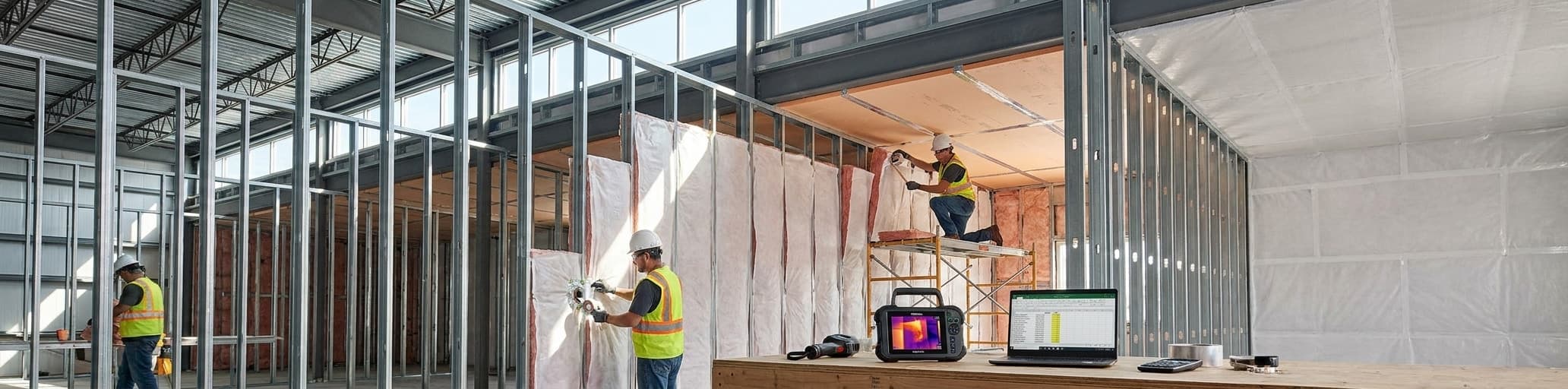

We help you understand steel building insulation fundamentals, from R-values and vapor barriers to energy code requirements across climate zones. Properly specified insulation typically pays back in two to four years while protecting your structure from costly moisture damage and reducing HVAC strain.
Understanding Steel Building Insulation Basics
Proper steel building insulation maintains consistent interior temperatures, reduces energy costs, prevents condensation damage, and improves usability without overtaxing your HVAC systems.
What is steel building insulation and why it matters
Steel is one of the most efficient heat conductors in common building materials, which means outdoor temperature swings transfer directly into your building without a thermal break.[3] Steel building insulation slows that heat exchange between inside and outside — keeping your warehouse cool in July and your hangar warm in January without overtaxing HVAC systems.[2] Most commercial steel buildings in the U.S. are conditioned spaces required to meet minimum insulation standards under governing energy codes.[1] Not every steel structure needs the same treatment.
Simple storage sheds and open barns often go without insulation entirely, while "semi-heated" spaces — agricultural buildings needing only freeze protection, for example — fall somewhere between fully conditioned and unconditioned use.[1] For working facilities like warehouses, hangars, retail spaces, and agricultural steel buildings, proper steel building insulation delivers four concrete benefits: consistent interior temperatures, lower energy bills, condensation prevention that protects structural steel components, and sound absorption that makes a metal interior genuinely usable.[1] The insulation system itself typically combines a vapor retarder facing the interior with one or more layers of fiberglass, rigid foam board, or insulated metal panels — chosen based on your energy code requirements, budget, and building end use.[1]
Key components: R-values, vapor barriers, and air sealing
R-value measures a single insulation material's resistance to heat flow — the higher the number, the harder it is for heat to pass through.[1] For steel buildings, R-values typically range from R-8 to R-30, but the number that actually governs your project comes from your local energy code, not a rule of thumb.[1] R-value describes the product in isolation; U-factor — its mathematical reciprocal — describes how the entire roof or wall assembly performs as a unified system.[1] Energy codes set legal minimums using U-factors, so hitting a target R-value on your insulation product alone doesn't guarantee code compliance if the assembly has thermal bridges at the framing.[1] Vapor retarders work alongside insulation but address a separate problem: they slow water vapor migration through the building envelope before it can condense on cold steel.[5] Performance is rated in perms — the lower the perm rating, the less moisture penetrates — with commercial products ranging from 0.02 to 0.9 perms.[1] In winter, a correctly placed vapor retarder keeps warm interior air from reaching cold framing members; in hot and humid climates, it blocks outside moisture from working inward.[5] Most manufacturers laminate the retarder directly onto fiberglass insulation — available in vinyl, polypropylene, polyethylene, foil, or metalized polyester facings — so you install thermal resistance and moisture control in a single pass.[4] Air barriers round out the system by stopping uncontrolled air leakage through the building envelope — the gaps that quietly undercut R-value and inflate heating and cooling costs regardless of insulation quality.[1] They became a mandatory requirement under the IECC 2015/ASHRAE 90.1-2013 code cycle, meaning every metal building project in adopting states must include one.[1] The barrier can sit on the interior side, exterior side, or within the assembly itself, but it must be continuous across all joints and identified on project drawings to satisfy code.[1]
How steel framing affects thermal performance
Steel's high thermal conductance is the single biggest variable separating a steel building's nominal R-value from its real-world performance. Because steel studs conduct heat far more efficiently than wood, they act as thermal bridges — continuous pathways that pull heat through the framing and bypass cavity insulation almost entirely.[7] ASHRAE 90.1-2016 quantifies the damage precisely: R-11 cavity insulation installed between steel studs at 16" OC delivers an effective R-value of just 5.5 — a 50% reduction from the labeled rating.[8] The penalty compounds as you specify thicker insulation.
Upgrading from R-13 to R-19 requires deeper, costlier 6-inch framing but only gains R-1.1 in real assembly performance, and R-25 insulation in 8-inch framing yields just R-7.8 — a 68.8% loss from its nominal value.[8] For your warehouse, hangar, or retail space, that gap means your building can fail an energy code inspection even when the insulation product itself meets the required rating, because energy codes for steel-framed buildings set separate and stricter requirements than those for wood construction precisely because of this dynamic.[7] Continuous insulation applied to the exterior face of the framing resolves what cavity insulation alone cannot. By wrapping the entire wall plane — studs included — it eliminates the direct conduction path through the framing rather than just filling the space between it.[8] Research on lightweight steel frame systems confirms that adding external insulation or high thermal resistance cladding can reduce spatial variation in surface temperature by up to 75%, which is the measurable signature of a well-controlled thermal bridge.[6] Even adding 50mm of mineral wool within the cavity of a steel wall assembly can cut the wall's overall thermal transmittance by up to 58%.[6] The practical takeaway for your project: specify continuous insulation on the exterior of the steel frame — not only in the cavity — and your installed building will perform at the R-value your energy model predicted rather than at half of it.
Selecting the Right R-Value for Your Project
Verify your state's adopted code cycle and climate zone before selecting insulation, since R-value minimums vary significantly between IECC, ASHRAE 90.1, and state-specific standards.
Climate-specific R-value guidelines for steel structures
The IECC divides the U.S. into 8 climate zones and assigns separate minimum insulation requirements to each, so the R-value your steel warehouse needs in Phoenix is nothing like what a hangar in Minneapolis must hit.[9] For steel building roofs built using a Liner System (LS) configuration, IECC Table C402.1.3 requires unfaced insulation ranging from R-19 to R-30 depending on your climate zone, plus a separate minimum R-11 LS layer installed within the liner system itself — and that second number applies across all 8 zones without exception.[9] Wall assemblies carry their own climate-zone-specific minimums, broken out further by construction method, which means a metal stud wall that clears code in Climate Zone 2 won't satisfy Zone 6 requirements using the same spec.[9] Before you select any product, the single most important step is confirming which code cycle your state has actually adopted — some states follow the IECC, others follow ASHRAE 90.1, and a handful enforce their own state-level energy code entirely, and the minimum R-values differ between them.[1] As updated code editions from recent cycles continue rolling into enforcement across U.S. jurisdictions, projects permitted under older adoptions may face stricter requirements than a dated reference chart suggests — another reason to verify your local status before finalizing specs, as discussed in our prefab warehouse planning guide.[1] Conditioned and semi-heated spaces also carry separate prescriptive U-factor requirements in the code tables: a freeze-protection-only agricultural building in Zone 5 legally requires less insulation than a fully conditioned retail space at the same address.[1] The most reliable path to compliance is pulling the applicable prescriptive U-factor table for your roof and wall assemblies in your climate zone, then working backward to determine the installed R-value your chosen insulation system must deliver — not selecting a product R-value from a catalog and assuming it satisfies the assembly requirement.[9]
Comparing insulation materials for steel buildings
Fiberglass blanket insulation is the default starting point for most steel buildings because it delivers the lowest installed cost per R-value, absorbs sound, and arrives with an integrated vapor retarder facing that doubles as a finished interior surface.[10] The limitation is structural: blankets compress where they cross purlins, creating thermal bridges that cut effective R-value — and a single-layer system no longer meets conditioned-space energy codes in most U.S. jurisdictions.[11] High-R fiberglass systems address both problems by adding a fabric liner below the purlins, running a first unfaced layer between them, and installing a second layer perpendicular across the top — reaching R-30 to R-38 in a roof assembly while thermal break tape on wall girts reduces bridging at every framing member.[11] For warehouses, farm buildings, and aviation hangars where budget discipline matters, this remains the most cost-effective path to code compliance.
When your application demands tighter thermal control — cold storage, food processing, or any facility where condensation would destroy inventory or equipment — three higher-performing options enter the picture.
Rigid foam board (polyisocyanurate or polyurethane) is the only continuous insulation solution for metal buildings: it covers the full framing plane rather than filling cavities between members, delivers a high R-value per inch, and its taped seams satisfy air barrier requirements simultaneously.[11] Closed-cell spray foam fills every gap and adds structural rigidity to wall panels, but it costs more than fiberglass, requires a professional applicator, and should never be applied directly to exposed-fastener panels because it can trap moisture against the steel and void panel warranties.[11] Insulated metal panels (IMPs) — two steel skins sandwiching a rigid foam core — eliminate field-assembled insulation entirely, delivering the cleanest interior finish and the highest thermal performance of any option, though they require heavy equipment to set and carry the highest installed cost on the market.[10] Foil bubble reflective insulation, rated only R-1.0 to R-1.3, reflects radiant heat rather than resisting conduction and functions only as a supplement in unconditioned structures — not a standalone solution for any conditioned steel building.[11]
Balancing cost, quality, and energy efficiency
The right insulation spec isn't the highest R-value you can afford — it's the one where the energy savings justify the upfront cost within your payback window.
A simple formula keeps the decision grounded: divide your total insulation upgrade cost by the annual energy savings it produces, and the result is your payback period in years.[12] For a conditioned warehouse, hangar, or prefab retail building, insulation delivers savings across three compounding returns: reduced HVAC operating load, lower maintenance costs from condensation-related damage, and higher resale value — all of which improve with time.[13] The material tradeoff is predictable: fiberglass multi-layer systems cost the least per installed R-value and clear code minimums in most climate zones, while rigid foam board and insulated metal panels carry higher upfront cost but eliminate the thermal bridging losses that silently undercut cheaper assemblies.[4] One factor owners routinely miss: a tighter, higher-performing building envelope lets you specify smaller mechanical equipment at the design stage, and that reduction in HVAC capital cost partially offsets the premium you pay for better insulation before a single energy bill arrives.[12]
Vapor Barriers and Moisture Management Solutions
Properly sealed vapor barriers reduce mold occurrence by more than half and can drop corrosion rates by 25 percent while keeping your insulation at its rated R-value.
Role of vapor barriers in steel building longevity
Condensation is steel's quietest threat — and the damage accumulates long before it's visible.
Uncontrolled moisture in metal structures can drive structural damage rates as high as 85%, while moisture saturation in fiberglass insulation fills fiber air pockets and reduces effective R-value by up to 30%, forcing your HVAC system to compensate for an assembly performing well below spec.[15] A vapor barrier stops this cycle at the source by keeping warm, moist interior air from reaching cold framing members where it would condense and corrode.[5] The protection is measurable: combining vapor barriers with insulation reduces mold occurrence rates by more than half, and one storage facility project recorded a 25% drop in corrosion rates after adding a properly installed barrier system.[15] Humidity in unventilated steel buildings can spike to 100% — a condition that accelerates oxidation in framing, degrades insulation performance, and damages stored inventory or equipment simultaneously.[15] For warehouses, hay storage buildings, and agricultural facilities where both the structure and its contents carry real dollar value, a vapor barrier isn't optional — it's what keeps your insulation at its rated R-value, your steel framing intact, and your long-term maintenance costs where you budgeted them.[14]
Best-practice installation techniques
Three installation rules determine whether your vapor barrier performs at spec or fails silently inside the wall cavity.
Overlap all seams by at least 6 inches and seal them with specialized vapor barrier tape, paying close attention to edges and penetrations — those are the gaps that actually let moist air through.[15] Because moisture moves far more readily with air than through diffusion alone, sealing every transition point is as critical as the barrier material itself.[16] Keep each assembly to a single vapor barrier layer: installing one on both sides of a wall cavity sandwiches moisture between them, eliminates any drying path, and creates the exact corrosion and mold conditions the barrier was meant to prevent.[16] Placement follows climate logic — in cold climates, position the barrier on the warm interior side of the insulation so humid air hits the barrier before reaching cold steel framing; in mixed climates, it sits closer to the exterior.[16] When using faced fiberglass insulation, the facing always orients toward the interior, not the framing cavity — and if your insulation product already includes an integrated vapor layer, switch to unfaced batts to avoid an unintentional double barrier.[16] Back-venting the gap between the metal skin and your insulation gives the assembly an active drying path: passive airflow in that cavity keeps the metal surface drier and can contribute incremental R-value when the bottom of the wall is properly sealed.[16]
Preventing condensation and mold in metal frames
Condensation forms the moment a metal surface drops below the dew point — the temperature at which air can no longer hold its moisture load.[18] Your insulation system's real job is keeping the metal surface above that threshold, and the right material choice makes a direct difference: vinyl-backed insulation and closed-cell spray foam both stop warm, humid air from reaching cold panels, preventing the contact event that starts the condensation cycle.[18] Ventilation handles what insulation alone cannot.
Ridge vents at the roof peak paired with soffit vents at the eaves create passive airflow that continuously flushes humid air out before it saturates — and for larger commercial spaces in high-humidity regions, a mechanical exhaust system fills the gap when passive flow isn't sufficient to maintain conditions above the dew point.[17] One installation trap that catches building owners off-guard: over-insulating without leaving controlled air gaps traps humid air against cold steel just as effectively as not insulating at all, creating exactly the rust-and-mold conditions you're trying to avoid.[17] Installing furring strips or hat channels between the insulation and metal skin creates a small passive air channel that gives trapped moisture a way out rather than a surface to collect on.[17] For conditioned warehouses, hangars, and food-adjacent agricultural facilities where mold would damage inventory or equipment, a dehumidifier provides a measurable safety net: indoor humidity between 30% and 60% during cooler months keeps condensation risk low, while levels that exceed 70% for extended periods cross the threshold where mold growth becomes probable regardless of insulation quality.[18]
Calculating Payback and Maximizing ROI
Most heated warehouses and shops see insulation pay for itself in two to four years while cutting heating costs by 25% to 40%.
Using the steel building insulation payback calculator
The formula is straightforward: divide your total insulation cost by the annual energy savings it produces, and the result is your payback period in years.[19] Running it accurately takes two real inputs.
Pull your actual utility bills and calculate your current annual heating and cooling spend — proper steel building insulation can cut those costs by 10% to 50% annually depending on your climate zone, building type, and how well the current envelope performs.[19] Then get a materials quote for your specific footprint: a reflective insulation retrofit on a 40×60 building runs roughly $1,500 to $3,000 in materials, and adding a fiberglass layer for cold-climate code compliance adds another $500 to $1,500 on top of that.[20] Plug both numbers in and most heated warehouses, shops, and conditioned prefab mini storage buildings in colder regions land in a two-to-four-year payback window — cold-climate properties typically report 25% to 40% reductions in heating costs after insulation is installed.[20] The calculator only captures the energy line; condensation prevention, reduced HVAC wear, and avoided moisture damage extend your actual return well beyond what utility bills alone will show.[20]
Real-world case studies and energy savings
Numbers from the field confirm what the payback formula predicts.
A farm in central Oklahoma recorded a 40% reduction in maintenance costs over 15 years after switching from a wood pole barn to a steel-framed structure — a compounding return that exceeded the original insulation upgrade cost well before the project hit its mid-point.[21] A retailer in Tulsa upgraded to insulated steel panels and watched HVAC bills drop 25% in the first year, a direct result of eliminating the thermal bridging losses that had been silently inflating energy costs through an uninsulated envelope.[21] At scale, a 75,000 sq ft e-commerce fulfillment center built with pre-engineered steel in Calgary came in at roughly $92 per square foot — below comparable tilt-up concrete costs — while a faster enclosure schedule moved the revenue start date forward by weeks.[12] The insulated metal panels driving that thermal performance use closed-cell cores with high R-per-inch values, cutting heating loads in winter and cooling loads in summer across multiple climate types.[12] The pattern across every project is the same: steel building insulation pays back through overlapping returns — lower utility bills, fewer maintenance cycles, and a structure that holds asset value — rather than through any single line on the ledger.[21]
Ongoing maintenance and service excellence tips
Long-term performance comes down to scheduled inspections, not reactive repairs.
Water intrusion is the leading cause of maintenance calls in metal buildings — catching a failed seam or penetration seal at an annual walkthrough costs a fraction of what corrosion remediation runs once moisture reaches structural framing.[23] Check vapor barrier laps, trim junctions, and any roof or wall penetrations each year; those are the actual entry points for air and moisture, not the field areas between them.[23] Properly installed insulation reduces strain on your HVAC system by maintaining a stable thermal envelope, extending equipment service life and cutting the replacement cycles that quietly inflate operating budgets over time.[22] If your building is already erected and R-value falls short, cavity fill insulation can be added around existing purlins and girts post-assembly without tearing the wall apart — a practical two-step upgrade when a tight construction schedule forced a basic blanket install during erection.[22] A well-sealed building engineered from the design phase also closes the small gaps that allow rodents, birds, and insects to enter, eliminating an entire maintenance category — pest damage, contamination, and equipment downtime — that owners across agricultural, aviation, and storage applications consistently underestimate.[23] For a practical breakdown of which steel building maintenance tasks actually demand your time and which you can skip entirely, the agricultural steel building maintenance guide lays out the full inspection framework.
Buildings that enter service with continuous vapor barriers, properly lapped and taped seams, and a code-compliant insulation assembly need little beyond those annual checks — which is exactly where your maintenance budget should stay.
- Steel conducts heat efficiently, so thermal bridges in steel framing reduce cavity insulation effectiveness by 50-68%, requiring continuous exterior insulation to achieve rated R-values.
- Energy codes vary by climate zone and state adoption; verify your local code cycle and climate zone requirements before selecting insulation, as specifications differ significantly.
- Vapor barriers must be single-layer with 6-inch overlapped and sealed seams, positioned on the warm side in cold climates to prevent condensation that can reduce R-value by 30%.
- Uncontrolled moisture in metal buildings drives structural damage rates up to 85% and reduces fiberglass insulation performance, making vapor barriers critical for long-term durability.
- Most heated warehouses achieve two-to-four-year payback periods through combined energy savings, reduced maintenance costs, and avoided moisture damage rather than utility bills alone.
- Rigid foam board and insulated metal panels eliminate thermal bridging losses but cost more upfront; fiberglass multi-layer systems offer lowest cost-per-R-value for code compliance.
- Annual inspections of vapor barrier laps, trim junctions, and roof penetrations prevent water intrusion, the leading cause of maintenance calls in metal buildings.
- https://therm-all.com/a-guide-to-metal-building-insulation/
- https://www.clearspan.com/news/everything-you-need-insulated-steel-buildings/
- https://themetalshopllc.com/how-to-insulate-a-steel-building/
- https://norsteelbuildings.com/steel-building-insulation/metal-building-insulation/
- https://cmi-insulation.com/best-vapor-barrier-setup-in-metal-buildings/
- https://www.sciencedirect.com/science/article/abs/pii/S2352710221007518
- https://www.greenbuildingadvisor.com/question/effect-on-thermal-bridging-through-metal-studs-when-coupled-with-exterior-insulation
- https://www.dryvit.com/blog/nominal-vs-effective-r-values
- https://www.cecobuildings.com/blog/energy-code-insulation-solutions-metal-buildings/
- https://www.buildingsguide.com/build/metal-building-insulation/?srsltid=AfmBOop7ysP3Fi44egtCKHww21Z0GOYbjUNFileYXGGwI-Vtt3d8P8RN
- https://www.texassteel.com/building-blog/metal-building-insulation-guide
- https://metalprobuildings.com/steel-industrial-building-cost-roi/
- https://www.factorysteeloverstock.com/insulation-costs-and-return-on-investment-a-comprehensive-guide/
- https://www.insulation4less.com/is-a-vapor-barrier-necessary-for-insulating-my-metal-building?srsltid=AfmBOoqaBHc4SJbTbFsbH5Dw2YhsNwUpPSSB3B4yf8ZePU59pJH9qftL
- https://chinasteelbuildsales.com/metal-buildings-vapor-barrier/
- https://bluetexinsulation.com/blogs/articles/tagged/vapor-barrier?srsltid=AfmBOoqxQSFZbYRmqRKBHJXckVPRkUBdpD-VfhWHzdzdOrwBXM0qc_1w
- https://lonestarinsulation.net/how-to-insulate-a-metal-building-without-trapping-moisture/
- https://www.buildingenclosureonline.com/blogs/14-the-be-blog-building-enclosure/post/91226-the-best-ways-to-prevent-condensation-in-metal-buildings
- https://www.insulation4less.com/the-real-return-on-insulation-investment?srsltid=AfmBOoqvCDDhL7HdAYaUMAOwCYM_duMQD_2X8JLQehkA0IwR-lw6pLmE
- https://www.factorysteeloverstock.com/how-to-insulate-an-existing-metal-building/
- https://metalcontractors.com/comparing-metal-vs-wood-buildings-a-cost-perspective/
- https://norsteelbuildings.com/us/steel-building-insulation/how-to-insulate-a-steel-building/
- https://mbmisteelbuildings.com/blog/sealed-steel-buildings/