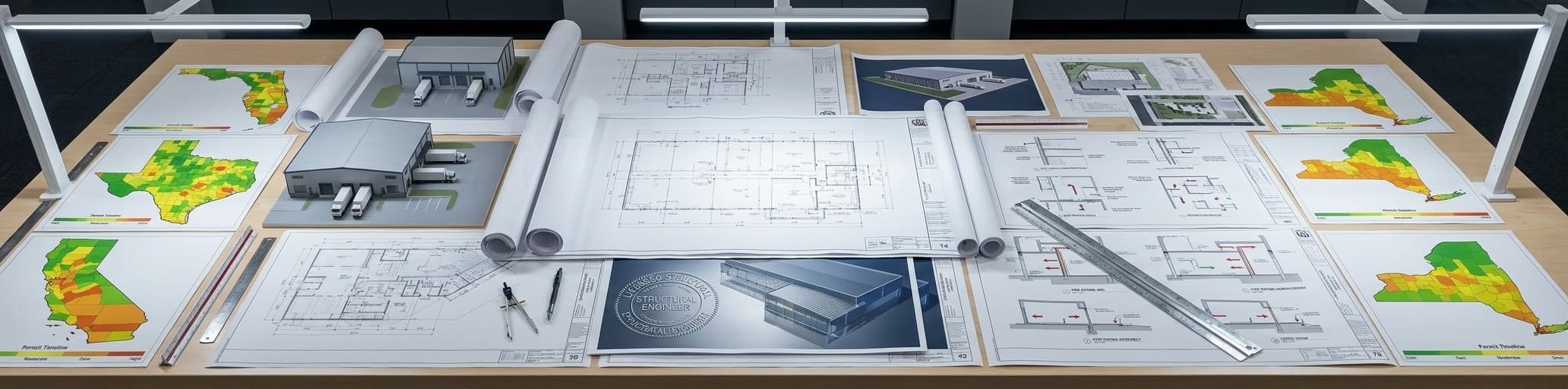

Warehouse expansion permits vary drastically by state and county because zoning, building codes, and environmental rules differ everywhere–and missing compliance steps before design costs far more than getting them right upfront.
Why Warehouse Expansion Permits Vary So Drastically Across States
Skipping early compliance research costs more in fines and delays than it saves in budget, making regulatory coordination your highest-return investment before construction begins.
The Hidden Cost of Not Understanding Local Permitting Requirements
Most warehouse expansion failures trace back not to bad materials or poor construction — but to planning that skipped compliance steps weeks or months before a shovel touched the ground.[3] In the U.S., local zoning requirements, building codes, and environmental regulations vary by state and county, and the International Code Council updates those codes every three years.[2] That moving target means a design your engineer cleared on a previous project may trigger a rejection today.
The exposure is direct: ignoring local permitting requirements opens your expansion to work stoppages, costly fines, and lawsuits — consequences that consistently exceed whatever budget was saved by skipping early compliance research.[1][2] Missing even one code requirement during design forces corrections mid-permitting or mid-construction, compounding both cost and timeline in ways that are difficult and expensive to recover from.[3] The costs of noncompliance reliably outpace initial budget savings, making early regulatory coordination one of the highest-return investments on any commercial warehouse project.[1] Working with experienced steel building contractors who already know your local code requirements is the fastest way to keep your expansion within budget and moving on schedule — every step of the way.
How National Steel Buildings Navigates Regional Compliance for You
State-Level Zoning vs. County-Level Building Codes: What Controls Your Timeline Zoning and building codes are separate legal instruments enforced by different authorities, and your warehouse expansion needs clearance from both before a permit issues.
Zoning — set and enforced at the local government level — determines what you can build and where: use classifications, setbacks, height limits, and lot coverage ratios that vary by municipality.[7] Building codes govern how you build it: structural load calculations, fire ratings, egress requirements, and occupancy standards.[6] Most states adopt a version of the ICC's International Building Code, updated every three years, but counties and municipalities may then amend it, add stricter provisions, or selectively exclude sections — meaning the code your engineer designed to on a prior project may not match what the current jurisdiction enforces.[6] There is no single national building code all jurisdictions must follow, which means approved plans in one county aren't automatically approved in the next, even within the same state.[6] Approval times reflect this fragmentation directly: some jurisdictions run digital submissions and return comments within days, while others require in-person filing, sequential agency reviews, and public hearings that push the same scope of work past three months.[8] Untangling which layer — state code, county amendment, or municipal zoning overlay — controls each element of your design is where most warehouse expansions lose weeks they can't recover.
Permit Timelines and Approval Processes by Region
Texas and Florida deliver permits in 3-8 weeks for standard warehouses through competitive municipal markets and automatic approval mandates, respectively.
Fast-Track States: Texas, Florida, and the Southeast (30-60 Days Average)
Texas suburbs and Florida suburbs consistently rank as the fastest commercial permitting jurisdictions in the country, returning permits in 3 to 8 weeks for standard warehouse and light industrial occupancies.[10] The speed comes from structural policy differences, not bureaucratic luck.
Texas achieves it through market competition between municipalities — local governments actively compete for development, which keeps review cycles lean and discourages the sequential agency queues common in slower markets.[10] Florida took a legislative path: a 2023 state mandate requires every jurisdiction to either issue a permit or formally request corrections within 120 days of a complete application, or the permit is automatically deemed approved.[10] That backstop has measurably compressed timelines statewide.[10] Broader Southeast markets — Georgia, North Carolina, and South Carolina — generally track in the 60-90 day range for comparable commercial scopes, supported by growth-oriented local policy and well-staffed building departments that handle high application volume without the backlog pressure found in coastal California or New York.[11] The cost environment reinforces the timing advantage: Southeast projects run 0.90x to 1.00x the national construction cost baseline, and Texas projects run 0.85x to 0.95x — the most favorable multipliers in the country.[9] For property owners planning a steel warehouse addition in these markets, that combination of short permit windows and below-average construction costs makes the Southeast corridor one of the strongest regions for keeping your industrial warehouse construction costs within budget.
Moderate-Timeline States: Midwest and Mid-Atlantic (60-120 Days Average)
Midwest and Mid-Atlantic markets — Ohio, Illinois, Michigan, Pennsylvania, New Jersey, and Maryland among them — sit in the 60-120 day window because the permitting rhythm, while predictable in its sequence, adds time at every step. Most commercial plan reviews move through the same cycle: initial review, first comment letter, resubmittal, second review, and often a third round for complex scopes.[12] Resubmittals typically move faster than the original submission, with many cities cutting review time roughly in half on the second cycle, but that compression only helps if your first submittal was complete and clean.[12] Expect at least two to three full comment rounds as a baseline for any commercial warehouse scope — and understand that five or more cycles aren't unusual when multiple departments review in sequence rather than in parallel, or when a local code amendment wasn't caught during design.[12] That lap count is where most 60-day projects become 120-day projects.
Pennsylvania illustrates the pattern directly: municipal zoning, building plan review, and fire marshal oversight often run sequentially, and owners expanding into a new Pennsylvania county for the first time rarely budget for the lead time that sequencing adds. Getting familiar with the jurisdiction's specific submission requirements before you submit — not after a first rejection — is what keeps your project on the shorter end of that range.
If Pennsylvania is your target market, a 30×30 steel building code checklist for Pennsylvania permits maps the layered submission standards that determine whether your drawings clear the first review or trigger another cycle.
Extended-Review States: California, New York, and the Northeast (120-180+ Days Average)
California, New York, and the broader Northeast aren't slow by accident. The drag is structural: centralized code adoption, high development pressure, building departments processing thousands of simultaneous applications, and environmental review requirements that have no equivalent in faster markets.[10] In California, the California Environmental Quality Act (CEQA) triggers on commercial projects above certain thresholds.[10] A warehouse addition on previously developed land in a non-sensitive area may qualify for a categorical exemption — resolved in a matter of weeks — but any project that triggers a full Environmental Impact Report adds 18 to 36 months of environmental review before a building permit application can even be accepted.[10] That isn't a worst-case scenario to plan around; it's a site-selection variable that has to be evaluated before land acquisition, not after the land is purchased.[10]
California's Assembly Bill 2234, signed in 2022, established shot-clock requirements for permit review — 30 business days for smaller projects and 60 business days for larger ones — but the law targets housing developments, not commercial warehouse occupancies.[14] Exemptions can pause those clocks entirely when outside agencies are involved or when a jurisdiction makes written findings citing public health and safety concerns, and incomplete applications don't start the review clock at all.[14] For warehouse additions, each resubmittal cycle after a plan-check comment adds 2 to 6 weeks, and drawings that miss local code amendments typically cycle through 2 to 4 resubmittals before clearing.[10] That resubmittal count is what pushes a 120-day estimate past 180 days — and occasionally past 14 months in markets like Los Angeles County.[10]
New York City routes commercial projects through DOB NOW for digital submissions, but plan exam, after-hour variances, and certificate of occupancy requirements each run through separate workflows and review queues that operate on independent timelines.[13] The Northeast more broadly — Connecticut, Massachusetts, and New Jersey among them — mirrors California's structural drag: high application volume, sequential agency reviews, and municipalities that haven't adopted the digital submission infrastructure that compresses timelines in Sun Belt markets.[10] For any warehouse expansion targeting one of these markets, submitting complete, code-compliant drawings on the first attempt — and completing all pre-application meetings before the official clock starts — is the most direct way to keep carrying costs from compounding while the project sits in queue.[10]
Common Permit Requirements Across All States: Essentials and Documentation Guide
Structural drawings sealed by a licensed engineer are non-negotiable for permit approval, as reviewers verify every load path from foundation to roof before moving forward.
Structural Engineering Drawings and Load Calculations Every State Demands
Architectural drawings show what your warehouse addition will look like. Structural drawings show how it will stand up — and until a building department has both, reviewed and coordinated, your permit won't move.[17] Structural drawings are engineering documents prepared by a licensed structural engineer (SE) that define the complete load-bearing system from the foundation buried in the ground to the last roof connection.[17] Every drawing in the set carries a professional seal — the engineer's legal statement that the structure meets applicable codes — and without that seal, there is no engineering verification, and without engineering verification, there is no permit.[17] Most jurisdictions base structural review on the International Building Code (IBC), which references ASCE 7 as the governing standard for minimum structural load requirements including wind, snow, seismic, and other environmental forces.[15] For large warehouse additions with clear-span requirements and heavy floor loads, structural engineering isn't optional paperwork — it's the core of what reviewers check before approving your drawings.[16]
A complete structural drawing set covers several distinct components, each serving a specific role in plan review.[17] The foundation plan documents dimensions, reinforcement, and anchor bolt patterns sized to the actual soil bearing capacity at your site — a detail that can't be pulled from a generic span table.[17] Floor and roof framing plans show every joist, beam, post, and column with sizes, spans, and spacing, giving inspectors the information they need to trace how clear-span loads distribute across the structure.[17] Shear wall schedules document the lateral force resisting system: the sheathing type, nailing patterns, hold-down hardware, and anchor bolt configurations that transfer wind and seismic forces safely down to the foundation.[17] Connection details show every critical load transfer point at large enough scale for a contractor to install without interpretation.[17] The structural calculation package ties everything together — it documents every load combination, member sizing justification, and complete load path verification that plan reviewers trace before clearing your submission.[17] Missing or incomplete connection details or calculations are the most consistent cause of structural plan-check corrections on warehouse projects.[17]
Load calculations are where state-specific requirements diverge most sharply, because the forces your warehouse must resist depend entirely on geography.[15] Steel buildings must be engineered to resist six primary load types under ASCE 7:
- Dead loads — the permanent weight of the structure, roofing, and fixed equipment
- Live loads — occupants, forklifts, and stored inventory
- Snow loads — ranging from near-zero in South Florida to over 100 psf at high-elevation Mountain West sites
- Wind loads — from 85 mph basic design wind speeds in Midwest interior zones to 180 mph in South Florida coastal areas
- Seismic loads — negligible in most of the Southeast, critical in California, the Pacific Northwest, and parts of Nevada and Utah
- Collateral loads — fire sprinkler systems, HVAC equipment, lighting, and any suspended mechanical systems
Even adjacent counties can carry different design parameters when they fall in separate ASCE 7 wind or seismic zones, which is why structural drawings that passed plan check on a prior project in one jurisdiction won't automatically clear in the next.[15] Seismic Design Categories D, E, and F — covering most of California and the Pacific Northwest — impose significantly more demanding lateral detailing requirements than SDC A or B, including mandatory special inspections during construction and, in many states, an SE licence specifically rather than a standard civil engineering licence to seal the drawings.[17] Understanding the structural steel components that form your building's load path is the fastest way to align with your engineer before the first submission and avoid the correction cycles that push 60-day approvals past 120 days.
Site Plans, Setbacks, and Lot Coverage Restrictions That Slow Projects Down
A site plan does more than show where your building sits — it documents every site element a zoning reviewer needs to verify compliance before approving your permit.[19] For commercial warehouse additions, a complete site plan must show building placement and dimensions, parking layout with ADA-accessible spaces and van-accessible spots, fire department access routes, loading zones, drainage systems, and utility connections.[19] Denver requires a written project narrative alongside those drawings, and projects that expand warehouse square footage may trigger additional off-street parking or landscaping requirements that weren't part of the original site configuration.[18] Any exterior changes — new doors, dock openings, or additions — also require building elevations, not just a floor plan.[18] Missing one of those elements doesn't pause the review; it restarts the clock.
Setbacks are where warehouse additions most often hit hard footprint constraints. They define the minimum distance between your structure and the property line and apply to every edge of your proposed addition — front, rear, and both sides.[20] In Jefferson County, Colorado, setbacks are measured to the outermost point of the structure, which matters when your addition includes roof overhangs, equipment pads, or dock canopies that extend beyond the building wall.[20] Structures built within easements — utility corridors often centered on lot lines — are prohibited outright, and easement locations aren't always visible from a deed without a current survey.[20] Lot coverage restrictions compound the setback problem: your zone district may cap the percentage of your lot that any structure can occupy, which means an addition that clears every setback line can still fail a lot coverage calculation if your existing building already consumes a large share of the site.[19] Both constraints must be resolved on the site plan before submission — a lot coverage violation discovered after structural drawings are complete forces a footprint redesign, not just a document revision.
New commercial structures and large additions in many jurisdictions must also clear a Site Development Plan (SDP) process before a building permit application is even accepted.[20] Jefferson County's SDP process covers landscaping, architecture, parking, easements, and site access as a separate sequential review — your building permit clock doesn't start until that upstream process closes.[20] Even a change in tenant use within an existing structure can trigger a new building permit and a full zoning review of parking and occupancy, independent of any construction scope.[20] Owners expanding into a new jurisdiction for the first time frequently underestimate this sequencing because prior projects ran through a single-step review. Identifying which pre-permit processes apply to your specific site — SDP, environmental review, or access approval — before drawings are finalized keeps your prefab warehouse clear-span specs aligned with what the jurisdiction will actually accept on first submission.
Fire Rating, Egress, and Safety Code Compliance: What Inspectors Look For
Fire compliance isn't a final-inspection item you schedule after framing is up — plan reviewers check fire ratings, egress paths, and suppression systems at the drawing stage, and a design that fails those checks forces revisions before construction begins.[21] The IBC assigns each building an occupancy classification that drives every fire protection decision: which wall assemblies need ratings, where sprinklers must cover, and how many exits the floor plan must provide.[22] Getting that classification wrong — even by one category — can change your entire fire protection layout, triggering costly redesigns during construction rather than minor corrections at the design stage.[21]
Fire-rated wall assemblies are measured in hours — 1-hour, 2-hour, or higher — and apply to specific building elements based on occupancy and construction type.[21] Stairway enclosures typically require a 2-hour rating to protect the exit path from smoke and flames.[21] Each rated assembly must include compliant fire doors, dampers at HVAC penetrations, and proper firestopping at every opening, because a single unprotected penetration voids the rating of the entire assembly.[21] Steel framing that isn't coated with spray-applied fireproofing won't maintain structural integrity for the required fire-resistance duration — and inspectors verify fireproofing coverage during construction, not only at final sign-off.[21] Understanding how steel frame structures handle fire ratings and insurance classifications relative to wood-frame alternatives helps you make smarter decisions before your engineer finalizes the drawings.
Egress is where warehouse additions fail plan review most often. The IBC sets exit quantity, placement, and separation distances based on occupancy load — the number of people the code assumes occupy the space simultaneously — and both the count and location of exits must appear on submitted drawings before a permit issues.[21] Exit doors must swing in the direction of egress travel, panic hardware is required on doors serving high-occupancy areas, and exit signs with battery-backup lighting must be visible from every occupied point in the floor plan.[21] Travel distance from any occupied point to an exit is capped, and in sprinklered buildings those caps are more generous — which means sprinkler system design and egress layout are co-dependent decisions that must be resolved together during design, not separately.[21]
Automatic fire sprinkler systems are required in most commercial warehouse occupancies and must be designed to NFPA 13 standards, with coverage density, pipe sizing, and water supply calculated to the specific hazard level of your operation.[21] Higher hazard classifications — common in storage facilities with high-pile inventory or flammable materials — require greater water discharge rates and larger pipe diameters, changes that can ripple through plumbing layouts and ceiling plans if not addressed at the design stage.[21] Fire detection and alarm systems must layer on top of suppression: automatic detection devices, manual pull stations, and occupant notification devices must all appear on submitted drawings, and the alarm system must connect to a monitoring service and include battery backup to maintain coverage during a power outage.[21]
Final inspection for fire compliance moves through four areas in sequence:
- Life safety systems — alarms, sprinklers, and emergency lighting are tested and confirmed operational
- Egress routes — exits are verified clear, functional, and compliant with approved plans
- Fire-rated assemblies — checked against the approved drawing set for correct installation
- Documentation — signed acceptance test forms for alarm and sprinkler systems, commissioning records, and certifications
Fire officials require all four before issuing a Certificate of Occupancy, and missing documentation carries the same consequence as a failed system — your occupancy approval waits until every record is in hand.[23] Any correction notice after inspection triggers a re-inspection fee and restarts your tenant move-in clock, which is why submitting fire protection drawings that match code requirements on the first submission is always the faster and more cost-effective path.[21]
How to Accelerate Permitting and Avoid Costly Delays
Submit complete, code-compliant drawings on your first attempt and consult local authorities before design development to eliminate costly resubmittal cycles.
Pre-Permitting Consultation: Partnering with Commercial Metal Building Contractors Near You
The single most effective way to compress permitting time is submitting thorough, code-compliant drawings on the first attempt.[10] That sounds simple until you account for what "complete" actually requires at intake: architectural drawings, structural calculations carrying an engineer's seal, site plans, energy compliance documentation, and — depending on occupancy and jurisdiction — fire sprinkler plans and geotechnical reports.[24][25] Most jurisdictions won't start the review clock until every required document is in hand, so an incomplete application sits in intake while your carrying costs accumulate.[10] Three weeks spent in pre-application meetings with the building department can eliminate six weeks of resubmittal cycles — and each resubmittal cycle adds 2 to 6 weeks to your approval timeline.[10] Finding out which documents your specific jurisdiction requires before you submit is exactly where partnering with commercial metal building contractors near you pays off: a contractor who has already pulled permits in your county knows the local plan reviewer's expectations, the code amendment layers your drawings must reflect, and which specialty agencies — fire marshal, health department, environmental review — require parallel submissions that can hold up your building permit even after the building department clears it.[10] Pre-engineered steel suppliers can also offer a permit hold arrangement that delays fabrication until your stamped drawings clear plan review, protecting your design from mid-production changes while locking in your steel price.[25] Consulting local authorities early — before design development, not during plan check — is the move that keeps your project on the shorter end of any approval range.[24]
Design-Build Advantage: Why Single-Source Solutions Reduce Approval Friction
The permitting friction that stacks up under separate design and construction contracts has a structural cause: two teams with separate scopes, separate schedules, and no shared accountability for what the building department returns. Design-build eliminates that gap by placing a single contract across both design and construction — the fundamental distinction from every other project delivery method.[26] When your designer and builder operate as one entity, plan check comments don't travel between firms waiting for a response; they get resolved internally, folded into the next drawing set, and your resubmittal moves.[26] That integration is why research across decades consistently shows design-build delivers faster project completion, more reliable schedule performance, and less cost growth than traditional delivery methods.[26] The market reflects it: design-build is now the fastest-growing and most commonly used project delivery method in the U.S., projected to account for 47% of construction spending and $2.6 trillion in activity over the 2024-2028 forecast period.[26]
For warehouse additions specifically, the single-source model compresses permitting friction at every point where handoffs between separate firms typically cause delays. When the engineer who sized your structural frame also coordinates with the contractor detailing fire sprinkler rough-ins, HVAC penetrations, and shear wall nailing patterns, the drawings submitted to the building department are already internally coordinated — not independently produced documents that contradict each other at the plan check stage.[27] For warehouse owners confirming zoning, site-access requirements, and expansion potential in the initial footprint — decisions that interact directly with what your drawing package must demonstrate — having one team carry that context from site selection through permit submission keeps your prefab steel building schedule and cost predictable every step of the way.[27] The design-build model is described as a highly collaborative, fully integrated undertaking built on trust and creative problem-solving — one that works best when every party makes the mental shift to function as a single entity focused on shared project goals.[26] For a warehouse addition in a 60-to-120-day jurisdiction, that shared accountability is what separates a clean first submission from a resubmittal cycle that runs your carrying costs past the point where the permit delay costs more than the building correction.[28]
Post-Approval Success: Inspection Readiness and Quality Assurance Standards
Permit approval starts the construction clock, but it doesn't end your compliance obligations — local inspectors visit your site multiple times during construction, not just at the end, and missing a required intermediate inspection is one of the most consistent causes of re-inspection fees and certificate of occupancy delays.[29] The sequence runs in a fixed order: foundation inspection before concrete is poured, rough-in inspections for mechanical, electrical, and plumbing systems before those systems are concealed behind walls or ceiling assemblies, and a final inspection once all construction work is complete.[31] The foundation stage is the highest-stakes checkpoint — elements like pier depths, structural rebar placement, footings, and anchor bolt patterns can't be corrected after the pour, which means a missed or failed foundation inspection forces demolition and reconstruction, not just a paperwork correction.[31] Scheduling each inspection at exactly the right construction phase — after work is visible but before it's covered — is the operational discipline that keeps your project moving without forced backtracking.
Quality assurance during construction comes down to documentation discipline: keeping a current copy of approved drawings on site, confirming that installed work matches the stamped and approved set at every phase, and maintaining signed inspection records for every stage that passes.[30] A code compliance audit — checking structural integrity, electrical systems, plumbing, and accessibility against the approved drawings — should run as an internal checkpoint before you call for each municipal inspection, not after a correction notice arrives.[30] Jurisdictions that require special inspections during construction, particularly in higher seismic design categories, expect signed special inspection reports delivered to the building department as conditions of the final inspection; missing those records holds your certificate of occupancy regardless of how well the physical work was done.[29] For warehouse additions where energy code compliance is also inspected — covering envelope performance, HVAC, and lighting power density — keeping energy-efficient metal building documentation current from the start of construction means you're handing the inspector a complete file, not assembling one under deadline pressure.
The final inspection covers the building's interior and exterior in full: exterior completion, egress door operation, guardrails on open stairways and balconies, roofing material, electrical fixtures and panels, smoke detectors, heating systems, plumbing fixtures, and wastewater connections.[31] Inspectors conducting the final walkthrough review inspection history and prior correction notices before arriving on site, so any item flagged at an earlier stage and not formally closed will surface again.[31] Giving your contractor a heads-up about what the final inspection covers — including common code violation triggers like improper notching or cutting in structural framing members and blocked egress paths — reduces the correction rate before the inspector sets foot on the site.[31] Every correction notice after final inspection triggers a re-inspection fee and resets your tenant move-in or occupancy date, so running your own documented walkthrough against the approved drawings before scheduling the final inspection is always the faster path to a clean sign-off.[29]
- Permit timelines range from 3-8 weeks in Texas and Florida to 14+ months in Los Angeles due to structural regulatory differences.
- Submitting complete, code-compliant drawings on the first attempt eliminates 2-6 week resubmittal cycles that compound delays.
- State and county building codes update every three years; designs approved in one jurisdiction may trigger rejections in the next.
- Structural drawings require a licensed engineer's seal and must address site-specific load calculations for wind, snow, seismic, and occupancy forces.
- Design-build delivery compresses permitting friction by placing design and construction under one contract, eliminating handoff delays between separate firms.
- Fire compliance, egress layout, and sprinkler design must be resolved during design phase, not mid-construction, to avoid costly revisions.
- Missing intermediate inspections during construction triggers re-inspection fees and delays certificate of occupancy; scheduling inspections at exact construction phases prevents backtracking.
- https://grokipedia.com/page/Risks_of_Low-Budget_Warehouse_Construction
- https://www.edcweb.com/key-considerations-for-warehouse-construction-projects
- https://gidelkocal.com/pre-construction-planning-services/
- https://www.jeffco.us/2163/Permits
- https://safetyculture.com/topics/commercial-construction/warehouse-construction
- https://www.congress.gov/crs-product/R47665
- https://rtp.fedsoc.org/paper/the-land-use-labyrinth-problems-of-land-use-regulation-and-the-permitting-process/
- https://ecseco.com/blog/how-long-does-it-take-to-get-a-building-permit/
- https://www.americanindustrialmagazine.com/blogs/industry/industrial-warehouse-construction-complete-2026-guide-for-the-united-states
- https://terrapincg.com/news/commercial-construction-permitting-timeline-by-state-2026
- https://terrapincg.com/commercial-construction-permitting-timeline-guide
- https://hoverarchitecture.com/building-permit-timelines-explained-how-long-does-it-really-take/
- https://www.nyc.gov/site/buildings/industry/obtaining-a-permit.page
- https://www.calbo.org/post/permitting-timelines
- https://torosteelbuildings.com/resources/building-codes-usa-states/
- https://jdj-consulting.com/complete-guide-to-warehouse-permit-requirements/
- https://www.noblyn.com/what-are-structural-drawings-and-why-are-they-required-for-a-permit/
- https://denvergov.org/Government/Agencies-Departments-Offices/Agencies-Departments-Offices-Directory/Community-Planning-and-Development/Plan-Review-Permits-and-Inspections/Zoning-Permits/Apply-for-Commercial-Zoning-Permits/General-Requirements-for-Commercial-Zoning-Applications
- https://buyasiteplan.com/commercial-building-site-plan-for-permit/?srsltid=AfmBOoo7FkWtylOxWzMv9_xk978PErTXoJ0UFkA6Ro52TPHOnwk2VaTH
- https://www.jeffco.us/4050/Commercial-and-Industrial
- https://jdj-consulting.com/fire-code-requirements-for-commercial-development/
- https://www.iccsafe.org/products-and-services/i-codes/ibc/
- https://www.blueprintcommercial.com/blogs/checklist-for-new-code-compliance-in-2025
- https://www.steelcobuildings.com/how-do-i-get-a-permit-for-my-warehouse/
- https://www.rhinobldg.com/blog/construction-permits-for-metal-buildings
- https://dbia.org/what-is-design-build/
- https://www.clarisdesignbuild.com/6-key-considerations-to-build-commercial-warehouse-manufacturing-and-logistics-facilities/
- https://billd.com/blog/design-build-construction/
- https://www.techture.global/blog/building-permit-inspection-checklist
- https://proprli.com/knowledge-center/building-compliance-checklist-safety-and-regulations-checklist-for-properties/
- https://safetyculture.com/checklists/compliance/final-inspection-checklist